http://www.ijias.issr-journals.org/
Corresponding Author: Bijoux Lituka 1859
Etude de la dynamique spatiale et structure du Jardin Botanique Stanislas Lisowski de
la Faculté des Sciences, UNIKIS, RD Congo
[ Study of the spatial dynamics and structure of the botanical garden Stanislas Lisowski
of the Faculty of Sciences, UNIKIS, RD Congo ]
Bijoux Lituka1, Francine B. Kirongozi2, Jacques N.B. Tchatchambe2, and Hyppolite S-M. Nshimba1
1Faculté des sciences, Université de Kisangani, B.P. 2012, RD Congo
2Centre de Surveillance de la Biodiversité, Université de Kisangani, B.P. 2012, RD Congo
Copyright © 2018 ISSR Journals. This is an open access article distributed under the Creative Commons Attribution License, which permits unrestricted use, distribution, and reproduction in any medium, provided the original work is properly cited.
ABSTRACT: The inventory, drawn up on the the whole garden, has permitted us to obtain 541 individuals distributed into 221
species, 60 families and 31 orders the studied florura contains a high content of spermaphytes. Angiosperms, almost alone, constitute the flora of this entity. Phanerophytes are largely dominant; the type of the species Diasporas is mostly sarcochores or fleshy Diasporas. Accordingly, 93species identified beforehand have disappeared from the garden due to lack of medium adaptation, and 16 other species are considered as newly settled since they are not mentioned in previous works.KEYWORDS: dynamics, spatial, Structure, botanical garden, Lisowski.
RESUME: L’inventaire a porté sur toutes les espèces d’arbres présents dans le jardin et a permis d’obtenir 541 individus répartis
en 221espèces, 60 familles et 31 ordres. La florule étudiée est riche en spermaphytes, les Angiospermes forment presque seules, la flore de cette entité. Les phanérophytes sont largement dominants. Le type de diaspore des espèces est surtout dominé par les sarcochores ou diaspores charnus. De ceci, il découle que 93 espèces préalablement recensés, sont disparues du jardin suite à la non adaptation aux conditions écologiques du milieu et 16 autres espèces sont considérés comme nouvellement installées car non signalées dans les travaux antérieurs.MOTS-CLEFS: dynamique, Spatiale, Structure, Jardin botanique, Lisowski.
1
INTRODUCTION
Forests play a major role in preserving biodiversity, climate change and sustainable development [1]. This biodiversity plays a significant role in the forest dynamics. Tropical forests, particularly wet dense forests, are considered to house more than 50%, or even up to 80% of the specific terrestrial diversity. On hectare of dense humid forest, three hundred individuals are sometimes identified against a maximum of a few tens in temperate zones. Two-thirds of flowering plants are of tropical moist origin [2].
The protection of living species ultimately implies to be effective, the implementation of at least two types of measures: In situ conservation: here, regardless of the salvage interest of endangered species through ex situ preservation measures, only the preservation of species habitat is likely to ensure the long-term conservation of biodiversity;
ISSN : 2028-9324 Vol. 24 No. 4, Nov. 2018 1860 The botanical and zoological gardens are created in this ex situ conservation framework. But then, these not only have the objective of protecting endangered species, but also and above all these are centers of environmental education, places of scientific research on biodiversity and places for tourists In search of peace and natural beauty [4].
At the Faculty of Science, one of the faculties of the University of Kisangani, a botanical garden was established for didactic reasons. Although conceived for these reasons, it contains the most common and most representative species of the local flora [5]. In the Department of Ecology and Management of plant resources of this faculty, a botanical garden is important not only for the sequestration of CO2, recycling of the material in the cycle biogeochemical, morphological and physiological studies, But still in studies on the equatorial flora and the systematics of species. In an ecosystem, the competition between species both at the intra-specific level and at the interspecific level for the conquest of Water and energy sources (light) is a real battle for life [3].
The results lead to a fragile balance in which the whole community of living beings can be placed. This ecosystem is driven to evolve [1]. According to [6] the dynamics is the expression of the evolution in time and space, under the influence of the factors of the natural and anthropogenic parameters of the composition intra and inter specific of the population occupying a given space.
This work will report on the current state of the botanical garden Stanislas Lisowsky, its present floristic composition, to be compared with that which existed during its implantation and finally, to study certain variables of the dynamics of the garden.
2
ENVIRONMENT, MATERIALS AND METHODS
2.1 STUDY ENVIRONMENT
2.1.1 DESCRIPTION OF THE ENVIRONMENT
The Stanislas LISOWSKI Botanical Garden at the University of Kisangani is our study environment and is located within the Faculty of Science, in its southeastern part (city of Kisangani). It is located near the equator, at 25 ° 11 ' East longitude and 0 ° 31 ' north latitude [7].
Figure 1 gives the geographical location of the Faculty of Science of the University of Kisangani.
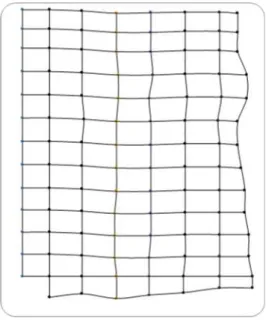
ISSN : 2028-9324 Vol. 24 No. 4, Nov. 2018 1861 The Botanical Garden of the Faculty of Science contains 13 lines (1-13) and 7 columns (A-G) divided into 91 plots separated by a distance of 100 cm. The floristic inventory was made from one parcel to another in the square below (Figure 2). Its surface area of 7,076 m which extends over a length of 116 m and a width of 61 m.
Fig. 2. The Botanical Garden
2.2 MATERIALS
To carry out this field work, the following instruments have used:
A pruner for the collection of samples;
Papers, Sheets and presses to form herbariums;
Notebooks, pencils, ball pens and markers for taking notes.
2.3 METHODS
2.3.1 FLORISTIC INVENTORY
The investigation covered the whole garden. The inventory was carried out randomly parcel by parcel following the order of rows and rows.
2.3.2 ANALYSIS OF BIOLOGICAL TYPES AND ECOLOGICAL SPECTRUM 2.3.2.1 BIOLOGICAL TYPES
For a given species, the biological type refers to the set of anatomical and morphological devices that characterise its vegetative apparatus and conspicuous its port and physiognomy [8]. The different biological types obtained in this work are defined according to the classification of [9], adopted in tropical regions by many authors [10]; [11]. The different biological types obtained in this work are defined according to the classification of [9], adopted in tropical regions by many authors [10]; [11].Depending on the nature and degree of protection of buds and seedlings during the period Rigorous, the following types are distinguished:
The phanerophytes
ISSN : 2028-9324 Vol. 24 No. 4, Nov. 2018 1862 A. Woody or erect phanerophytes:
All plants that are generally erected and necessarily have a fully woody architecture regardless of their size.
MgPh: Mégaphanérophytes, trees whose tender organs are situated above 30 cm from the ground;
Hcts: Mésophanérophytes, organ trees located between 10 and 30 cm above the ground;
McPh: Microphanérophytes, shrubs with buds between 4 – 10 cm from the soil;
NPh: Nanophanérophytes; Subshrubs with young shoots at a height of between 0.4 – 4 cm.
B. Creepy or climbing phanerophytes (Phgr)
These are lianas that can reach a considerable thickness and easily climb up to the top of the trees using various fastening modes. There are some types:
Voluble and propped Up (Phgrv): Lianas winding around their support thanks to their little Woody end, voluble;
A spins and hooks (Phgrc): These are lianas whose stem progression on their support is facilitated by numerous tendrils located either at the end of the branches or at the nodes or leaf insertion;
Herbaceous (Phgrh): small creeping vines, subwood or belatedly lignified.
Geophytes
They are plants possessing a shoot apparatus whose buds are in the soil; It includes:
Grh: Geophytes rhizomatous; Plants having perennial organs, or rhizomes;
Gtu: Geophytes tuberous; Plants having perennial organs of tubers.
2.3.2.2 TYPES OF DIASPORES
1. The dissemination of diaspores plays an essential role in forest Dynamics [12] in [13]. Thus, the diaspores of the species identified in the set of phytosociological surveys carried out were determined from the literature [14], [15] and [13]. They meet the categories defined by [16] and [17].
2. Autochores
Diaspores not showing any obvious adaptation to any external dispersion agent. We can distinguish in this category:
Ballochores (Ballo): Diaspores ejected by the plant itself;
Barachores (Baro): Diaspores characterized by their weights and the absence of another characteristic with dispersion.
3. Hétérochores
The diaspores are fitted with appendages and extremely light or wrapped in fleshy layers. In this group we have:
Pléochores (Pléo): Diaspores having a flotation device;
Pogonochores (Pogo): Diaspores with feathery appendages, hairs and egrets;
Ptérochores (Ptéro): Diaspores with winged appendages;
Sarcochores (Sarco): Diaspores provided with fleshy outer layers and marrow;
Sclérochores (Scléro): diaspores hanging or adhesive.
2.3.3 DYNAMICS OF THE GARDEN
It is based on a few fundamental processes: reproduction (flowering, pollination, fruiting, spreading and germination), growth and death of individuals or species.
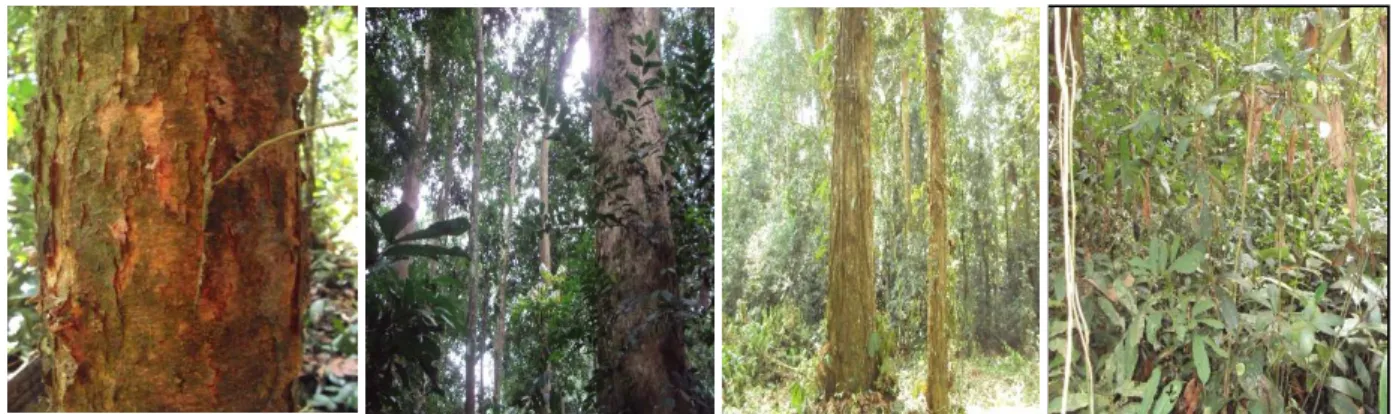
ISSN : 2028-9324 Vol. 24 No. 4, Nov. 2018 1863 Figure 3 presents the S. Lisowski Botanical Garden with some lighthouse species.
Fig. 3. Some lighthouse species and the undergrowth of the Botanical garden S. Lisowski (Faculty of Science, University of Kisangani)
3
RESULTS
3.1 FLORISTIC AND TAXONOMIC ANALYSIS
The floristic inventory of families and species collected in the garden is given below. The following elements accompany these species: biological type (TB), diaspores type (TD) and phytogeographic distribution (DP).
3.1.1 BIOLOGICAL TYPES
Overall, the study of the current composition of the flora of the Botanical Garden of the Faculty of Sciences gave 541 individuals belonging to 221 species, 183 genera grouped in 60 families, 31 orders and 4 branches. The majority of these species are Spermaphytes; the pteridophytes are almost not represented.
We present in the Fig. 4 the different biological types.
Fig. 4. Biological Types
ISSN : 2028-9324 Vol. 24 No. 4, Nov. 2018 1864 3.1.2 TYPE OF DIASPORES
In the following figure, we present the different types of diaspores:
Fig. 5. Type of Diaspores
This graph reveals that the majority of species identified are disseminated by Sarcochorie with 71.53% followed by Ballochorie 16.27%; However, Pogonochores and Ptérochores are less represented with 1.66% and 1.84% respectively.
3.1.3 PHYTOGEOGRAPHIC DISTRIBUTION
Fig. 6. Phytogeographic Distribution
This figure shows a clear predominance of guineo-Congolese species with 31.24%, followed by pantropical species with 24.03%; After come the Guinean species with 16.64%. The other species are less represented.
3.1.4 DENSITY
3.1.4.1 SPECIES DENSITIES
ISSN : 2028-9324 Vol. 24 No. 4, Nov. 2018 1865 From this graph, it is apparent that the greatest relative density is that of the species Leptonychia Tokana R. Germain with 7.76%; This is followed by species Pycnanthus angolensis (Welb.) Exell, Trachyphrynium Braunianum. (K. Schum.) Bak and Millettia laurentii from Wild.
3.1.4.2 FAMILY DENSITIES
Fig. 8. Density of families
The relative densities of the highest families are observed in the following families: Fabaceae with 16.27%, Malvaceae with 11.83%, Rubiaceae with 11.46%, Euphorbiaceae with 6.47%. The other families are poorly represented.
3.1.5 GARDEN DYNAMICS 3.1.5.1 BASAL AREA
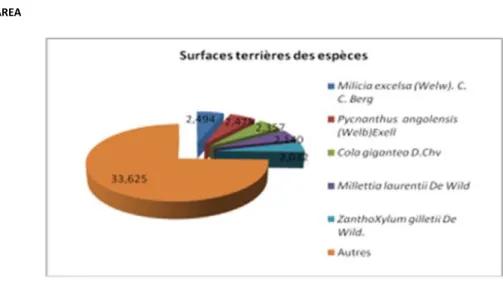
Fig. 9. Basal area
It follows from this graph that the species Milicia excelsa occupies the largest basal area with 2.49%, followed by Pycnanthus angolensis with 2.47% and Cola gigantea with 2.14%.
3.1.5.2 PHYSIOGNOMY OF THE GARDEN
[19] in [20] defines the physiognomy of a forest as a morphological organization of elements and strata dominated by biological forms and well-defined taxa. The garden is already a forest. In fact, a forest is a closed tree formation. In its structure, we distinguish the following elements:
ISSN : 2028-9324 Vol. 24 No. 4, Nov. 2018 1866
o Trees with dbh greater than 50 cm: are mostly trees that emerge from the garden.
o Trees with dbh between 30 and 50 cm. Form the middle category.
o Trees with dbh less than 30 cm. They are made up in most cases, individuals who are growing. B. Shrubs: Usually have a dbh less than 10 cm. They form with the large grasses of the monocotyledons, the shrub layer having an estimated height of 1 – 5 m. Among the shrubs, there are those that merge with the young trees and usually have a dbh of at least 5 cm.
Herbs: Apart from the large herbs that are associated with shrubs (Marantaceae), we find in this garden a good number of species that form the low herbaceous stratum.
Lianas: Some lianas species have developed well in the garden, such as Cnetis ferruginea.
Stranglers: Plants of the genus Ficus strangle stipes of Elaeis guineensis and trunks of other trees.
The epiphytic: Beside the Stranglers, there are many plant species that live as epiphytic
3.1.5.3 DOMINANCE OF FAMILIES
Family dominance is given in Figure 10 below:
Fig. 10. Dominance of families
This figure shows that the following families are dominant: Fabaceae, Moraceae, Euphorbiaceae, Malvaceae, Myristicaceae.
3.1.5.4 DOMINANCE OF SPECIES
ISSN : 2028-9324 Vol. 24 No. 4, Nov. 2018 1867 3.1.5.5 EXTINCT SPECIES
In total, 98 species that existed at least once in the garden are no longer present.
The analysis of this list shows that most of these extinct species are ornamental plants such as Plumeria acuminata, Thevettia neriifolia, Bixa Orellana, Allamanda cathartica, Agave americana, spontaneous species such as Talinum triangulare, Bridelia ndellensis, Thunbergia erecta, plants that are maintained only in the cultivated state as Pineapple Ananas comosus, Dioscorea bulbifera and also exotic plants from temperate areas such as Cycas Circinalis, Cyperus Distans.
3.1.5.6 NEWLY EMERGED SPECIES
The new species identified during this work and which are not included in the previous work are 17 (table presenting the different species newly appeared in the Garden Lisoswki new species: Alchornea floribunda, Amaranthus viridis, Antiaris Toxicana, Bidens pilosa, Akbar Kirkii, Cassia occidentalis, Catharanthus roseus, Cleome Spinoza, Cynodon typistn, Desplatsia dewevrei, Euphorbia hirta, Musa sp, Oxyanthus speciosus, Paspalum virgatum, Physalis micrantha, Portulaca oleracea, Scaphopetalum thonneri.
Among them, we find the forest species such as Scaphopetalum thonneri, Akbar Kirkii, Desplatsia Dewevrei and also plants grown as Solanum Melongena, Musa sp. Other species are ruderal and ségetales species.
3.1.5.7 THE DYNAMIC SPECIES OF THE GARDEN
At this point we hold some species like Millettia laurentti, Craterispermum Cerinanthum, Averrhoa Pilea, Leptonychia Tokana, Tricalisia bequaertii, Pseudospondias microcarpa.
3.1.5.8 THE SENESCENT SPECIES OF THE GARDEN
These species are characterized by the ageing of the organs. Among these, we have the species Musanga cecropioides, Myrianthus arboreus, Anonidium mannii, Pericopsis elata. Others are cultivated plants such as Psidium Guajava, Aristolochia rangens.
4
DISCUSSION
This work focuses on the spatial and temporal dynamics of the garden. Overall we obtained 541 individuals divided into 221 species, 60 families.
In this chapter we will try to compare our results with those of the other authors to assert or refute the following hypotheses:
the garden would be in a state of evolution towards a natural forest;
some species of origin would have disappeared in the garden due to environmental conditions;
the garden would contain a number of the Recrus.
4.1 BIOLOGICAL TYPES AND THOSE OF OTHER BIOTOPES
The comparison of biological types shows a massive dominance of phanerophytes in our florule. This reflects the forest nature of our environment and it’s belonging to the equatorial climate region where the flora is composed essentially of 88% of Phanerophytes [21].
This also confirms the low proportion of chaméphytes and geophytes by the fact that the large proportions of phanerophytes would be the consequence of development-friendly climatic factors which reduces the proliferation of herbs, which form the groups of Geophytes, Chaméphytes and Thérophytes.
4.2 FLORISTIC COMPARISON
ISSN : 2028-9324 Vol. 24 No. 4, Nov. 2018 1868 Table 1. Comparaison
Forest Type MASAKO YOKO J.B 1996 J.B 2011
Number of species 270 304 332 221
Ptéridophytes 10 13 10 5
Spermaphytes 260 291 321 208
Gymnosperms 1 1 2 1
Angiosperms 259 290 261 194
Monocots 37 32 59 32
Dicots 223 258 261 162
This table shows that our medium is essentially composed of the Spermaphytes among which the flowering plants are very abundant while the gymnosperms are less represented.
4.3 INTERPRETATIONS OF SPECIES DYNAMICS
Dispersal of species depends on the combination of ecological and migratory factors of species [24] cited by [20]. The physical environment and especially the climate play a major role in the dynamics of species.
Extinct species
The extinct species are in most of the cultivated plants. From our observations we say that these species have not found good ecological conditions for their development. This would be the main cause but then the exotic plants were unable to withstand without favorable conservation conditions especially since they were removed in their ecological environment.
The Ananas Comosus species would be extirpated by the non-renewal of its cycle and other ruderal species would be extirpated by the influence of large trees and the lack of maintenance of the garden. There would also be species extinct by human action such as Zingiber officinalis, Discorea bulbifera, Citrus lemon by cutting organs (leaves, stems, flowers, roots).
Newly installed species
Some other species were newly emerged as Akbar Kirki, Antiaris Toxicana, Desplatsia Dewevrei, Scaphorpetalum tonneri others were mostly spontaneous, allegedly brought by Zoochorie.
Dynamic species
These are species that are resistant to the current ecological conditions of the garden, we believe that these are species that have found conditions similar to those in their home environment or simply they are indifferent species that Adapt to several biotopes. These species such as Bridelia Atroviridis Mull. Arg, Funtumia africana (Benth). Staf, Carterispermum cerinanthum Heirn, Pseudospondias microcarpa (A. Rich) Eng, Musanga Cecropioides R.Br., Myrianthys Arboreus. P. Beauv; Scaphopetalum Thonnerii from Wild. ; are considered as secondary forest species according to [21].
Other species are found to be characteristic of climax forests Piptadeniastrum africana (Hook. F), Albizia Lebbeck (L) Beth, Milicia excelsa (WELW). C. C. Berg, Isolona Hexaloba Engl & Diels, Gilbertiodendron dewevrei J. Léornard; According to [10] and [25]; this shows us that our study environment already has a start to a natural forest. Most shrubs that are dynamic are those that support shading conditions like; Leptonychia Tokana R. Germain, Cathium vulgaris (K. Schum) Bull., Theobroma cacao L, Averrhoa pilea l, Hura crepitans L, Tricalysia bequaertii, Carterispermum cerinanthum Hiern,
5
CONCLUSION AND SUGGESTIONS
The present work focused on the dynamics of the garden, 541 individuals were inventoried and distributed in 221 species, 183 genera 60 most important families are: Fabaceae, Moraceae, Euphorbiaceae, Malvaceae, Myristicaceae.
ISSN : 2028-9324 Vol. 24 No. 4, Nov. 2018 1869 The comparison of our results with previous work reveals the disappearance of 98 species that are lost over time by the non-adaptation to environmental conditions of the environment, the lack of maintenance of the garden, the absence of conditions favorable to Development. The same comparison found 16 newly installed species, not reported in previous work.
REFERENCES
[1] KUKUPULA, M., 2009 : Etude de la dynamique spatio-temporelle de Megaphrynium macrostahyum (Bentu) Milne-renead (Marantaceae) dans la Réserve de la YOKO (Kisangani RDC) DEA inédit FS 70 p.
[2] RICHARD, F., 2008 : Des forêts des bois 121 pp.
[3] PONCEBLANC, M., 2000 : Science de la vie et de la terre, 223 p. Edition: Cécile colonna-zunguin [4] DEBAL, A., LANATA, F., MADUNGU, A., 2010 : Les jardins botaniques en RDC 34p
[5] TOIRAMBE, B., 1986 : Inventaire des plantes cultivées au jardin botanique de la Faculté des Sciences de Kisangani, Monographie inédit FS, 36pp.
[6] Reynaud-Farrera, I., Maley, J. & Wirrmann, D. 1996. Végétation et climat dans les forêts du Sud-Ouest Cameroun depuis 4770 ans B.P. analyse pollinique des sédiments du lac Ossa. C. R. Acad. Sci. Paris, Série 2a, 322, 749–755.
[7] M. NYAKABWA. Phytocenose de l’écosystème urbain de Kisangani (RDC). Thèse de doctorat, Faculté des Sciences, Université de Kisangani, République démocratique du Congo, 1982.
[8] LEBRUN, J. et Gilbert, G., 1954 : une classification écologique des forêts du Congo. Pub INEAC sér. Scient. N° 63 Pages [9] RAUNKIAER, C. 1934. – The life forms of plants and statistical plant geography. Oxford Univ. Press, Oxford.
[10] LEBRUN, J, et GILBERT, G., 1954 : Une classification écologique des forêts du Congo. Publ. INEAC, série SC ; 800p. [11] SCHNELL 1971, R. 1971. – Introduction à la phytogéographie des pays tropicaux. Vol. II : les milieux, les Groupements
végétaux. Gauthier-Villars, Paris : 951p.
[12] FORGET, C. & Penelon, A. 1999. – Ecocertification de bois tropicaux. L’écologie par l’économie. Revue Canopée n° 15, pp11-16.
[13] LOMBA, B., 2007 : Contribution à l’étude de la phytodiversité de la réserve forestière de la YOKO (Ubundu, R.D.Congo) DES, Faculté des Science, UNIKIS 72p + annexe
[14] NSHIMBA, S, 2005 : Etude floristique écologique et phytosociologique de forêt inondée de l’ile Mbiye à Kisangani (RDC) DEA Faculté des Sciences, UNIKIS 101p + annexe.
[15] 15. BOYEMBA 2008 : Régénération naturelle post-exploitation dans le sous-bois des forêts denses humides d’Ubundu à Kisangani, RDC Ann. Fac. Sci. Unikis 13 :49-59
[16] DANSEREAU, P. & Lems, K. 1957. – The grading of dispersal types in plant communities and their Ecological significance. Contrib. Inst. Bot. Univ. Montréal, 71: 52 p.
[17] LANDE, R., DEVRIES, P. J. and Walla, T. R. 2000. When species accumulation curves intersect: implications for ranking diversity using small samples. Oikos 89: 601- 605.
[18] MOKBONDO, L., 1999 : Contribution à étude de la dynamique du sous-bois de l’arboretum de Kisangani Mémoire inédit, FS, 38 p.
[19] GOUNOT, M. 1969 – Méthode d’étude quantitative de la végétation. Ed. Masson & Cie, Paris, 314 p. [20] GOUNOT, M., 1969. - Méthodes d'étude quantitative de la végétation. Masson et Cie, Paris, 314p.
[21] KASERAKA, S., 1999 : Flore et aspect dynamique du jardin botanique de la Faculté de Sciences, Mémoire inédit FS, UNIKIS 59p.
[22] NYAKABWA, M., 1976 : Flore urbaine de Kisangani, Mémoire inédit FS, UNIKIS, 228 p.
[23] MAKANA, M., 1984 : Contribution à l’étude de l’humide du sol de différents biotopes de la FS de l’UNIKIS. Monographie inédit, 38p
[24] UMUNAY, M., 2004 : Contribution à l’étude floristique de la forêt à Brachystegia laurentii (De Wild.) Louis de la réserve forestière de la YOKO. Mémoire inédit FS , 52p
[25] GODRON, M., POISSONET, J. et POISSONET, P., 1967. - Méthodes d'étude des formations herbacées denses. Essais d'application à l'étude du dynamisme de la végétation. Document n° 35J C.N.R.S.C.E.P.E., Montpellier, 28p.
[26] GILBERT, G. & Troupin, G. 1951. - Flore du Congo Belge et du Rwanda-Urundi. Spermatophytes. Myristicaceae, vol.II, Publ. I.N.E.A.C, Bxl, pp 390-399.
ISSN : 2028-9324 Vol. 24 No. 4, Nov. 2018 1870
ANNEXES
FLORISTIC LIST
FAMILY SPECIES TB TD DP
ACANTHACEAE Acanthus montanus (Nees) T. Anders NPh Ballo Guin
Asystasia gangetica (L) T.Ander Chd Ballo Pantr
Graptophyllum pictum (L) Griffith Phgr Ballo Cguin
Pseuderanthemum ludovicianum Chr Sarco Guin
Sanchezia nobilis Hook.F. NPh Ballo Pantr
AMARANTHACEAE Amaranthus viridis L. Thd Sclero Cosm
Cyathula prostata (L.) Blume. Thd Desmo Pantr
ANACARDIACEAE Antrocaryon nanannii (Oliv) Engl MsPh Sarco Cguin
Lannea welwitschii (Hiern) Engl MsPh Sarco Guin
Mangifera indica L. MsPh Sarco Pantr
Pseudospondias microcarpa A.Rich MsPh Sarco Afr-trp
Spondias cytherea Sonner. MsPh sarco Paléo
Spondias mombin L. MsPH Sarco Afr-trp
ANNONACEAE Anonidium mannii (Oliv)Engl Diel MsPh Sarco Cguin
Cananga odorata (Lam.) Hook.F. MsPh Sarco Pantr
Isolona congolana Engl & Diels. MsPh Sarco Guin
Isolona hexaloba Engl & Diels. MsPh Sarco Cguin
Monodora angolensis Welw. MsPh Sarco Cguin
Monodora myristica (Gaerth.) Dunal. McPh Sarco Guin
Xylopia aethiopica (Dunal). A. Rich. MsPh Sarco CGC
APOCYNACEAE Cantharanthus roseus (L.) G. Dom. Ch Sarco Pantr
Funtumia africana (Benth).Staf. MsPh Pogo Cguin
Gongronema latifolium Benth. PhGr Sarco Afr-trp
Landolfia owariensis P.Beau. PhGr Sarco Afr-trp
Rauvolfia vomitoria Afzel. NPh Sarco Guin
ARACEAE Anthurium andraeanum Lind. Gr Sarco Pantr
Colocasia esculenta(L) Schott. Grh Sarco Pantr
Scindapus aeraeus Eng. Grh Sarco Pantr
Xanthosoma sagitifolia Schott. Gb Sarco Pantr
ARALIACEA Polyscias balfouriana Bailey. PhGr Sarco Pantr
ARECACEAE Areca cathecu L. MsPH Sarco Pantr
Arenga pinnata (Wurmb) Mirril. McPh Sarco Pantr
Borassus aethiopum Mart. MsPh Sarco Afr-trp
Elaeis guineensis Jacq. McPh Sarco Guin
Raphia gilleti (De Wild.) Becc MsPh Sarco Afr-trp
Rostonea regia O.F.Cook PhGr Sarco Pantr
ARISTOLOCHIACEAE Aristolochia ringens Vahl. McPh Ballo Guin
ASPARAGACEAE Cordiline terminalis Kunth McPh Sarco Pantr
Dracaena arborea (Wild) Link NPh Sarco Guin
Dracaena nitens Welw McPh Sarco Afr-trp
Sansevieria trifasciata Prain Gr Sarco Pantr
ASPLENIACEAE Asplenium africanum Desv Grh Sclero Pantr
ASTERACEAE Ageratum conyzoides L. Thd Desmo Pantr
Bidens pilosa L. Thd Desmo Pantr
Eleutheranthera ruderalis SW. Thd Ptero Pantr
Synedrella nodifolia Gaerth Thd Ptero Pantr
Vernonia amygdalina Del. McPh Pogo Afr-trp
BIGNONIACEAE Fernandoa adolfi- frederici Heine MgPh Ptero RDC
Kigelia africana (lam) Benth MsPh Baro Afr-trp
ISSN : 2028-9324 Vol. 24 No. 4, Nov. 2018 1871
CARICACEAE Carica papaya L. McPh Ballo Pantr
CLEOMACEAE Cleome spinosa Jacq. Thr Sclero Cosm
CLUSIACEAE Garcinia cola Heckel MgPh Sarco Guin
Mammea africana Sabine MgPH Sarco Cguin
COMBRETACEAE Combretum lokele Liben MgPh Ptero RDC
Terminalia superba Engl& Diels MsPH Sarco Guin
COMMELINACEAE Palisota hirsuta (Thumb) K. schum Chd Sarco Cguin
Zebrina pendula Schnitzl Chpr Sarco Pantr
CONNARACEAE Cnestis ferruginnea DC PhGr Sarco Cguin
CONVOLVULACEAE Ipomoea involucrata Beauv Gt Sarco Afr-trp
Ipomoea mauritiana Jacq Gt Sarco Pantr
COSTACEAE Costus lucanusianus J.Braun Gr Sarco Pantr
Costus phyllocephalus K. Schum Gr Sarco Pantr
CUCURBITACEAE Coccinea barteri(Hook.F) Keay PhGr Sarco Afr-trp
Lagenaria breviflora Benth Thgr Sarco Afr-trp
Momordica charantia L. Thgr Sarco Pantr
EUPHORBIACEAE Acalypha neptunica Mull.Arg NPh Sarco Cguin
Alchornea cordifolia McPh Sarco Afr-trp
Alchornea yambuyaensis De Wild. NPH Sarco Guin
Bridelia atroviridis Mull. Arg. McPh Sarco Afr-trp
Croton haumanianus J.Léonard MsPh Sarco Cguin
Dichostema glaucescens Pierre McPh Sarco Cguin
Euphorbia hirta L. Thr Sclero Pantr
Hevea brasiliensis (Willd.).Mull.Arg MgPh Ballo Pantr
Hura crepitans L MsPh Sarco Pantr
Jatropha curcas L. McPh Sarco Cguin
Macaranga spinosa Mull.Arg. MsPh Sarco Cguin
Manihot esculenta Crant Gt Ballo Pantr
Maniophyton fulvum Mull. MsPh Ballo Cguin
Ricinodendron heudelotii Pierre MsPh Sarco Pantr
Tetrorchidium didymostemon Pax MsPh Sarco Pantr
FABACEAE Acassia sp. MsPh Ballo Guin
Acassia kirkii Oliv MsPH Ballo Afrotrp
Afzelia bella Harms McPh Sarco Cguin
Albisia gummifera MsPh Ballo Guin
Albizia chinensis (Osbeck) Merril MsPh Ballo Guin
Albizia ferruginea (Guill. &Pierre) McPh Ballo Guin
Albizia lebbeck (L) Beth MsPh Ballo Guin
Anthonotha macrophylla. P. Beauv MgPh Ballo Guin
Aphanocalyx cynometroides Oliv MsPH Ballo Paléo
Baikiaea insignis Benth subsp. MsPh Ballo CGC
Cassia fructicosa Mill MsPH Ballo AfrAm
Cassia hirsuta L. NPH Ballo Pantr
Cassia occidentalis L. NPH Baro Pantr
Cassia siamea Lam NPH Ballo AfrAm
Cassia Spectabilis DC McPh Baro Pantr
Centrosema pubenscens Benth McPh Desmo Cguin
Dalbergia laxiflora Micheli Phgr Desmo Afr-trp
Dalhousia africa S. Moore PhGr Desmo RDC
Delonus regia Raf. MsPh Baro Cguin
Dioclea reflexa Hook.F PhGr Desmo Cguin
Gilbertiodendron dewevrei J.L. MsPh Baro Cguin
Leeucaena leucocephala Lam. McPh Sarco Pantr
Millettia drastica Welw MsPh Ballo Cguin
Millettia elskensii De Wild Phgr Ballo Cguin
ISSN : 2028-9324 Vol. 24 No. 4, Nov. 2018 1872
Millettia laurentii De Wild MsPh Ballo Cguin
Millettia versicolor. Welw. Ex. Bak MsPh Ballo Cguin
Monopetalantus microphyllus.Harms MgPh Baro Cguin
Panchyelasma tessmanii (Harms) Harms MsPh Sarco Afr-trp
Paramacrolobium coerulum J. Leonard McPh Sarco Pantr
Pentaclethra macrophylla Benth MsPh Ballo Guin
Pericopsis elata (Harms) van Meeuven MgPh Ballo RDC
Piptadeniastrum africana (Hook.F) Brenan MgPh Ballo Guin
Pterocarpus soyauxi Taub MgPh Sarco Cguin
Scorodophloeus zenkeri Harms MgPH Ballo Afr-trp
Tamarindus indica L McPh Ballo Cguin
Tetrapleura tetraptera Thonn McPh Ballo RDC
Vigna racemosa Hutur & Dalz Chgr Sarco Pantr
Vigna vexillata (L) Benth Chgr Desmo Pantr
IRVINGIACEAE Irvingia gabonensis Ex. O'Rooke MgPh Sarco Cguin
Irvingia grandifolia (Eng).Eng MgPh Sarco CGC
LAMIACEAE Clerodendrum Schweinfurthii Gur PhGr Sarco Cguin
Congea velutina vight PhGr Sarco Afr-trp
Solenostemon monostachyus P. Beauv. Thd Sarco Afr-trp
Tectonia grandis. L MsPh Sarco Pantr
Vitex welwitshii Gurke MsPh Sarco Cguin
LAURACEAE Persea americana Mull. MsPh Sarco Pantr
LECYTHIDACEAE Petersianthus macrocarpus Liben MgPh Ptero Guin
LILIACEAE Curculogo recurvata Ait. MsPh Sarco Cguin
LINACEAE Hygonia plastysepala welw. Ex oli Phgr Sarco Guin
MALVACEAE Laportea aestturans (L) Chew Thd Desmo Pantr
Cola gigantea D.Chv McPh Sarco Cguin
Desplasia dewevrei De Wild. &Th. McPh Sarco Guin
Gluphaea brevis (Spreng.) Monach McPh Sclero Afr-trp
Hibiscus schizopetalus(Mast) Hoddof NPh Sarco Afr-trp
Leptonychia tokana R.Germain McPh Sarco RDC
Malvaviscus arboreus CAV NPh Sarco Pantr
Pachira acquatica Aublet McPh Pogo Pantr
Pterygota bequaertii De Wild McPh Sarco Cguin
Scaphopetalum thonnerii Dewild. & Th.Dur. McPh Sarco Cguin
Sida acuta Burn Chd Desmo Pantr
Theobroma cacao L McPh Sarco Pantr
Urena lobata L. Chd Desmo Pantr
MARANTACEAE Ataenidia conferta (Bentz) K. Grh Sarco Guin
Trachyphynium braunianum.(K.Schum) Bak PhGr Sarco Guin
MELASTOMATACEAE Bellucia aubletii Seem McPh Sarco Afr-trp
MELIACEAE Antandrophragma candolei Harms McPh Ptero CGC
Carapa procera DC.var procera MsPh Sarco RDC
Entandrophragma utile Sprague. MsPh Ptero Guin
Trichilia welwitshii C.DC MsPh Sarco CGC
MENISPERMACEAE Cisampelos owariensis P. Beauv. Phgr Sarco Guin
MORACEAE Antiaris toxicana Well. MsPh Sarco Afr-trp
Artocarpus insisa L. F MsPh Sarco Pantr
Ficus asperifolia Miq. MsPH Sarco Afr-trp
Ficus bubu Warb MsPh Sarco Cguin
Ficus seretti lebrun & Boutique MsPH Sarco Cguin
Ficus sp MsPh Sarco Afrotrp
Ficus valis -choudae Del MsPh Sarco Afrotrp
Milicia excelsa (Welw). C. C. Berg MgPh Sarco Cguin
ISSN : 2028-9324 Vol. 24 No. 4, Nov. 2018 1873
Myrianthys arboreus .P.Beauv McPh Sarco Guin
Trilepisium madagascariensis DC MsPh Sarco Cguin
MUSACEAE Musa sp Grh Sarco Pantr
MYRISTICACEAE Pycnanthus angolensis Welb MsPh Sarco Cguin
Staudia gabonensis Warb MsPh Sarco Cguin
MYRTACEAE Psidium guajava L McPh Sarco Cguin
Syzygium congolensis Vermoeser.ex.Amsh MsPh Sarco Cguin
Syzygium jambos (L) Aloton MsPh Sarco Afr-trp
NEPHROLEPIDACEAE Nephrolepis acutifolia (DSV) Chuist G epi Sclero Pantr
Nephrolepis biserata (S.W) Alston Grh Sclero Cguin
OCHNACEAE Rhabdophyllum arnoldinum De Wil McPh Sarco Cguin
OXALIDACEAE Averrhoa carambola L McPh Sarco Pantr
Oxalis barrelieri L. Thd Sarco AfrAm
PANDANACEAE Pandanus Sanderi Mast McPh Sarco Pantr
Pandanus pacificus.Weitch McPh Sarco Pantr
PHYLLANTHACEAE Breynia nivosa (W.G.Sm) Small McPh Sarco Pantr
Phyllantus niururi L. Thd Ballo Paléo
Uapaca guineensis Mull.Arg MsPh Sarco Cguin
PIPERACEAE Peperomia pellucida (L) H.B. et K Thd Sarco Pantr
POACEAE Bambusa vulagaris Schrad. MsPh Sclero Afr-trp
Cynodon dactylon (L.) Pers. Ch Sclero Cosm
Panicum brevifolium L Thr Sclero Paléo
Panicum maximum L. Ch Sclero Pantr
Panicum repens L Grh Sclero Pantr
Paspalum conjugatum Berg Chr Sarco Pantr
Paspalum virigatum Steud. CH Sclero Cosm
POLIPADIACEAE Microsorium punctatum (L) copel G épi Sclero Cosm
Phymatosorus scolopendria Pic. G épi Sclero Cosm
PORTULACACEAE Portulaca oleracea Link. TH Ballo Pantr
RUBIACEAE Cathium vulgaris (K.Schum) Bull PhGr Sarco Afo-trp
Coffea canephora Pierre NPh Sarco Pantr
Coffea robusta Pierre. McPh Sarco RDC
Craterispermum cerinanthum Heirn McPh Sarco Cguin
Heinsia crinita (Afzel) G. Tayl McPh Sarco Guin
Ixora coccinea (BL) DC NPh Sarco Pantr
Ixora javanica L NPh Sarco Pantr
Morinda lucida Benth MsPh Sarco Guin
Oxyanthus speciosuis DC MsPH Sclero Cosm
Oxyanthus unilocularis Hierm MgPh Sarco Guin
Pauridianta callicarpoide (Heirn Bremek) MsPh Sarco Cguin
Tricalisia bequaertii De Wild McPh Sarco Cguin
Trilepisium madagascariensis DC MsPh Sarco Cguin
RUTACEAE Zanthoxylum gilletii De Wild. MgPh Sarco Afr-trp
Zanthoxylum lemaeri De Wild McPh Sarco Guin
SALICACEAE Barteria nigritiana Hook. F. McPh Sarco Afr-trp
Caloncoba crepiniana (De Wild & Th). Gilg McPh Sarco RDC
SAPINDACEAE Allophylus africana P.Beauv. McPh Sarco Afr-trp
Blighia weluritschii (Hiern) Radlk McPh Sarco Afr-trp
SAPOTACEAE Autranella concolensis De Wild MgPh Sarco Cguin
Synsepalum Stipulatum Schum McPh Sarco Guin
SOLANACEAE Capsicum frutescens Roxb NPh Sarco Pantr
Physalis angulata L Thd Sarco Pantr
Physalis micrantha Link. Thd Sclero Pantr
Solanum melongena L. Chg Sclero Pantr
STERLITZIACEAE Ravenala madagascariensis Sonne MsPh Sarco Pantr
ISSN : 2028-9324 Vol. 24 No. 4, Nov. 2018 1874
VITACEAE Cyphostemma adenocoulestend A. Chg Sarco Cguin
ZAMIACEAE Encephalarthos laurentianus De Wild. MsPh Sarco Afr-trp
ZINGIBERACEAE Afromomum sanguineum (K. Schum) K. Gr Sarco Afr-trp
Branch s/ Branch Class s/ Class
Order Families No. of species No. of individuals
Branch : Magnoliophyta s/ Branch : Magnoliophytina Class : Lilliopsida
S/ Class : Lilliidae S/Class : Commelinidae Lilliales Asparagales Alismatales Pandanales Arecales Commelinales Zingiberales Poales Liliaceae Asparagaceae Araceae Pandanaceae Arecaceae Commelinaceae Maranthaceae Sterliziaceae Musaceae Costaceae Zingiberaceae Poaceae 1 4 4 1 6 2 2 1 1 2 1 7 1 5 4 3 20 2 23 2 1 2 1 8 Class Magnoliopsida Magnoliales
Laurales Piperales Cariophyllales Annonaceae Myristicaceae Lauraceae Aristolochiaceae Piperaceae Amaranthaceae Portulacaceae 7 2 1 1 1 1 1 7 28 2 1 1 2 1 Branch : Rosophytina
Class : Rosopsida s/Class : Eurosidae I
ISSN : 2028-9324 Vol. 24 No. 4, Nov. 2018 1875 Class : Asteropsida
S/Class : Préastéridae
S/Class : Euasteridae I
S/Class : Euasteridae II
Ericales
Gentianales
Lamiales
Solanales
Asterales Dipsacales
Sapotaceae Lecythidaceae Rubiaceae Apocynaceae Acanthaceae Lamiaceae Bignoniaceae Thomandersiaceae Solanaceae Convolvulaceae Asteraceae Araliaceae
2 1 14 5 5 5 3 1 4 2 5 1
2 1 62 14 8 6 7 1 4 2 5 1 Branch : Spermaphyta
S/ Branch : Pinophytina Class : Cycadopsida
Branch : Pteridophyta S/Branch : Pteridophytina Class : Leptofilicidae
Zamiales
Filicales
Zamiaceae
Aspleniaceae Nephrolepidiaceae Polipodiaceae
1
1 2 2
2
1 2 2