UDC 811.111'243+(004.738.4:159.953)
CONSTRUCTIVIST LANGUAGE LEARNING TOOL
Martin Jovanović, Milena Stanković, Dejan TodosijevićFaculty of Electronic Engineering, University of Niš Phone: +38118529523, E-Mail: [email protected]
Abstract. The topic of this paper is a constructivism-oriented foreign language learning tool currently in the development at the CIITLAB laboratory of the University of Niš, Faculty of Electronic Engineering. This tool is a follow-up to the existing DSi e-learning framework, developed at the same laboratory which expands its feature set in the direction of constructivism. One of its primary aims is foreign language learning, and it is expected to be positioned as a component in larger e-learning environments, though it is able to operate in a stand-alone fashion. The tool is in the prototype phase and it is being tested against several use cases. The core concept of the tool is coupling the ubiquitous drag and drop user interface with the semantic structure of the textual instructional documents. By dragging and dropping, the learner interacts with the tool and affects the document semantics. The approach is learner-centered and enables the learner to take the active role in learning.
Key words: e-learning, language learning, constructivism, semantic, rdf, drag and drop
1.INTRODUCTION
It has been nearly a century since technology has first found its way into the realm of teaching. Though the exact moment remains vague, it is widely accepted that its first occurrence took place in 1920s, with the ‘learning machine’ by Sydney Pressy (Pressy, 1926). This is not to be confused with distance education, though the two terms semantically overlap and are frequently confused. The first known distance education dates back to 1728, when the Boston Gazette newspaper published a first correspondence course ad ever; however, this approach applied no true learning technology. In 1960, the first serious computer-based education attempt was made with the PLATO system (Smith, 1976), able to serve 1000 students simultaneously. In 1970 the first PhD on this topic was written (Bernard Luskin) and six years later the first online college1 was founded. The computer-based education as we know it today was not possible until the invention of the World Wide Web in 1989 (Berners-Lee, 1989). The things sped up at accelerated rate until the e-learning ‘hype cycle’ peaked in 2000,2 which was followed by a sobering and more realistic stage, stretching up to today. To date, the entire development of the field has been more chaotic than structured (Holmes, 2006) while the precise definition of e-learning remains elusive (Nicholson, 2007). The swift growth of number of tools suitable for teaching, especially from Web onwards, provided plethora of
options ready to be tested out; however, many can not be considered e-learning (Horton, 2001) but rather media of connection and storage of classical education – which can be achieved even with pre-computer technology. E-learning is frequently defined as the delivery of personalized, dynamic learning material in real-time (Drucker, 2000) or just-in-time education with fast value chains (Stojanović, 2001), denoting that it is about technology-enabled approach, rather than technology itself. Use of some type of technology is always implied, as well as interaction with peers, while physical distance from the teacher is a frequent feature (Ally, 2008). The information and communication technology (ICT) is viewed as primary means for improvement of teaching (Martinez-Torres, 2011), but also as democracy in learning (Khan 2015). Within this paradigm two major directions emerged: learning (content) management systems (LMS/LCMS) on one side and intelligent tutoring systems (ITS) on the other; first two focused on content and activity management, and the third one oriented towards ‘teaching by a machine’, through application of artificial intelligence (Samuelis, 2007). As the field developed, its branching deepened into more dimensions, including pedagogical and technological aspects, interface design, evaluation, management, institutional issues, resource support and ethical aspects (Aguti, 2014), or scales, as system magnitude or learning timeframe. (Phillips, 2012). Though tendencies in the development of learning technologies are visible, the overall development of the field lacks clear structure, just as its key notions still lack precise and standardized definitions (Moore, 2010).
1.1. Theoretical Foundations of E-Learning
The research activities in the field show similar lack of structure, with majority of publications in the form of specific technology usage description and results evaluation (Nichols, 2003), most of which more descriptive than quantitative in nature and with the emphasis on technology, neglecting or omitting theoretical foundation (Ravencroft, 2001). The absence of a unified theoretical model to lead the way (including, for example, a standardized vocabulary of new terms), the development in this area is obstructed and multi-directional. As a response, control and advisory bodies began to emerge, offering surveillance, metrics, best practices and guidelines. The IEEE Learning Technology Task Force offered one of the first sets of fundamental e-learning development principles (Nichols, 2003). It contains ten items, third of which states that the choice of e-learning tools must reflect, rather than dictate, the pedagogy of the course - reflecting the importance (and current neglecting) of theory.
audio-visual); the long-term memory should be applied to the learning process in order to integrate (or link) the new material from the short-term memory, information should be presented in chunks (Miller, 1956), individual learning styles must be taken into consideration, etc. These requirements could not be met with simple, mechanical tools. However, modern computer is a natural environment for them. Starting from the outside behavior and moving towards the inside mental processes, the next thing to consider is the role of the student in the learning process. This is where the constructivist learning theory takes place.
The major shift provided by the constructivist learning theory is advancing the student from the passive role of the receiver of information/knowledge, as presented and paced by the teacher, to the active role of constructing the knowledge through the interaction with their environment (Keene, 2014). This shifts the learning paradigm from teacher-centered to student-teacher-centered, enabling the student to construct the knowledge by actively researching, experimenting, collaborating and using their existing knowledge to build upon it in a ‘spiral’ fashion. In order to achieve this, the student must be presented with the sources of knowledge, as well as the appropriate challenges and means of collaboration with peers, while the teacher takes the role of the facilitator. Other constructivist learning elements include the testing of gained knowledge in practical situation and learning in the contextual manner. Though this set of requirements might seem elaborate, it is achievable even with generic learning solutions such as Moodle3 (Moreno, 2007) or Blackboard4 (Liaw, 2008). The latter study showed that the primary concern of students, prior to the quality of the multimedia learning material, is the
interactivity of the system, which speaks in favor of constructivist approach. Similar to the general field of e-learning, the research in constructivist learning technology usually yields descriptive results and sets of guidelines (Koohang, 2009). However, precise, quantitative measurements do exist. In a study of adult introductory Java programming course (Alonso, 2009) the results showed that classical e-learning came out worse in overall learning outcome than the classical, face-to-face learning. However, when altered to apply constructivist principles to learning, the outcome was better than in traditional setting; still, the average effort (invested time) was significantly smaller in traditional setting, but at the price of higher cost for participants. Despite the shortage in quantitative research, constructivist approach to e-learning appears promising. The central topic of this paper is an e-learning tool developed to facilitate the constructivist learning behavior elements in students.
1.2. Technology in Language Learning
The review of literature in the field of technology-aided language learning from 1990 to 2000 shows similar trends as in general e-learning domain (Liu, 2002). The primary concern has shifted from the acceptance of computers in language teaching in 1990s, to the issue of effective integration of technology into the teaching workflow, while the research was firstly focused on discussing technologies and later on the technology effectiveness in learning. The majority of studies are descriptive in nature, predominantly founded on student self-evaluation (Stepp-Greany, 2002), or their perception of the
learning technology used. Often, even in the students’ evaluation the accent on technology is noticeable (Yang, 2007). Probably the most important issue in technology-aided language learning are various aspects of language. Studies show that e-learning brings different levels of benefit in various aspects (Hui, 2008). One of the conclusions is: with all the issues mentioned so far, it is up to technology to provide information, not to integrate it (Blake, 2009). However, in this domain, providing is much more than displaying.
In the following chapter an overview of the proposed language-oriented e-learning tool is given. The user experience is discussed in more detail, while the technical underpinning is explained briefly. The last section gives several learning scenarios specific to language learning, such as learning and exercising homonyms, synonyms and similar word groups, brainstorming for creating essay paragraphs and text comprehension exercising.
2.THE LANGUAGE-ORIENTED E-LEARNING TOOL
In order to present the principle behind the proposed language-oriented e-learning tool (LOET), a brief overview of its origins must be given. The fundamental concept behind it is the intersection of simple human-computer interaction (drag-and-drop) and the layering of the textual learning material into two: the text itself and the underlying semantic structure of it, which defines relations between key notions from the text (Jovanović, 2007). The importance of these relationships came from the definition of learning. If we assume that learning is the act of acquiring new, or modifying/reinforcing existing knowledge, behaviors, skills, etc.,5 and understanding is a relation between the knower and an object of understanding, and the one who understands is able to think about it and uses concepts to deal adequately with that object6, it can be concluded that learning implies acquisition of a new concept about an abstract or a real entity (object, principle etc.). Furthermore, if we assume that a concept is an abstraction or generalization from experience, or the result of a transformation of the existing ideas7, the act of learning implies forming mental connections between the known and new ideas (forming new concepts). In this respect, relations between notions are fundamental to knowledge, therefore to learning. In visual terms, knowledge may be presented in a form of a well-connected graph, with notions in nodes and relations in edges. Acquisition of knowledge about a new notion (node) implies forming meaningful relationships (new edges) from the known (existing graph) to the unknown (new notion). Approaches like this exist (Sowa, 1984), (Sowa, 1992). The approach proposed (Jovanović, 2007) builds upon these ideas in the direction of readily available e-learning accelerating feature and is closer examined in Jovanović (2015). The knowledge transfer in this approach is uni-directional: the learner can only obtain information from the system. This is aimed at linearizing the path through the course (lowering the number of returns for reviewing definitions, thus lowering the time needed to complete the course). Bearing in mind the benefits of constructivist approach to e-learning, the LOET described in this paper has
been altered to put the learner in a more active position by adding the assessment dimension and through allowing the user to add their own relations. This not only puts the learner in charge of learning, but also opens up a vast array of new application modes in language learning. Also, it is not a holistic learning environment. Instead, it is a singular tool that can be used as a component in larger e-learning systems, as well as operate as a stand-alone Web application. Strictly speaking, LOAT can be labeled a framework, as it represents a set of functionalities rather than a specific solution implemented in a specific technology, as programming languages, development frameworks, and supporting data structure can vary with no bearings on user experience. In the current state of development, LOAT is implemented as a stand-alone compact Web application.
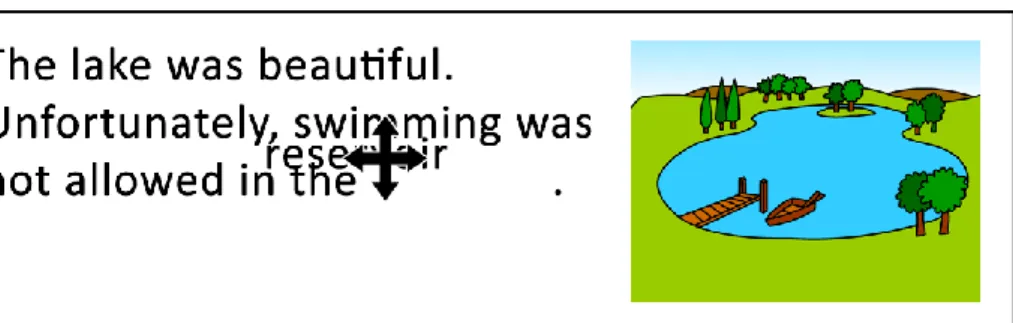
The current version of the tool is aimed strictly at textual learning materials. Upon logging onto the system, the student is presented with the lesson (it can contain various types of material, however only textual part is of interest), as presented in Figure 1.
Fig. 1 Initial learning situation
All words in the text are drag-enabled. This means that the learner can drag all the words in the text in the same fashion that they drag icons on their desktop, only the area of dragging is limited to the main area of the browser window. This is shown in Figure 2, where the word ‘reservoir’ is dragged away from its original position.
Fig. 2 Text draggability, word-wise
Another way this interaction can be implemented is through predefining multiple options for the learner to choose from; this way learner’s input is not freeform, but rather structured in a predefined way (as shown in Figure 4.)
Fig. 3 New relation prompt on word drop action
Fig. 4 Several offered options on word drop action
The learner may enter more than one relation. In case any relations between the two terms are already entered, the tool will display them along with the text field ready for a new relation. The entered relations are stored in a separate document which is created by the system at the session start.
The format of the document may vary. In the current version, the Resource Description Framework (RDF)8 document type, defined by the W3C9 within the Semantic Web10 initiative, was chosen for several reasons. First of all, RDF is a W3C standard and one of the fundamental Semantic Web technologies. Semantic Web is a new version of the World Wide Web and its development is carefully monitored and directed by the W3 Consortium, founded and led by the World Wide Web author (Berners-Lee, 2006). Semantic Web upgrade will enable automated computer reasoning and data integration, unleashing the power of today’s computers that stand helpless before unstructured, human-understandable but machine-unusable data. As it slowly emerges as the new Internet paradigm, Semantic Web brings about numerous standards and interoperability options, one of which is the RDF. Thus, storing data in this format will
8 https://www.w3.org/RDF/ 9 http://www.w3.org
make it easily accessible for processing in the new Web environment, integration of multiple separate data collections will be straightforward, as well as integrating data into more complex and sophisticated structures.
The RDF approach is fairly simple. An RDF document is a collection of triples – statements in the subject-predicate-object form. RDF is a specification of a data structure, not a specific language to express data. Most frequently used language for formal RDF expression is XML11 (Figure 5 shows a statement ‘John Smith owns Tesla X’ where ‘John Smith’ is a subject, ‘owns’ a predicate and ‘Tesla X’ an object).
<rdf:Description rdf:about="John Smith"> <owns>Tesla X</owns>
</rdf:Description>
Fig. 5 The RDF/XML expression of an RDF statement
The structure this simple has relatively low expressive power, and is lacking formal semantics that would enable automated reasoners to reason upon RDF documents, as they can in case of more structured representations, such as the OWL.12 As the tradeoff, RDF is missing limitations and firm structure, thus being able to address wider scope of data scenarios. Moreover, a plethora of tools for manipulating the RDF documents (such as RAP13) already exists, which does not hold for more complex data structures. In the proof-of-concept phase, RDF appears to be the most reasonable solution, placed in the sweet spot between simplicity, usability and standards.
3.ENGLISH LANGUAGE LEARNING EXAMPLE SCENARIOS
In this section, several example tool usage scenarios are given. The tool presented is not limited to these and its set of functionalities can be expanded to cover more activities, such as assessment. Directions of further development are given in the last section.
3.1. Synonyms, Homonyms and the Like
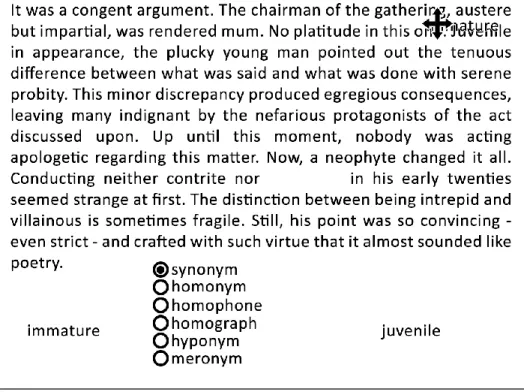
Each binary relation between words is perfectly suitable for this tool. Examples include synonyms, homonyms, homophones, homographs, hyponyms, meronyms, etc. In the basic mode, the learning tool would display a paragraph, and on each word drag a text-field would appear for the learner to enter a specific relation between the chosen words, be it a synonym, homonym or any other (Figure 6). Different relations within a single text may exist. In the second proposed mode of use, instead of allowing the learner to freely type, and perhaps mistype like in Figure 6, the tool would offer a list of possible relations for the learner to choose from (the case of words ‘immature’ and ‘juvenile’ is shown in Figure 7). This is a more structured approach, with less freedom on the learner side but also less prone to typing errors. It is worth mentioning that this scenario, as well as any other, may be performed in a collaborative manner, as the semantic document,
11 http://www.w3.org/XML/
12 http://www.w3.org/TR/owl2-primer/
which contains relations, and can this way be built by a group of learners. Moreover, this approach can be generalized to any type of assessment. Another possible mode of operation is a form of a self-questionnaire: the learner can compose their own text, the one that gives the context for the words to be learned in which they are best remembered, and the underlying semantic layer can be applied to it, bringing these words into relations and enabling questions as described.
Fig 6. Freeform learner’s input
3.2. Essay Composition Brainstorms
Though the initial tool has been envisioned with simple binary relations in mind, there are no limitations as to the length of the relation. This can be applied in early stages of courses on essay composition. It is a common practice that any course on essays begins with the composition of paragraphs, starting with brainstorm sessions. Supporting this phase, the tool can present the learner with a paragraph of text to choose keywords from and contrast them at will – entering the content of a possible essay paragraph (Figure 8).
3.3. Collocations and Similar Problems
learner is not required to type any relation. The relation ‘is to be collocated with’ is, in this case, predefined within the lesson. It is up to the learner only to provide all instances of this relation. The student can freely drag any words, but only a subset of words will form collocations. The system may provide instant or delayed feedback, depending on the chosen pedagogy.
Fig 7. Structured and more restrictive interaction
The paragraph presented to the learner can have several definite and/or indefinite articles omitted. The learner is expected to drag the present articles onto the words they find appropriate. In case of indefinite article, instead of typing, the tool can offer two options to the student: a and an. This exercise can help the learner to both differentiate definite from indefinite article positioning, as well as practice indefinite article a/an
situations.
In another scenario, the I was/I were type of difference can be practiced. Both was
Fig 8. Contrasting notions to inspire paragraphs
Fig 9. An example of a newly entered relation
<rdf:Description rdf:about="Juliet"> <sister>john</sister>
</rdf:Description>
Fig 10. The newly formed RDF triple
3.4. Text Comprehension and Other Student Input
assessment, as the students grading their peers’ input feature is easy to implement. If relations can be entered freely, with the large number of learners, their input is likely to show a normal distribution of values, the most accurate being the most probable. This way a knowledge base of relations can be formed in a Web 2.0 fashion, adding to both learning and future testing. Moreover, relations that learners enter can be marked by their peers, introducing peer-assessment scenario into the learning process. The consequence of each entered relation is a new RDF triple, as shown in Figure 10.
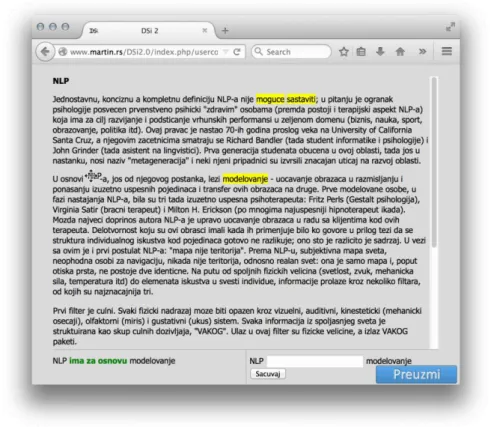
Fig 12. The screenshot of the current prototype
4. CONCLUSION
must be put on short but effective training prior to using the tool. Another limitation lies in the free form of relations. At the current phase of the tool development, relations are given as plain strings of characters, formulated in human form, with no formal semantics at hand. Though this approach is simple to develop and use, it is limited in terms of any future automated reasoning, as well as vulnerable to simple typing errors. Finally, the optimization of the technical side needs to be performed, as the tool puts significant load on the Web server for it needs to respond to learner’s interactions in real time. Further development of the tool will go in the direction of assessment and collaboration, with the peer-review approach in mind. Further on, the development will assume the direction of automated quiz question generation, based on learners’ interactions with the learning material.
REFERENCES
Pressey, S.L. 1926. A simple apparatus which gives tests and scores - and teaches. School and Society, 23 (586), pp. 373-376.
Smith S.G, Sherwood B.A. 1976. Educational Uses of the PLATO Computer System, Science, New Series, Vol. 192, No. 4237 (Apr. 23, 1976), pp. 344-352, http://www.jstor.org/stable/1742096, retrieved on September 30th, 2015.
Berners-Lee T. 1989. http://www.w3.org/History/1989/proposal.html The simulation of the world's first website, as it looked on a contemporary computer, is accessible at http://line-mode.cern.ch/www/hypertext/WWW/TheProject.html
Holmes B, Gardner J. 2006. E-Learning: Concepts and Practice, Pine Forge Press, 2006, ISBN 141291119, Chapter 3.
Nicholson P. 2007. A History of E-Learning - Echoes of the Pioneers, u Manjón, B. F. et al, Computers and Education: E-Learning from Theory to Practice, Springer, 2007, ISBN 1402049137, pp. 1-11.
Horton, W. 2001. Leading E-Learning: Here is how You Can Chart your Course, Champion Implementation, Ensure Success, American Society for Training and Development, 2001, ISBN 1562862987.
Drucker, P. 2000 Need to Know: Integrating e-Learning with High Velocity Value Chains, A Delphi Group White Paper, 2000.
Stojanovic Lj, Staab, S, Studer, R. 2001. Elearning Based on the Semantic Web, WebNet2001 - World Conference on the WWW and Internet, 2001, pp. 23-27. Accessible at http://www.researchgate.net/publication/2488066, retrieved on Sept. 30th.
Ally, M. 2008. Foundations of Educational Theory for Online Learning, u Anderson, T. (editor) - The Theory and Practice of Online Learning, Athabasca University Press, 2008, ISBN 1897425082, pp. 15-44.
Martínez-Torres M. R, Toral S. L, Barrero, F. 2011. Identification of the design variables of eLearning tools, Interacting with Computers, 2011, 23 (3), pp. 279-288.
Badrul H. Khan, B. H, Ally, M. (Editors): International Handbook of E-Learning Volume 1: Theoretical Perspectives and Research, Volume 2, Routledge, Feb 20, 2015, ISBN: 978-1-138-79368-2 (hbk), 978-1-315-76093-3 (ebk).
Aguti, B, Walters R. J, Gary B Wills. 2014. Effective Use of E-Learning Technologies to Promote Student-Centered Learning Paradigms within Higher Education Institutions, International Journal for e-Learning Security (IJeLS), Volume 4, Issues 3/4, September/December 2014, ISSN 2046-4568, Published by Infonomics Society. Phillips, R, McNaught, C, Kennedy, G. 2012. Evaluating E-Learning: Guiding Research
and Practice, Routledge 2012, ISBN 978-0-203-81336-2 (eBook).
Moore, J. L, Dickson-Deane, C, Gaylen, K. 2011. E-Learning, Online Learning, and Distance Learning Environments: Are They the Same?, Internet and Higher Education 14 (2011), pp. 129-135.
Nichols M. 2003. A Theory for eLearning, Discussion Summary, Educational Technology & Society (issued by International Forum of Educational Technology & Society, IEEE Learning Technology Task Force), ISSN 1436-4522, Vol. 6, No. 2, April 2003, pp. 1-10.
Ravenscroft A. 2001. Designing E-learning Interactions in the 21st Century: Revisiting and Rethinking the Role of Theory. European Journal of Education, 36 (2), pp. 133-156. Chawla A, Singh J. P. 2006. Organizational Environment and Performance of Research Groups – a Typological Analysis, Scientometrics, Vol. 43, No. 3, 1998, Akadémiai Kiadó with Springer Science and Business Media B. V., ISSN 0138- 9130, pp. 373-391.
Pearce N, Merletti F. 2006. Complexity, Simplicity and Epidemiology, International Journal of Epidemiology 2006 35(3), pp. 515-519; doi:10.1093/ije/dyi322, specifically page 515, chapter on Complexity.
Liu M, Moore Z, Graham L, Lee S, 2002. A Look at the Research on Computer-Based Technology Use in Second Language Learning, Journal of Research on Technology in Education, Vol. 34, No. 3, pp. 250-273, © 2002 EBSCO Publishing.
Stepp-Greany J. 2002. Student Perceptions on Language Learning in a Technological Environment: Implications for the New Millennium, Language Learning & Technology, Vol. 6, No.1, January 2002, pp. 165-180.
Yang S. C, Chen Y. J. 2007. Technology-Enhanced Language Learning: a Case Study, Computers in Human Behavior, Volume 23, Issue 1, January 2007, pp 860–879. Hui W, Hu P. J, Clark T.H.K, Tam, K.Y, Milton, J. 2008. Technology-assisted learning: a
longitudinal field study of knowledge category, learning effectiveness and satisfaction in language learning, Journal of Computer Assisted Learning, Volume 24, Issue 3, pp. 245–259, June 2008.
Blake R. 2009. The Use of Technology for Second Language Distance Learning, The Modern Language Journal, Volume 93, Issue Supplement s1, pp. 822–835, December 2009.
Miller G. A. 1956. The Magical Number Seven, Plus or Minus Two: Some Limits on our Capacity for Processing Information, Psychological Review. Vol 101(2), April 1994, pp. 343-352.
Keengwe J, Onchwari G, Agamba J, 2014. Promoting effective e-learning practices through the constructivist pedagogy, Education and Information Technologies, December 2014, Volume 19, Issue 4, pp. 887-898.
and collaborative methodological approach in engineering education, Computers & Education, Volume 49, Issue 3, November 2007, pp. 891–915.
Liaw, S.S. 2008. Investigating students’ perceived satisfaction, behavioral intention, and effectiveness of e-learning: A case study of the Blackboard system, Computers & Education, Volume 51, Issue 2, September 2008, pp. 864–873.
Koohang A, Riley L, Smith T.J, Scheurs J. 2009. E-Learning and Constructivism: From Theory to Application, Interdisciplinary Journal of e-Skills and Lifelong Learning, Volume 5, 2009.
Alonso F, Manrique D, Vines J.M. 2009. A moderate constructivist e-learning instructional model evaluated on computer specialists, Computers & Education, Volume 53, Issue 1, August 2009, pp. 57–65.
Jovanović, M. 2007. Arhitektura konceptualno-orijentisanog alata za podršku učenju (Architecture of the Concept-Oriented Learning Support Tool), Infoteh-Jahorina Conference, Proceedings of Papers, Jahorina, Republic of Srpska, March 28-30. 2007, Vol. 6, Ref. E-IV-4, pp. 477-479, issued by Faculty of Electronics Southern Sarajevo, 2007, ISBN 99938-624-2-8.
Sowa J. F. 1984. Conceptual structures: information processing in mind and machine, Addison-Wesley Longman Publishing, Boston, MA, USA, 1984, ISBN:0-201- 14472-7
Sowa J. F. 1992. Semantic Networks, Encyclopedia of Artificial Intelligence, ed. Stuart C. Shapiro, Wiley, 1987, II Edition, 1992.
Jovanović M, Stanković M, Todosijević D. 2015. Semantic Language E-Learning Platform, Proceedings of the The Second International Conference on Teaching English for Specific Purposes and New Language Learning Technologies, University of Niš, Faculty of Electronic Engineering, Serbia, May, 22th - 24th, 2015.