Comparative field performance of three different gas exchange systems
G.F. M IDGLEY*, M. VESTE**, D.J. VON W ILLERT**, G.W. DAVIS*, M. STEINBERG** and L.W. POWRIE*
Keywords: ecophysiology, gas exchange measurement, photosynthesis, transpiration
ABSTRACT
We compared portable and continuously monitoring gas exchange systems under field conditions, using Protea glabra Thunb. as a test species. The aim was to determine if the same patterns of gas exchange and ancillary parameters could be obtained with rather different measurement systems, and whether the same interpretation and conclusions about environmental control of gas exchange could be drawn. The following systems were compared: 1, a ‘closed’ portable 1RGA manufactured by Ll-Cor (LI-6200); 2, an ‘open’ portable porometer manufactured by Walz; and 3, a continuously monitoring minicuvette system with temperature control facility, also manufactured by Walz.
All three systems yielded similar diurnal curves for CO2 uptake, although absolute flux values for the minicuvette system were lower than those obtained for the portable systems. This was likely due to stem respiration and self-shading of leaves on the shoot enclosed in the minicuvette. Differences in sampling technique between the two portable systems, primarily with regard to changes in leaf orientation, resulted in some differences in absolute values of gas fluxes and ancillary parameters such as leaf temperature and leaf to air vapour pressure difference. However, data from all three systems allowed similar interpreta tions to be made about the environmental dependencies of gas exchange patterns. It appears that each system has certain drawbacks associated with widely varying field conditions. A combination of portable and continuous monitoring techniques would seem to be the most powerful approach to investigating the gas exchange patterns of terrestrial plants in their natural environment.
expect results yielded by them to be directly comparable? Only one published study (Winner et al. 1989) that we know of has addressed this important question, by com paring a closed portable photosynthesis system (LI-6200, LICOR, Lincoln, Nebraska) with an open system (ADC LCA-2, Analytical Development Corporation, Hoddesdon, England). Although the results of this study suggested that the systems gave comparable gas flux values, problems with experimental protocol prevented a conclusive result.
In this paper, we provide a direct comparison of gas exchange data obtained by three different gas exchange systems in a highly variable field environment. This is an important form of data control in a field where different research groups become more or less committed to one make or type of instrument. Our comparison is prelimi nary in that we do not address subtle and complex ques tions of cuvette design differences between instruments. We also attempt to draw attention to the advantages of combining the use of different approaches to gas exchange measurement in an ecophysiological study.
MATERIALS AND METHODS
Study site and measurement protocol
The study was carried out on the Farm Papkuilsfontein, near Niewoudtville, Cape Province, South Africa, in an area of natural vegetation comprising arid Fynbos and some Karoo elements. The study site was situated near the edge of an escarpment of the Bokkeveld Mountains (altitude 800 m, 33°30'S 19°05’E).
For our primary comparison, we present the results of gas exchange measurements on Protea glabra Thunb., an evergreen, broad-leaved, sclerophyllous shrub, made on INTRODUCTION
In the last decade, a number of advances in the simul taneous measurement of water vapour and CO2 exchange
by plant organs have been made. The present availability of several commercially produced systems provides a healthy competitive environment which is to the benefit of researchers and the quality of their science. However, the different approaches to gas exchange measurement used by gas exchange systems make them suitable for different purposes, and may also have important implica tions for the interpretation of results obtained when using them. In essence, no perfect all-purpose gas exchange sys tem exists (Field et al. 1989). The choice of instrument for any particular task involves two fundamental trade offs— between portability and the facility for environ mental control, and between replication and resolution. Field et al. (1989) suggest that a combination of instru ments with complementary strengths is a good solution to this dilemma. This view assumes that different gas ex change systems yield similar results, but this assumption should be tested (Reich et al. 1988). Apart from inade quate calibration protocol (Reich & M iddendorf 1990), concern has been expressed about the accuracy of gas flux and leaf temperature data obtained with leaf cuvettes, and the need for correction procedures (Rochette et al. 1990; Idso 1992). On the other hand, Monteith (1990) suggests that correction of these data is not necessary, as long as correct sampling procedures are followed.
Considering that sampling approach and technique may differ a great deal between gas exchange systems, can one
* Stress Ecology Research Programme, National Botanical Institute, Private Bag X7, Claremont, 7735 Cape Town.
** Department of Applied Botany, University of Munster, D-4400 Munster, Federal Republic of Germany.
31 January 1991 (i.e. midsummer). Measurements were made with a LICOR LI-6200 portable IRGA (LICOR, Lincoln, Nebraska, USA), a Walz CO2/H2O portable
porometer (Walz, Effeltrich, Germany), and a continuous- monitoring minicuvette system with temperature control facility (Walz, Effeltrich, Germany). We also provide the results of a comparison between only the minicuvette sys tem and the Walz porometer, using data collected on 29 September 1990 (spring).
In January, measurements were carried out on adult individuals which were approximately 1.5 to 2 m tall. To minimize disturbance to the individual being continuously monitored by the Walz minicuvette system for other pur poses, we used the portable gas exchange systems to sam ple an individual of matching size and water status less than 150 m away (water potentials were measured before dawn and through the day using a pressure chamber). All gas exchange instruments were unmodified, and were used according to their instruction manuals. We attempted to synchronize sampling with the portable systems as far as possible. One leaf (that most recently fully expanded on the shoot) on each of five shoots was measured with each portable instrument at each sampling time. We re turned to measure the same leaves throughout the day, except that a small number of leaves measured with the Walz porometer became detached from the plant stem; these were replaced by leaves of a comparable age and position on an adjacent stem. Towards the end of the day (after 16h00), permanently marked leaves sampled by the LI-6200 became shaded; after this occurred, well-irradi ated leaves of a similar age and stem position were sam pled and removed at each sampling event. Sampling of leaves with the LI-6200 was carried out with as little dis turbance to the natural leaf angle as possible, although some disturbance was usually unavoidable. With the Walz porometer, the upper leaf surface was turned to face the sun after being enclosed in the cuvette, this being neces sary to prevent shading of the leaf by the cuvette lid.
In September 1990, the Walz porometer was compared only with the minicuvette system. An identical procedure was followed, except that three leaves were sampled per sampling period with the Walz porometer, from a smaller shrub situated not more than 50 m from the continuously sampled individual.
Leaf areas were measured with a LI-3000 belt system, or a digitized CAD system (Summa Sketch II, programme from the Department of Plant Physiology, University of Wien, Austria).
Instrumentation
L l-C o r 6200 (Ll-Cor Inc., Lincoln, Nebraska, USA)
We used this battery-powered instrument in its normal configuration, i.e. a closed system (Welles 1986). After the leaf is placed in the cuvette, air circulates between the cuvette and the gas analyser, and the CO2 exchange rate
is computed from the rate of change of CO2 concentration
due to net CO2 uptake or loss by the leaf. Air vapour
pressure can be held constant by manually adjusting a
valve which allows a portion of the circulating air to pass through a magnesium perchlorate dessicant column— in this way the effect of leaf transpiration on the vapour pres sure of the enclosed air volume can be countered. Leaf temperature is measured by a chromel-constantan thermo couple which makes contact with the underside of the leaf when the hinged lid of the cuvette is closed. Air tempera ture in the cuvette is measured by a shielded thermistor. Relative humidity is measured by a capacitance sensor (Vaisala Humicap), which is situated beneath the radiation shield in the cuvette. The gas analyser (LI-6250) is a non- dispersive, infrared type which is tuned to the 4.26 mi crometer band, providing rejection of IR absorption by gases other than CO2. The analyser uses as a reference
gas, a closed loop of air that is continuously scrubbed of CO2. Any drift in this zero reference was checked roughly
every two hours during the field work, by switching the measurement air loop through a soda lime scrubber, with out a leaf in the sample cuvette. We used a standard 0.251 chamber (LI-6000-13), which is constructed of polycar bonate, and has a teflon-coated inner surface to minimize adsorption and desorption effects. The cuvette contains a small fan which minimizes boundary layer resistance. In cident photosynthetic photon flux density is measured by a LI-190S-1 quantum sensor, which is mounted parallel with the sampled leaf surface.
W alz C O2/H2O p o ro m e te r (Walz, Effeltrich, Germ any)
This instrument is best operated with the aid of gen- erator-supplied power. A 12V motor car battery may be used under field conditions, but this results in a poor IRGA temperature stabilization, and subsequent drifts in the CO2
zero point. The instrument is normally configured as an open system (Schulze et al. 1982). Gas exchange rate is calculated from the difference in concentration between a reference gas line which samples ambient air, and a sam ple gas line which is passed through a cuvette containing the sampled leaf. Water vapour and CO2 concentrations
are measured by a BINOS I differential infrared gas an alyser (Leybold Heraeus, Hanau, Germany). The zero point of the H2O and CO2 of the BINOS is recorded after
every five measurements for later calculation correction. This is carried out by making a measurement in the normal way, but without a leaf in the cuvette. The flowrate in the measurement line is controlled by a flowmeter (Tylan, Carson, California, USA).
85 W alz m in icuvette system (Walz, Effeltrich, Germany)
This system can be operated in the field only with the aid of power supplied by at least a 0.6 kW generator. The instrument is configured as an open system, but with a continuous zero reference, obviating the requirement for removing the leaf from the sample cuvette to check the IRGA zero. The humidity of air in the sample and refer ence paths may be manipulated by a dewpoint controller. D ifferences in H2O and C O2 concentrations between
measurement and reference paths are measured by a dif feren tial in frared gas an a ly se r (B IN O S I, Leybold Heraeus, Hanau, Germany). Two dewpoint mirrors (MTS M K1, Walz, Effeltrich, G erm any) are mounted in the flowpath of the measurement gas, one measuring the dew- point of air entering the cuvette, and the other the exiting air. This allows calculation of air vapour pressure and tran spiration rate which is independent of the reading pro vided by the BINOS. This is especially important when high daytime transpiration rates exceed the range of the BINOS water vapour channel.
The minicuvette (GK 022) consists of two parts: an environmental control system of mainly nickel construc tion mounted inside a polyethylene shield, and a plexiglass leaf chamber. Chamber air temperature is controlled by Peltier elements which are thermally connected to a heat sink ventilated by a small fan. Cuvette air temperature can be set to track that of ambient air (measured by a ventilated PT100 resistance temperature sensor), or can be set to maintain a user-defined constant temperature. Under field conditions the former option is most com monly used. Chamber vapour pressure deficit can also be controlled, or set to track that of the ambient air. The instrument setup can utilize more than one sample cuvette.
The cuvette design allows a whole shoot of the target plant to be sampled in its natural position (different cham ber types can be constructed which provide great flexibil ity in sam pling). L eaf tem perature is measured by a nickel-chromel thermocouple which is pressed to the un derside of a representative leaf. Chamber air temperature is measured by a radiation-shielded thermistor. Photosyn thetic photon flux density is measured by a L I-190S quan tum sensor. A data logger stores data from relevant channels, and controls the timing of the IRGA zeroing sequence. The data can be transferred to a personal com puter for further computation. The IRGA, pumps and data logging facilities are best mounted in a medium-sized ve hicle (such as a minibus) for mobility, and to alleviate the harsh conditions often encountered in the field.
Calculation o f gas fluxes and conductances
All gas exchange parameters were calculated after Von Caemmerer & Farquhar (1981) for all three measurement systems. All fluxes are expressed on a total leaf area basis (i.e. the total of the upper plus lower leaf surfaces), as leaves are amphistomatous in this species.
The LI-6200 and the two Walz systems differ slightly in their approach to calculating leaf conductance to water vapour. The LI-6200 software computes stomatal conduc tance (gs) from leaf conductance to water vapour (gH2o)
by correcting for leaf boundary layer conductance (gb), according to the equation
1 /g s = l / g H 2 0 - 1 /g b
The boundary layer conductance value should be experi mentally verified for different leaf shapes and sizes, and may vary according to leaf position in the cuvette. We used a nominal figure for gb of 1.7 mol n r 2 s_1, which was obtained by using a wet filter paper replica of a sam pled leaf in a standard position in the cuvette. The Walz systems compute total leaf conductance to water vapour (gH2oX an<3 do not derive stomatal conductance.
Converting gs computed by the LI-6200 to gH20 re_ duced the conductance value by roughly 0.6% per 10 mmol n r 2 s-1 (i.e. a gs of 100 mmol n r 2 s-1 is equal to g H 2 0 ° f 9 4 mmol n r 2 S '2 ), which, within the conductance range of the species used in this study, is a trivial correction in relation to other possible sources of error. Therefore, in this paper we treat gs derived by the LI-6200 as equivalent to gH20 fr°m the Walz instruments, as would be the situation when comparing separately published values.
RESULTS
Carbon dioxide exchange
The diurnal pattern o f CO2 exchange (Figure 1A)
yielded by the three instruments was qualitatively similar, with a clear mid-morning peak, followed by a rapid de crease (less rapid for the LI-6200) towards midday, and a steady but less marked decrease towards the evening. The daily maximum CO2 uptake rate was recorded during the
same period for all systems; maximum rate yielded by the minicuvette system (3 (imol n r 2 s_1) was lower than the mean recorded by the LI-6200 (3.8 (imol n r 2 S '1) and the Walz porometer (4.9 |imol n r 2 s*1)- Data variability for the portable systems (i.e. the coefficient of variation for each sample period mean expressed as a percentage), was considerably greater for the LI-6200 (typically 37%) than for the Walz (typically 27%) during the light period. Nei ther portable system gave a realistic value for respiration rate at low light levels in the early morning, but the LI- 6200 measured a mean respiration rate comparable to that given by the minicuvette system at the end of the day.
Integrated CO2 uptake for the light period on the Janu
ary sampling date for the Walz porometer was 120 mmol CO2 n r 2, double that of the minicuvette system (57 mmol
CO2 n r 2), with the value for the LI-6200 between these
(99 mmol CO2 n r 2).
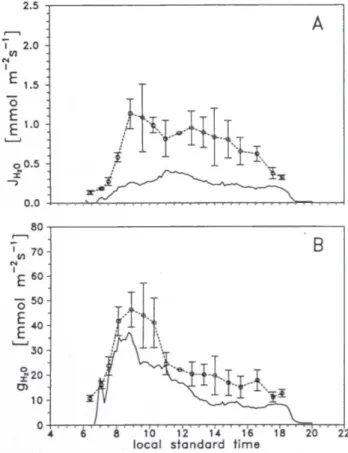
Water vapour exchange and stomatal conductance
meas-FIGURE 1.— Diurnal trends, using Protea glabra as test species, of parameters measured by three different gas exchange systems on 31 January 1991. A, C 02 flux; B, transpiration rate; C, cuvette temperature and dewpoint temperatures of air entering and exiting sample cuvette on Walz minicuvette system; D, stomatal conduc tance for Walz and LICOR portable systems. A, B, D: Walz porometer, • ; LI-6200, ■; C, Walz minicuvette system, — ; dew-point out,---- ; dewdew-point in . Vertical bars represent standard deviations.
uring gas flowpath in the region of the cuvette. This is reflected in the parallel changes in ambient cuvette tem perature and the dewpoint temperature of exiting air be
fore 12h00 in the minicuvette system (Figure 1C), and it is unlikely that the transpiration values as measured by this instrument under these conditions are biologically meaningful.
The pattern of stomatal conductance as measured by the two portable systems, as well as the absolute values and data variability, agree well for most of the day, except for a marked divergence between the two systems before 09h00 (Figure ID). The transpiration rates measured and conductances calculated by the LI-6200 for the last sam pling period were highly variable, and sometimes nega tive, and are not given.
Physical parameters
Each measurement system was applied in a slightly different way in the field, and this led to some differences in measured physical parameters such as PPFD (Figure 2A). The Walz porometer measured higher values from earlier in the day than the LI-6200, due to the need to orientate the enclosed leaf towards the sun (unfortunately the Walz porometer used by us did not have the facility to provide readings greater than 2000 |imol n r 2 s~l). Meas ured leaf temperature in the Walz minicuvette system was much lower through the day than that measured by either portable system, and the Walz porometer yielded higher leaf temperatures than the LI-6200 (Figure 2B). These tem perature differences led also to different leaf to air vapour pressure differences (AW) in each system (Figure 2C).
Secondary comparison
The comparison of transpiration rate measured by the Walz porometer and minicuvette system in September 1990 (Figure 3A) show better agreement in qualitative pat tern, and give the expected lower maximum (due to lower AW) measured by the minicuvette system. Also, conductance patterns for these two systems were quantitatively and qualitatively comparable on that day (Figure 3B).
Summary relationships
Linear regressions fitted to plots of CO2 exchange rate
against stomatal conductance (Figure 4A, B) were signifi cantly positive. The slopes of this relationship compared well with the Walz systems in September 1990, but the LI-6200 gave a somewhat reduced slope value than the Walz porometer in January 1991, and the lowest correla tion coefficient for the regression.
FIGURE 2.— Diurnal trends, using Protea glabra as test species, of physical parameters measured by three different gas exchange systems on 31 January 1991. A, photosynthetic photon flux den sity; B, leaf temperature; C, leaf to air vapour pressure difference. Walz porometer, • ; LI-6200, ■; Walz minicuvette system, — . Vertical bars represent standard deviations.
DISCUSSION
'O u r simultaneous use of three different gas exchange systems highlighted some heartening similarities in their data outputs. In contrast to the study of Winner et al.
(1989), the test species used in this study had a clear di urnal pattern of water vapour and CO2 exchange which
was revealed by all three systems. However, the data also suggest some im portant differences between systems which may to a large extent be minimized by improve ment in system design or standardization of sampling technique. The biggest difference was found between the portable machines and the Walz minicuvette system, in terms of absolute values of CO2 and water vapour flux,
and subsequently calculated conductances. This may be explained by the inclusion of a whole shoot in the mini cuvette system, an approach which had three obvious im plications: 1, the gas exchange of leaves with a range of ages was sampled. It has been established that young
leaves of Protea species tend to have lower photosynthetic rates than developing and mature leaves (Von Willert et al. 1989; Van der Heyden & Lewis 1990). The contribu tion of all leaves in the cuvette to net CO2 and water
vapour exchange is equally weighted as these fluxes are calculated on a leaf area basis. This would lead to an underestimation of these fluxes relative to those measured by the portable systems, which were used to sample only mature leaves; 2, leaves on the shoot were self-shaded to a greater or lesser extent or obliquely positioned relative to the sun’s rays depending on the position of the sun (and more closely representing the real situation in the field); 3, stem material enclosed in the Walz minicuvette sample chamber would have contributed respired CO2.
Because sampling with the LI-6200 system involved minimum disturbance to leaf orientation, while the Walz cuvette was aimed directly at the sun for some time before taking the measurement, the expectation was that Walz values of CO2 flux during the light period would be
greater than LI-6200 values. This proved to be the case, especially at midday, when leaf orientation led to the greatest difference in sampled leaf orientation between the two portable systems. Which is the correct way to sample, or indeed, is there a correct way? It can be argued that enclosing a leaf in any sampling chamber constitutes a disturbance to the leaf environment. This is especially true of gas exchange cuvettes, which use turbulent airflow gen erated by an internal fan to reduce the leaf boundary layer resistance. If sampling occurs rapidly enough, it is as sumed that stomata do not have time to respond to this disruption, but it is likely that this assumption is violated
6
-
5-
4-3-
2-
1 -
0
-1 7
o
■ ..o'”, o 00
,.-*r
for portable systems such as stratifying sampling accord ing to leaf orientation or angle classes, but depends on knowledge of the rapidity of the physiological response.
Gas flux values obtained with a continuous monitoring system, such as the minicuvette system, may be the most accurate means of estimating diurnal carbon and water budgets, but the technique is limited by low potential for replication. Certainly, this type of system offers a level of data resolution which may improve interpretation of the effects of changing environmental conditions on gas ex change processes. This can be seen clearly in the relation ship between AW and gH20> which reveals a remarkably close relationship between these parameters that is masked by considerable variability in the data from the portable systems.
Technical limitations
Each system we used revealed shortcomings in the widely varying field environment. For the minicuvette system, the main problem seemed to be adsorption and desorption processes, especially under conditions of high air dew point temperature (i.e. in the morning on the Janu ary sampling date). The problem was not apparent on the September sampling date, when relative humidity was relatively low during the morning.
FIGURE 4.—The relationship for Protea glabra between stomatal con ductance and C 02 flux as measured by three different gas ex change systems. A ,31 January 1991; B, 29 September 1990. Walz porometer, O; LI-6200, ■ ; Walz minicuvette system, • . Statistics are as follows: A, LI-6200, r2 = 0.65, df = 51, Y = 0.05X + 0.44. Walz porometer, r2 = 0.80, df = 46, Y = 0.08X + 0.15. B, Walz porometer, r2 = 0.88, d f=45, Y = 0.08X - 0.22. Walz minicuvette system, r2 = 0.82, df = 90, Y = 0.08X + 0.24.
under certain circumstances, and is species-specific. The energy balance of a leaf is also altered after being enclosed in a cuvette, but this is also assumed to have limited im mediate effect on leaf function during sampling. McDer- m itt (1990) provides a b rief sum m ary of im portant considerations in this regard. Changes in leaf orientation during sampling constitute a disruption to the function of the leaf which may have immediate or delayed impacts on leaf energy balance, stomatal movements and the ve locity of leaf photo- and biochemical reactions. Leaf pho tochemical reactions may be rapid in response to changes in light energy, but stomatal responses tend to be rather slower (Gross & Chabot 1979). If leaf orientation is to be altered for a sample, it seems prudent to establish first the rapidity o f stomatal and biochemical changes in the spe cies under study.
By changing sampled leaf orientation it is possible to control, to some extent, the PPFD incident on a sampled leaf surface using a portable system. This can be a useful technique, for example, for standardizing light conditions for different samples. In this study, the effect of stand ardizing light conditions (i.e. by aiming the leaf directly at the sun), using the Walz porometer, appeared to result in less noisy data, as can be seen in the correlation coef ficients for the relationship between gH20 a°d A for the portable instruments. This method could shortcut more comprehensive but time-consuming sampling strategies
Accurate measurement of water vapour concentration in the sample cuvette appeared to be a major problem for the LI-6200 early and late in the day, when humidity was high. The LI-6200 relies on an accurate measurement of this parameter for calculating transpiration rate and hence stomatal conductance. It is well documented that the ac curacy of the Vaisala Humicap sensor is strongly affected above about 80% relative humidity (McDermitt 1990), and that fairly small errors in humidity measurement can lead to large errors in conductance when ambient humidity is either very low or very high (Welles 1986; McDermitt
1990); this may explain the deviation of conductance val ues between the portable systems early in the morning and at the end of the light period. However, the Vaisala Humicap is relatively robust within the effective range (10% -80% , McDermitt 1990), as is clear from the simi larity between measurements of water vapour flux be tween this system and the Walz porometer through the day. The combination CO2/H2O IRGA used by the Walz
porometer appeared to be a superior system under high humidity conditions.
Sampling with the portable systems was plagued pri marily by cuvette heating problems, which were of two types: firstly, enclosed leaves heated up rapidly during m easurem ent, and secondly, the cuvettes them selves heated up during a sampling run. Apart from direct effects on leaf function, this affects compound parameters such as leaf to air vapour pressure difference, a parameter which is thought to be of considerable importance in sto m atal m ovem ents (A phalo & Jarvis 1991), possibly through its effect on transpiration rate (Mott & Parkhurst
1991). Schulze et al. (1982) suggested shading the head of portable porometers between measurements to avoid heating, yet Tyree & Wilmot (1990) showed how a shaded LICOR L i-1600 porometer cuvette rapidly reduced the temperature of irradiated sugar maple leaves, leading to considerable modification of water vapour flux and cal culated conductance. Recently developed portable systems which use Peltier cooling systems to allow chamber tem perature to track ambient temperature may remove this limitation. This is a positive step in reducing the intru siveness of sampling with a portable system.
CONCLUSIONS
All sampling techniques used by us yielded equivalent results, and therefore appear to be directly comparable. However, we urge users of portable systems to describe the procedure followed when clam ping cuvettes onto leaves; this will contribute to more effective assessment and cross-comparison of data.
In general, matching interpretations about complex en vironmental and stomatal determinants of gas exchange patterns could be made using the data obtained from all three systems, which can be seen clearly in the relation ships obtained between stomatal conductance and daytime CO2 fluxes, and between AW and stomatal conductance.
Therefore, we concur with the suggestion of Field et al.
(1989: 239) that the combination of a continuous moni toring technique with a well designed stratified sampling strategy using a portable system, may be the most pow
erful way to investigate gas exchange patterns in the field. It remains to be seen whether more recently developed portable systems with peltier-cooled cuvettes will increase the effectiveness of clamp-on gas exchange systems.
ACKNOWLEDGEMENTS
The support of the Deutscher Akademischer Austausch- dienst and the Deutsche Forschungsgemeinschaft is ac knowledged (MV, DJvW, MS). Volkswagen of SA Ltd (Uitenhage, South Africa) supplied two vehicles. We thank W illem van W yk, ow ner o f Papkuilsfontein at Nie- woudtville, for permission to work on his property, and for his helpfulness and hospitality during our stay.
REFERENCES
APHALO, PJ. & JARVIS, PG. 1991. Do stomata respond to relative humidity? P/anr, Cell and Environment 14: 127-132.
FIELD, C.B., BALL, J.T. & BERRY, J.A. 1989. Photosynthesis: princi ples and field techniques. In R.W. Pearcy, J.R. Ehleringer, H.A. Mooney & PW. Rundel, Plant physiological ecology, field meth ods and instrumentation: 209-253. Chapman & Hall, London. GROSS, L.J. & CHABOT, B.F. 1979. Time course of photosynthetic
responses to changes in incident light energy. Plant Physiology 63: 1033-1038.
IDSO, S B. 1992. Net photosynthesis: corrections required of leaf chamber measurements. Agricultural and Forest Meteorology 58: 35-42. MCDERMITT, D.K. 1990. Sources of error in the estimation of stomatal
conductance and transpiration from porometer data. Hortscience 25: 1538-1548.
MONTEITH, J.L. 1990. Porometry and baseline analysis: the case for compatability. Agricultural and Forest Meteorology 49: 155-167. MOTT, K.A. & PARKHURST, D.F. 1991. Stomatal responses to humid
ity in air and helox. Plant, Cell and Environment 14: 509-515. REICH, PB. & MIDDENDORF, L. 1990. Sources of variation in
porometry data. Plant, Cell and Environment 13: 879.
REICH. P.B., WALTERS, M.B. & TABONE, T.J. 1988. Variation in response of five identical steady-state porometers. Plant, Cell and Environment 11: 785, 786.
ROCHETTE. P., PATTEY, E„ DESJARDINS, R.L. & DWYER, L.M. 1990. Adjustment of leaf temperature measurements in LI-COR 6200 assimilation chamber using energy balance calculations. Agricultural and Forest Meteorology 53: 149-156.
SCHULZE, E.-D., HALL, A.E., LANGE, O.L. & WALZ, H. 1982. A portable steady-state porometer for measuring the carbon dioxide and water vapour exchange of leaves under natural conditions. Oecologia 53: 141-145.
TYREE, M.T. & WILMOT, T.R. 1990. Errors in the calculation of evapo ration and leaf conductance in steady-state porometry: the impor tance of accurate measurement of leaf temperature. Canadian Journal of Forest Research 20: 1031-1035.
VAN DER HEYDEN, F. & LEWIS, O.A.M. 1990. Environmental control of photosynthetic gas exchange characteristics of fynbos species representing three growth forms. South African Journal o f Botany 56: 654-658.
VON CAEMMERER, S. & FARQUHAR, G.D. 1981. Some relation ships between the biochemistry of photosynthesis and the gas exchange of leaves under natural conditions. Planta 153: 376-387.
VON WILLERT, D.J., HERPPICH, M. & MILLER, J.M. 1989. Photo synthetic characteristics and leaf water relations of mountain fyn bos vegetation in the Cedarberg area (South Africa). South African Journal o f Botany 55: 288-298.
WELLES, J. 1986. A portable photosynthesis system. In W.G. Gensler, Advanced agricultural instrumentation, design and use: 21-38. Nijhoff, Dordrecht.