O R I G I N A L R E S E A R C H
Open Access
Optimal economic operation of isolated
community microgrid incorporating
temperature controlling devices
Bo Hu
*, He Wang and Sen Yao
Abstract
With the increasing connection of controllable devices to isolated community microgrid, an economic operation model of isolated community microgrid based on the temperature regulation characteristics of temperature controlling devices composed of wind turbine, micro-gas turbine, energy storage battery and heat pump is proposed. With full consideration of various economic costs, including fuel cost, start-stop cost, energy storage battery depletion expense and penalty for wind curtailment, the model is solved by hybrid particle swarm optimization (HPSO) algorithm. The optimal output of the micro-sources and total operating cost of the system in the scheduling cycle are also obtained. The case study demonstrates that temperature adjustment of temperature controlling devices can adjust the power load indirectly and increase the schedulability of the isolated community microgrid, and reduce the operating cost of the microgrid.
Keywords: Isolated community microgrid, Temperature controlling devices, Economic operation, Energy storage system
1 Introduction
To solve the increasingly prominent energy crisis and environmental problems, microgrid that can accept vari-ous renewable energy sources has been developed [1–5]. However, renewable energy sources (e.g. wind energy and solar energy) in the microgrid and connection of controllable loads at the demand side have brought new challenges to microgrid scheduling and operation. The community microgrid has complicated electrical and thermal relationships due to the abundant temperature controlling devices. Therefore, adequate scheduling is the prerequisite of optimal economic operation of the community microgrid incorporating temperature con-trolling devices.
Optimal economic operation of microgrid is to prop-erly allocate the output of micro-sources to increase the economic benefits of the microgrid. Many related researches have been reported. Based on the new
photovoltaic output model, Reference [6] formed a prob-ability sequence of wind-solar collaborative output through the convolution method and established a microgrid optimal economic operation model that can convert stochastic constraint into certainty constraints. The microgrid optimal economic operation model estab-lished in [7] took the impact of the electricity market into account and by optimizing the outputs of different micro-sources it reduced power fluctuation of the power lines and the total operating costs. Reference [8] put forward a multi-objective fuzzy adaptive HPSO algo-rithm to optimize the microgrid operation. It converted the multiple objective functions of power supply cost, environmental pollution expenses and generating cost into a single objective through the proposed algorithm. Reference [9] established a model for energy storage
charge–discharge loss and incorporated it into the
microgrid economic operation model to analyze its effect on the economic operation of the microgrid. In Reference [10], considering the energy storage character-istics, electric/heat load and time-of-use (TOU) power price, it proposed an economic operation model for
* Correspondence:[email protected]
State Key Laboratory of Power Transmission Equipment & System Security and New Technology, Chongqing University, Chongqing 400044, Shapingba District, China
regional connected microgrid that uses electricity-heat combined scheduling. References [11–16] considered the connection of renewable energy sources into the co-generation microgrid and the impacts of the characteris-tics of renewable energy power generation equipment and load randomness on optimal operation of the micro-grid to optimize the outputs of different micro-sources, in order to achieve the lowest economic cost.
Based on the literature, it is found that existing re-searches on economic operation of microgrid mainly focus on two aspects. One studies the problems caused by volatility and intermittence of renewable energy power generation units in the microgrid and the other considers diversified energy demands in the microgrid and establishes optimal economic operation models for co-generation microgrid through independent or com-bined scheduling of the electric and heat systems.
However, few researches have discussed the influences of temperature controlling devices at the load side on the economic operation of microgrid. Electrical loads can be adjusted indirectly through the temperature adjustment characteristics of the temperature controlling devices, thus increasing the schedulability of the microgrid.
This paper establishes an optimal economic oper-ation model for community microgrid incorporating temperature controlling devices with wind turbine, micro-gas turbine, energy storage battery and heat pump. With full consideration of various economic
costs, including fuel cost, start-stop cost, energy stor-age battery depletion expenses, and penalty for wind curtailment, the model is solved by hybrid particle swarm optimization (HPSO) algorithm to achieve the optimal economic benefit. The case study validates that temperature adjustment of temperature control-ling devices can reduce operating cost of the commu-nity microgrid.
2 Mathematical models for common units in the microgrid
2.1 Structure of the community microgrid
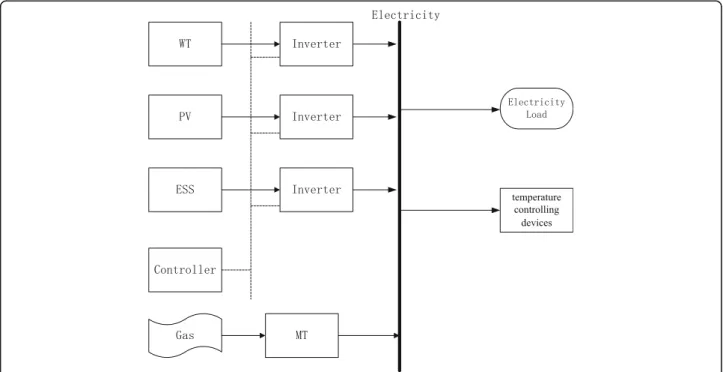
Common community microgrid generally includes renewable energy power generation equipment (e.g. wind turbine (WT) and photovoltaic (PV)) and trad-itional power generator sets (e.g. micro-gas turbine (MT)). Besides, it also has energy storage systems (ESS) to smooth renewable energy outputs. WT, PV and energy storage battery are controlled by the micro-grid control unit. There are different types of loads connected to the microgrid. Due to large numbers of residential users in community microgrid, temperature controlling load accounts for a significant proportion. Structure of a typical community microgrid incorpor-ating temperature controlling devices is shown in Fig. 1. The microgrid studied in this paper only has one type of renewable energy power generation equip-ment (i.e. WT).
2.2 WT output model
For distributed renewable energy generations, wind power technology is the most mature and widely used one. Due to the intermittence, randomness and in-stability of wind energy, WT output is influenced by meteorological factors, such as wind speed. However, the relationship between WT output and wind speed is not a simple linear one. According to many re-searches, WT output is related to terrain, wake effect and wind power output loss. To simplify WT output, existing studies have revealed that it is closely related to the actual wind speed of the moment. Through analyzing wind speed and WT output, it was found that WT output can be determined by the cut-in wind speed, cut-out wind speed and rated wind speed.
The relationship between WT output power and wind speed can be expressed approximately as a piecewise function [17] and a typical WT output power curve is shown in Fig. 2.
According to [17], the relationship between WT out-put power (Pwt) and wind speed (v) can be approximated as:
Pwt ¼
0 0 ≤vt≤vci
P vð Þ vci<vt ≤vr
Pwr vr<vt <vco
0 vt ≥ vco 8
> < >
: ð1Þ
where vci and vco are the cut-in and cut-out wind
speeds, respectively.vris the rated wind speed and Pwr is the rated WT output power. When the wind speed is between vci and vr, the WT output power P(v) can
be approximated as an linear function of the wind speed:
P vð Þ ¼Pwr ðvt−vciÞ vr−vci
ð Þ ð2Þ
2.3 MT output model
MT is a widely used distributed power generation equip-ment. It generates electricity using high-quality heat en-ergy produced by combustion of natural gas. Compared to other distributed power generator sets that consume traditional energy sources, MT has higher energy utilization and fewer pollutant emissions. The output power of MT can be expressed as [10]:
PMTð Þ ¼t GMTð Þt ηeq ð3Þ
where PMT(t) and GMT(t) are the generated output and
natural gas consumption of MT during the momentt;q
is the heat value of natural gas; ηeis the generating
effi-ciency of MT during the momentt.
The fuel cost of MT during the momentt(CMT(t)) is:
CMTð Þ ¼t CCH4⋅GMTð Þt ð4Þ
whereCCH4is the price of natural gas.
2.4 Charge–discharge model of the energy storage system
With increasing renewable energy sources (e.g. WT and PV) connected to the microgrid, energy storage unit which can effectively smooth renewable energy sources output and ensure reliable operation of the microgrid has become an important component. When there is renew-able energy output surplus, the energy storage unit can store surplus energy to reduce wind and PV curtailment. When there is insufficient power supply, the energy stor-age unit can provide stable power output to the loads.
Energy storage can generally be divided into physical en-ergy storage and chemical enen-ergy storage. Typical physical energy storage includes pumped storage, superconducting energy storage and flywheel energy storage, whereas typ-ical chemtyp-ical energy storage includes accumulator energy storage and capacitor energy storage.
Among the different energy storages, accumulator is superior to others and has been extensively used because of its low cost, stable performance, long service life and deep charge–discharge operations. During microgrid op-eration, state of charge (SOC) of the energy storage sys-tem can be expressed as follows [18].
At charging stage:
Socðtþ1Þ ¼Socð Þ þt P c
tηcΔt Cbat
ð5Þ
At discharging stage:
Socðtþ1Þ ¼Socð Þt −P d
tΔt=ηd
Cbat ð
6Þ
where Soc(t+ 1) and Soc(t) are the SOC of the lead-acid
battery at t+ 1 and t, respectively; Pct and Pdt are the charge and discharge power of the lead-acid battery att;
ηcandηdare the charging and discharging efficiencies of
the lead-acid battery; Δt is the simulation time interval (1 h in this paper); and Cbat is the capacity of the
lead-acid battery.
3 Simulation model of typical temperature controlling devices
3.1 Equivalent model of temperature controlling devices
Community microgrid has to consider simultaneous supply of electricity and heat (temperature controlled). Typical temperature controlling devices have heat storage capacity, such as heat pump, air conditioner, water heater, etc.
In this paper, heat pump is chosen as the typical temperature controlling device. From the perspective of increasing absorption of clean energy sources, energy storage system and heat pump both store surplus energy and have similar functions. With respect to implementa-tion, energy storage systems store surplus renewable power directly, while heat pump transforms surplus re-newable power into heat energy.
Generally speaking, electricity storage has high cost and its service life can be shortened during the charge– discharge process. In contrast, heat pump has good economic benefits due to its lower investment and main-tenance cost, though with higher energy consumption. Moreover, it is equipped with temperature adjustment that can adjust the total electrical load in the microgrid.
In western developed countries, temperature control-ling devices like heating, ventilation and air conditioning (HVAC) system, water heater and refrigerator make
great proportions of the total load. They have good en-ergy storage characteristics and potentially can replace some energy storage devices in the microgrid [19].
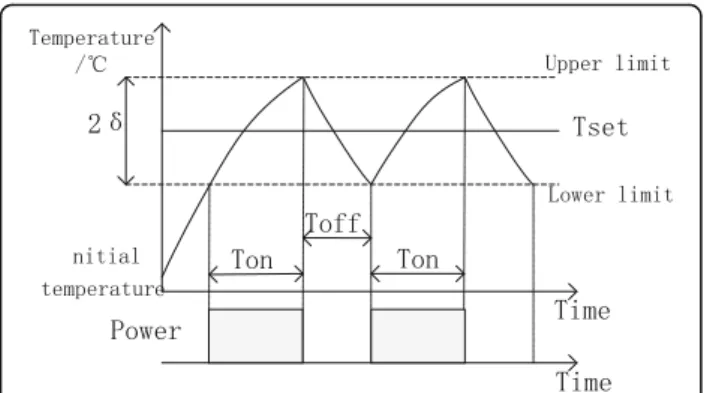
According to the first principle of thermodynamics, a thermal dynamic equation (ETP) model can be established for residential energy consumption, which has been used to some extent. The equivalent electric circuit of the ETP model of a typical residential HVAC system [20] is shown in Fig. 3 and its thermal behavior is shown in Fig. 4.
In Figs. 3 and 4,CaandCmare the specific heat capacity
of air and solids (J/°C), respectively;Qis the thermal power
of the HVAC system (W);UAis the standby thermal loss
coefficient (W/°C);R1equals to 1/UA and R2equals to 1/
UAmass;To,TiandTmare the ambient temperature, indoor
air temperature and the temperature of indoor solid matters (°C), respectively.
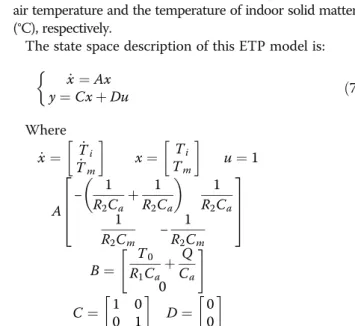
The state space description of this ETP model is:
_
x¼Ax y¼CxþDu
ð7Þ
Where
_
x¼ T__i Tm
x¼ TTi
m
u¼1
A
− 1
R2Ca
þ 1
R2Ca
1 R2Ca
1 R2Cm −
1 R2Cm 2 6 6 4 3 7 7 5 B¼ T0 R1Ca
þ Q
Ca
0
" #
C¼ 10 01
D¼ 00
Based on [20], Reference [21] simplified this ETP model into a first-order differential equation suitable for
engineering analysis. For the heat pump used in this paper, when it is off,
Troomtþ1¼Totþ1−Totþ1−Ttroome−Δt=RC ð8Þ
When it is on,
Troomtþ1¼Totþ1
þQR−Totþ1þQR−Ttroome−Δt=RC ð9Þ
whereTroomis the indoor temperature (°C); CandRare
the equivalent thermal capacitance (J/°C) and thermal
resistance (°C/W), respectively; Q is the thermal power
(W);Tois the outdoor ambient temperature (°C);tis the
simulation time andΔtis the simulation step size. This ETP model keeps the main characteristics of the thermodynamic changes of the heat pump. When temperature exceeds the given upper and lower limits, the heat pump is started and begins to consume power to adjust the temperature changes, transforming electric energy into heat energy. When temperature is within the upper and lower limits, the heat pump is turned off and temperature changes naturally. This paper also employs this simplified ETP model as the simulation model of temperature controlling devices.
3.2 Operation strategy of microgrid incorporating temperature controlling devices
Community microgrid generally has strict demand of power load, but less strict requirement on temperature comfort. Therefore, temperature controlling devices in community microgrid have certain schedulability. The proposed operation strategies for community microgrid incorporating temperature controlling devices based on
the temperature adjustment characteristics of
temperature controlling devices is shown as follow:
①Satisfy demands for general power load in the
operation period.
②Judge whether indoor temperature in this operation
period is within the adjustment range. If yes, do not start the temperature controlling devices; otherwise, turn on the temperature controlling devices. These temperature controlling devices are under
centralized control and indoor temperature is determined according to ambient temperature and the simulation model. Finally, power load in the community microgrid during the operation period is determined.
③Micro-sources scheduling is adjusted according to
optimized time series load power. Renewable energy power generation is used firstly, and is followed by traditional generator sets.
4 Optimal economic operation model of
community microgrid incorporating temperature controlling devices
4.1 Objective function
Based on the performance features of microgrid incorp-orating temperature controlling devices, the objective function of the model is established, which covers sev-eral economic objective functions including MT operat-ing cost, unit start-stop cost, depletion expense of energy storage system and penalty for wind curtailment:
minF¼CfuelþCopþCwc þCbat
¼XT
t¼1
Emtð Þt ⋅ffuelþfopð Þ þt Ewcð Þt ⋅fwc
þCbat
ð10Þ
where F is the total operation cost in the scheduling
period;Cfuel,CopandCwcare the fuel cost, MT start-stop
cost and wind curtailment cost in the scheduling period, respectively; Cbat is the depletion expense of the energy
storage system; Emt(t) and Ewc(t) are the fuel
consump-tion and wind curtailment at t, respectively; ffuel is the
unit fuel cost and fwcthe unit penalty for wind
curtail-ment; fop(t) is the MT start-stop cost at t. These costs
can be calculated from (11–14):
Cfuel¼Emtð Þt ⋅ffuel¼ffuel
Ptmt
ηeq Δt ð11Þ
Cop¼ XT
t¼1
fopð Þ ¼t XT
t¼1
max 0f ;x tð Þ−x tð−1Þg
⋅ βnþγn 1−e −t 0
n;t=σn
ð Þ
ð12Þ
where Ptmtis the generated output of MT at t; ηeis the
efficiency of MT andq the heat value of natural gas;x(t) is the state variable of MT: x(t) =1 means turn on the MT andx(t) =0 means turn off the MT;βn,γn,σnare the
coefficients of the turn-on cost of the MT;t0n;t is the out-age time of the MT beforet.
Cwc¼ XT
t¼1
Ewcð Þt ⋅fwc¼ XT
t¼1
fwc⋅ Pwt−Pwat
Δt ð13Þ
Cbat¼ XNT
k¼0 Ein
Nk
ð14Þ
wherePw
t is the WT generated output, which can be
cal-culated from the WT output model according to the forecasted wind speed; Ptwa is the available WT output
for the microgrid; NT is the charge–discharge cycles of
the energy storage system in the scheduling period, and
Nk the maximum charge–discharge cycles of the
lead-acid battery [9]; Ein is the investment of energy storage
devices in the microgrid.
4.2 Model constraints
The microgrid incorporating temperature controlling devices mainly has to meet power load balance during the operation.
①Power load balance:
PwtþPmtþPdisess−Pchess¼PlþPhp ð15Þ
where Pwt and Pmt are the WT and MT output power,
respectively; Pdis
ess and Pchess are the discharge and charge power of the energy storage system, respectively; Pl is
the general power load in the microgrid and Php the
demanded power of the heat pump.
②Allowed temperature adjustment range:
Tset−δ≤Tt≤Tsetþδ ð16Þ
whereTset is the set temperature and δthe temperature
adjustment range after temperature comfort of users be-ing taken into account.
③Constraint of MT output:
Pminmt ≤Pmt≤Pmaxmt ð17Þ
wherePmin
mt is the allowed minimum output when MT is
turned on and Pmaxmt the allowed maximum output when
MT is turned off.
④Constraint of heat pump output
Pminhp ≤Php≤Pmh ð18Þ
where Pminhp and Pmaxhp are the allowed minimum and
maximum power when the heat pump is turned on.
⑤Constraint of the energy storage system
Depth of charge and discharge of the energy storage system has far-reaching influence on its service life. To prevent over-charge and over-discharge of the energy storage system, the SOC constraint is:
Socmin≤Soc tð Þ≤Socmax ð19Þ
where Socmin and Socmax are the minimum and
max-imum SOC of the energy storage system, respectively. Constraint of charge and discharge power of the en-ergy storage system is:
Pchess;min≤Pchess≤Pchess;max ð20Þ
Pdisess;min≤Pdisess≤Pdisess;max ð21Þ
Both large power grid and microgrid have periodic scheduling. Generally speaking, SOC of the energy stor-age system at the beginning and end of the scheduling period shall be the same, i.e.:
Socð Þ ¼1 Soc Tð Þ ¼Socinitial ð22Þ
whereSoc(1) andSoc(T) are the SOC of the energy stor-age system at the beginning and end of scheduling period respectively.Socinitialis the set SOC of the energy
storage system at the initial scheduling period.
5 Solving method of the model
5.1 Principle of HPSO algorithm
Traditional PSO algorithm has been improved in existing researches and a hybrid particle swarm optimization (HPSO) algorithm was proposed [22]. To enrich diversity of particles, crossing and mutation operations in genetic algorithm have been introduced into qualified particles, which avoids local optimal convergence and increases the success rate of searching the optimal solution.
The crossing operation is to cross two individuals and updates individuals again to get particles out of the local optimal region and expand the search region. In this paper, updating of particle positions and speeds are:
X01 ¼X1⋅randþX2⋅ð1−randÞ
X02 ¼X2⋅randþX1⋅ð1−randÞ (
ð23Þ
V01¼
V1þV2 V1
j j þjV2j V1
j j
V02¼
V1þV2 V1
j j þjV2j V2
j j 8 > > < > >
: ð24Þ
where X1 andX2 are the positions of parent particles; X
0
1 and X02 are the positions of offspring particles after the crossing operation;randis a random number between [0,1];
V1andV2are the speeds of parent particles;V
0 1 andV
0 2 are
5.2 Steps of the solving method based on HPSO algorithm
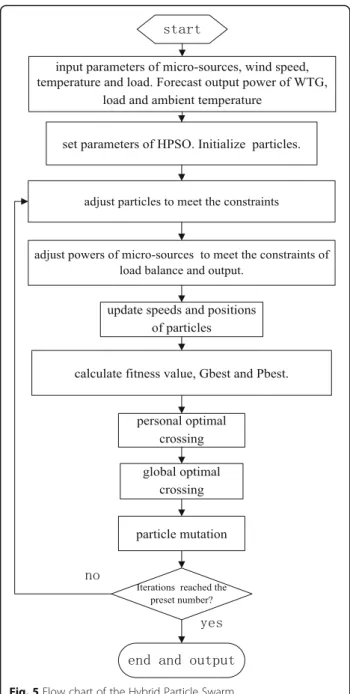
The established optimal economic operation model of community microgrid incorporating temperature con-trolling devices is solved by HPSO algorithm with the following specific steps:
Step1: input parameters of the micro-sources, wind speed, temperature and load. Forecast output power of WT, load and ambient temperature.
Step2: set parameters of HPSO. Initialize the position and speed of particles, and produce the initial particle swarm.
Step3: according to the generated outputs and loads of the micro-sources, adjust the micro-source power and the energy storage system to meet the constraints of load balance and output.
Step4: calculate fitness value. The above objective
function is used as the fitness value:fitness=F.
Step5: update the speeds and positions of particles. Meanwhile, the optimal personal particle and optimal global particle are updated according to the calculated fitness value.
Step6: implement the crossing and mutation
operations. New particle of personal optimal crossing is gained through crossing of the personal best particles. New particle of global optimal crossing is gained through crossing of the personal best particles and global best particles. Particle mutation refers to getting new particles through mutation by
themselves.
Step7: judge whether iterations have reached the preset number. If not, turn to step 3; otherwise, turn to step 8. Step 8: end the cyclical iteration and output the global optimum and the optimal particle position. These are the optimal economic cost and outputs of the micro-sources and the energy storage system during the scheduling period.
The flow chart of this HPSO algorithm is shown in Fig. 5.
6 Case study
6.1 Brief introduction to the example
The case study is implemented based on an isolated community microgrid incorporating temperature con-trolling devices. This microgrid has MT, WT, energy storage device and heat pump. Parameters of these
Fig. 5Flow chart of the Hybrid Particle Swarm Optimization algorithm
Table 1Data of the Micro turbines
Type Power(kW) Amount
up down
MT1 20 70 1
MT2 10 50 1
Table 2Data of the WT
Type Power (kW) vci vco vr Amount
up down (m/s) (m/s) (m/s) (m/s)
WT 0 30 3 25 15 2
Table 3Parameters of the heat pumps
Type Pmax(kW) Pmin(kW) Pr(kW) Amount
equipment are listed in Tables 1, 2, 3, 4, respectively. Generating efficiencies of MT1 and MT2 are 0.9 and 0.8 respectively. Heat value and price of the natural gas are set at 37 MJ/m3and 0.4$/m3, respectively.βn, γnand σn
of MT1 are 5, 7 and 1, while those of MT2 are 10, 8 and 1, respectively. Penalty for unit wind curtailment in the microgrid is 2$/kW∙h. Parameters related to the calcula-tion of energy storage loss are introduced as in [9]. SOCinitial of the energy storage device is 48kWh. In the
simulation model of the temperature controlling devices, R = 0.1208 °C/W, C = 3599.3 J/W and Q = 300 W.
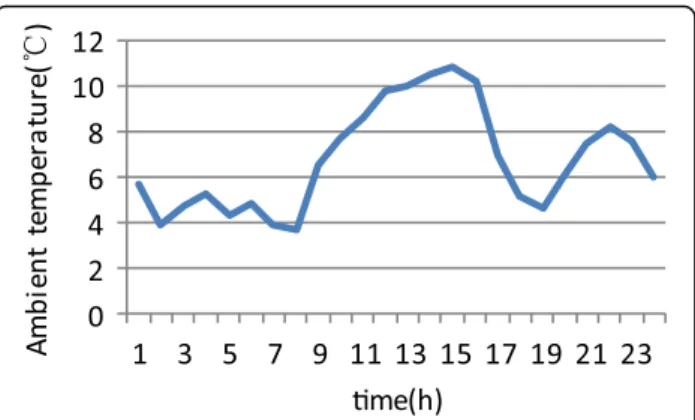
Forecasted results of wind power, load and ambient temperature in the coming 24 h of the scheduling period are exhibited in Figs. 6 and 7. For simplicity, their fore-casting errors are neglected when solving the established model.
6.2 Example analysis
①Optimal economic operation of the microgrid without
temperature adjustment
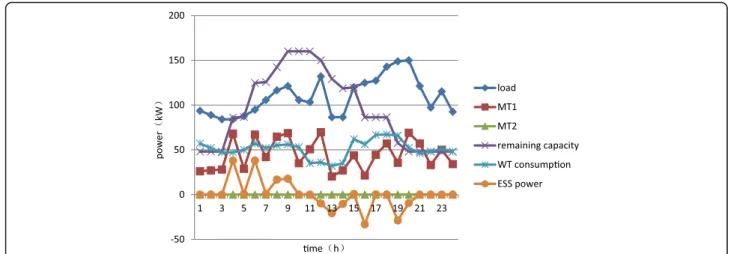
Based on the established optimal economic operation model of the microgrid, outputs of the micro-sources in the microgrid in the coming 24 h are optimized accord-ing to forecasted load, wind power and ambient temperature. The optimal power generation scheduling without temperature adjustment is shown in Fig. 8. The total system operating cost in the scheduling period is calculated as 926.715$.
It can be seen from Fig. 8 that:
1) Based on known parameters, MT1 has large output power, low start-stop cost and fuel cost, and high
generation efficiency. It is thus mainly used to undertake basic load and remains operational in the 24 h period.
2) It is known from Table 1 that MT2 has small output power, high start-stop cost and fuel cost, and low gener-ation efficiency. It is thus used as a reserve set and is off during the whole studying period.
3) In the study, renewable energy power generation (e.g. WT) is used first. The use of temperature control-ling devices increases renewable energy consumption without wind curtailment.
4) The lead-acid battery is charged from 3:00–7:00
when there’s low load and discharged from 20:00–22:00 when the load is high.
5) Service life of the lead-acid batter is closely related to the depth of charge and discharge. Figure 8 shows that the energy storage system charges and discharges frequently in the coming 24 h, indicating a significant loss of energy storage system life.
② Optimal economic operation of the microgrid with
temperature adjustment
Incorporated temperature controlling devices (e.g. heat pump) need adequately participate in demand response. At the same time, the allowed temperature adjustment range is set at ±2 °C and the load curve in the scheduling period is optimized considering user comfort. The optimal power generation scheduling of the microgrid with temperature adjustment is presented in Fig. 9. The total system operat-ing cost in the scheduloperat-ing period is 846.701$.
From Fig. 9, it can be seen that:
1) MT1 is mainly used to undertake basic load and keeps running in the scheduling period. However, the overall output decreases and becomes more stable in the scheduling period compared to that without temperature adjustment.
2) Similar to previous case, MT2 is used as a reserve set and remains off during the studying period. 3) Renewable energy power generation (e.g. WT) is
used first. The use of temperature controlling
Fig. 6Load and wind power forecasting curve
Fig. 7Ambient temperature forecasting curve Table 4Data of the battery
Type Power(kW) Soc min (kWh)
Soc max (kWh)
ηc ηd Pch-max Pdis-max
devices increases renewable energy consumption, and wind energy can be fully absorbed in the microgrid.
4) The lead-acid battery is charged from 3:00–5:00
dur-ing low load and discharged from 19:00–23:00
dur-ing high load.
5) Time series load in the coming 24 h is optimized according to the temperature control characteristics, leading to few charges and discharges, small power
and depth of charge–discharge of the energy storage
system.
Comparing Figs. 8 and 9, the case with temperature adjustment of temperature controlling devices achieves 8.63% lower system operating cost than that without
temperature adjustment. Moreover, the charge–
dis-charge cycles of lead-acid battery decrease from 10 to 7 when temperature adjustment is enabled and the
depth of charge–discharge also decreases, leading to
increased service life of the energy storage system.
③Effect of the allowed temperature adjustment range
on operating cost
The operating costs of the microgrid without and with different temperature adjustment ranges (±1 ° C ~ ±4 °C) are analyzed. During the study, other parameters are fixed and the results are shown in Fig. 10.
It can be known from Fig. 10 that increasing the
allowed temperature adjustment range of the
temperature controlling devices gradually decreases the operating costs in the scheduling period.This indicates that reasonable scheduling of temperature controlling devices can improve the economic efficiency of the microgrid.
④Analysis of adjusted temperature of the temperature
controlling devices
Adjusting the temperature of the temperature control-ling devices can not only indirectly control the loads of the community microgrid, but also satisfy the comfort of residential users. The comparison between ambient
Fig. 8Optimal power generation scheduling of microgrid without temperature adjustmen
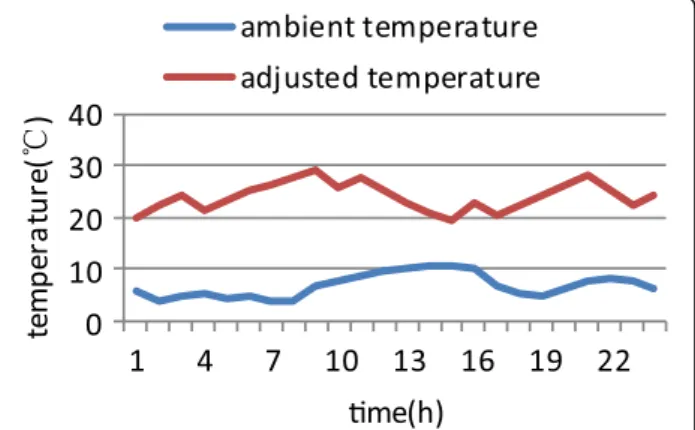
temperature and adjusted temperature without temperature adjustment is shown in Fig. 11. With temperature adjustment, the temperature controlling de-vices will switch between on and off when the adjusted temperature exceeds the limits, making the adjusted temperature change in up-down-up manner. Comparison
of the ambient and adjusted temperatures with
temperature adjustment is shown in Fig. 12.
It can be observed from Fig. 11 that without temperature adjustment, the adjusted temperature increases continu-ously until reaching the peak and then becomes stable. The average adjusted indoor temperature in the coming 24 h reaches as high as 32.4 °C which well exceeds the comfort of residential users. In contrast, Fig. 12 shows that with temperature adjustment, the indoor temperature is within users’comfort level, averaging at 24.4 °C.
7 Conclusions
This paper optimizes the time series output of temperature controlling devices through temperature adjustment by
combining the dynamic variation law of adjusted
temperature and power consumption, thus indirectly adjusting power load. An optimal economic operation model of microgrid is established, which takes the
minimum sum of fuel cost, start-stop cost, penalty for wind curtailment and cost of energy storage loss as the objective function. The model is solved by HPSO algorithm which is easy-to-operate, has high accuracy, and overcomes local optimum. An isolated community microgrid with heat pump is used in the case study and the heat pump properly participates in microgrid scheduling according to the temperature adjustment characteristics. The results show that temperature adjustment of temperature controlling de-vices can not only improve the economic efficiency of the microgrid, but also reduce charge–discharge cycles of the energy storage system and increase microgrid schedulabil-ity. In practical engineering applications, temperature con-trolling devices can adopt more complicated control strategies and realize minute-based scheduling of the microgrid which will be the key content of our future research.
Acknowledgements
This work was supported in part by the National Natural Science Foundation of China under Grant 51677011.
Authors’contributions
BH carried out the model of the optimal economic of community microgrid incorporating temperature controlling devices and participated in the design of the study. HW participated in the design of the study, statistical analysis and drafting the manuscript. SY participated in the design of the study, statistical analysis. All authors read and approved the final manuscript.
Competing interests
The authors declare that they have no competing interests.
Received: 24 August 2016 Accepted: 7 February 2017
Reference
1. Lu, Z., Wang, C., Mim, Y., Zhou, S., Lv, J., & Wang, Y. (2007). On the Research of Microgrid[J].Automation of Electric Power Systems, 31(19), 100–107. 2. ISC Committee. (2003).IEEE standard for interconnecting distributed
resources with electric power systems[J]. New York: Institute of Electrical and Electronics Engineers.
3. Lasseter R, Akhil A, Marnay C, et al. The CERTS microgrid concept[J]. White paper for Transmission Reliability Program, Office of Power Technologies, US Department of Energy, 2002, 2(3):30. http://pserc.wisc.edu/documents/
Fig. 10Influence of Temperature adjustment ranges on the economy of microgrid
Fig. 11The comparison of ambient temperature and adjusted temperature without temperature adjustment
research_documents/certs_documents/certs_publications/certs_microgrid/ certsmicrogridwhitepaper.pdf
4. Lasseter R H, Paigi P. Microgrid: a conceptual solution[C]//Power Electronics Specialists Conference, 2004. PESC 04. 2004 IEEE 35th Annual. IEEE, 2004, 6: 4285–4290
5. Su, L., Zhang, J., Wang, L., Miao, W., & Wu, Z. (2010). Study on some key problems and technique related to microgrid [J].Power System Protection and Control, 38(19), 235–239.
6. Jin, P., Ai, X., & Xu, J. (2012). An Economic Operation Model for Isolated Microgrid Based on Sequence Operation Theory [J].Proceedings of the CSEE, 32(25), 52–59.
7. Xu Lizhong, Yang Guangya, Xu. Zhao, E. Al. Combined scheduling of electricity and heat in a microgrid with volatile wind power[J]. Automation of Electric Power Systems, 2011, 35(9): 53–60
8. Niknam, T., Meymand, H. Z., & Mojarrad, H. D. (2011). A practical multi-objective PSO algorithm for optimal operation management of distribution network with regard to fuel cell power plants[J].Renewable Energy, 36(5), 1529–1544. 9. Shen, Y., Hu, B., Xie, K., Xiang, B., & Wan, L. (2014). Optimal Economic
Operation of Isolated Microgrid Considering Battery Life Loss [J].Power System Technology, 38(09), 2371–2378.
10. Li, Z., Zhang, F., Liang, J., Yun, Z., & Zhang, J. (2015). Optimization on Microgrid With Combined Heat and Power System [J].Proceedings of the CSEE, 35(14), 3569–3576.
11. Chen, J., Yang, X., Zhu, L., Zhang, M., & Li, Z. (2013). Microgrid Multi-objective Economic Dispatch Optimization [J].Proceedings of the CSEE, 33(19), 57–66. 12. Peng, C., Xie, P., Zhan, J., & Sun, H. (2014). Robust Economic Dispatch of Microgrid Using Improved Bacterial Foraging Algorithm [J].Power System Technology, 38(09), 2392–2398.
13. Wu, X., Wang, X., Wang, J., & Bie, Z. (2013). Economic Generation Scheduling of a Microgrid using Mixed integer programming [J].Proceedings of the CSEE, 33(28), 1–9.
14. Wang, R., Gu, W., & Wu, Z. (2011). Economic and Optimal Operation of a Combined Heat and Power Microgrid with Renewable Energy Resources[J]. Automation of Electric Power Systems, 35(08), 22–27.
15. Gu, W., Wu, Z., Bo, R., et al. (2014). Modeling, planning and optimal energy management of combined cooling, heating and power microgrid: A review[J]. International Journal of Electrical Power & Energy Systems, 54(1), 26–37. 16. Wu, X., Wang, X., Bie, Z., & Wang, J. (2013). Economic operation of microgrid
with combined heat and power system[J].Electric Power Automation Equipment, 33(08), 1–6.
17. Zhang, J., Cheng, H., Hu, Z., Ma, Z., Zhang, J., & Yao, L. (2009). Power System Probabilistic Production Simulation Including Wind Farms [J].Proceedings of the CSEE, 29(28), 34–39.
18. Guo, Y., Hu, B., Wan, L., Xie, K., Yang, H., & Shen, Y. (2015). Short-term Economic Scheduling of CHP Microgrid Incorporating Heat Pump [J]. Automation of Electric Power Systems, 39(14), 16–22.
19. Callaway, D. S., & Hiskens, I. A. (2011). Achieving controllability of electric loads[J].Proceedings of the IEEE, 99(1), 184–199.
20. Katipamula S, L. N. Evaluation of residential HVAC control strategies for demand response programs[J]. Transactions-american society of heating refrigerating and air conditioning engineers, 2006, 112(1): 535.
21. Lu, N. (2012). An evaluation of the HVAC load potential for providing load balancing service[J].IEEE Transactions On Smart Grid, 3(3), 1263–1270. 22. Kou, B., Yang, T., Zhang, X., Zhang, Q., Liu, W., & Ge, J. (2007). A New Hybrid
Particle Swarm Optimization Based on Crossover and Mutation [J.Computer Engineering and Applications, 43(17), 85–88.
Submit your manuscript to a
journal and benefi t from:
7Convenient online submission
7Rigorous peer review
7Immediate publication on acceptance
7Open access: articles freely available online
7High visibility within the fi eld
7Retaining the copyright to your article