AUSTRALIAN JOURNAL OF BASIC AND
APPLIED SCIENCES
ISSN:1991-8178 EISSN: 2309-8414 Journal home page: www.ajbasweb.com
Open Access Journal
Published BY AENSI Publication
© 2016 AENSI Publisher All rights reserved
This work is licensed under the Creative Commons Attribution International License (CC BY).
http://creativecommons.org/licenses/by/4.0/
To Cite This Article: R. Sittalatchoumy, R. Kanthavel and R. Seetharaman., Power Cluster: an Efficient Clustering MAC Protocol for RF Rechargeable Wireless Sensor Networks. Aust. J. Basic & Appl. Sci., 10(1): 619-624, 2016
Power Cluster: an Efficient Clustering MAC Protocol for RF Rechargeable
Wireless Sensor Networks
1R. Sittalatchoumy, 2R. Kanthavel and 3R. Seetharaman
1.3 Department of Electronics and CommunicationEngineering, Anna University, India
2 Department of Electronics and CommunicationEngineering, Velammal Engineering College, India.
Address For Correspondence:
R. Sittalatchoumy, 1.3 Department of Electronics and Communication Engineering, Anna University, India E-mail:[email protected]
A R T I C L E I N F O A B S T R A C T Article history:
Received 12 February 2016 Accepted 12 March 2016 Available online 20 March 2016
Keywords:
Cluster, MAC Protocol, RF energy, Wireless energy harvesting, WSN.
Recharging a sensor node by using energy harvesting techniques is increasingly gaining importance in recent trends. One popular method of energy harvesting is the use of RF waves to increase the battery lifetime of the sensor node. The use of dedicated RF energy for energy harvesting requires commercial off the shelf products making the cost of the network feasible. However, the energy transfer occurs in the data communication band thereby requiring an efficient protocol to share the medium appropriately. We propose a clustered approach to solve the issue of compromise between energy and data transfer. By extensive simulations, we show that the proposed protocol optimizes the energy harvested by each sensor node while causing minimum interruption to data communication.
INTRODUCTION
power to its cluster dominator using PowerRequest (PR) signal. The nodes in the vicinity of the requesting node also go into recharging mode when the dominator provides RF energy.
The main contributions of our work are as follows
A novel approach for clustering of nodes for RF power transfer.
A time schedule is identified to separate RF power transfer and data transfer
Fig. 1: Network Architecture.
The rest of the paper is organized as follows. Section 2 briefs the related work is provided. In Section 3, the set up model of the Wireless sensor network considered is described. Section 4 provides the overview of the proposed protocol. Section 5 explains the MAC framework in detail followed by performance analysis in Section 6. Section 7 concludes our work.
II. Related Work:
In (Naderi, M.Y., 2014), the authors proposed a distributed MAC protocol for RF energy harvesting sensors using in-band energy and data transfer. However, the protocol does not solve the issue of idle listening and provides energy access priority over data causing critical data communication to be disrupted. In the authors proposed a centralized MAC protocol for WSN with RF energy harvesting. In this approach the node adopts a duty cycle based on the energy harvested by it. This protocol requires global synchronization and uses out of band energy transfer. In (Watfa, M.K., 2011), authors present concept for multi hop wireless energy transfer and derive the efficiency of the same. This method however has a disadvantage that it requires magnetic coupled resonators with perfectly aligned coils among the transmitter and receiver. In (Chen, L., 2014), a token MAC protocol system is detailed which provides fair access to the medium for all tags but this system is not capable to generate enough energy for a typical sensor node. The authors in (Curty, J.P., 2006) presented RFID technology in which the RFID tag operates by using the energy from the RF Power incident on it from the transmitter. (Iannello, F., 2012) discussed the design of and analysis of MAC protocols of sensor networks which are recharged by using ambient energy harvesting.
III. Setup Model:
The network consists of dominator nodes and sensor nodes. The dominator nodes are assumed to have no power constraints and can easily charge up the sensor nodes in its power cluster. Sensor nodes in network are provided with the RF energy harvesting circuit and a super capacitor. The dominator nodes provide RF Power to the normal sensor nodes which in turn charges the super capacitor. The sensor node uses its residual energy for the operations like sensing, computing, packet transmission and reception, which is powered again the recharging mode.
IV. Overview of the Protocol:
The protocol consists of two phases, the initial start-up phase and the steady state phase.
4.1. Initial Start-up Phase:
The initial phase consists of power cluster formation and is identified by advertisement phase and setup phase.
4.1.1. Advertisement phase:
4.1.2. Setup phase:
The dominator on receiving interest from the nodes to form a power cluster comes up with the schedule for the nodes to aid in transmission and reception. This schedule is published to the cluster nodes.
4.2. Steady state phase:
After the completion of initial start-up phase each dominator is aware of the set of nodes to which it should service energy. The node also identifies its cluster dominator and the amount of time required for it to completely recharge. The steady state phase consists of a set of periodically repeating cycle of active mode followed by a sleep mode. Each period consists of an active duration and sleep duration. The active duration follows slotted CSMA during which data transmission occurs. In the sleep duration, the sensor nodes switch their radio off. During the sleep mode, the node can request for RF power to its cluster dominator by sending a Power Request (PR) signal by indicating its charging period as computed in Section 5.1.1 .
V. Detailed Protocol Description:
The protocol operation can be explained by two phases; initial start-up phase and the steady state phase
5.1. Initial Start-Up Phase:
In the initial start-up phase, the power clusters are formed. Each dominator node identifies a group of nodes it grants Power Request’s. The initial start-up phase comprises of Advertisement phase and setup phase
5.1.1. Advertisement Phase:
This phase is detailed by the following set of operations. Every dominator node is provided a time slot for it to send a beacon signal. All nodes listen to the beacon signals and identify the dominator with the highest RSSI (i.e., the dominator which is the nearest to them). The equation is computed from the energy of the capacitor as
(1)
In our case ~ 2V and = 3.3 V which are the minimum and maximum operating voltage
for Mica2 mote. Thus the value of is computed by
= 2C (2)
(3)
where C is the capacitance of the capacitor , is the power received in the beacon signal and is the
duration of the beacon signal.
The recharging duration of the node is computed as
(4)
The dominator beacon which causes the minimum value of is chosen as the cluster dominator.
5.1.2. Setup Phase:
In the setup phase, the nodes indicate the interest of forming a power cluster to the chosen dominator node in the advertisement phase. The dominator node accepts the interest from the nodes. It estimates a cycle schedule for the cluster nodes. Every cycle consists of a beacon signal from the dominator followed by an active mode and a sleep mode. The beacon signal is of the duration 15 µs. The duration of active mode and sleep mode is decided by the cluster dominator node based on the number of cluster sensor nodes. The active duration
and the sleep duration are computed similar to the IEEE 802.15.4 standards [8] by
= x 15.38 ms (5)
= x 15.38 ms (6)
where 0 ≤ ≤ M ; 0 ≤ ≤
This schedule is published to the cluster members by the cluster dominator.
5.2. Steady State Phase:
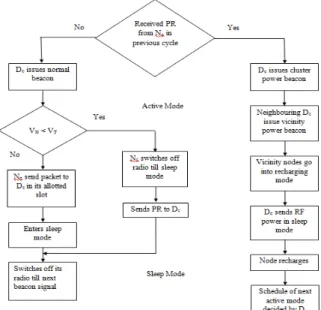
transmission by slotted CSMA using the allotted code. The DIFS duration for the slotted CSMA is 320 µs similar to the IEEE 802.15.4 standards (Howitt, I., J. Gutierrez, 2003). When the node has no packet for transmission it waits for any other node to receive a packet in the active period. In the sleep mode, the node switches OFF its radio and waits for the start of the next active cycle. When the node requires RF power from the cluster dominator, it switches ON the radio during the sleep mode and sends a Power Request(PR). PR signal indicates the node ID and the recharging duration . The cluster dominator receives the PR and
indicates the acceptance by sending a cluster power beacon indicating a RF Power cycle. The cluster power beacon contains information about the node ID which requested the RF Power transfer along with the duration of RF Power transfer and the time of the start of the RF Power transfer. Usually the RF Power transfer takes place in the sleep mode of the power cluster. If there are no PRs received by the cluster dominator, the dominator sends a normal beacon to signal the start of the next cycle. On sensing a power beacon, the neighbouring dominators transmit a vicinity power beacon signal which informs the nodes about the time of RF power transmission. The nodes in the vicinity of the dominator cluster enter into recharging mode on hearing a vicinity power beacon. The dominator cluster sends RF power after the commencement of the sleep mode. The sensor nodes in the cluster as well as those nodes in the vicinity of the cluster recharge using the RF power. After the end of recharging mode, the dominator cluster sends a normal beacon signal indicating the start of the next cycle. The flow of operations is illustrated in the Figure 2.
Fig. 2: Operations in Steady state phase.
VI. Performance Analysis:
In this section, we evaluate the performance of the protocol by simulation analysis. The protocol is compared with RF-MAC, where the ET’s are treated as nodes for packet transfer in order to have a fair comparison along with a Clustered CSMA MAC protocol where the nodes form power clusters but do not have a cycle of active and sleep modes. The performance metrics are the average packet loss and the average number of PowerRequest’s per node. The average packet loss is computed by estimating the averaging the number of packets dropped against the total number of packets during the simulation. The average number of PowerRequest’s per node is found by recording the number of times a sensor node requests for RF Power and averaging the value during the simulation. The parameters of the simulation are set as follows. The energy harvesting circuit parameters are based on (Nintanavongsa, P., 2012). The operational characteristics of the sensor are modelled on Mica2 mote specifications. 200 sensor nodes are uniformly deployed at random in a grid of 400 x 400 m2 area. The grid is subdivided into grids of 10 x 10 m2 area in which 40 dominators are placed at the centre of each grid. The traffic load is generated by CBR flows. Sender receiver pairs are identified randomly.
6.1 Evaluating Dominator node density:
Fig. 3: Effect of Dominator node density.
6.2. Effect of number of flows:
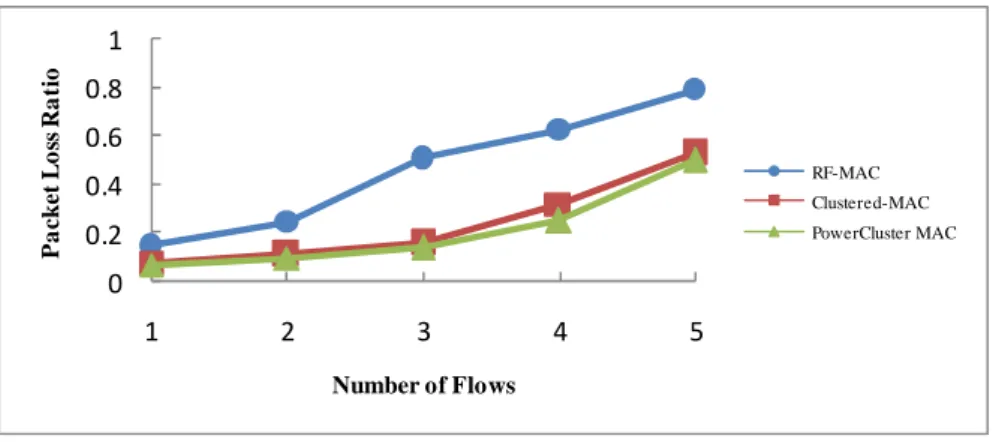
The impact of increasing the number of data flows is investigated. Figure 4shows the average packet loss when the number of data flows is varied from 1 to 5. The average packet loss is significantly less in the proposed protocol when compared to and Clustered MAC. The nodes are clustered for energy transfer to a cluster dominator causes lesser amount of RF Power interference than RF-MAC.
0 0.2 0.4 0.6 0.8 1
1 2 3 4 5
P
a
c
k
e
t
L
o
ss
R
a
ti
o
Number of Flows
RF-MAC Clustered-MAC PowerCluster MAC
Fig. 4: Effect of Number of Flows on Packet Loss Ratio.
6.3. Impact of Node Density:
We investigate the network performance by varying the number of sensor nodes from 250 to 500. The dominator nodes are increased correspondingly in the ratio of 1:4 with respect to the sensor nodes. The variation of the average packet loss with the node density is shown in Figure 5. As the node density increases, the network becomes crowded resulting in a similar packet loss for all the three MAC protocols.
0 0.05 0.1 0.15 0.2 0.25 0.3
250 300 350 400 450 500
P
a
c
k
e
t
L
o
ss
R
a
ti
o
Number of sensor nodes
RF-MAC Clustered-MAC PowerCluster MAC
Fig. 5: Effect of Node density on Packet Loss Ratio.
5 10 15 20 25 30 35 40
250 300 350 400 450 500
N
u
m
b
er
o
f
P
R
's/
N
o
d
e
Number of sensor nodes
RF-MAC Clustered-MAC PowerCluster MAC
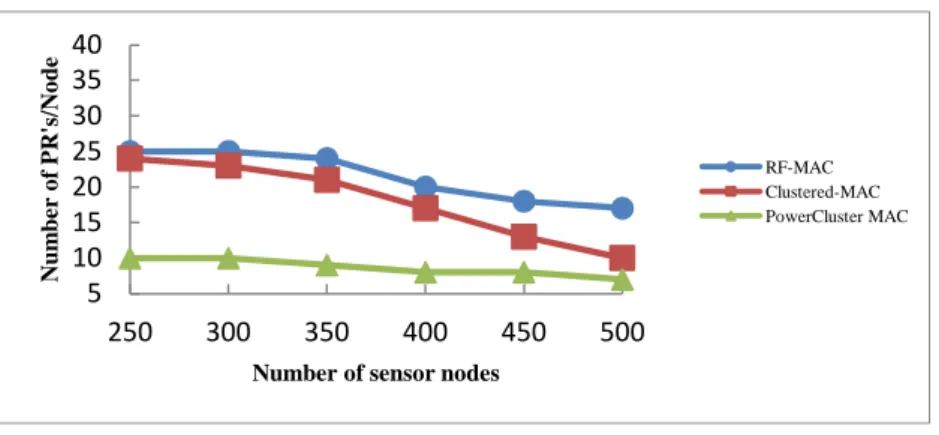
Fig. 6: Effect of node density on Number of Power Request’s.
The reason being as the nodes are closer to each other, they are able to scavenge the RF Power requested by the neighbouring nodes.
VII. Conclusion and Future Work:
In this paper, a MAC protocol is proposed for RF rechargeable WSN. The novel idea of using clustering for RF Power transfer is explored in this paper. Simulation results conclude that by using clustering for RF Power transfer, we can minimize the packet loss as well the number of Power Request’s and also maintain the network lifetime. Future work will include the effect of dealing with collisions in data as well as RF Power transfer.
REFERENCES
Eu, Z.A., H.P. Tan, W.K. Seah, 2011. Design and performance analysis of MAC schemes for wireless sensor networks powered by ambient energy harvesting. Ad Hoc Networks, 9(3): 300-323.
Kim, J., J.W. Lee, 2011. Energy adaptive MAC protocol for wireless sensor networks with RF energy transfer. In Ubiquitous and Future Networks (ICUFN), Third International Conference on (pp: 89-94). IEEE.
Naderi, M.Y., P. Nintanavongsa, K.R. Chowdhury, 2014. RF-MAC: A medium access control protocol for re-chargeable sensor networks powered by wireless energy harvesting. Wireless Communications, IEEE Transactions on, 13(7): 3926-3937.
Watfa, M.K., H. AlHassanieh, S. Selman, 2011. Multi-hop wireless energy transfer in WSNs. Communications Letters, IEEE, 15(12): 1275-1277.
Chen, L., I. Demirkol, W. Heinzelman, 2014. Token-MAC: A fair MAC protocol for passive RFID systems. Mobile Computing, IEEE Transactions on, 13(6): 1352-1365.
Curty, J.P., M. Declercq, C. Dehollain, N. Joehl, 2006. Design and optimization of passive UHF RFID systems. Springer Science & Business Media.
Iannello, F., O. Simeone, U. Spagnolini, 2012. Medium access control protocols for wireless sensor networks with energy harvesting.Communications, IEEE Transactions on, 60(5): 1381-1389.
Howitt, I., J. Gutierrez, 2003. IEEE 802.15. 4 low rate-wireless personal area network coexistence issues. In Wireless Communications and Networking, WCNC. IEEE, 3: 1481-1486. IEEE.