International Journal of Education
in Mathematics, Science and
Technology (IJEMST)
www.ijemst.com
Using Classroom Scenarios to Reveal
Mathematics Teachers’ Understanding of
Sociomathematical Norms
Ismail Ozgur Zembat1, Seyit Ali Yasa2 Mevlana (Rumi) University1
Enderun High School2
To cite this article:
Zembat, I. O. & Yasa, S. A. (2015). Using classroom scenarios to reveal mathematics
teachers’ understanding of sociomathematical norms.
International Journal of Education in
Mathematics, Science and Technology, 3
(3), 242-261.
This article may be used for research, teaching, and private study purposes.
Any substantial or systematic reproduction, redistribution, reselling, loan, sub-licensing,
systematic supply, or distribution in any form to anyone is expressly forbidden.
Authors alone are responsible for the contents of their articles. The journal owns the
copyright of the articles.
Volume 3, Number 3, July 2015, Page 242-261
ISSN: 2147-611X
Using Classroom Scenarios to Reveal Mathematics Teachers’
Understanding of Sociomathematical Norms
Ismail Ozgur Zembat1*, Seyit Ali Yasa2 1
Mevlana (Rumi) University 2Enderun High School
Abstract
The purpose of this study was to uncover the degree to which in-service teachers understand sociomathematical norms and the nature of that understanding without having to enter and observe their classes. We therefore developed five classroom scenarios exemplifying classroom interactions shaped by certain sociomathematical norms. We then administered these scenarios to in-service elementary school and grade 5-12 mathematics teachers and collected their written responses. We also collected data about what teachers believe about sociomathematical norms through a Likert-type questionnaire. We then analyzed the data using quantitative and qualitative techniques. First, the findings suggest that the teachers’ understanding of sociomathematical norms is neither dependent on the level of schools teachers teach, or their background or demographic characteristics such as number of years they spent in teaching, specialty area, faculty graduated, highest degree earned, and gender. Second, what teachers believe about sociomathematical norms seem to be not parallel to how they analyze the scenarios illustrating sociomathematical norms. Third, use of scenarios was helpful in revealing how teachers think about sociomathematical norms. Finally, there are three cross-cutting themes to which all the teachers referred in common for all sociomathematical norms: opposition (opposition to the core of the norm), social facilitator (considering all targeted norms as supporting and regulating the classroom social environment) and condition-based (believing that interactions given in scenarios are only possible under certain conditions). Key words: Sociomathematical norm understanding, In-service mathematics teacher education, Role of teaching scenarios, Testing mathematics teacher knowledge, Nature of mathematics teacher knowledge.
Introduction
The purpose of this study was to uncover the degree to which in-service teachers understand sociomathematical norms and the nature of that understanding without having to enter and observe their classes. In so doing we also aim to understand how the ways in which teachers treat sociomathematical norms differ with respect to certain demographic variables (e.g., different grade levels they teach, teaching experience, degree owned, etc.). To answer these questions, we generated classroom scenarios to identify the nature of teachers’ understanding of sociomathematical norms and the aspects of the classroom interactions teachers focus on in analyzing these scenarios. Norms can be investigated through long-term classroom observations but the purpose in this study was to identify teachers’ norm understanding without going into their classes or observing their teaching, which makes it easier to elicit and interpret their understanding of sociomathematical norms. Following such a method, we believe, would be useful in conducting effective assessment of mathematics teacher knowledge, designing useful courses to serve prospective teachers in teacher education programs, and producing practical hiring policies for administrators.
Theoretical Background, Rationale and Research Questions
Cultural and social processes are intertwined with mathematical activity (Voigt, 1995, cited in Yackel & Cobb, 1996). “The development of individuals' reasoning and sense-making processes cannot be separated from their participation in the interactive constitution of taken-as-shared mathematical meanings” (Yackel & Cobb, 1996, p.460).Therefore, learning of mathematics in classes and students’ in-class mathematical activities are integral
*
to classroom social interaction (Brandt & Tatsis, 2009; Cobb, Jaworski, & Presmeg, 1996). Classroom social interaction affects both the quality of mathematics learning and student reasoning. Based on this argument and by benefitting from such a sociological perspective on mathematical activity Cobb and his colleagues developed the construct of norms, descriptions and examples of which are given below.
Every classroom as a group operates with certain interaction and behavior patterns, which influence quality of teaching and student learning. When the focus is on the “regularities in patterns of social interaction” (Yackel & Cobb, 1996, p.460), in general, these patterns of interaction are called social norms; whereas when it is on “normative aspects of mathematics discussions specific to students' mathematical activity” (Yackel & Cobb 1996, p.461), they are called sociomathematical norms. An example for a social norm is ‘shared solutions needs to be explained,’ whereas an example for a corresponding sociomathematical norm is ‘solutions should be articulated through acceptable mathematical explanations.’ In this sense, social norms can be related to any field, whereas sociomathematical norms are specific to mathematics. Norms, whether social or sociomathematical, are negotiated among group members (the teacher and the students) and established through such a negotiation process, not through imposing (Cobb, Stephan, McClain, & Gravemeijer, 2001). As the group members participate in this negotiation process, they develop taken-as-shared understandings of “when to do what and how to do it” (Bauersfeld, 1993, p.4, cited in Yackel & Cobb, 1996) in terms of social or mathematical processes.
Norms, as regularities in behavioral patterns, are apparent in a classroom for an observer regardless of whether the students or the teacher are aware of them (Voigt, 1996). If a teacher has the necessary knowledge of classroom norms, then she/he may use it to orchestrate the student–student and student–teacher interactions (Cobb & Bauersfeld, 1995) as well as to promote students’ mathematical understandings (Yackel, Cobb, & Wood, 1991). This suggests that knowledge of norms and their effective use should be a core part of teacher knowledge, which can be considered as part of Shulman’s (1986) description of knowledge of pedagogy. Norms are also important in terms of helping students develop appropriate mathematical language, support students’ development of mathematical ideas, and design the classroom as a mathematical community that challenges students’ mathematical reasoning (Yackel & Cobb, 1996). Therefore, teachers’ understanding of classroom norms may be considered one of the factors affecting the quality of teaching in classrooms.
To further detail the importance of (sociomathematical) norms, why they should be considered as an essential part of teacher knowledge, and how they impact students’ (mathematical) understanding, we can reflect on the following scenario. Consider a classroom in which students work on a given problem such as, “what would be an ‘odd number + odd number’?” and they find their solution using the following solution method: “3 and 5 are odd numbers and adding them up gives 8, which is even. 7 and 9 are also odds, and their addition gives 16, that is also even. So two odds, when added up, make an even number.” If the teacher in this class knows about the sociomathematical norm of justification (giving convincing/acceptable mathematical explanations/rationales), s/he would follow up on this answer through questions like, “how do you know that two odds always make an even number? How can we make sure?” and continue through such questioning. This in turn would encourage students to think about a more convincing argument that goes beyond a trial-error method. If this continues throughout, for example, a semester, then students will likely begin operating with the understanding that “I should give answers that convince others.” On the other hand, if such a norm is not in the repertoire of the teacher of this class, s/he would not be aware of the positive effect of such sociomathematical norm on student development and, as a result, s/he would just accept the first given answer and move on to another question; hence, miss the opportunity to create an environment supporting students’ mathematical development. Therefore, norms are essential parts of teacher knowledge in terms of supporting students’ mathematical development and shaping the quality of classroom (social) interactions.
researchers gain time and wisely speculate about possible teaching trajectories that the teachers may pursue before observing their actual teaching. The second issue is about developing effective measures of testing knowledge of norms. If the knowledge of norms is a core part of teacher knowledge, then different ways of measuring such knowledge and that are applicable to big counts of teachers, not a bunch, in a short time need to be developed. Doing so would inform administrators in developing appropriate ways to assess teacher knowledge before hiring the teachers. Assessing teacher understanding in this regard would also inform the mathematics education field about how such understanding differs in different grade levels. Unfortunately, we could not find any research in the relevant literature focusing on these issues. This study takes the first stab in finding solutions to these problems through investigating the following research questions:
1. How do grade 1-12 in-service teachers think about classrooms (described in scenarios) operating with certain sociomathematical norms?
2. What do grade 1-12 in-service teachers believe about use of sociomathematical norms in classes? 3. How does participant teachers’ thinking about sociomathematical norms differ with respect to different
grade levels?
4. What is a useful way to assess teachers’ understanding of sociomathematical norms without having to enter their classes?
The purpose of this study was to answer these questions for teachers working within the Turkish education system.
Method
This study was designed as a mixed-methods study investigating the ways in which teachers understand sociomathematical norms using qualitative and quantitative measures. The detailed information about participants, data collection process and data analysis process are given below.
Participants
Overall, 18–22 in-service public school mathematics teachers from each school level (grades 1–4, elementary teachers; grades 5–8, middle school mathematics teachers; and grades 9–12, high school mathematics teachers) totaling 61 participated in the study (see Table 1 for demographics). Participant teachers’ ages range from 27 to 58 (average = 37.6, median = 36). Table 1 suggests that participants have enough classroom teaching experience in order to be able to analyze and talk about classroom scenarios.
Table 1. Demographic information for participant teachers.
We used convenience sampling for choosing participants. The second author went to certain schools in a metropolitan city in the middle part of Turkey, informed mathematics teachers about this study, and asked them to voluntarily participate in an approximately one-hour problem-solving session. Then, the author applied the questionnaire to the volunteers during their spare time in school. Once each individual teacher completed the questionnaire, the author collected the participants’ written responses and the data collection ended.
Data Collection Instrument
We initially identified seven sociomathematical norms that cut across the relevant literature (Cobb, Stephan, McClain, & Gravemeijer, 2001; Kazemi & Stipek, 2001; McClain & Cobb, 2001; McNeal & Simon, 2000; Tatsis, & Koleza, 2008; Van Zoest, Stockero, & Taylor, 2012; Yackel, Cobb, & Wood, 1991; Yackel & Cobb, 1996) and prepared a classroom scenario for each norm to test teachers’ understanding of these norms. We piloted these early scenarios on 15 mathematics teachers from different school levels and revised them based on our experience. We then narrowed down the number of sociomathematical norms to five (hereafter, abbreviated
Teaching Experience (in years)
School Level 3-10 11-15 16-20 21-30 Total
Elementary 4 6 8 3 21
Middle School 11 3 1 3 18
High School 4 11 6 1 22
as SMN) to be tested and again revised the classroom scenarios that we had previously generated. These five norms appear vastly in the literature and these norms we believe are the kind of SMN that a mathematics teacher easily experience in daily teaching practice. Next, we had another PhD mathematics educator check the questionnaire consisting of scenarios as an outsider and then finalized it based on that feedback. Each scenario was placed on a single page in the questionnaire (see Appendix 1 for details about targeted SMN and scenarios). The pilot study showed us that the questionnaire required about one hour completing, and this was enough time commitment on the part of the participants given that their participation was voluntary.
The SMN we decided to focus on in this study are;
i. offering/distinguishing mathematically different solutions through an analysis of what makes one solution mathematically different from another,
ii. offering/generating mathematically more sophisticated solutions than the given one, iii. reaching a consensus through necessary mathematical argumentation,
iv. giving convincing/acceptable mathematical explanations/rationales, and v. using mistakes as opportunities to reconceptualize a problem.
Note that we developed each scenario to help participants specifically focus on the core idea for the targeted SMN only. For example, for a mathematical difference norm (SMN#1), we gave participants a scenario that specifically includes a student discussion about what makes a given solution to an addition of whole numbers problem mathematically different from another. The scenario for the mathematical justification norm (SMN#4) was also specific to convincing mathematical argumentation – a group of students trying to convince each other about which of the two given fractions is bigger as if they explain it to a blind person (see Appendix 1 for further details about scenarios). Our purpose in developing and using these scenarios was to understand how participant teachers with a variety of backgrounds analyze classroom situations in which students and the teacher operate with certain SMN and to understand nature of their understanding as reflected in those analyses. Through such an analysis we tried to develop useful qualitative and quantitative descriptions of how teachers think about such classroom organizations and what they think they would actually do in terms of SMN establishment in their own classrooms. In addition to scenarios we also developed a Likert-type mini questionnaire including two questions with five subquestions for each to also test what teachers’ actually believe about norms. The details of this questionnaire are given in Results section.
Data Analysis Process
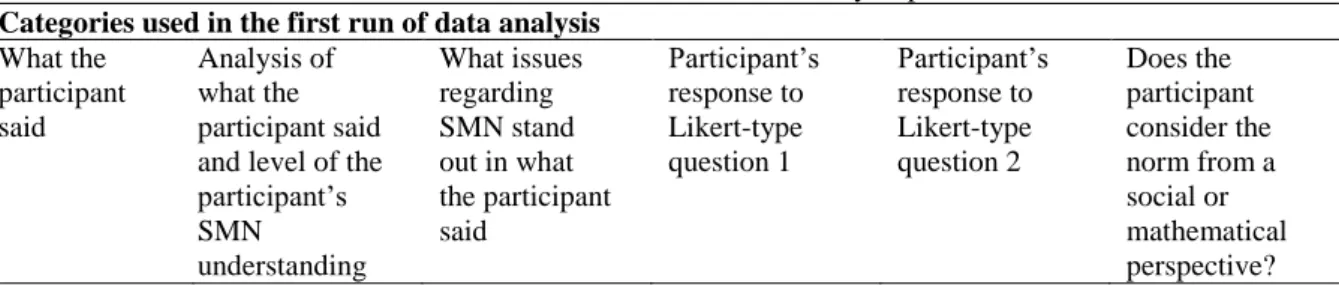
The data analysis process started with organizing the data by giving each respondent a code organizing his or her responses (Miles & Huberman, 1994) and analyzing those as in Table 2. We also developed rubrics to analyze participants’ level of understanding of SMN (see Appendix 2 for details). After the first run of the analysis is completed, we then checked each participant teacher’s responses again and searched for overarching themes describing teachers’ work for characterizing their understanding of each individual norm as well as crosscutting themes for norms in general. We generated an initial list of overarching themes, crosschecked them, and through use of this cycle in iteration narrowed the list in each run of the data analysis down to its final form.
Table 2. Structure used in the initial data analysis process. Categories used in the first run of data analysis
What the participant said
Analysis of what the participant said and level of the participant’s SMN
understanding
What issues regarding SMN stand out in what the participant said
Participant’s response to Likert-type question 1
Participant’s response to Likert-type question 2
Does the participant consider the norm from a social or mathematical perspective?
Results
Quantitative Results
each separate group (elementary, middle school, and high school) and calculated the differences between average scores and ranked scores. We then conducted the non-parametric Levene’s test of these difference scores to verify the equality of variances in the samples (homogeneity of variance) (Nordstokke & Zumbo, 2010; Nordstokke, Zumbo, Cairns, & Saklofske, 2011). The results (Levene statistic=.621; p=.541>.05) show that the data set has homogenous variance. We finally conducted an ANOVA on difference scores using the elementary, middle-, and high-school groups as independent variables and found that there is no significant difference between the groups (F=1.096; p=.341>.05). This suggests that SMN understanding level does not seem to significantly differ for elementary, middle-school, or high-school mathematics teachers. We also checked the data to see whether the norm understandings differ based on gender, number of years in teaching, faculties graduated, specialty area, and the highest degree earned as detailed in Table 3. In all these checks, we could not find any statistically significant difference among groups.
Table 3. ANOVA results with respect to certain demographic factors. ANOVA
F p
Gender 1.096 .341
Number of years in teaching 1.983 .084
Faculty graduated .700 .595
Specialty area .995 .446
Highest degree earned 1.164 .320
All these quantitative findings suggest that norm understanding of grade 1-12 in-service teachers does not seem to change over years and it is not dependent on how strong a mathematical or educational background they have. We also analyzed teacher responses based on whether they analyzed the given scenario from a mathematical point of view (e.g., talking only about mathematical aspects of the given scenarios, solving the mathematical questions given in the scenarios even though not asked) or a social point of view (e.g., considering interactions as supporting classroom discussions, participation). Interestingly, many teachers consider the given scenarios for SMN#2 and SMN#4 from a mathematical standpoint as illustrated in Table 4.
Table 4. Treatment of scenarios from a social/mathematical standpoint.
SMN #1 SMN #2 SMN #3 SMN #4 SMN #5
Math Social Math Social Math Social Math Social Math Social
Elementary (1-4) 6 14 18 3 7 12 18 0 12 9
Middle School (5-8) 7 11 18 0 6 12 18 0 11 4
High School (9-12) 13 9 22 0 6 16 22 0 15 5
Table 5. Participant teachers’ level of norm understanding. Understanding for Level of
understanding Elementary Middle School High School
SMN #1 Very low 7 (35%) 8 (44%) 11 (50%)
Low 12 (60%) 9 (50%) 7 (32%)
Medium 1 (5%) 0 4 (18%)
High 0 1 (6%) 0
SMN #2 Very low 18 (86%) 7 (39%) 7 (32%)
Low 1 (5%) 7 (39%) 12 (55%)
Medium 2 (10%) 3 (17%) 3 (14%)
High 0 1 (5%) 0
SMN #3 Very low 9 (47%) 12 (68%) 12 (55%)
Low 4 (21%) 4 (22%) 8 (36%)
Medium 6 (32%) 2 (10%) 2 (9%)
High 0 0 0
SMN #4 Very low 3 (17%) 4 (22%) 2 (9%)
Low 15 (83%) 11 (61%) 18 (82%)
Medium 0 3 (17%) 2 (9%)
High 0 0 0
SMN #5 Very low 12 (57%) 8 (53%) 9 (45%)
Low 4 (19%) 6 (40%) 9 (45%)
Medium 4 (19%) 0 1 (5%)
Surprisingly, the scenarios generated to test SMN#2 and SMN#4 were almost exclusively interpreted by the participants from a mathematical standpoint; whereas the scenarios targeting SMN #1, #3, and #5 were analyzed by focusing mostly on the social aspects. In fact in each scenario the participants were specifically asked about the “normative aspects of mathematics discussions specific to students' mathematical activity” (Yackel & Cobb 1996, p.461) as opposed to “regularities in patterns of social interaction” (Yackel & Cobb, 1996, p.460). This is also interesting in the sense that Scenarios #2 and #4 were about evaluating mathematical solutions, whereas the others consist of classroom interactions. This may suggest that the participant teachers consider classroom interactions as social events as opposed to environments supporting mathematical development of students. However, this result needs to be justified through further research.
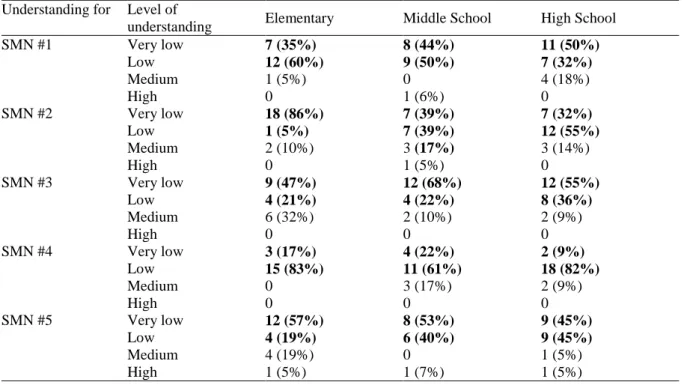
We also checked the degree to which participant teachers understand SMN (see Appendix 2). As illustrated in Table 5, many of the participant teachers interpreted the given scenarios by operating with a “very low” or “low” level of understanding of norms. For each scenario designed to test a single norm (except SMN#3 for elementary teachers, 68%), interestingly, 76%–100% of teachers fall into either the very low or low category in terms of their understanding of sociomathematical norms. This is quite a big percentage when knowing about SMN and using them as effective learning and classroom design tools are important assets of teacher knowledge (Even & Tirosh, 2002). On the other hand, only 5 out of 61 teachers (1 for SMN#1, 1 for SMN#2, and 3 for SMN#5, totaling 8%) seem to have a high level of understanding of sociomathematical norms, which is quite low. The participants were also asked, right after their work with scenarios was completed, about what they believe about the kind of abilities regarding SMN students should have and about whether they allow certain SMN in their own classes as illustrated in Table 6. Note that each question in each section of the questionnaire given in Table 6 corresponds to a SMN presented in each scenario given in the questionnaire; however, the order in which these questions were given to the participants was not same as the one given in Table 6.
Table 6. Likert-type questions asked the participants to reveal what they believe about SMN What abilities do you think students should have?
Answer this question based on the scale given on the right and mark the necessary box given next.
1: Absolutely disagree; 2: Disagree; 3: Not sure; 4: Agree
5: Absolutely agree
1 Be able to predict whether the proposed mathematical
solutions are mathematically different from each other. 1 2 3 4 5 2 Try to / Develop more sophisticated mathematical solutions
than the shared solutions. 1 2 3 4 5
3 Be able to reach a consensus through challenging each other’s
mathematical reasoning and convincing each other. 1 2 3 4 5 4 Be able to provide convincing mathematical justifications as
they explain an issue. 1 2 3 4 5
5
Be able to draw lessons from an analysis of the mathematical mistakes they fall into and modify their knowledge based on this analysis.
1 2 3 4 5
How often do you allow the following in your classes?
Answer this question based on the scale given on the right and mark the necessary box given next.
1: Never; 2: Seldom; 3: Sometimes 4: Often; 5: Always
1
In my classes, I provide my students with the opportunities to understand what makes a solution mathematically different from another
1 2 3 4 5
2
In my classes, I build the necessary environment for my students to generate mathematically more sophisticated solutions than the shared ones.
1 2 3 4 5
3
I provide the necessary environment for my students to seriously question the shared mathematical ideas and reasoning to reach a consensus.
1 2 3 4 5
4 I encourage my students to provide convincing and
explanatory arguments in my classes. 1 2 3 4 5
5
I provide my students with the opportunity to use mistakes as occasions to reconceptualize problems and reorganize their knowledge by learning lessons from those mistakes.
1 2 3 4 5
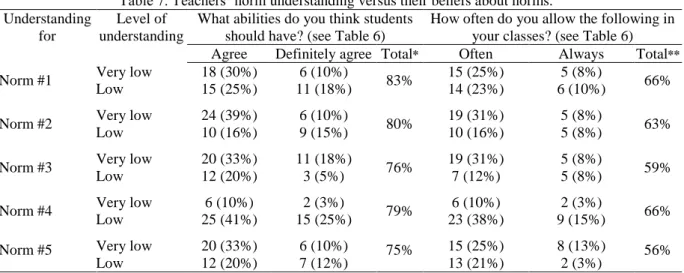
abilities, and they design their classes to support SMN given in the questionnaire. This contradiction between participants’ level of SMN understanding and what they believe about SMN suggests that they believe that SMN are important and should be established without genuinely knowing the core of what it means for a class to operate with certain established SMN. This contradiction also suggests that teachers’ beliefs do not guide their classroom practice; they believe but do not operate with that belief. Though, we are cautious about this result since it should be tested through further research.
Table 7. Teachers’ norm understanding versus their beliefs about norms. Understanding
for
Level of understanding
What abilities do you think students should have? (see Table 6)
How often do you allow the following in your classes? (see Table 6) Agree Definitely agree Total* Often Always Total**
Norm #1 Very low 18 (30%) 6 (10%) 83% 15 (25%) 5 (8%) 66%
Low 15 (25%) 11 (18%) 14 (23%) 6 (10%)
Norm #2 Very low 24 (39%) 6 (10%) 80% 19 (31%) 5 (8%) 63%
Low 10 (16%) 9 (15%) 10 (16%) 5 (8%)
Norm #3 Very low 20 (33%) 11 (18%) 76% 19 (31%) 5 (8%) 59%
Low 12 (20%) 3 (5%) 7 (12%) 5 (8%)
Norm #4 Very low 6 (10%) 2 (3%) 79% 6 (10%) 2 (3%) 66%
Low 25 (41%) 15 (25%) 23 (38%) 9 (15%)
Norm #5 Very low 20 (33%) 6 (10%) 75% 15 (25%) 8 (13%) 56%
Low 12 (20%) 7 (12%) 13 (21%) 2 (3%)
* This total represents the total percentage of participants who “agree” or “definitely agree” with the given statement.
** This total represents the total percentage of participants who chose “often” or “always” as their answers.
To sum up, quantitative analysis helped us see, in addition to the contrast between the teachers’ level of understanding of SMN and what they believe about SMN, that SMN understanding of participant teachers does not change with respect to the grade level teachers teach and other aforesaid demographic variables. Based on these findings we looked through all data to examine more deeply to uncover the nature of teachers’ understanding of SMN, which is detailed in the following section.
Qualitative Results
We conducted a qualitative analysis to better understand about the nature of teachers’ understanding of SMN to characterize their level of understanding of each targeted SMN. Our analysis suggests that the teachers view each targeted SMN as in Table 8. We initially identified what aspects of the given scenarios the teachers highlighted in analyzing those scenarios through which we characterized their level of understanding of SMN. In the following section, we initially categorize teachers’ descriptions of SMN as in Table 8 and we then defined and detailed each category of descriptors by drawing on the relevant data.
Table 8. Teachers’ characterization of sociomathematical norms. SMN #1 –
Mathematical difference norm
SMN #2 – Mathematical sophistication norm
(5% did not comment)
SMN #3 –Mathematical consensus norm
(4% did not comment)
SMN #4 – Mathematical justification norm
(14% did not comment)
SMN #5 – Mistakes-as-opportunities norm
(5% did not comment)
Unusual (%33) Easy/Understandable (52%)
Social negotiation tool (30%)
Understandable (23%)
Correction (23%)
Social supplier (%28)
Making connections (16%)
Develops student thinking (38%)
Numeric pattern (26%)
Support social environment (26%)
Restrictive (%23) Dependent on student/class level (11%)
Conditional (23%) Structural (16%) Mathematical content (23%)
Variety (%16) Supporting learning (16%)
Consensus (5%) Non-explanatory,
non-convincing (21%)
1. Teachers’ Use of Descriptors for Mathematical Difference Norm
In the mathematical difference norm (SMN#1) scenario students decide on whether to accept or reject the offered solutions to be written on the board based on their analysis of mathematical similarity or difference of these solutions. Participant teachers responded to this scenario in four different ways.
a. Some of the participants (33%) considered this way of interaction of students and what makes a solution mathematically different from another by resorting to the following descriptions: “effective solutions,” “beyond routine solutions,” “solutions paving the way for making mental calculations,” “memorable solutions,” “nice solutions,” “interesting solutions,” “solutions helping develop different perspectives,” “wise solutions,” “solutions having structural difference,” “solutions contributing to [students].” All these descriptors suggest that these teachers seem to understand that the given scenario is about students’ elimination of proposed mathematical solutions. These teachers considered this way of interaction as singling out unusual solutions and disregarding others. The reason we called this understanding as unusual is that teachers in their responses constantly referred to solutions beyond expected, different or promoting different abilities.
b. Another group of participant teachers (17, 28%) considered the way students in the scenario approach the given solutions as both improving students’ individual and social identities and establishing and developing classroom social setup. These teachers focused on the idea that such interaction supports students’ social development as members of the class. For example, teacher responses in this category included that such interaction improves certain social qualities of students (“self-confidence,” “awareness,” “success,” “practicality”) and frees student thinking from mechanic procedures (“being away from memorizing facts,” “brain storming,” “encourage to think”). Since these are the qualities that are not directly about mathematics but support students’ social development, we call this way of characterization the teachers made as social supplier. In addition, 13 of these teachers focused only on how such interaction affects the social setup of the classroom. What makes this interaction valuable for these teachers were the fact that such interaction “provides opportunities for students to learn from each other through discussion,” “enables consensus among students,” “develops and organizes social environment,” “provides democratic environment,” “helps students respect each other,” “increases classroom participation,” and “helps reach a conclusion together.” All these descriptions are about social aspects of classroom or student development. Teachers in this category put forward these aspects as opposed to the potential mathematical contribution of the interaction to the students in the given scenario. In other words, they considered a sociomathematical norm as a social supplier for students rather than a mathematical one.
c. The third group of the participants (14, %23) equates focusing on mathematical difference in the given scenario to focusing on solutions that are “appropriate for students’/class’ level,” “doable,” “easy,” “useful,” “reasonable,” “not explained well,” and “challenging.” In this sense, teachers in this category considered mathematical difference as restrictive to certain qualities. For example a teacher suggested,
“I agree. I would behave the same way as the teacher did. I would listen to any kind of answer, I would choose the one that provides the maximum gain with respect to the understanding to be learned (rounding to the nearest ten), and I would have them written on the board […].”
This perspective of the teacher suggests that his focus was on choosing the solution providing the “maximum gain” instead of mathematically different solutions. In so doing, the teacher restricts mathematical difference to a limited domain, the solutions providing the maximum gain. Some of the teachers in this third group (3, %5) completely opposed to focus on different mathematical solutions since they might cause “confusion” among students and might have “discouraging” effect on students whose solutions are disregarded because of similarity. Moreover, 6 of the teachers in this group (10%) also believe that the teacher should be the determiner of whether given solutions are same or different, not the students. All these descriptions of participants suggest that teachers in this category either considered focusing on mathematical difference as restrictive for the class or suggested focusing on a limited number of solutions without looking into mathematical difference.
2. Teachers’ Use of Descriptors for Mathematical Sophistication Norm
In the given scenario for mathematical sophistication norm (SMN#2) four different solutions are given to participant teachers and they were asked to decide on with which one they would engage their students in their classes. The way the participants interpreted the given scenario is detailed below.
a. About half of the teachers (32, 52%) who answered this question pointed out that the solution to be focused on and used for encouragement in classes should be “clear,” “understandable,” “easy,” “concrete,” “practical,” “basic,” “less likely to make mistakes,” and “easier to comprehend” instead of being sophisticated furthering student thinking. For example, one teacher suggested “I would prefer the answer of group #1. It is easy to understand and easy to explain. Having fewer calculations make its expression easier”, whereas another teacher wrote, “I would prefer the answer of group 3, because I think that it is a figure that is understandable by more students easily.” Such descriptions suggest that teachers make reference to easiness/understandability for the notion of mathematical sophistication.
b. Some of the participants (10, 16%) preferred solutions that have the potential to enable students to make connections among upcoming concepts to be pursued in the curriculum or that have the potential to be transferred to other upcoming concepts or grades. These teachers particularly pointed out the solutions they would focus on as the ones “having students comprehend different mathematical relationships, applicable to other topics,” “giving opportunity to prepare [students] for upcoming concepts [to be taught],” “including mathematical relations,” and “transferable to other problems.”
For example, half of the teachers in this group chose second group’s answer in the given scenario since it includes difference of squares as illustrated in the following typical answer:
Teacher: I would prefer brainstorming and thinking more on Group 2’s solution because the topic under question is about squares. It is important since it is about finding square of a number and about understanding the relationship between squares of numbers. At the same time it is also important with respect to establishing a relation among visual patterns.
This teacher chose second group’s answer because it directs student attention to relations among visual patterns and in-between squares of numbers. Hence, the teachers in this group make their preferences based on making connections.
c. Another group of teachers (7, 11%) made their decision about the given solutions based on class’ or students’ level of understanding. The participants in this category in some way or other mentioned that “each solution method can be applied in different level of classrooms.” These teachers think that the solution to be pursued in classes is dependent on student/class level.
d. The last group of participants (10, 16%) in this group considered the solutions to be brought to students’ attention in the class as the ones that give students the opportunity to learn better, in other words, that support student learning. Seven of these teachers used descriptions for the solutions as “useful,” “visual,” “easily stored in mind,” “deepens student thinking,” “interesting,” “long lasting,” and “giving opportunities to reorganize knowledge,” for solutions to be stimulated in class.
In this regard, teachers in this category consider sophisticated solutions as solutions consisting of elements supporting student learning. One of the teachers, who gave the only level-4 answer in this category, pointed out the reason for his preference of second solution as follows:
3. Teachers’ Use of Descriptors for Mathematical Consensus Norm
The scenario generated to test teachers’ understanding of mathematical consensus norm (SMN#3) included students’ reaching a consensus through debating their ideas. Teachers’ use of descriptions for this norm fall into four categories as detailed below.
a. A number of participant teachers (18, 30%) considered the interaction pattern in the given scenario as a social negotiation tool. For these teachers students in the given scenario reach “the right” or “most appropriate” solution through “interaction,” “discussion,” “questioning,” “inspecting,” and “exchanging ideas.” Some of these teachers here (14, 23%) also referred to the facts that students in the given scenario “interpret the reasons of given ideas,” “reveal reasoning behind ideas,” “defend” and “prove” given ideas and “convince each other” and these teachers saw the classroom operation valuable with respect to these aspects. Such descriptors as “discussion,” “inspecting,” “questioning,” etc. are the kind of descriptors modelling the classroom interaction in the given scenario from a very general perspective without any solid examples from the given scenario. For example, a teacher said, “students reach the right solution through discussing and inspecting ideas” without mentioning which (mathematical) ideas and how. In this sense participant teachers found the classroom interaction in the given scenario useful as a social negotiation tool instead of students reaching a consensus through a mathematical negotiation process which may contribute to students’ mathematical development.
b. A significant number of teachers (23, 38%) described such classroom operation as “nice,” “preventing students from rote learning,” “having students learn better,” “enabling new ideas to be constructed on previous ideas,” “enabling long-lasting learning,” and “making students active.” However, the teachers making these descriptions about the operating of the class made them in very general terms without providing any examples or details from the given scenario. As a result participant teachers in this category focused on the contribution of such class operation to the development of student thinking and valued it using this aspect.
c. Some of the participants mentioned that in order for such a class to operate, there should be certain a priori conditions established in that class. For example, these teachers mentioned that in order to have such a class students should have “the necessary prior/background knowledge,” “communications skills,” “culture of debate,” and “developed reasoning skills.” These participants also added that these conditions must be satisfied before such classroom operation could take place. Hence these participants seem to consider these conditions as obstacles to be overcome and it is impossible to have such a class without these conditions for these teachers. In other words, the teachers in this category did not seem to find such classroom scenario realistic and therefore tied such operation to certain a priori conditions. For example, one of the teachers mentioned, “Such a discussion environment is impossible in the classes I teach. I neither can teach this topic this well nor are the students well-behaved. I do not have students at this level.” As seen in this response the teacher based his argument on certain conditions such as not having “well-behaved” students or not having students at a certain “level.”
d. A few participants (3, 5%) pointed out that with the help of the classroom operation in the given scenario “students are convinced through adding to each other’s ideas,” “students agreed upon a common solution,” and “students themselves reach a consensus together.” These teachers are the only ones who can identify, even though in general terms, that there is a negotiation process to reach a consensus among students in the given scenario. In this sense these three participants referred to reaching a consensus in analyzing the given scenario.
4. Teachers’ Use of Descriptors for Mathematical Justification Norm
In the given scenario for mathematical justification norm (SMN#4) participant teachers are given four different student solutions to a pattern problem and asked to decide which one was more exploratory and convincing. The way the participants interpreted the given scenario is detailed below.
b. A group of participants(16, 26%) put more emphasis on numerical solutions and pointed out that the more numerical the solution was the more convincing it would be. Nine of these teachers considered the given numerical pattern in the solution as “far from rote,” “not confusing,” “not crowded with formulas,” “short and right,” whereas 7 of them considered the pattern as appropriate for grade 1-8 students only. These teachers decided on whether a given solution includes appropriate justification or not based on whether it includes a numeric pattern or not. For these participants numeric pattern inclusion, rather than having the necessary mathematical argumentation, is what makes a solution justifiable.
c. In the given scenario the first group’s solution was inductive and the second group’s answer was based on deductive reasoning. Whereas the first group of students gives the formula as a solution to the given problem and then explains the components of the formula, second group figures out the formula inductively building the numeric pattern and then finding the formula. 10 teachers (16%) preferred second solution and considered it as “easily remembered,” “paving the way for reasoning,” “logical,” “easily drawn,” and “working through figure-formula connection.” One typical answer in this category is, “The second group’s answer is more explanatory and convincing. Because the solution starts from the beginning, generalize the question and tries to find a formula. It easily uses the figure and finds the formula inductively.” All these suggest that participants in this group referred to the structural nature of the given solution and their preference was on inductive nature of the solution.
d. A group of teachers (13, 21%) equated convincing arguments with that of “not crowded,” “practical,” “most plain solution,” “not including any explanation,” and “directly giving a clear formula.” The interesting issue here is that teachers in this group almost equate “convincing” to non-exploratory or non-convincing. In other words, the better is the solution method, the shorter it gets the student to the formula or the lesser explanation it includes.
5. Teachers’ Use of Descriptors for Mistakes-as-Opportunities Norm
In the given scenario for mistakes-as-opportunities norm (SMN#5) participant teachers are given a classroom scenario in which students derive lessons from a faulty solution about a sharing situation and fraction addition. The different ways in which the participants interpreted the given scenario are detailed below.
a. A group of teachers (14, 23%) used some general descriptions to explain the interaction in the class such as “a mistake is seen/found/derived by students,” “a mistake is corrected,” “it is written on board so it does not occur again.” The teachers here considered such classroom work as a way of simple correction (by the teacher) of student mistakes instead of a regular interaction pattern to catch a problem and reconceptualize it.
b. Another group of teachers (16, 26%) consider such classroom interaction as a way to support social environment in class. Such interaction for these teachers enable students to “brainstorm,” “discuss,” “question and investigate,” “be active,” and “have the opportunity to think” to reach the right solution. They also support such classroom interaction since such environments “teach students tolerate other opinions” and “enable having different perspectives and finding different solutions.” All these descriptions suggest that the participants in this category valued this way of interaction because of the opportunities provided to support social environment. c. The teachers who mostly focused on the mathematical content in the given scenario (14, 23%) interpreted the teacher’s purpose in the scenario as to identify, or to have students identify, the mathematical errors in the shared solutions in class and these participants basically described the errors in the given solutions. For example, the teachers in this category pointed out that the purpose in the class is “to show students that two fractions cannot be added without finding common denominator,” “to show how to add fractions,” and “to teach the importance of size of quantities in fraction addition and subtraction.” In fact, in the given scenario, the issue is about the sharing of a quantity among so many groups as opposed to the addition of fractions. The teachers in this category only focused on the mathematics involved for the purpose of correcting a mistake but ignored the given classroom interaction and how that supported student understanding. Hence, they only valued the mathematical content in the given scenario.
whereas the second part is about teacher-centeredness, how the teacher herself would do it through show-tell method, which is a contradiction. Like this one, the teachers in this category used words remotely connected to classroom norms in answering the first part of the question, whereas they were in a denial position by resorting to teacher-directed and teacher-centered classroom teaching mode.
Discussion of Results and Conclusions
The purpose of this study was to understand grade 1-12 in-service teachers’ level of understanding of SMN and the nature of that understanding as it was reflected in teachers’ analyses of given classroom scenarios in which the students operate with certain established SMN. The relevant literature includes many studies about norms through long-term classroom observations, whereas this study targeted revealing teachers’ norm understanding without observing the teaching of teachers.
The findings suggest that norm understanding is neither dependent on which school level teachers teach nor dependent on their background or demographic characteristics such as number of years they spent in teaching, specialty area, faculty graduated, highest degree earned, and gender. This is interesting in the sense that the more experience teachers have does not necessarily mean the better they would do in classes. This is also consistent with the results in the relevant literature (e.g., Monk, 1994, Rice, 2010). The fact that norm understanding does not differ significantly with respect to grade level also suggests that teacher preparation programs for different levels in Turkey seem to be closely aligned and do not prepare teachers well about norms, which is an indispensable part of classroom teaching (Voigt, 1994; Even & Tirosh, 2002).
It is also interesting that what participant teachers believe about SMN are almost in contrast with what they actually know about these norms. They believe that norms are integral to teaching and students should operate with certain SMN whereas they lack the necessary understanding of SMN. This suggests that teachers need support in understanding effective ways of orchestrating classroom interaction that support students’ mathematical development, which is an essential part of teacher knowledge as implied by Voigt (1996). In addition, use of scenarios was helpful in uncovering teachers’ level of understanding of sociomathematical norms more accurately than Likert-type questionnaires only testing teacher beliefs. There are attempts in the literature to develop measures, such as multiple-choice questionnaires, to check the quality of mathematics teacher knowledge (Hill, Schilling, & Ball, 2004). As Ball mentioned “For the field to grow to contribute to policy and practice, and to teachers’ learning, however, we need to build capacity for smart, probing, comparative and large scale studies” (Adler, Ball, Krainer, Lin, & Novotna, 2005, p.378) and we intended in the current study to take a stab at this issue through use of scenarios. The scenarios gave the participant teachers an opportunity to analyze the nature of the interaction embedded in the scenarios, which in turn helped us identify teachers’ understanding of normative aspects of mathematical discussions. The follow-up Likert-type questionnaire, even though it targeted the same norms embedded in the scenarios, gave us the opportunity to see the gap in between what teachers actually know and believe. Therefore, use of scenarios in revealing teachers’ understanding of sociomathematical norms may be a useful venue to follow in this regard, although finding more effective ways to analyze teacher responses is necessary.
As we run through the data about teachers’ analyses of the given scenarios in which the classes operate with certain SMN, we identified three crosscutting themes that the teachers referred to in common for all SMN which reveal their overall understanding of SMN:
1. There is an opposition to the core of the norm being analyzed. Note that the participants focus on unusual instead of difference for mathematical difference norm, on easy solutions instead of mathematically sophisticated questions, on the idea of giving students no explanation for solutions instead of mathematical justification, on direct teaching of mistakes instead of use of mistakes as opportunities to help students’ development. In so doing, the teachers in a sense focused on the opposite characteristics of norms being exemplified in the given scenarios.
the data led us believe that sociomathematical norms for the participants are important only because they facilitate social aspects of behavioral patterns – as social facilitator.
3. The teachers in this study seem to consider SMN as condition-based. They believe that the kind of interaction within a class presented in the given scenarios is only possible in classes under certain conditions (e.g., focusing on restriction of mathematical difference norm, having students with appropriate level of mathematics for other norms) and with students having certain characteristics (e.g., having respect for others, etc.) and knowledge. The teachers participated in this study had a range of experience in teaching but seem to lack the necessary knowledge about SMN to support student development well. This is reasonable and expected in the sense that these teachers might not have had the opportunity to experience, as a student, the classes in which SMN are established and therefore could not draw on such experience once they become a teacher. It also seems that teaching experience was not supportive for these teachers to become aware of SMN. As a result, these teachers misinterpreted these SMN by resorting to certain common aspects like opposition, social facilitator and condition-based. The fact that these teachers operate with certain understanding of SMN in analyzing given scenarios implies that the teacher education programs they went through did not prepare them well enough to help them “understand what a sociomathematical norm is and construct pedagogical strategies that can be applied in a variety of contexts” (Kazemi & Stipek, 2001, p.135). Such lack of understanding seems to lead the teachers to separate “individuals' reasoning and sense-making processes … from their participation in the interactive constitution of taken-as-shared mathematical meanings” (Yackel & Cobb, 1996, p.460). This in turn would affect student understanding and the variety of opportunities that the teachers may introduce in classes. Therefore, in order to adopt a sociological perspective as an integral part of mathematical activity and benefit from such perspective to support students’ mathematical development, SMN should be seriously considered as a core part of mathematics teacher knowledge. In this regard, designing or developing appropriate courses for teachers and teacher education programs in a way that help teachers develop solid understandings of SMN is important and should be seriously taken into account by mathematics educators and policymakers.
Acknowledgements
The data used in this study is from the master thesis work of the second author (Yaşa, 2015) that was supervised by the first author from Mevlana (Rumi) University. Part of the data used here is presented in the following conferences during 2015: 24th National Educational Sciences Congress (Niğde/Turkey), International Conference on Education in Mathematics, Science & Technology (Antalya/Turkey), and Turkish Computer and Mathematics Education Symposium (Adıyaman/Turkey). In addition, we would like to thank the anonymous reviewers for their thoughtful and timely reviews that helped improve the paper significantly.
References
Adler, J., Ball, D., Krainer, K., Lin, F-L., & Novotna, J. (2005). Reflections on an emerging field: Researching mathematics teacher education. Educational Studies in Mathematics, 60, 359-381.
Bauersfeld, H. (1993, March). Teachers’ pre and in-service education for mathematics teaching. Seminaire sur la Representation, No. 78, CIRADE, Université du Québec á Montréal, Canada.
Boaler, J., & Humphreys, C. (2005). Connecting mathematical ideas: Middle school video cases to support teaching and learning. Portsmouth, NH: Heinemann.
Brandt, B., & Tatsis, K. (2009). Using Goffman's concepts to explore collaborative interaction processes in elementary school mathematics. Research in Mathematics Education, 11(1), 39-55.
Cobb, P., & Bauersfeld, H. (Eds.). (1995). Emergence of mathematical meaning: Interaction in class-room cultures. Hillsdale, NJ: Erlbaum.
Cobb, P., Jaworski, B., & Presmeg, N. (1996). Emergent and sociocultural views of mathematical activity. In P. Nesher, L. P. Steffe, P. Cobb, G. Goldin, & B. Greer (Eds.), Theories of mathematical learning (pp. 3– 20). Mahwah, NJ: Lawrence Erlbaum Associates, Inc.
Cobb, P., Stephan, M., McClain, K., & Gravemeijer, K. (2001). Participating in classroom mathematical practices. Journal of the Learning Sciences, 10(1–2), 113–163.
Even, R. & Tirosh, D. (2002). Teacher knowledge and understanding of students' mathematical learning. In L. English (Ed.), Handbook of international research in mathematics education (pp. 219-240). Mahwah, NJ: Lawrence Erlbaum.
IBM Corp. (2012). IBM SPSS statistics for windows - Version 21. Armonk, NY: IBM Corp.
Kazemi, E., & Stipek, D. (2001). Promoting conceptual thinking in four upper elementary classrooms. The Elementary School Journal, 102(1), 59-80.
McClain, K., & Cobb, P. (2001). An analysis of development of sociomathematical norms in one first-grade classroom. Journal for Research in Mathematics Education, 32(3), 236–266.
McNeal, B., & Simon, M. A. (2000). Mathematics culture clash: Negotiating new classroom norms with prospective teachers. Journal of Mathematical Behavior, 18(4), 475–509.
Miles, M. B., & Huberman, A. M. (1994). Qualitative data analysis: An expanded sourcebook (2nd Ed.). Thousand Oaks, CA: Sage.
Monk, D. H. (1994). Subject area preparation of secondary mathematics and science teachers and student achievement. Economics of Education Review, 13(2), 125-145.
Nordstokke, D. W., & Zumbo, B. D. (2010). A new nonparametric Levene test for equal variances. Psicoloόgica, 31(2), 401-430.
Nordstokke, D. W., Zumbo, B. D., Cairns, S. L., & Saklofske, D. H. (2011). The operating characteristics of the nonparametric Levene test for equal variances with assessment and evaluation data. Practical Assessment, Research & Evaluation, 1(5).
Rice, J. K. (2010). The impact of teacher experience – Examining the evidence and policy implications. Washington, D.C.: Urban Institute.
Shulman, L. (1986). Those who understand: Knowledge growth in teaching. American Educational Research Association, 15(2), 4-14.
Tatsis, K., & Koleza, E. (2008). Social and socio-mathematical norms in collaborative problem-solving. European Journal of Teacher Education, 31(1), 89–100.
Van Zoest, L. R., Stockero, S. L., & Taylor, C. E. (2012). The durability of professional and sociomathematical norms intentionally fostered in an early pedagogy course. Journal of Mathematics Teacher Education, 15, 293-315.
Voigt, J. (1994). Negotiation of mathematical meaning and learning mathematics. Educational Studies in Mathematics, 26(2/3), 275–298.
Voigt, J. (1995). Thematic patterns of interaction and sociomathematical norms. In P. Cobb & H. Bauersfeld (Eds.), Emergence of mathematical meaning: Interaction in classroom cultures (pp. 163-201). Hillsdale, NJ: Erlbaum.
Voigt, J. (1996). Negotiation of mathematical meaning in classroom practices: Social interaction and learning mathematics. In L. P. Steffe, P. Nesher, P. Cobb. G. A. Goldin, & B. Greer (Eds.), Theories of mathematical learning (pp. 21–50). Mahwah, NJ: Lawrence Erlbaum Associates.
Yackel, E. (2002). What can we learn from analyzing the teacher’s role in collective argumentation? Journal of Mathematical Behavior, 21, 423–440.
Yackel, E., & Cobb, P. (1996). Sociomathematical norms, argumentation, and autonomy in mathematics. Journal for Research in Mathematics Education, 27(4), 458–77.
Yackel, E., Cobb, P., & Wood, T. (1991). Small-group interactions as a source of learning opportunities in second-grade mathematics. Journal for Research in Mathematics Education, 22(5), 390–408.
Appendix 1 – Copy of the Norm Questionnaire
Section I
This section was designed to ask about demographic information for teachers. Section II
Norm #1: Offering/Distinguishing mathematically different solutions through an analysis of what makes one solution mathematically different from another.
Scenario #1
Miss Aisha asked her students to do “18+32” mentally and told them that she would put up the responses on which the class agreed on the board. As you will see in the following dialog, the students valued and accepted some of the answers, whereas rejected others and the teacher allowed for such an interaction.
a. What kind of a perception/understanding should there be as to how mathematical solutions should be ingrained in the students in this class so that they deemed some shared answers valuable to be written on the board whereas they rejected the others?
b. If you were the teacher in this scenario, explain in detail whether or not you would support the way students themselves evaluate the shared solutions in this way.
[Note: As you answer the question think about the given scenario here as opposed to the class you currently teach. Instead of giving answers such as “I’d support it” or “I’d not support it,” give a justification for your answer.]
Teacher: I would like you to share your solutions with your classmates. Once you discuss your answers, I will put the ones you valued up on the board. Aslı?
Aslı: I added up 18 and 32 using the known column method. In this way the answer is 50! Teacher: Alright, you heard Aslı’s answer. Is that right? [students nod their heads to approve the
answer] Is there anyone who did it in another way?
Osman: Well, I also did write 32 first and put 18 right under that and added them up from top to bottom.
Fahri: [by talking without permission] I did add 32 and 18 side by side. My answer is also 50. Ayça: [Talking to Osman and Fahri] Good but how do your answers differ from Aslı’s? You both
add mentally either side by side or through column approach.
Ömer: [with a tone of supporting Ayça] I think so too! All these three answers are alike. Addition rule is used in all of them. If we were to put them up on the board we should only write one of them because they are all done using same logic.
Teacher: Do you all agree with this? What do you think? Class: [talking together] Yeees!
Teacher: Alright! I will put Aslı’s method up on the board. Is there anyone who did it in another way? [choosing one who raised her hand] Betül?
Betül: Instead of adding 18 and 32 I added 20 and 32 since it is easier, which makes 52. Then I subtracted 2 from this result because I’d added 2 to 18 initially. The result is 50.
Osman: This solution is nice. We can write it on the board.
Cemil: [interrupting impatiently] Betül’s seems to me different too. I haven’t thought of that. I first added tens, 10 plus 30 makes 40. Then 8 and 2 makes 10. 40 plus 10 makes 50. I found it this way.
Teacher: You heard aboutCemil’s and Betül’s solutions. Which one do you think we should put on the board?
Aslı: There are no such solutions on the board. They are different! I think we should put both. Fahri: I think so too. One is adding up tens whereas the other adds and subtracts 2. [Other students
Norm #2: Offering/generating mathematically more sophisticated solutions than the given one.
Scenario #2*
A teacher showed a picture similar to the one on the right to the students and asked, “Find a way to figure out how many unit squares there are in the shaded area in this picture without counting one by one” and then he found 4 types of answers in students’ notebooks. Without making any comment, the teacher put the answers on the board as given next. If you were the teacher in this class, once the following answers were given by the students, especially which one of those answers would you have your students think more and hard on? Explain your reasons in detail. [Note: Here you are not asked to explain what kind of a teaching you would do or which solution you would explain to the students. Instead, you are asked to explain which one of these 4 answers, given by students themselves, you would have your students focus on.]
Type-I Answers
There are 8 units on each side except the corners. In this case, there are 4×8=32 square units on each side except the corners. Since there are 4 square units on the corners [in total], there are 32+4=36 square units altogether.
Type-II Answer
We have 102=100 square units in total. There are 82=64 unit squares inside except the shaded border. 100-64 = 36 would give us the number of units in the shaded border just like in a2-b2. Type-III Answer
There are 2×10=20 units on the left and right vertical sides (including the corners). There are 2×8=16 units at the top and bottom. In total, there are 20+16=36 units in the shaded border.
Type-IV Answer
When we count the differently colored units on the border by thinking successively of 9 units at a time, we see that there are 9+9+9+9=36 units in total.
*Note that the question of finding the number of shaded square units laid in the border of a 10 by 10 grid was first seen in the video case given in Boaler and Humphreys (2005) and adopted from this source.
Norm #3: Reaching a consensus through necessary mathematical argumentation.
Scenario #3
A teacher asked, “which of 4/5 and 6/7 is bigger?” to her class where students do not know equivalent fractions and decimals. She also wanted the students to explain their answers as if they are to explain them to a blind person. She separated the class into three groups and the following discussion took place among these groups. a. In what kind of a classroom in which there is such an established understanding/perception of in-class argumentation would you see such an interaction among students? In answering this question, analyze the dialog given next based on the kind of reasoning, questioning, inquiry, and answers students used.
b. Why do you think the teacher in this scenario allows such an interaction among students? Would you follow such a method in your own classes? Explain your answer.
[Note: Consider the question as if there is no competency (in the negative way) among students in this class.] Group I: We think that “6/7” is bigger. Because when we draw both fractions, “6/7” looks bigger
than 4/5. Since it looks bigger, “6/7” should be bigger!
Group II: Yeah but a blind person cannot see your drawing. So this cannot be a complete solution. We think that both fractions are same, because the difference between numerator and denominator is same for both fractions, namely, 1. Since differences are same, the fractions must be same. What do you think?
Group III: [Talking to Group II.] You did not accept Group I’s solution but we wonder how accurate your solution is. Numerator
–
denominator differences for both “99/100” and “1/2” are 1 too, but are these same. Try to draw those and you will see what we mean. So we should not put the drawing aside.Group I: They are right, their answer is nice! For example “1/2” is a half and “99/100” is a fraction that is very close to 1, so it is much bigger than “1/2”; in fact, there is no need to draw it. Well, we wonder if it doesn’t matter at all if the difference between numerator and denominator is 1.
Group III: The fact that the difference is 1 may be important. If we were to draw, what would we do – let’s think about it. We may then be able to visualize it in our minds. If we were to draw these fractions, we would shade in 4 parts out of 5 from a whole; whereas we would shade in 6 parts out of 7 from the same whole.
Group II: That’s it, we found it! There is only one piece left unshaded for each fraction. In other words, the difference between numerators and denominators is “1” for both fractions. Instead of focusing on the shaded parts what if we focused on the unshaded parts? In both, there is a single part unshaded.
Group I: In that case, both fractions are one part away from the whole. We can make this conclusion from the unshaded parts. Which fraction would be further away from the whole?
Group III: Don’t we need to think about the size of the parts? In which fraction are the parts bigger? Group I: Fifths are bigger than sevenths.
Group II: How do you know? Don’t tell us that you drew again!
Group I: We can also draw but there is no need for that, it is easy for us. We divide a whole into five parts when we find fifths, but we divide the whole into 7 parts when we find sevenths. So when we divide the whole into seven, the parts will be smaller.
Group II: Since 1/7-part is smaller than a 1/5-part, then isn’t 6/7 greater? Because 6/7 would be closer to the whole. Since 1/7 is a smaller part, then 6/7 is closer to the whole.
Group III: We think you are right! Since the 1/5-parts within 4/5 are bigger parts, then the fraction 4/5 is further away from the whole.