Taxonomic paper
First report of the genus
Conostigmus
Dahlbom
(Hymenoptera: Ceraphronoidea: Megaspilidae)
from India with description of a new species
C Bijoy, K Rajmohana, Ramesh Kumar
† Western Ghats Regional Centre, Zoological Survey of India, Calicut-673006, Kerala, India ‡ National Bureau of Agriculturally Important Insects, Hebbal, Bangalore-560024, Karnataka, India
Corresponding author: C Bijoy ([email protected])
Academic editor: Lyubomir Penev
Received: 30 Aug 2013 | Accepted: 26 Dec 2013 | Published: 02 Jan 2014
Citation: Bijoy C, Rajmohana K, Kumar R (2014) First report of the genus Conostigmus Dahlbom (Hymenoptera: Ceraphronoidea: Megaspilidae) from India with description of a new species. Biodiversity Data Journal 2: e991. doi: 10.3897/BDJ.2.e991
ZooBank: urn:lsid:zoobank.org:pub:7B5C7A33-F8F5-489A-9A3C-A736B5FB1AB6
Abstract
The genus Conostigmus Dahlbom (Hymenoptera: Ceraphronoidea: Megaspilidae) is reported for the first time from India, along with description and illustration ofC. neotubifer sp. n. A comparative discussion on the morphological affinities of the new species with its putative sisterC. tubiferDessart is provided. An intermixing of character states of genera Conostigmus as well as Dendrocerus Ratzeburg is observed.
Keywords
Conostigmus, Megaspilidae, new species, India
Introduction
Superfamily Ceraphronoidea (Hymenoptera) comprises two extant families of parasitoid wasps, Ceraphronidae and Megaspilidae (Johnson and Musetti 2004). Megaspilidae
† † ‡
includes 305 valid species in 13 genera (http://hol.osu.edu/index.html?id=91). The species of Megaspilidae are generally ectoparasitoids attacking cocoons and puparia, primarily on Diptera, Neuroptera, Coleoptera, Mecoptera and also as hyperparasitoids of Hymenoptera (Dessart 1995).
Among the 13 genera of Megaspilidae, the most speciose and widely distributed are DendrocerusRatzeburg 1852 and ConostigmusDahlbom 1858. The genus Conostigmus was erected by Dahlbom (1858), as a subgenus ofMegaspilusWestwood, withMegaspilus alutaceusThomson as type species. Later in 1951, Muesebeck and Walkley elevated the taxon to generic level. The genus is distributed widely in all geographical realms and has 168 species. Only 9 species have been reported from Oriental region so far (Johnson and Musetti 2004, Dessart 1997) (catalogued as 8 species by Johnson and Musetti (2004), missing out C. occipitalis Dessart 1997).
In continuation with our pioneer taxonomic studies on the superfamily Ceraphronoidea of India, a new species of Conostigmusviz. C. neotubifersp. n. is hereby described and illustrated. A comparative discussion on the morphological affinities of the new species with C. tubiferDessart 1997, the most resembling species is also provided. Both the species are remarkable for their intermixing of characters seen in two genera,Conostigmusand Dendrocerus.
Materials and methods
The specimens under study were collected using malaise trap set among the grassy patches of Port Blair, Andaman and Nicobar Islands, India. The specimens were card mounted on point-card tips. Description and imaging works were carried out employing Leica M205A stereomicroscope, with 1 × objective and Leica DFC-500 digital camera. Morphological terminology follows Fergusson (1980), Dessart (1997) and Miko and Deans (2009). Based on Dessart (1997), we have attempted to define the various states of ocellar triangle in Megaspilidae. If OOL > POL, the ocellar triangle is ‘narrow-based’ and if OOL POL.
Both the Holotype and the Paratypes are deposited in the National Zoological Collection at Zoological Survey of India, Calicut.
Abbreviations:DFIm – Minimal Interocular Facial Distance; OOL – Ocellocular Length; POL – Postocellar Length; LOL – Lateral Ocellar Length; T3 – Metasomal tergite 3.
Taxon treatment
Conostigmus neotubiferBijoy & Rajmohana, 2014, sp. n.
• ZooBank urn:lsid:zoobank.org:act:4BF76167-8B66-4FB5-B4C1-DEB4C9FBF302
Materials
Holotype:
a. scientificNameID: Conostigmus neotubifer; kingdom: Animalia; phylum: Arthropoda; class: Insecta; order: Hymenoptera; family: Megaspilidae; genus: Conostigmus; specificEpithet: neotubifer; scientificNameAuthorship: Bijoy and Rajmohana; continent: Asia; island: Andaman and Nicobar island; country: India; stateProvince: Andaman and Nicobar island; locality: Port Blair; verbatimLocality: Bathu Barthi; decimalLatitude: 11.768 N; decimalLongitude: 92.737 E; habitat: grassy field; eventRemarks: collected in malasie trap; individualID: ZSI/WGRC/IR/INV.2652; individualCount: 1; sex: male; lifeStage: adult; preparations: Card mount; recordedBy: Ramesh Kumar; identifiedBy: Bijoy and
Rajmohana; dateIdentified: 06/27/2013; institutionID: ZSIC
Paratypes:
a. scientificNameID: Conostigmus neotubifer; kingdom: Animalia; phylum: Arthropoda; class: Insecta; order: Hymenoptera; genus: Conostigmus; specificEpithet: neotubifer; scientificNameAuthorship: Bijoy and Rajmohana; continent: Asia; island: Andaman and Nicobar island; country: India; stateProvince: Andaman and Nicobar island; locality: Port Blair; verbatimLocality: Bathu Barthi; decimalLatitude: 11.768 N; decimalLongitude: 92.737 E; habitat: grassy field; eventRemarks: collected in malasie trap; individualID: ZSI/ WGRC/IR/INV.2653; individualCount: 1; sex: female; lifeStage: adult; preparations: Card mount; recordedBy: Ramesh Kumar; identifiedBy: Bijoy and Rajmohana; dateIdentified: 06/27/2013; institutionID: ZSIC
b. scientificNameID: Conostigmus neotubifer; kingdom: Animalia; phylum: Arthropoda; class: Insecta; order: Hymenoptera; genus: Conostigmus; specificEpithet: neotubifer; scientificNameAuthorship: Bijoy and Rajmohana; continent: Asia; island: Andaman and Nicobar island; country: India; stateProvince: Andaman and Nicobar island; locality: Port Blair; verbatimLocality: Bathu Barthi; decimalLatitude: 11.768 N; decimalLongitude: 92.737 E; habitat: grassy field; eventRemarks: collected in malasie trap; individualID: ZSI/ WGRC/IR/INV.2654; individualCount: 1; sex: female; lifeStage: adult; preparations: Card mount; recordedBy: Ramesh Kumar; identifiedBy: Bijoy and Rajmohana; dateIdentified: 06/27/2013; institutionID: ZSIC
Description
Figure 1.
Male habitus, lateral view.
Figure 2.
Figure 3.
Male head, dorsal view.
Figure 4.
Figure 5.
Male head and mesosoma, dorsal view.
Figure 6.
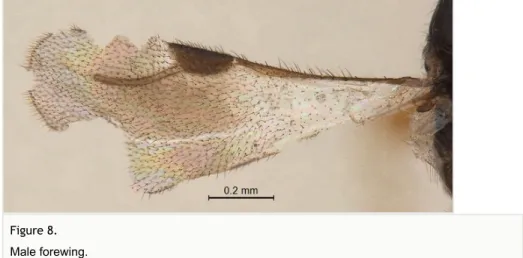
Coloration: Body blackish brown with head more darker; eyes and ocelli silvery with a bronze tinge; fore wing clear at base, with large infuscate area below pterostigma and radial vein extending to its posterior margin; scape, pedicel and A3 brownish yellow turning darker towards segments from A4 onwards; legs brownish yellow with coxae and posterior half of hind tibia blackish brown (Fig. 1); mandible light brown with darker distal extreme; pterostigma brown getting darker to wing margin; radial vein and costal vein pale brown (Fig. 8); body pubescence white.
Body: length: 1.52 mm.
Head: (length/width/height: 230/580/460); eye (length/width: 260/210); preoccipital crescent well-separated from posterior ocelli merging laterally into eye margin (Fig. 3); temple strongly carinated; preoccipital furrow present; ocellar triangle isosceles, narrow, short and raised; LOL
Antenna:(Fig. 2); very long (subequal to the body length) and slender; scape nearly 4 × longer than wide; pedicel small and almost globular; A3 highly slender, nearly 4.8 ×
Figure 7.
Male clypeus, anterior view.
longer than wide, subequal to scape; flagellar segments quasi cylindrical with very slight serrations basally; pubescence shorter than breadth of segments; length/width measurements of antennal segments: scape (252/66), pedicel (60/48), A3 (255/53), A4 (147/54), A5 (140/53), A6 (122/53), A7 (128/61), A8 (117/64), A9 (108/57), A10 (82/70), A11 (127/54).
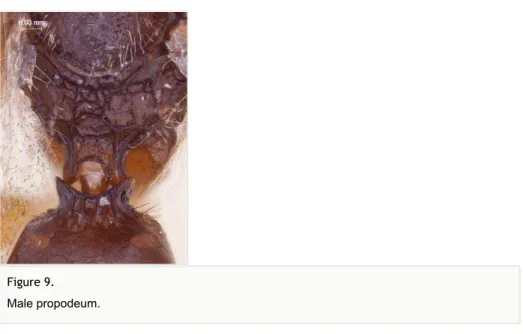
Mesosoma: (length/width/height: 610/450/460); mesosoma robust with very angular shoulders; alutaceous in sculpture; mesoscutum: (length/width: 230/440); mesoscutum nearly 2 × wider than long; lateral margin of mesoscutum posterior to anterior margin of notaulus convex; coarsely foveolate notaulices curve smoothly and converging posteriorly, meeting median furrow at transscutal articulation (Fig. 5); scutellum broadly rounded at apex with long hairs; axilliluar carinae present; metanotal-propodeal sulcus placed in regular intervals medially and with some longitudinal carina remote laterally (Fig. 9); propodeum unarmed, smooth and bare with sculpture effaced and with irregular carinae (Fig. 9) but stretched posteriorly into a inverted ‘U’ shaped narrow apex. Lateral propodeal carinae present. Propodeal spiracle large and conspicuous (Fig. 1); sternaulus absent (Fig. 6); anterior mesopleural sulcus and meso-metapleural sulcus distinct and foveolate; metapleuron bordered by incomplete carina; lower margin of mesopleuron and metapleuron with dense hairs.
Forewing: (Fig. 8); total wing length 1.25 mm. Pterostigma (length/width: 200/80) semielliptical, 2.4 × longer than wide. Radius (0.27 mm), slightly curved and 1.36 × the length of pterostigma; maximal width of fused costal and subcostal vein wider than radius; basal part with less hairs.
Metasoma: (Fig. 10); (length/width/height: 484/390/340); metasoma smooth; gastral collar well developed and widened more than that of propodeal strip, with syntergal translucent patch. Four strong transverse gastral carinae present on basal portion of
metasoma. A pair of paler gastrocoeli seen quite below gastral collar; largest tergite, T3 occupying 72% of metasomal length. Metasoma held in an elevated manner, above propodeal plane (Fig. 1) (best visible in lateral view). Genitalia with short basal ring, volsella widely separated basaly with long terminal setae on each parossiculi (Fig. 15) (harpe damaged).
Figure 10.
Male, metasoma dorsal view.
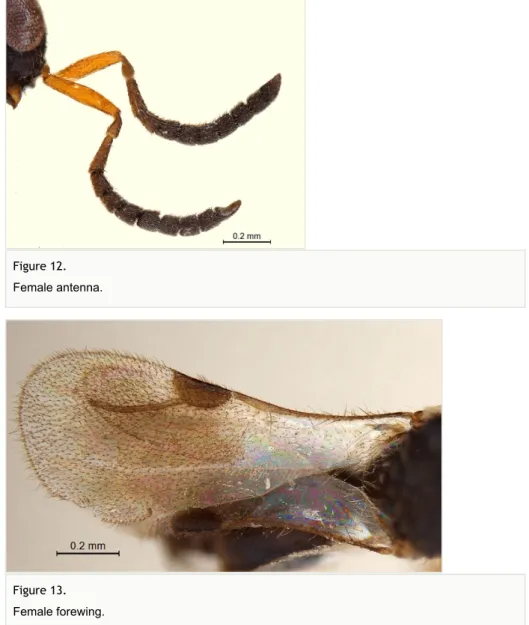
Figure 12. Female antenna.
Female (Paratype): Figs 11, 12, 13, 14.
Body length 1.68 mm. Body colouration and the morphological features of head, mesosoma and metasoma are the same as holotype, except the measurements of antennal segments, proportion of radius and pterostigma and length of metasoma.
Scape more than 4 × as long as wide and A3 more than 3 × as long as wide. Pedicel slender to succeeding antennal segments. Length/width measurements of antennal segments: scape (321/73), pedicel (103/51), A3 (170/51), A4 (97/65), A5 (86/79), A6 (83/90), A7 (90/87), A8 (79/84), A9 (80/85), A10 (87/78), A11 (124/68).
Figure 14.
Female, metasoma dorsal view.
Figure 15.
DFIm 52% of head width and fore wing infuscation much darker compared to paler infuscation in male fore wing. T3 occupying 57% of metasomal length.
Diagnosis
Conostigmus neotubifer sp. n. can be diagnosed by the following features.
Head transverse, wider than mesosoma. Male antenna subequal to body length with A3 highly slender, 4.8 × as long as wide and subequal to scape. Flagellar segments in male quasi cylindrical with very slight serrations basally. Female antenna with scape more than 4 × as long as wide and A3 more than 3 × as long as wide. Ocellar triangle isosceles, narrow based, short and raised in both sexes. Facial sulcus extending to intertorular carina in both sexes. Preoccipital furrow distinct. Supraclypeal furrow absent. DFIm 0.57% of head width in male and 0.52% of head width in female. Eyes densely pubescent. Dorsal margin of propodeal foramen ‘U’ shaped in dorsal view; median propodeal projection absent. Sternaulus absent. Metasoma dorsally elevated from the propodeal axis. Forewing infuscus, darker in female and paler in male.
Etymology
The species is named 'neotubifer', since this species resembles Conostigmus tubifer ('Neo' in Latin = 'new').
Distribution
INDIA, Andaman Nicobar island, Port Blair.
Biology
Unknown.
Discussion
Characters Conostigmus Dendrocerus C.neotubifer sp. n. C.tubifer
Ocellar triangle Usually with narrow base
Usually with broad base
Conostigmus Dendrocerus
Shape of head Usually globular Usually transverse Dendrocerus Dendrocerus
Intertorular carina Complete and with a median projection
Complete or incomplete but without a median projection
Conostigmus Conostigmus
Notauli Smoothly curved towards anterior angles of mesoscutum
Sharply angulate towards anterior angles of mesoscutum
Conostigmus Conostigmus
Mesoscutum Anteriorly narrowed Quadrate Dendrocerus Dendrocerus
Basal antennal segments of male
Cylindrical Serrate, triangular, ramose or quasi cylindrical
Quasi cylindrical as in Dendrocerus
Quasi cylindrical as in Dendrocerus
Shape of scutellum
Flat Convex or raised Conostigmus Conostigmus
Parossiculi Independent Fused Conostigmus Conostigmus
InC. neotubifersp. n., OOL > POL (ocellar triangle is narrow based), while inC. tubifer OOL C. tubifer in Dessart (1997), regarding ocelli, is a mismatch. In the description of the holotype male, Dessart clearly states, supported by numerical values, that the ocellar triangle is broad based, which is in contradiction to the medial placement of ocellar triangle in the illustration. As the holotype ofC. tubifercould not be traced, we had no means than to go by the descriptive part of the original literature, since it is supported by numerical values. Though NHM is mentioned as the type depository of C. tubifer, in Johnson and Musetti (2004) and Dessart (1997), on enquiry at NHM, we were informed that the types were never deposited there in reality.
In addition, the differences in the following characters also ensure that tubifer and neotubifer are not conspecific.
1. Forewing infuscation extending further to the distal margins beyond pterostigma and radius in C. neotubifer sp. n. (restricted under stigma and radius in C. tubifer). 2. Facial groove distinct in both sexes inC. neotubifersp. n. (inC. tubiferfacial groove
present in male and absent in female).
3. Pterostigma is 2.4 × longer than wide in C. neotubifersp. n. (only 2 × longer than wide in C. tubifer).
4. DFIm value is 52% in female in C. neotubifer sp. n. (46% in female in C. tubifer). 5. Scape and A3 of male subequal in length inC. neotubifersp. n. (inC. tubifer, A3 is
shorter (only 0.85 ×) than scape). Table 1.
6. InC. neotubifersp. n., A3 of female antenna is 3 × longer than wide and scape 2 × longer than A3 (inC. tubifer, A3 is only two 2 × longer than wide and scape is 4 × longer than A3).
Acknowledgements
The authors are grateful to the Director of the Zoological Survey of India, Kolkata and the Officer-in-Charge, ZSI, Western Ghat Regional Centre, Calicut, Kerala, for providing facilities and encouragement. Thanks are also due to Istvan Miko for his valuable help in interpreting the generic limits of Conostigmus and Dendrocerusand also for literature support. We are grateful to David Notton, for checking the availability of the types at the Natural History Museum, London. The authors profusely thank Dr. J Poorani, for sharing specimens for this study.
Author contributions
Bijoy C: Identification, species concept and imaging
Rajmohana K: Identification and species concept
Ramesh Kumar: Specimen collection and manuscript preparation
References
• Dahlbom AG (1858) Svenska sma-ichneumonerans familijer och slagten. Ofvers. K. Vet. Akad. Forh. 14: 289‑298.
• Dessart P (1995) Megaspilidae. In: Hanson P, Gauld ID (Eds) Hymenoptera of Costa Rica. Oxford University Press, Oxford, 893 pp.
• Dessart P (1997) Les Megaspilidae ni europieens, ni americains 1. Le genre Conostigmus
Dahlbom, 1858 (Hym. Ceraphronoidea Megaspilidae). Mem. Soc. R. Belge Entomol. 37: 144. • Dessart P, Cancemi P (1989) Trois especes nouvelles de Ceraphron a feutrage propodeal
(Hymenoptera Ceraphronoidea Ceraphronidae). Bull. Inst. R. Sci. Nat. Belg. 58: 95‑100. • Fergusson NDM (1980) A revision of the British species of Dendrocerus Ratzburg (Hymenoptera:
Ceraphronoidea) with a review of their biology as aphid hyperparasites. Bull. Brit. Mus. (Nat. Hist.) Entomol. 41: 255‑314.
• Johnson NF, Musetti L (2004) Catalog of systematic literature of the super family Ceraphronoidea (Hymenoptera). 33(2). Contributions of the American Entomological institute, 149 pp.
• Miko I, Deans AR (2009) Masner, a new genus of Ceraphronidae (Hymenoptera, Ceraphronoidea) described using controlled vocabularies. Zookeys 20: 127‑153. DOI: 10.3897/zookeys.20.119 • Ratzeburg JTC (1852) Die Ichneumonen der Forstinsecten in forstlicher und entomologischer