Address for correspondence Dr. Suchibrata Das
Department of Dermatology, Venereology and Leprosy,
NRS Medical College,
138 AJC Bose Rd, Kolkata 700014 Email: [email protected]
Original Article
Pattern of psychosexual disorders among male
patient attending dermatology OPD in a tertiary care
center - a descriptive study
Introduction
Psychosexual disorder (PSD) is a term which may simply refer to a sexual problem that is psychological, rather than physiological in
origin. "Psychosexual disorder" was a term used in Freudian psychology. Sigmund Freud has contributed to the idea of psychosexual disorders and furthered research of the topic through his ideas of psychosexual development and his psychoanalytic sex drive theory. Too much stimulation at a certain stage of development could lead to regression when that individual is in distress, also possibly leading to a psychosexual disorder.1 Behaviorists view
sexual dysfunction as the outcome of Saikat Banerjee, Suchibrata Das, Alok Kr. Roy
Department of Dermatology, Venereology and Leprosy, NRS Medical College, 138 AJC Bose Rd, Kolkata 700014
Abstract
Objective To evaluate the pattern of psychosexual disorder in male patient psychosexual disorders (PSDs) in male patientsMethods Male patients of 18 years and above who attended dermatology OPD for some psychosexual disorder were evaluated for the study. A complete demographic information including age, educational status, occupation, marital status was taken.
Results Total 364 patients with psychosexual problems were included. The mean age of patients was 35.47±11.83 years. The highest number of patients was of 26 to 40 years age group (46.2%). Premature ejaculation (PME) was the commonest PSD (35.2%), followed by erectile dysfunction (ED), (23.65%). Many patients had more than one type of PSDs, of them PME and ED combination the most prevalent (14.3%). Mental stress was very much related (64.8%) to PSDs and usually PSD pts consulted doctors for their problems(68.7%).In married patients, PME (64.41%) and ED (45.76%) whereas in unmarried this number was 29.69% and 25%, respectively. Dhat syndrome (DS) and nocturnal emission (NE) was mainly problem of the unmarried patients. Religion, background, literacy and economic status is not important factors for different types of PSDs .There is a trend of PSDs in different age group.
Conclusion The lack of education regarding sexual health may have been responsible for seeking help when the sexual situation arose after marriage. A more elaborative sexual education which would lead to timely medical consultation with qualified practitioner to deal the problem effectively is the need of the hour.
Key words
conditioned response and learned interpersonal behavior.2 Diagnosis of psychosexual
dysfunction may not be made if the sexual dysfunction is attributed entirely to organic factors or due to another Axis I mental disorder according to DSM-IV.
Sexual problems are highly prevalent in population but frequently underrecognised in clinical practice. In a study in rural South Indian population, the prevalence of male sexual disorders were 21.15%.3 Other available
community studies show the prevalence of male sexual disorders to be ranging from 10% to 52%.4,5
Even with increasing literacy, sex is still a taboo in India and sexual knowledge is poor among most of the individuals. The exact data regarding prevalence and comorbidity of psychosexual disorders with other conditions is inconsistent and is not well known in India, especially Eastern India. The purpose of the present study was to evaluate the pattern of psychosexual disorder in male patient attending dermatology OPD in a tertiary care center.
Methods
The current study was undertaken to estimate the prevalence of psycho-sexual disorders in a Dermatological OPD in a tertiary care hospital in Eastern India.
All male patients of 18 years and above attended in Dermatology OPD were evaluated for the study. Out of them, we assessed those patients who came to us with self-reported sexual problems. A complete demographic information including age, educational status, occupation, marital status was taken. All patients were asked about sexual development and any sex education patients had received and its source (relatives,
friends, audiovisual media, literature and others).
Detailed information regarding presenting complaints, sexual and marital history, family history was recorded. Patients were asked about premarital and extramarital sexual exposures.
A complete physical examination including general physical, detailed clinical examination of the secondary sexual characters and genitalia (penile shaft, testicular size etc.) and neurological examinations were done to rule out organic causes for their sexual complaints. Relevant investigations (of urine, blood, semen etc.) and specialist opinion were sought whenever required.
The globally recognized standard definitions and criteria were followed to diagnose the psychosexual disorders.
Details were recorded in a structured proforma and analyzed with MEDCAL Analytical software.
Results
A total 6640 male new patients of 18 years and above age group were attended in the dermatological OPD during 1st March upto 31st May 2016 period, out of them 364 patients with psychosexual problems were included. The socio-demographic pattern is shown in Table 1. The mean age of patients was 35.47±11.83 years. The highest number of patients was of 26 to 40 years age group (46.2%).
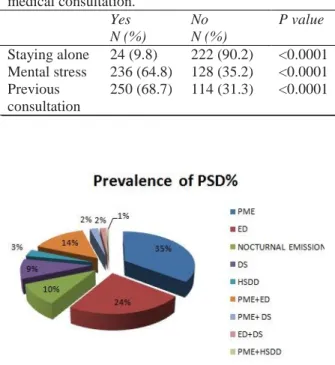
The pattern of PSDs is depicted in as follows
Table 1 Socio-demographic parameters of patients (n=364).
N (%) Age (years)
18-25 82 (22.5)
26-40 168 (46.2)
41-55 88 (24.2)
≥ 56 26 (7.1)
Religion
Hindu 198 (54.4)
Islam 160 (44.0)
Others 6 (1.6)
Background
Urban 259 (71.2)
Rural 105 (28.8)
Literacy
Illiterate 52 (14.3) Upto secondary 176 (48.4) Above secondary 136 (37.4) Marital status
Unmarried 128 (35.2)
Married 236 (64.8)
Economic status
Lower 126 (34.6)
Middle 234 (64.3)
Upper 4 (1.1)
Table 2 Relation with staying alone and stress and medical consultation.
Yes N (%)
No N (%)
P value
Staying alone 24 (9.8) 222 (90.2) <0.0001 Mental stress 236 (64.8) 128 (35.2) <0.0001 Previous
consultation
250 (68.7) 114 (31.3) <0.0001
DS: Dhat syndrome, ED: erectile disorder, HSDD: male hypoactive sexual desire disorder, PME: premature ejaculation.
Figure 1 Prevalence different of psychosocial disorders (n=364).
Though staying alone was not a contributory factor (9.8% patients were staying alone), but mental stress was very much related (64.8%) to PSDs and usually PSD patients consulted doctors repeatedly for their problems (68.7%)
(Table 2).
There was significant difference of PSDs between married and unmarried patients (Table 4). PME (64.4%) and ED (45.8%) were more frequent in married patients whereas in unmarried this number were 29.7% and 25%, respectively. DS and NE were mainly problem of the unmarried patients where 28.1% patients each were suffering in comparison to 5.9% and 2.11% in married group.
Religion, social background and literacy were not important factors for different types of PSDs
(Table 5, 6,7). Similarly, economic status was also not very much important for PSD (Table 8).
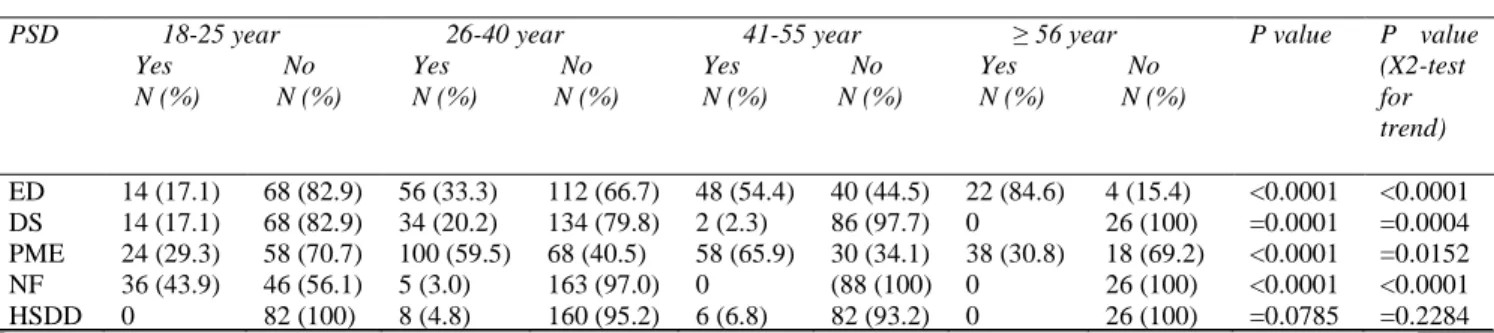
There was a trend of PSDs in different age group
(Table 9).
Discussion
Sexual dysfunctions were a major healthcare issue and therefore deserve a timely recognition, proper investigation and appropriate treatment.6
Table 3 Comparison of different psychosexual disorders (PSD) between married and unmarried patients.
Type of PSD Married Unmarried P value Contingency
coefficient
Yes No Yes No
PME 152 (64.4%) 84 (35.6%) 38 (29.7%) 90 (70.3%) <0.0001 0.310
ED 108 (45.8%) 128 (54.2%) 32 (5-25%) 96 (75%) =0.0002 0.0002
DS 14 (5.9%) 222 (94.1%) 36 (28.1%) 92 (71.9%) <0.0001 0.287
HSDD 8 (3.4%) 228 (96.6%) 6 (4.7%) 122 (95.3%) =0.7419 0.017
NE 5 (2.1%) 231 (97.9%) 36 (28.1%) 92 (71.9%) <0.0001 0.358
DS: Dhat syndrome, ED: erectile disorder, HSDD: male hypoactive sexual desire disorder, NE: nocturnal emission, PME: premature ejaculation.
Table 4Comparison of different psychosexual disorders in different religions.
Type of psychosexual disorder Hindu, N (%) Muslim, N (%) Others, N (%)
Erectile dysfunction 40 (20.2) 44 (27.5) 2 (33.3)
Dhat syndrome 20 (10.1) 12 (7.5) 2 (33.3)
Premature ejaculation 78 (39.4) 50 (31.2) 0
Nocturnal emission 20 (10.1) 14 (8.8) 2 (33.3)
Male hypoactive sexual desire disorder 2 (1) 1 (6.3) 0
Dhat syndrome + premature ejaculation 6 (3.0%) 4 (2.5) 0
Dhat syndrome + erectile dysfunction 2 (1.0) 4 (2.5) 0
Erectile dysfunction + premature ejaculation 28 (14.1) 22 (13.8) 0
Premature ejaculation + male hypoactive sexual desire disorder
2 (1.0) 0 0
Total 198 (54.4) 160 (44.0) 6 (1.6)
Table 5 Comparison of different psychosexual disorders (PSDs) with social background of patients.
Type of PSD Rural Urban P value Contingency
coefficient
Yes, N (%) No, N (%) Yes, N (%) No, N (%)
ED 42 (40) 63 (60) 98 (37.8) 161 (62.2) =0.7908 0.014
DH 12 (11.4) 93 (88.6) 38 (14.7) 221 (85.3) 0.5181 0.034
PME 64 (61.0) 41 (39.0) 126 (48.7) 133 (51.3) 0.0441 0.105
NE 5 (4.8) 100 (95.2) 36 (13.9) 223 (86.1) 0.0206 0.120
HSDD 8 (7.6) 97 (98.4) 6 (2.3) 253 (97.7) 0.0373 0.109
DS: Dhat syndrome, ED: erectile disorder, HSDD: male hypoactive sexual desire disorder, NE: nocturnal emission, PME: premature ejaculation.
Table 6 Comparison of different psychosexual disorders (PSDs) with level literacy.
PSD Illiterate Upto secondary Above secondary P value Contingency
coefficient
N (%) N (%) N (%) N (%) N (%) N (%)
ED 24 (46.1) 28 (53.9) 72 (40.9) 104 (59.1) 44 (32.3) 92 (67.7) 0.1430 0.103
DS 6 (11.5) 46 (88.5) 24 (13.6) 152 (86.4) 20 (14.7) 116 (85.3) 0.8516 0.03
PME 30 (57.7) 22 (42.3) 82 (46.6) 94 (53.4) 78 (57.4) 58 (42.7) 0.1168 0.108
NE 3 (5.8) 49 (94.2) 26 (14.8) 150 (85.2) 12 (8.8) 124 (91.2) 0.1028 0.111
HSDD 6 (11.5) 46 (88.5) 2 (1.1) 174 (98.9) 6 (4.4) 130 (95.6) 0.0026 0.178
DS: Dhat syndrome, ED: erectile disorder, HSDD: male hypoactive sexual desire disorder, NE: nocturnal emission, PME: premature ejaculation.
Table 7 Comparison of different psychosexual disorders (PSDs) with different age groups.
PSD 18-25 year
Yes No
N (%) N (%)
26-40 year
Yes No
N (%) N (%)
41-55 year
Yes No
N (%) N (%)
≥ 56 year
Yes No
N (%) N (%)
P value P value
(X2-test for trend)
ED 14 (17.1) 68 (82.9) 56 (33.3) 112 (66.7) 48 (54.4) 40 (44.5) 22 (84.6) 4 (15.4) <0.0001 <0.0001
DS 14 (17.1) 68 (82.9) 34 (20.2) 134 (79.8) 2 (2.3) 86 (97.7) 0 26 (100) =0.0001 =0.0004
PME 24 (29.3) 58 (70.7) 100 (59.5) 68 (40.5) 58 (65.9) 30 (34.1) 38 (30.8) 18 (69.2) <0.0001 =0.0152
NF 36 (43.9) 46 (56.1) 5 (3.0) 163 (97.0) 0 (88 (100) 0 26 (100) <0.0001 <0.0001
HSDD 0 82 (100) 8 (4.8) 160 (95.2) 6 (6.8) 82 (93.2) 0 26 (100) =0.0785 =0.2284
Table 8 Comparison of different psychosexual disorders (PSDs) with social background of patients.
PSD Illiterate Upto secondary Above secondary P value Contingency
coefficient
N (%) N (%) N (%) N (%) N (%) N (%)
ED 40 (31.8) 86 (68.2) 98 (41.9) 136 (58.1) 2 (50.0) 2 (50.0) 0.1510 0.101
DS 20 (15.9) 106 (84.1) 30 (12.8) 204 (87.2) 0 4 (100) 0.5252 0.059
PME 84 (66.7) 42 (33.3) 102 (43.6) 132 (56.4) 4 (100) 0 <0.0001 0.235
NF 8 (6.3) 118 (93.7) 33 (14.1) 201 (85.9) 0 4 (100) 0.0659 0.121
HSDD 4 (3.2) 122 (96.8) 10 (4.3) 224 (95.7) 0 4 (100) 0.8069 0.034
DS: Dhat syndrome, ED: erectile disorder, HSDD: male hypoactive sexual desire disorder, NE: nocturnal emission, PME: premature ejaculation.
In the study by Mittal et al.7 showed mean age of
PSD patients around 32 years (i.e. middle age group) with majority (80%) of the affected patients were married stating that sexual dysfunctions are mostly diagnosed during married life or phase of being sexually active.
Similarly in our study we found out that PME was the commonest PSD with only PME in 35.2% patients, and total 52.2% patients had PME with or without other PSD. PME was most prevalent in patients of 26 to 40 years age group (52.6%), followed by 41 to 55 years age group (30.5%). Factors associated with PME were literacy, (84.2%) literate patients in comparison with 15.8% illiterate patients), middle socioeconomic status (53.7% of middle socioeconomic and all patients of higher socioeconomic status), marriage (married patients 80%, unmarried 20%), and urban dwelling (66.3% urban than rural 33.7%).
In contrast to our study previous studies had noted Dhat Syndrome to be the most frequent form of psychosexual disorder in India.6 Few
studies have also observed ED to be the most frequent form of PSD. For example study performed by Avasthi et al.8 in 1994, in which
66 male patients with psychosexual dysfunction with respect to socio-demographic and clinical variables were included, 30% of patients were reported to have ED, 12% had PME and 45% presented with combination of ED and PME, and 9% with Dhat syndrome. In another study performed by Gupta et al.9 who clinically
assessed 150 patients attending dermatology outpatient department for psychosexual problems, the most common PSD was ED (34%) followed by PME (16.6%), Dhat syndrome (15.3%), and nocturnal emission (14%).9 Also in
a study performed by Bhatia et al.6 ED was
found to be second most common form of PSD.(19%). In our study 23.6% patients had ED and in association with other PSDs, 39.5% patients complained of ED. In ED patient group in our study, 45.8% were married, no difference between rural (40%) and urban (37.8%), mostly affected in 41 to 55 years age group (54.6% patients of this group) than 26 to 40 years age group (33.3% patients of this group had ED), illiterate patients suffered more (46.1% patients of this group) than literate group( 37.2% in literate group) and middle income group suffered more (41.9%) than lower income group (31.8%).
So in our study also ED has been complained by substantial number of patient though it was not the main complaint among the majority of patients like in above mentioned studies. But few studies have also supported our observation, like Verma et al.10 (1998) analyzed data on 1000
consecutive patients’ sexual disorders at All India Institute of Medical Sciences attending the psychosexual clinic. They found premature ejaculation (PME) (77.6%) and nocturnal emission (71.3%) frequent problems.
neurosis quite common in natives of the Indian subcontinent.11 Some studies referred it as the
commonest PSD. In Bhatia et al.6 62 (62.0%)
cases presented with Dhat syndrome. Dhikav et al.12 studied 30 patients with Dhat syndrome and
found that the mean age of onset was 19 years, with mean duration of the illness being 11 months. Twenty out of 30 patients met the diagnostic criteria for depression. A majority of the cases were unmarried (64.2%) and educated till 5th standard or above. Ten (33.3%) patients were found to have a comorbid problem of premature ejaculation and 10 (6.6%) patients reported erectile dysfunction. In our study, 13.1% patients were suffering from DS, out of them 9.3% had only DS as their PSD. The patients of 18 to 25 years and 26 to 40 years age group were suffered from it, a complaint of unmarried group (28.1% in unmarried in comparison to 5.9% in married group). Literacy (11.5% in illiterate group vs 16.4% in literate group), socioeconomic status (12.8% in middle income group vs 15.9% in low income group) and urban or rural background (11.4% rural vs 14.5%) did not affect much. So it is a relatively minor complaint in our study compared to previous studies. It may be attributed to better knowledge and understanding of the condition in recent years.
Additionally in our study, patients (6.81%) of 40 to 55 years age group and 4.8% patients of 26 to 40 age group complained of HSDD. Patients of younger age group did not complain of HSDD. Illiterate patients (11.5%) and rural (7.6%) patients had more complaint of HSDD than literate (2.6%) and urban (2.3%) patients. Nocturnal emission was purely a complain of young age (18 to 25 years) in our study with 43.0% patients of this age group had NE. Only 2.12% married patients had NE. It was more common in urban (13.7% urban patients compared to 4.8% rural patients had NE), literate (12.2% literate patients compared to
5.8% illiterate patients had NE) and middle income group patients (14.1% of middle income group in comparison to 6.3% of low income group had NE). As previously explained, study by Gupta et al.9 showed 14% patients had NE,
most of the patients were below 20 years of age, 76.2% patients were unmarried, majority were student. So in relation to NE, these findings are comparable to findings in our study.
Stress is very important associated factor of PSD. In our study, about 64.8% patients were suffering from different kind of mental stress and medical consultations were also taken by 68.7% patients before attending our hospital. This finding supports previous studies.13,14
Components of stress have been reported as interpersonal stress in 22%, financial stress in 52%, and occupational stress in 32% of patients.14 Patients usually take consultation
from physician before consulting to psychiatric care. This could be due to the significant stigma to consult a psychiatrist and also a general tendency to keep the sexual problems secretive.13
Conclusion
References
1. Freud S, editor. An Outline of Psychoanalysis, 23 edn. New York: WW Norton; 1940.
2. Annon JS. The Behavioural Treatment of Sexual Problems; Brief Therapy. New York: Harper & Row, 1976.
3. Sathyanarayana, Rao TS, Darshan MS, Tandon A. An epidemiological study of sexual disorders in south Indian rural population. Indian J Psychiatr. 2015;57:150-7.
4. Frank E, Anderson C, Rubinstein D. Frequency of sexual dysfunction in normal couples. N Engl J Med. 1978;299:111-5. 5. Rosen RC. Medical and psychological
interventions for erectile dysfunction: Toward a combined treatment approach. In: Leiblum SR, Rosen RC, editors. Principles and Practice of Sex Therapy. 3rd edn. New York: Guilford Press; 2000. pp. 276-304 6. Bhatia MS, Jhanjee A, Srivastava S. Pattern
of psychosexual disorders among males attending psychiatry OPD of a tertiary care Hospital. Delhi Psychiatry J. 2011;14:266-9. 7. Mittal AK, Gupta V, Kapoor A, Dang P. Sexual dysfunctions in rural population as
indicators of psychiatric and addiction problems. Int J Sci Study. 2014;2:86-90 8. Avasthi A, Basu D, Kulhara P, Banerjee ST.
Psychosexual dysfunction in Indian male patients: Revisited after seven years. Arch Sex Behav. 1994;23:685-95.
9. Gupta SK, Dayal S, Jain VK, Kataria U, Relhan V. Profile of male patients with psychosexual disorders. Indian J Sex Transm Dis. 2004;25:33-7.
10. Verma KK, Khaitan BK, Singh OP. The frequency of sexual dysfunctions in patients attending a sex therapy clinic in north India. Arch Sex Behav. 1998;27:309-14.
11. Wig NN. Problems of mental health in India. J Clin Social Psychol (India). 1960;17:48-53.
12. Dhikav V, Aggarwal N, Gupta S, Jadhavi R, Singh K. Depression in Dhat syndrome. J Sex Med. 2008;5:841-4
13. Verma R, Mina S, Shiraz Ul-Hassan, Balhara YPS. A Descriptive analysis of patients presenting to psychosexual clinic at a tertiary care center. Indian J Psychol Med. 2013;35:241-7.