DATABASE
PUG-View: programmatic access to chemical
annotations integrated in PubChem
Sunghwan Kim
†, Paul A. Thiessen
†, Tiejun Cheng , Jian Zhang , Asta Gindulyte and Evan E. Bolton
*Abstract
PubChem is a chemical data repository that provides comprehensive information on various chemical entities. It contains a wealth of chemical information from hundreds of data sources. Programmatic access to this large amount of data provides researchers with new opportunities for data-intensive research. PubChem provides several program-matic access routes. One of these is PUG-View, which is a Representational State Transfer (REST)-style web service interface specialized for accessing annotation data contained in PubChem. The present paper describes various aspects of View, including the scope of data accessible through View, the syntax for formulating a PUG-View request URL, the difference of PUG-PUG-View from other web service interfaces in PubChem, and its limitations and usage policies.
Keywords: PubChem, PUG-View, PUG-REST, Programmatic access, Web service
© The Author(s) 2019. This article is distributed under the terms of the Creative Commons Attribution 4.0 International License (http://creat iveco mmons .org/licen ses/by/4.0/), which permits unrestricted use, distribution, and reproduction in any medium, provided you give appropriate credit to the original author(s) and the source, provide a link to the Creative Commons license, and indicate if changes were made. The Creative Commons Public Domain Dedication waiver (http://creat iveco mmons .org/ publi cdoma in/zero/1.0/) applies to the data made available in this article, unless otherwise stated.
Introduction
PubChem (https ://pubch em.ncbi.nlm.nih.gov) [1–3] is a chemical data repository and open chemistry database that aims to provide comprehensive information on vari-ous chemical entities, including small molecules, siRNAs, miRNAs, carbohydrates, lipids, peptides, and chemically modified macromolecules. It is one of the most popular chemical information resources in the public domain, with millions of unique users per month. An overview of PubChem, including data sources, data contents, data organization, web-based tools and services, and pro-grammatic access, is given in our previous papers [1, 2].
PubChem contains a wealth of knowledge from hun-dreds of data sources, which are listed in the PubChem Sources page (https ://pubch em.ncbi.nlm.nih.gov/sourc es). Programmatic access to this large amount of data provides researchers with new opportunities for data-intensive research. PubChem provides several
pro-grammatic access routes [4], including NCBI’s Entrez
Utilities (E-Utilities) [5], Power User Gateway (PUG) [4],
PUG-SOAP [4], and PUG-REST [4, 6, 7]. Among these, PUG-REST [4, 6, 7] is the most heavily used, with mil-lions of daily requests from tens of thousands of unique IP addresses. PUG-REST is a Representational State Transfer (REST) [8, 9]—like web service interface to PubChem. It is designed to handle synchronous tasks, in which the output of the requests is returned to the user immediately, as opposed to a queuing system that requires the use of a polling scheme to check for com-pletion. In addition, because (almost) all necessary information for a PUG-REST request is encoded into a single-line uniform resource locator (URL), it is easy to use and learn relative to other programmatic access interfaces to PubChem that require prior knowledge of a PubChem-specific eXtensible Markup Language (XML) specification [10] or use of a Simple Object Access Proto-col (SOAP) envelope [11].
While a substantial amount of PubChem data is from voluntary data submission by individual data deposi-tors, PubChem also collects information from authori-tative and manually curated third-party information sources—what PubChem calls annotations. These pri-marily textual, non-archival annotations cover a wide range of subject fields, including pharmacology, drug target information, toxicology, safety and handling information, patents, environmental health, regulatory
Open Access
*Correspondence: [email protected]
requirements, and many others. They are presented in PubChem web pages, such as the Compound Summary page for a given chemical, which provides a compre-hensive and aggregated view of the information
avail-able in PubChem for that chemical [2]. Because the
existing web service interfaces in PubChem (including PUG-REST) were not designed to handle this type of data appropriately, PubChem developed a new REST-style interface, called PUG-View, which serves infor-mation needed to render interactive web pages but that also allows one to programmatically access the chemi-cal annotations and summary information in PubChem. The present paper will describe important aspects of PUG-View, including the scope of data accessible through View, the syntax for formulation a PUG-View request URL, difference of PUG-PUG-View from other web service interfaces in PubChem, and its limitations and usage policies.
Construction and content PUG‑View URL syntax
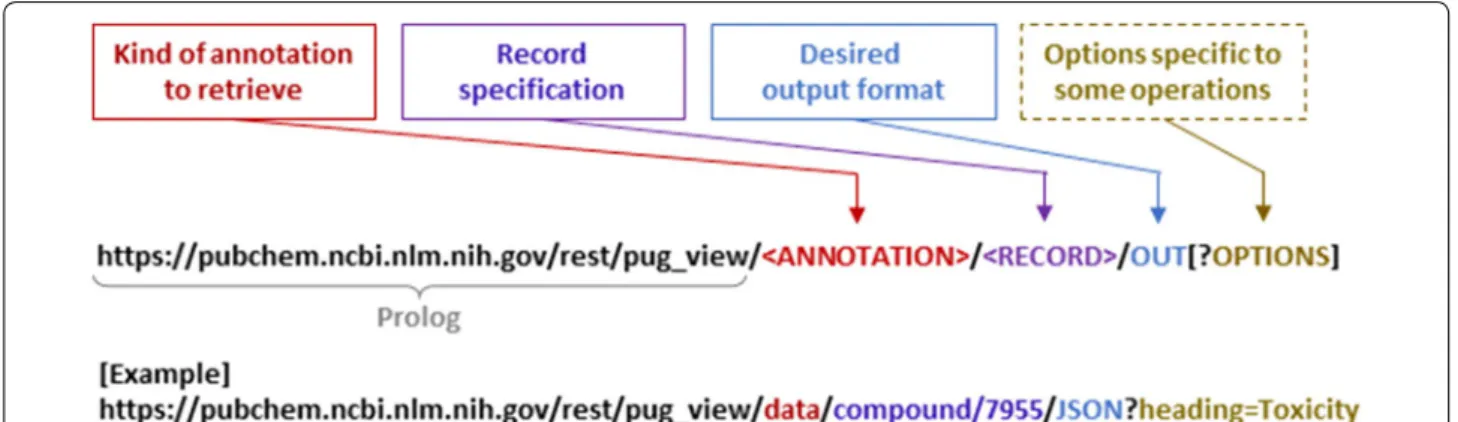
Figure 1 shows the general URL syntax for a PUG-View
request. With a few exceptions (to be discussed later), almost all PUG-View requests require three pieces of information: (1) the type of annotations to retrieve, (2) the specification of the record of interest, and (3) the desired output format. In PUG-View, these three pieces are encoded in a single, one-line URL. Some requests need additional information, which can be specified as optional parameters (Table 1).
PUG-View provides annotation data in several formats, including XML [10], JavaScript Object Notation (JSON) [12], JSON with padding (JSONP) [13], or Abstract Syn-tax Notation One (ASN.1) [14, 15] as text (ASNT) or binary (ASNB). Non-textual annotations (e.g., images) may be present in other formats, such as Scalable
Vec-tor Graphics (SVG) [16] or Portable Network Graphics
(PNG) [17]. The XML schema for the PUG-View
annota-tion data is available at the following URL:
Fig. 1 URL construction of a typical PUG-View request. A typical PUG-View request URL encodes three pieces of information (the kind of annotation to retrieve, the record specification, and the desired output format) into one-line URL. Optional parameters specific to some requests may be added to the URL after the question mark (“?”). The available values for the ⟨ANNOTATION⟩ part are “data”, “index”, “annotations”, “categories”, “neighbors”, “literature”, “structure”, “image”, “qr”, and “linkout”
Table 1 Optional parameters used in PUG-View requests
Parameter Value Description
Page n (integer) Retrieves the nth page of the output data when the data is paginated. This option is useful when downloading the annotations under a specific heading for all compounds
Version n (for a substance)
n.m (for an assay) Retrieves the data for a particular version of a substance or assay record. A version number for a substance is an integer. A version number for an assay record is in the form of n.m (where both n and m are integers) Heading (Sub)heading name Retrieves data presented in a specified (sub)heading. If the (sub)heading name provided as an optional
param-eter (i.e., as a URL argument) contains the “space” character, it may be replaced with a plus (“+”) character Source Data source name Retrieves annotation data from a specified source
Callback func JSONP callback function name, used mainly in dynamic data retrieval by JavaScript
Response_type Save or display Save the returned data (for response_type = save) or displays them on the web browser (for response_ type = display)
https ://pubch em.ncbi.nlm.nih.gov/pug_view/pug_ view.xsd.
Note that the JSON and ASN.1 formats follow the same content model, but we do not provide a JSON schema or hyper-schema.
More detailed explanation on how to formulate PUG-View request URLs for specific tasks is provided below, along with examples.
Full (text) annotations for a given record
As explained elsewhere [2], PubChem data are
organ-ized into three inter-linked databases: Compound, Sub-stance, and BioAssay, and each record in these databases is assigned a numeric identifier [called Compound ID (CID), Substance ID (SID), or Assay ID (AID), depending on the type of the record]. Each record has a dedicated web page that presents information available for that record in PubChem. This page is called the Compound Summary, Substance Record, or BioAssay Record page,
depending on the type of the record [2]. The
annota-tions presented on this page can be retrieved using the following URLs (with CID 1983, SID 46506142, and AID 1259416 as examples).
• For the Compound Summary page (CID 1983) https ://pubch em.ncbi.nlm.nih.gov/rest/pug_view/ data/compo und/1983/JSON
• For the Substance Record page (SID 46506142) https ://pubch em.ncbi.nlm.nih.gov/rest/pug_view/ data/subst ance/46506 142/JSON
• For the BioAssay Record page (AID 1259416) https ://pubch em.ncbi.nlm.nih.gov/rest/pug_view/ data/assay /12594 16/JSON
It is noteworthy that only a single record can be encoded in a PUG-View request URL. PUG-View is also used as the backend service to retrieve the data that are presented on the Summary page for a given compound (or the Record page for a given substance or bioassay), and so is optimized for individual record retrieval, rather than as a bulk service.
The PubChem Laboratory Chemical Safety Summary (LCSS) [18, 19] provides a concise view of the health and safety data for a given compound. The data presented on the LCSS page is a subset of those presented on the Com-pound Summary page of the corresponding chemical. One can retrieve these LCSS data by using an optional param-eter to PUG-View (Table 1), as shown in this example:
https ://pubch em.ncbi.nlm.nih.gov/rest/pug_view/data/ compo und/887/JSON?toc=LCSS+TOC.
This example returns the health and safety data for CID 887 (methanol).
It is possible to retrieve a previous version of depositor-provided data for a substance record or assay record by specifying the version number as an optional parameter (Table 1), as shown in the following examples:
https ://pubch em.ncbi.nlm.nih.gov/rest/pug_view/data/ subst ance/46507 068/JSON?versi on=2,
https ://pubch em.ncbi.nlm.nih.gov/rest/pug_view/data/ assay /369/JSON?versi on=1.1
In addition to the Summary and Record pages, PubChem provides data-centric view pages, including the Patent View and Target View pages [1]. The Patent View page for a given patent provides compounds and substances mentioned in it, along with other information including patent title, abstract, application/publication dates, applicant and inventor. The Target View page for a given gene or protein provides a “target-centric” view of PubChem data pertinent to a given gene or protein target, including the chemicals tested against the target and biological assay experiments performed against the target, along with the annotated information about the target collected from authoritative sources. The anno-tated information presented on these View pages are also available for programmatic access through PUG-View, as shown in the examples below:
• Patent View (US4681893)
https ://pubch em.ncbi.nlm.nih.gov/rest/pug_view/ data/paten t/US468 1893/JSON
• Gene Target View (Gene ID 3269)
https ://pubch em.ncbi.nlm.nih.gov/rest/pug_view/ data/gene/3269/JSON
• Protein Target View (accession P35367)
https ://pubch em.ncbi.nlm.nih.gov/rest/pug_view/ data/prote in/P3536 7/JSON
Note that the request URLs for the gene and protein targets use the NCBI Gene ID (3269) and protein acces-sion identifier (P35367), respectively, which correspond to the human histamine receptor H1 (HRH1) gene and its encoded protein.
Particular type of (text) annotations for a given record The annotations presented under a given (sub)heading of the Summary/Record or View page can be retrieved by specifying the (sub)heading of interest as an optional
parameter (Table 1). For example, the following two
URLs retrieve the annotations specified:
• Experimental properties of CID 1983
https ://pubch em.ncbi.nlm.nih.gov/rest/pug_view/ data/compo und/1983/JSON?headi ng=Exper iment al+Prope rties
https ://pubch em.ncbi.nlm.nih.gov/rest/pug_view/ data/compo und/1983/JSON?headi ng=Solub ility .
Note that the space between the two words in “Experi-mental Properties” is replaced with the “+” character
(this is standard URL encoding). Section headings that can be used in PUG-View data retrieval can be found in the PubChem Compound TOC tree (using the PubChem Classification Browser [2]:
https ://pubch em.ncbi.nlm.nih.gov/class ifica tion/#hid=72).
The above two PUG-View request URLs assume that CID 1983 has annotations in the “Experimental Prop-erties” and “Solubility” sections. If the compound does not have any data to present in that section, the requests would return an error message. The presence (or absence) of the desired annotations for a given compound can be checked through a PUG-View request that retrieves the available (sub)headings for that compound without get-ting all annotations. This can be done using the following URL (with CID 1983 as an example):
• Available (sub)headings (“indices”) for CID 1983 https ://pubch em.ncbi.nlm.nih.gov/rest/pug_view/ index /compo und/1983/JSON
Essentially, this request returns the Table of Contents for the Summary page of CID 1983, without the entire data content of the record.
Particular type of (text) annotation for all records
PUG-View allows users to retrieve a specific type of annotation for all records. For example, the following URLs allow one to download all viscosity measurements, with links to primary PubChem records:
https ://pubch em.ncbi.nlm.nih.gov/rest/pug_view/ annot ation s/headi ng/Visco sity/JSON,
https ://pubch em.ncbi.nlm.nih.gov/rest/pug_view/ annot ation s/headi ng/JSON?headi ng=Visco sity.
The two URLs are equivalent to each other, returning the same result. The heading name in the URL is
case-insensitive. However, if the heading name contains a spe-cial character that is not compatible with the URL syntax (e.g., a forward slash), the heading must be provided as an optional parameter (Table 1):
https ://pubch em.ncbi.nlm.nih.gov/rest/pug_view/ annot ation s/headi ng/JSON?headi ng=formu latio ns/
prepa ratio ns.
Note that the request URLs for bulk download of spe-cific annotation data are exceptions to the URL syntax presented in Fig. 1, in the sense that these URLs do not contain a specific input record identifier.
Some annotation data in PubChem are from multiple data sources, and it is possible to retrieve the annotation data from a specific data source by providing the source name as an optional parameter (Table 1) in a PUG-View request. For instance, the following request returns the octanol–water partition coefficient (log P) data from DrugBank [20]:
https ://pubch em.ncbi.nlm.nih.gov/rest/pug_view/ annot ation s/headi ng/JSON/?headi ng=LogP&sourc e=DrugB ank.
Some headings have so much annotation data that it is not possible to retrieve all of them through a single PUG-View request. Like PUG-REST, a PUG-PUG-View request has a maximum time limit of 30 s. If a PUG-View request exceeds this, a time-out error is returned. To circumvent time-out errors, the returned data have “TotalPage” and “Pages” values provided. These indicate the total page count of the annotations data and the current page num-ber of the returned data, respectively. By default, only the data on the first page is returned and subsequent pages (up to the “TotalPages” limit) can be accessed by adding a page argument (Table 1). For example, the following URL returns page 212 of the CAS registry number data (among the total of > 1000 pages):
https ://pubch em.ncbi.nlm.nih.gov/rest/pug_view/ annot ation s/headi ng/CAS/JSON?page=212.
One should check the “TotalPages” number of the returned annotation data to see if more data is available. In addition, when retrieving annotation data through multiple PUG-View calls, users should throttle their requests not to overload PubChem servers (to be dis-cussed later in more detail). Some fields are too numer-ous to be downloaded in bulk through PUG-View calls (e.g., synonyms, InChI strings, associated patents for all compounds). Such information should be downloaded via the PubChem FTP site
(ftp://ftp.ncbi.nlm.nih.gov/pubch em/ or https ://ftp. ncbi.nlm.nih.gov/pubch em/).
Special reports
In addition to serving out general record summary data blobs, PUG-View also handles a variety of special reports for more specialized data, each with its own unique data model that is different from the generic summary record. These are described in the following sections.
Substances by category
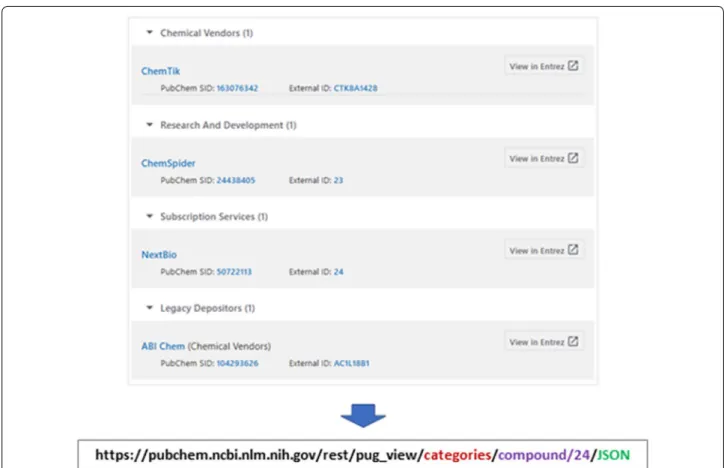
The Summary page of each compound has the “Sub-stances by Categories” section, which presents the associ-ated substance records classified according to the source category (Fig. 2). For example, the following URL directs to the “Substances by Categories” section for CID 24.
The data presented in this section can be retrieved using the following PUG-View request URL:
https ://pubch em.ncbi.nlm.nih.gov/rest/pug_view/categ ories /compo und/24/JSON.
Related compounds with annotation
For each compound, PubChem pre-computes its “neigh-bors”, which are structurally similar compounds in terms of 2-D and 3-D similarity measures, as described in detail elsewhere [21–24]. If these neighbors have pre-defined types of annotations (such as medications, liter-ature, 3-D structure, bioactivities, and patents), they are presented in the “Related Compounds with Annotation” section of the Summary page of the compound, as in the following example (for CID 60823):
https ://pubch em.ncbi.nlm.nih.gov/compo und/60823 #secti on=Relat ed-Compo unds-with-Annot ation .
The data content presented in this section may be retrieved through PUG-View, using the following request URL:
https ://pubch em.ncbi.nlm.nih.gov/rest/pug_view/ neigh bors/compo und/60823 /JSON.
Note that this request returns only the neighbors with pre-defined types of annotations. To get all neighbors for a given compound (regardless of whether they have annotations or not), PUG-REST (not PUG-View) should be used as explained in previous papers [4, 6, 7].
Literature
As explained in a previous paper [25], PubChem contains a large amount of associations between chemicals and scientific articles. Some of these associations are derived by PubChem through matching between chemical names and MeSH terms associated with PubMed articles. The links to such articles for a given compound are available in the “NLM curated PubMed citations” section of the Com-pound Summary page, as shown in the following example:
ht t p s : / / p u b c h e m . n c b i . n l m . n i h . g o v / co mp o und/2244#secti on=NLM-Curat ed-PubMe d-Citat ions.
Note that the section allows one to retrieve not only all the relevant articles but also those indexed by the National Library of Medicine (NLM) with a particular MeSH subheading. One can get the links shown in this section via the following PUG-View request URL:
https ://pubch em.ncbi.nlm.nih.gov/rest/pug_view/liter ature /compo und/2244/JSON.
PubChem also collects some scientific articles for a given compound from curated sources, and they are dis-played in several sections of the Compound Summary page, such as the “Synthesis References”, “General Ref-erences”, and “Metabolite References”. These data can be retrieved through a PUG-View record retrieval with the desired (sub)heading specified as an optional parameter. For example, the following URL retrieves papers about the synthesis of CID 2244 (aspirin), presented in the “Synthesis Reference” section:
https ://pubch em.ncbi.nlm.nih.gov/rest/pug_view/data/ compo und/2244/JSON?headi ng=Synth esis+Refer ences .
Many chemical-literature associations in PubChem are submitted by individual data depositors and presented in the “Depositor Provided PubMed Citations”. These data may be retrieved through PUG-REST (not PUG-View). For example, the following URL retrieves the depositor-provided PubMed Citations for CID 2244:
https ://pubch em.ncbi.nlm.nih.gov/rest/pug/compo und/cid/2244/xrefs /PubMe dID/JSON.
3‑D protein‑bound structures
Some compounds in PubChem have experimental 3-D protein-bound structures, collected from Protein
Data Bank (PDB) [26] and Molecular Modeling
Data-base (MMDB) [27]. While MMDB collects and
anno-tates experimental structures deposited in PDB, the two resources provide slightly different sets of protein–ligand associations. PUG-View supports programmatic access to the list of the protein structures associated with a given chemical, collected from MMDB. For example, the following URL retrieves the MMDB protein structures with which CID 123631 has been co-crystalized:
https ://pubch em.ncbi.nlm.nih.gov/rest/pug_view/struc ture/compo und/12363 1/JSON.
Biologic description
The PubChem Compound database contains more than a half million biologic molecules, including short peptides, carbohydrates, lipids, nucleotides, etc. The Compound Summary page of a biologic displays a two-dimensional (2-D) structure representation in the “Biologic Descrip-tion” section, as shown in the following example (for CID 91848714):
https ://pubch em.ncbi.nlm.nih.gov/compo und/91848 714#secti on=Biolo gic-Descr iptio n.
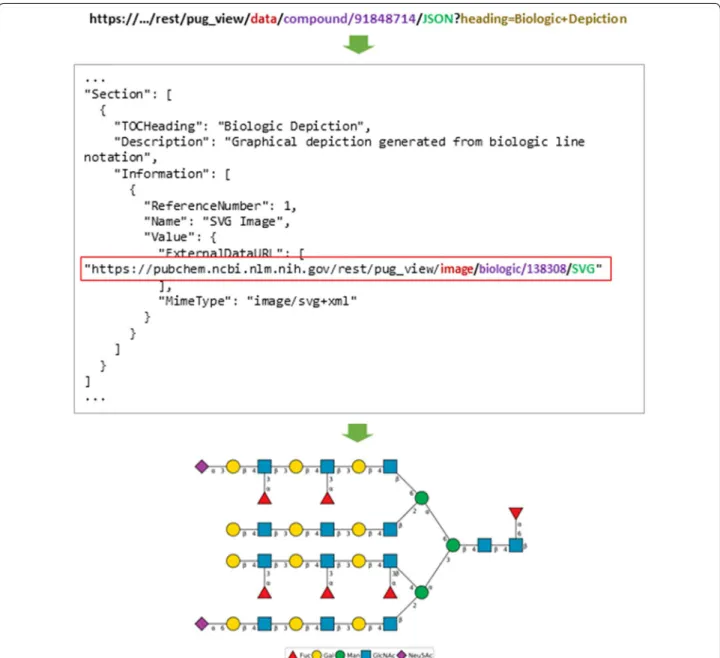
Retrieval of the biologic depiction image for a com-pound through PUG-View is a two-step process (Fig. 3). Each biologic molecule is assigned an internal identifier,
which can be found in the annotation data in the “Bio-logic Depiction” section, retrieved from a PUG-View request. For example, the internal biologic identifier for the above biologic structure (CID 91848714) can be retrieved via the URL:
https ://pubch em.ncbi.nlm.nih.gov/rest/pug_view/data/ compo und/91848 714/JSON?headi ng=Biolo gic+Descr iptio n.
Then, the retrieved internal identifier (138308) can be used to obtain the biologic depiction image in SVG for-mat, using the following URL:
https ://pubch em.ncbi.nlm.nih.gov/rest/pug_view/ image /biolo gic/13830 8/SVG.
Below is another example of the biologic depiction image retrieval for CID 56842075, whose internal identi-fier is 703612:
https ://pubch em.ncbi.nlm.nih.gov/rest/pug_view/ image /biolo gic/70361 2/SVG.
Note that the two biologic depiction examples given here return the images of different biologic types: car-bohydrate (for CID 91848714) and peptide (for CID 56842075).
Annotation attachments
Some annotation data in PubChem are files attached to a given record, such as spectral images. For example, CID 7510 has several mass spectral data (including meta data and spectral images). These can be accessed via its Com-pound Summary page using the URL:
ht t p s : / / p u b c h e m . n c b i . n l m . n i h . g o v / co mp o und/7510#secti on=Mass-Spect romet ry.
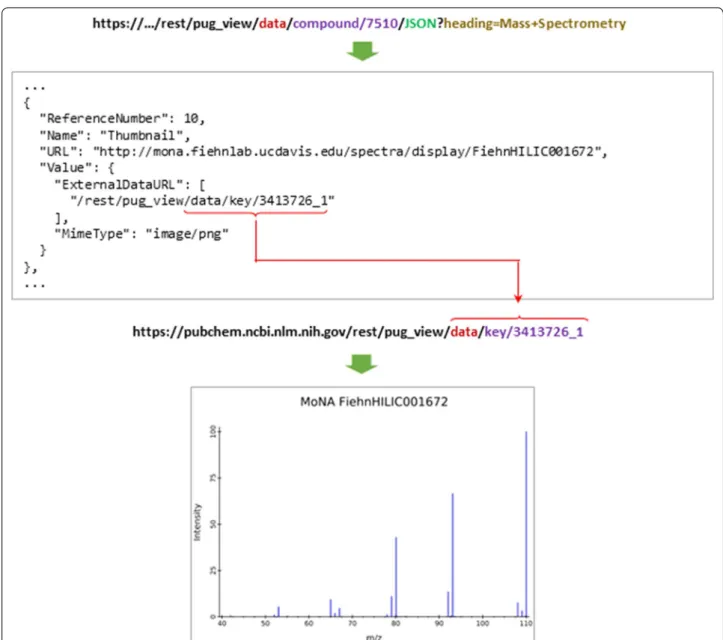
Accessing these spectral images through PUG-View is a two-step process (Fig. 4). Each spectral image on this page has a unique key, which can be found in the annota-tion data returned from the following PUG-View request:
https ://pubch em.ncbi.nlm.nih.gov/rest/pug_view/data/ compo und/7510/JSON?headi ng=Mass+Spect romet ry.
One of the keys from this request is “3413726_1” and it can be used in a subsequent PUG-REST request to retrieve the corresponding image, using the following URL:
https ://pubch em.ncbi.nlm.nih.gov/rest/pug_view/data/ key/34137 26_1.
Note that, because the returned data from this request is an existing file (in the Portable Network Graphics
(PNG) format [17]), the output format should not be
QR codes
Through PUG-View, one can generate the QR codes that provides a quick access to information for a given compound. For example, the QR codes generated from the following request URLs lead users to the PubChem Compound Summary page for CID 702 (ethanol), either directly or indirectly (via google):
https ://pubch em.ncbi.nlm.nih.gov/rest/pug_view/qr/ long/compo und/702/SVG, https ://pubch em.ncbi.nlm. nih.gov/rest/pug_view/qr/short /compo und/702/SVG.
The chemical QR code was developed to provide easy and quick access from mobile devices to chemical hazard and safety information for chemicals commonly used in the academic laboratory. It is possible to generate a QR code that encodes the link specifically to the PubChem
LCSS page [18, 19] of a chemical, as shown in this
example:
https ://pubch em.ncbi.nlm.nih.gov/rest/pug_view/qr/ long/compo und/702/LCSS/SVG.
Linkout
The NCBI LinkOut service [28] provides links between
records in the NCBI resources and those in various infor-mation resources beyond the NCBI systems. PUG-View can be used to retrieve a list of all the NCBI LinkOut data available for a compound record, as shown in this exam-ple (for CID 2244):
https ://pubch em.ncbi.nlm.nih.gov/rest/pug_view/linko ut/compo und/2244/JSON.
Utility and discussion Limitation of PUG‑View
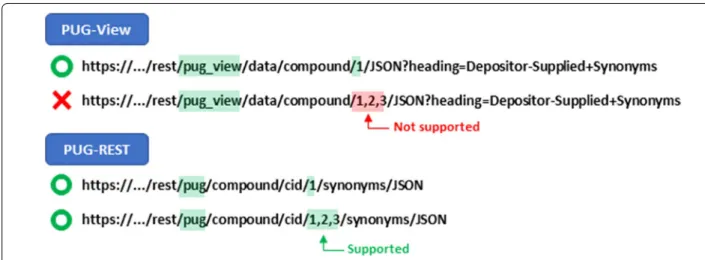
As mentioned previously, PUG-View is used as a backend service to serve the data presented on the interactive web Summary page of a PubChem record. Because this Sum-mary page presents information on a single record, PUG-View is designed to handle only one input identifier at a time. Therefore, PUG-View cannot take multiple record identifiers in the request URL (see Fig. 5).
Fig. 4 Retrieval of annotation attachments. Some annotations collected from authoritative sources are file attachments. Retrieving these
In addition, when accessing the annotation data for a compound, PUG-View primarily takes only the corre-sponding CID (rather than chemical names, International Chemical Identifier (InChI) [29, 30], InChIKeys [29, 30], Simplified Molecular Input Line Entry System (SMILES) [31–33] or other identifiers) in the request URL, because the CID is used as the primary record identifier (acces-sion) for the Compound database. Therefore, to get anno-tations corresponding to non-CID identifiers, they need to be converted to CIDs first (e.g., using PUG REST) and then those CIDs should be used in PUG-View requests.
It is also noteworthy that not all data presented on the Summary/Record/View page are necessarily avail-able through PUG-View. Some data are availavail-able only through PUG-REST (e.g., computed compound proper-ties) or some other backend service. The JSON/XML file returned from a PUG-View request for such data usually have nodes called “ExternalTableName” and “External-TableNumRows”, as exemplified in the output returned from the following request:
https ://pubch em.ncbi.nlm.nih.gov/rest/pug_view/data/ compo und/60823 /JSON?headi ng=Depos itor+Provi ded+PubMe d+Citat ions.
Such tables are also available programmatically but are beyond the scope of this paper. The nature of the content (non-archival data from contributors) is what sets PUG View apart from other PubChem content interfaces like PUG REST.
Comparison of PUG‑View with PUG‑REST
PUG-View can be easily confused with PUG-REST. Although both PUG-View and PUG-REST are REST-like interfaces, they aim to serve distinct kinds of data
in general. PUG-REST primarily provides access to data that can be readily structured, such as computed proper-ties of compounds, activity data for assays, associations (cross-references) between PubChem records and other resources, and so on. On the other hand, PUG-View is intended to support the retrieval of unstructured, largely textual annotation data (e.g., excerpts about handling or first aid procedure for a chemical). The data models for the JSON/XML returned by these services are also com-pletely different. In general, PUG-REST is intended to be used to grab small, specific bits of information; whereas PUG-View is used for larger reports, another reason that PUG-View does not handle multiple records in a single request.
Usage policies
All PUG-View requests are subject to a 30-s time limit. If a request takes longer than this 30-s limit for any reason, it will return an error message. Because this time limit would be an issue when downloading a large annotation data (e.g., specific annotation for all records), it is “pagi-nated” and should be retrieved through multiple requests using a loop.
PubChem often receives too many programmatic ser-vice requests (including PUG-REST and PUG-View), causing service interruptions. Therefore, as described
elsewhere [6], PubChem has usage policies on request
volume limits. The current limits are:
Note that, when PubChem gets an excessive number of service requests, these limits are tightened through a dynamic web-request throttling [6]. Users should mod-erate the speed at which requests are sent according to the traffic status information contained in the HTTP response header returned for PUG-View and PUG-REST requests. More detailed information can be found at the PubChem Help page
(https ://pubch emdoc s.ncbi.nlm.nih.gov/progr ammat ic-acces s$_Reque stVol umeLi mtati ons).
Conclusions
Third-party annotation content in PubChem has an ever-expanding scope and is increasingly provided for enti-ties beyond the archival records [assay (AID), substance (SID), and compound (CID)], including the recently released protein target, gene target, and patent data view pages. PUG-View allows one to programmatically access this annotation content in PubChem and is also used as a backend service to provide annotation content to display on the web Summary pages for PubChem records. PUG-View is available to the public free of charge.
Although both PUG-View and PUG-REST are REST-style interfaces, they serve different types of data and have different use cases. For example, while PUG-REST is best for accessing specific individual computed compound properties, PUG-View is geared towards retrieving full textual annotations and other longer specialized reports.
PUG-View has several limitations. For example, a PUG-View request cannot take multiple input record identifiers. In addition, annotation data under multiple headings for a given compound cannot be retrieved with a single request, unless the full annotation data retrieval is requested. Importantly, some specialized (especially tabular) data come from other backend service(s) and are not currently accessible through PUG-View.
Abbreviations
PUG: Power User Gateway; REST: Representational State Transfer [8, 9]; SOAP: Simple Object Access Protocol [11]; XML: eXtensible Markup Language [10]; URL: uniform resource locator; JSON: JavaScript Object Notation [12]; JSONP: JavaScript Object Notation with padding [13]; SVG: Scalable Vector Graphics [16]; ASN.1: Abstract Syntax Notation One [14]; CID: Compound ID; SID: Sub-stance ID; AID: Assay ID; PNG: Portable Network Graphics [17]; LCSS: Laboratory Chemical Safety Summary [18, 19]; SMILES: Simplified Molecular Input Line Entry System [31–33]; InChI: International Chemical Identifier [29, 30].
Acknowledgements
We thank all PubChem users, contributors, and collaborators. We also thank the anonymous reviewers for their valuable remarks.
Authors’ contributions
PT developed and maintains PUG-View. AG contributed to PUG-View design discussions while developing the framework which reads data provided by PUG-VIEW and renders interactive web pages. SK wrote an initial draft and SK, PT, and EB revised it. All authors read and approved the final manuscript.
Funding
This research was supported by the Intramural Research Program of the National Library of Medicine, National Institutes of Health, US Department of Health and Human Services.
Availability of data and materials
PUG-View is provided to the public free of charge.
Ethics approval and consent to participate
Not applicable.
Competing interests
The authors declare that they have no competing interests.
Received: 5 May 2019 Accepted: 29 July 2019
References
1. Kim S, Chen J, Cheng T, Gindulyte A, He J, He S, Li Q, Shoemaker BA, Thiessen PA, Yu B, Zaslavsky L, Zhang J, Bolton EE (2019) PubChem 2019 update: improved access to chemical data. Nucleic Acids Res 47:D1102–D1109
2. Kim S, Thiessen PA, Bolton EE, Chen J, Fu G, Gindulyte A, Han LY, He JE, He SQ, Shoemaker BA, Wang JY, Yu B, Zhang J, Bryant SH (2016) PubChem substance and compound databases. Nucleic Acids Res 44:D1202–D1213 3. Kim S (2016) Getting the most out of PubChem for virtual screening.
Expert Opin Drug Discov 11:843–855
4. Kim S, Thiessen PA, Bolton EE, Bryant SH (2015) SOAP and PUG-REST: web services for programmatic access to chemical information in PubChem. Nucleic Acids Res 43:W605–W611
5. Entrez programming utilities help. https ://www.ncbi.nlm.nih.gov/ books /NBK25 501/. Accessed 6 Mar 2019
6. Kim S, Thiessen PA, Cheng TJ, Yu B, Bolton EE (2018) An update on PUG-REST: RESTful interface for programmatic access to PubChem. Nucleic Acids Res 46:W563–W570
7. Kim S, Thiessen PA, Bolton EE (2019) Programmatic retrieval of small molecule information from PubChem using PUG-REST. In: Kutchukian PS (ed) Chemical biology informatics and modeling. Humana Press, New York
8. Fielding RT, Taylor RN (2000) Principled design of the modern web architecture. In: Proceedings of the 22nd international conference on software engineering, pp 407–416
9. Fielding RT (2000) Representational state transfer (REST). Architectural styles and the design of network-based software architectures. Univer-sity of California, Irvine
10. Extensible Markup Language (XML). https ://www.w3.org/XML/. Accessed 6 Mar 2019
11. Simple Object Access Protocol (SOAP) Specifications. https ://www. w3.org/TR/soap/. Accessed 6 Mar 2019
12. JavaScript Object Notation (JSON). http://www.json.org/. Accessed 6 Mar 2019
13. JSONP. https ://en.wikip edia.org/wiki/JSONP . Accessed 5 Apr 2019 14. ASN.1 File Format (Summary). https ://www.ncbi.nlm.nih.gov/Struc ture/
asn1.html. Accessed 6 Mar 2019
15. Abstract Syntax Notation One. https ://en.wikip edia.org/wiki/Abstr act_Synta x_Notat ion_One. Accessed 6 Mar 2019
16. Scalable Vector Graphics (SVG). https ://www.w3.org/Graph ics/SVG/. Accessed 6 Mar 2019
17. PNG (Portable Network Graphics) Home Site. http://www.libpn g.org/ pub/png/. Accessed 6 Mar 2019
18. Laboratory Chemical Safety Summary (LCSS). https ://pubch emdoc s.ncbi.nlm.nih.gov/lcss. Accessed 6 Mar 2019
•fast, convenient online submission •
thorough peer review by experienced researchers in your field • rapid publication on acceptance
• support for research data, including large and complex data types •
gold Open Access which fosters wider collaboration and increased citations maximum visibility for your research: over 100M website views per year •
At BMC, research is always in progress.
Learn more biomedcentral.com/submissions
Ready to submit your research? Choose BMC and benefit from: 20. Wishart DS, Feunang YD, Guo AC, Lo EJ, Marcu A, Grant JR, Sajed T,
Johnson D, Li C, Sayeeda Z, Assempour N, Iynkkaran I, Liu YF, Maciejew-ski A, Gale N, Wilson A, Chin L, Cummings R, Le D, Pon A, Knox C, Wil-son M (2018) DrugBank 5.0: a major update to the DrugBank database for 2018. Nucleic Acids Res 46:D1074–D1082
21. Bolton EE, Chen J, Kim S, Han LY, He SQ, Shi WY, Simonyan V, Sun Y, Thiessen PA, Wang JY, Yu B, Zhang J, Bryant SH (2011) PubChem3D: a new resource for scientists. J Cheminform 3:32
22. Kim S, Bolton EE, Bryant SH (2011) PubChem3D: shape compatibility filtering using molecular shape quadrupoles. J Cheminform 3:25 23. Bolton EE, Kim S, Bryant SH (2011) PubChem3D: similar conformers. J
Cheminform 3:13
24. Kim S, Bolton EE, Bryant SH (2016) Similar compounds versus similar conformers: complementarity between PubChem 2-D and 3-D neigh-boring sets. J Cheminform 8:62
25. Kim S, Thiessen PA, Cheng T, Yu B, Shoemaker BA, Wang JY, Bolton EE, Wang YL, Bryant SH (2016) Literature information in PubChem: associa-tions between PubChem records and scientific articles. J Cheminform 8:32
26. Berman HM, Westbrook J, Feng Z, Gilliland G, Bhat TN, Weissig H, Shin-dyalov IN, Bourne PE (2000) The Protein Data Bank. Nucleic Acids Res 28:235–242
27. Madej T, Lanczycki CJ, Zhang DC, Thiessen PA, Geer RC, Marchler-Bauer A, Bryant SH (2014) MMDB and VAST+: tracking structural similarities between macromolecular complexes. Nucleic Acids Res 42:D297–D303 28. NCBI LinkOut. https ://www.ncbi.nlm.nih.gov/proje cts/linko ut/.
Accessed 6 Mar 2019
29. Heller SR, McNaught A, Pletnev I, Stein S, Tchekhovskoi D (2015) InChI, the IUPAC international chemical identifier. J Cheminform 7:23 30. Heller S, McNaught A, Stein S, Tchekhovskoi D, Pletnev I (2013) InChI—
the worldwide chemical structure identifier standard. J Cheminform 5:7
31. Weininger D (1988) SMILES, a chemical language and information-system. 1. Introduction to methodology and encoding rules. J Chem Inf Comput Sci 28:31–36
32. Weininger D, Weininger A, Weininger JL (1989) SMILES. 2. Algorithm for generation of unique smiles notation. J Chem Inf Comput Sci 29:97–101 33. Weininger D (1990) SMILES. 3. DEPICT—graphical depiction of chemical
structures. J Chem Inf Comput Sci 30:237–243
Publisher’s Note