Chapter 4. Options for Service Coordination
INTRODUCTION
There are currently more than seventeen agencies offering transportation services in the Greater Derry-Salem area. Each has its own mission, equipment, eligibility requirements, funding sources, and institutional objectives. All of the providers report that their transportation needs are being met somewhat well or very well. However, while providers only report turning away a limited number of clients in a week, estimates of the various transportation dependent
populations in the region suggest a level of need much higher than the current level of service. The following pages outline costs and benefits of service coordination, coordination models that could be applied in the region, and criteria for selecting a coordinating host agency.
BENEFITS OF COORDINATION
Coordination can improve the performance of individual transportation providers as well as the overall mobility within the region. A regional coordinated service can achieve economies of scale in many areas by consolidating client intake, reservations, scheduling, and dispatching functions. Joint purchase of maintenance services, fuel, and items like scheduling software can also save money. Greater efficiency can stretch the limited funding and personnel resources available to the agencies in the region in a number of ways:
• Reducing duplication of effort in terms of staff time devoted to intake, scheduling, dispatching, and other administrative functions.
• Making more efficient use of vehicles by increasing the number of riders per trip. • Streamlining the reimbursement billing process for Medicaid and other funding sources
through the use of paratransit scheduling and tracking software, thus allowing providers to cost-effectively access critical funding.
Another benefit related to funding service is that centralized tracking of trip information allows providers to more easily demonstrate their impact and effectiveness when they pursue funding. An innovative coordinated system will help providers access funding that may not be available to them for general operation of individual vans.
COSTS OF COORDINATION
In terms of overall dollars going to transportation services, a coordinated system will initially be more expensive than the status quo, as funding will need to be secured to establish and staff the call center. It is unlikely to free up funding to be shifted to other services beside transportation. In the long run, though, it will reduce unit cost per ride and overall cost effectiveness. It will also expand the region's ability to secure funding for transportation, thus expanding the ability to provide service.
Securing this start-up funding will not be easy to achieve, even with a strong model and
committed partners. Concord Area Transit and the Community Providers Network are finding this out as they try to implement their coordination plan for Merrimack County. Funds through
NHDOT and NHDHHS may be more readily available in the coming years, as these agencies are now working to coordinate their programs and funding streams. In the meantime, the most likely source of funding for establishing a call center or brokerage will likely be private foundation funding.
ALTERNATIVE MODELS FOR COORDINATION
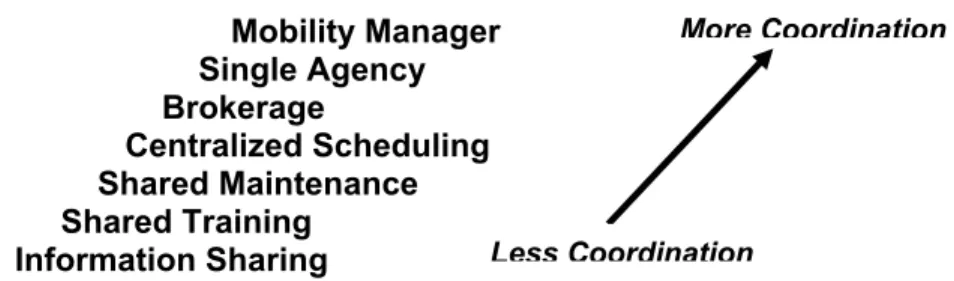
The Community Transportation Association of America describes what it calls the "Coordination Continuum" pictured in Figure 4.1. Coordination can range from simple cooperation, in terms of sharing information, up to full centralization of all transportation services with a single agency. Figure 4.1 - The Coordination Continuum
More Coordination Mobility Manager
Single Agency Brokerage
Centralized Scheduling Shared Maintenance Shared Training
Less Coordination Information Sharing
While there is a benefit to any level of coordination, the real benefits in terms of eliminating duplication of effort and reducing unit costs per ride are realized once major functions such as eligibility processing, scheduling, dispatching, billing, and funding administration are
centralized. Most coordinated systems use one of the three models at the top of the list -
brokerage, single agency, or mobility manager. These three models, and a fourth that centralizes scheduling and dispatching, are described in the following pages.
The two models at the top of the list in Figure 4.1, single agency control and mobility
management, involve consolidation of transportation services. In these approaches, all human service transportation in the region would be managed by a single agency. Vehicles previously operated by other providers in the region would be shifted to the central agency to operate and maintain. This sort of centralization provides perhaps the greatest opportunities for improving service consistency, quality, and cost effectiveness, as duplication of effort among agencies is eliminated. However, depending on the existing mix of transportation provider agencies in a region, this sort of centralization is not always the most effective or feasible approach. The potential drawbacks of these models are also discussed below.
Single Agency Control
Under the single agency control model one agency provides all transportation services for individuals in the region. Other agencies participating in the coordinated system contract with this lead agency to meet their transportation needs. This approach is very efficient in terms of centralized management and operations. However, it is usually used only where there is a strong existing regional transit agency that already provides much of the transit service in a region. While several providers have expressed an interest in contracting out their transportation services, consolidation to a single provider is not feasible in the region.
Mobility Manager
The mobility manager model takes the single agency model one step further by centralizing provision of all modes of transit in the region. The mobility manager not only provides all
demand response service in the region, but also provides fixed route transit service, and serves as the clearinghouse for information on vanpool and carpool ridematching.
Given the large number of demand-response providers in the region, the important role played by existing volunteer networks in the region, and the lack of a single dominant transit agency, we believe that the single agency and mobility manager models are not appropriate models for the Derry Salem area at this point. The following pages describe in detail two models which may be appropriate for the region: the brokerage model, and a somewhat less sophisticated call center model that would coordinate scheduling and dispatching but would not centralize billing. Brokerage Model
Under a brokerage the overall management of the transit system is consolidated, but the vehicle fleets are not consolidated as with a single agency model. Brokerage systems have the following characteristics:
• The broker serves as central point for client contact, intake/eligibility determination, scheduling, dispatching, and reporting/invoicing.
• The broker assigns rides to any of the participating provider agencies, typically on a least-cost basis.
• The broker may or may not provide service directly
• The broker usually manages maintenance for all vehicles in the combined fleet, insurance, and staff training
The brokerage concept is probably the most widely used coordination model nationally. It makes efficient use of staff time by centralizing intake, scheduling, dispatching; while maintaining existence of multiple providers.
Funding and billing are typically run through the broker in a brokered system. Providers bill the broker for each ride they provide, while the broker bills funding agencies for reimbursement. The broker charges an administrative fee for each ride it schedules to cover the costs of running the call center and other services.
This process is simplified through the use of paratransit scheduling and tracking software. Once a client has been entered into the computer system and his/her eligibility for Medicaid or other funding programs determined, the broker can readily print out reports and invoices for billing and reimbursement. Most scheduling software is based on a Geographic Information System (GIS), such that the program can locate a client’s home, identify the most appropriate vehicle in the area to make the pick-up, and identify the most efficient route to mesh that client’s trip with other trip requests. Some software packages also allow multiple providers as well as funders to access scheduling, billing, and reporting information on-line.
A brokerage could be most easily established through an agency that already has staff capacity in place to handle intake, scheduling, billing, training, and maintenance. A brokerage could also be housed with an agency that does not already provide transportation services, but all of these positions would need to be hired and an entirely new structure created. For the Merrimack County brokerage study, ATC Paratransit estimated that a staff of five would be needed to establish a brokerage as a new independent agency: 1) a Manager; 2) a Reservations Agent, 3) a Scheduler; 4) a Dispatcher; and 5) an Administrative Assistant. This level of staffing was based on an estimated number of rides of 400 per day. Based on the incomplete information on ridership gathered through the first round of surveys, participation of all providers would yield a
combined ridership of approximately 160-200 per day, so lower staffing is likely possible. Also, to the extent that one or more of these roles could be provided in kind by the agency taking on the Brokerage office functions, this number of new staff, and the consequent cost, could be reduced.
Summary of Broker Responsibilities
The following list outlines the typical responsibilities of a brokerage, as proposed for Merrimack County and implemented elsewhere in the country:
Client Intake
• Conduct client certification or eligibility determination depending upon various participating agencies’ policy and procedures.
• Develop computerized client information database including address information, special needs, funding eligibility, etc.
Reservations & Scheduling
• Provide call center services including computerized trip reservations, trip distribution, trip assignment, vehicle routing and scheduling, and manifest production/distribution. Reporting & Billing
• Establish provider reimbursement methodology, fare structure and agency invoicing procedures.
• Select and develop contracts with service providers through competitive procurement or a negotiated process.
• Negotiate reimbursement agreements with agencies whose clients use the system.
• Accept completed manifests from service providers and update/reconcile trip database accordingly by recording no-shows, cancels, add-ons, etc.
• Generate all required reports, payable summaries and invoices from the database.
• Establish a record keeping system that ensures accountability and data integrity and allows for a well-defined audit trail for all transactions.
• Monitor service provider compliance with contract requirements, federal and local regulations.
Training & Operations Standards
• Provide all training of broker staff including program information, operation of office equipment and software, sensitivity and telephone courtesy.
• Coordinate training for drivers from all providers in safety and client assistance practices.
• Establish service standards, policy and procedures; program parameters; and training and monitoring programs in conjunction with an oversight committee and funding agencies.
• Monitor service performance including on-time performance, missed trips, no shows, driver courtesy, safety, passenger ride time, vehicle standards and wheelchair loading and tie down procedures.
• Accept and respond to all complaints and commendations in a timely manner and develop complaint reports and monitor for trends.
Promotion & System Development
• Develop and distribute program information; promote and market the service.
• Recruit new providers and agencies into the coordinated system.
• Pursue additional funding from public and private sources to expand the system. General Oversight
• Assist in establishing an advisory/oversight committee that includes representation from participating agencies, riders, funding sources and service providers.
Vehicle Maintenance
• Establish maintenance standards and schedules for all vehicles used in the coordinated system, and monitor compliance with the standards. In some cases the broker may directly provide vehicle maintenance if it has the necessary facilities and staff; or it may contract for maintenance with a third party.
Centralized Scheduling - Simplified Call Center Model
This model would centralize the intake, reservations, scheduling, and dispatching functions of the coordinated system without centralizing the funding and billing processes. As with the brokerage model, housing the call center with an agency that already has a structure in place for scheduling and dispatching rides will be more cost effective than creating the call center from scratch. Based on an estimated demand of 150-200 rides per day to be provided by the
coordinated system, a Simplified Call Center could likely be run effectively by a staff of two to three, including a Manager, a Reservations Agent/Scheduler, and a Dispatcher. The Manager would serve multiple roles, overseeing the other staff and the program as a whole, while also working to promote and expand the system, and implement coordinated training and service standards. While this approach does not capture major efficiency gains through centralized funding and billing, it could potentially be implemented without a restructuring of Medicaid and other funding processes at the state level.
Summary of Simplified Call Center Responsibilities
The following list outlines proposed responsibilities of a simplified call center. The major departures from the brokerage model are the removal of billing and maintenance functions.
Client Intake
• Conduct client certification or eligibility determination depending upon various participating agencies’ policy and procedures.
• Develop computerized client information database including address information, special needs, funding eligibility, etc.
Reservations & Scheduling
• Provide call center services including computerized trip reservations, trip distribution, trip assignment, vehicle routing and scheduling, and manifest production/distribution. Data Gathering & Reporting
• Accept completed manifests from service providers and update/reconcile trip database accordingly by recording no-shows, cancels, add-ons, etc.
• Generate reports tracking usage, as well as payable summaries to allow individual providers to bill Medicaid, TANF, and other funding agencies for services provided to eligible clients.
Training & Operations Standards
• Provide all training of broker staff including program information, operation of office equipment and software, sensitivity and telephone courtesy.
• Coordinate training for drivers from all providers in safety and client assistance practices. (optional)
• Establish service standards, policy and procedures; program parameters; and, training and monitoring programs in conjunction with an oversight committee and funding agencies.
• Monitor service performance including on-time performance, missed trips, no shows, driver courtesy, safety, passenger ride time, vehicle standards and wheelchair loading and tie down procedures.
• Accept and respond to all complaints and commendations in a timely manner and develop complaint reports and monitor for trends.
Promotion & System Development
• Develop and distribute program information; promote and market the service.
• Recruit new providers and agencies into the coordinated system.
General Oversight
• Assist in establishing an advisory/oversight committee that includes representation from participating agencies, riders, funding sources and service providers.
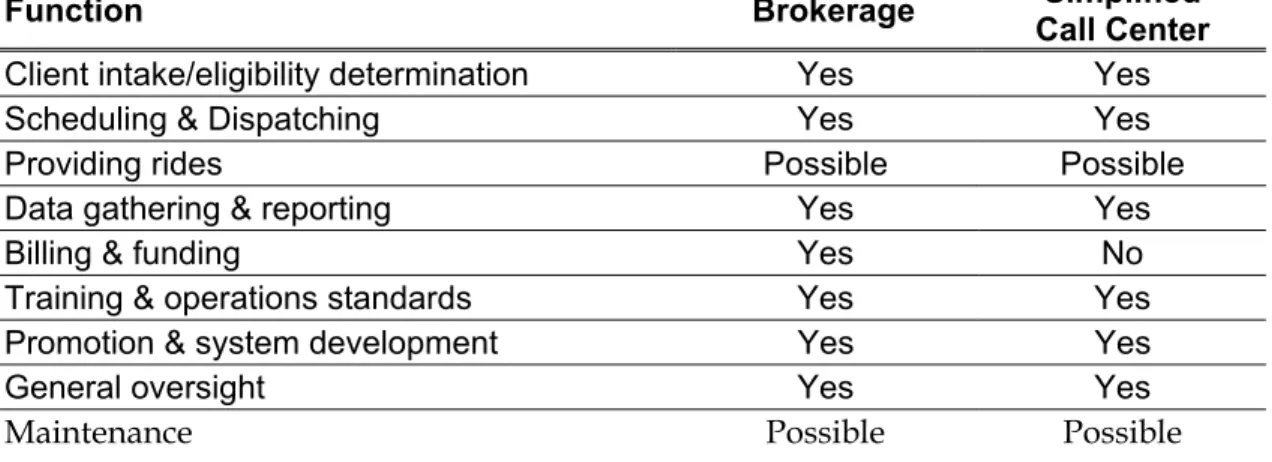
Figure 4.2 - Summary of Functions Centralized Under Each Service Model
Function Brokerage Simplified
Call Center Client intake/eligibility determination Yes Yes
Scheduling & Dispatching Yes Yes
Providing rides Possible Possible
Data gathering & reporting Yes Yes
Billing & funding Yes No
Training & operations standards Yes Yes
Promotion & system development Yes Yes
General oversight Yes Yes
Maintenance Possible Possible
The three coordination measures at the bottom of Figure 4.1 - shared information, shared training, and shared maintenance - are all considered as elements of the two service models. Shared information and training will be essential for either model to ensure consistent service. Sharing maintenance is not essential, but provides potential for cost savings and increased safety through consistent maintenance schedules and tracking.
CRITERIA FOR SELECTING HOST AGENCY
As noted above, a brokerage or a call center could be housed with an existing agency that provides transportation services, or with another agency that does not provide transportation, but recognizes transportation as a key need in accessing health care, work, or support services. In theory any of the existing providers participating in the study could take on the coordination role, though the role could most efficiently be filled by an agency that already has staff and infrastructure in place to schedule and dispatch rides. STS and to some extent Lamprey Health Care are the two providers who currently have this infrastructure.
Agencies that are not transportation providers also frequently serve as brokers. The project team discussed the prospect of taking on a coordinating role with both Southwest Service Link and Community Health Services of Derry. This approach would have the advantage of eliminating concerns that a broker/provider will assign preferred trips to itself. At the same time, brokers that are not providers may be less s financially in situations where trip demand is relatively low.
In general, criteria for selecting a host agency include the following:
• Willingness and capacity of host agency to take a proactive role in developing the coordinated system by adding new providers and client agencies as time goes on. • Ability to secure funding from a range of sources (A private not for profit or public
agency is key to securing foundation funding).
• Ability of agency, under its mission statement, to serve all parts of the transit dependent population in the region, including not just the elderly and disabled, but also low-income clients, youth, and others needing transportation options.
• Political acceptability of the host agency to other providers and client agencies taking part in the coordinated system.
• Willingness to consider eventual operation of fixed bus routes under contract with a regional transit system. The feasibility of fixed route service in the region, including potential routes, cost and ridership estimates, funding sources, and potential management structures, is discussed in Chapters 5 and 6.
Chapter 7 summarizes input received from provider agencies and other members of the Project Advisory Committee regarding preferences for both a service coordination model and an agency to take on the coordination role.