Multiple Regression Analysis for Life Expectancy at Birth:
Python Application
Natalia Irena Gust-Bardon
1. Problem Description
The purpose of this project is to obtain a prediction equation for the life expectancy at birth. The data set recorded mostly in 2015 consists of 102 observations (102 countries), one dependent variable (Life Expectancy) and the following 15 predictor variables representing four categories:
1. Environment
• Forest area (% of land area)
• Improved water source (% of population with access)
• Renewable energy consumption (% of total final energy consumption) 2. Economic Development
• Urban population (% of total) • GDP per capita
• Services value added (% of GDP)
• Exports of goods and services (% of GDP) • Developed economies (categorical variable)
• Labor force participation rate, female (% of female population ages 15+) • Gini Index
3. Health
• Health expenditure per capita (current US$)
• Improved sanitation facilities (% of population with access) • Obesity (in %)
• Prevalence of undernourishment (% of population) 4. Social Protection
• Share of unemployed receiving regular periodic social security unemployment • Public social protection expenditure [excluding health care] as a percentage of GDP
This report presents the set of activities allowing me to build a multivariate regression model, including:
(a) checking for the violations of model assumptions; (b) data transformation;
(c) variable selection techniques;
(d) incorporation of categorical explanatory variables; (e) application of F-tests.
2. Investigation of the Data
The data set consists of fourteen quantitative variables and one categorical variable (Developed Economy).
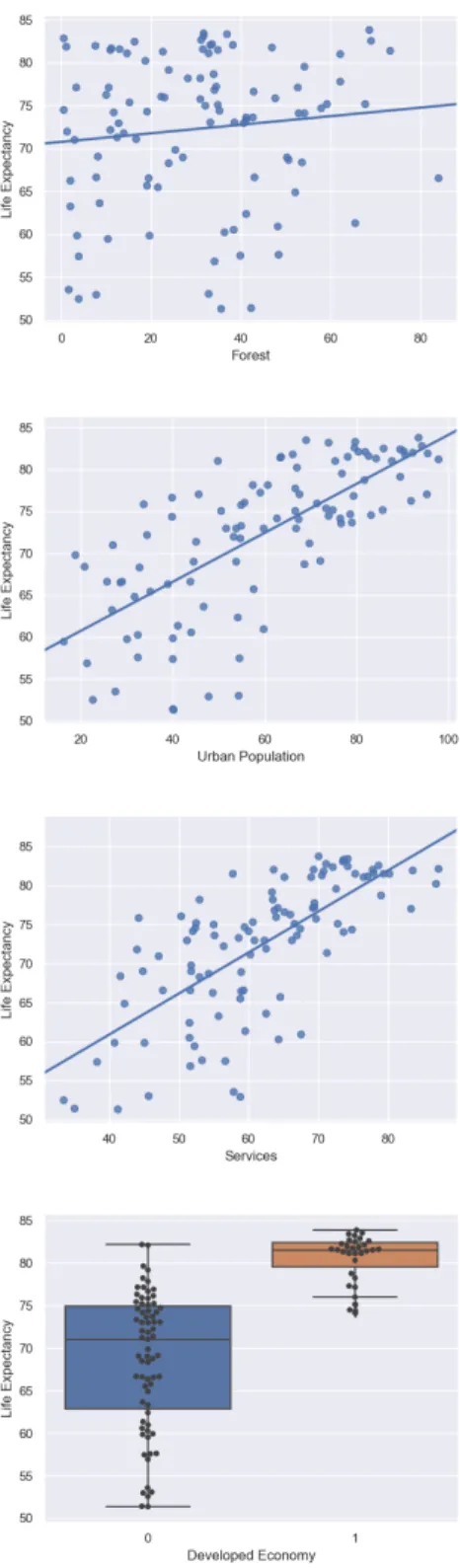
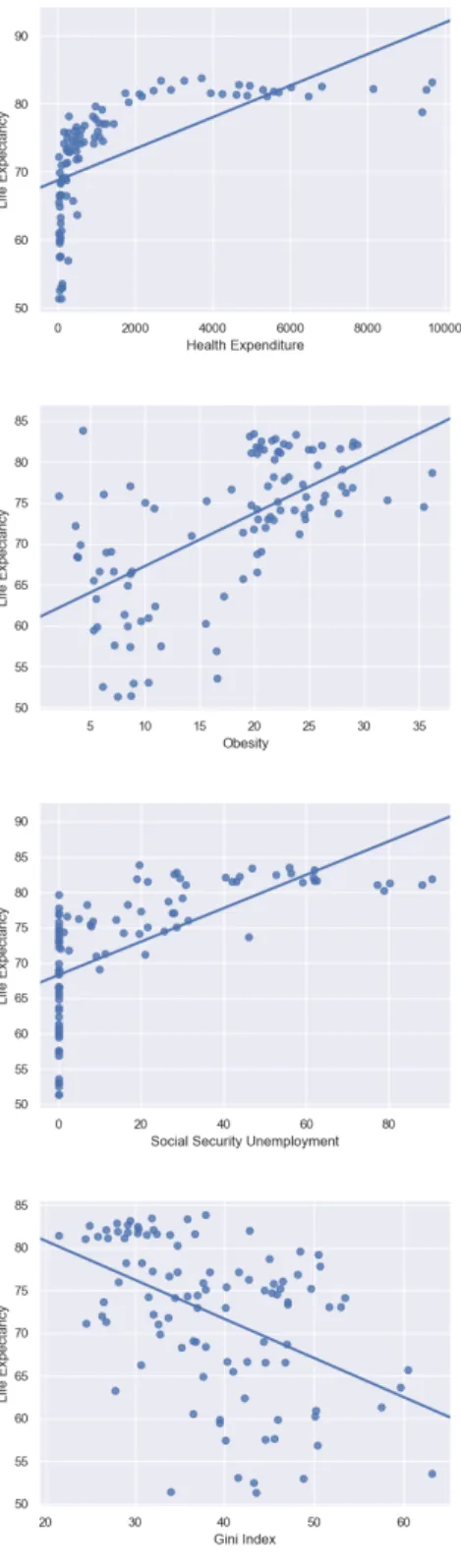
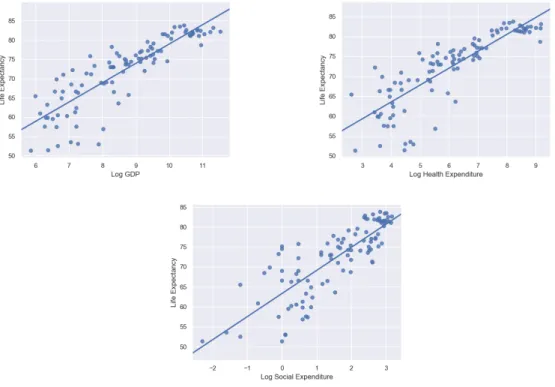
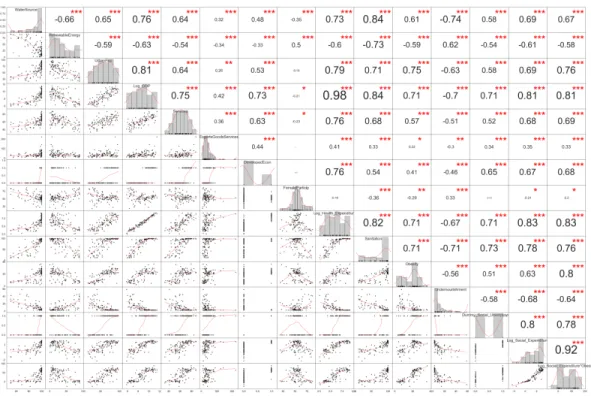
Based on the investigation of the data, we can see a non-linear relationship between Life Expectancy and some of the variables. Therefore, a preliminary transformation for the following variables is needed: GDP, Health Expenditure, Social Security Unemployment, and Social Expenditure.
As the trend in GDP, Health Expenditure, and Social Expenditure follows the log pattern, the logarithmic transformation was perform. Since the data of Social Security Unemployment contains “0” value, we have to find a different way from the log transformation to manage this predictor. One of the methods is to change this quantitative variable into a qualitative one (“0” when there is no social security unemployment, “1” otherwise).
Figure 2.2 Transformation of social security unemployment into a dummy variable
3. Specification of the Model
Based on Figure 2.1, we can see that no relationship occurs between Life Expectancy and Forest. Therefore, we do not include this predictor in our model. The following regressors will constitute the preliminary model:
Improved water source
Renewable energy consumption Urban population
log GDP per capita Services value added
Exports of goods and services Developed economies
Female labor force participation rate Log health expenditure per capita
Improved sanitation facilities Obesity
Undernourishment
Social security unemployment Log social protection expenditure
I have decided to add the interaction to the model : Obesity and Log social protection expenditure.
Model assumptions:
1. The mean of response is a linear function of the 2. The errors are independent
3. The errors are normally distributed
4. The errors have equal variance and mean zero x1 :
x2 :
x3 :
x4:
x5:
x6:
x7:
x8:
x9 :
x10:
x11:
x12:
x13:
x14:
yi=β0+β1xi1+β2xi2+β3xi3+β4logxi4+β5xi5+β6xi6+β7xi7+β8xi8+β9logxi9+β10xi10+ +β11xi11+β12xi12+β13xi13+β14logxi14+β15x11×logx14+ϵi
i = 1,...,n
4. Estimation of the Appropriate Model
Test for significance of Regression:
for at least one
p-value=0.000 <
We reject the null hypothesis. We can conclude that there is a statistically significant linear association between the life expectancy at birth and at least one of our predictor variables.
The prediction equation is: H0 :β1= . . . =β15= 0
H1:βj≠0 j
F0 = 47.15
α = 0.05
̂
y = 40.112882 + 0.0048x1−0.028468x2+ 0.014056x3+ 2.670223logx4+ 0.025143x5−0.01332x6
+0.641884x7+ 0.060922x8−1.095392logx9+ 0.182292x10−0.275188x11−0.007768x12 −2.267975x13+ 0.839871logx14+ 0.06638x11×logx14
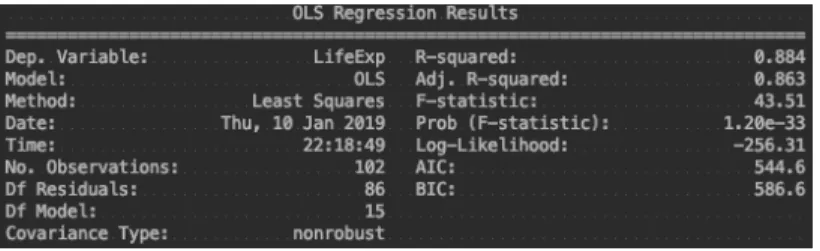
Table 4.1 OLE regression results
It appears from this analysis that only four following predictors are significant ( ): • Log GDP
• Female labor force participation rate • Sanitation
• Obesity
This preliminary model explains 88% (R-Square=0.884) of variations in the life expectancy at birth. However, further tests of model adequacy are required. Moreover, from the investigation stage, we can presume that some of the estimated coefficients can be inflated by the existence of correlation among predictor variables (e.g. relationship between GDP and Health expenditure per capita).
5. Assessment of the Chosen Prediction Equation
The Breusch-Pagan test for constancy of error variance:
(constant variance)
for at least one (non constant variance) P-value=0.001 <
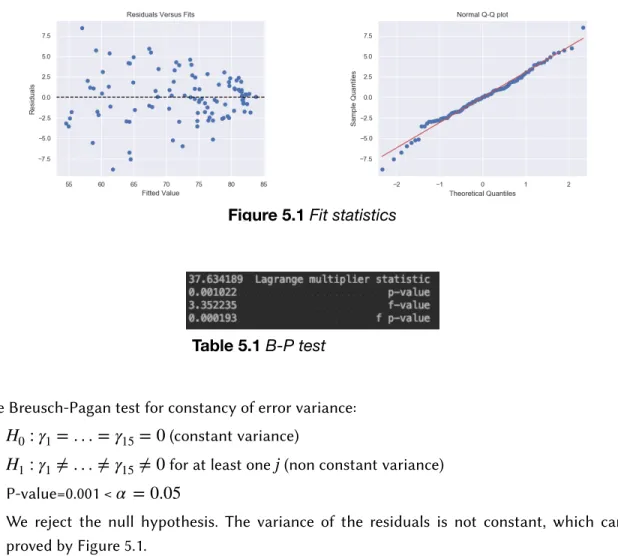
We reject the null hypothesis. The variance of the residuals is not constant, which can be also proved by Figure 5.1.
Since the variance of the residuals is not constant, we should consider the transformation of Y values. The Box-Cox analysis suggests , but we will continue with .
α = 0.05
H0 :γ1 = . . . =γ15= 0
H1:γ1≠. . . ≠γ15≠0 j α = 0.05
λ = 3.88 λ = 4
Table 5.1B-P test
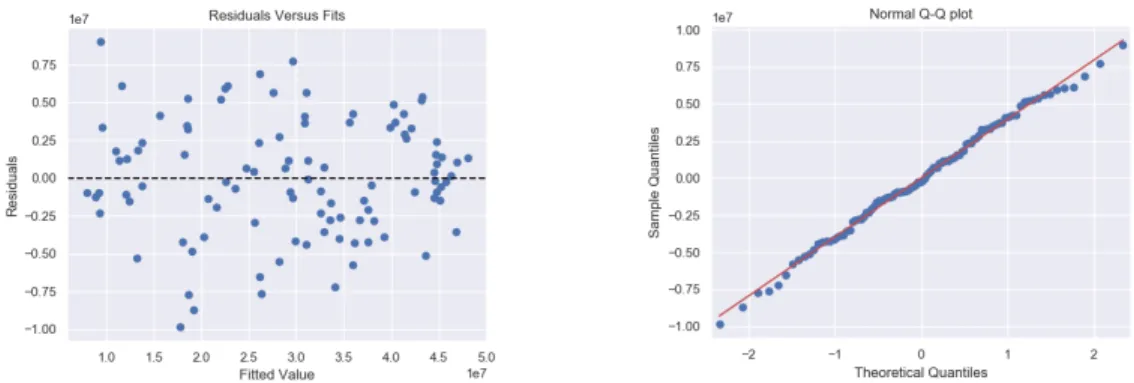
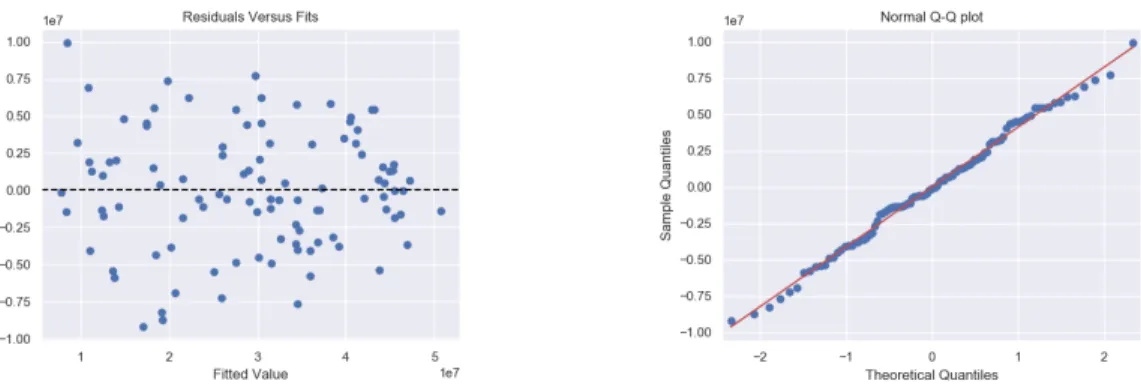
Figure 5.2 presents the fit diagnostics after the Box-Cox transformation. We can see that variance of the residuals has been improved. Normality has been also improved.
The Breusch-Pagan test for constancy of error variance: after the Box-Cox transformation:
(constant variance)
for at least one (non constant variance) P-value=0.06 >
We fail to reject the null hypothesis. The variance of the residuals is constant.
We use the Shapiro-Wilk test for normality. the errors follow a normal distribution the errors do not follow a normal distribution
P-value = 0.918 > . We fail to reject the null hypothesis. The errors follow a normal distribution.
H0 :γ1 = . . . =γ15= 0
H1:γ1≠. . . ≠γ15≠0 j α = 0.05
H0 :
H1:
α = 0.05
Figure 5.2 Fit Statistics after the Box-Cox transformation
6. Outliers Diagnostics
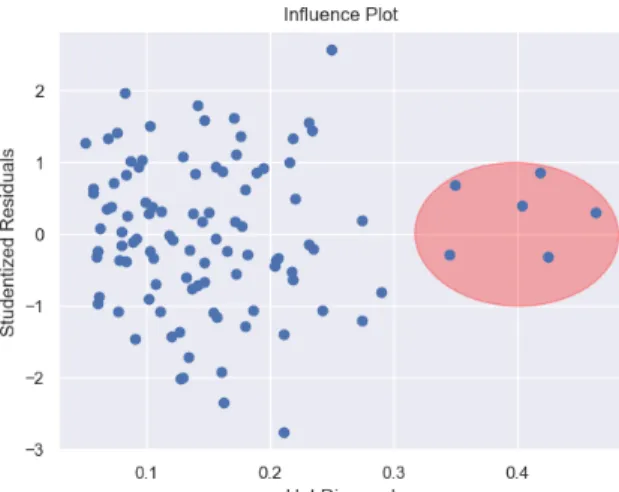
Figure 6.1 Influence plot: studentized residuals vs. hat diagonal
Figure 6.2 Influence plot: Cook’s distance vs. DFFITS
Measure Criteria Observations
Outlier |R|>3 none
six observations none
|DFFITS| six observations
D
i2
p
n
= 0.314
h
ii2
p
n
= 0.792
4
7. Multicollinearity Diagnostics
Coefficients for Log GDP, LogHealth Expenditure and the interaction Log Social Expenditure & Obesity are highly inflated.
Table 7.1 Variance inflation factor
Based on the multicollinearity diagnostics, the following predictor have been removed: • Log Social Expenditure & Obesity interaction
• Log GDP
• Log Social Expenditure
After the changes, the model includes the following variables:
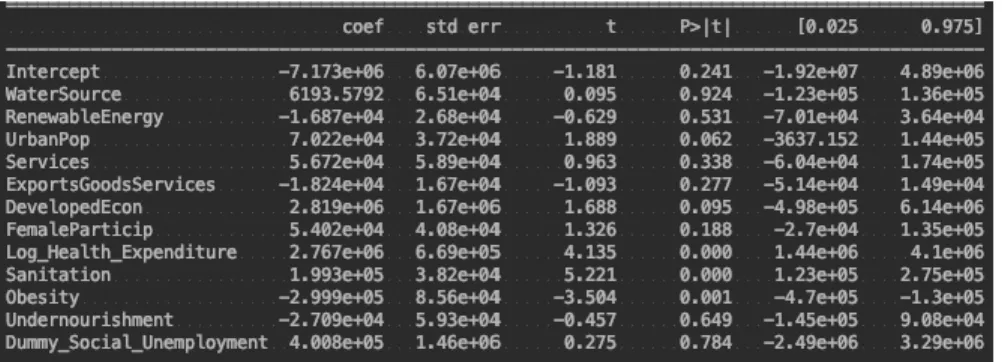
• Improved water source, Renewable Energy, Urban Population, Services, Export Goods and Services, Developed Economy, Female Labor force participation rate, Log Health Expenditure, Sanitation, Obesity, Undernourishment, Dummy Social Unemployment
We use the Shapiro-Wilk test for normality. the errors follow a normal distribution the errors do not follow a normal distribution
P-value = 0.806 > . We fail to reject the null hypothesis. The errors follow a normal distribution.
Based on Figure 7.2 and the Shapiro-Wilk test, we can conclude that the new model meets assumptions about constant variance and normality.
H0 :
H1:
α = 0.05
8. Selection of Variable Subset
With , there are three following significant predictors:
• Log health expenditure
• Improved sanitation facilities
• Obesity
With , there are five following significant predictors:
• Log health expenditure
• Improved sanitation facilities
• Obesity
• Urban population
• Developed Economies
After the statistical analysis the final model includes:
• Log health expenditure
• Improved sanitation facilities
• Obesity
• Urban population
• Developed Economies α = 0.05
α = 0.1
Table 8.1 Parameter estimates after multicollinearity diagnostics
With , all regressors are significant.
, which means that 89% of variation in the life expectancy at birth is explained by the model.
The Breusch-Pagan test for constancy of error variance: after the Box-Cox transformation:
(constant variance)
for at least one (non constant variance) P-value=0.057 >
We fail to reject the null hypothesis. The variance of the residuals is constant.
α = 0.1 R2= 0.889
H0 :γ1 = . . . =γ6= 0
H1:γ1≠. . . ≠γ6 ≠0 j α = 0.05
Table 8.3 Parameter estimates: model after variable selection
Figure 8.1 Fit diagnostics for a model after variable selection
We use the Shapiro-Wilk test for normality. the errors follow a normal distribution the errors do not follow a normal distribution
P-value = 0.988 > . We fail to reject the null hypothesis. The errors follow a normal distribution.
Based on Figure 8.1, B-P test and the Shapiro-Wilk test, we can conclude that the model meets assumptions about constant variance and normality.
H0 :
H1:
9. Validation of the Regression Model
In order to validate the regression model, the dataset has been split into training (70%) and test (30%) sets.
The sum of squares of the prediction errors is
The corrected sum of squares of the responses in the prediction data set is:
and the approximate for the prediction is:
We may expect this model to explain about 97% of the variability in new data.
(Life Expectancy)4=−4131028.131 + 76916.976×Urban Population+ 3471361.93×Developed Economy+
3010507.008×Log Health Expenditure+ 180000.231×Sanitation−192791.29×Obesity
∑ei2 =
SST =∑yi2− (∑yi) 2
n =
R2
R2
pred= 1− ∑e
2 i SST =
10. Conclusions
Research Question: What is the expected life expectancy at birth for a country where:
• Urban Population (in%): 34.277
• Developed Economy: 0
• Health Expenditure per capita (in USD): 30.833 (Log transformation needed: Log(30.833))
• Improved sanitation facilities (% of population with access):60.6
• Obesity (in %): 3.6
(Life Expectancy)4=−4131028.131 + 76916.976×Urban Population+ 3471361.93×Developed Economy+
3010507.008×Log Health Expenditure+ 180000.231×Sanitation−192791.29×Obesity
(Life Expectancy)4 = 19041250