585
© 2017 by the Serbian Biological Society How to cite this article: Zhang B, Ma R, Guo L, Song Z, Yu M. Effects of exogenous salicylic acid on physiological traits and CBF gene expression in peach floral organs under freezing stress. Arch Biol Sci. 2017;69(4)>585-92.
Effects of exogenous salicylic acid on physiological traits and CBF gene expression in
peach floral organs under freezing stress
Binbin Zhang, Ruijuan Ma*, Lei Guo, Zhizhong Song and Mingliang Yu
Institute of Horticulture, Jiangsu Academy of Agricultural Sciences/Jiangsu Key Laboratory of Horticultural Crop Genetic Improvement, Nanjing 210014, P.R. China
*Corresponding author: [email protected]
Received: August 16, 2016; Revised: November 9, 2016; Accepted: December 14, 2016; Published online: January 13, 2017
Abstract: To elucidate the effects of exogenous salicylic acid (SA) treatment on the cold resistance of peach flower, the floral organs of two peach cultivars were treated with 20 mg/L SA and stored at 0°C for observation and sample collection. Water application was the control. After a treatment period, the anther relative water content of the control and SA-treated flowers decreased. The extent of the reduction was greater in the control, suggesting that the SA treatment significantly helped to maintain the anther water content of peach. Analysis of the stigma relative electric conductivity revealed that the SA treatment prevented membrane injury during the low temperature treatment. Additionally, we measured CBF gene expression at low temperature in the petal, stigma and ovary. The expression was markedly upregulated in the cold-treated floral organs. CBF gene expression after SA treatment was higher than in the control when cold conditions continued. These results suggest that the effects of SA on ameliorating the freezing injury to peach floral organs and on enhancing cold tolerance may be associated with the induction of CBF gene.
Key words: peach; floral organ; salicylic acid; freezing stress; physiological trait; CBF
IntRoduCtIon
Plants grown in nature often face environmental stresses such as drought, salt, freezing, which are the most important factors limiting growth and productiv-ity [1-3]. Among these, low temperature is one of the most harmful, especially in the early spring during the florescence of many horticultural crops [4,5]. Freez-ing injuries to these crops (apple, apricot, peach, etc.) represent a major economic loss in many countries. Currently, climatic events frequently lead to frost-dam-age injuries and can be a limiting factor in obtaining optimal agronomical and economic crop performances [6]. In China, regional low temperature extremes have occurred intermittently in recent years on the lower Yangtze River in the early spring [7]. These low tem-peratures can last half a month. The blooming period of peach (Prunus persica L.) is in the early spring and, therefore, often coincides with low temperature condi-tions. Peach buds are less resistant to low temperatures from swell to blossom, however, floral organs, such as
the stamen, pistil and petal, are the most susceptible and lack resistance to freezing injuries [5,8].
SA is an endogenous regulator in plants and is involved in many plant physiological processes [9,10]. SA plays an important role not only in biotic stress [11] but also in abiotic stress [12-14]. Suitable con-centrations of SA in plants can increase resistance to freezing injuries or even prevent such injuries [15-18]. Although a significant relationship between the activity of antioxidant enzymes and H2O2 metabolism have been reported [19], it is still unclear how SA af-fects plant metabolism through gene expression and molecular mechanisms under low temperature condi-tions in peach.
under-period of two peach cultivars treated with SA were chosen to study the flower physiological character-istic changes and CBF gene expression during low-temperature treatment. It is important to increase our understanding of the cold resistant mechanisms of fruit trees during the blooming period.
MAtERIAls And MEthods
Plant materials and experimental conditions
Experiments were conducted during the peach bloom-ing season in the sprbloom-ing at the Experimental Orchard of the Jiangsu Academy of Agricultural Sciences, P. R. China. Two seven-year-old peach cultivars (‘Xiahui 6’ and ‘Xiacui’) were selected to study their sensitivity to SA and freezing stress. Branches that had medium growth vigor and had a length of 50~60 cm were brought to the laboratory immediately after being re-moved. Most of the flower buds were in the big bud period. SA (Sigma-Aldrich, St Louis, MO, USA) was dissolved in a small amount of ethanol and diluted to 20 mg/L, which is a suitable concentration according to the results of pre-experiments. The branches were sprayed with SA at 25°C, and the spraying was stopped as soon as the liquid dropped. The solution was ab-sorbed for 2 h. Then, the branches were stored at 0°C (the moment the branches were put into 0°C was re-corded as 0 h). Branches sprayed with water were used as controls. In this experiment, sixty branches of each treatment were used with three biological replications.
In a preliminary experiment, we observed that the floral organs of ‘Xiahui 6’ and ‘Xiacui’ exhibited low temperature tolerance differences. Flower buds on the upper part of ‘Xiahui 6’ and ‘Xiacui’ branches were picked at 0, 3, 10, 20 and 30 h. The petal, stigma, ovary and anther were separated after the flower buds were removed. Images of floral organs of each peach cultivar were taken at the end of the experiment. Sixty buds of each treatment were taken for the
measure-The anther RWC was measured using a conventional method [24]. Fresh anthers were placed in Petri dishes after being weighed and then put into an artificial cli-mate box at 25°C for 5 h. The anther RWC was calcu-lated after the pollen had dispersed completely. RWC (%) = (FW − DW) / (TW − DW) × 100. (FW: fresh weight; DW: dry weight; TW: turgor weight).
stigma relative electric conductivity (REC) measurement
To evaluate stigma plasma membrane integrity, we determined the REC of stigma picked from flowers under different treatments [25]. The stigmas were washed with distilled water to remove adsorbed elec-trolytes and then put into 10 mL of distilled water and a vacuum was applied for 30 min. After the vacuum was slowly released, the initial electric conductance (R1) was directly measured using an electrical con-ductivity meter (DDSJ-318, Leici Instrument Co., Shanghai, China) at 25°C. The mixture was boiled in a 100°C water-bath for 30 min and then cooled to room temperature (25°C) to determine the final electric conductance (R2). REC was evaluated as: REC (%) = R1/R2 × 100%.
qRt-PCR
CTTCAC-CATTCCAGTTCCATTGTC 3’, was used as the inter-nal control. qRT-PCR was performed using a My-IQ 2 (Bio-Rad, Hercules, CA, USA) and SYBR Premix Ex TaqTM (TaKaRa Bio, Kyoto, Japan). The qRT-PCR volume was 20 μL, containing 2 μL of diluted cDNA, 0.4 μL of each primer, 10 μL Master Mix and 7.2 μL ddH2O. Thermocycling conditions were set with an initial polymerase activation step for 2 min at 95°C, followed by 40 cycles for 15 s at 95°C for template denaturation, 15 s at 60°C for annealing, and 20 s at 72°C for extension and fluorescence measurement. Each assay was replicated three times with an organ replicate. Relative quantitative expression was deter-mined using 2(−∆∆Ct) method [27].
statistical analysis
The experiment was arranged as a completely ran-domized design with three replications. All the sam-ples were analyzed at least three times. Data were ana-lyzed using ANOVA, and the treatment means were compared using Duncan’s multiple range test at 5% of probability. The standard deviation is plotted in all the figures.
REsults
Influence of exogenous sA on morphological changes in peach floral organs under freezing stress
Fig. 1 shows the morphological changes in peach floral organs under freezing stress due to the SA ap-plication. The freezing stress caused serious damage to the floral organs of flowers that were treated with water only (controls). Symptoms of freezing injury
were found on the different floral organs. From the images, petal wilting and red color fading were docu-mented. Additionally, freezing injuries occurred on both the stigmas and the ovaries, and most of the ovaries became darker. Compared with the control group, the petals of flowers that were treated with SA maintained their red color and freezing injuries were rarely observed on the stigmas and ovaries.
Influence of exogenous sA on peach anther RWC under freezing stress
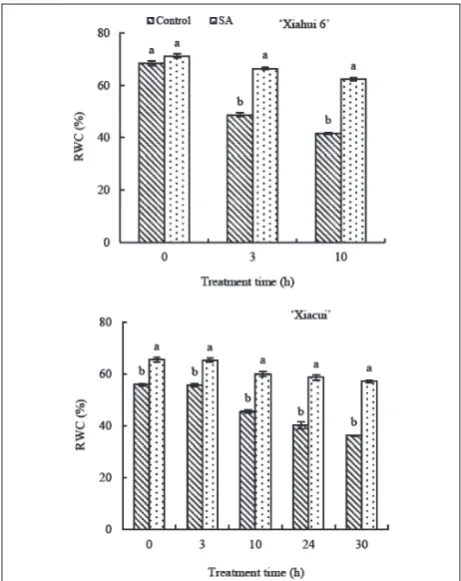
The anther RWC for both the control and SA of the two peach cultivars had similar downward trends dur-ing the whole experiment. For the ‘Xiahui 6’ anther RWC, there was no difference between the control and SA treatment (P>0.05); however, the control RWC was lower than that of the SA treatment at 3 h and 10 h (P<0.05) (Fig. 2). During the experiment, the anther RWC of ‘Xiacui’ under control conditions was always
Fig. 1. Influence of exogenous SA on morphological changes in peach floral organs under freezing stress.
control decreased to 36.18% with the decrease in an amplitude of 35.35% compared with the SA treatment, which decreased to 57.16% with the decrease in am-plitude of 12.73%.
Influence of exogenous sA on peach stigma REC under freezing stress
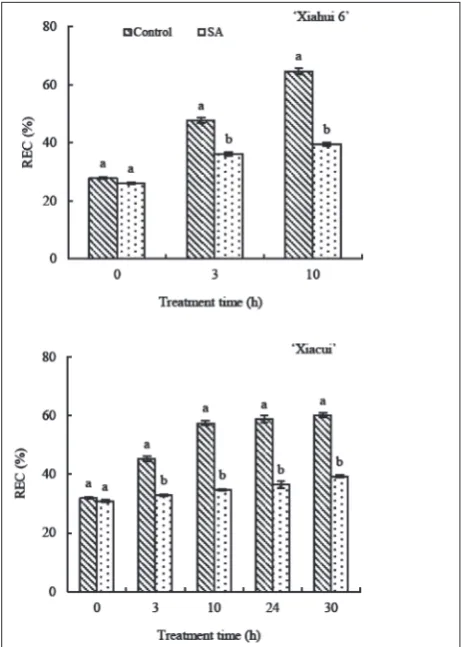
The peach stigma REC was measured to determine the degree of low-temperature damage to the stigma that was caused by freezing stress and the ameliorating effects of SA applications. Increasing trends of stigma REC were observed in each treatment of the two peach cultivars. There was no difference between the control and SA treatment at 0 h for the two cultivars. How-ever, the stigma REC of the SA treatment was lower than that of the control at the following detection pe-riods. The increasing amplitude of the SA treatment from 0 h to 10 h on ‘Xiahui 6’ was 51.01% compared with the control, which was 133.21% throughout the experiment (Fig. 3). As for ‘Xiacui’, the stigma REC increasing amplitude of the SA treatment was 12.54% compared with the control, which was 80.42% from 0 h to 10 h (Fig. 3). After 30 h of the freezing treatment, the stigma REC of ‘Xiacui’ under control conditions increased to 60.13% with a rising amplitude of 88.97% compared with the SA treatment, which was 39.28% with a rising amplitude of 27.57% (Fig. 3).
Influence of exogenous sA on CBF relative expression levels in peach floral organs under freezing stress
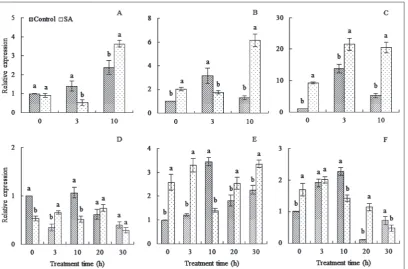
CBF-relative expression levels in peach floral organs caused by SA application under freezing stress are shown in Fig. 4. There was no difference in the the level of CBF expression in ‘Xiahui 6’ petals between the control and SA treatment at 0 h; however, the level of the control was lower than that of the SA treatment in the stigmas and ovaries (Fig. 4). CBF expression levels in the petal and stigma under control conditions were higher than those under the SA treatment at 3 h, but
the opposite was true in the ovary. At the end of the ex-periment, the CBF expression in the control was lower than in the three floral organs of SA-treated plants. The overall trend of CBF expression in the three floral organs under the two treatment conditions were dif-ferent from each other. CBF expression in the petals of the control increased during the experiment; however, the SA treatment first decreased and then increased expression (Fig. 4A). In the stigma, gene expression in the control first increased and then decreased, but an opposite trend was observed under SA treatment (Fig. 4B). In the ovary, the gene expression during both treatments had an increasing trend (Fig. 4C).
CBF expression in the petals of ‘Xiacui’ under freezing stress increased after 3 h of SA treatment, and was higher than in the control (Fig. 4D). At 10 h, the gene expression under SA treatment decreased and was much lower than in the control. No significant
difference was observed between the SA treatment and control at 20 h and 30 h. However, CBF expres-sion under both treatments at 30 h was lower than at 20 h (Fig. 4D). SA application led to higher CBF
expression levels in the stigma and ovaries than were found in the control at 0 h (Fig. 4E, Fig. 4F). After 3 h of freezing stress, CBF expression in the floral organs increased not only in the control but also in the SA treated samples. Gene expression under SA treatment decreased at 10 h and became lower than in the con-trol. At the end of the experiment, the gene expression level in the stigma was higher under the SA treatment than in the control (Fig. 4E). However, the opposite was found for the ovaries (Fig. 4F).
dIsCussIon
Isolated peach flowers that were treated with water at a low temperature showed severe freezing injury symptoms. Floral organs were damaged by different degrees. When comparing the two peach cultivars and when comparing SA-treated flowers with controls,
the degree of visible freezing injuries showed close correlations with the anther RWC and stigma REC. With the passage of time, the anther RWCs under SA treatment and control conditions in both cultivars showed a decreasing trend. In contrast, the stigma REC showed an increasing trend. The optimal anther RWC is important to maintain pollen activity when flowers are exposed to temperature stress during the blooming period. Our results showed that the anther RWC of SA-treated flowers decreased more slowly, and the decrease in amplitude was less than that of the control group. The result that SA could maintain RWC is corroborated by the findings of previous stud-ies [28,29]. This suggested that SA application could maintain the normal development of pollen better than water application under freezing stress.
Frost often accompanies low temperatures. In ad-dition, the status of the stigma affects peach pollina-tion and fertilizapollina-tion. In this study, the stigma REC of the control groups increased with time under freezing stress. Remarkably, although the stigma REC of the SA treatments also increased over time, the amplitude
easily lose water. Thus, there is a correlation between electrolyte leakage and freezing injury symptoms. This result is consistent with previous research [35]. How-ever, an SA application could ameliorate the effects of low temperature on peach floral organs and protect the floral organs from low-temperature damage.
SA is a signal molecule that is involved in the in-duction of defense mechanisms in plants [35]. Pre-treatments of plants with low concentrations of SA might have an effect similar to that of acclimation, causing an increased tolerance to most kinds of abiotic stresses [36]. In the present study, not only SA treat-ments, but also control groups of both peach cultivars altered the floral organs’ CBF expression in response to the low temperature.
In many plants, the CBF expression level may be a crucial factor in freezing tolerance, but the CBF genes are more or less specific to cold stress depending on the plant species [37-40]. The constitutive overexpres-sion of PpCBF1 in apple results in a 4-6°C increase in freezing tolerance in both the non-acclimated and acclimated states [41]. In grape, CBF expression in-creases at the beginning of cold stress and then de-creases [42]. In this study, CBF expression in different floral organs at both 3 h for ‘Xiahui 6’ and 10 h for ‘Xi-acui’ significantly increased (Fig. 4). However, freez-ing injury symptoms still existed. This indicated that although CBF expression increased in the different peach floral organs and freezing injury was relieved to some extent, freezing injury could not be avoided under freezing stress.
Many kinds of abiotic stresses, such as low tem-perature, drought and salt, can induce CBF expression, which is a normal plant response [42-44]. In addition to the abiotic stresses, SA can also enhance CBF ex-pression. The combined effects of SA and low tem-perature have a greater effect on CBF expression. Our data showed that CBF expression levels in the petals and stigmas of SA-treated ‘Xiahui 6’ flowers were the highest at 10 h compared with at 3 h in the ovaries.
that SA application could increase CBF expression in the floral organs of ‘Xiacui’ in the early stage under freezing stress.
ConClusIon
This study reports the positive effects of SA treat-ment on the maintenance of normal physiology and enhanced the cold resistance of peach floral organs during cold storage. The SA treatment significantly decreased the reduction in anther RWC and increased the stigma REC. Additionally, both SA treatments and control groups had increased expression levels of the CBF gene. SA treatment with freezing stress had an enhancing effect on CBF expression. Taken together, all the physiological, morphological and molecular evidence suggests that SA treatments are of signifi-cant practical value to peach flower storage under low temperatures.
Acknowledgments: The project was supported by the Free Ex-ploration Project for Youth Research of Jiangsu Academy of Ag-ricultural Sciences [No. ZX (15) 4009] and China Agriculture Research System (No. CARS-31).
Authors’ contribution: Binbin Zhang and Ruijuan Ma conceived and designed the study; Binbin Zhang performed the experiments; Lei Guo analyzed the data; Binbin Zhang and Ruijuan Ma wrote the paper; Zhizhong Song and Mingliang Yu revised the paper. All authors read and approved the final manuscript.
Conflict of interest disclosure: The authors have declared that no conflict of interests exists.
REFEREnCEs
1. Kasuga M, Liu Q, Miura S, Yamaguchi-Shinozaki K, Shino-zaki K. Improving plant drought, salt, and freezing tolerance by gene transfer of a single stress-inducible transcription fac-tor. Nat Biotechnol. 1999;17(3):287-91.
2. Savage JA, Cavender-Bares J. Phenological cues drive an apparent trade-off between freezing tolerance and growth in the family Salicaceae. Ecology. 2013;94(8):1708-17. 3. Fennell A. Freezing tolerance and injury in grapevines. J
4. Salazar-Gutiérrez MR, Chaves B, Hoogenboom G. Freezing tolerance of apple flower buds. Sci Hortic. 2016;198:344-51. 5. Szymajda M, Pruski K, Żurawicz E, Sitarek M. Freezing inju-ries to flower buds and their influence on yield of apricot (Prunus armeniaca L.) and peach (Prunus persica L.). Can J Plant Sci. 2013;93:191-8.
6. Reig G, Iglesias I, Miranda C, Gatius F, Alegre S. How does simulated frost treatment affect peach [Prunus persica (L.)] flowers of different cultivars from worldwide breeding pro-grammes? Sci Hortic. 2013;160:70-7.
7. Duan J, Zhang QB, Lv L, Zhang C. Regional-scale winter-spring temperature variability and chilling damage dynam-ics over the past two centuries in southeastern China. Clim Dynam. 2012;39(3-4):919-28.
8. Rodrigo J. Spring frosts in deciduous fruit trees-morphologi-cal damage and flower hardiness. Sci Hortic. 2000;85(3):155-73.
9. Hayat Q, Hayat S, Irfan M, Ahmad A. Effect of exogenous salicylic acid under changing environment: a review. Envi-ron Exp Bot. 2010;68:14-25.
10. Miura K, Tada Y. Regulation of water, salinity, and cold stress responses by salicylic acid. Front Plant Sci. 2014;5:1-12. 11. Vlot AC, Dempsey DA, Klessig DF. Salicylic acid, a
multi-faceted hormone to combat disease. Annu Rev Phytopathol. 2009;47:177-206.
12. Ananieva EA, Christov KN, Popova LP. Exogenous treat-ment with salicylic acid leads to increased antioxidant capac-ity in leaves of barley plants exposed to paraquat. J Plant Physiol. 2004;161;319-28.
13. Cao S, Hu Z, Zheng Y, Lu B. Synergistic effect of heat treatment and salicylic acid on alleviating internal brown-ing in cold-stored peach fruit. Postharvest Bio Technol. 2010;58:93-7.
14. Kim Y, Park S, Gilmour SJ, Thomashow MF. Roles of CAMTA transcription factors and salicylic acid in config-uring the low-temperature transcriptome and freezing toler-ance of Arabidopsis. Plant J. 2013;75(3):364-76.
15. Taşgın E, Atıcı Ö, Nalbantoğlu B, Popova LP. Effects of sali-cylic acid and cold treatments on protein levels and on the activities of antioxidant enzymes in the apoplast of winter wheat leaves. Phytochemistry. 2006;67(7):710-5.
16. Hashempour A, Ghasemnezhad M, Ghazvini RF, Sohani MM. The physiological and biochemical responses to freez-ing stress of olive plants treated with salicylic acid. Russ J Plant Physiol. 2014;61(4):443-50.
17. Unal BT, Mentis O, Akyol E. Effects of exogenous sali-cylic acid on antioxidant activity and proline accumula-tion in apple (Malus domestica L.). Hortic Environ Biote. 2015;56(5):606-11.
18. Keshavarz H, Sanavy SAMM, Moghadam RSG. Impact of foliar application with salicylic acid on biochemical char-acters of canola plants under cold stress condition. Not Sci Biol. 2016;8(1):98-105.
19. Janda T, Szalai G, Rios-Gonzales K, Veisa O Paldi E. Com-parative study of frost tolerance and antioxidant activity in cereals. Plant Sci. 2003;164:301-6.
20. Licausi F, Ohme-Takagi M, Perata P. APETALA2/Ethylene Responsive Factor (AP2/ERF) transcription factors:
media-tors of stress responses and developmental programs. New Phytol. 2013;199(3):639-49.
21. Akhtar M, Jaiswal A, Taj G, Jaiswal JP, Qureshi MI, Singh NK. DREB1/CBF transcription factors: their structure, func-tion and role in abiotic stress tolerance in plants. J Genet. 2012;91(3):385-95.
22. Lee YP, Fleming AJ, Koerner C, Meins Jr F. Differential expression of the CBF pathway and cell cycle-related genes in Arabidopsis accessions in response to chronic low-temper-ature exposure. Plant Bio. 2009;11(3):273-83.
23. Ma Q, Suo J, Huber DJ, Dong X, Han Y, Zhang Z, Rao J. Effect of hot water treatments on chilling injury and expres-sion of a new C-repeat binding factor (CBF) in ‘Hongyang’ kiwifruit during low temperature storage. Postharvest Bio Technol. 2014;97:102-10.
24. Guo L, Zhang BB, Ma RJ, Cai ZX, Qian W. Effects of tem-perature on the pollen dissemination and germination of peach. Plant Physiol J. 2014;50:269-74.
25. Sutinen ML, Palta JP, Reich PB. Seasonal differences in freezing stress resistance of needles of Pinus nigra and Pinus resinosa: evaluation of the electrolyte leakage method. Tree Physiol. 1992;11:241-54.
26. Chang S, Puryear J, Cairney J. A simple and efficient method for isolating RNA from pine trees. Plant Mol Bio Rep. 1993;11(2):113-6.
27. Livak KJ, Schmittgen TD. Analysis of relative gene expres-sion data using real-time quantitative PCR and the 2−∆∆C
T method. Methods. 2001;25:402-8.
28. Moussa HR, El-Gamal SM. Effect of salicylic acid pre-treatment on cadmium toxicity in wheat. Biol Plantarum. 2010;54(2):315-20.
29. Antonić D, Milošević S, Cingel A, Lojić M, Trifunović-Momčilov M, Petrić M, Subotić A, Simonović A. Effects of exogenous salicylic acid on Impatiens walleriana L. grown in vitro under polyethylene glycol-imposed drought. S Afr J Bot. 2016;105:226-33.
30. Palta JP, Levitt J, Stadelmann EJ. Freezing injury in onion bulb cells. II. Post-thawing injury or recovery. Plant Physiol. 1977;60:398-401.
31. Flint HL, Boyse BR, Beattie DJ. Index of injury-a useful expression of freezing injury to plant tissues as determined by the electrolytic method. Can J Plant Sci. 1967;47:229-30. 32. Murray MB, Cape JN, Fowler D. Quantification of frost
damage in plant tissues by rates of electrolyte leakage. New Phytol. 1989;113:307-11.
33. Tian F, Gong J, Zhang J, Zhang M, Wang G, Li A, Wang W. Enhanced stability of thylakoid membrane proteins and antioxidant competence contribute to drought stress resistance in the tasg1 wheat stay-green mutant. J Exp Bot. 2013;64(6):1509-20.
34. Kim HS, Oh JM, Luan S, Carlson JE, Ahn SJ. Cold stress causes rapid but differential changes in properties of plasma
membrane H+-ATPase of camelina and rapeseed. J Plant
Physiol. 2013;170(9):828-37.
family in hexaploid wheat and its relationship to the phylo-genetic complexity of cereals CBFs. Mol Genet Genomics. 2007;277:533-54.
39. Champ KI, Febres VJ, Moore BD. The role of CBF transcrip-tional activators in two Citrus species (Poncirus and Citrus) with contrasting levels of freezing tolerance. Physiol Plan-tarum. 2007;129:529-41.
40. Huang BO, Jin LG, Liu JY. Molecular cloning and functional characterization of a DREB1/CBF-like gene (GhDREB1L) from cotton. Sci China, Ser C, Life Sci. 2007;50:7-14.
2015;197:521-6.
43. Kitashiba H, Ishizaka T, Isuzugawa K, Nishimura K, Suzuki T. Expression of a sweet cherry DREB1/CBF ortholog in Arabidopsis confers salt and freezing tolerance. J Plant Physiol. 2004;161:1171-6.