671
© 2017 by the Serbian Biological Society How to cite this article: Stojadinović DM, Čubrić T, Milošević ĐD, Jovanović BLj, Ćorović JV, Paunović M, Crnobrnja-Isailović JM. Contribution to the knowledge of spatial movements of adult Hermann’s tortoises. Arch Biol Sci. 2017;69(4):671-7.
Contribution to the knowledge of spatial movements of adult Hermann’s tortoises
Dragana M. Stojadinović1,*, Tijana Čubrić1, Đurađ D. Milošević1, Bogdan Lj. Jovanović2, Jelena V. Ćorović2,
Мomir Paunović2 and Jelka M. Crnobrnja-Isailović1,2
1University of Niš, Faculty of Sciences and Mathematics, Department of Biology and Ecology, Višegradska 33, 18000 Niš, Serbia
2University of Belgrade, Institute for Biological Research “Siniša Stanković”, Department of Evolutionary Biology, Bulevar despota Stefana 142, 11060 Belgrade, Serbia
*Corresponding author: [email protected]
Received: February 17, 2017; Revised: April 2, 2017; Accepted: April 19, 2017; Published online: April 28, 2017
Abstract: We recorded the movements of adult Eastern Hermann’s tortoises (Testudo hermanni boettgeri) in a local popula-tion situated in a complex forested habitat system. The average total movement range size (TMRS) calculated over three consecutive years was 4.56 ha and 7.53 ha for males and females, respectively. The largest estimated TMRS of male and female tortoises was 27 ha and 90 ha, respectively. Six females and three males (or 9% and 4%, respectively, of the overall sample) had a movement range size (MRS) greater than 10 ha. Significant differences between male and female MRS were not detected. Body size had no influence on the MRS of individuals in the sample, except on the core movement range size (CMRS) in males. Although the collected data did not enable calculation of the home range in the studied population, the results indicate that the calculated average TMRS of local Hermann tortoises is larger than the average home range in some other populations. Therefore, in the absence of information on the home range size of local adult tortoises, the MRS could be a suitable alternative for planning local species reserves.
Key words: adult tortoises; habitat system; movement range; spatial movements; Testudo hermanni boettgeri
INTRODUCTION
The role of dispersal (as an important aspect of life-history) in the evolution of a species is reflected in colonization and the establishment of new popula-tions, in maintaining out-breeding (in sexual species), and in enhancing individual survival through the ac-tive choice of a more suitable environment [1]. Animal ecologists recognize two types of dispersal – dispersal in a narrow sense, and migration, which they define as “the movements of individuals away from their source” [2]. Additionally, the outcomes of dispersal may vary among individuals in the same population [3]. Those dispersing over larger distances contribute to the colonization of new space and to overall range expansion. Moreover, different dispersal capacities of males and females, if they exist, lead to sex-biased dispersal [4]. Reliable knowledge on all aspects of dis-persal capacity of an endangered species is required for setting up protected areas [5,6]. The larger the dispersal, the more likely it is for individuals to
fre-quently move beyond their refugia, if these areas do not meet the minimal required size for the species.
knowledge on the dispersal capacity of local popula-tion must be acquired.
Two subspecies of Hermann’s tortoise are cur-rently recognized: the western subspecies T. hermanni hermanni inhabits parts of Spain, France and Italy, while the eastern subspecies T. hermanni boettgeri is distributed in Croatia, Bosnia and Herzegovina, Montenegro, Albania, Serbia, FYRM, Romania, Bul-garia, Greece and Turkey [14]. We recorded the move-ments of Eastern Hermann’s tortoises during spring and summer in the period 2010-2012, within an ex-perimental area in southeastern Serbia. Our initial hypothesis was that during these two seasons local male Hermann’s tortoises could have a larger MRS than females due to reproductive activities (e.g. ac-tive search for mates), although literature data mostly showed an equal MRS for both sexes [15-19]. More-over, we assumed that within a gender, larger and heavier tortoises could have a larger CMRS and TMRS in comparison to smaller animals, as large individuals need to have more energy to invest in movement [20]. Our aim was to examine whether the tortoises from the analyzed population have a larger MRS than their more southern counterparts (in Spain, France, central and southern Italy, Greece), and a smaller MRS in comparison to northern populations in Romania or northern Italy [21].
MATERIAL AND METHODS
Species and study site
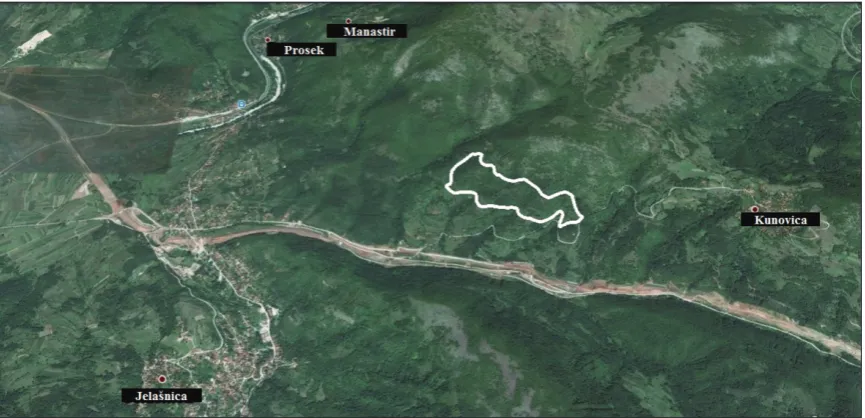
Analysis was conducted in the hilly area of village Ku-novica (43o18’N; 22o04’E; 324 - 462 m altitude), 17 km
east of the city of Niš (Fig. 1). The study area was a com-plex habitat system, dominated by deciduous forests of Quercetum farnetto-cerris [22], but partially degraded into meadows, orchards and vineyards. Most of them have been abandoned and are overgrown by primary vegetation. However, some orchards and vineyards have been actively exploited. More details on the study site are presented in [23]. Repeated records of adult Tes-tudo hermanni individuals were regularly collected from 2010 to 2012 during the last week of May and third week of July within a 23-ha experimental study area. During all visits, the same number of working days and the same daily routine were dedicated to data sampling, with the same number of researchers. The reproductive activities of tortoises, including courtship and egg-laying, were recorded in both seasons.
Data collection
General information on the procedure of collecting data was previously described in [23]. Researchers recorded the geographic coordinates at spots where
individual tortoises were located by a Garmin-E-Trex Vista handheld GPS device with 2-m precision. At first capture, the tortoises were permanently marked by shell notching and their unique numbers were re-corded in individual protocols together with the data on straight carapace length (SCL) and body mass (BM) [23]. During subsequent encounters labelled individuals were recognized by their unique marks. Only adult tortoises were included in the analysis as they represent the majority (79%) of the overall sample. Tortoises recaptured less than four times were excluded from further analysis. As a polygon cannot be created with less than three input points, we con-sidered it uninformative and therefore defined four input points as the minimum.
Statistical analyses
We calculated the hypothetical MRS of individual tor-toises using Ranges 7 software [24]. This software en-ables different types of spatial analyses by radio track-ing or GPS data, from home range or dispersal to the frequency of specific habitat use and social arrange-ment of individuals. Input data were the longitude and latitude coordinates of individual records – locations, transformed into decimal degrees. The minimum con-vex polygon (MCP) method was chosen to calculate 50%, 95% and 100% of the obtained movement area (designated as MCP50%, MCP95% and MCP100%, respectively). The normal distribution of the obtained MRS values was tested separately for males and females by Kolmogorov-Smirnov and Lilliefors tests. Since the distribution of original data was non-normal, a log10
transformation was applied. As described in [25], we checked the occurrence and direction of correlation be-tween the MRS and the number of locations, as well as between the MRS and the timespan (one, two or three years) during which a particular tortoise was recap-tured. Analysis was done by Pearson product-moment correlation, separately for males and females. General linear model (GLM) analysis was used for testing inter-sexual differences in variations of MRS. Multiple regres-sion with MRS as the dependent variable and SCL and BM as predictor variables was performed separately for males and females to examine the relations between body size and hypothetical MRS. All analyses were per-formed using Statistica 7.0 software.
RESULTS
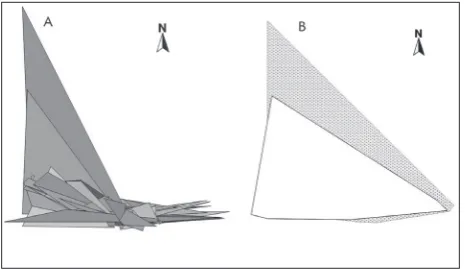
Movement range size (MRS) within the experimental area was calculated for 68 adult tortoises – 41 females and 27 males. An average 100% or TMRS was esti-mated as 4.56 ha and 7.53 ha for males and females, respectively (Table 1). The average CMRS (50%) was estimated as 0.02 ha and 0.06 ha for males and fe-males, respectively. The maximal estimated CMRS for females was 0.76 ha and 0.23 ha for males. Minimal CMRS was the same in both sexes – 0.004 ha. The maximal TMRS of male and female tortoises was 27 ha and 90 ha, respectively. Six females and three males (or 9% and 4% of the overall sample, respectively) had TMRS larger than 10 ha. The surfaces of individual polygons created by connecting the geographic coor-dinates of recapture points for every tortoise analyzed
Тable 1. Descriptive statistics for the minimum convex polygon describing 50%, 95% and 100% size of the obtained movement area in adult male and female Hermann’s tortoises from Kunovica.
MRS N M S.E. Min Max
Мales
100% 27 4.56 1.37 0.02 27.41
95% 27 4.56 1.37 0.02 27.41
50% 27 0.02 0.009 0.0004 0.23
Females
100% 41 7.53 2.54 0.04 90.07
95% 41 7.45 2.54 0.04 90.07
50% 41 0.06 0.02 0.0004 0.76
N – sample size; M – mean (ha), S.E. – standard error of mean; Min and Max – the smallest and largest MRS (ha) in a sample, respectively.
in this study are presented in Fig. 2A. The surfaces of pooled recapture points created separately for males and females are presented on Fig. 2B. There was a positive correlation between the number of locations recorded and the tortoises’ MCP50% for both males (r=0.58, p=0.02) and females (r=0.37, p=0.02). The timespan between recaptures was correlated to the number of locations in females only (r=0.56, p<0.001).
The GLM analysis performed on log-transformed MRS revealed the absence of differences in variation between sexes (Table 2). Additionally, there was no relation between the body size of the females and the size of their area of activity (Table 3), while positive and negative partial correlations of SCL and BM, re-spectively, to the CMRS of males (p<0.05 for both relations) were detected.
Females with larger CMRS also had larg-er TMRS (MCP50&MCP95:Pearson r=0.55, p<0.001; MCP50&MCP100:Pearson r=0.51, p=0.001; MCP95&MCP100:Pearson r=0.98, p<0.001). Similar result was obtained for males (MCP50&MCP95:Pearson r=0.55, p=0.003; MCP50&MCP100: Pearson r=0.55, p=0.003; MCP95&MCP100:Pearson r=1.00).
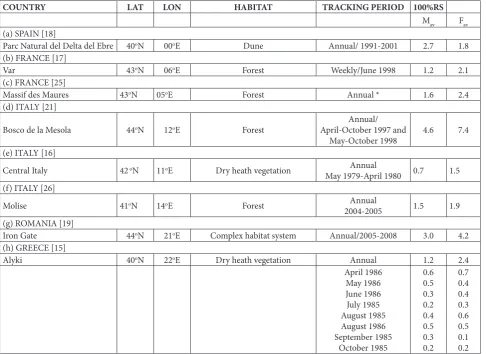
The literature data presenting variations in range size in adult Hermann’s tortoises across the distribu-tion area (Fig. 3) are summarized in Table 4. The av-erage values of range sizes at all localities in Table 4 varied from 1.2 ha to 4.6 ha in males, and from 1.8 ha to 7.5 ha in females.
Таble 2. GLM analysis of MRS in adult Hermann’s tortoises from Kunovica with log10MRS as dependent variable and sex as a factor.
Еffect SS df MS F p
log10 (100% MRS)
Slope 5.19 1 5.19 9.80 0.003
Sex 1.32 66 1.32 2.50 0.12
Error 34.98 0.53
log 10(95%MRS)
Slope 4.84 1 4.84 9.06 0.004
Sex 1.15 1 1.15 2.15 0.15
Error 35.31 66 0.54
log10 (50% MRS)
Slope 290.43 1 290.43 523.20 0.000
Sex 1.94 1 1.94 3.50 0.07
Error 36.64 66 0.56
SS –sum of squares, MS – mean squares, df – degrees of freedom, F – F-ratio, p – significance.
Таble 3. Multiple regression analysis performed on adult male and female Hermann’s tortoises analyzed in this study, with MRS as a dependent variable and SCL and BM as independent predic-tor variables.
Β S.E.β B S.E.B t(23) p
log10 (100% MRS)
MALES
Slope -16.34 19.37 -0.84 0.41
log10SCL 0.69 0.55 18.43 14.60 1.26 0.22
log10BM -0.81 0.52 -8.26 5.22 -1.58 0.13 FEMALES
Slope 20.39 12.39 1.65 0.11
log10SCL -0.44 0.31 -11.95 8.36 -1.43 0.16
log10BM 0.29 0.31 2.58 2.78 0.93 0.36 log 10(95% MRS)
MALES
Slope -16.34 19.37 -0.84 0.41
log10SCL 0.69 0.55 18.43 14.60 1.26 0.22
log10BM -0.81 0.52 -8.26 5.22 -1.58 0.13 FEMALES
Slope 23.30 12.43 1.87 0.07
log10SCL -0.50 0.31 -13.66 8.40 -1.63 0.11
log10BM 0.32 0.31 2.88 2.79 1.03 0.31 log10 (50% MRS)
MALES
Slope -27.24 14.25 -1.91 0.07
log10SCL 1.16 0.53 23.56 10.76 2.19 0.04
log10BM -1.19 0.50 -9.19 3.84 -2.39 0.02
FEMALES
Slope -4.41 15.62 -0.28 0.78
log10SCL -0.007 0.32 -0.24 10.54 -0.02 0.98
log10BM 0.11 0.32 1.25 3.50 0.36 0.72
Parameters having statistically significant p values are bold.
DISCUSSION
Our analyses showed that a longer period of recapture was accompanied by a higher number of recaptures in female tortoises. Moreover, a higher number of re-captures was related to a larger CMRS in both sexes. Therefore, we took into consideration only TMRS for analysis as it was unbiased by either the number of locations or the timespan of recording recaptures.
The TMRS value was higher in the analyzed fe-males than in fe-males, but overall gender differences were not statistically significant. In a number of studies on home range size in Hermann’s tortoises throughout the distribution area [15-19] gender dif-ferences were not detected; however, opposite results have been reported [21,25,26]. Also, [19] reported a different extent of tortoise movements at a monthly
rate, but the authors did not detect gender differences in the annual home range size when analyzing year-by-year and when performing inter-seasonal com-parisons. In [15], the authors confirmed that in Alyki (northwestern Greece), at least during summer, adult Hermann’s tortoises of opposite sexes had different home ranges. In [27] the authors provided more gen-eral information on the affinity toward dispersion in Hermann’s tortoise; namely, some individuals utilized specific microhabitats (and consequently had small home range sizes), while others were more oppor-tunistic and thus had even three to four times larger home ranges. In a previous study [19] it was suggested that home ranges in tortoises can be of similar size in both sexes under conditions where complex habi-tat systems provide access to diverse habihabi-tat types throughout the entire year and to all individuals. This explanation could also be applied to the movements
Table 4. Overview of range sizes for different populations of Hermann’s tortoise in Europe.
COUNTRY LAT LON HABITAT TRACKING PERIOD 100%RS
Mav Fav
(a) SPAIN [18]
Parc Natural del Delta del Ebre 40oN 00oE Dune Annual/ 1991-2001 2.7 1.8
(b) FRANCE [17]
Var 43oN 06oE Forest Weekly/June 1998 1.2 2.1
(c) FRANCE [25]
Massif des Maures 43oN 05oE Forest Annual * 1.6 2.4
(d) ITALY [21]
Bosco de la Mesola 44oN 12oE Forest April-October 1997 and Annual/
May-October 1998 4.6 7.4
(e) ITALY [16]
Central Italy 42 oN 11oE Dry heath vegetation Annual
May 1979-April 1980 0.7 1.5
(f) ITALY [26]
Molise 41oN 14oE Forest Annual
2004-2005 1.5 1.9
(g) ROMANIA [19]
Iron Gate 44oN 21oE Complex habitat system Annual/2005-2008 3.0 4.2
(h) GREECE [15]
Alyki 40oN 22oE Dry heath vegetation Annual 1.2 2.4
April 1986 May 1986 June 1986 July 1985 August 1985 August 1986 September 1985
October 1985
0.6 0.5 0.3 0.2 0.4 0.5 0.3 0.2
0.7 0.4 0.4 0.3 0.6 0.5 0.1 0.2
of adult tortoises in our study, or at least during the mating season when our study was conducted.
In a habitat system similar to ours, the correlation between body size and range size in adult tortoises was not detected in females; however, it occurred in males to some extent [19]. The absence of correlation between body size and TMRS was confirmed in our study for the analyzed parts of spring and summer. Our results suggest that smaller males could have larger CMRS, at least during the reproductive period. Nonetheless, this could be a biased estimate since the analysis showed a dependence of male CMRS on the number of locations recorded.
The mean TMRS of adult Hermann’s tortoises in our study was close to the estimate of the annual home range in a population from northern Italy [21]. The authors explained the relatively large movement areas of local Hermann’s tortoises as the consequence of suboptimal environmental conditions, e.g. a forested habitat and relatively low ambient temperatures, re-sulting in a low population density. In contrast, the population from Kunovica was considered to be in good condition compared to some adjacent locali-ties, e.g. it had a higher density than the population inhabiting the more open, shrubby habitat in southern Serbia [23]. Several authors [17,19,25] have claimed that the relatively high average TMRS values for Her-mann’s tortoises inhabiting local predominantly for-ested habitats with optimal conditions are due to the complex structure of the landscape.
The aim of this study was to obtain insight into the extent of movements of adult individuals within a defined study area during a particular part of the year when the expected movement of the animals is high due to reproductive activities. Although the collected data did not allow for the calculation of the home range, we acquired an indication that the movements of local tortoises could be larger than in populations from other parts of the distribution area and similar in size to the estimated home range in one of the north-ernmost populations. If we consider the knowledge on species dispersal as important to the planning of future conservation actions, then the results of this study could be valuable in defining the sizes of local reserves for Eastern Hermann’s tortoise [28].
Acknowledgements: This study was supported by Grant No. 173025 of the Ministry of Education, Science and Technological Development of the Republic of Serbia. We are grateful to many students of biology and ecology at the Faculty of Sciences and Mathematics of the University of Niš for sharing their time with us and participating in data collection. We are also indebted to S. Stojadinović and J. Mijatović for the logistic support and to M.A. Carretero for useful advice. The permits for field work were is-sued by the Ministry of the Environment and Spatial Planning of the Republic of Serbia Nos. 1134/2010-03 and 353-01-29/2011-03, Ministry of the Environment, Mining and Spatial Planning of the Republic of Serbia No. 353-01-505/2012-03, and the Ministry of Energetics, Development and Nature Protection Nos. 353-01-54/2013-08 and 353-01-312/2014-08.
Authors’ contribution: DMS is the leading author who developed the topics and conducted the research. JMC-I is the team leader who designed the research concept. Fieldwork was performed by DMS and JMC-I. Statistical analyses were performed by ĐDM, DMS, BLjJ, MP, JVČ, TČ and JMC-I. The interpretation of the results was done and approved by all authors.
Conflict of interest disclosure: The authors state that there is no conflict of interest.
REFERENCES
1. Futuyma D. Evolutionary Biology. 3rd ed. Sunderland: Sin-nauer Associates, Inc; 1998. 763p.
2. Schowalter TD. Insect Ecology: an ecosystem approach. San Diego: Academic Press; 2000. 483p.
3. Bowler DE, Benton TG. Causes and consequences of animal dispersal strategies: relating individual behavior to spatial dynamics. Biol Rev. 2005;80:205-25.
4. Gandon S. Kin competition, the cost of inbreeding and evo-lution of dispersal. J Theor Biol. 1999;200:345-64.
5. Simberloff D. The Contribution of population and commu-nity ecology to conservation science. Ann Rev Ecol System. 1988;19:473-511.
6. Lindenmayer DB, Nix HA. Ecological principle for the design of wildlife corridors. In: Ehrenfeld D, editor. To pre-serve biodiversity − Readings from Conservation Biology. Cambridge: John Wiley & Sons; 2009. p. 79-82.
7. van Dijk PP, Corti C, Mellado VP, Cheylan M. Testudo her-manni. The IUCN Red List of Threatened Species. 2004: e.T21648A9306057
8. Fernández–Chacón A, Bertolero A, Amengual A, Tavecchia G, Homar V, Oro D. Exploring the effects of climate change on the population dynamics of a Mediterranean tortoise. Global Change Biol. 2011;17:3075-88.
9. Guyot G, Clobert J. Conservation measures for a population of Hermann’s tortoise Testudo hermanni in southern France bisected by a major highway. Biol Conserv. 1997;79:251-6. 10. Celse J, Catard A, Caron S, Ballouard JM, Gagno S, Jardé N,
Agence Régionale Pour l’ Environnement de Provence Alpes Côtes d’Azur; 2014. 210 p.
11. Iosif R, Railroad-associated mortality hot spots for a
popu-lation of Romanian Hermann’s tortoise (Testudo hermanni
boettgeri): a gravity model for railroad-segment analysis. Procedia Environ Sci. 2012;14:123-31.
12. Vujović A, Iković V, Golubović A, Đorđević S, Pešić V, Tomović Lj. Effects of fires and roadkills on the isolated
population of Testudo hermanni Gmelin 1789 (Reptilia:
Testudinidae) in Central Montenegro. Acta Zool Bulg. 2015;67(1):75-84.
13. Matache Ml, Rozylowicz L, Hura C, Matache M. Organo-chlorine pesticides-a threat on the Hermann’s tortoise per-petuation. Organohalogen Compounds. 2006;68:728-31. 14. Fritz U, Auer M, Bertolero A, Cheylan M, Fatizzo T,
Hunds-dörfer AK, Martín Sampayo M, Pretus JL, Široký P, Wink M. A rangewide phylogeography of Hermann’s tortoise, Testudo hermanni (Reptilia: Testudines: Testudinidae): Implications for taxonomy. Zool Scr. 2006;35:531-43.
15. Hailey A. How do animals move? Routine movements in a tortoise. Can J Zool. 1989;67:208-15.
16. Calzolai R., Chelazzi G. Habitat use in a central Italy population of Testudo hermanni Gmelin. Ethol Ecol Evol. 1991;3:153–66.
17. Longepierre S, Hailey A, Grenot C. Home range area in the tortoise Testudo hermanni in relation to habitat complex-ity: implications for conservation of biodiversity. Biodivers Conser. 2001;10:1131-40.
18. Bertolero A. Biología de la tortuga mediterránea Testudo hermanni aplicada a su conservación [dissertation]. [Barce-lona]: University of Barcelona; 2002. 226 p. Catalan. 19. Rozylowicz L, Popescu VD. Habitat selection and movement
ecology of eastern Hermann’s tortoises in a rural Romanian landscape. Eur J Wildl Res. 2013;59:47-55.
20. Léna JP, CLobert J, de Fraipont M, Lecomte J, Guyot G. The relative influence of density and kinship on dispersal in the common lizard. Behav Ecol. 1998;500-7.
21. Mazzotti S, Pisapia A, Fasola M. Activity and home range of Testudo hermanni in Northern Italy. Amphibia-Reptilia. 2002;23:305-12.
22. Ranđelović N, Ranđelović V, Zlatković B. Flora and vegeta-tion of natural resources within area of Niš. In: Vlajković M, editor. The City in Ecology–Ecology in the City. Niš: City Directorate for Environmental Protection; 1996. p. 110-20. 23. Stojadinović D, Milošević DJ, Crnobrnja-Isailović J. Right-ing time versus shell size and shape dimorphism in adult Hermann’s tortoises: Field observations meet theoretical predictions. Anim Biol. 2013;63:381-96.
24. South AB, Kenward RE, Walls SS. Ranges7 v 1.0: For the analysis of tracking and location data. Warehem, UK: Ana-track Ltd.; 2005.
25. Swingland IR, Stubbs D, Newdick M, Worton B. Movement patterns in Testudo hermanni and implications for manage-ment. In: Roček Z, editor. Studies in Herpetology. Prague: Charles University; 1986. p. 573-8.
26. Loy A, Cianfrani C. The ecology of Eurotestudo h. hermanni in a mesic area of southern Italy: first evidence of sperm storage. Ethol Ecol Evol. 2010;22:1-16.
27. Guyot G. Biologie de la conservation chez la tortue d’Hermann française [dissertation]. [Paris]: University of Paris; 1996. 187 p.