Volume 4 (2006)
Proceedings of the
Second International Workshop on
Graph and Model Transformation
(GraMoT 2006)
Semantical Correctness of Simulation-to-Animation
Model and Rule Transformation
Claudia Ermel, Hartmut Ehrig, and Karsten Ehrig
14 pages
Guest Editors: Gabor Karsai, Gabriele Taentzer
Managing Editors: Tiziana Margaria, Julia Padberg, Gabriele Taentzer
Semantical Correctness of Simulation-to-Animation
Model and Rule Transformation
Claudia Ermel1, Hartmut Ehrig1, and Karsten Ehrig2
1Institut f¨ur Softwaretechnik und Theoretische Informatik
Technische Universit¨at Berlin, Germany [email protected],[email protected]
2Department of Computer Science, University of Leicester, UK
Abstract: In the framework of graph transformation, simulation rules are
well-known to define the operational behavior of visual models. Moreover, it has been shown already how to construct animation rules in a domain specific layout from simulation rules. An important requirement of this construction is the semantical correctness which has not yet been considered. In this paper we give a precise definition forsimulation-to-animation (S2A) model and rule transformations. Our main results show under which conditions semantical correctness can be obtained. The results are applied to analyze theS2Atransformation of a Radio Clock model.
Keywords: graph transformation, model and rule transformation, semantical
cor-rectness, simulation, animation
1
Introduction
In recent years, visual models represented by graphs have become very popular in model-based software development, as the wide-spread use of UML and Petri nets proves. For the definition of an operational semantics for visual models, the transformation of graphs plays a similar central role as term rewriting in the traditional case of textual models. The area of graph transformation provides a rule-based setting to express the semantics of visual models (see e.g. [Roz97]). The objective ofsimulation rulesis their application to the states of a visual model, deriving subse-quent model states, thus characterizing system evolution. Asimulation scenario, i.e. a sequence of such simulation steps can be visualized by showing the states before and after each simulation rule application as graphs.
For validation purposes, simulation may be extended to a domain specific view, called anima-tion view[EB04,EE05b,EHKZ05], which allows to define scenario visualizations in the layout of the application domain. The animation view is defined by extending the alphabet of the origi-nal visual modeling language by symbols representing entities from the application domain. The simulation rules for a specific visual model are translated to the animation view by performing a
Comparable theoretical research in the area of applying graph transformation rules to rules has been done by Parisi-Presicce [PP96]. His approach has provided the basis of our definition ofS2Atransformations which additionally allows to transform not only the rule interfaces, and which also treats negative application conditions (NACs), both for the transforming rules and for the transformed rules.
An important requirement is thesemantical correctnessof theS2Atransformation in the sense that the behavior of the original model is preserved in the animation view. In this paper, we give a formal definition forS2A transformations and show under which conditions semantical correctness can be obtained. In our approach, anS2A transformation generates one animation rule for each simulation rule. Hence, our notion of semantical correctness implies that each animation step (obtained by applying an animation rule) corresponds to a simulation step of the original model. Please note that there are more general definitions for the semantical correctness of model transformations which establish a correspondence between one simulation step in the source model and a sequence of simulation steps in the target model. For S2Atransformation it is sufficient to relate single simulation and animation steps. Intermediate animation states providing smooth state transitions are possible nonetheless: They are defined by enriching an animation rule by animation operations to specify continuous changes of object properties. Since animation operations leave the states before and after a rule application unchanged, they do not influence the semantical correctness ofS2Atransformation. Our approach has been implemented in the generic visual modeling environment GENGED [Gen]. The implementation includes an animation editor to define animation operations visually, and to export animation scenarios to the SVG format [WWW03].
There exist related tool-oriented approaches, where different visual representations are used to visualize a model’s behavior. One example is the reactive animation approach by Harel [HEC03], where behavior is specified by UML diagrams. The animated representation of the system behavior is implemented by linking UML tools to pure animation tools like Macromedia FLASHor DIRECTOR[Mac04]. Hence, the mapping from simulation to animation views hap-pens at the implementation level and is not specified formally. Analogously, different Petri net tools also offer support for customized Petri net animations (e.g. the SimPEP tool [Gra99] to animate transition firings of low-level Petri nets). In general, approaches to enhance the front end of CASE tools for simulating/animating the behavior of models are restricted to one specific modeling language. In our approach we integrate animation views at model level with graph transformation representations for different visual modeling languages based on a formal speci-fication. This provides the model designer with more flexibility, as the modeling language to be enhanced by animation features, can be freely chosen.
2
Basic Concepts of Simulation and Animation
We use typed algebraic graph transformation systems (TGTS) in the double-pushout-approach (DPO) [EEPT06] which have proven to be an adequate formalism for visual language (VL) modeling. A VL is modeled by a type graph capturing the definition of the underlying visual alphabet, i.e. the symbols and relations which are available. Sentences or diagrams of the VL are given by graphs typed over the type graph. We distinguish abstract and concrete syntax in alphabets and models, where the concrete syntax includes the abstract symbols and relations, and additionally defines their layout. Formally, a VL can be considered as a subclass of graphs typed over a type graphT Gin the categoryGraphsTG.
For behavioral diagrams like Statecharts, an operational semantics can be given by a set of simulation rulesPS, using the abstract syntax of the modeling VL. A simulation rule p= (L←
I →R)∈PS is a graph transformation rule, consisting of a left-hand sideL, an interfaceI, a right-hand side R, and two injective morphisms. Applying rule pto a graph Gmeans to find a match of L−→m Gand to replace the occurrence m(L) ofL in Gby Rleading to the target graphG0. In the DPO approach, the deletion ofm(L)and the addition ofRare described by two pushouts (a DPO) in the categoryGraphsTG of typed graphs. A rule pmay be extended by a
set ofnegative application conditions (NACs)[EEPT06], describing situations in which the rule should not be applied toG. Formally, matchL−→m Gsatisfies NACL−→n N if there does not exist an injective graph morphismN−→x Gwithx◦n=m. A sequenceG0⇒G1⇒...⇒Gnof graph transformation steps is calledtransformationand denoted asG0
∗
⇒Gn. A transformation
G0
∗
⇒Gn, where rules from Pare applied as long as possible (i.e. as long as matches can be found satisfying the NACs), is denoted byG0
P !
=⇒Gn.
We define a model’ssimulation language V LS, typed over the simulation alphabetT GS, as a sublanguage of the modeling languageV L, such that all diagramsGS∈V LSrepresent different states during simulation. Based onV LS, the operational semantics of a model is given by a
simulation specification.
Definition 1 (Simulation Specification) Given a visual language VLS typed over T GS, i.e.
VLS⊆GraphsTGS, a simulation specification SimSpecVLS = (VLS,PS) over VLS is given by a
TGTS(T GS,PS)s.t. VLS is closed under simulation steps, i.e. GS∈VLSandGS⇒HSviapS∈
PSimpliesHS∈VLS. The rulespS∈PSare called simulation rules.
In order to transform a simulation specification to an animation view, we define anS2A trans-formationS2A= (S2AM,S2AR) consisting of a simulation-to-animation model transformation
S2AM, and a corresponding rule transformationS2AR. TheS2AM transformation appliesS2A
transformation rules from a rule setQto each GS∈V LS as long as possible, adding symbols from the application domain to the model state graphs. The resulting set of graphs comprises the animation languageV LA.
Definition 2(S2AM-Transformation) Given a simulation specificationSimSpecV LS= (V LS,PS)
withVLStyped overT GSand a type graphT GA, called animation type graph, withT GS⊆T GA, a
andS2AM-transformationsGS
Q !
=⇒GA withGS∈VLS. Theanimation language VLA is defined by VLA={GA| ∃ GS∈VLS & GS
Q !
=⇒GA}. This means GS
Q !
=⇒GA implies GS ∈VLS and
GA∈VLA, where each intermediate stepGi
qi
=⇒Gi+1is calledS2AM-step.
Our aim is not only to transform model states but to obtain a complete animation specification, including animation rules, from the simulation specification. Hence, we define a construction allowing us to apply the S2A transformation rules from Q also to the simulation rules. The following definition extends the construction for rewriting rules by rules given by Parisi-Presicce in [PP96], where a ruleqis only applicable to a rule pif it is applicable to the interface graph of p. In this paper, we want to add animation symbols to simulation rules even if the S2A
transformation rule isnotapplicable to the interface of the simulation rule. Hence, we distinguish three cases in Def.3. Case (1) corresponds to the notion of rule rewriting in [PP96], adapted to non-deleting S2A transformation rules. In Case (2), the S2A transformation rule q is not applicable to the interface, but only to the left-hand side of a rule p, and in Case (3), qis only applicable to the right-hand side ofp.
Definition 3(Transformation of Rules by Non-Deleting Rules) Given a non-deleting ruleq=
(Lq→Rq)and a rule p1= (L1
l1
←I1
r1
→R1), thenqis appicable to p1leading to arule
transfor-mation step p1
q _*4
p2 , if the precondition of one of the following three cases is satisfied, and
p2= (L2
l2
←I2
r2
→R2)is defined according to the corresponding construction.
Lq
h
q //
(1)
Rq I1 r1 l1
qI //
I2 l2 r2
L1 qL
(1a) //
L2
R1 qR
(1b) //
R2
Lq
h0
q //
(2)
Rq
L1
qL //
L2
Lq
h00
q //
(3)
Rq
R1
qR //
R2
Case (1)
Precondition (1): There is a matchLq h
−→I1.
Construction (1):I2,L2, andR2are defined by pushouts(1),(1a)and(1b), leading to injective morphismsl2andr2.
Case (2)
Precondition (2): There is no matchLq h
−→I1, but a matchLq
h0
−→L1.
Construction (2):L2is defined by pushout(2), andI2=I1,R2=R1,r2=r1, andl2=qL◦l1.
Case (3)
Precondition (3): There are no matchesLq h
−→I1andLq
h0
−→L1, but there is a matchLq
h00
−→R1.
The transformation of rules defined above allows now to define an S2AR transformation of rules, leading to anS2AtransformationS2A= (S2AM,S2AR)from the simulation specification
SimSpecV LS to the animation specificationAnimSpecV LA.
Definition 4(S2AR-Transformation) Given a simulation specificationSimSpecV LS = (VLS,PS)
and anS2AM-transformationS2AM= (VLS,T GA,Q)then asimulation-to-animation rule
trans-formation, shortS2AR-trafo,S2AR:PS→PA is given byS2AR= (PS,T GA,Q)andS2AR
trans-formation sequence pS
Q_!*4
pA with pS∈PS, where rule transformation steps p1
q _*4
p2
withq∈Q(see Def.3) are applied as long as possible.
Theanimation rules PAare defined byPA={pA| ∃pS∈PS∧ pS
Q_!*4
pA}.
This means pS
Q_!*4
pA impliespS∈PSandpA∈PA, where each intermediate step pi
qi_*4
pi+1
is calledS2AR-step.
Definition 5(Animation Specification andS2ATransformation) Given a simulation
specifica-tionSimSpecV LS = (VLS,PS), anS2AMtransformation S2AM:VLS→VLA and anS2AR
trans-formationS2AR:PS→PA, then
1. AnimSpecV LA = (VLA,PA)is calledanimation specification, and each transformation step
GA
pA
=⇒HAwithGA,HA∈VLAandpA∈PA is calledanimation step.
2. S2A:SimSpecV LS →AnimSpecV LA, defined byS2A= (S2AM,S2AR)is called
simulation-to-animation model and rule transformation, shortS2Atransformation.
3
Case Study: Radio Clock
In this section, we illustrate the main concepts of Section2by the well-known Radio Clock case study from Harel [Har87]. The behavior of a radio clock is modeled by the nested Statechart shown in Fig.1(a). The radio clock display can show alternatively the time, the date or allows to set the alarm time. The changes between the modes are modeled by transitions labeled with the eventMode. The nested stateAlarm allows to change to modes for setting the hours and the minutes (transitionSelect) of the alarm time. ASet event increments the number of hours or minutes which are currently displayed.
Figure 1: Radio Clock Statechart (a), and Animation View Snapshots (b)
state Set:Hoursbefore and after the set event has been processed. The animation view shows directly the current display of the clock and indicates by a red light that in the current state the hours may be set. Furthermore, buttons are shown either to proceed to the state where the minutes may be set (buttonSelect), or to switch back to theTimedisplay (buttonMode).
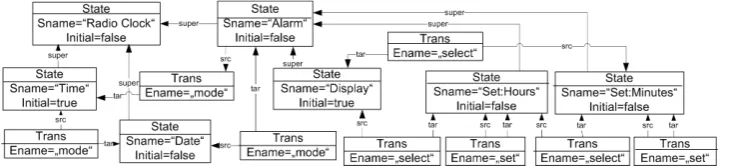
The abstract syntax graph of the Radio Clock Statechart is the given by the graphGIin Fig.2.
Figure 2: Abstract Syntax GraphGI of the Radio Clock Statechart
The set of model-specific simulation rules PS ={paddOb ject,paddEvent,pdownTime, pdownDisp,
pupAlarm, pupClock,pmodeT D,pmodeDA,pmodeAD,pselectH,pselectM,pselectD,psetH,psetM} to be applied
toGI contains initialization rules which generate the object node with attribute values for the initial alarm time, set thecurrentpointer to the top level stateRadio Clock, and fill the event queue. Additional simulation rules are defined which realize the actual simulation, processing the events in the queue. For each superstate there is a rule moving thecurrentpointer from the superstate down to its initial substate. Analogously, there are rules moving the pointer from a substate to its superstate. For each transition there is a rule which moves the pointer from the source state of the transition to its target state and removes the triggering event from the queue. The full set
PSof simulation rules is given in [EEE06]. Fig.3shows the sample simulation rulepsetH for the transitionsetwhose source and target is the stateSet:Hours. In addition to processing the event
set, this rule increments the hour value of the current alarm time.
Figure 3: A Simulation Rule psetH
The simulation specificationSimSpecV LS= (VLS,PS)for the Radio Clock consists of the
sim-ulation language VLS typed over T GS, where T GS is the simulation alphabet depicted in the left-hand side of Fig.4,PSis the set of simulation rules, andVLSconsists of all graphs that can occur in any Radio Clock simulation scenario: VLS={GS|∃GI
PS∗
=⇒GS}, whereGI is the initial graph shown in Fig.2.
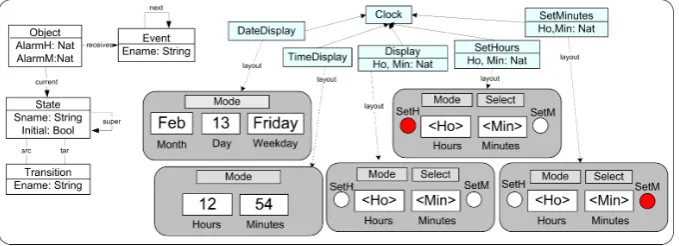
Figure 4: Simulation and Animation Alphabet
and three alarm displays showing the alarm time but differing in the states of two red lights which indicate the statesDisplay(both lights off),Set:Hours(lightSetHon), andSet:Minutes(lightSetM
on).
The S2A transformation rules Q={qClock,qDate,qTime,qDisp,qSetH,qSetM} add visualization symbols to the simulation rule graphs and to the initial radio clock graph. The initialS2Arule
qClock adds the root symbolClock to all graphs it is applied to. The remaining S2A rules add
visualization symbols depending on the state of the current pointer. We visualize only basic states which do not have any substates. Superstates are not shown in the animation view, as they are considered as transient, abstract states which are active on the way of thecurrentpointer up and down the state hierarchy between two basic states, but have no concrete layout themselves.
The full set Q ofS2A rules is given in [EEE06]. The top row of Fig. 5 shows the sample
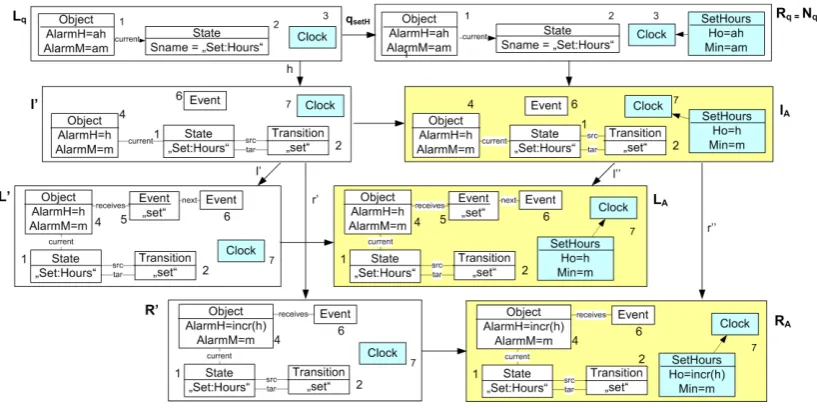
S2A transformation rule qsetH which adds aSetHours symbol and links it to the clock symbol in the case that the currentpointer points to the state named“Set:Hours”. The attributes are set accordingly. Note that eachS2Aruleqhas to be applied at most once at the same match, which is formalized by a NACLq→Nq, such thatNqandRqare isomorphic. The Radio ClockS2AM transformationS2AM:VLS→VLAis given byS2AM= (VLS,T GA,Q)with animation language
VLA={GA|∃GS∈VLS:GS
Q !
=⇒GA}. The Radio ClockS2ARtransformationS2AR:PS→PA is given byS2AR= (PS,T GA,Q)with animation rulesPA={pA|∃pS∈PS: pS
Q_!*4
pA }. A sample S2AR transformation step p0setH qsetH_4* pAsetH is shown in Fig.5. Here,S2A rule
Lq
qsetH
−→Rqis applied to the rule p0setH, according to Case(1)of Def.3. Rule p
0
setH = (L
0←I0→ R0)in Fig.5corresponds to rulep1= (L1←I1→R1)in Def.3. The result of the rule rewriting
step in Fig.5is rulepAsetH= (LA←IA→RA), which corresponds to rulep2= (L2←I2→R2)in
Def.3. Note that variables for node attributes can be assigned to other variables or to expressions. For instance, in Fig.5, the variablehfor attributeAlarmHinI0is assigned to the expressionincr(h)
in R0 by the morphismI0 r
0
−→ R0. Hence, a resulting animation rule can contain variables or expressions for attributes to be assigned to corresponding attribute values in graphs when the animation rule is applied.
trans-Figure 5:S2ATransformation Step p0setH−→qsetH pAsetH
formationS2A=(S2AM,S2AR)is given by the animation languageVLA, obtained by the Radio Clock S2AM transformation, and the animation rules PA, obtained by the Radio ClockS2AR transformation. The full setPAof animation rules is given in [EEE06].
Fig. 6 shows a sample animation scenario in the concrete notation of the animation view, where animation rules fromPAare applied. The first state of the scenario in Fig.6is obtained by applying the initial animation rules setting the alarm time and initializing the event queue with the events mode, mode, select, set, mode. The subsequent animation steps result from applying animation rules for event processing or for moving up and down the state hierarchy.
Figure 6: Radio Clock Animation Scenario
4
Semantical Correctness of
S2A
Transformations
In this section, we continue the general theory of Section2and study semantical correctness of
S2A-transformations. In our case, semantical correctness of an S2A-transformation means that for each simulation stepGS
pS
=⇒HS there is a corresponding animation stepGA
pA
=⇒HA where
GA (resp. HA) are obtained byS2A model transformation fromGS (resp. HS), and pA byS2A rule transformation from pS. Note that this is a special case of semantical correctness defined in [EE05a], where instead of a single stepGA
pA
=⇒HA more general sequencesGA
∗
=⇒HA and
HS
∗
Definition 6(Semantical Correctness ofS2ATransformations) AnS2A-transformationS2A:
SimSpecV LS →AnimSpecV LA given by S2A= (S2AM:VLS →VLA,S2AR:PS→PA) is called
semantically correct, if for each simulation stepGS
pS
=⇒HSwith
GS∈VLS and each S2AR-transformation sequence pS
Q_!*4
pA (see Def.4) we have
1. S2AM-transformation sequencesGS
Q !
=⇒GAandHS
Q !
=⇒HA, and
2. an animation stepGA
pA
=⇒HA
GS
Q ! +3
pS GA pA
Q ! _*4
HS
Q ! +3
HA
Before we prove semantical correctness in Theorem2, we first show local semantical correct-ness in Theorem1where only oneS2AM-step (resp.S2AR-step) is considered.
Theorem 1(Local Semantical Correctness ofS2A-Transformations) Given an
S2A-transfor-mation S2A:SimSpecV LS →AnimSpecV LA with S2A= (S2AM:VLS→VLA,S2AR:PS→PA)
and an S2AR-transformation sequence pS
Q _!*4
pA with intermediate S2AR-step pi
q_*4
pi+1
with q∈Q. Then for each graph transformation step Gi
pi
=⇒Hiwith Gi,Hi∈GraphsTGAwe have
1. Graph transformation steps Gi
qi
=⇒ Gi+1 in Cases (1) and (2),
Gi id
=⇒Gi+1 in Case (3), Hi q
=⇒Hi+1in Cases (1) and (3), and
Hi id
=⇒Hi+1in Case (2) of Def.3.
2. Graph transformation step Gi+1
pi+1
=⇒ Hi+1 with Gi+1, Hi+1 ∈
GraphsTGA
Gi
q/id +3
pi
Gi+1
pi+1
q _*4
Hi
q/id +3
Hi+1
Proof. We consider the respective pushout diagrams for pi
q_*4
pi+1 according to the three
rule transformation cases in Def. 3, and show by pushout composition/decomposition that in each case we obtain the commuting double cube below where the two back squares comprise the given DPO for the transformation stepGi
pi
=⇒Hi, and in the front squares we get the required DPO for the transformation stepGi+1
pi+1
=⇒Hi+1.
Li
mi
Ii li o o
ri //
Ri
Li+1
mi+1
Ii+1
o
o
/
/Ri+1
Gi Ci o o /
/Hi
Gi+1 oo Ci+1 //Hi+1
Lq
h
q //
(POI)
Rq
Ii
qi+1 //
Ii+1
In Case (1) of Def.3, we obtain the top squares as pushouts and then constructGi+1,Ci+1,
Hi+1as pushouts in the diagonal squares, leading to unique induced morphismsCi+1→Gi+1and
the front and the bottom squares are pushouts. Furthermore, we obtain pushouts for the trans-formation stepsGi
q
=⇒Gi+1andHi
q
=⇒Hi+1by composing pushout(POI)with the respective pushouts from the double cube. Cases (2) and (3) are handled similarly, with the difference that some morphisms in the respective double cubes are identities.
The following notions are used for proving the main Theorem2.
Definition 7(Termination ofS2AMand Rule Compatibility ofS2A) AnS2AMtransformation
S2AM:VLS→VLAisterminatingif each transformationGS
Q ∗
=⇒Gncan be extended toGS
Q ∗
=⇒
Gn
∗
=⇒Gm such that no q∈Q is applicable to Gm anymore. An S2A-transformation S2A= (S2AM:VLS→VLA,S2AR:PS→PA)withS2AM= (VLS,T GA,Q)is calledrule compatible, if for allpA∈PAandq∈Qwe have that pAandqare parallel and sequential independent.
More precisely, for eachG=p⇒A HwithGS
Q ∗
=⇒GandHS
Q ∗
=⇒Hfor someGS,HS∈VLSand each
G=⇒q G0 (resp. H=⇒q H0) we have parallel (resp. sequential) independence ofG=p⇒A H and
G=⇒q G0(resp.H=q⇒H0).
Theorem 2(Semantical Correctness ofS2A) Each S2A transformation S2A= (S2AM,S2AR)
is semantically correct, provided that S2A is rule compatible, and S2AM is terminating.
Proof. GivenS2A= (S2AM:VLS→VLA,S2AR:PS→PA) with terminatingS2AM, a simula-tion stepGS
pS
=⇒HS with GS∈VLS, and anS2AR transformation sequence pS
Q_!*4
pA with
pS=p0
q0 _*4
p1
q1 _*4.. qn−1_*4
pn=pA withn≥1, then we can apply the Local Semantical Correctness Theorem1fori=0, ..,n−1, leading to the diagram below, which includes the case
n=0 withGS=G0,HS=H0andpS=p0=pA, where noq∈Qcan be applied to pS.
GS=G0
q0 +3
pS=p0
G1
q1 +3
p1
G2
q2 +3
p2
... +3Gn−1 qn−1 +3
pn−1
Gn
pn=pA
Q! _*4
HS=H0 q0
+
3H1
q1
+
3H2
q2
+
3... +3Hn−1 qn−1
+
3Hn
If noq∈Qcan be applied to Gn andHn anymore, we are ready, because the top sequence is
GS
Q !
=⇒Gn=GA, and the bottom sequence isHS
Q !
=⇒Hn=HA.
Now assume that we haveqn∈Qwhich is applicable toGn leading toGn
qn
=⇒Gn+1. Then,
rule compatibility implies parallel independence withGA
pA
=⇒HA, and the Local Church Rosser Theorem [EEPT06] leads to square(n):
Gn
qn +3
pA
(n)
Gn+1 +3
pA
... +3Gm−1 qm−1
+
3
pA
Gm=GA
pA
Hn
qn +3
Hn+1 +3... +3Hm−1
qm−1+3
This procedure can be repeated as long as rulesqi∈Qare applicable toGi fori≥n. Since
S2AM is terminating, we have some m>nsuch that no q∈Qis applicable to Gm anymore, leading to a sequence GS =G0
Q !
=⇒Gm=GA. Now assume that there is some q∈Q which is still applicable to Hm leading toHm
q
=⇒Hm+1. Now rule compatibility implies sequential
independence ofGm
pA
=⇒Hm
q
=⇒Hm+1. In this case, the Local Church Rosser Theorem would
lead to a sequenceGm q
=⇒Gm+1
pA
=⇒Hm+1which contradicts the fact that noq∈Qis applicable
toGmanymore. This implies that alsoH0
Q ∗
=⇒Hn
Q ∗
=⇒Hmis terminating, leading to the required sequenceHS=H0
Q !
=⇒Hm=HA.
Extension by Negative Application Conditions
Considering rules with NACs both for theS2Arules inQ(now of the formq= (Nq←Lq→Rq)), and for the simulation rules inPS(now of the form pS= (Ni←L←I→R)), has the following consequences on the construction of the animation specification byS2Atransformation: Def.3 has to be extended to deal with the additional transformation of NACs in Cases (1) and (2) (in Case (3), the NACs remain unchanged). Moreover, a new Case (4) has to be added covering the case that preconditions (1) - (3) are not satisfied, but there are matches into Ni. Furthermore, the preconditions for all cases now also require the satisfaction of NACq= (Lq
n
−→Nq). To extend rule compatibility (Def.7), in addition to parallel and sequential independence in the case without NACs, we have to require that the induced matches satisfy the corresponding NACs. The proof of local semantical correctness ofS2Atransformations with NACs requires also NAC-compatibility of S2AM and S2AR for all q∈Q andGi
pi
=⇒Hi. NAC-compatibility of S2AM means that ifqis applicable to a rule pS, then each match ofqinGi (resp. Hi) satisfiesNACq. NAC-compatibility ofS2ARmeans that if pi
q_*4
pi+1 satisfiesNACq, andGi
pi
=⇒Hisatisfies
NAC(pi)thenGi+1
pi+1
=⇒Hi+1satisfiesNAC(pi+1).
Considering these additional requirements, we can show that eachS2A-transformationS2A= (S2AM,S2AR) is semantically correct includingNACs, provided that S2A is rule compatible,
S2AM is terminating andS2A is NAC-compatible. This extends Theorem 2, where now rule compatibility and termination have to be required with NACs (for the complete extended theorem see [EEE06,Erm06]).
Using the extended theorem, we show the semantical correctness of our Radio Clock case study in [EEE06]. Termination is shown to be fulfilled for generalS2Atransformation systems with suitable rule layers and applied to our case study in [EEE06]. Moreover, it is shown that each
S2ARtransformation is NAC-compatible provided that we have suitable rule layers as in our case study. Thus, it suffices to show only NAC-compatibility ofS2AMexplicitly for the Radio Clock.
5
Related Work
presented to verify the semantical equivalence for particular model transformations. It is shown by finding bisimulations that a target model preserves the semantics of the source model with respect to a particular property. This technique does not prove the correctness of the model transformation rules in general, as we propose in this paper for the restricted case ofS2A trans-formation rules. The formal background of bisimulations for graph transtrans-formations has been considered also in e.g. [EK04].
For the specification of model transformations,triple graph grammars[Sch94] have been fre-quently used. These grammars are based on a coupling of the syntax rules for the source and target language, which allows derivations in the source language to be translated into deriva-tions of the target language. A third grammar in between source and target produces a mapping structure to keep track of the relation between the source and target structures. Triple graph grammars have been recently used also to model tool integration [KS06] and the integration of multiple views on a system [GDL05]. Here, views are (possibly overlapping) parts of a global alphabet, and graph triples are made of one repository (the complete integrated model), one view and an intermediate graph that relates objects of both. The triple graph grammar specifies the gluing of the views in the repository. This approach has similarities to our approach concerning the relation of simulation and animation alphabets. But the restriction to subtypes of a VL type graph alone is usually not enough to define views which abstract from model details. Given a type graph for Petri nets, for example, it would not be possible to define a view which shows only the markings of particular states and hides the others. In this respect, our approach ofS2A
transformation is much more flexible. Moreover, our notion ofS2AR transformation allows to relate views with behavior.
The animation specification resulting from an S2Atransformation provides a good basis for user interaction when defining scenarios in the animation view (e.g. by clicking on a radio clock button to apply an animation rule). Here lies the central advantage of coding the animation view information into the rules instead of translating directly simulation steps into animation steps (as realized e.g. in [HEC03]).
6
Conclusion and Ongoing Work
In this paper we have given a precise definition for simulation-to-animation (S2A) model and rule transformations. The main results show under which conditions an S2A transformation
S2A:SimSpecV LS →AnimSpecV LA is semantically correct in the cases without and with negative
application conditions. The results have been used to show semantical correctness of a radio clock case study.
For simplicity, the theory has been presented in the DPO-approach for typed graphs, but it can also be extended to typed attributed graphs, where injective graph morphisms are replaced by suitable classesMandM0of typed attributed graph morphisms for rules and NACs, respectively [EEPT06]. Non DPO-based approaches have not yet been considered.
In addition to analyzing the semantical correctness ofS2A, it may be interesting to construct also a backward model and rule transformationA2S:AnimSpecV LA →SimSpecV LS, essentially
given by restriction of all graphs and rules to the type graph T GS. Semantical correctness of
A2S means that for each animation step GA
pA
step GS
pS
=⇒ HS using the restrictions GS,HS and pS of GA,HA and pA, respectively. Finally, we can consider semantical equivalence ofSimSpecV LS andAnimSpecV LA, which requires
exis-tence and semantical correctness ofS2AandA2S, such that both are inverse to each other, i.e.
A2S◦S2A=IdandS2A◦A2S=Id.
Bibliography
[EB04] C. Ermel, R. Bardohl. Scenario Animation for Visual Behavior Models: A Generic Approach.Software and System Modeling: Special Section on Graph Transforma-tions and Visual Modeling Techniques3(2):164–177, 2004.
http://www.springerlink.com/content/pfhmyfu60l7f/
[EE05a] H. Ehrig, K. Ehrig. Overview of Formal Concepts for Model Transformations based on Typed Attributed Graph Transformation. In Proc. Intern. Workshop on Graph and Model Transformation (GraMoT’05). ENTCS 152. Elsevier Science, 2005. [EE05b] C. Ermel, K. Ehrig. View Transformation in Visual Environments applied to Petri
Nets. In Rozenberg et al. (eds.),Proc. Workshop on Petri Nets and Graph Transfor-mation (PNGT). ENTCS 127(2), pp. 61–86. Elsevier Science, 2005.
[EEE06] C. Ermel, H. Ehrig, K. Ehrig. Semantical Correctness of Simulation-to-Animation Model and Rule Transformation: Long Version. Technical report 2006/10, TU Berlin, Fak. IV, 2006.http://iv.tu-berlin.de/TechnBerichte/2006/2006-10.pdf
[EEPT06] H. Ehrig, K. Ehrig, U. Prange, G. Taentzer. Fundamentals of Algebraic Graph Transformation. EATCS Monographs in Theoretical Computer Science. Springer, 2006.http://www.springer.com/3-540-31187-4
[EHKZ05] C. Ermel, K. H¨olscher, S. Kuske, P. Ziemann. Animated Simulation of Integrated UML Behavioral Models based on Graph Transformation. In Erwig and Sch¨urr (eds.),Proc. IEEE Symposium on Visual Languages and Human-Centric Computing (VL/HCC’05). IEEE Computer Society, 2005.
[EK04] H. Ehrig, B. Koenig. Deriving Bisimulation Congruences in the DPO Approach to Graph Rewriting. In Proc. FOSSACS 2004. LNCS 2987, pp. 151–166. Springer, 2004.
[Erm06] C. Ermel.Simulation and Animation of Visual Languages based on Typed Algebraic Graph Transformation. PhD thesis, Technische Universit¨at Berlin, Fak. IV, 2006. http://opus.kobv.de/tuberlin/volltexte/2006/1368/
[GDL05] E. Guerra, P. Diaz, J. de Lara. A Formal Approach to the Generation of Visual Language Environments Supporting Multiple Views. InProc. IEEE Symposium on Visual Languages and Human-Centric Computing (VL/HCC’05). IEEE Computer Society, 2005.
[Gra99] B. Grahlmann. The State of PEP. In A. (ed.),Proceedings of AMAST’98 (Algebraic Methodology and Software Technology). LNCS 1548. Springer, 1999.
[Har87] D. Harel. Statecharts: a visual formalism for complex systems.Science of Computer Programming8:231–274, 1987.
[HEC03] D. Harel, S. Efroni, I. Cohen. Reactive Animation. In Boer et al. (eds.), Proc. First Int. Symposium on Formal Methods for Components and Objects (FMCO’02). LNCS 2852, pp. 136–153. Springer, 2003.
[KS06] A. K¨onigs, A. Sch¨urr. Tool Integration with Triple Graph Grammars - A Survey. In
Proc. SegraVis School on Foundations of Visual Modelling Techniques. ENTCS 148, pp. 113–150. Elsevier Science, 2006.
http://www.sciencedirect.com/science/journal/15710661
[Mac04] Macromedia, Inc. Macromedia Flash MX 2004 and Director MX 2004. 2004. http://www.macromedia.com/software/.
[NK06] A. Narayanan, G. Karsai. Towards Verifying ModelTransformations. InProc. Work-shop on Graph Transformation and Visual Modeling Techniques (GT-VMT’06). ENTCS, Elsevier Science, 2006.
http://www.sciencedirect.com/science/journal/15710661
[PP96] F. Parisi-Presicce. Transformation of Graph Grammars. In 5th Int. Workshop on Graph Grammars and their Application to Computer Science. LNCS 1073. Springer, 1996.
[Roz97] G. Rozenberg (ed.). Handbook of Graph Grammars and Computing by Graph Transformations, Volume 1: Foundations. World Scientific, 1997.
[Sch94] A. Sch¨urr. Specification of Graph Translators with Triple Graph Grammars. In Tin-hofer (ed.), WG94 20th Int. Workshop on Graph-Theoretic Concepts in Computer Science. LNCS 903, pp. 151–163. Springer, 1994.
[SV03] A. Schmidt, D. Varr´o. CheckVML: A Tool for Model Checking Visual Modeling´ Languages. In Stevens et al. (eds.),Proc. UML 2003 - The Unified Modeling Lan-guage, Modeling Languages and Applications, 6th Intern. Con., San Francisco, CA, USA, October 20-24, 2003. LNCS 2863, pp. 92–95. Springer, 2003.
[Var04] D. Varr´o. Automated formal verification of visual modeling languages by model checking.Software and System Modeling3(2):85–113, 2004.
http://www.springerlink.com/index/10.1007/s10270-003-0050-x