Volume 10 (2008)
Proceedings of the
Seventh International Workshop on
Graph Transformation and Visual Modeling Techniques
(GT-VMT 2008)
Controlling resource access in Directed Bigraphs
Davide Grohmann, Marino Miculan
21 pages
Guest Editors: Claudia Ermel, Reiko Heckel, Juan de Lara
Managing Editors: Tiziana Margaria, Julia Padberg, Gabriele Taentzer
Controlling resource access in Directed Bigraphs
Davide Grohmann1, Marino Miculan2
1[email protected],2[email protected]
Department of Mathematics and Computer Science, University of Udine, Italy
Abstract: We studydirected bigraph with negative ports, a bigraphical framework for representing models for distributed, concurrent and ubiquitous computing. With respect to previous versions, we add the possibility that components maygovernthe access to resources, like (web) servers control requests from clients. This frame-work encompasses many common computational aspects, such as name or channel creation, references, client/server connections, localities, etc, still allowing to derive systematically labelled transition systems whose bisimilarities are congruences. As application examples, we analyse the encodings of client/server communications through firewalls, of (compositional) Petri nets and of chemical reactions.
Keywords: Bigraphs, reactive systems, (open) Petri nets, graph-based approaches to service-oriented applications.
1
Introduction
Bigraphical reactive systems (BRSs)are an emerging graphical framework proposed by Milner
and others [Mil01,Mil06] as a unifying theory of process models for distributed, concurrent and ubiquitous computing. A bigraphical reactive system consists of a category ofbigraphs(usually generated over a givensignature of controls) and a set ofreaction rules. Bigraphs can be seen as representations of the possible configurations of the system, and the reaction rules specify how these configuration can evolve, i.e., the reaction relation between bigraphs. Often, bigraphs represent terms up-to structural congruence and reaction rules represent term rewrite rules.
Many process calculi have successfully represented as bigraphical reactive systems:λ-calculus [Mil07], CCS [Mil06],π-calculus [BS06, JM04], Mobile Ambients [Jen08], Homer [BH06], Fusion [GM07b], Petri nets [LM06], and context-aware systems [BDE+06]. The advantage of using bigraphical reactive systems is that they provide general results for deriving a labelled tran-sition systemautomaticallyfrom the reaction rules, via the so-calledIPO construction. Notably, the bisimulation on this transition system is always a congruence; thus, bigraphical reactive sys-tems provide general tools for compositional reasoning about concurrent, distributed syssys-tems.
Bigraphs are the key structures supporting these results. A bigraph is a set of nodes (the
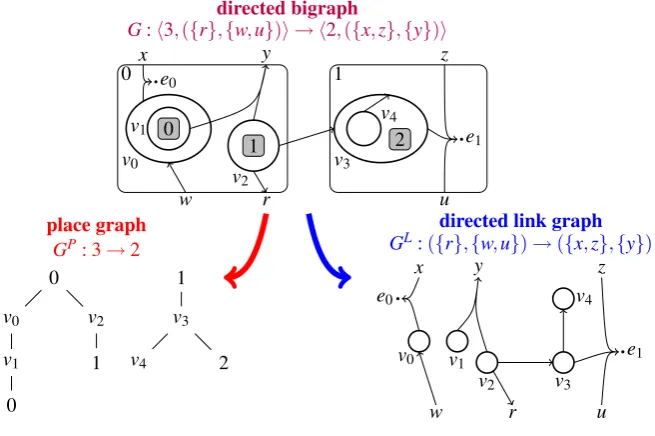
con-trols), endowed with two independent structures, theplace graphand thelink graph(Figure1).
directed bigraph
G:h3,({r},{w,u})i → h2,({x,z},{y})i 0
v0 v1
v2 0
1
x y
e0
w
1
v3 v4
2 e1 z
u r
place graph
GP: 3→2
0
v0 v2
v1 1
0
1
v3
v4 2
directed link graph
GL:({r},{w,u})→({x,z},{y})
v0 v1 v2
x y
e0
w
v3 v4
e1 z
u r
Figure 1: An example of directed bigraph, with negative ports.
In Milner’s “pure bigraphs” [Mil06], connections are represented by hyper-arcs between nodes. This model has been successfully used to represent many calculi, such as CCS, and (with a small variant) λ-calculus, π-calculus. Nevertheless, other calculi, such as Fusion [PV98], seem to escape this framework. Aiming to a more expressive framework, in previous work [GM07a,
GM07b], we have introduceddirected bigraphs. Pure and directed bigraphs differ only on the link structure: in the directed variant, we distinguish “edges” from “connections”. Intuitively, edges represent(delocalized) resources, orknowledge tokens, which can beaccessed by con-trols. Arcs are arrows from ports of controls to edges (possibly through names on the interfaces of bigraphs); moreover, in the version considered in the present paper, we allow arcs to point to other control’s ports (Figure1). Outward ports on a control represent the capability of the control to access to (external) resources; insted, inward ports represent the capability of the control to “stop” or “govern” other node’s requests. The presence of both kinds of capabilities is common in distributed scenarios, such as client/server communications, firewalls, web services etc; for instance a system may ask to access to some data, but this attempt may be blocked, checked and possibly redirected by a guarding mechanism. Moreover, controls with inward ports can
repre-sentlocalizedresources, that is, resources with a position within the place hierarchy; this cannot
be represented easily by edges, which do not appear in the place graph.
Notably, these extended bigraphs have relative pushout (RPO) and idem pushout (IPO) con-structions, admit a notion of normal form, and a sound a complete axiomatization can be given. Therefore, these bigraphs can be conveniently used for building wide reaction systems from which we can synthesize labelled transition systems, and whose bisimilarity is a congruence.
definitions about directed bigraphs. General theoretical results (e.g., normal form, complete axiomatization, RPO construction, etc.) are presented in Sections3–5. Then, Section6is devoted to example applications. We apply this framework to the representation of distributed services and protocols (taking a three-tier architecture with a firewall as an example) and of chemical reactions. Moreover, we consider the encoding of Petri nets in greater detail; in particular, we show that the IPO bisimilarity is sound with respect to theη-bisimilarity of open Petri nets.
Conclusions and direction for future work are in Section7.
2
Directed bigraphs over polarized signatures
In this section we introduce directed bigraphs, with inward (“negative”) ports on controls, ex-tending [GM07a]. Following previous developments about pure and directed bigraphs, we work
insupported monoidal precategories; we refer to [JM04,§3] for an introduction.
A polarized signatureis a signature of controls, which may have two kind of ports:
nega-tiveandpositive. LetK be a polarized signature; we denote witharn,arp:K →Nthe arity
functions of the negative and positive ports, respectively. Thus, fork∈K, the arity function is
ar(k),(arn(k),arp(k)). A controlkispositiveif it has only positive ports (i.e.,arn(k) =0); it
isnegativeif it has only negative ports (i.e.,arp(k) =0).
Definition 1 Apolarized interface X is a pair of sets of namesX= (X−,X+); the two compo-nents are calleddownwardandupwardinterfaces, respectively.
Adirected link graph A:X →Y isA= (V,E,ctrl,link)whereX,Y are theinnerandouter
interfaces,V is the set of nodes, E is the set of edges, ctrl:V →K is the control map, and
link:Pnt(A)→Lnk(A)is thelink map, whereports,pointsandlinksofAare defined as follows:
Prtn(A),
∑
v∈Varn(ctrl(v)) Prtp(A),
∑
v∈V
arp(ctrl(v)) Prt(A),Prtn(A)∪Prtp(A)
Pnt(A),X+]Y−]Prtp(A) Lnk(A),X−]Y+]Prtn(A)]E
The link map cannot connect downward and upward names of the same interface, i.e., the fol-lowing condition must hold: (link(X+)∩X−)∪(link(Y−)∩Y+) = /0; moreover the link map cannot connect positive and negative ports of the same node.
Directed link graphs are graphically depicted much like ordinary link graphs, with the differ-ence that edges are explicit objects, and not hyper-arcs connecting points and names; points and names are associated to links (that is edges or negative ports) or other names by (simple, non hyper) directed arcs. An example are given in Figure1. This notation aims to make explicit the “resource request flow”: positive ports and names in the interfaces can be associated either to internal or to external resources. In the first case, positive ports and names are connected to an edge or a negative port; these names are “inward” because they offer to the context the access to an internal resource. In the second case, the positive ports and names are connected to an “outward” name, which is waiting to be plugged by the context into a resource.
Definition 2 The precategory ofdirected link graphshas polarized interfaces as objects, and directed link graphs as morphisms.
Given two directed link graphsAi= (Vi,Ei,ctrli,linki):Xi→Xi+1(i=0,1), the composition
A1◦A0:X0→X2is defined when the two link graphs have disjoint nodes and edges. In this case,
A1◦A0,(V,E,ctrl,link), whereV ,V0]V1,ctrl,ctrl0]ctrl1,E,E0]E1and
link:X0+]X2−]Prtp(A0)]Prtp(A1)→X0−]X2+]E]Prtn(A0)]Prtn(A1)
is defined as follows:
link(p),
link0(p) ifp∈X0+]Prtp(A0)andlink0(p)∈X0−]E0]Prtn(A0)
link1(x) ifp∈X0+]Prtp(A0)andlink0(p) =x∈X1+
link1(p) ifp∈X2−]Prtp(A1)andlink1(p)∈X2+]E1]Prtn(A1)
link0(x) ifp∈X2−]Prtp(A1)andlink1(p) =x∈X1−.
The identity link graph ofX isidX,(/0,/0,/0K,idX−∪idX+):X→X.
It is easy to check that composition is associative, and that given a link graphA:X→Y, the compositionsA◦idX andidY◦Aare defined and equal toA.
Definition1forbids connections between names of the same interface in order to avoid unde-fined link maps after compositions. Similarly, links between ports on the same node are forbid-den, because these graphs cannot be obtained by composing an “unlinked” node and a context.
It is easy to see that the precategory0DLG is self-dual, that is0DLG∼=0DLGop.
The notions of openness, closeness, leanness, etc. defined in [GM07a] can be easily extended to the new framework, considering negative ports as a new kind of resources. Moreover, the definition of tensor product can be derived extending to negative ports the one given in [GM07a]. Finally, we can define the (extended) directed bigraphsas the composition of standard place graphs (see [JM04,§7] for definitions) and directed link graphs.
Definition 3 Adirected bigraphwith signatureK isG= (V,E,ctrl,prnt,link):I→J, where
I=hm,XiandJ=hn,Yiare its inner and outer interfaces respectively. An interface is composed
by awidth(a finite ordinal) and by a pair of finite sets of names.VandEare the sets of nodes and
edges respectively, andprnt,ctrlandlinkare the parent, control and link maps, such thatGP,
(V,ctrl,prnt):m→nis a place graph andGL,(V,E,ctrl,link):X→Y is a directed link graph.
We denoteGas combination ofGP andGLbyG=hGP,GLi. In this notation, a place graph and a (directed) link graph can be put together iff they have the same sets of nodes.
Definition 4 The precategory0DBIGof directed bigraph with signatureK has interfacesI=
hm,Xi as objects and directed bigraphsG=hGP,GLi:I →J as morphisms. If H:J →K is another directed bigraph with sets of nodes and edges disjoint from the respectively ones ofG, then their composition is defined by composing their components, i.e.:
H◦G,hHP◦GP,HL◦GLi:I→K.
Analogously, the tensor product of two bigraphs can be defined tensoring their components. It is easy to check that for every signature K, the precategory0DBIGis wide monoidal; the origin is ε =h0,(/0,/0)i and the interface hn,Xi has width n. Hence, 0DBIG can be used for applying the theory ofwide reaction systemsandwide transition systemsas developed by Jensen and Milner; [JM04,§4,§5]. To this end, we need to show that0DBIGhas RPOs and IPOs. Since place graphs are as usual, it suffices to show that directed link graphs have RPOs and IPOs.
Theorem 1 If a pair~A of link graphs has a bound~D, there exists an RPO(B~,B)for~A to~D.
As a consequence,0DLG has IPOs too. See section4for the direct construction for RPOs in directed bigraphs with negative ports, extending the construction given in [GM07a].
Actually, often we do not want to distinguish bigraphs differing only on the identity of nodes and edges. To this end, we introduce the category DBIG ofabstract directed bigraphs, which is constructed from0DBIGforgetting the identity of nodes and edges and any idle edge. More precisely, abstract bigraphs are bigraphs taken up-to an equivalencem(see [JM04] for details).
Definition 5 Two concrete directed bigraphs G and H are lean-support equivalent, written
GmH, if there exists an iso between their nodes and edges sets after removing any idle edges. The category DBIGof abstract directed bigraphs has the same objects as0DBIG, and its arrows are lean-support equivalence classes of directed bigraphs.
3
Algebra and Axiomatization
In this section, generalizing similar results for directed bigraphs, we describe the main classes of bigraphs and the elementary bigraphs which can generate all bigraphs according to a well-defined normal form. As main result we give a normalization theorem. We refer the reader to [GM08] for a detailed presentation of the notation used here.
First, we introduce two distinct and complementary subclasses of bigraphs: wiringsand
dis-crete bigraphs, that are used in defining the normal form and the axiomatization.
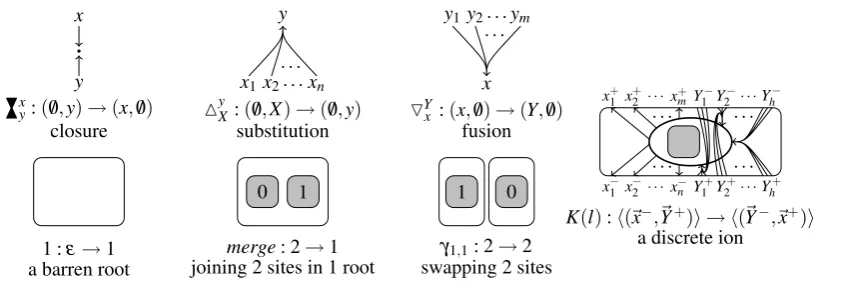
Definition 6 Awiringis a bigraph whose interfaces have zero width (and hence has no nodes). The wiringsω are generated by the composition or tensor product of three elements: substitu-tionsσ:(/0,X+)→(/0,Y+), fusionsδ :(Y−,/0)→(X−,/0), and closuresHNxy:(/0,y)→(x,/0).
Definition 7 An interface is prime if its width is 1. Often we abbreviate a prime interface h1,(X−,X+)iwithh(X−,X+)i, in particular 1=h(/0,/0)i. A prime bigraphP:hm,(Y−,Y+)i → h(X−,X+)ihas a prime outer interface and the names inY+,X−are linked to negative ports ofP.
An important prime bigraph ismergem:m→1, it has no nodes and mapsmsites to one root.
Definition 8 A bigraph isdiscreteif it has no edges and every open link has exactly one point.
y x
H
Nxy:(/0,y)→(x,/0) closure
y
x1x2. . .xn . . .
MyX:(/0,X)→(/0,y) substitution
x y1y2. . .ym
. . .
OYx :(x,/0)→(Y,/0) fusion
1 :ε→1
a barren root
0 1
merge: 2→1 joining 2 sites in 1 root
1 0
γ1,1: 2→2 swapping 2 sites
x−1 x−2 . . .x−n x+1 x+2 . . .x+m
Y1+Y2+. . .Yh+ Y1−Y2−. . .Yh− . . .
. . .
. . .
. . .
K(l):h(~x−,~Y+)i → h(~Y−,~x+)i
a discrete ion
Figure 2: Elementary Bigraphs over polarized signatures.
Definition 9 LetKbe any non atomic control with arity(k−,k+), let~x−,~x+ be two sequences of distinct names, and let~Y+,~Y− be two sequences of (possibly empty) sets of distinct names, such that:|~x−|+|~x+|=k+and|~Y−|=|~Y+|=k−. For aK-nodev, we define the discreteion
K(v,l):h(~x−,~Y+)i → h(~Y−,~x+)i
as the bigraph with exactly a nodevandlis a pair of maps: an iso maplp:~x−∪~x+→Prtp(v) describing the linking among positive ports and names in~x− or~x+, and another iso mapln:
~
Y−∪~Y+→Prtn(v)describing the linking among negative ports and sets of upward inner names (in~Y+) and sets of downward outer names (in~Y−). We omitvwhen it can be understood.
For a prime discrete bigraphPwith outer names in(Z−,Z+), we define a discretemoleculeas:
(K(l)⊗id(Z−\~x−,Z+\~Y+))◦P.
IfKis atomic, we define the discreteatom, as an ion without the site
K(l):(~x−,~Y+)→ h(~Y−,~x+)i.
An arbitrary (non-discrete) ion, molecule or atom is formed by the composition of ω⊗id1 with a discrete one. Often we omit. . .⊗idI in the compositions, when there is no ambiguity.
Figure2 shows thealgebraic signature, that is a set of elementary bigraphs which allow to define any other bigraph using solely composition and tensor product. Before giving a formal result, we provide an intuitive explanation of the meaning of these elementary bigraphs.
• The first three bigraphs build up all wirings, i.e. all link graphs having no nodes. All sub-stitutions (fusions, resp.) can be obtained tensoring elementary subsub-stitutionsMyX (fusionsO
Y x, resp.); the tensor products of singleton substitutionsMyxor singleton fusionsOxygive all renam-ings. Composition and tensor product of substitutions, fusions and closures give all wirrenam-ings.
• The next three bigraphs define all placings, i.e. all place graphs having no nodes; for example
mergem:m→1, mergingmsites in a unique root, are defined as:
Notice thatmerge1=idandmerge2=merge, and that all permutationsπ are constructed by composition and tensor product from the place symmetryγ1,1.
• Finally, for expressing any direct bigraph we need to introduce only the discrete ionsK(l): h(~x−,~Y+)i → h(~Y−,~x+)i. In particular, we can express any discrete atoms asK(l)◦1.
The following proposition shows that every bigraph can be expressed in a normal form, called
discrete diagonal normal form(DDNF). We will useD,QandNto denote discrete, prime and
discrete bigraphs, and discrete molecules respectively.
Theorem 2 1. A bigraph G on signatureK can be expressed uniquely (up to iso) as:
G= (ω⊗idn)◦D◦(ω0⊗idm) (1)
where D is a discrete bigraph andω,ω0are two wirings satisfying the following conditions:
i. inω, if two outer downward names are peer, then their target is an edge;
ii. inω0 there are no edges, and no two inner upward names are peer.
2. Every discrete bigraph D:hn,Zi → hm,Wi, may be factored uniquely (up to iso) on the width
m in the following form:
D=α⊗
(Q0⊗χ1out,0⊗χ2out,0⊗. . . )◦
(χ0in,1⊗Q1⊗χ2out,1⊗. . . )◦
(χ0in,2⊗χ1in,2⊗ Q2 ⊗. . . )◦
. ..
( . . .⊗ Qm−3 ⊗χm−out2,m−3⊗χm−out1,m−3)◦
( . . .⊗χm−in 3,m−2⊗ Qm−2 ⊗χm−out1,m−2)◦
( . . .⊗χm−in 3,m−1⊗χm−in 2,m−1⊗ Qm−1)
◦(π⊗iddom(~Q)) shortly:
D=α⊗(χ(Q0, . . . ,Qm−1)◦(π⊗iddom(~Q))) (2)
where α is a renaming,π is a permutation, each Qi :hhi,(Xi−,Xi+)i → h(Y
−
i ,Yi+)i is prime
and discrete, and χi,lout (χi,lin resp.) are the identities on the outer (inner resp.) names of Qi at
level l∈ {0, . . . ,m−1}, which are not used by Ql, . . . ,Qi−1(Qi+1, . . . ,Ql resp.). Formally:
χi,lout,idh(Y−
i \( Ui−1
j=lX
−
j ),Y + i \(
Ui−1 j=lX
+
j ))i for i>l
χi,lin,idhh i,(Xi−\(
Ul j=i+1Y
−
j ),X + i \(
Ul j=i+1Y
+
j ))i for i<l.
3. Every prime and discrete Q, may be factored uniquely (up to iso) in the following form:
Q= (mergen+p⊗idcodom(~N))◦(idn⊗χ(N0, . . . ,Np−1))◦(π⊗iddom(~N)) (3)
4. Every discrete molecule N, may be factored uniquely (up to iso) in the following form:
N= (K(l)⊗id(codom(Q)\(~x−,~Y+)))◦Q. (4)
Furthermore, the expression is unique up to iso on the parts and reordering of Ns in Q.
These equations can be used for normalizing any bigraphGas follows; first, we apply equa-tions (1), (2) toGonce, obtaining an expression containing prime discrete bigraphsQ0, . . . ,Qm−1. These are decomposed further using equations (3), (4) repeatedly: eachQi is decomposed into an expression containing moleculesNi,0, . . . ,Ni,pi−1, each of which is decomposed in turn into an ion containing another prime discreteQ0i,j. The last two steps are repeated recursively until the ions are atoms or have only holes as children. Note that 1 is a special case ofQwhenn=p=0. Notice that if the signature has only positive controls, then all the “Qilayers” can be collapsed in a unique one, obtaining a normal form that is very similar to the Milner’s DNF (see [Mil06]). Furthermore, a renaming is discrete but not prime (since it has zero width); this is why the factorization has such a factor. The uniqueness of that factorization depends on the fact that prime bigraphs have upward inner names and downward outer names linked to negative ports.
In Table1we give a set of axioms which we prove to be sound and complete.
Each of these equations holds only when both sides are defined; in particular, recall that the tensor product of two bigraphs is defined only if the name sets are disjoint. It is important to notice that for ions only the renaming axiom is needed (because names are treated positionally).
Theorem 3 Let E0,E1be two expressions constructed from the elementary bigraphs by
com-position and tensor product. Then, E0 and E1denote the same bigraph inDBIGif and only if
the equation E0=E1can be proved by the axioms in Table1.
Sharing productsTo conclude this section ,we define some variants of the tensor product, which
allow the sharing of names. Actually, these operators can be defined in terms of composition and tensor, but they turn out quite useful in the encoding of process calculi, where in the usual “par-allel”P|Q, processesPandQcan share names. In directed bigraphs, this sharing can involve inner downward names and/or outer upward names, as described by the following definitions.
Definition 10 The outer sharing product ( ), inner sharing product () and sharing prod-uct(k) of two objectsX = (X−,X+),Y = (Y−,Y+)and of two link graphsAi:Xi→Yi(i=0,1) are defined as follows:
(X−,X+) (Y−,Y+),(X−]Y−,X+∪Y+)
(X−,X+)(Y −
,Y+),(X−∪Y−,X+]Y+)
A0 A1,(V0]V1,E0]E1,ctrl0]ctrl1,link0]link1):X0⊗X1→Y0 Y1
A0A1,(V0]V1,E0]E1,ctrl0]ctrl1,link0]link1):X0X1→Y0⊗Y1
A0kA1,(V0]V1,E0]E1,ctrl0]ctrl1,link0]link1):X0X1→Y0 Y1
Categorical Axioms
A◦id=A=id◦A A◦(B◦C) = (A◦B)◦C
A⊗idε=A=idε⊗A A⊗(B⊗C) = (A⊗B)⊗C
γI,ε =idI γJ,I◦γI,J=idI⊗J γI⊗J,K= (γI,K⊗idJ)◦(idI⊗γJ,K)
(A1⊗B1)◦(A0⊗B0) = (A1◦A0)⊗(B1◦B0)
γI,K◦(A⊗B) = (B⊗A)◦γH,J (whereA:H→I,B:J→K)
Link Axioms
Mxx=id(/0,x) Oxx=id(x,/0) HNxy◦M y z=HN
x
z O
z x◦HN
x y=HN
z
y Ox◦HN x y◦M
y=
idε
Mz(Y]y)◦(id(/0,Y)⊗M y X) =M
z
(Y]X) (id(Y,/0)⊗OXy)◦O (Y]y)
z =O
(X]Y) z
Place Axioms
merge◦(1⊗id1) =id1 merge◦γ1,1=merge
merge◦(merge⊗id1) =merge◦(id1⊗merge)
Node Axioms
LetK(l):h(~x−,~Y+)i → h(~Y−,~x+)i
(id1⊗α+⊗ζ−)◦K(l) =K(l0)withl0= ((id~x−∪α+)◦lp,((ζ−)op∪id~
Y+)◦ln)
K(l)◦(id1⊗α−⊗ζ+) =K(l00)withl00= ((α−∪id~x+)◦lp,(id~ Y−∪(ζ
+)op
)◦ln)
whereα+:~x+→~z+,α−:~x−→~z−are renamings and
ζ−:~Z−→~Y−,ζ+:~
Z+→~Y+are surjective fusions.
Table 1: Axiomatization for the abstract directed bigraphs.
The outer sharing product, inner sharing product andsharing product of two objects I =
hm,Xi,J=hn,Yiand of two bigraphsGi:Ii→Ji (i=0,1) are defined by extending the corre-sponding products on their link graphs with the tensor product on widths and place graphs:
hm,Xi hn,Yi,hn+m,X Yi hm,Xihn,Yi,hn+m,XYi
G0 G1,hGP0⊗GP1,G0L GL1i:I0⊗I1→J0 J1
G0G1,hGP0⊗GP1,G0LGL1i:I0I1→J0⊗J1
G0kG1,hGP0⊗GP1,G0LkGL1i:I0I1→J0 J1.
defined when interfaces are defined andGihave disjoint node and edge sets.
4
Construction of RPOs
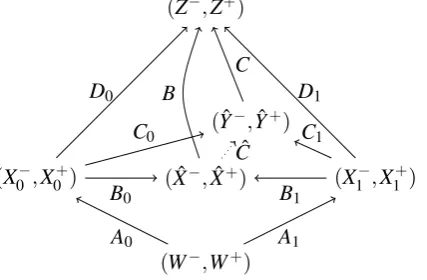
We first give an idea of how the construction works. SupposeD0:X0→Z, D1:X1→Z is a bound for a spanA0:W→X0,A1:W→X1and we wish to construct the RPO(B0:X0→Xˆ,B1:
X1→Xˆ,B: ˆX→Z). In the following we will denote a pair(A0,A1)by~Aand the link map ofA simply byA. To form the pair~Bwe truncate~Dby removing all the edges, nodes and ports not present in~A. Then in the outer interface of~B, we create an outer name for each point unlinked by the truncation: the downward names connected to the same link (name, edge or negative port) must be “bound together”, i.e. we must consider all the possible ways to associate a downward name ofA0with one ofA1and vice versa; further we must equate an upward name ofA0with one ofA1if they are both connected to a point shared betweenA0andA1. Formally:
Construction1 A relative pushout(~B:~X→Xˆ,B: ˆX→Z), for a pair~A:W→~Xof link graphs
relative to a bound~D:~X→Z, will be built in three stages. Since RPOs are preserved by isomor-phisms, we can assume the components ofX0andX1disjoint.
nodes and edges IfViare the nodes ofAi(i=0,1), then the nodes ofDiareVDi = (V¯i\Vi)]V2 for someV2. Define the nodes ofBi andBto beVBi ,V¯i\Vi(i=0,1)andVB,V2. Edges
Eiand portsP p i ,P
n
i ofAiare treated analogously.
interface Construct the shared codomain ˆX = (Xˆ−,Xˆ+) of~B as follows: first we define the names in eachXi= (Xi−,Xi+), fori=0,1, that must be mapped into ˆX= (Xˆ−,Xˆ+):
Xi0−,{x∈Xi−| ∃y∈X¯−
i s.t.Ai(x) =Ai¯(y)orAi(x)∈(Ei\Ei¯)](P n i \P¯in)}
Xi0+,{x∈Xi+|Di(x)∈(E2]P2n]Z+)}.
LetRes,W−](E0∩E1)](P0n∩P1n). We define for eachl∈Resthe set of names inXi0−
linked tol:
Xi0−(l),{x∈Xi0−|Ai(x) =l} (i=0,1).
Now we must “bind together” names connected to the same link, so we create all the possible pairs between a name inX00−and a name inX10−. Further we must add to ˆX−all the names inXi0−“not associable” to any name ofX¯0−
i . Then the set of downward names of~Bis:
ˆ
X−, [
l∈Res
X00−(l)×X10−(l)∪
∑
i∈{0,1}[
e∈(Ei\E¯i)](Pin\Pi¯n)
Xi0−(e).
Next, on the disjoint sumX00++X10+, define∼=to be the smallest equivalence for which
(0,x0)∼= (1,x1)iff there exists p∈W+](P0p∩P1p)such thatA0(p) =x0andA1(p) =x1. Then define:
ˆ
X+,(X00++X10+)/∼=.
(W−,W+)
(X0−,X0+) (Xˆ−,Xˆ+) (X1−,X1+) (Yˆ−,Yˆ+)
(Z−,Z+)
A0 A1
B0 B1
C0 C1
D0 D1
C B
ˆ
C
Figure 3: Construction of the unique arrow form the RPO to any other candidate.
links Define the link maps ofBi as follows:
forx∈Xi+: Bi(x), (
Di(x) ifx∈(Xi+\Xi0+)
c
i,x ifx∈Xi0+;
forp∈Pi¯p\Pip: Bi(p), (
Di(p) ifA¯i(p)∈/X¯i+
c ¯
i,x ifA¯i(p) =x∈X¯i+;
for ˆx∈Xˆ−: Bi(xˆ),
x if ˆx= (x,y)andi=0
y if ˆx= (x,y)andi=1
ˆ
x if ˆx∈(Xˆ−∩Xi−)
A¯i(xˆ) if ˆx∈(Xˆ−∩X¯i−).
Finally we define the link map ofB:
for ˆx∈Xˆ+: B(xˆ),Di(x)where ˆx=ic,xandx∈Xi+;
forp∈P2p]Z−: B(p),
Di(p) ifDi(p)∈(E2]P2n]Z+)
D¯i(p) ifDi(p)∈(Ei¯\Ei)](P¯in\P n i )
Di(p) ifDi¯(p)∈(Ei\E¯i)](Pin\Pi¯n)
(x,y) ifD0(p) =x∈X0−andD1(p) =y∈X1−.
Theorem 4 In0DLG, whenever a pair~A of link graphs has a bound~D, there exists an RPO
(~B,B)for~A to~D, and Construction1yields such an RPO.
Proof. The proof is in two parts. First we have to check that(~B,B)is an RPO candidate; this is
constructed as follows: let beVC the nodes ofC, fori=0,1 the set of nodes ofCi isVCi ,
(V¯i\Vi)]V3, where V3 is such that V2 =V3]VC; edges ECi and ports PCi ofCi are defined analogously. Then ˆC hasV3,E3 andP3 as sets of nodes, edges and ports respectively. Its link map is defined as follows:
for cj,x∈Xˆ+: Cˆ(cj,x),Cj(x);
forp∈P3p]Yˆ−: Cˆ(p),
Ci(p) ifCi(p)∈(E3]P3n]Yˆ+)
C0(p) ifC0(p)∈(Xˆ−∩X0−)
C1(p) ifC1(p)∈(Xˆ−∩X1−)
(x,y) ifC0(p) =x∈X0− andC1(p) =x∈X1−
As an immediate consequence, since0DLG is self-dual, we can calculate RPBs as well.
As regards IPOs, their existence is guaranteed by Theorem4. Due to lack of space, we omit here a direct construction of IPOs, which can be obtained by adapting the one presented in [GM07a] to the RPO construction given above.
5
Directed Bigraphical Reactive and Transition Systems
In this section we introduce reactive systems and transition systems over directed bigraphs over polarized signatures. For sake of simplicity, we will keep using the namesdirected bigraphical
reactive systems anddirected bigraphical transition systemsrespectively, as in [GM07b]. For
the definitions about wide reactive systems over monoidal precategories, see [Mil06].
Definition 11 A ground reaction rule is a pair(r,r0), whererandr0are ground with the same outer interface. Given a set of ground rules, the reaction relation −→over agents is the least, such thatDr−→Dr0for each active contextDand each ground rule(r,r0).
A parametric reaction rule has a redexRand reactumR0, and takes the form:
(R:I→J,R0:I→J)
For anyX and discreted:I⊗X, the parametric rule generates the ground rule:
((R⊗idX)◦d,(R0⊗idX)◦d).
Definition 12 Adirected bigraphical reactive system(DBRS) over the polarized signatureK, denoted byD(K,R)is the precategory0DBIG(K)equipped with a setRof reaction rules.
Now we can prove the following important result:
Proposition 1 DBRSs are wide reactive systems over a wide monoidal precategory
Definition 13 Atransitionfor a DBRSD(K,R)is a quadruple(a,L,λ,a0), written asa−→L λ
a0, whereaanda0are ground bigraphs and there exist a ground reaction rule(r,r0)∈R and an active contextDsuch thatLa=Dr, andλ=width(D)(width(cod(r)))anda0lDr0.
A transition isIPOif the(L,D)is an IPO for(a,r).
Definition 14 A directed bigraphical transition system (DBTS)L forD is a pair (I,T), whereI is a set of interfaces; theagentsofL are the ground bigraphs with outer interfaces in I;T is a set of transitions whose sources and targets are agents ofL.
Thefull(IPO, resp.) transition system has all interfaces, with all (IPO, resp.) transitions.
The following result follows from [Mil06, Theorem 4.6] and Proposition1above.
Theorem 5 In any DBRS equipped with the IPO transition system, wide bisimilarity is a con-gruence.
6
Applications
6.1 Three-tier interaction with access control
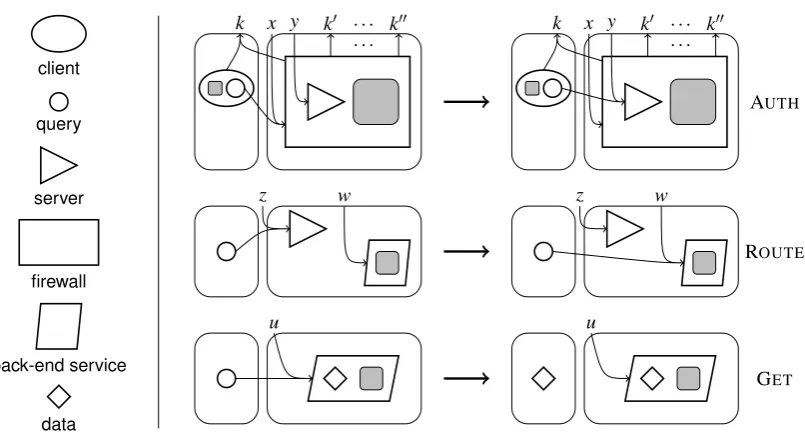
As mentioned before, directed bigraphs over polarized signatures allow to represent resource access control, by means of negative ports. This is particularly useful for representing access policies between systems, possibly in different locations; the edges can represent access tokens (or keys), which are global (although known possibly to only some controls). An example and quite common scenario is a client-server connection, where the access to the server is subject to authentication; after the request has been accepted, the server can route it to a back-end service (e.g., a DBMS); see Figure4. The security policy is implemented by the firewall control, which allows a query to reach the server only if the client knows the correct key (rule AUTH). The server routes the query to the correct back-end service using rules like ROUTE; finally the back-end service provides the data (rule GET). An example computation is shown in Figure5.
6.2 Compositional Petri Nets
In this section we recall briefly what a Petri net is and we give an encoding of these nets as directed bigraphs; to this end it is preferable to work with sorted links, as in [LM06]. Notice that this encoding yields naturally a notion of composition between Petri nets.
Definition 15 Aplace transition net(P/T net) is a 5-tuple(P,T,F,Mi)(P∩T =/0), where: • Pis the set ofplaces; T is the set oftransitions;
• F is the multiset of arcs,linking places to transitions and vice versa: F ,h(P×T)∪(T×
P),f :(P×T)∪(T×P)→Ni, with the constrain∀t∈T.∃p,q∈P.(p,t)∈F∧(t,q)∈F;
• M:P→Nis amarking,giving to each place a number of tokens, a placepismarkedbyMif
client
query
server
firewall
back-end service
data
x y
k k0 . . . k00 . . .
AUTH x y
k k0 . . . k00 . . .
z w
ROUTE
z w
u
GET u
Figure 4: Signatures and rules for three-tier architecture services through a firewall.
u u u u
Figure 5: An example of client-server interaction through a firewall.
We define•t,{p|(p,t)∈F}to be thepre-multisetof the transitiont, andt•,{p|(t,p)∈F}
thepost-multisetof the transitiont.
A transitiontisenabledby a markingMifMmarks every place in•t; a transitionfiresfrom a markingMto a markingM0, writtenM→t M0, iff for allp∈P:M0(p) =M(p)−](•p) +](p•), where](•p)and](p•)are the number of occurrences ofpin•t,t•, respectively.
Notice that we allow multiple connections between a place and a transition, which is analogous to assign a weight to an arc representing the number of tokens to consume for firing the reaction.
Definition 16 LetN= (P,T,F,M)andN0= (P0,T0,F0,M0)be two P/T nets, we say thatNand
N0areisomorphic, if there exist two bijectionsα:P→P0andβ:T →T0, such that:
• (p,t)∈F iff(α(p),β(t))∈F0;
• (t,p)∈F iff(β(t),α(p))∈F0;
• M=M0◦α.
token
x:i y:o
x:i y:o
i o placex,yx,y
i i i ~x:i
o o o
~y:o
trans(|~x|,|~y|)~x,~y
Figure 6: Signature for the encoding of compositional Petri nets.
Definition 17 A link sorting is a triple Σ= (Θ,K,Φ), where Φ is a set of sorts, and K
is a sorted signature (that is, a signature enriched with a sort to ports of each control). Fur-thermore, each name in the interface(X−,X+) is given a sort, so the interfaces take the form
({x−1 :θ1−, . . . ,xn−:θn−},{x+1 :θ +
1, . . . ,xm+:θm+}). Finally,Φis a rule on such enriched bigraphs, that is preserved by identities, composition and tensor product.
We denote the precategory and category of, respectively, concrete and abstract Σ-sorted di-rected bigraphs with0DBIG(Σ)and DBIG(Σ).
Definition 18 Apositive-negative sorting Σ= (Θ,K,Φ) has sorts: Θ={θ1, . . . ,θn}. The signatureK assigns sorts to ports arbitrarily. The uniqueΦrule is: a point and a link (except of
edges) can be connected if they are equally sorted.
In order to define an encoding for compositional Petri nets, we introduce a positive-negative sortingΣpetri, having sortΘpetri,{i,o}and sorted signature:
Kpetri,{token:(0,0),place:({1 :i,1 :o},0),trans(h,k):(0,{h:i,k:o})} whereh,k>0
where the controlstokenandtransare both atomic, while the control placeis passive (i.e., no reactions can take place inside such a node). Finally, theΦrule ensures that the linking is allowed
only among ports having the same sort. An example of use of this sorted signature is shown in Figure6. The encoding functionJ·Kis defined as follows:
J(P,T,F,M)K=merge(|P|+|T|)◦
id|P|OP×{i,o}
t∈T
trans(|•t|, |t•|)(•t×{i},t•×{o})
◦
∑
p∈Pplace(p,i),(p,i),(p,o)(p,o)◦(merge(|M(p)|+1)◦(M{(p,i),(p,o)}⊗( M(p)
∑
i=0token)⊗1))
! .
(5)
where, with an abuse of notation,trans(|•t|,|t•|)(•t×{i},t•×{o})means that if in the multisets there
are some repetitions of places then the ports oftransare linked to the same downward inner name (i.e.,(p,i)or(p,o)), an alternative definition is to link every port oftransto a different downward inner name and then (eventually) “equate” these names using fusions.
Proposition 2 Let N,N0be two P/T nets, N is isomorphic to N0 iffJNK=JN0K.
We have a different reaction rule for any pair(h,k)associated to the controltrans, in Figure7
x:i x:o y:i y:o z:i z:o u:i u:ow:iw:o x:i x:o y:i y:o z:i z:o u:i u:ow:iw:o
Figure 7: Example of reaction rule in the case of 3 input and 2 output places.
x:i x:o y:i y:o z:i z:o x:i x:o y:i y:o z:i z:o
Figure 8: Example of reaction rule in the case of 2 input and 1 output places (with multiple arcs).
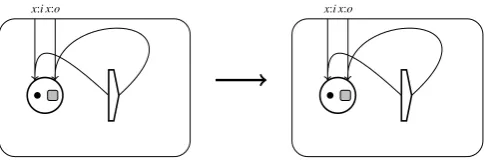
Moreover, we allow multiple connections between places and transitions, as in Figure8, and we can have transitions using some places as inputs and outputs, see Figure9.
Now we can show that the given translation is adequate.
Theorem 6 Let(P,T,F,Mi)be a P/T net, M t
→M0iffJ(P,T,F,M)K−→J(P,T,F,M 0)
K.
Proof. (⇒) Suppose M→t M0, soM enable the transitiont, then there exists atrans-node in
J(P,T,F,M)Kencoding the transitiont, and the correspondingplace-node of
•tcontain the nec-essary tokens to fire the transition (by translation ofM), then we can apply the appropriate rule to perform the reaction reaching the configurationJ(P,T,F,M0)K.
(⇐)IfJ(P,T,F,M)K−→J(P,T,F,M 0)
K, there exists a matching of a rule with a sub-bigraph
ofJ(P,T,F,M)K, in particular the matched nodes have a counter part into the P/T net(P,T,F,M),
so the markingMenables a transitiont(corresponding to thetrans-node), and thenM→t M0.
In order to study the relation between the open Petri nets, introduced in [BCE+07], and our compositional Petri nets, we need some definitions.
Definition 19 Anopen Petri netis pairZ= (NZ,OZ), whereNZis a P/T net andOZ= (O+Z,O − Z)∈ 2P×2Pare the sets ofinputandoutput open placesof the net.
x:i x:o x:i x:o
Figure 9: Example of reaction rule in the case of 1 place used as input and output.
The definition of the pre-multiset and post-multiset for the new events is the obvious one: •+
p=/0,+•p={p}and•−p={p},−•p=/0; moreover we can lift thefiringof a transition to the new setting:M→δ M0iff∀p∈P.M0(p) =M(p)−](•δ) +](δ•)(whereδ ∈T orδ = +p,−p).
The encoding function for open Petri nets is analogous to the previous one (5), the only differ-ence is replacingOP×{i,o} withO((P\O+)×{i})∪((P\O−)×{o}). This means “opening” the places in
O, which is encoded by leaving an outer downward names linked to theioroport of a place de-pending if it is an input or output open place. In this way, places can be accessed by the context. With an abuse of notation, we denote withJ·Kthe new encoding function.
Now, we are ready to introduce a labelled transition system for open Petri nets.
Definition 20 Thefiring LTSassociated to an open Petri netZis the triplehM¯,Λ, M,Z¯ i, where the states are the markingsM∈M¯, the set of labelΛ={τ} ∪ {+p|p∈O+Z} ∪ {−p|p∈O−Z} and the transition relation M,Z¯ ⊆M¯ ×Λ×M¯ includes all transitionM λM,Z¯ M0 iffM→λ M0 andλ= +p,−por there existst∈T such thatM
t
→M0andλ=τ.
We shall often omit the transition relation subscripts when derivable from the context. The firing LTS has the following associated bisimulation.
Definition 21 LetZ1,Z2be two open Petri nets, andη:OZ1↔OZ2 a correspondence between
Z1andZ2. Aη-bisimulation betweenZ1,Z2is a relation over markingsR⊆M¯1×M¯2such that ifM1RM2then
• ifM1 l M10, then there existsM20 such thatM2η(l)M20 andM10RM20;
• the vice versa holds;
whereη(+p) = +η(p),η(−p) =−η(p)andη(τ) =τ.
Two open Petri netsZ1,Z2areη-bisimilar (denoted∼η) ifη:O1↔O2is a correspondence and there exists aη-bisimulationR such thatMZ1RMZ2, where MZ1,MZ2 are the initial mark-ings.Z1,Z2are bisimilar (written∼) if they areη-bisimilar for someη.
x:i x:o y:o
y:o
plusx,y
x:i x:o y:o
y:o
plusx,y
y:i y:o x:o
x:o
minusx,y
y:i y:o x:o
x:o
minusx,y
Figure 10: The labels representing the consuming or adding of tokens inside an open place.
H e
Na e
C e
e
e e
O
e e
e
e e e
Cl
e e
e
e e e e
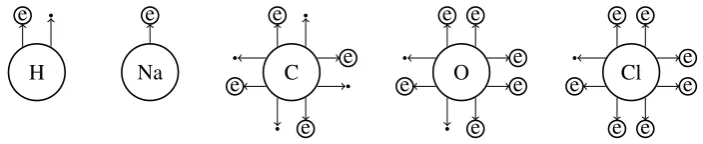
Figure 11: Example of atom encodings in directed link graphs.
names in the outer interface. In other words, an open placep1ofZ1is in correspondence with an open placep2ofZ2iff in their encodingsJZ1KandJZ2K,p1andp2are linked to the same names.
In order to prove the soundness result, we need to identify the IPO labels representing the labels +p and −p of the firing LTS. These labels are listed in Figure 10, where denotes the identity over the downward names of the agent filling the context. The following results hold.
Lemma 1 Given two open Petri nets Z1,Z2, and let C[·]∈ {minusx,y⊗id
JZ1K,plusx,y⊗idJZ1K}
(where id
JZ1K=idJZ2K), then C[JZ1K]∼IPOC[JZ2K]iffJZ1K∼IPOJZ2K.
Theorem 7 The IPO bisimilarity is sound with respect to the firing bisimilarity.
Proof. We have to show that∼IPOis aη-bisimulation. SupposeJZ1K∼IPOJZ2K, and letMZ1
λ
MZ0
1. We have to find aM 0
Z2 such thatMZ2
λ
MZ0
2 andJZ 0
1K∼IPOJZ 0
2K, whereZ 0
1andZ02are the encodings ofZ1andZ2with the new markings. This can be proved by cases onλ.
6.3 Chemical Reactions
A chemical reaction is a process describing the conversions of a chemical compositions. The chemical changes caused by a reaction always involve the motion of electrons in the forming or breaking of chemical bonds. For example, theoctet rulesays that atoms tend to gain, lose or share electrons so as to have eight electrons in their outer electron shell.
H e H e
2H→H2
H e H
e H e O e e e e e e H
e 2H+O→H2O H e O e e e e e e H e C e e e e C e e e e H e H e H e H e
4H+2C→H4C2
C e e e e C e e e e H e H e H e H e
Figure 12: Example of covalent bonds among atoms.
do not force all incoming connections to be linked to a precise point of the node). Moreover, some nodes can have extra ports, that are initially linked to edges, hydrogen and oxygen can be two examples, the idea is that such a configuration describes the aim of the atom to “capture” electrons to complete its external shell; e.g. an oxygen atom has two missing electrons, so it tries to share these two electrons with a pair of hydrogen atoms forming the water molecule.
We apply this model describing the forming and breaking of bonds among atoms, here we deal
withstrong bonds, that iscovalentandionic bonds.
Some examples of covalent bonds are in Figure12. The first shows how two hydrogen atoms can share their electrons. The second one is well-know and describes how, in the generation of a water molecule, the oxygen shares one electron with each hydrogen; in this way it gets the two missing electrons in its external orbit, conversely each hydrogen atom completes its orbit sharing an electron with the oxygen. The latter describes a more complicate situation, where two carbon atoms (each needing four electron to complete its orbit) share two electron with the other carbon atom, and the total remaining four missing electrons are provided by two pairs of hydrogen.
In Figure 13, we show an example of ionic bond: given an atom of sodium and a chlorine one, it may happen (by octet rule) that the external electron of sodium is lost by the atom and “captured” by the chlorine, forming a sodium (positive) ion and a chlorine (negative) ion. These two ions attract each other by the electrostatic force caused by the electron exchange. Finally the ions can be composed to form sodium-chloride molecule, that is the common salt.
Na e Cl
e e
e
e e e e
Na Cl
e e
e e
e e e e
Na e Cl
e e
e
e e e e
Na+Cl→Na++Cl−→NaCl
Figure 13: Examples of ion bonds among atoms.
7
Conclusions
In this paper, we have considered directed bigraphs over polarized signatures, a bigraphical model for concurrent, distributed system with resources and controls. The main difference with previous versions of bigraphs is the capability of nodes (i.e., systems) to ask for resource access (via the “positive ports”) and to control other’s requests, providing access to own resources (via the negative ports). These bigraphs have RPO and IPO constructions, thus allowing to derive systematically labelled transition systems from reactive systems, as in [JM03, GM07b], such that the corresponding bisimilarities are always congruences. These directed bigraphs admit also a notion of normal form, and a complete axiomatization.
We have exhibited the expressive power of this framework, by applying it some interesting cases: a three-tier interaction between client, server and back-end service through a firewall, the Petri nets (for which the induced IPO bisimilarity is proved to be sound with respect toη -bisimilarity of open Petri nets), and chemical reactions. All these cases are faithfully encoded as directed bigraphs with polarized signatures (possibly with sorting).
An interesting future work is to develop properly the treatment of web service interactions, extending the ideas shown in Section 6.1. In particular, we would like to give a bigraphical semantics of some formal calculus for web services, such as SCC or CC-Pi [BBC+06,BM07].
Another future development is to use this kind of bigraphs as a general framework for systems biology. Some preliminary experiment about the representation of biochemical reactions, not shown in this paper due to lack of space, are promising: ions, electrons, chemical links can be represented as controls and arcs, and the place structure can be fruitfully used to represent nesting of chemical compounds. It would be interesting to encode in directed bigraphs some important formalism for systems biology, such as theκ-calculus [DL04]. Along this line, also the possibility of adding quantitative aspects (i.e., reaction rates) sounds very promising.
Bibliography
[BBC+06] M. Boreale, R. Bruni, L. Caires, R. De Nicola, I. Lanese, M. Loreti, F. Martins, U. Montanari, A. Ravara, D. Sangiorgi, V. Vasconcelos, G. Zavattaro. SCC: A Ser-vice Centered Calculus. InProc. WS-FM. LNCS 4184, pp. 38–57. Springer, 2006.
Proc. CALCO. Lecture Notes in Computer Science 4624, pp. 126–142. 2007.
[BDE+06] L. Birkedal, S. Debois, E. Elsborg, T. Hildebrandt, H. Niss. Bigraphical Models of Context-Aware Systems. In Proc. FoSSaCS. Lecture Notes in Computer Sci-ence 3921, pp. 187–201. Springer, 2006.
[BH06] M. Bundgaard, T. T. Hildebrandt. Bigraphical Semantics of Higher-Order Mo-bile Embedded Resources with Local Names. Electr. Notes Theor. Comput. Sci.
154(2):7–29, 2006.
[BM07] M. G. Buscemi, U. Montanari. CC-Pi: A Constraint-Based Language for Speci-fying Service Level Agreements. In Proc. ESOP. Lecture Notes in Computer Sci-ence 4421, pp. 18–32. Springer, 2007.
[BS06] M. Bundgaard, V. Sassone. Typed polyadic pi-calculus in bigraphs. In Bossi and Maher (eds.),Proc. PPDP. Pp. 1–12. ACM, 2006.
[DL04] V. Danos, C. Laneve. Formal molecular biology.Theor. Compu. Sci.325, 2004.
[GM07a] D. Grohmann, M. Miculan. Directed bigraphs. In Proc. XXIII MFPS. Electronic Notes in Theoretical Computer Science 173, pp. 121–137. Elsevier, 2007.
[GM07b] D. Grohmann, M. Miculan. Reactive Systems over Directed Bigraphs. InProc.
CON-CUR 2007. Lecture Notes in Computer Science 4703, pp. 380–394. Springer, 2007.
[GM08] D. Grohmann, M. Miculan. An Algebra for Directed Bigraphs. In Mackie and Plump (eds.), Proceedings of TERMGRAPH 2007. Electronic Notes in Theoretical Com-puter Science 203(1), pp. 49–63. Elsevier, 2008.
[Jen08] O. H. Jensen. Mobile Processes in Bigraphs. PhD thesis, University of Aalborg, 2008. To appear.
[JM03] O. H. Jensen, R. Milner. Bigraphs and transitions. InProc. POPL. Pp. 38–49. 2003.
[JM04] O. H. Jensen, R. Milner. Bigraphs and mobile processes (revised). Technical re-port UCAM-CL-TR-580, Computer Laboratory, University of Cambridge, 2004.
[LM06] J. J. Leifer, R. Milner. Transition systems, link graphs and Petri nets.Mathematical
Structures in Computer Science16(6):989–1047, 2006.
[Mil01] R. Milner. Bigraphical Reactive Systems. In Larsen and Nielsen (eds.), Proc. 12th
CONCUR. Lecture Notes in Computer Science 2154, pp. 16–35. Springer, 2001.
[Mil06] R. Milner. Pure bigraphs: Structure and dynamics. Information and Computation
204(1):60–122, 2006.
[Mil07] R. Milner. Local Bigraphs and Confluence: Two Conjectures. In Proc. EXPRESS 2006. Electronic Notes in Theoretical Computer Science 175(3), pp. 65–73. 2007.