Grubert, Anna and Eimer, Martin (2016) The speed of serial attention shifts
in visual search: evidence from the N2pc component. Journal of Cognitive
Neuroscience 28 (2), pp. 319-332. ISSN 0898-929X.
Downloaded from:
Usage Guidelines:
Please refer to usage guidelines at or alternatively
The speed of serial attention shifts in visual search: Evidence from the N2pc component
Anna Grubert and Martin Eimer*
*Corresponding author
Department of Psychological Sciences, Birkbeck, University of London,
Malet Street, London WC1E 7HX, UK
Phone: 0044 20 76316358
Fax: 0044 20 76316312
Email: [email protected]
Abstract
Finding target objects among distractors in visual search display is often assumed to
be based on sequential movements of attention between different objects. However, the
speed of such serial attention shifts is still under dispute. We employed a search task that
encouraged the successive allocation of attention to two target objects in the same search
display, and measured N2pc components to determine how fast attention moved between
these objects. Each display contained one digit in a known color (fixed-color target) and
another digit whose color changed unpredictably across trials (variable-color target)
together with two grey distractor digits. Participants’ task was to find the fixed-color digit
and compare its numerical value to that of the variable-color digit. N2pc components to
fixed-color targets preceded N2pc components to variable-color digits, demonstrating that
these two targets were indeed selected in a fixed serial order. The N2pc to variable-color
digits emerged approximately 60 ms after the N2pc to fixed-color digits, which shows that
attention can be re-allocated very rapidly between different target objects in the visual
field. When search display durations were increased, thereby relaxing the temporal
demands on serial selection, the two N2pc components to fixed-color and variable-color
targets were elicited within 90 ms of each other. Results demonstrate that sequential shifts
of attention between different target locations can operate very rapidly, at speeds that are
in line with the assumptions of serial selection models of visual search.
Keywords: visual attention, top-down control, visual search, event-related brain potentials,
Introduction
In visual search tasks, observers have to find target objects when their identity is
known, but their location among task-irrelevant distractors in the visual field is
unpredictable. Several models of visual search assume that during such goal-directed
explorations of visual scenes, attention is allocated sequentially to different objects until the
target is found (e.g., Treisman, 1988; Wolfe, 1994, 2007). Such serial accounts of visual
search raise a number of important and controversial questions. How fast does attention
move between different objects in the visual field? Does the speed of such attention
movements differ for different types of attentional selection tasks? And most
fundamentally, is attention always allocated serially to individual objects in visual search
displays or are there situations where multiple objects can be selected in parallel?
In many visual search experiments, the time to find a target increases linearly as a
function of the number of items in a search display (e.g., Treisman & Gelade, 1980; see
Wolfe, 1998a, for a detailed review). Serial models of visual search have used these display
size effects (“search slopes”) to estimate the time required for attention to move between
individual objects. Empirically observed search slopes suggest that attentional selection
processes operate rapidly, at rates of about 50 ms per object, or even faster (e.g., Wolfe,
1998b). However, this conclusion has remained controversial. It assumes that visual objects
are selected in a strictly serial fashion, but alternative parallel models are difficult to rule out
(see Townsend, 1990, on the problem of deciding between serial and parallel accounts of
visual search performance). If attentional selection operates in parallel, with focal attention
directed simultaneously to multiple objects (e.g., Desimone & Duncan, 1995), the search
slopes observed during visual search are consistent with relatively slow movements of
attention between different parts in the visual field, and “attentional dwell times” of 200 to
500 ms (Duncan, Ward, & Shapiro, 1994; Moore et al., 1996).
To determine the involvement of serial or parallel object selection mechanisms
during visual search, these mechanisms need be investigated with measures that can track
their time course precisely. Electrophysiological studies using single-unit recordings from
cortical neurons in non-human primates during visual search tasks have suggested that
2009), but will usually involve both parallel and serial mechanisms (e.g., Bichot, Rossi, &
Desimone, 2005). In humans, the N2pc component of the event-related potential (ERP)
provides a temporally accurate marker of attentional object selection processes that can be
employed to study the parallel versus serial nature of visual search processes. The N2pc is
an enhanced negativity at posterior electrodes contralateral to the visual field of candidate
target objects that appear among distractors in visual search displays. This component
typically emerges 180-200 ms after stimulus onset, is generated in extrastriate areas of the
ventral visual processing stream, and reflects the allocation of spatial attention to objects
that match target-defining features (e.g., Luck & Hillyard, 1994; Eimer, 1996; Woodman &
Luck, 1999, 2003; Hopf et al., 2004; Kiss, Driver, & Eimer, 2009). Although the N2pc is
typically measured in response to search displays that contain a single target among several
distractor objects, it can also be used to assess the processes involved in the attentional
selection of multiple targets. Because the N2pc is elicited contralaterally to candidate target
objects in the left or right visual field, this component is absent for displays where an object
with target-matching features appears on the vertical meridian (above or below central
fixation). For search displays that contain one target on the vertical meridian and another
target on the left or right side, the N2pc will therefore exclusively reflect the attentional
selection of the lateral target object, independently of the simultaneous attentional
processing of the other vertical target (e.g., Woodman & Luck, 2003; Hickey, McDonald, &
Theeuwes, 2006; Eimer, Kiss, & Nicholas, 2011).
In a recent ERP study (Eimer & Grubert, 2014; see also Grubert & Eimer, 2015), we
employed the N2pc to track attentional object selection processes in a task where two
target objects were presented in rapid succession. On each trial, two search displays that
each contained a color-defined target and a distractor object in a different color on opposite
sides were presented sequentially, and the stimulus onset asynchrony (SOA) between the
two displays was either extremely short (10 ms) or slightly longer (100 ms). The two target
items in the two displays always had the same color, and participants’ task was to report
whether these two color-defined targets belonged to the same alphanumerical category
(two letters, two digits) or not (one letter and one digit). The target-nontarget pair in one
display always appeared on the horizontal midline, the other stimulus pair was presented on
the vertical meridian, and trials where the horizontal display preceded the vertical display
allowed us to measure the N2pc as a marker of the attentional selection of horizontal target
objects independently of the selection of the vertical target in the other display. When the
two displays were separated by a 100 ms SOA, the N2pc to horizontal targets in the first
display preceded the N2pc to horizontal targets in the second display by almost exactly 100
ms. When the SOA between the two displays was 10 ms, the latency difference of the N2pc
components to horizontal targets in the first versus second display was 10 ms, mirroring this
objective time interval between the two displays precisely. Furthermore, these two N2pc
components were equal in size and overlapped in time. These observations suggest that
attention was directed rapidly and in parallel to different target objects at different
locations in the visual field, with each selection process following its own independent time
course.
These N2pc results are problematic for strictly serial models of attentional object
selection in visual search which assume that attention is always allocated sequentially to
individual objects in the visual field, so that the attentional selection of a new object can
only be initiated once attention is withdrawn from its previous location. They suggest that
when two target objects are both defined by the same feature (i.e., a specific color),
attention can be allocated simultaneously and independently to both objects. However, this
does not imply that visual attention always operates in a parallel fashion. Serial movements
of attention are clearly possible when they are required by the specific demands of an
attentional task. For example, when observers monitor a rapid serial visual presentation
(RSVP) character stream for a particular cue stimulus that instructs them to move their
attention to another RSVP stream at a different location in order to report items in this
second stream as rapidly as possible (e.g., Reeves & Sperling, 1986; Sperling &
Weichselgartner, 1995), focal attention is intentionally shifted from its original location to
the cued RSVP stream. The results of such experiments suggested that it takes about 300 ms
to move attention to a new location, indicating that voluntary attentional movements are
remarkably slow. Similar estimates of the speed of serial shifts of voluntary attention were
obtained by Horowitz et al. (2009) with a different paradigm. Here, observers monitored a
rapid sequence of brief displays that contained multiple objects, and had to move their
attention in an orderly and sequential fashion to specific locations within these displays
(e.g., clockwise within a series of circular frames) in order to detect a target object that was
Wolfe, Alvarez, & Horowitz, 2000). Participants were able to perform this task only when
each frame was presented for a minimum duration of approximately 250 ms, which again
suggests that serial shifts of voluntary attention operate at a low speed.
The slow pace of serial attention shifts that was suggested by the results of these
behavioral experiments appears inconsistent with the claims made by serial models of visual
search that sequential movements of attention between different objects can operate at
rates of around 50 ms per object (e.g., Wolfe, 1998b). This discrepancy could be due to the
fact that the type of attentional control employed in typical visual search tasks differs from
the top-down control processes that were investigated by Reeves & Sperling (1986) and in
the commanded search task of Horowitz et al. (2009). In these tasks, attention had to be
deliberately shifted between different objects in accordance with specific serial selection
instructions, irrespective of the visual properties of these objects. During typical visual
search tasks, the allocation of attention can be guided by participants’ knowledge about the
features of a currently task-relevant target object. When search targets are known in
advance, the allocation of attention during the search process is controlled by
representations of target features (“attentional templates”; Duncan & Humphreys, 1989).
These templates are activated in visual working memory during the preparation for search,
and guide the allocation of attention towards objects with target-matching features (e.g.,
Olivers, Peters, Houtkamp, & Roelfsema, 2011). Once an attentional template for a
particular target feature has been activated, attention can be directed rapidly and efficiently
to possible target objects in the visual field (see Eimer, 2014, and Eimer, in press, for details
on how search templates control attentional target selection processes in visual search). In
template-guided visual search tasks, the allocation of attention is determined by a match
between visual features and a currently active search template. This type of
“priority-driven” attentional selection (Horowitz et al., 2009) may operate considerably faster than
deliberate serial deployments of attention that are not controlled by templates for specific
target features. This was demonstrated by Horowitz et al. (2009) in another condition of
their study, where participants were allowed to move attention freely between different
locations in any order (“anarchic search”). Here, the estimated speed of attention shifts was
considerably faster than in the commanded search condition, as target detection was now
the serial allocation of attention to different objects in such priority-driven visual search
tasks may operate at speeds that are in line with the assumptions of serial search models.
To goal of the present study was to test the hypothesis that priority-driven search
processes which are controlled by particular search templates can be based on a rapid serial
attentional selection mechanism where attention is allocated to objects with
template-matching features at speeds of around 50 ms per object. As the attentional selection of
multiple objects with known target features can sometimes operate in parallel (e.g., Eimer &
Grubert, 2014), this hypothesis needs to be investigated in search tasks where different
target objects are selected in a particular sequential order. In the current study, we used a
task that imposed such a serial selection strategy, and employed the N2pc component to
measure the speed of serial movements of spatial attention.
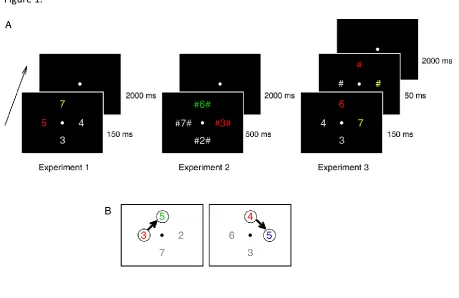
Each search display contained two colored target digits and two equiluminant grey
distractor digits (Figure 1A). The color of one digit remained constant across the experiment
(fixed-color target), while the color of other colored digit was selected randomly from one
of three possible colors on each trial (variable-color target). Participants’ task was to identify
the digit in the known color and to compare its value to the value of the other colored digit
in the display. In this task, the attentional selection of the fixed-color target can be guided
by a preparatory attentional template for the known target color. Previous N2pc studies
have demonstrated that such template-guided attentional selection processes are triggered
rapidly and efficiently (e.g., Luck & Hillyard, 1994; Grubert & Eimer, 2013). Observers were
therefore expected to adopt a serial selection strategy, by allocating their attention first to
fixed-color targets before moving attention to variable-color targets (as illustrated in Figure
1B). Critically, the interval between these two selection processes should reflect the time
required to move the focus of attention from its initial location to a new location in the
visual field. Task instructions (“find the red digit and decide whether the digit value in the
other color is bigger/smaller”) emphasized the serial nature of this task to further encourage
observers to select the two target objects in a particular order.
We recorded N2pc components to fixed-color and variable-color targets to assess
the speed with which attention was allocated to these targets, and to verify that they were
indeed selected in the predicted sequential order. To measure the selection of these two
types of target independently of each other, one target object always appeared on the
(above or below fixation; see Figure 1A). Displays with a fixed-color target on the horizontal
meridian and a variable-color target on the vertical meridian and trials where this spatial
arrangement was reversed were presented in random order and with equal probability in
each block. The template-guided attentional selection of the fixed-color target was expected
to be triggered rapidly, as reflected by N2pc components in response to displays with
horizontal fixed-color targets that emerge within 200 ms after search display onset. The
critical question concerned the onset latency of N2pc components to displays with
horizontal variable-color targets. If our task design was successful in imposing a serial
selection strategy, the N2pc to variable-color targets should emerge later than the N2pc to
fixed-color targets (see Figure 1B). Importantly, the onset delay between these two N2pc
components will reflect the time required to move focal attention from its original location
to a new target object in the visual field. If such priority-driven serial attention shifts can
operate at speeds of around 50 ms per object (e.g., Wolfe et al., 1998b; Horowitz et al.,
2009), this should be reflected by a corresponding onset delay of the N2pc to variable-color
as compared to fixed-color targets. These predictions were tested in three experiments.
Experiment 1 investigated the basic time course of the attentional selection of fixed-color
and variable-color targets. The other two experiments assessed whether this time course
would change when the time demands on attentional selection were either less stringent
(Experiment 2) or more severe (Experiment 3).
Experiment 1
Methods
Participants
Twenty-two paid participants were tested. One was excluded due to excessive eye
activity resulting in an exclusion of more than 50% of all trials in the artefact rejection.
Another participant was excluded because they reported after the experiment to have
adopted the opposite serial target selection strategy (see Methods section below). The
two left-handed) had normal or corrected-to-normal vision and normal color vision, as
substantiated by means of the Ishihara color vision test (Ishihara, 1972).
Stimuli and procedure
Search displays were presented on a 22-inch Samsung wide SyncMaster 2233 LCD
monitor against a black background at a viewing distance of approximately 100 cm. They
contained four different digits (2, 3, 4, 5, 6, or 7; each subtending 0.9° x 0.6° of visual angle)
that were presented above, below, to the left, and to the right of a central fixation cross at
an eccentricity of 2.5°. Each display contained two colored target digits. The color of one of
them remained constant throughout the experiment for each participant (fixed-color
target). The color of the other colored digit was randomly chosen from three other colors on
each trial (variable-color target). The four possible colors were red (CIE color coordinates:
.637/.329), green (.264/.556), blue (.179/.168), and yellow (.423/.461). Each of these four
colors served as fixed color for five participants. The two other digits in each display were
grey (.333/.353). All digit stimuli were equiluminant (~7.5 cd/m2). One of the two colored
digits always appeared on the horizontal meridian (randomly and equiprobably on the left
or right of fixation) and the other on the vertical meridian (randomly and equiprobably
above or below fixation; see Figure 1A). Displays where the fixed-color digit was presented
on the horizontal meridian and trials with the variable-color digit on the horizontal midline
appeared in random order and with equal probability in each block. A central grey fixation
point (.333/.353; 0.2° x 0.2°) remained continuously present throughout each experimental
block.
Each display was presented for 150 ms, and displays of successive trials were
separated by an intertrial interval of 2000 ms. Participants were informed that one digit in
each display would always have the same fixed color and that another digit would appear in
one of the three other colors. They were instructed to identify the digit in the known fixed
color and then to compare it to the variable-color digit in order to determine whether the
value of this second digit was higher or lower than the value of the first digit. Fixed-color
digits were chosen from a set of four digits (3, 4, 5, or 6). The set for variable-color and grey
digits was 2, 3, 4, 5, 6, and 7. On each trial, four different digits were randomly selected
finger of their left or right hand whenever the variable-color digit was higher than the
fixed-color digit, and refrain from responding when it was lower. This Go/Nogo response
assignment was reversed for the other half of participants. Response hand was
counterbalanced across participants. We chose this Go/Nogo task instead of an alternative
choice response task where the increase versus decrease in the value of the variable-color
digit relative to the fixed-color digits is mapped to a left versus right response. In a pilot
study where this choice response task was tested, participants found it very difficult to
maintain these two response mappings simultaneously with the fixed-color and
variable-color assignments, resulting in unacceptably high error rates and slow responses.
The experiment contained eight blocks, with 64 trials per block. Each block included
four trials for each combination of horizontal target (fixed-color versus variable-color item),
fixed/variable-color target locations (horizontal/vertical; vertical/horizontal), and response
(Go versus Nogo). One full practice block preceded the experimental blocks. At the end of
the experimental session, participants were asked about the target selection strategy that
they adopted during the experiment. One participant reported to have strategically and
consistently selected the two colored targets in the opposite order than the sequence that
was specified in the task instructions (i.e., attending to variable-color targets prior to
directing attention to fixed-color targets). This participant was removed from the sample,
but their N2pc results (shown in Figure 5) are considered in the General Discussion. All other
participants confirmed that they allocated their attention to fixed-color targets before
attending to variable-color targets.
EEG recording and data analyses
The continuous EEG was DC-recorded from 23 scalp electrodes (Fpz, F7, F3, Fz, F4,
F8, FC5, FC6, T7, C3, Cz, C4, T8, CP5, CP6, P7, P3, Pz, P4, P8, PO7, PO8, Oz), sampled at a rate
of 500 Hz, and digitally low-pass filtered at 40 Hz. No other offline filters were applied. All
channels were online referenced to the left earlobe and re-referenced offline to the average
of both earlobes. Trials contaminated with artifacts (eye movements exceeding ±30 µV in
the HEOG channels; eye blinks exceeding ±60 µV at Fpz; muscular movements exceeding
±80 µV in all other channels) and Go trials with anticipatory (faster than 200 ms) or very
of all trials (with individual rejection rates ranging from 0.4% to 18.8%). Go trials with
missing responses and Nogo trials where a response was recorded were also excluded from
analysis. For the remaining trials, EEG was segmented into epochs ranging from 100 ms prior
to 500 ms after the display onset, and was baseline corrected relative to the 100 ms
pre-stimulus interval. EEG was averaged separately for each combination of horizontal target
(fixed-color versus variable-color) and horizontal target side (left versus right).
N2pc components were quantified on the basis of ERP waveforms measured at
lateral posterior electrodes PO7 and PO8. N2pc onset latencies were measured on the basis
of difference waveforms, computed by subtracting ERPs at PO7/8 ipsilateral to a horizontal
color target from contralateral ERPs. N2pc onset latencies on trials with horizontal
fixed-color and horizontal variable-fixed-color targets were determined and compared with a
jackknife-based procedure (Miller, Patterson, & Ulrich, 1998). Twenty grand-average difference waves
were computed for both trial types, each excluding one different participant from the
original sample. N2pc onset latency was defined as the point in time when each subsample
difference wave reached an absolute onset criterion of -0.5 µV. The N2pc onset latency
difference between fixed-color and variable-color targets was assessed with a two-tailed
t-test, t-values (labelled tc) were corrected according to the formula described by Miller et al.
(1998). To confirm that N2pc components were reliably elicited for displays with horizontal
fixed-color targets and with horizontal variable-color targets, contralateral and ipsilateral
ERP waveforms in response to these displays were compared with paired two-tailed t-tests.
To measure effect sizes, Cohen’s d (Cohen, 1998) was computed for all significant t-tests
comparing behavioral data and N2pc amplitudes. As there is no standardized formula to
correct individual group means and standard deviations of jackknifed samples in order to
calculate effect size measures such as Cohen’s d, jackknifed group means of N2pc latency
values were fed into one-way ANOVAs where the error variance can be corrected according
to the formula described by Ulrich and Miller (2001) in order to calculate corrected partial
eta squared values (as suggested in a personal communication by Jeff Miller, September 25,
2015). For all t-tests on N2pc latency measures, effect sizes are reported as corrected partial
eta squared (labelled ηp2c).
Behavioral performance. Mean reaction time (RT) was 690 ms, and did not differ
between the two display types (horizontal fixed-color target and vertical variable-color
target, or vice versa), t(19) < 1. Error rates were low: Participants failed to respond on 0.6%
of all Go trials, and incorrectly responded on 3.2% of all Nogo trials. There were no
differences between the two display types for error rates, both t(19) < 1.
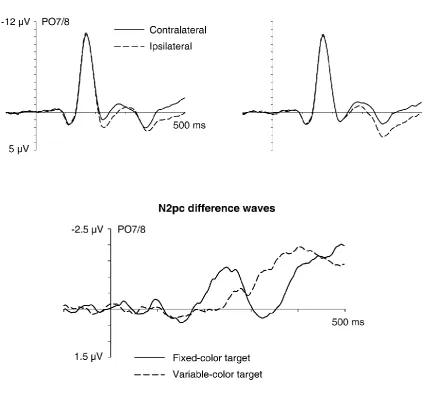
N2pc components. Figure 2 (top panel) shows ERPs elicited in the 400 ms interval
after search display onset at posterior electrodes PO7/8 contralateral and ipsilateral to the
side where the horizontal target digit was presented. N2pc components in response to
displays with a horizontal fixed-color target (and a vertical variable-color target) and displays
with a horizontal variable-color target (and a vertical fixed-color target) are shown
separately. The corresponding N2pc difference waveforms obtained by subtracting
ipsilateral from contralateral ERPs are shown in Figure 2 (bottom panel). As predicted, the
N2pc to displays with fixed-color targets was triggered earlier than the N2pc to displays with
variable-color targets. Critically, the onset delay of the N2pc to variable-color targets was
much smaller than expected. A jackknife-based latency analysis obtained an onset estimate
of 201 ms for the N2pc to fixed-color targets, and 259 ms for the N2pc to variable-color
targets. This N2pc onset latency difference of 58 ms was highly significant, tc(19) = 9.6; p <
.001, ηp2c = .83. Analyses of ERP mean amplitudes at electrodes PO7/8 contralateral and
ipsilateral to the horizontal colored digit within 100 ms time windows (190-290 ms
post-stimulus for fixed-color targets; 260-360 ms post-post-stimulus for variable-color targets),
confirmed that N2pc components were reliably elicited for both types of targets (fixed-color
N2pc: t(19) = 4.7, p < .001, d = .19; variable-color N2pc: t(19) = 4.1, p = .001, d = .20).
Discussion of Experiment 1
The pattern of N2pc results observed in Experiment 1 was very systematic, and
confirmed that fixed-color and variable-color targets were indeed selected in a sequential
fashion. The early onset of the N2pc to fixed-color targets (201 ms post-stimulus) is
objects were defined by a known color (e.g., Luck & Hillyard, 1994; Kiss et al., 2009; Grubert
& Eimer, 2013), and demonstrates that target objects can be selected rapidly when this
selection process is guided by a color-specific attentional template. In contrast, no N2pc
component was present during the first 260 ms after search display onset for horizontal
variable-color targets, in line with our prediction that participants would adopt the
instructed serial selection strategy, with attention being directed first to the fixed-color
target before being allocated to the variable-color target. The absence of an early N2pc to
horizontal variable-color targets that were accompanied by a fixed-color target on the
vertical meridian demonstrates that during the initial phase of attentional processing,
attention was exclusively focused on the fixed-color target before it was allocated to the
variable-color target. If serial movements of attention to new locations in the visual field
generally require about 250-300 ms, as suggested by some previous behavioral studies (e.g.,
e.g., Reeves & Sperling, 1986; Sperling & Weichselgartner, 1995), this should have been
reflected by a much longer delay of the N2pc to variable-color targets relative to fixed-color
targets, with the variable-color target N2pc only emerging at post-stimulus latencies beyond
400 ms. However, this was clearly not the case. The N2pc to variable-color targets was
triggered within 260 ms after search display onset, that is, only approximately 60 ms after
the onset of the N2pc to fixed-color targets. This observation suggests that serial
movements of focal attention during priority-driven search can be initiated remarkably
rapidly, at speeds that are in line with the estimates of attentional shift times that were
derived from the search slopes observed in visual search experiments (e.g., Wolfe, 1998a,
1998b).
Experiments 2 and 3 were conducted to confirm these observations, and to
investigate whether the speed with which attention can be moved to new target locations
depends on the time demands on attentional object selection that are imposed by the
specific parameters of a particular search tasks.
Experiment 2
The remarkably short onset latency difference between N2pc components to
search displays were only presented for 150 ms. Such short display durations may have
encouraged particularly rapid attention movements, as longer dwell times at the location of
fixed-color targets may have resulted in participants not being able to selectively process
and identify variable-color target digits in the same display. A previous N2pc study from our
lab (Kiss et al., 2012) has demonstrated that temporal task demands associated with
manipulations of search display durations can have systematic effects on attentional
allocation strategies. It is thus possible that the speed of moving attention from fixed-color
to variable-color target objects may be considerably slower when search displays remain
visible for longer, so that observers will be able to identify both target objects in the search
display even with less rapid attention shifts. To test this, all search displays were presented
for 500 ms in Experiment 2. In addition, all four digits in each display were flanked by two
distractor elements (hash marks) on either side (see Figure 1). As these flankers can
interfere with the identification of the central target digits, there presence may encourage
longer attentional dwell times at the location of fixed-color targets, thereby further delaying
the subsequent allocation of attention to variable-color targets.
Methods
Participants
Twenty-five paid participants were tested. Three participants were excluded for
losing more than 50% of all trials due to eye movements. Two other participants were
excluded because they reported to have adopted the opposite serial target selection
strategy (see below). The remaining twenty participants (aged 20 to 40 years, mean age
30.3 years, eleven females, two left-handed) had normal or corrected-to-normal vision and
normal color vision.
Stimuli and procedure
These were identical to Experiment 1, with two exceptions. Display duration was
on their left and right side. The size of each hash mark/digit stimulus set was 0.9° x 1.8°.
Artefact rejection and the removal of trials with very fast or very slow responses led to the
exclusion of 8.7% of all trials (with individual rejection rates ranging from 0.6% to 24.2%,
except for one participant who lost 40.2% of all trials due to horizontal eye movements).
Two participants were excluded because they reported after the experiment to have
consistently attended to variable-color targets prior to shifting attention to fixed-color
targets (see Figure 5 for their individual pattern of N2pc results). To compare N2pc onset
latency delays for fixed-color versus variable-color targets between Experiments 1 and 2, a
repeated-measures ANOVA was used, with the F value (labelled Fc) corrected according to
Ulrich and Miller (2001).
Results
Behavioral performance. Mean RT was 720 ms, and there was a small but reliable RT
difference between trials with horizontal fixed-color and horizontal variable-color targets
(713 ms versus 728 ms; t(19) = 2.7, p = .013, d = .13). Participants failed to respond on 0.7%
of all Go trials, and incorrectly responded on 3.7% of all Nogo trials. There were no
differences between trials with horizontal fixed-color and horizontal variable-color target for
error rates, both t(19) < 1.
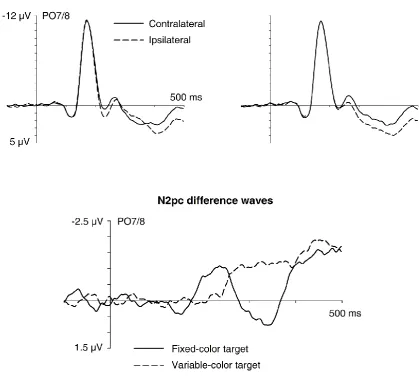
N2pc components. Figure 3 shows ERPs at posterior electrodes PO7/8 contralateral
and ipsilateral to the side of horizontal fixed-color targets or horizontal variable-color
targets, together with N2pc difference waveforms obtained by subtracting ipsilateral from
contralateral ERPs. As in Experiment 1, N2pc components to fixed-color targets emerged
earlier than N2pcs to variable-color targets. This N2pc onset latency difference between
these two types of targets was 92 ms (192 ms versus 284 ms post-stimulus), and was highly
significant, tc(19) = 11.4, p < .001, ηp2c = .87. Analyses of ERP mean amplitudes at electrodes
PO7/8 contralateral and ipsilateral to the horizontal colored digit (190-290 ms post-stimulus
for fixed-color trials; 260-360 ms post-stimulus for variable-color trials), confirmed the
presence of reliable N2pc components for both types of trials (fixed-color N2pc: t(19) = 3.8,
onset latency differences between fixed-color and variable-color targets between
Experiments 1 and 2 confirmed that the onset difference observed in Experiment 2 (92 ms)
was reliably larger than the corresponding difference in Experiment 1 (58 ms; Fc(1,19) =
13.8, p = .001, ηp2c = .42).
Discussion of Experiment 2
As in Experiment 1, the N2pc to variable-color targets emerged later than the N2pc
to fixed-color targets, confirming that the template-based selection of fixed-color targets
preceded the selection of variable-color targets. The fact that the N2pc onset latency
difference between these two types of targets observed in Experiment 2 (92 ms) was
significantly larger than the 58 ms difference measured in Experiment 1 suggests that
differences in the temporal demands of an attentional selection task can affect the time
course of the sequential selection of two target objects. Because search displays remained
visible for 500 ms in Experiment 2, longer attentional dwell times at the location of the
fixed-target objects would have been less detrimental for the subsequent selection of
variable-color targets than in Experiment 1, where displays were presented for only 150 ms.
The fact that targets were flanked by distractor objects in Experiment 2 in order to increase
the difficulty of target identification may also have contributed to the increased N2pc onset
latency difference observed in this experiment. However, the main insight from Experiment
2 was that the allocation of attention to variable-color targets was still initiated remarkably
rapidly, within less than 100 ms after the previous selection of fixed-color targets, in spite of
the fact that slower sequential selection speeds would still have been sufficient to
successfully select and identify both target items in each search display. This suggests that
rapid serial shifts of focal attention between target objects in the same display are not only
triggered when they are required by the high temporal demands of a selection task, but that
such speeds are the norm rather than the exception during visual search. Experiment 3
tested whether such attention movements can be triggered even more rapidly in a task
Experiment 3
Experiment 2 has shown that relaxing temporal task demands can slightly reduce the
speed with which two target objects in the same search display are sequentially selected. In
Experiment 3, we investigated whether serial selection may operate even more rapidly than
in the first experiment when the demands on selection speed are further increased.
Procedures were identical to Experiment 1, except that all four display items were
immediately replaced by masking stimuli (see Figure 1A). Because backward masks impede
iconic memory (e.g., Coltheart, 1980), their presence may necessitate particularly rapid
attention shifts between fixed-color and variable-color targets, to enable observers to
identify a variable-color digit before it becomes inaccessible through the intervention of the
mask. If this was the case, the onset latency difference between N2pc components to
fixed-color and variable-fixed-color targets may be even shorter than in Experiment 1.
Methods
Participants
Twelve paid participants with normal or corrected vision and normal color vision
(aged 23 to 38 years, mean age 29.7 years, seven females, one left-handed) were tested.
Stimuli and procedure
These were identical to Experiment 1, except that each four-digit display (150 ms
duration) was now followed immediately by a four-hash mark display (50 ms duration). Each
hash mark had the same color and occupied the same location as the preceding digit it
masked. The size of each hash mark item was 0.9° x 0.6°. 7% of all trials were removed due
to artefacts or extremely fast/slow RTs (ranging between 1.6% and 20.1% for individual
Results
Behavioral performance. Mean RT was 724 ms, and there was no significant
difference between trials with horizontal fixed-color and variable-color targets, t(11) = 1.9, p
= .079. Participants failed to respond on 2.1% of all Go trials, and incorrectly responded on
3.7% of all Nogo trials. There were no differences between trials with horizontal fixed-color
and variable-color targets for error rates, both t(11) < 1.
N2pc components. Figure 4 shows ERPs at posterior electrodes PO7/8 contralateral
and ipsilateral to the side of horizontal fixed-color or variable-color targets, together with
N2pc difference waveforms obtained by subtracting ipsilateral from contralateral ERPs. As in
Experiments 1 and 2, N2pc components to fixed-color targets preceded N2pc components
to variable-color targets. This N2pc onset latency difference was 59 ms (190 ms versus 249
ms post-stimulus), and was highly significant, tc(11) = 8.6, p < .001, ηp2c = .87. Analyses of
ERP mean amplitudes at electrodes PO7/8 contralateral and ipsilateral to the horizontal
targets (190-290 ms post-stimulus for fixed-color targets; 260-360 ms post-stimulus for
variable-color targets) confirmed the presence of reliable N2pc components for both types
of targets (fixed-color N2pc: t(19) = 2.6, p = .025, d = .09; variable-color N2pc: t(19) = 3.3, p =
.007, d = .17).
Discussion of Experiment 3
The N2pc results of Experiment 3 were very similar to those observed in Experiment
1. Again, the time course of N2pc components to fixed-color and variable-color targets
demonstrated that these two types of targets were selected in a sequential order, with the
template-based selection of fixed-color targets preceding the selection of variable-color
targets. The N2pc onset latency difference between these two types of targets (59 ms) was
virtually identical to the corresponding difference observed in Experiment 1, in spite of the
fact that all items were now immediately replaced by backward masks. As these masks
prevent the use of iconic memory traces of the two target objects for their identification,
fixed-color to the variable-color target. The observation that the speed of serial attention
movements, as reflected by the onset of N2pc components to these two types of targets,
was identical to Experiment 1, where no backward masks were employed, suggests that a
value of approximately 60 ms may represent a lower limit for the initiation of serial
attention movements to new target locations.
General Discussion
In three experiments, we employed the N2pc as a temporal marker of attentional
selection processes in a new experimental procedure that was designed to impose a serial
selection order with respect to two target objects in the same display. Observers had to
identify one target digit in a known color (fixed-color target) and compare its value to
another digit in a different unpredictable color (variable-color target). Because the fixed
color of one target object was known in advance, its selection could be controlled by a
preparatory color-specific attentional template. In contrast, the selection of the other target
object in the unpredictable variable color could not be guided by a color-specific search
template. Because template-based selection processes are known to be fast and efficient,
the two target objects were expected to be selected in a fixed serial order, with the
selection of fixed-color targets preceding the selection of variable-color targets. By
measuring the N2pc to these two types of targets, we confirmed that they were indeed
selected in the predicted sequential fashion, and obtained new insights into the speed with
which focal attention can be allocated serially to a new target object.
In all three experiments, N2pc components to fixed-color targets were elicited within
190-200 ms after stimulus onset, confirming previous observations from N2pc experiments
that attentional selection processes that are guided by feature-specific attentional
templates can be triggered rapidly (e.g., Luck & Hillyard, 1994; Grubert & Eimer, 2013).
While the N2pc to fixed-color targets was reliably present between 200-250 ms
post-stimulus, horizontal variable-color targets did not elicit any contralateral negativity during
this time interval in any of the three experiments. This demonstrates that the
variable-color targets. However, and critically, the N2pc to variable-color targets emerged
much earlier than would have been expected on the basis of previous behavioral evidence
suggesting that serial movements of spatial attention to new object locations operate at
rates of approximately 250-300 ms per object (e.g., Reeves & Sperling, 1986). The N2pc to
variable-color target objects was consistently triggered within less than 100 ms after the
emergence of the N2pc to fixed-color targets. In Experiments 1 and 3, where displays were
presented for only 150 ms, the N2pc onset latency differences between fixed-color and
variable-color targets were 58 ms and 59 ms, respectively, suggesting that attention can be
allocated to a new target location within 60 ms after another target has been selected. In
Experiment 2, where search displays were visible for 500 ms, this latency difference was
slightly but reliably increased (92 ms). This suggests that the relaxation of the temporal
demands on attentional object selection has a moderate but systematic effect on the speed
of attentional movements between visual objects. Overall, the N2pc results observed in this
study confirm that our experimental procedures were successful in imposing a specific
sequential order in which two targets in the same display were selected. They also
demonstrate that serial attention shifts can be initiated very rapidly, within approximately
60 ms after another target object in the same search display has been selected.
It should be noted that in the current experiments, one colored target was always
presented on the horizontal meridian and the other on the vertical meridian, in order to use
the N2pc as a marker of the attentional selection of the colored target on the left or right
side, independently of the allocation of attention to the other vertical colored target. The
observed temporal sequence of N2pc components to fixed-color targets preceding N2pcs to
variable-color targets therefore reflects selection processes that are elicited when these
targets are presented on the horizontal midline, and are accompanied by the other colored
item on the vertical meridian. The implicit assumption in this and previous N2pc studies that
used the same horizontal/vertical target presentation procedure (e.g., Woodman & Luck,
2003; Hickey et al., 2006; Eimer et al., 2011; Eimer & Grubert, 2014) is that there are no
systematic differences in the time course of allocating attention to target objects on the
horizontal and vertical midline. Because the N2pc can only be measured in response to
targets in the left versus right visual field, this assumption cannot be directly verified.
A series of previous N2pc experiments that investigated the speed of serial attention
procedures to ensure that observers would allocate their attention in a fixed order to
different objects in a search display. Four differently colored objects were presented among
black background items, and participants were informed that target objects would have one
specific color (e.g. red) on 75% of all target-present trials, and another color (e.g. blue) on
25% of these trials. N2pc components were elicited earlier for objects in the more likely
target color relative to objects in the less likely color, indicating that observers did allocate
their attention sequentially to these two objects. However, the onset delay between the
two N2pc components to more versus less likely color target objects (100 – 150 ms) was
approximately twice as large as the N2pc onset difference between fixed-color and
variable-color targets observed in the present study, suggesting that the speed of sequential
selection processes may be considerably slower than the 50 ms assumed by models of visual
search (e.g., Wolfe, 1998b). This difference between the N2pc results reported by
Woodman and Luck (1999, 2003) and the current findings is likely due to the fact that search
displays were more complex and crowded and targets more difficult to identify in these
earlier experiments.
How can the conclusion from the present study that serial shifts of visual attention
between different target objects can be elicited within 60 ms of each other be reconciled
with previous findings from behavioral studies which suggest that attention moves much
more slowly, at speeds of about 250-300 ms per object? In these studies, the time and
target location for a particular attention shift were determined entirely by cue stimuli
(Reeves & Sperling, 1986; Sperling & Weichselgartner, 1995), or by specific sequential
selection instructions (the “commanded search” condition in Horowitz et al., 2009), but not
by the presence of target-defining features at a particular location in the visual field. In such
situations, the allocation of attention cannot be guided by the visual properties of the
stimulus displays, and attention shifts can therefore only be based on internally generated
top-down attentional control signals. Such fully voluntary attentional movements may
indeed be considerably slower than the serial attention shifts observed in the present
experiments that could be guided by the presence of task-relevant color signals in the
search displays. This type of visual search for known target features that was described as
priority-driven selection by Horowitz et al. (2009) is based on an interplay of top-down and
stimulus driven factors, and is therefore neither completely automatic nor entirely
search template in working memory that is set up in a voluntary fashion prior to the start of
a search episode, after the task-relevant features of target objects have been specified.
However, once such preparatory search templates are activated, they can guide the
allocation of spatial attention to candidate target objects without the additional
intervention of voluntary top-down control. The fact that attention can be captured in a
task-set contingent fashion by irrelevant visual objects with features that match a currently
active attentional template (e.g., Folk et al., 1992; Eimer & Kiss, 2008) demonstrates this
automatic aspect of priority-driven attentional guidance processes during visual search. The
difference between the slow speed of fully voluntary attention shifts observed in previous
behavioral studies (e.g., Reeves & Sperling, 1986; “commanded search” in Horowitz et al.,
2009) and the rapid serial attention shifts found for priority-driven selection processes in
the present experiments may therefore reflect the time demands of endogenous voluntary
control processes that were required prior to the start of each new attention movement in
these behavioral studies, but not in the current study.
The serial selection order revealed by the time course of N2pc components to
fixed-color and variable-fixed-color targets suggests that in line with task instructions, participants
voluntarily adopted a specific search strategy and therefore attended first to fixed-color
targets before allocating attention to variable-color targets. There is however an alternative
interpretation of this pattern of N2pc results. Instead of allocating attention serially,
participants may have activated separate attentional templates for fixed-color and
variable-color targets simultaneously and in parallel. In this case, the delayed onset of N2pc
components to variable-color targets may not reflect a voluntary serial selection strategy,
but instead the slower speed of selection processes mediated by a variable-color template
(e.g., “any colored item”) relative to the selection of a target in a known fixed color.
Previous ERP studies that have measured N2pc components to color-defined singleton
targets have found little evidence for such a speed difference between the selection of
fixed-color and variable-color targets. For example, Mazza, Turatto, & Caramazza (2009,
Exp.1) found no N2pc differences between a task where the target color was known in
advance and another task where this color varied unpredictably across trials, so that
participants had to adopt a feature-unspecific singleton search mode (Bacon & Egeth, 1994)
for any color discontinuity (see also Eimer & Kiss, 2010, for similar N2pc components to
selection of targets in a known color and the selection of color singletons irrespective of
their feature value can operate at similar speeds, and suggest that the N2pc latency
differences between fixed-color and variable color targets observed in the present study
primarily reflect a voluntary serial selection strategy, and not two parallel selection
processes that differ in their time course.
If the N2pc latency differences between fixed-color and variable-color targets reflect
participants following task instructions by adopting a serial attentional allocation strategy,
alternative strategies should in principle have been available. Indeed, one participant in
Experiment 1 and two participants in Experiment 2 revealed during the post-experimental
debriefing that they had chosen to ignore the task instructions which emphasized a
particular selection order, and had instead decided to consistently allocate attention first to
the variable-color target before shifting attention to the fixed-color target. These
participants were excluded from the analyses reported above, but an inspection of their
individual pattern of N2pc results demonstrated that their introspective reports were
remarkably accurate. As shown in Figure 5, N2pc components to horizontal variable-color
targets preceded the N2pc to fixed-color targets for those three participants who reported
to have adopted this reverse target selection strategy. These observations underline the fact
that the serial allocation of attention to fixed-color and then to variable-color targets did
indeed reflect a voluntary selection strategy that could be replaced by a different strategy if
participants were minded to do so. They also show that N2pc measures can be employed to
detect such idiosyncratic attentional allocation policies at the level of individual participants.
The N2pc results observed in the present experiment provide clear-cut
electrophysiological evidence that target objects can be selected in a serial fashion when
this is encouraged by the specific demands of a search task. However, this does not
necessarily support strictly serial models of visual search which assume that attention has to
be completely withdrawn from one object before it can be allocated to another object. The
N2pc component reflects a relatively early phase of the attentional processing of visual
information (i.e., the spatially selective enhancement of visual activity at the location of
possible target events) that takes place prior to the attention-dependent encoding and
maintenance of selected objects in working memory (see Eimer, 2014, and Eimer, in press,
for detailed discussions of object selection and identification as dissociable stages of
should therefore not be interpreted as evidence that attention had been fully de-allocated
from fixed-color targets. Although this was not the focus of the current research, the N2pc
difference waveforms in Figures 2 to 4 show that at around 380 ms post-stimulus, a second
enhanced contralateral negativity emerged for horizontal fixed-color targets. This late
sustained posterior contralateral negativity (SPCN) is assumed to reflect the spatially
selective activation of target representations in visual working memory (e.g., Mazza et al.,
2007; see also Eimer, 2015, for further discussion). Its presence suggests that the
attention-mediated working memory processing of fixed-color targets was taking place during and
after the deployment of attention to variable-color targets (see also Wolfe, 2007, for a
similar argument that serial selection mechanisms can co-exist with attentional
identification processes that operate in parallel for multiple objects).
In summary, the current results provide novel electrophysiological evidence that
sequential shifts of spatial attention between different target objects in the same search
displays can be elicited remarkably rapidly, within approximately 60 ms of each other. This
fast speed of attentional movements is consistent with the central assumption made by
serial models of visual search that successive attentional selection processes follow each
other rapidly, at rates of at least 50 ms per object (e.g., Wolfe, 1998b). Even though the idea
that attentional selection processes during visual search always operate in a strictly serial
fashion has been challenged by recent N2pc findings (e.g., Eimer & Grubert, 2014; see also
Grubert & Eimer, 2015), there is no doubt that sequential selection strategies can be
employed when they are required by the specific demands of a particular search task. The
rapid speed of such serial selection mechanisms revealed by the current experiments
demonstrates that one of the core assumptions of serial models of visual search is
neurophysiologically sound.
This work was supported by grant ES/K006142/1 from the Economic and Social Research
Council (ESRC), UK. We thank Sue Nicholas for help with the data collection, and Todd
References
Bacon, W. F. & Egeth, H., (1994). Overriding stimulus-driven attentional capture. Perception
& Psychophysics, 55, 485-496.
Bichot, N. P., Rossi, A. F., & Desimone, R. (2005) Parallel and serial neural mechanisms for
visual search in macaque area V4. Science, 308, 520-534.
Buschman, T. J. & Miller, E. K. (2009). Serial, covert shifts of attention during visual search
are reflected by the frontal eye fields and correlated with population oscillations.
Neuron, 63, 386-396.
Cohen, J. (1988). Statistical power analysis for the behavioral sciences (2nd ed.). Hillsdale,
NJ: Lawrence Earlbaum Associates.
Coltheart, M. (1980). Iconic memory and visible persistence. Perception and Psychophysics,
27, 183-228.
Desimone, R., & Duncan, J. (1995). Neural mechanisms of selective visual attention. Annual
Review of Neuroscience, 18, 193-222.
Duncan, J., & Humphreys, G. W. (1989). Visual search and stimulus similarity. Psychological
Review, 96, 433-458.
Duncan, J., Ward, R., & Shapiro, K. (1994). Direct measurement of attentional dwell time in
human vision. Nature, 369, 313-315.
Eimer, M. (1996). The N2pc component as an indicator of attentional selectivity.
Electroencephalography and Clinical Neurophysiology, 99, 225-234.
Eimer, M. (2014). The neural basis of attentional control in visual search. Trends in Cognitive
Sciences, 18, 526-535.
Eimer, M. (2015). Visual working memory and attentional object selection. In: Jolicoeur, P.,
Lefebvre, C., & Martinez-Trujillo, J. (Eds). Mechanisms of sensory working memory,
Attention and Performance XXV; Chapter 8 (pp.90-104). Amsterdam: Elsevier.
Eimer, M. (in press). EPS Mid-Career Award 2014: The control of attention in visual search -
Cognitive and neural mechanisms. The Quarterly Journal of Experimental Psychology.
Eimer, M., & Grubert, A. (2014). Spatial attention can be allocated rapidly and in parallel to
Eimer, M., & Kiss, M. (2008). Involuntary attentional capture is determined by task set:
Evidence from event-related brain potentials. Journal of Cognitive Neuroscience, 20,
1423-1433.
Eimer, M. & Kiss, M. (2010). Top-down search strategies determine attentional capture in
visual search: Behavioral and electrophysiological evidence. Attention, Perception, &
Psychophysics, 72, 951-962.
Eimer, M., Kiss, M., & Nicholas, S. (2011). What top-down task sets do for us: An ERP study
on the benefits of advance preparation in visual search. Journal of Experimental
Psychology: Human Perception and Performance, 37, 1758-1766.
Folk, C. L., Remington, R. W., & Johnston, J. C. (1992). Involuntary covert orienting is
contingent on attentional control settings. Journal of Experimental Psychology: Human
Perception and Performance, 18, 1030-1044.
Grubert, A., & Eimer, M. (2013). Qualitative differences in the guidance of attention during
single-color and multiple-color visual search: Behavioral and electrophysiological
evidence. Journal of Experimental Psychology: Human Perception and Performance, 39,
1433-1442.
Grubert, A., & Eimer, M. (2015). Rapid parallel attentional target selection in single-color
and multiple-color visual search. Journal of Experimental Psychology: Human Perception
and Performance, 41, 86-101.
Hickey, C., McDonald, J. J., & Theeuwes, J. (2006). Electrophysiological evidence of the
capture of visual attention. Journal of Cognitive Neuroscience, 18, 604-613.
Hopf, J. M., Boelmans, K., Schoenfeld, A., Luck, S. J., & Heinze, H.-J. (2004). Attention to
features precedes attention to locations in visual search: Evidence from
electromagnetic brain responses in humans. Journal of Neuroscience, 24, 1822-1832.
Horowitz, T. S., Wolfe, J. M., Alvarez, G. A., Cohen, M. A., & Kuzmova, Y. I. (2009). The speed
of free will. The Quarterly Journal of Experimental Psychology, 62, 2262-2288.
Ishihara, S. (1972). Tests for color-blindness. Tokyo: Kanehara Shuppan.
Kiss, M., Driver, J., & Eimer, M. (2009). Reward priority of visual target singletons modulates
ERP signatures of attentional selection. Psychological Science, 20, 245-251.
Kiss, M., Grubert, A., Petersen, A., & Eimer, M. (2012). Attentional capture by salient
distractors during visual search is determined by temporal task demands. Journal of
Luck, S. J., & Hillyard, S. A. (1994). Spatial filtering during visual search: Evidence from
human electrophysiology. Journal of Experimental Psychology: Human Perception and
Performance, 20, 1000-1014.
Mazza, V., Turatto, M., & Caramazza, A. (2009). Attention selection, distractor suppression
and N2pc. Cortex, 45, 879-890.
Mazza, V., Turatto, M., Umiltà, C., & Eimer, M. (2007). Attentional selection and
identification of visual objects are reflected by distinct electrophysiological responses.
Experimental Brain Research, 181, 531-536.
Miller, J., Patterson, T., & Ulrich, R. (1998). Jackknife-based method for measuring LRP onset
latency differences. Psychophysiology, 35, 99-115.
Moore, C. M., Egeth, H., Berglan, L. R., & Luck, S. J. (1996). Are attentional dwell times
inconsistent with serial visual search? Psychonomic Bulletin and Review, 3, 360-365.
Olivers, C. N. L., Peters, J., Houtkamp, R. & Roelfsema, P.R. (2011). Different states in visual
working memory: when it guides attention and when it does not. Trends in Cognitive
Sciences, 15, 327-334.
Reeves, A., & Sperling, G. (1986). Attention gating in short-term visual memory.
Psychological Review, 93, 180-206.
Sperling, G., & Weichselgartner, E. (1995). Episodic theory of the dynamics of spatial
attention. Psychological Review, 102, 503-532.
Townsend, J. T. (1990). Serial vs. parallel processing: sometimes they look like Tweedledum
and Tweedledee but they can (and should) be distinguished. Psychological Science, 1,
46-54.
Treisman, A. (1988). Features and objects: The fourteenth Bartlett memorial lecture.
Quarterly Journal of Experimental Psychology, 40A, 201-237.
Treisman, A., & Gelade, G. (1980). A feature-integration theory of attention. Cognitive
Psychology, 12, 97-136.
Ulrich, R., & Miller, J. O. (2001). Using the jackknife-based scoring method for measuring LRP
onset effects in factorial designs. Psychophysiology, 38, 816-827.
Wolfe, J. M. (1994). Guided Search 2.0: A revised model of visual search. Psychonomic
Bulletin and Review, 1, 202-238.
Wolfe, J. M. (1998a). Visual Search. In H. Pashler (Ed.), Attention (pp. 13-74). London UK:
Wolfe, J. M. (1998b). What Can 1,000,000 Trials Tell Us About Visual Search? Psychological
Science, 9, 33-39.
Wolfe, J. M. (2007). Guided Search 4.0: Current Progress with a model of visual search. In W.
Gray (Ed.), Integrated Models of Cognitive Systems (pp. 99-119). New York: Oxford.
Wolfe, J. M., Alvarez, G. A., & Horowitz, T. S. (2000) Attention is fast but volition is slow.
Nature, 406, 691.
Woodman, G. F., & Luck, S. J. (1999). Electrophysiological measurement of rapid shifts of
attention during visual search. Nature, 400, 867-869.
Woodman, G. F., & Luck, S. J. (2003). Serial deployment of attention during visual search.
Figure Legends
Figure 1. (A)Schematic illustration of the search display properties in Experiments 1, 2, and 3. All displays included a fixed-color and variable-color target and two grey distractors. One
of the two colored objects always appeared on the horizontal midline, and the other on the
vertical midline. See text for further details. (B) Illustration of the predicted sequence of
attentional target selection processes, with the selection of fixed-color targets (shown here
in red) preceding the attentional selection of variable-color targets.
Figure 2. Top panels: Grand-average ERP waveforms measured in Experiment 1 in the 500 ms interval after display onset at posterior electrodes PO7/PO8 contralateral and ipsilateral
to the side of a horizontal fixed-color target (left) or a horizontal variable-color target (right).
Bottom panel: N2pc difference waveforms obtained by subtracting ipsilateral from
contralateral ERPs, separately for horizontal fixed-color and variable-color targets.
Figure 3. Top panels: Grand-average ERP waveforms measured in Experiment 2 in the 500 ms interval after display onset at posterior electrodes PO7/PO8 contralateral and ipsilateral
to the side of a horizontal fixed-color target (left) or a horizontal variable-color target (right).
Bottom panel: N2pc difference waveforms obtained by subtracting ipsilateral from
contralateral ERPs, separately for horizontal fixed-color and variable-color targets.
Figure 4. Top panels: Grand-average ERP waveforms measured in Experiment 3 in the 500 ms interval after display onset at posterior electrodes PO7/PO8 contralateral and ipsilateral
to the side of a horizontal fixed-color target (left) or a horizontal variable-color target (right).
Bottom panel: N2pc difference waveforms obtained by subtracting ipsilateral from
contralateral ERPs, separately for horizontal fixed-color and variable-color targets.
Figure 5. N2pc difference waveforms obtained for three individual participants who reported to have attended to variable-color targets prior to fixed-color targets. One of them