ISSN: 2278-3369
International Journal of Advances in Management and Economics
Available online at
www.managementjournal.info
RESEARCH ARTICLE
The Industrialization of People’s Republic of China and Turkey
Comparison
Fatih Mehmet Öcal*
Social and Human Sciences Faculty, Department of Economics, Necmettin Erbakan University.
Abstract
China, after centuries of dynasties which was ruled by nationalists and socialists in the XX. century and on the one hand made peace agreements with Japan and on the other hand developed trade with the USA, started the industrial development by attracting especially the fixed foreign investments to the country after Mao. Standing generally at the forefront of production and science throughout human history, China laid the foundation of industrialization by directing the material resources of the country and the power of technology to important projects in the central planning period after its foundation in 1949. China, which was trying to begin advanced technology-based production in addition to the labor intensive manufacturing in the 1970s, transferring the allocation of agriculture resources to the private sector from the 1980s, directing its investments to the innovation-based high technology from the beginning of 2000s, is virtually the factory of the world today in the industrial production. In this study, a comparison between China and Turkey which started with private sector in 1923 and although it is not at a satisfactory level, has covered quite a distance with its public and mixed economic policy applications for almost a century, and their industrialization processes, similar and different aspects were emphasized.
Keywords: Innovation, Technology, Industrialisation, Economic Development, Employment. JEL Codes: E22, E23, E24, O11, O14
Introduction
As a concept the industrialization, which is described as all actions taken to convert raw materials into intermediate goods and goods [1] or described as the relative growth of the volume of the industrial sector in the economy or the production of high-tech goods and the realization of such production with reducing costs as a result of the application of advanced production techniques to economic activities by the famous economist Colin Klark [2], includes the extraction, processing and production processes of mines as a sector.
The industrial sector, which is a combination of mining, manufacturing and energy sub-sectors, compososes the cornerstone of countries' rapid, stable and sustainable growth. Since the pace of industrialization, which means the increase in income in the industrial sector, is at the same time one of the top factors affecting the rate of increase of national income in the long run [3], there is almost no difference between the two
concepts today. The industrial sector is at the forefront of the key sectors playing a key role in raising the welfare of the countries in terms of the mutual procurement network with many business units in the process of productizing the raw materials, the value added share and the employment effect. More advanced than the agricultural and services sector in terms of value that is added to the economy, the industrial sector[4] has the function to increase employment, to make production at a certain level, and to ensure that the economy is stabilized entirely, without frequent cyclical fluctuations.
Industrial Revolution, Industrialization and Industrialization Policy
For this reason, the expected outcome of industrialization policies is directly related to the capacity to incorporate various criteria such as the technology level of the country, the level of development of the political, legal and democratic environment, the openness of the society to innovations and the high level of human capital that can be internalized.
When industrialization is taken into account as a complex process which is not a spontaneous and sudden event [6] and contains social, political, institutional, and cultural characteristics, it is self-evident how important the industrialization policies are successful or not that started in Europe and extended to North America, Russia and Far East Asia for the human history [7]. It is not a coincidence to have a stable growth rate and to have a word in almost all world politics for those countries that do not miss the target of industrial revolution and direct their industrialization policies to such fields as education, Research-Development (R&D) and technology.
The most effective and shortest way to increase the productivity and provide total benefit from the industrialization policies and processes can only be possible via completing the structural transformation [8] by transferring the labor force and resources from agriculture, labor intensive but low productive fields to high technology productive business lines in industry sectors.
The countries that progress in this direction have higher per capita incomes with the Gross Domestic Product, the distribution of their mentioned income is much more fair and their social prosperity and peace levels are more unproblematic. Countries have to achieve industrialization if they want to grow and export and if they do not want their balance of foreign trade to have deficit account. It is not in vain that the British economist Kaldor describes the manufacturing industry as "the engine of growth".
Industrialization alone does not mean the established and working factories. The thing needed to be understood from the industrialization is that the creation of an industry layer on an international scale, an all-encompassing industrialization process and the initiation and support of state-led advanced technology industrialization [9].
In the latter period, industrialization should be supported until it reaches a certain level of development and stand on its own legs, and then a special system should be established that will only be commissioned when a problem arises and will provide everlasting persistency by leaving it to the private sector.
The Industrial Revolution, which first started in England in the second half of the XVIII. century and later influenced other western countries, transformed these countries into Intensive good producing economies with low cost. The emergence of intensive production facilities naturally brought the problem of the demand for raw materials and the marketing of a large number of manufactured goods to the agenda.
The trade of goods and raw materials, agro-products and natural resources between the Western countries and the underdeveloped countries that are rich in raw materials and natural resources has grown rapidly along with developments in maritime [10]. The plunder of the Western countries of rich natural resources and underground resources from the backward countries and doing this by ignoring crimes against humanity such as massacres and genocide explains the reason why today's world economy can not achieve a stable and sustainable growth trend.
A General Overview of Industrialization Process
economic developments in the external world and the expected results of industrialization could not have been reached.
Despite the emphasis on the importance of industry and development in the Izmir Economy Congress gathered in 1923, the expected results did not appear in 1923-33 period [12].
When the impossibilty to provide private sector-based industrialization was understood, there were many efforts for the implementation of ‘Planned industrialization under state leadership’ and the industrialization was invested in a realistic way, comprising the years 1933-38, and despite all [13] serious steps were not taken towards industrialization because of the Second World War.
Despite the fact that after 1950, Turkey tried to open up to the outside world and became a member of NATO and applied an economic model based on the market system, the result was far behind the planned destinations for industrialization because of such reasons [11] as the inadequacy of the resources required for the financing of the industry, the failure of the State Economic Enterprises (SEEs) to meet expectations for quality, productivity and competition, and the inability of governments to form an industrial policy.
The deterioration of economic stability with the second half of 1950-60 period combined with the devaluation of 1958 so, the necessity of planned development gained importance and the planned development period started in Turkey with the establishment of State Planning Organization on 30 September 1960.
If the 1960-80 period was examined in general, it shows that despite the increase in the share of the industrial sector compared to the agricultural sector, employment does not reflect in the same way, but the intermediate and investment goods exceed 50% of the total manufacturing industry composition, indicating that success at a certain level is achieved even if it is not at the desired level in industrialization [14].
During the 1980-90 period, the rate of growth declined due to the Gulf War, and in 1991 it stroke the bottom to four per thousand. When Table 1 is examined it is clear that the growth rate of GNP has decreased sharply in this period and in addition not only the industry sector
but also other sectors are adversely affected from the Gulf War.
Table 1: Turkey GDP and sectoral growth rates (1981-1999)
Years GNP Agriculture Industry Services
1981-1983 4,0 2,1 7,4 3,3
1984-1987 6,7 2,0 8,9 6,7
1989-1991 4,0 -0,1 5,7 3,7
1987 9,3 1,1 8,9 9,4
1988 1,5 7,8 1,8 2,0
1989 1,6 -7,6 4,6 4,3
1990 9,4 6,8 8,6 8,6
1991 0,3 -0,9 2,7 0,3
1992 64 4,3 5,9 6,3
1993 81 -1,3 8,2 9,5
1994 -61 -0,7 -5,7 -4,2
1995 80 2,0 12,1 6,4
1996 71 4,4 7,1 7,5
1997 83 -2,3 10,4 8,3
1998 39 8,4 2,0 2,4
1999 -61 -5,0 -5,0 -5,2
Although the highest share of fixed capital investments in the 1970s was in the manufacturing industry, for example; it was 36.3% in 1975, the public sector investments in industry decreased after January 24, 1980.
The private sector is also affected negatively and as a result its investments are reduced [15], and it was the source of all problems in the context of the economic uncertainty of all times passing through the present day. Again for the 1990-1999 period in Table 1, the growth rate of the industrial sector in GNP has not been steadily growing, while it has been a period of considerable growth, and vice versa, there are years in which it has slowed considerably down or even declined.
From the 1980s onwards, the liberal winds of the economy started to flow much faster by applying policies that approach the liberal line of the economy. As a result, the public sector entered the process of reducing industrialization investments and industrialization over the private sector was preferred. When it comes to the years 2000, it
is seen that the state withdrew considerably from the industrialization, for example, the share of the public sector is less than 10% in the production value of the manufacturing industry [2]. The decrease in public investments can not be compensated by the investments made by the private sector and the increase in production in the industrial sector has been achieved not by the new investments but generally by increasing the capacity utilization rates [2]. Attempting to increase production with pure capacity increase without increasing new domestic and foreign fixed deposits also resulted in a permanent structural problem of unemployment in Turkey in 2017.
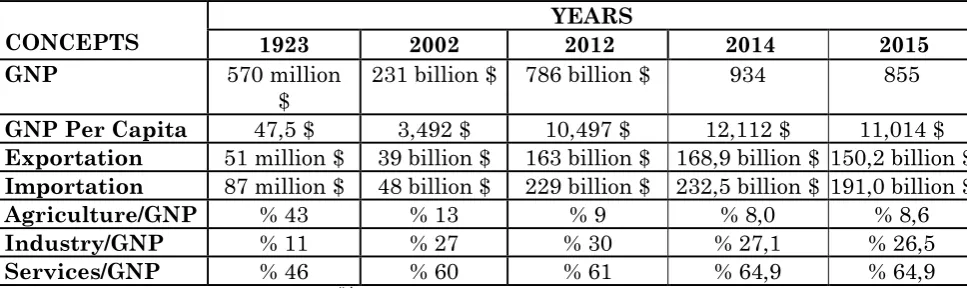
Table 2. Changes experienced in Turkish economy
CONCEPTS 1923 2002 YEARS 2012 2014 2015
GNP 570 million
$ 231 billion $ 786 billion $ 934 855
GNP Per Capita 47,5 $ 3,492 $ 10,497 $ 12,112 $ 11,014 $
Exportation 51 million $ 39 billion $ 163 billion $ 168,9 billion $ 150,2 billion $
Importation 87 million $ 48 billion $ 229 billion $ 232,5 billion $ 191,0 billion $
Agriculture/GNP % 43 % 13 % 9 % 8,0 % 8,6
Industry/GNP % 11 % 27 % 30 % 27,1 % 26,5
Services/GNP % 46 % 60 % 61 % 64,9 % 64,9
Resource: Makroekonomik Göstergeler, TÜİK, Hazine Müst., TCMB, Maliye Bak., BDDK, TOBB, ekonomik Rapor, http://www.mahfiegilmez.com/p/gostergeler.html,https://www.tobb.org.tr/Documents/yayinlar/2016/72GK/72-Genel-KurulEkono mik Rapor 2015. pdf, Available Date: 10.07.2017.
When Table 2 is examined, it can be seen that the GNP increased to 855 billion dollars from 570 million dollars between the years 1923 and 2015, and exports and imports increased at a great rate and the sector share of industrial sector increased from 11% to 30% in 2012 but then dropped to 26.5%.
It cannot be said that GNP, foreign trade variables and the share of the industrial sector meet the expectations even if they are considered as positive figures at first sight. Because in this period other countries have also continued their development efforts, and South Korea, which has lagged behind us in almost every aspect even in the 1950s, has managed to enter the advanced country class, while our country is still in the group of developing countries.
Despite the fact that the agriculture sector and employment occupy less space in the economy and the expansion of industry and services sector is described as "structural change" in the period from the establishment of the Republic until the present day, it is clear that this result is in fact based not on planned and conscious politics but on the necessity to migration to cities.
countries which are still in the state of high technological industrialization [16]. It is a remote possibility that Turkey makes an industrialization sector-led breakthrough since industrialization cannot be brought to the advanced level due to such factors as [17]; hot money and direct foreign investments turning to trade and non-production sectors, and as if staying far away from the manufacturing industry while it needs to be built on the development of the manufacturing industry.
In addition to the failure of succeding in achieving the potential growth rate calculated on an average of 5% in the period
of about one century from the establishment of the Republic until the present day, Turkey failed to pass on the advanced technology production from the stage of medium and low level technology based industrial production because of the political crises, military and civilian bombings and populist policies. In the process of industrialization, Turkey failed to spread a solid production culture throughout the economy due to the fact that the development of the real economy according to the financial sector and the efficiency of the economy are not effective enough.
China’s Industrialization
China was ruled by dynasties from the year 2200 BC to the beginning of the XX. century, and by nationalists until 1949, and later by the communist party. China was always in the first place in the world in the trade of products such as porcelain, silk, paper and spices before the industrial revolution and in science and production at every moment of the history. It clearly indicates the importance of China that at the beginning of the XIX. century, 32.4% of the world's GDP was provided by China, while at the same time this figure was 26% for Europe.
However, this rates increases to %40,3 for Europe while it decreases to %13,2 for China in 1890. China, which implemented the centrally planned economy program with the management of the nationalists in 1949, was blocked in the next period and faced with a slowdown in the speed of development despite the successful results at first. [19] In 1949, with the establishment of the People's Republic of China, in the centralized economy period, the material resources of the country and the technology power were transferred to important projects and the balance of the regional economies was established and the substructure of the industrialization was prepared.
Nationalization of pre-Mao period by nationalists continued at the beginning of this period also and 80% of the production was carried out by SEEs on condition that it was under the control of the economic center planning. During the period 1952-1978, industrial production increased by an average of 11% annually, while employment increased by about 10 times. In this period, with the technology transfer from the Soviet and eastern bloc countries China passed from low-tech labor intensive production to high-low-tech products such as petroleum refineries, nuclear weapons and satellites with the increase in the given emphasis on education and R&D. Ministries and large SEEs working with universities and their composing technical high schools and R & D centers have raised China's production quality [20]. China's first five-year development plan, which was put into practice in 1953, aimed at achieving high-rate economic growth through the development of industrialization, especially of the heavy industry. Looking at the results this period, high economic growth and industrialization were achieved.
A significant portion of its infrastructure has been rebuilt, inflation has been pulled down, exports to the Soviet bloc have increased due to the rapprochement established with the Soviet Union. In 1956, Mao launched a new era with the name "Hundred Flowers" in order to benefit from free ideas. However, eight million intellectuals were arrested and several were sent to the labor camps after the criticism of this period disturbed the administration. In the second five-year development period of 1958-62, agriculture was banned, aimed at transitioning from agriculture society to iron-steel-based industrial society.
the bureaucracy and the young generation to be disappointed, and this also resulted in the necessity of softening the policies. In the third five-year development period, which started in 1966 as a movement called the "cultural revolution" and emphasized the national defense emphasis, even though terror and internal turmoil occurred, the determined goals for industrial development were achieved [21].
Table 3: Share of industry from investments (1956-1963) (%)
Years Agriculture Sector shares in total investments Light industry Heavy industry
1956 7,7 6,1 37,8
1957 8,3 7,7 42,8
1958 9,8 8,1 56,2
1959 9,4 6,6 53,1
1960 11,6 5,4 53,7
1961 13,3 6,1 54,2
1962 20,2 4,4 51,8
1963 23,0 3,7 46,4
Resource: Dali L. Yang, Calamity and Reform in China: State, Rural Society, and Institutional, file:///C:/Users/user/Desktop /12-umit-calik-cin-ekonomisi.pdf, Available Date: 11.07.2017
Table 3 shows that China has taken steps to enter the path of industrialization by transferring the investments made by the light industry to the heavy industry, and that the resources of the public investment in the period have also been transferred to heavy industry, and that all of these shows that China understands the importance of the industrialization for its self-development.
In the era of "Cultural Revolution" which started in 1966, the fact that China went wrong with the economy and put the economy into a complex situation in the name of development, strengthened the thoughts that this system could not sustain further. In the period when the cultural revolution began to lose its popular support, Deng Xioaping came to power in 1978 when Mao died and put a new program on its behalf called the Chinese style socialist market economy [19].
From 1979 until the beginning of the 1990s, the sectoral structure was steadily adjusted through the implementation of China's reform via the application of open-door policy, and China showed a significant improvement in industrialization. By the early 1990s, with the establishment and development of the socialist market economy system in China, it was planned to complete the industrialization and to transfer to the information society until 2020.
From 1950's to 2002, the share of agriculture in China fell from 45.4% to 14.5%, while the share of services sector increased from 20.2% to 33.7% and the share of industrial sector from 34.4% to 51.8% [22] shows that China understood the importance of developing by producing on the basis of thought and took a considerable distance.
In the process of economic development, China started its leaps in the 1930s, and its transition to maturity in the 1980s. The transformation process that started in 1978 was based on the introduction of the socialist market model. A few of some steps taken with these years have been mentioned below;
1978: The application of reform policies,
1980: Establishment of four separate economic zones in special circumstances and the implementation of the law giving the possibility to acquire land,
1985: Opening of foreign trade in 14 cities having coast and port in the Pacific, Removal of state monopoly on purchasing and selling agricultural products,
1990: Opening the Shanghai Stock Exchange,
1992: Restarting foreign investment and privatization reforms,
1996: Partially convertibility of the currency Yuan,
2001: Becoming a member of the World Trade Organization,
2004: Recognition of the right of private property by reviewing the constitution.
Today, when economic development and industrialization have the same meaning and industrialization is regarded as a precondition for development, China is a country that later joins among the "new industrializing countries" with India [23].
In China, where huge increases in total industrial output have been observed in recent years, the industrial growth rate was 9.3% in 2008 and 8.1% in 2009. This increase was primarily realized by the village and town businesses.
Therefore, local agricultural residual value emerged as low-tech labor intensive manufacturing industry investments. Since the 1990s, industrial production has increased significantly as the result of foreign-funded enterprises.
Today, with the effect of attracting foreign investments to the country and the relative cheapness of labor force and energy, China is at an advanced level in many industrial fields. Areas such as modern metallurgy, mining and energy equipment, aircraft construction, automobile production, large machinery parts, casting, aerospace industry, large energy circuits, electronics, communication equipment, measurement tools are all the signs that Chinese industry has recently shown a significant progress. In the industrial sectors such as mining, power plant, metallurgy, fuel oil, chemicals, automotive and shipbuilding, China is still able to be self-sufficient in every aspect [24].
Table 4: Per capita GDP and growth change (1997-2014)
Years GDP per
capıta ($) Growth rate (%) Years
GDP per
capıta ($) Growth rate (%)
1997 781.7 9,2 2006 2.099 12,7
1998 828.6 7,8 2007 2.695 14,2
1999 873.3 7,7 2008 3.471 9,7
2000 959.4 8,5 2009 3.838 9,4
2001 1.053 8,3 2010 4.560 10,6
2002 1.148 9,1 2011 5.633 9,5
2003 1.288 10,0 2012 6.337 7,9
2004 1.508 10,1 2013 7.077 7,8
2005 1.753 11,4 2014 7.683 7,3
Resource: World Bank - World Development Indicators.
Table 4 shows that China has increased GDP per capita tenfold in about a quarter of a century, despite the fact that the growth rate has decreased by 7% from 10%, which is identified with itself after 2010, it still has to be accepted as a great success when considering the population of the country.
The secret of China’s growth rate is twice as much as the global growth, despite its ten-fold increase in GDP per capita and the decrease in growth rate to 7% in such a short time span of twenty years, lies in the success of being second around the world after the US in investments made outside the country, rather than attracting the foreign investments directly.
market resulting from it, the stabilization of the country in terms of political and social aspects, the completion of infrastructure investments to a considerable extent, maintaining the growth rate at an annual average rate of 7-9% and giving confidence to foreign investors from a legal point of view by being a member of the World Trade Organization WTO) in 2001, are indications of the long-term stability of industrialization and stable growth.
According to a report released by the United Nations Conference on Trade and Development (UNCTAD), China's foreign direct investment has increased by 44% that is about 183 billion dollars in 2016 under the influence of mergers and acquisitions.
According to this report, the United States is in the first place, and it is followed by China in the Netherlands comes in third place. China, which is expected to continue its strong performance in the coming years as part of the "One Generation, One Way" project, is third in the direct capital inflows to the country after US and UK with 134 billion dollars. Foreseeing that total direct investment, which declined by 2% on a global scale in 2016, would grow by around 5% in 2017 [25] gives strong signals that China may close the gap with the US in terms of economic size in the mids of this century. Moreover, the transfer of the current surplus resulting from the surplus of foreign trade to AR-GE expenditures suggests that China will be in a position to compete with the USA, Japan and Germany in the near future based on advanced technology. China, which has benefited from the blessings of the two major cost elements such as cheap labor and energy for many years, must analyze the causes of the clogging of the growth rate in recent years and save itself from getting middle income by improving its technological investments. Because the slowdown in
China's growth, which is described as the world's factory, will have an impact that could lead to the stagnation of the global economy.
The most important factor underlying the industrialization and development of China and the world's second largest economy is the fact that it has a long-standing civilization and state tradition based on a written history of about four thousand years, established order and bureaucracy. Failure to take into account this distinction when examining China will lead to all the explanations and interpretations made in the air. Another reason for China's coming as the industrial giant of the present day lies in adapting to the changing and developing world conditions of the communist party.
China, which Mao established with socialist understanding in 1949, and where the efforts of modernization and industrialization in the 1950s and 1960s failed, started to invest in such fields as agriculture, industry, science, technology and defense after the death of Mao and his "Cultural Revolution". However, realizing that development in these areas could not take place without foreign capital China, began to work to attract foreign capital to the country before Asian countries such as Japan and South Korea in the early 1980’s. Industrialization was supported on the one hand by the state, while on the other hand, a large part of the farmer population was encouraged to migrate to cities and work in factories. This was an important milestone in the transition process from the agricultural society to the industrial society. Another factor that led to the rapid industrialization of the country due to the changes that began in the 1980s in the economy and industry was that it was not purely liberal economic policies but only its own specific application of market conditions determined entirely by the administration. China, which continues to grow rapidly towards the end of the 1990s, has become a member of the World Trade Organization, while giving employees the right of obtaining state property and of business creation.
Comparison of Chinese and Turkish Industrialization
The most fundamental difference between the two countries is that their political governments are different. While China was ruled by the nationalists at the beginning of the XX. century and by the communist regime that seized the power in the mids of the XX. century, Turkey was ruled by a single party from 1923 until 1950, and since that date, democracy has often been interrupted by a military coups, despite the fact that it is a multi-party allegation.
The two countries, along with the 1980s, began to enter the world markets by putting liberal economic policies into practice. However, the fact that China, which is governed by the communist regime, occupies much more in the economy with public activities shows that the influence of the state (public economy) is clearly well ahead from Turkey.
While Taiwan under US influence and Hon Kong under British influence are fulfilling the capitalist direction of the economy, the socialist direction of the state capitalism is fulfilled by China. Approximately 70% of the investments made in China come from Taiwan and Hong Kong [27], and this demonstrates the importance of these two countries in the development of China.
If countries want to grow steadily, they should modernize the agriculture sector and invest in the manufacturing industry based on technology with their residual income.With this in mind, it is necessary to underline that China initiated reforms with the agriculture sector[28], not with the financial sector, and China has pursued the right policy.
It is the international direct investments and quantities that have led to a significant difference in terms of industrialization and growth rate between Turkey and China. While China's liberalization policies and international direct investments, which have been implemented along with the Deng period, have accelerated the production capacity and technology transfer by reaching important figures in China since 1990, the share of international direct investments in GDP reached 6% only in 2006 in Turkey.
When the ranking of global FDI is examined USA comes first with 5.409,9 billion dollars, China is the fourth with 1.085,3 billion dollars and Turkey is the thirty-first with merely 168,6 billion dollars[29]. By analyzing the causes well, actions that lead to economic, political, social and social instability should be avoided and the opportunities that our country offers for foreign investors should be announced on a global scale well.
Although China tries to manage its economy according to market conditions, the ratio of its savings to GDP is about 50% since it is rooted in socialist politics, which is about 14% for Turkey [30]. This data is the result of the GDP, which is the most important factor determining the level of investment in our country, and hence the savings and investments. The conditions for the growth of GDP pass through the transfer of savings to the middle and high tech industries. Although China is not based on democratic conditions, it is among the countries that have succeeded in directing industrial and domestic savings to industry sector.
The reason why Turkey is below the average growth potential calculated at 5%, is that the efforts for consumption-oriented growth the investment made in manufacturing industry is insufficient and it does not depend on the real economy.
Both countries have significant differences in terms of geography and population. China, which is geographically 12 and 16 times in population as large as Turkey, has been organizing industrial policies according to regions, climate and population conditions, and in Turkey disintegration incentives and plans have been started according to regions only after 2002.
the share of high technology in total exports and in having a say in the market by launching important smart phone, computer and etc. brands to the market.
Conclusion
The industrial concept, which plays a key role in the steady growth of the countries, is expressed as all the methods for the purpose of processing the raw materials into intermediate goods or goods. Industrialization, on the other hand, increases the share of the national income by increasing the use of machinery in the process of producing goods and ensuring that high-technology goods are produced with decreasing costs.
The industrialization efforts, which is used synonymously with the growth and development of the countries, which started with the declaration of the Republic in our country in 1923 and which were tried to be kept up to date, failed because of such reasons as the policy applications that are inconsistent with reality, human and physical insufficiencies, military conflicts that have disrupted the democratic process, low level investments in AR- GE and technology, modern and educational policies that do not include present-day conditions, and frequently implemented short-term populist policies.
China, ruled by a dynastic, nationalist and communist regime, who sits on a historic heritage of more than four thousand years, standing always in the forefront of scientific developments during that time, began to implement a new program called socialist market economy during Deng administration in 1978. China, which has been using the cheap labor and energy advantage very well and has succeeded in attracting the direct fixed foreign investment in global scale to the country with the advantages it presents to the investors, came to the position to compete with the developed countries of the world as USA, Germany and Japan in industrial production by transferring the revenues under the central government discipline to AR-GE investments and to high-level technology.
References
1.“Sanayi Nedir”, https://www.muhasebeturk.org/ nedir/sanayi-nedir-ne-demek-anlami-tanimi, Available Date: 10.05.2017.
2. Şahin, H (2011) Türkiye Ekonomisi, 11. Press, Bursa, Ezgi Kitabevi Yayınları, p. 349.
3. Eren, A (2010) Türkiye Ekonomisi, 3. Press, Bursa, Ekin Basım Yayın Dağıtım, p. 330.
4.Adıgüzel, M (2011) Türkiye Ekonomisi ve Stratejik Dönüşümü, 1. Basım, Ankara, Nobel Yayın, p. 74.
5.“Ekonomi, Kalkınma, Sanayileşme”, https://www. tmmob.org.tr/etkinlik/tmmob-demokrasi-kurultayi-1998/ekonomi-kalkinma-sanayilesme, Available Date: 05.07.2017.
6. Emmioğlu, E (2010) Türkiye’de Sanayileşmenin Serüveni, 1. Press, İstanbul, Truva Yayınları, p.123.
7. Eser, U (1993) Türkiye’de Sanayileşme, 1. Press, Ankara, İmge Kitabevi, p. 13.
8. Rodrik, D (2007) “Türkiye için Sanayileşme Politikaları”, Available Date:25.07.2007, https://eaf. ku.edu. tr/sites/eaf.ku.edu.tr/files/danirodrik .pdf), s. 4, Available Date: 22.04.2017.
9.Yülek, M, “Sanayileşme ve Sanayi Politikaları”, https://www.dunya.com/kose-yazisi/sanayilesme-ve-sanayi-politikalari/28065, Available Date: 09.05.2017.
10. Pamuk, Ş (2014) Türkiye’nin 200 Yıllık İktisadi Tarihi, 2. Press, İstanbul, TR İş Bankası Kültür Yayını, p. 85.
11.Kılıçbay, A (1993) Değişen Dünyada Türk Ekonomisi, İstanbul, Cem Yayınevi, p. 61.
12. Hiç, S (1990) Türkiye Ekonomisi 2, İstanbul, Menteş Kitabevi, p. 139.
13. Karluk, R (1995) Türkiye Ekonomisi Tarihsel Gelişim-Yapısal Değişim, Eskişehir, Beta A.Ş., p. 73.
11. Kılıçbay, A (1993) Değişen Dünyada Türk Ekonomisi, İstanbul, Cem Yayınevi, p. 63.
14. Buluş, A ( 2015) Türk İktisat Politikalarının Tarihi Temelleri, Konya, Çizgi Kitabevi, p. 129.
15. Kurtoğlu, R (2012) Türkiye Ekonomisi (1838-2010), Ankara, Sinemis Yayın Grup, p. 557.
2. Şahin, H (2011) Türkiye Ekonomisi, Yenilenmiş 11. Press, Bursa, Ezgi Kitabevi Yayınları, p. 774.
16. “Türkiye'deki Değişimin Sosyo-Ekonomik Analizi”, http://www.mahfiegilmez.com/2014/03/turki yedeki-degisimin-sosyo-ekonomik.html,Available Date: 10.06.2017.
17. “Hollanda Hastalığının (Dutch Disease) Alternatif Yorumu, Sanayisizleşme ve Çıkış Yolları”,http:// anahtar.sanayi.gov.tr/tr/news/hollanda-hastaligi nin-dutch-disease-alternatif-yorumu-sanayisizlesme-ve-cikis-yollari/692, Available Date: 15.06.2017.
18. “Türkiye Ekonomisi Göstergeleri ve İdeal Ölçüler”, http://www.mahfiegilmez.com/2014/12/ turkiye-ekonomisi-gostergeleri-ve-ideal.html,13 Aralık 2014, Available Date: 02.07.2017.
19 Sandıklı, A (2009) “Geleceğin Süper Gücü Çin”, Bilge Strateji, Vol 1, No 1, Güz 2009, s. 41-42, http:// dergipark.gov.tr/download/article-file/43531, Available Date: 25.06.2015.
20 Brandt, L. Ma, D. ve Rawski T (2016) “Industrialization in China, Institute of Labor Economics”, IZA DP No. 10096, s. 16-19, file:///C:/Users/user/Downloads/SSRN-id2819378.pdf, Available Date: 10.05.2017.
21 Çalık, Ü (2011) “Çin Ekonomisi (Mao ve Mao Sonrası Dönem)”, Liberal Düşünce, Yıl 16, Sayı 64, Güz 2011, s. 191. http://www.libertedownload.com /LD/arsiv/64/12-umit-calik-cin-ekonomisi.pdf, Available Date: 02.07.2017.
19 Sandıklı, A (2009) “Geleceğin Süper Gücü Çin”, Bilge Strateji, Vol 1, No 1, Güz 2009, p. 42, http://dergipark.gov.tr/download/article-file/43531, Available Date: 25.06.2015.
22 “Çin Ekonomisi, Çin Ekonomisinin Genel Görünümü”, http://www.ekodialog.com/Konular/cin_ ekonomi_sektor. html, Available Date: 01.07.2017.
23 “Çin Ekonomisinin Yapisal Dönüşümü ve Gelişmekte Olan Ülkeler Açısından Sonuçları”, http://www.tasam.org/tr-TR/Icerik/3170/cin_ekonomi sinin_yapisal_donusumu_ve_gelismekte_olan_ulkeler_ acisin dan_sonuclari, Available Date: 11.07.2017.
24 “Çin Sanayi Sektörü”, Dış Ticaret Müsteşarlığı, http://dijitalport.com/cinde-sanayi-sektoru/, Available Date: 11.07.2017.
23 “Çin Ekonomisinin Yapısal Dönüşümü ve Gelişmekte Olan Ülkeler Açısından Sonuçları”, http://www.tasam.org/tr-TR/Icerik/3170/cin_ekono misinin_yapisal_donusumu_ve_gelismekte_olan_ulkeler_ acisin dan_sonuclari, Available Date: 11.07.2017.
25 “ÇİN BÜLTENİ”, Haziran 2017, https://ekonomi. isbank.com.tr/Userfiles/pdf/ar_04_2017.pdf, Available Date: 03.07.2017.
26 Çin’in Yükselişinin Ardındaki Gerçek/Batı Neden Kaybediyor, http://www.guvencelikkaya.com/?p=139, Available Date: 03.07.2017.
27 Gökgöz, G (2013) “Düzenleme Okulu'nun Perspektifinden Çin'in Ekonomi-Politiğine ve Kültürel Yapısı'na Bakmak”, Avrasya İncelemeleri Dergisi (AVİD), II/1 (2013), p.182-183.
28 Saray, M O ve - Gökdemir, L (2007) “Çin Ekonomisinin Büyüme Aşamaları (1978-2005)”, E-Journal of Yaşar University, Vol 2, No 7, http:// journal.yasar.edu.tr/wp-content/uploads/2012 /05/No_ 7_vol2_04_saray_gokdemir.pdf, s. 664-666, Available Date: 01.11.2016.
29 “Uluslararası Doğrudan Yatırımlar 2014 Yılı Raporu”, T.C. Ekonomi Bakanlığı, Eylül 2015, http://www.ekonomi.gov.tr/portal/content/ conn/UCM/uuid/dDocName:EK-212362, Available Date: 12.7.2017.
30 “Tasarruf Sorunumuz Büyük”, 24 Ekim 2014, http://www.mahfiegilmez.com/2014/10/tasarruf-soru numuz-buyuyor.html, Available Date: 09.04.2017.
31 “Ar-Ge Harcamalarının GSYİH’ye Oranı”, https://www.tubitak.gov.tr/sites/default/files/bty01_2.pdf, Available Date: 12.07.2017.