Testing a model of L2 communication among Iranian EFL learners:
A path analysis framework
Nasser Fallah
(Lecturer, English Department, University of Zabol, Iran)
Habibollah Mashhady*
(Associate Professor, English Department, University of Zabol, Iran)
*Corresponding author email:[email protected]
(Received: 2014/09/23, Accepted: 2014/12/27)
Abstract
Using willingness to communicate (WTC) and socio-educational models as a framework, the present study aimed at examining WTC in English and its underlying variables in a sample of 372 Iranian non-English major EFL learners. The data were collected through self-reported questionnaires. Path analysis framework using the Amos Program with maximum likelihood estimation was also utilized to examine the hypothesized model and the potential relationships between the variables. The final model showed a very good fit to the data. The results of structural equation modeling revealed that self-perceived communication competence (SPCC), international posture and motivation were significant predictors of L2WTC. The findings also showed that L2 communication anxiety (CA), motivation, personality trait of agreeableness and teacher immediacy could exert indirect effects on L2WTC. Furthermore, each of teacher immediacy and agreeableness variables predicted both international posture and CA among the EFL learners. Following these findings, potential factors affecting learners WTC should receive sufficient attention by teachers, administrators and learners alike. By adopting more immediacy behaviors, EFL teachers can also establish relaxing and supportive classroom climate and lower the learners’ affective filter. In such an atmosphere learners are more emotionally secured, suffer less communication apprehension, perceive themselves to be more proficient and motivated, obtain promoted international posture by forming realistic attitudes toward different cultures, and consequently become more willing to communicate in English.
Keywords: Agreeableness, international posture, L2 communication anxiety, motivation, self-perceived communication competence, teacher immediacy, willingness to communicate in English
Introduction
Since the advent of communicative approaches to second language pedagogy, enhancing communicative competence has been underscored instead of merely having mastery over the structural elements of language (Savignon, 2000). As Ellis (2008) argued, these L2 instruction approaches are based on the hypothesis that L2 communicative competence is developed through performance and information exchange. MacIntyre and Charos (1996) also
believed that the primary reason for language learning is defined in terms of communication.
original conceptualization (see McCroskey & Baer, 1985), they defined WTC as “a readiness to enter into discourse, at a particular time with a specific person or persons, using L2” (p. 547). In this model WTC was deemed a situational variable which could be affected by various linguistic, communicative, affective -cognitive, contextual- social variables. Further, MacIntyre et al. (1998) proposed that the main objective of second/foreign language learning should be to “engender in language students the willingness to seek out communication opportunities and the willingness actually to communicate in them” (p. 547). Since this pioneering work of MacIntyre et al., L2WTC has been studied extensively in different English as a second language (ESL) contexts (e.g., Cao & Philp, 2006; Clément, Baker & MacIntyre, 2003; MacIntyre, Babin & Clément, 1999; MacIntyre, Baker, Clément, & Conrod, 2001; MacIntyre, Baker, Clément, & Donovan, 2003; Peng, 2007, to name a few).
Nevertheless, WTC has been mostly examined in second language context in which there is constant linguistic exposure to and direct contact with the L2 society (Fallah, 2014). And it has not been given enough scholarly attention in EFL context, where students mostly learn English as an academically mandatory subject, and there are few immediate linguistic requirements for them to use English in daily life (see Cetinkaya, 2005). As such, to shed further light on the concept of WTC in EFL context, it would be crucial to examine Iranian EFL learners’ willingness to communicate in English along with other variables related to English communication.
In short, based on MacIntyre’s (1994) WTC mode and Gardner’s (1985) socio-educational model, the present study set out
to test a model of L2 communication by examining the potential connections among L2WTC, motivation, perceived communication confidence, international posture, communication anxiety, teacher immediacy and personality trait of agreeableness among non-English major EFL learners.
Literature review
This section includes a review of the related literature on communicative, affective-cognitive, contextual and personality variables which according to previous research (see MacIntyre et al., 1998) can affect language learners’ WTC.
Communicative variables
Two communicative factors, namely self-perceived communication competence (SPCC) and communication apprehension (CA) have been extensively examined in both empirical and conceptualization studies concerning WTC. Based on studies conducted on WTC, McCroskey (1997) argued that SPCC and CA tend to make significant contribution to prediction of WTC.
Richmond, 1990; MacIntyre, 1994; MacIntyre & Charos, 1996; MacIntyre, Babin, & Clément, 1999; Yashima, 2002) have unanimously shown that perceived competence is the strongest predictor of L2WTC. Learners who perceived themselves as competent communicators are usually more willing to communicate.
Language anxiety is also defined by Gardner and MacIntyre (1993, p. 5) as “the apprehension experienced when a situation requires the use of a second language with which the individual is not fully proficient”. Horwitz, Horwitz, and Cope (1986) believed that foreign language anxiety consists of three constituents, namely test anxiety, communication apprehension and fear of negative evaluation.
Studies have consistently demonstrated the association of anxiety with foreign language learning and performance (MacIntyre & Gardner,1991; MacIntyre, 1995; Saito & Samimy, 1996; Saminy & Radin, 1994; MacIntyre, Noels, & Clément, 1997; Cheng, Horwitz, & Schallert, 1999). Clément, Dörnyei and Noels (1994) stated that, compared to their highly anxious peers, students who are less anxious over speaking in English think positively about their language proficiency, and they are interested in increasing their contact with English.
MacIntyre et al. (1997) also argued that L2 learners’ perception of L2 competence can be affected by level of language anxiety so that L2 learners who are more anxious about communicating in L2 tend to perceive their actual L2 competence more negatively and lower than that rated by neutral observers. Furthermore, research has revealed an inverse relationship between L2WTC and anxiety i. e. the more students are anxious, the more reluctant they are to enter into L2 conversations (e.g., Gardner & MacIntyre,
1993; Hashimoto, 2002; MacIntyre & Clément, 1996).
Affective variables
Motivation and international posture are two major affective-cognitive variables which have proven to be theoretically and empirically related to WTC.
Motivation as a major individual factor can significantly affect language learning success (Dörnyei, 2005). According to Dornyei, motivation inspires L2 learning and it can be a stimulating and encouraging force to endure the long and rather tiresome learning course. Without adequate motivation, even learners with the most exceptional abilities can hardly achieve long-term goals.
However, due to the different nature of EFL context in which there is little or no immediate contact with English native speakers, some scholars (e.g., Clément, Dörnyei, & Noels, 1994; Clément & Kruidenier, 1983) believe that Gardners’ socioeducational model is not as much relevant to this context as it is to ESL context. Connected to this, Yashima (2002) advanced “international posture” concept as an orientation close to integrative orientation. This concept represents components such as interest in foreign or international affairs, enthusiasm for going abroad for study or work purposes, willingness to speak with intercultural peers and non-ethnocentric stance on different cultural issues (Yashima, 2002). Empirically, it has been shown that international posture can positively affect L2WTC (Cetinkaya, 2005; Yashima, 2002).
Teacher immediacy
Another factor which can exert significant effect on learners’ communication including their WTC is the contextual variable of teacher immediacy (Wen & Clement, 2003).
The construct of immediacy was introduced by Mehrabian (1967) who defined it as the communication behaviors which improve psychological and physical closeness with others. Utilizing approach-avoidance theory, Mehrabian (1971) stated that individuals are attracted toward people and things they are interested in and think of highly. Furthermore, Andersen (1979) believed that immediacy behaviors play an important functional role in communication by conveying positive attitudes of the sender to the receiver.
Immediacy behaviors are divided into two kinds, nonverbal and verbal. Nonverbal immediacy indicates behaviors like positive use of gestures, smiling, vocal variety, eye contact, a relaxed body position and forward
body lean. Verbal immediacy includes verbal behaviors such as using humor and using “we” and “our” in class (Frymier, 1993).
Teacher immediacy is then conceptualized as communication behaviors that reduce the perceived distance between teacher and students (Andersen, 1979). Anderson argued that immediacy behaviors convey teacher warmth and positive emotions, indicate accessibility and approach for communication, and enhances physiological arousal in learners. The concept of teacher immediacy has received substantial attention in the instructional context. It has been found to positively affect students. Verbal and nonverbal immediacy were correlated with increased affective learning (Anderson, 1979; Gorham, 1988). Along the same line, positive associations were noticed between teacher immediacy and learners’ motivation (Christophel, 1990; Frymier, 1993). Carrell and Menzel’s (1998) findings revealed that the teacher’s verbal immediacy behavior was positively connected to learners’ inclination to speak in class in a liberal arts context.
However, teacher immediacy has not been given sufficient scholarly attention in the TESOL field. There are only a few studies reported in the existent literature.
only through the mediation of communication competence and anxiety. Rashidi and Mahmoudi Kia (2014) investigated the relationship between teachers communicative behavior and EFL learners motivation and involvement in their language learning. The results revealed that teachers’ immediacy behaviors were significantly and positively correlated with learners’ willingness to talk.
Finally, Nabi Karimi, Shabani, and Hosseini’s (2012) study showed that teacher immediacy was significantly associated with EFL learners’ willingness to engage in interaction and meaning negotiation with their teachers.
Thus, as an attempt to bridge the current gap and enrich the literature, the present study sought to explore teacher immediacy in the context of L2WTC.
Personality
Though research on the role of personality in L2 achievement is admittedly slim, it seems that the personality of the language learner would exert some effect on the process of L2 acquisition (MacIntyre, Clément, & Noels, 2007). Personality and anxiety have been linked to speaking ability (Campbell & Rushton, 1978; Dewaele & Furnham, 1999). MacIntyre et al.’s (1998) argued that people of different personality types approach language learning opportunities such as in-class activities and real-life encounters of intercultural communication in different ways.
The Big Five model as developed by Goldberg (1993) is a personality model that
covers five basic and independent personality traits:
Introversion/Extraversion Intellect/Sophistication
Pleasantness/Agreeableness Emotional Stability
Conscientiousness/Dependability
Goldberg (1992) utilized bipolar inventory to describe and measure these five personality traits. For example, the pleasantness/agreeableness dimension, which is tested in the current study, is typified through a sequence from selfish, uncooperative and unkind to unselfish, cooperative and kind.
In MacIntyre et al.’s (1998) model, personality is at the base of the pyramid, and is thought to play a significant role in shaping the person’s communication pattern. MacIntyre and Charos’s (1996) findings, for example, revealed that, personality traits of openness to experience and extraversion exerted indirect effects on L2WTC through the mediation SPCC and CA, respectively. Further, despite the premise that personality factors would influence L2 WTC indirectly, agreeableness proved to be directly associated with WTC.
The initial hypothesized model
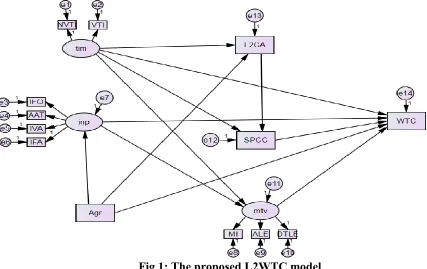
Using willingness to communicate (WTC) and socio-educational models as a framework, the initially hypothesized model of the current study was formed by three latent variables (international posture, teacher immediacy and motivation) and four observed variables (SPCC, CA, WTC and personality trait of agreeableness). The links among these variables are schematically represented in Fig. 1.
direct path between teacher immediacy and SPCC. Furthermore, based on Yu’s (2009) findings and Wen and Clément’s (2003) argument that teacher immediacy can exert potential impact on EFL learners’ L2WTC, a direct positive path was drawn from teacher immediacy to learners’ L2WTC.
Following MacIntyre (1994) and MacIntyre and Charos (1996), a direct negative path was hypothesized from CA to SPCC. Further, one positive path between SPCC and WTC was expected (e.g., Baker & MacIntyre, 2003; MacIntyre & Charos, 1996; Yu, 2009).
The two expected positive paths from motivation and international posture to L2WTC paralleled previous research (Ghonsooly et al., 2012; Yashima, 2002). A positive path from motivation to L2WTC was also anticipated based on Dörnyei and Kormos (2000) and MacIntyre et al.’s (1998) pyramid model of L2WTC. As for the agreeableness personality trait, Clement (1980) argued that those who are pleasant and agreeable are more interested in interacting positively with L2 speakers. The most probable variable to be affected by this trait is integrativeness (MacIntyre & Charos, 1996). Further, Yashima (2002) argued that integrativeness can be represented and
epitomized by international posture in EFL context. Therefore, a positive path is proposed from agreeableness to international posture.
The hypothesized negative path from agreeableness to communication anxiety is also supported by previous research in personality and behavioral psychology. For example, it was shown that highly agreeable individuals automatically engaged in emotion regulation processes when exposed to unpleasant stimuli (Jensen-Campbell, Rosselli, Workman, Santisi, Rios & Bojan, 2002). Tobin and Graziano’s (2011) findings also revealed a significant relation between agreeableness and negative affect regulation in young learners. Finally, in response to MacIntyre and Charos’s (1996) call, a positive path from agreeableness to L2WTC was hypothesized and re-examined.
In short, the following research questions were addressed to provide answer to the objectives of the study:
Q 1: Is the proposed model of L2 communication (Figure 1) appropriate for the Iranian EFL learners?
Fig 1: The proposed L2WTC model
Note: L2WTC = willingness to communicate in L2; con = L2 self-confidence; SPCC = self-perceived communicative competence; LCA = L2 communication anxiety; Agr = agreeableness; inp = international posture; IFO = interest in foreign affairs; IVA = interest in international vocation/activities; AAT = approach/avoidance tendency; IFO = intercultural friendship orientation in English learning; mtv = L2 motivation; MI: motivation intensity; ALE: attitude toward learning English; DTLE: desire to learn English; tim: teacher immediacy
Method Participants
For the purpose of this study, 398 Iranian non-English major undergraduate students were recruited randomly from Colleges of Humanities, Natural Resources, Engineering, Agriculture, Veterinarian and Basic Sciences at the University of Zabol. Out of these, 372 participants (about 93.5 % return rate) completed the questionnaires. They aged between 18 and 34 years (M = 19.13, SD = 1.69). One hundred seventy three students were male (46.5 %), and 199 (53.5 %) were female. They were freshmen who had just studied English as a foreign language for 7 consecutive years in junior high school and high school. They were all taking General English as a compulsory university course prior to their ESP courses.
Procedure
Before the data collection, the researchers obtained approval from 8 EFL professors. Then, the questionnaires were distributed in twelve classes within 2 weeks in the middle of winter semester. The participants completed the Persian versions of the questionnaires in their classes.
Measures
The required data were collected through the following ten questionnaires. These questionnaires have been utilized extensively in EFL settings (e.g., Cetinkaya, 2005; Fallah, 2014; Ghonsooly et al., 2012; Yashima, 2002; Yashima et al., 2004; Yu, 2009). The original English questionnaires were translated into Farsi in the present study.
Willingness to communicate
EFL learners’ WTC in English was tested through twelve items from McCroskey (1992) in terms of contexts of communication (group discussions, public speaking, interpersonal conversations and talking in meetings) and types of receivers (strangers, acquaintances, and friends). The participants chose the amount (0% - 100%) that they would be willing to communicate in each situation. Scores were the sum of the points that the respondents achieved based on the WTC scale (Cronbach’s α = .94). Sample item is “I am willing to talk in a small group of strangers in English”.
Self-perceived communication competence (SPCC)
McCroskey and McCroskey’s (1988) 12-item questionnaire was utilized to gauge the learners’ self-perceived communication competence. Like the WTC scale, the items in the SPCC scale refer to 4 basic communication contexts and three types of receivers. Participants appraised their communication competence on a 0-100 scale. (Cronbach’s α = .93). Sample item is “I can Talk in English in a large meeting among strangers”.
Communication anxiety (CA)
This was measured by twelve items used by Yashima (2002). The respondents indicated the percentage of time that they would feel anxious engaging in a special activity. Similar to the WTC and SPCC scales, it
includes 12 permutations (four situations, three receiver groups) (Cronbach’s α = .91). Sample item is “I feel anxious while talking
in English to a stranger”.
Teacher immediacy
The immediacy behavior scale comprised items tapping on teacher verbal (20 items, Gorham, 1988, Cronbach’s α = .89.) and nonverbal (14 items, Richmond, Gorham, & McCroskey, 1987, Cronbach’s α = .88) immediacy behaviors. Respondents indicated whether or not their teachers exhibited such behaviors and their incidence of use on a range from “one” (rarely) to “four” (very often). Sample item is “my teacher uses a variety of vocal expressions when talking to the class”.
Agreeableness measure
Two items from The Ten Item Personality Inventory (TIPI; Gosling, Rentfrow, & Swann, 2003) were used. The authors reported TIPI is a reliable and valid measure of personality. The test begins with the stem ‘‘I see myself as:’’ followed by pairs of two-trait descriptors, which respondents assess on a 7-point likert scale varying from 1 (strongly disagree) to 7 (strongly agree) (Cronbach’s α = .68). Sample item is “I am sympathetic and warm”.
Motivation
The 30-itme Motivation scale with three constituents (Motivational Intensity, Attitudes toward Learning English and Desire to Learn English) was originally developed by Gardner (1985) as part of the Attitude/Motivation Test Battery. Each component was measured by 10 multiple items. (Cronbach’s α = .90, 86 and 87 for MI, DLE and ALE, respectively). Sample item is “I plan to learn as much English as possible”.
International posture
questionnaire. The questionnaire included four sub-scales, namely Intercultural Friendship Orientation (4 items, sample:
“studying English will allow me to meet and
converse with more and varied people”),
Approach-Avoidance Tendency (7 items, sample: “I try to avoid talking with
foreigners if I can”), Interest in International
Vocation/Activities (5 items, sample: “I
want to live in a foreign country” ) and
Interest in Foreign Affairs (2 items, sample: “I often read and watch news about foreign
countries” ). The participants marked the
amount to which they agreed with each item on a 7-point scale by marking a number between 1 (strongly disagree) and 7 (strongly agree). The reliability estimates (Cronbach’s α) were .75, .79, .71 and .66 for the four scales respectively.
Results and discussion
Pearson correlations were used to examine the relationships between continuous variables. Table 1 shows the mean, standard deviation, and correlation matrix between the variables. Furthermore, to answer the research questions, as to whether the proposed model is appropriate for the Iranian EFL learners and whether the independent variables can predict dependant variables including L2WTC, Structural Equation Modeling was conducted through AMOS 20. This analysis allows for testing complex hypotheses and examining the relationship between one or more independent variables and one or more dependant variables. In addition, this approach examines the direct, indirect and total effects of the links among the model variables.
In the present study, model estimation was conducted using maximum likelihood (ML) estimation. As shown in Figure 1, the proposed model was tested and the results indicated that the goodness-of-fit measures for the base model were as follows:
goodness-of-fit (GFI) index = .94, adjusted goodness-of-fit (AGFI) index = .90, comparative fit index (CFI) = .92, root mean square error of approximation (RMSEA) = .07, and Chi-Square = 153.01 (57 df), p < .001 which show an unacceptable good fit for the base model. To have a very good fit model, RMSEA should be smaller than .05, CFI, GFI and AGFI should indicate values higher than .90, and p value should be higher than .05. Thus, model modifications were conducted to improve the model.
First, the four non-significant paths (the path from agreeableness to L2WTC and the 3 paths from teacher immediacy to L2WTC, SPCC and motivation) were deleted. The goodness-of-fit measures were reanalyzed for the revised model. They were not completely acceptable yet: GFI = .94, AGFI = .91, CFI = .92, RMSEA = .07 and Chi-Square = 156.65 (61 df), p < .001.
Post hoc model modifications were then conducted in order to improve model fit. The significant chi-square test for the modified model indicated that further variance could be accounted for in case new paths were drawn. Contrary to the confirmatory approach followed till now, drawing additional paths, as MacCallum, Roznowski, and Necowitz, (1992) stated, is an exploratory procedure. These paths should be considered as data driven, and serve as potential avenues for future research (MacIntyre & Charos, 1996).
.97, RMSEA = .03) except for the chi-square which was significant (χ2 = 88.83 (59 df), p < .01) due to the relatively large sample size. However, a conventional way of dealing with this sample-size impact on the Model Chi-Square is the relative/normed chi-square (χ2/df) which in our study
displays a value below the acceptable level of 2 (see Hooper et al., 2008; Tabachnick & Fidell, 2007). Therefore, it can be concluded that the final measurement model have a very good fit to the data, and it can be deemed an appropriate communication model for the Iranian EFL context.
Table 1: interrelationship between the variables (n = 372)
Variables M / SD 1 2 3 4 5 6 7 8 9 10 11 12 13
1. L2WTC 46.47 / 30.40 1.00 2. SPCC 56.45 / 31.93 .41** 1.00 3. CA 44.25 / 26.77 -.08 -.30** 1.00
4.VTI 62.57 / 7.44 .14** .08 -.19** 1.00 5. NVTI 48.57 / 6.28 .06 -.01 -.10* .34** 1.00
6. IFO 22.24 / 4.57 .34** .15** -.07 27** .17** 1.00
7. AAT 36.14 / 7.32 .40** .22** -.16** .32** .20** .66** 1.00
8. IVA 24.91 / 6.84 .26** .22** -.16** .06 .03 .34** .34** 1.00
9. IFA 9.25 / 2.74 .19** .06 -. 05 .18** .03 .33** .30** .29** 1.00 10. MI 22.38 / 7.16 .27** .21** -.13**.19** .07 .27** .32** .12* .18** 1.00
11. ALE 47.82 / 11.16 .36** .19** -.06 .22** .12* .49** .57** .26** .28**.38* 1.00 12. DTLE 21.91 / 5.12 .42** .25** -.15** .26** .10* .50** .60** .33** . 33* .47** .73** 1.00
13. Agr 9.53 / 1.99 .12* .00 .16** .09 .08 .17** .20** -.01 .03 .07 .13* .06 1.00
**. Correlation is significant at the 0.01 level (2-tailed). *. Correlation is significant at the 0.05 level (2-tailed).
Table 2: Step-by-Step Modification Process of the Structural Model
Model χ² df χ²/df GFI AGFI CFI RMSEA Base Model 153.01 (p < .001) 57 2.68 .94 .90 .92 .07 Revision 1: Deleting 156.65 (p < .001) 61 2.56 .94 .91 .92 .07 insignificant Paths
Revision 2: Adding
Teacher immediacy → 109.515 (p < .001) 60 1.825 .95 .93 .96 .05 international posture
Revision 3: Adding
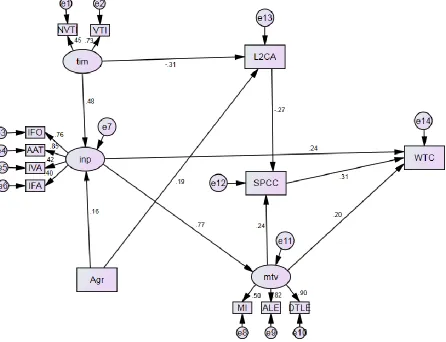
In the structural equation model, significant paths were obtained leading from SPCC, motivation and international posture to their anticipated destination of L2WTC. L2CA had a direct path to SPCC, while immediacy had a direct path to L2CA. Also direct paths were found leading from international posture to motivation, from agreeableness to international posture and L2CA, and from L2CA to SPCC. As for the data driven paths, two significant paths indicated the impacts of motivation and immediacy on SPCC and international posture, respectively. The paths were all found to be significant at least at the level of .05. Thus, it can be safely said that all the independent variables could significantly predict the dependant variables in the final model.
The significant path (p < .001, c.r. = 6.85) showing the effect of SPCC on WTC confirms the results obtained in previous studies (McCroskey & Richmond, 1990; MacIntyre, 1994; MacIntyre, Babin, & Clément, 1999; MacIntyre & Charos, 1996; Yashima, 2002; Yu, 2009). The strength of this impact on WTC also parallels the findings of these studies suggesting that SPCC exerts the highest effect on L2WTC. This indicates that, irrespective of one’s real proficiency, simply deeming oneself able to communicate can influence the willingness or intention to get engaged in communication. The significant effect (p <
.001, c.r. = - 5.63) of L2CA on SPCC was also supported by previous research (MacIntyre, 1994; MacIntyre & Charos, 1996; Yu, 2009).
Fig 2: The final model
Interestingly, the role that motivation played was two-dimensional as it also contributed to L2WTC indirectly, through impacting the learners’ SPCC. In other words, the role of Iranian EFL learners’ motivation in increasing learners’ L2WTC in English can be mediated by their perception of their own ability to communicate.
The results of this study also revealed a mildly significant path (p < .05, c.r. = 2.54) and a strong direct path (p < .001, c.r. = 7.07) from international posture to L2WTC and motivation respectively, suggesting that the more internationally aligned learners were, the more tendency they had to enter into communication and also the more
motivation they have to pursue their L2 education. This is basically supported by the socioeducational model in that attitudes affect motivation. In the present study attitude (international posture) covered the learners’ attitudes toward international vocation or activities, intercultural communication, and foreign affairs.
The results also revealed that teacher immediacy had a significant negative effect (p < .001, c.r. = - 4.05) on EFL learners’ L2CA. This corroborates Rodriguez, Plax, and Kearney’s (1996) argument that immediate teachers facilitate interpersonal closeness and create warm and friendly atmosphere in the classroom through conveying positive attitudes, thereby reducing anxiety. Connected to this, Wen and Clement (2003) stated that teacher’s dependability and affability make learners feel emotionally supported and less communicatively nervous. Therefore, in Iranian EFL context, where the teacher is the main authority in the classroom, teacher immediacy behaviors can be deemed an important emotional resource, under the auspices of which the learners can tackle communication apprehension. Put it into nutshell, learners feel happier and less stressed in classes with caring and affectionate teachers (Ellen & Michael, 1993).
The significant path (p < .001, c.r. = 4.28) from teacher immediacy to international posture is one of the data-driven paths of the present study. It suggests that the more EFL learners find their teachers physically and psychologically approachable, the more positive attitude they develop towards the international society. As Yashima (2002) argued, language learners’ attitudes toward the international community are subject to change. As such, EFL teachers’ verbal and non-verbal immediacy behaviors can be an invaluable asset in creating a supportive and non-threatening learning milieu for learners. Such an environment is conducive to the development of positive attitudes and views toward language learning and intercultural community among EFL learners. Since adding an additional path is deemed data-driven and exploratory, this path should to
be replicated and further examined along with the path from motivation to SPCC.
Given the strong effect of teacher immediacy on international posture, the unquestionable impact of international posture on the learners’ motivation, and the mildly significant path leading from international posture to L2WTC, it appears that teacher immediacy exerts positive indirect effects on both learners’ motivation and their L2WTC.
Furthermore, the significant path (p < .01, c.r. = 2.77) indicating the impact of agreeableness on international posture suggested that agreeable EFL learners tended to be more interested in foreign languages and international activities and affaires. Given the agreeable individuals’ high social desirability, positive prosocial behaviors and friendly disposition (Graziano & Tobin, 2013), it is likely that they have more positive feelings and attitudes toward international community. This interpretation gains more credibility in the light of MacIntyre et al.’s (1998) notion that personality can affect the way a person reacts to foreign people and cultures.
communication, in most likelihood, is set up as a form of competition. If this line of reasoning is valid, then persons high in agreeableness perhaps do not care to participate or at least do it with an extra burden of carrying communication apprehension. This conjecture seems to gain more plausibility in the light of Graziano, Hair, and Finch’s (1997) argument that highly agreeable individuals are interested in social harmony and, compared to their less-agreeable peers, they dislike conflicts and competitions. Connected to this, Ryckman, Thornton and Gold (2009) found that competition avoiders were pleasant, agreeable and acquiescent in their social interactions. An intriguing study (Bilalic, McLeod & Gobet, 2007) also showed that playing chess was not appealing to highly agreeable participants due to the competitive nature of chess where players endure constant confrontations.
Conclusion and implications
This study tested a model of L2WTC among Iranian EFL learners. The final model was an acceptable representation of the dataset regarding the evaluated variables. The results of structural equation modeling supported both the WTC model and the socio-educational model.
The findings indicated that L2WTC is a complex concept and obviously connected to different factors in EFL context. It was shown that SPCC, international posture and motivation were significant predictors of L2WTC. The indirect effects of CA and motivation on L2WTC were mediated by SPCC, and the roles of teacher immediacy and agreeableness in enhancing EFL learners’ L2WTC were also mediated by international posture. Therefore, SPCC, international posture and motivation seemed to play a key role in understanding and improving L2 communication in the Iranian
EFL context. Further, while teacher immediacy significantly predicted international posture and CA, personality trait of agreeableness predicted international posture and communication apprehension among the EFL learners.
Based on these findings, it can be suggested that for more effectively enhancing EFL learners’ willingness to communicate, teachers and learners as well should be more aware of the effect of affective and personal factors on learners’ communication capacity including their WTC. They should try to assuage communication anxiety and improve learners’ motivation and their beliefs and attitudes toward the international community.
Since the participants were a selected group of EFL learners from only one university, any generalization of the findings to other contexts should be done with caution. The data collection was done only through self-reported questionnaires. In order to obtain a more accurate estimate of the variables, future research should utilize qualitative methods such as interview and observation, too. It is also recommended that this study be replicated in different EFL contexts among learners with diverse cultural, educational and socioeconomic backgrounds.
Acknowledgments
This study was supported by a research grant (No. 19-93) from the University of Zabol. Also, we would like to especially thank Professor William Graziano from Purdue University, Dr. Mostafa Papi from Michigan State University and the Journal’s anonymous reviewers for their invaluable and insightful comments on the earlier versions of the manuscript. We must also thank all colleagues and participants for their warm cooperation during the data collection phase.
References
Andersen, J. F. (1979). Teacher immediacy as a predictor of teaching effectiveness. In D.Nimmo (Ed.),
Communication Yearbook 3 (pp.
543-559). New Brunswick, NJ: Transaction Books.
Arbuckle, J. L. (1997). Amos users’ guide. SPSS Inc. Chicago.
Baker, S. C., & MacIntyre, P. D. (2003). The role of gender and immersion in communication and second language orientations. Language Learning, 53(1), 65–96.
Bilalic, M., McLeod, P., & Gobet, F. (2007). Personality profiles of young
chess players. Personality &
Individual Differences, 42, 901-910.
Campbell, A., & Rushton, J. P. (1978). Bodily communication and personality. British Journal of Social
and Clinical Psychology, 17, 31-36.
Cao, Y., & Philp, J. (2006). Interactional context and willingness to communicate: A comparison of behavior in whole class, group and dyadic interaction. System 34, 480-493.
Carrell, L. J., & Menzel, K. E. (1998, November). Gender, cognitive style, anxiety, academic ability, and professor behavior as predictors of a
student's willingness to talk in class.
Paper presented at the annual meeting of the National Communication Association, New York City.
Cetinkaya, Y. B. (2005). Turkish college students’ willingness to communicate in English as a foreign language (Unpublished doctoral dissertation). Ohio State University, Columbus. Cheng, YS., Horwitz, E. K., & Schallert, D.
L. (1999). Language anxiety: Differentiating writing and speaking components. Language Learning, 49,417-446.
Christophel, D. M. (1990). The relationships among teacher immediacy behaviors, student motivation and learning.
Communication Education, 39,
323-340.
Christophel, D. M., & Gorham, J. (1995). A test-retest analysis of student motivation, teacher immediacy, and perceived sources of motivation and demotivation in college classes.
Communication Education, 44,
292-306.
Robinson & P. M. Smity (Eds.),
Language: Social-psychological
perspectives (pp. 147-154). Oxford,
United Kingdom: Pergamon Press. Clément, R., & Kruidenier, B. (1983).
Orientations in second language acquisition: The effects of ethnicity, milieu, and target language on their emergence. Language Learning, 33, 273–291.
Clement, R., Dornyei, Z., & Noels, K. (1994). Motivation, self-confidence and group cohesion in the foreign language classroom. Language
Learning, 44, 417-448.
Clément, R., Baker, S. C., & MacIntyre, P. D. (2003). Willingness to communicate in a second language: the effects of context, norms and vitality. Journal of Language and
Social Psychology 22 (2). 190–209.
Dewaele, J. M., & Furnham, A. (1999), Extraversion: the unloved variable in applied linguisticsresearch,Language
Learning, 49 (3), pp. 509-544.
Dörnyei, Z. (2005). The psychology of
language learner: Individual
differences in second language
acquisition. Mahwah, NJ: Lawrence
Erlbaum.
Dörnyei, Z. & Kormos, J. (2000). The role of individual and social variables in oral task performance. Language
Teaching Research, 4 (3), 275-300.
Ellen, A. S., & Michael, J. B. (1993). Motivation in the Classroom: Reciprocal Effects of Teacher Behavior and Student Engagement Across the School Year. Journal of
Educational Psychology. 85 (4),
571-581.
Ellis, R. (2008). The study of second
language acquisition. Oxford,
England: Oxford University Press. Fallah, N. (2014). Willingness to
communicate in English,
communication self-confidence, motivation, shyness and teacher immediacy among Iranian English-major undergraduates: A structural equation modeling approach. Learning and Individual Differences, 30, 140-147.
Frymier, A. B. (1993). The relationship
Among communication
apprehension, immediacy, and motivation to study. Communication
Reports, 6, 8-17.
Gardner, R. C. (1985). Social psychology and second language learning: The roles of attitudes and motivation. London, England: Edward Arnold. Gardner, R. C. (2007). Motivation and
second language acquisition. Porta
Linguarum, 8, 9-20.
Gardner, R. C., & MacIntyre, P. D. (1993). A student’s contribution to second language learning: Part II, affective factors. Language Teaching, 26, 1-11.
Ghonsooly, B., Khajavy, G. H., & Asadpour, S. F. (2012). Willingness to communicate in English among Iranian non–English major university students. Journal of Language and
Social Psychology, 31 (2), 197-211.
Goldberg, L. R. (1992). The development of markers for the big-five factor structure. Psychological Assessment 4, 26-42.
Goldberg, L. R. (1993). The structure of phenotypic personality traits.
American Psychologist, 48 (1),
26-34.
Gorham, J. (1988). The relationship between verbal teacher immediacy behaviors and student learning. Communication
Education, 37, 40-53.
domains. Journal of Research in
Personality, 37, 504–528.
Graziano, W. G., Hair, E. C., & Finch, J. F. (1997). Competitiveness mediates the link between personality and group performance. Journal of Personality and Social Psychology, 73, 1394–1408.
Graziano, W. G., & Tobin, R. M. (2013). The Cognitive and Motivational
Foundations Underlying
Agreeableness. M. D. Robinson, E. Watkins, & E. Harmon-Jones (Eds.), Handbook of Cognition and Emotion (pp. 1-41). New York: Guilford. Hashimoto, Y. (2002). Motivation and
willingness to communicate as predictors of reported L2 use: The Japanese ESL context. Second
Language Studies, 20 (2), 29-70.
Hooper, D., Coughlan, J., & Mullen, M. (2008). Structural Equation Modeling: Guidelines for Determining Model Fit. Electronic Journal of Business Research
Methods, 6, 53-60.
Horwitz, E. K., Horwitz, M. B., & Cope, J. (1986). Foreign language classroom anxiety. Modern Language Journal, 70, 125-132.
Hsu, L. L. (2005). The relationship among teachers’ verbal and nonverbal immediacy behaviors and students’ willingness to speak in English in
central Taiwanese college
classrooms. Unpublished doctoral
dissertation, Oral Roberts University, Tulsa, Oklahoma.
Jensen-Campbell, L. A., Rosselli, M., Workman, K. A., Santisi, M., Rios, J. D., & Bojan, D. (2002). Agreeableness conscientiousness and effortful control processes. Journal
of Research in Personality, 36,
476-489.
Kim, S. J. (2004). Exploring willingness to communicate (WTC) in English among Korean EFL (English as a foreign language) students in Korea: WTC as a predictor of success in
second language acquisition
(Unpublished doctoral dissertation). Ohio State University, Columbus. Krashen, S. (1982). Principles and practices
in second language acquisition.
Oxford: Pergamon Press.
MacCalluo, R. C., Roznowski, M., & Necovritz, L. B. (1992). Model modifications in covariance structure analysis: The problem of capitalization on chance
.Psychological Bulletin, 111,
490-504.
MacIntyre, P. D. (1994). Willingness to communicate: A causal analysis. Communication Research Reports, 11 (2), 135-142.
MacIntyre, P. D. (1995). How does anxiety affect second language learning? A reply to Sparks and Ganschow. The
Modern Language Journal, 79,
90-99.
MacIntyre, P. D., Babin, P. A., & Clément, R. (1999). Willingness to communicate: Antecedents and consequences. Communication
Quarterly, 47 (2), 215-229.
MacIntyre, P. D., Baker, S. C., Clément, R., & Conrod, S. (2001). Willingness to communicate, social support, and language-learning orientations of immersion students. Studies in
Second Language Acquisition, 23,
369-388.
MacIntyre, P. D., Baker, S. C., Clément, R., & Donovan, L. A. (2003). Talking in order to learn: Willingness to communicate and intensive language programs. Canadian Modern
MacIntyre, P. D., & Charos, C. (1996). Personality, attitudes, and affect as predictors of second language communication. Journal of Language and Social Psychology,
15(1), 3-26.
MacIntyre, P. D., & Clément, R. (1996, August). A model of willingness to
communicate in a second language:
The concept, its antecedents and
implications. Paper presented at the
World Congress of Applied Linguistics (AILA), Jyväskylä, Finland.
MacIntyre, P. D., Clément, R., Dörnyei, Z., & Noels, K. A. (1998). Conceptualizing willingness to communicate in a L2: A situational model of L2 confidence and affiliation. Modern Language
Journal, 82, 545-562.
MacIntyre, P. D., Clement, R., & Noels, K. A. (2007). Affective variables, attitude and personality in context. In D. Ayoun (Ed.), Handbook of
French applied linguistics (pp. 270 –
298). Philadelphia, PA: John Benjamins.
MacIntyre, P. D., & Gardner, R. C. (1991). Methods and results in the study of anxiety and language learning: A review of the literature. Language
Learning, 41, 85-115.
MacIntyre, P.D., Noels, K., & Clément, R. (1997). Biases in self-ratings of second language proficiency: The role of language anxiety. Language
Learning, 47, 265-287.
McCroskey, J. C. (1992). Reliability and validity of the willingness to communicate scale. Communication
Quarterly, 40, 16-25.
McCroskey, J. C. (1997). Willingness to communicate, communication apprehension, and self perceived communication competence:
Conceptualizations and perspectives. In J. Daly et al., (eds), Avoiding communication: Shyness, reticence, & communication apprehension (pp.75-108). Cresskill, NJ: Hampton Press.
McCroskey, J. C., & Baer, J. E. (1985). Willingness to communicate: The
construct and its measurement.
Paper presented at the Speech Communication Association convention, Denver, CO.
McCroskey, J. C., & McCroskey, L. L. (1986, November). Communication competence and willingness to
communicate. Paper presented at the
Speech Communication Association convention, Chicago, IL. (c
McCroskey, J. C., & McCroskey, L. L. (1988). Self-report as an approach to measuring communication competence. Communication
Research Reports, 5 (2), 108-113.
McCroskey, J. C., & Richmond, V. P. (1987). Willingness to communicate and interpersonal communication. In J. C. McCroskey & J. A. Daly (Eds.),
Personality and interpersonal
communication (pp. 129-159).
Newbury Park, CA: SAGE.
McCroskey, J. C., & Richmond, V. P. (1990). Willingness to communicate: A cognitive view. In M. Booth-Butterfield (Ed.), Communication,
cognition, and anxiety (pp. 19-37).
Newbury Park, CA: Sage.
Mehrabian, A. (1967). Orientation behaviors and nonverbal attitude communication. Journal of
Communication, 17(4), 324-332.
Mehrabian, A. (1971). Verbal and nonverbal interaction of strangers in a waiting situation. Journal of Experimental
Research in Personality, 5, 127-138.
engagement in meaning negotiation and classroom interaction as a function of their perceptions of teachers’ instructional communicative behaviors. Iranian Journal of Applied Language
Studies. 4 (1), 39-58.
Peng, J. (2007). Willingness to communicate in an L2 and integrative motivation among college students in an intensive English language program in China. University of Sydney
Papers in TESOL, 2, 33-59.
Rashidi, N., & Mahmoudi Kia, M. (2014). The effect of teachers’ immediacy on Iranian students’ willingness to
communicate (WTC) in EFL
classroom. International Symposium
on Language and Communication: Research Trends and Challenges (ISLC).
Richmond, V. P., Gorham, J., & McCroskey, J. C. (1987). The relationship between selected immediacy behaviors and cognitive learning. In M. A. McLaughlin (Ed.),
Communication Yearbook X
(pp.574-590). Newbury Park, CA: Sage. Rodriguez, J. L., Plax, T. G., & Kearney, P.
(1996). Clarifying the relationship between teacher nonverbal immediacy and student cognitive learning: affective learning as the central causal mediator.
Communication Education, 45,
293-305.
Ryckman, R.M., B. Thornton and J.A. Gold, (2009). Assessing competition avoidance as a basic personality dimension. Psychology, 143, 175-192.
Saito, Y., & Samimy, K. K. (1996). Foreign language anxiety and language performance: A study of learner anxiety in beginning, intermediate,
and advanced-level college students of Japanese. Foreign Language
Annals, 29 (2), 239-252.
Samimy, K. K., & Rardin, J. P. (1994). Adult language learners’ affective reactions to community language learning: A descriptive study.
Foreign Language Annals, 27,
379-390.
Savignon, S. J. (2000). Communicative language teaching. In Byram, M.
Routledge Encyclopedia of
Language Teaching and Learning, (pp. 125–129). London: Routledge. Tabachnick, B.G. and Fidell, L.S. (2007).
Using Multivariate Statistics (5th ed.). New York: Allyn and Bacon. Tobin, R. M., & Graziano, W. G. (2011).
The disappointing gift: Dispositional and situational moderators of emotional expressions. Journal of
Experimental Child Psychology, 110,
227-240.
Wen, W. P., & Clément, R. (2003). A Chinese conceptualization of willingness to communicate in ESL. Language, Culture and Curriculum, 16, 18-38.
Yashima, T. (2002). Willingness to communicate in a second language: The Japanese EFL context. Modern
Language Journal, 86, 54-66.
Yu, M. (2009). Willingness to communicateof foreign language
learners in a Chinese setting.