Research Article
a
August
2018
Computer Science and Software Engineering
ISSN: 2277-128X (Volume-8, Issue-8)
A Review on Solar based Induction Motor for Water Pumping
Sanjay Tiwari*
PG Scholar Department of EXTC, PRMIT&R, Badnera, Amravati,
Maharashtra, India
Girish Patil
Department of EXTC, PRMIT&R, Badnera, Amravati,
Maharashtra, India
Dr. S. M. Deshmukh
Head, Department of EXTC, PRMIT&R, Badnera, Amravati,
Maharashtra, India
Abstract— The shortfall in electric supply and scarcity of fossil fuel such as diesel alongwith its high costs affects the pumping requirements of irrigation; a promising substitute to conventional electricity and diesel based water pumping systems is to used solar energy for water pumping. Majorly the water pumping is done by centrifugal pump driven by induction motor. Solar based Induction motor for water pumping is based on photovoltaic (PV) technology which converts solar energy into electrical energy to run induction motor based water pump. The main objective of the study offered in this paper is to present a inclusive literature review of solar pumping technology, discover research gaps and propose a solar power based induction motor for water pumping system.
Keywords— Solar, Induction motor, microcontroller, vibration sensor, irrigation, temperature, speed, GUI, etc.
I. INTRODUCTION
Energy is an important input ingredient for the economic development of a country, and it is derived from several sources. These sources can broadly be classified as non-renewable such as oil, natural gas, and coal, or renewable, such as biomass, wind, solar and hydel sources. In fact renewable energy sources can be traced to belong to the oldest form of energy utilization ever known to mankind. Yet their importance was not recognized till recently and was considered to be non-conventional. These sources are renewable in the sense of being wholly regenerated in the annual solar cycle.[1]
As the range of applications for solar energy increases, so does the need for improved materials and methods used to harness this power source. There are several factors that affect the efficiency of the collection process. Major influences on overall efficiency include solar cell efficiency, intensity of source radiation and storage techniques. The materials used in solar cell manufacturing limit the efficiency of a solar cell. This makes it particularly difficult to make considerable improvements in the performance of the cell, and hence restricts the efficiency of the overall collection process. Therefore, the most attainable method of improving the performance of solar power collection is to increase the mean intensity of radiation received from the source.
It is common to use diesel to power generators in agricultural operations. While these systems can provide power where needed there are some significant drawbacks, including:
• Fuel has to be transported to the generator’s location, which may be quite a distance over some challenging roads and landscape.
• Its noise and fumes can disturb livestock.
• Fuel costs add up, and spills can contaminate the land.
• Generators require a significant amount of maintenance and, like all mechanical systems, they break down and need replacement parts that are not always available.
There are also major disadvantages in using propane or bottled gas to heat water for pen cleaning or in crop processing applications, or to heat air for crop drying, including transportation to the location where you need the heat, costs of fuel and safety issues. For many agricultural needs, the alternative is solar energy. Modern, well-designed, simpleto-maintain solar systems can provide the energy that is needed where it is needed, and when it is needed. These are systems that have been tested and proven around the world to be cost-effective and reliable, and they are already raising levels of agricultural productivity worldwide.
ISSN(E): 2277-128X, ISSN(P): 2277-6451, pp. 7-12
Therefore solar power Induction motor based water pumps are the most useful solution to all the problems discussed.
II. REVIEW OF LITERATURE
An Photovoltaic (PV) power for irrigation is cost-competitive in comparison to traditional energy sources for small-scale water pumping requirements. With the continuous increase in fossil fuel cost and reduction in peak watt cost of solar cells due to mass production, the photovoltaic power is to become further economical in future [4]. PV powered water pumping systems have become attractive for livestock and agriculture applications in remote locations with limited access to conventional electricity [5]. A number of studies have been carried out on performance evaluation, optimization, sizing techniques, efficiency improvement, and factors affecting system performance, economical and environmental aspects of PV pumping systems. The highlights of the research investigations are presented in this section.
Gad [6] developed a methodology for performance prediction of a direct coupled PV water pumping system in South Sinai, Egypt using a computer simulation program. The program simulates the hourly performance of the system at any day of the year, under different PV array orientations. The system is found to be capable of pumping 24.06 l/day, 21.47 l/day and 12.12 l/day in summer solstice, equinoxes and winter clear sky days respectively. The calculated PV array efficiency ranges from 13.86% in winters to 13.91% in summers. Katan et al. [7] analyzed the performance of a solar water pumping system consisting of a PV array, sun-tracker, a permanent-magnet (PM) DC motor, a helical rotor pump and found that the performance of the system is enhanced when maximum power point tracker (MPPT) and a sun-tracker are added to the system. The analysis of the PV array was carried out using PSPICE software. Theoretical results are verified by field tests.
Loxsom and Veroj [8] developed and tested an algorithm to estimate the long term monthly performance of a solar photovoltaic water pumping system without any battery storage system for four locations in USA by using average monthly solar insolation input data and estimated the total monthly volume of water pumped with hourly simulation.
Khan et al. [9] designed a solar photovoltaic water pump by adding a DC–DC buck converter to provide current boosting to the DC pump. No battery and inverter are used in the system so as to reduce the cost and maintenance. The highest no load speed goes up to 3000–3200 revolutions per minute (rpm). The results from the no load test revealed that the integration of DC motor with the centrifugal pump has matched quite perfectly. A direct coupled system without a Power Conditioning Unit (PCU) is compared with DC–DC convertor type system. The DC motor operating voltage, operating current, shaft rpm and the discharge rate at different pressures during different times of a day for both systems are measured and improvement in the electrical power output is found in the designed DC water pumping system.
Mokeddem et al. [10] investigated the performance of a directly coupled DC powered PV water pumping system. The system operates without battery and electronic controls. The motor-pump efficiency did notexceed30%,which is typical for a directly-coupled photovoltaic pumping system; yet such a system is suitable for low head irrigation in remote areas. The efficiency of the system can be increased by selecting the size of PV array, its orientation and motor-pump system.
Velvizhi and Subramanian [11] presented design aspects and simulation procedure leading to performance enhancement of PV based water pumping system. Authors presented two algorithms: two inductor boost converter and maximum power point tracking algorithm. The concept of maximum power point tracking is implemented using perturb and observe algorithm in MATLAB environment using Simulink blocks. A 400 W PV panel, twoinductor boost converter (TIBC) with auxiliary transformer, three phase inverter is implemented using Simulink blocks. Efficiency of water pumping is found to increase with MPPT as compared to a system without MPPT.
Kou et al. [12] developed a method to predict the long-term performance of a direct-coupled PV pumping system. The method uses PV module and pump–motor manufacturer data in the study. Weather data are generated from monthly averages of horizontal radiation and ambient temperature. The method predicts monthly pumped water to within 6% of TRNSYS prediction based on hourly weather data and can be used in designing and estimating the long-term performance of a PV water pumping system for US climates. Hadj et al. [13] analyzed the performance of different PV water pumping systems for 4 different locations: Algiers, Bechar, Oran and Tamanrasset in Algeria using typical meteorological year(TMY) data. The study is carried out for 3 different profiles: three tank capacities; two PV modules types; two PV array configurations and several pumping heads applied to two centrifugal pumps and concluded that PV generator costs can decrease if the simulationprogram accounts for the type of pump, pumping head and daily load profile. The system can be optimized by studying individual requirements using computer program based on mathematical models of a motor pump, PV generator.
ISSN(E): 2277-128X, ISSN(P): 2277-6451, pp. 7-12
DC motor-pump mono-block) can provide 70–100 kPa pressure at the delivery side with a discharge of 3.4–3.8 l/h from each dripper during different hours of the day. The emission uniformity was found to be 92–96% in a field of 1 ha. It is suggested that PV water pumping systems need to be extensively tested for water harvesting tanks with lower suction head for growing orchards in arid region.
Mohanlal et al. [15] studied and analyzed the performance of a PV-powered DC (PM) motor coupled with a centrifugal pump at different solar intensities and corresponding cell temperatures. The experimental results obtained are compared with calculated values, and found that this system has a good match between the PV array and the electro-mechanical system characteristics. The authors reported that through manual tracking i.e., changing the orientation of PV array, three times a day to face Sun, the output obtained is 20% more as compared to the fixed tilted PV array.
Alghuwainem et al. [16] investigated the steady-state performance of a PV powered DC motor driving an isolated three-phase self-excited induction generator (SEIG) and found that SEIG is a perfect load match for a PV powered DC motor with the PV generator for maximum utilization of efficiency. The use of a SEIG avoids the need for matching devices or peak power trackers which increases the total system cost. It is found that due to the unique torque speed characteristics of the SEIG, the utilization efficiency is close to maximum at all in solation levels with no peak-power tracking. The proposed arrangement is useful as part of an integrated renewable energy system.
Atlam and Kolhe [17] analyzed the operation of directly PV powered DC PM (direct current permanent magnet) motor propeller system for the selection of motor parameters and found that the performance of the system mainly depends on the incident solar radiation, operating cell temperature, DC motor and propeller load parameters. It is observed that the operating points of the PV DC PM motor propeller system matches very closely with the maximum power points (MPPs) of the PV array. Authors concluded that the system performance and efficiency can be improved by matching the output torque speed characteristics of this system with the electromagnetic torque speed characteristics of motor under different solar radiation levels.
Setiawan et al. [18] presented various stages of development of a solar water pumping system to solve water supply problem in Purwodadi Village, Gunungkidul, India. The authors suggested two important design parameters which are: analysis of piping system to determine the type of pump to be used and the power system planning. PV water pumping system developed was able to lift water to 1400 m. The system uses 32 solar PV panels to produce3200Wp maximum power and operates 2 submersible pumps. The flow rate of water produced is about 0.4–0.9 l/s.
Reddy and Reddy [19] presented control system of electrical power supplied by PV to a single phase induction motor which is used for water pumping applications. The overall performance of a photovoltaic system can be improved with dynamic models for the Z-source inverter, single phase induction motor and neural network based maximum power point tracking.
Bhave [20] highlighted the potential of solar PV water pumping systems in India and concluded that there is a vast scope of replacing traditional and diesel pumps with solar pumps for low and medium head pumping applications but the capital costs are very high. Solar water pumping systems are found to be more suitable for drinking water and minor irrigation requirements due to their cost, size factors considerations.
Eyad and Al-Soud [21] studied the potential of solar water pumping in Jordan and selected 10 sites based on the availability of solar radiation data under three categories: adequate, promising and poor and suggested other water pumping alternatives for these sites.
Alawaji et al. [22] discussed components, basic operation and performance of water pumping and desalination in the remote areas of Saudi Arabia. The study reported that utilization of PV energy for water pumping and desalination is reliable and cost effective.
Kaka and Gregoire [23] studied the performance of a PV water pumping system in a village at 30 km of Keita (Niger) to meet the water needs of 500 persons and reported that the cost of one cubic meter of water pumped by the PV system is more advantageous than other systems. PV water pumping is found to be well suited for arid and semi-arid areas due to the existence of underground water potential, and large solar energy potential of more than6 kWh/m².
Padmavathi and Daniel [24] analyzed various photovoltaic water pumping options and domestic water requirements for Bangalore city in India and concluded that PV panels ranging from60 Wp to 500Wp are sufficient for residential buildings in Bangalore and suggested that government policies and regulations are required for the promotion of using PV water pumps in urban domestic sector.
ISSN(E): 2277-128X, ISSN(P): 2277-6451, pp. 7-12
Ould-Amrouche et al. [26] developed a model using experimental results obtained with several motor-pump subsystems of different types and technologies. The results are compared by considering centrifugal and positive displacement motor-pump subsystems. The experimental tests are used to validate the developed model. Based on the motor-pump subsystem model, a method is proposed to estimate the amount of carbon dioxide(CO2) emissions saved by using a PV water pump in comparison to diesel generators.
Maurya et al. [27] developed relationships between array power and borehole depth per capita water use, rainfall, borehole depth and capital cost of solar photovoltaic water pumping systems in Nigeria which would lead to increased performance, reliability, cost-effectiveness and adoption of the technology.
Jafar [28] presented a simple method for modeling the output of a solar photovoltaic water pumping system, which relies one a sily measurable data. The procedure is applied to a Solar Star1000 pumping system to develop a model that predicts the volume flow rate for a given head and irradiance. The model predicts the flow rates within 8% of the measured values. The small deviation is attributed to fluctuations in the solar irradianceand unsteady module temperatures during the measurements.
III. PROPOSED METHODOLOGY
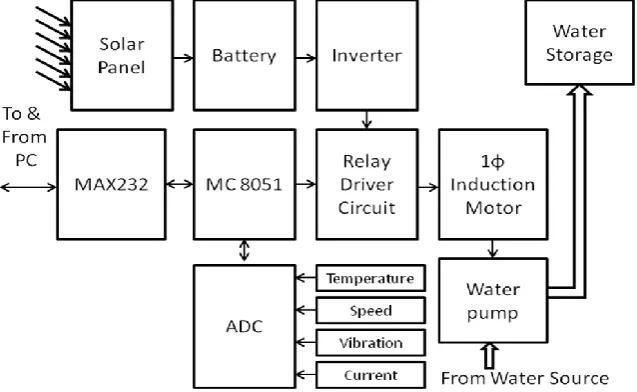
The proposed methodology for the project is presented in this section and Fig.1 shows the block diagram for the proposed methodology. The solar radiation are incident on the solar panel which are converted to the DC energy and stored in the battery of the specified ratings as per the requirement. The DC voltage from battery is then fed to the inverter which converts DC to AC supply required to run the Induction Motor. The AC supply is fed to IM through relay driver circuit utilizing three relays which sequentially turns ON and OFF with predetermined ON and OFF time duration to achieve the desired speed of rotation. The ON and OFF time of the relays are controlled from the program written in .NET framework and the hardware is controlled through relay drivers from the 8051 microcontroller. The communication between microcontroller and PC is done through proper signaling by serial interface IC MAX232 which is a logic level converter IC. As per the main task of the proposed work, to monitor the performance of the IM four sensors are used for this purpose namely temperature, speed, vibration and the current. All this sensors are fitted along the body of IM at appropriate places to collect the proper readings of the required parameter. This sensors are interfaced to microcontroller though Analog to digital converter IC which converts the incoming analog quantity to proportional digital quantity to be fed to the microcontroller. All the readings of the said parameters are taken with respect to time and corresponding values are stored in the log file in PC. All this values are used for the analysis of the system.
Fig. 1 Block Diagram of complete system with all units.
ISSN(E): 2277-128X, ISSN(P): 2277-6451, pp. 7-12
IV. CONCLUSIONS
The review of current status of solar based induction motor for water pumping system is presented. The study highlights current status of water pumping technology, various techniques used for solar based water pumping technology, performance analysis studies of such systems , environmental aspects and recent advances in materials and efficiency improvement of photovoltaic technology. Based on the study main conclusions are as follows:
PV water pumping technology is reliable and economically viable alternative to electric and diesel water pumps for irrigation of agriculture crops. Solar based induction motor water pumping can also be used for urban, rural and community water supplies and institutions, which is not still widely utilized. This technique will prove very useful in remote inaccessible locations with no grid electricity. As these sectors still depends on conventional electricity or diesel based pumping system resulting in increased recurring costs to the users. The proposed approach will be feasible and economical solutions to the various problems discussed in this paper.
REFERENCES
[1] S.S. Chandel a, N. M. Nagaraju Naik a, Rahul Chandel,Review of solar photovoltaic water pumping system technology for irrigation and community drinking water supplies, www.elsevier.com/locate/rser, Renewable and Sustainable Energy Reviews 49 (2015) 1084–1099
[2] Foster R, Majid G, Cota A. A test book of solar energy. Renew Energy Environ 2014
[3] Nabil M, Allam SM, Rashad EM. Performance improvement of a photovoltaic pumping system using a synchronous reluctance motor. Electr Power Compon Syst 2013;41(4):447–64.
[4] Eker B. Solar powered water pumping systems. Trakia J Sci 2005;3:7–11.
[5] A solar choice for pumping water in New Mexico for livestock and agriculture. New Mexico State University's (NMSU) Department of Engineering Technology. 〈www.engr.nmsu.edu〉; 2014 [accessed 07.08.14].
[6] Gad HE. Performance prediction of a proposed photovoltaic water pumping system at South Sinai, Egypt climate conditions. In: Proceedings of the thirteenth international water technology conference. Hurghada, Egypt; 2009. p. 739–52.
[7] Katan RE, Agelidis VG, Nayar CV. Performance analysis of a solar water pumping system. In: Proceedings of the 1996 IEEE international conference on power electronics, drives, and energy systems for industrial growth (PEDES); 1996. p. 81–7.
[8] Loxsom F, Veroj PD. Estimating the performance of a photovoltaic water pumping system. Sol Energy 1994; 52:215–9.
[9] Khan MTA, Ahmed MR, Ahmed SI, Khan SI. Design and Performance analysis of water pumping using solar PV. In: Proceedings of the international conference of developments in renewable energy technology (ICDRET); 2012.
[10] Mokeddem A, Midoun A, Kadri D, Said H, Iftikhar RA. Performance of a directly-coupled PV water pumping system. Energy Convers Manag 2011;52:3089–95.
[11] Velvizhi J, Subramanian DP. Performance enhancement of PV based water pumping system. Int J Innov Technol Explor Eng 2014;3(10):2278–3075.
[12] Kou Q, Klein SA, Beckman WA. A method for estimating the long-termperformance of direct-coupled PV pumping systems. Sol Energy1988;64:33–40.
[13] Hadj Arab A, Chenlo F, Mukadam K, Balenzategui JL. Performance of PV waterpumping systems. Renew Energy 1991;18:191–204.
[14] Pande PC, Singh AK, Ansari S, Vyas SK, Dave BK. Design development andtesting of a solar PV pump based drip system for orchards. Renew Energy2003;28:385–96.
[15] Mohanlal K, Joshi JC, Kothari DP. Performance analysis of a directly coupledphotovoltaic water-pumping system. IEEE Trans Energy Convers 2004;19:3.
[16] Alghuwainem SM. Performance analysis of a PV powered dc motor driving a3 phase self-excited induction generator. IEEE Trans Energy Convers1996;11:1.
[17] Atlam O, Kolhe M. Performance evaluation of directly photovoltaic powered DC PM (direct current permanent magnet) motor – propeller thrust system. Energy 2013;57:692–8.
[18] Setiawan A, Purwanto DH, Pamuji DS, Nurul Huda N. Development of a solar water pumping system in Karsts Rural Area Tepus, Gunungkidul through student community services. Energy Procedia 2014;47:7–14.
[19] Reddy PKR, Reddy JN. Photovoltaic energy conversion system for water pumping application. Int J Emerg Trends Electr Electron 2014;10 (2):2320–69.
ISSN(E): 2277-128X, ISSN(P): 2277-6451, pp. 7-12
[21] Eyad S, Al-Soud S. Potential of solar energy development for water pumping in Jordan. Renew Energy 2004;29:1393–9.
[22] Alawaji S, Mohammed S, Rafique S. PV powered water pumping and desalination plant for remote areas in Saudi Arabia. Appl Energy 1995;52:283–9.
[23] Kaka MS, Gregoire MS. Photovoltaic water pumping system in Niger, application of solar energy, Chapter-7; p. 184–94. 〈http://dx.doi.org/ 10.5772/54790〉.
[24] Padmavathi K, Daniel A. Studies on installing solar water pumps in domestic urban sector. Sustain Cities Soc 2011;2:135–41.
[25] Badari Mahayana P, Sanjeeva Reddy BR, Prasad M, Sanjay D. Design & simulation of solar DC pump in Simulink. IEEE Trans 2013;978 (1):4673–6150.
[26] Ould-Amrouche S, Rekioua D, Hamidat A. Modelling photovoltaic water pumping systems and evaluation of their CO2 emissions mitigation potential. Appl Energy 2010;87:3451–9.
[27] Maurya VN, Diwinder Kaur A, Maurya AK, Gautam RA. Numerical simulation and design parameters in solar photovoltaic water pumping systems. Am J Eng Technol 2013;1:01–9.
[28] Biji G. Modelling and simulation of PV based pumping system for maximum efficiency. IEEE Trans 2012. [29] Abouda S, Nollet F, Chaari A, Essounbouli N, Koubaa Y. Direct torque control –DTC of induction motor used
for piloting a centrifugal pump supplied by aphotovoltaic generator. Int J Electr Robot Electron Commun Eng 2013;7(8):619–24.
[30] Chandrasekaran N, Thyagarajah K. Modeling and performance study of singlephase induction motor in PV fed pumping system using MATLAB. Int J ElectrEng 2012;5(3):305–16.