Electronic Communications of the EASST
Volume 44 (2011)
Proceedings of the
Workshop on OCL and Textual Modelling
(OCL 2011)
Extending OCL Operation Contracts with Objective Functions
Matthias P. KriegerandAchim D. Brucker
18 pages
Guest Editors: Jordi Cabot, Robert Clariso, Martin Gogolla, Burkhart Wolff Managing Editors: Tiziana Margaria, Julia Padberg, Gabriele Taentzer
Extending OCL Operation Contracts with Objective Functions
Matthias P. Krieger1∗andAchim D. Brucker2
1[email protected],http://www.lri.fr/∼krieger/
Universit´e Paris-Sud, Parc Club Orsay Universit´e, 91893 Orsay Cedex, France
2[email protected],http://www.brucker.ch/
SAP Research, Vincenz-Priessnitz-Str. 1, 76131 Karlsruhe, Germany
Abstract: We explore the potential of adding objective functions to OCL operation contracts. If an operation contract includes an objective function, the operation has the obligation to yield results that make the objective function assume an optimal value. Thus, an objective function expresses a preference among the possible opera-tion results that conform to the postcondiopera-tions of the operaopera-tion contract and any class invariants. Objective functions strictly increase the expressiveness of OCL opera-tion contracts. While objective funcopera-tions arise naturally in applicaopera-tion domains like operations research, we argue that objective functions are a useful general-purpose specification instrument and discuss several application examples. As tool support for operation contracts with objective functions, we present an animator for OCL operation contracts with optimization capabilities. We ensure tool interoperability by specifying objective functions in a UML profile.
Keywords:OCL, Operation contracts, Model execution, Animation, SAT solvers
1
Introduction
OCL has been wisely conceived with executability in mind. The language omits constructs like unbounded quantifiers ranging over all integers that make expression evaluation intractable or entirely impossible. Recursion used for defining operations in postconditions is restricted by the OCL standard [Obj10] to be finite, so uncomputable operations are avoided. The collection constructors and operations are designed in a way that prevents an uncontrolled explosion of collection size. As a result, evaluators for OCL that check the conformance of an implementation to its OCL specification at runtime could be implemented without resorting to sophisticated reasoning techniques (e.g., [HDF02]). This is in contrast to other specification languages like Z [ISO] that offer more powerful constructs. For such languages constraint evaluation can be highly nontrivial, not to mention more difficult kinds of specification analysis like animation or test-case generation.
Naturally, the choice to restrict the expressive power of OCL comes at a price: some speci-fication tasks may be impossible to accomplish or require considerably higher effort. Working around limitations of the language may also lead to specifications that obscure the problem that was to be specified originally. This may be one of the reasons why the use of OCL operation
Extending OCL Operation Contracts with Objective Functions
contracts appears to still not have gained widespread acceptance, although OCL has established itself as a language for model well-formedness rules and is also widely employed for queries in model-transformation and action languages.
A shortcoming of OCL in this respect that we identified is the difficulty to express optimiza-tion tasks. Such problems ask for operaoptimiza-tion results for which an objective funcoptimiza-tion assumes an optimal value. Optimization problems arise naturally in application domains like operations re-search and constitute some of the most elementary algorithmic problems. A basic example is the problem of finding a shortest path in a graph.Figure 1lists fundamental optimization algorithms covered in a classic introductory algorithms textbook [Sed88].
We propose to facilitate the specification of such operations in OCL by adding objective func-tions to operation contracts. Thus, rather than enriching the expression language of OCL, we introduce an additional constituent of operation contracts. Objective functions in operation con-tracts would provide immediate support in OCL for specifying optimization problems. More-over, objective functions can also be used as a convenient means to specify that an operation should return a solution to a certain constraint if a solution exists: make the objective function evaluate whether the constraint holds and return the optimal value only if this is the case. Al-together, we think that this extension would make OCL operation contracts more attractive by facilitating the specification of many operations.
• Closest pair among a set of points
• Minimum spanning tree of a graph
• Shortest path in a graph
• Maximum network flow
• Maximum matching of a graph
• Regression: Least Squares
• Knapsack problem
• Linear programming
Figure 1: Optimization algorithms covered in a classical algorithms textbook [Sed88]
Objective functions strictly increase the expressiveness of OCL operation contracts. With the presence of an objective function, it is no longer decidable whether a set of re-turned operation results conforms to an op-eration contract. We propose to achieve tool interoperability by specifying objective func-tions in a UML profile. Existing tools can simply ignore the additional information rep-resented by objective functions. Thus, exist-ing applications of OCL are not compromised by the introduction of objective functions.
The paper is organized as follows. In Sec-tion 2we show how objective functions can be included in operation contracts. Section 3 discusses applications of objective functions to different specification tasks by means of an example specification. We see that objective functions help not only for specifying ordi-nary optimizations problems, but also in other situations. InSection 4we present an
2
Operation Contracts with Objective Functions
2.1 Syntax
Together with class invariants and different kinds of value definitions, operation contracts are a major ingredient of OCL specifications. Recall that an OCL operation contract consists of pre-and postconditions which are Boolean expressions. We propose to allow objective functions as a further element of operation contracts. Obviously, the type of an objective function must support comparison, so we restrict objective functions to expressions of typeIntegerorReal.1This cor-responds to the restrictions imposed on body expressions of thesortedByiterator. Furthermore, every operation contract may include at most one objective function.
Another useful extension proposed to OCL operation contracts are invariability clauses [Kos06] that specify which parts of the system state an operation may modify. We will also consider this extension since invariability clauses are essential for animation support that we will discuss later.
In all, an OCL operation contract for an operationopwith the argumentsx1, . . . ,xnwith these
extensions has the form:
contextC :: op(x1, . . . ,xn):T
pre:φ(self,x1, . . . ,xn)
pre:...
post:ψ(self,x1, . . . ,xn,result)
post:...
minimize:θ(self,x1, . . . ,xn,result)
modifies only:t1(self,x1, . . . ,xn)::a1, . . . ,tm(self,x1, . . . ,xn)::am
(1)
Here, the OCL expressionsφandψ are of type Boolean andθ is an OCL expression of type IntegerorReal. The OCL expressionst1, . . . ,tmdenote sets of objects in the pstate. We
re-quire that@predoes not occur inφort1, . . . ,tm. The operation contract (1) requires the operation
to minimize the functionθ. Thus, we extend the concrete syntax of operation contracts with the keywordminimize. Of course, a corresponding maximizekeyword can be introduced as syn-tactic sugar as well. In short, themodifies onlyclause in (1) specifies that the operation may only change the attributeaifor the objects inti. Attributes not mentioned in themodifies only
clause may not be changed for any object. A richer syntax formodifies onlyclauses is pre-sented in [Kos06].
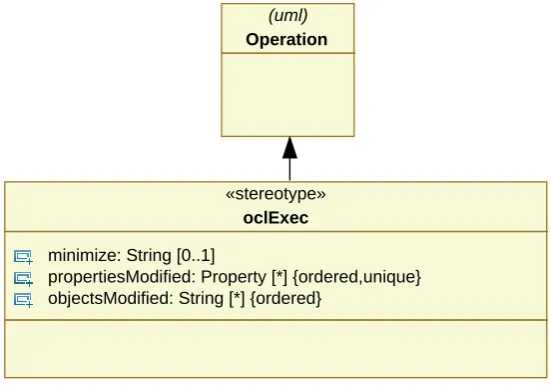
OCL operation contracts are often defined in UML models by storing OCL expressions as specifications of Constraint model elements. Operation elements can then reference such constraints through associations provided for by the UML metamodel. In order to avoid metamodel incompatibilities and to ensure the interoperability with OCL tools that do not use our operation contract extensions, we define the new operation contract elements in a UML pro-file. Figure 2 shows a UML profile for extending operation contracts with objective functions and invariability clauses. The objective function is stored as a string and can be parsed when
Extending OCL Operation Contracts with Objective Functions
«stereotype» oclExec
minimize: String [0..1]
propertiesModified: Property [*] {ordered,unique} objectsModified: String [*] {ordered}
(uml)
Operation
Figure 2: A UML profile for operation contract extensions
needed. The modifies onlyclause is defined by listing the expressionst1, . . . ,tm and the at-tributesa1, . . . ,amin separate attributes of the stereotype.
It may be more systematic to rather model objective functions andmodifies onlyclauses as separate stereotypes of theConstraintmetaclass. However, the profile inFigure 2is simple and can be applied easily in UML editors.
2.2 Semantics
When discussing the semantics of operation contracts we assume without loss of generality that there is exactly one preconditionφ and one postconditionψ. Following Annex A of the OCL
standard [Obj10], we define thesemanticsof an operation contract to be a relationRbetween pre-environments rpreand post-environmentsrpost. An environment includes the system state and
values of parameters to the operation.Ris defined by
R=
rpre,rpost
|φ(rpre)∧ψ rpre,rpost . (2)
Thus, a transition from a pre- to a post-environment is permitted by the semantics if both the pre- and the postcondition are satisfied. The behavior of an operation implementation can be described by a function f that maps pre-environments to post-environments. The operation im-plementationsatisfiesthe contract if and only if the graph of f is contained inR(graph(f)⊆R). We show how this original definition ofRcan be modified in order to take an objective function
θinto account. Let the contract require that the operation minimizesθ. This is expressed by the
following definition of the modified semanticsR0:
R0=
rpre,rpost
|φ rpre
∧ψ rpre,rpost
∧ ∀rpost0 .ψ rpre,r0post
=⇒ θ rpre,rpost
Thus, a pair of a pre- and post-environment rpre,rpost
can only belong to R0 if there is no other post-environmentr0postsatisfying the postcondition with a smaller objective value. Hence, the objective function constrains the set of permitted transitions and may forbid transitions that are allowed by the original semantics R. Note that there only is a difference to the original semantics if the contract is underspecified, i.e., there is a valid pre-environment for which there is more than one post-environment satisfying the postcondition. Otherwise,r0post=rpost whenever ψ rpre,r0post
, and the additional condition in (3) could never be violated. Thus, the objective function selects preferred post-states in case several are permitted by the postconditions.
Also note that the addition of the objective function increased the expressiveness of OCL operation contracts since the new semanticsR0 cannot in general be obtained by simply adding a postconditionθ rpre,rpost
≤c rpre
for some OCL expressionc. This only is an alternative if there exists such an expression c that computes the optimal value of the objective function from the pre-environment. However, this cannot always be the case, since the values of OCL expressions are effectively computable, but the existence of a post-environmentr0postviolating (3) is in general undecidable. Even in cases in which it is possible to designate such an expressionc, it is likely that this expression is much more complex than the addition of an objective function to the operation contract.
Finally, note that objective functions in operation contracts differ considerably from themin andmaxoperations on collections that are provided by the OCL standard library. While these operations select the minimum and maximum from a finite collection, objective functions operate on the set of all possible post-states, which tends to be much larger than an OCL collection or can even be infinite.
If a subclass redefines the operation, the semantics of the redefined operation must conform to the Liskov substitution principle. Specifically, the set of possible post-statesrpostthat can result
from calling the redefined operation in a certain pre-staterpresatisfying the preconditionφ must
be a subset of the set of post-states reachable from this pre-staterpre by calling the operation in
the superclass. The objective function can be redefined in the subclass as long as this requirement is met.
The modifies onlyclause further constrains the semantics of the operation contract. How-ever, unlike for objective functions, it is also possible to express this restriction through postcon-ditions. Such a transformation is described in [Kos06].
3
Applications of Objective Functions
Extending OCL Operation Contracts with Objective Functions
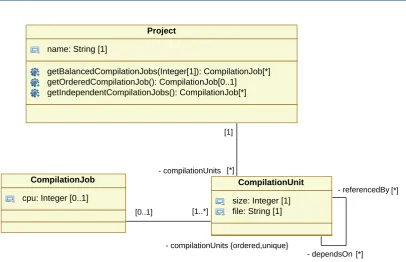
buildtool
Project
name: String [1]
getBalancedCompilationJobs(Integer[1]): CompilationJob[*] getOrderedCompilationJob(): CompilationJob[0..1]
getIndependentCompilationJobs(): CompilationJob[*]
CompilationUnit
size: Integer [1] file: String [1]
CompilationJob
cpu: Integer [0..1]
- compilationUnits [*] [1]
- dependsOn
- referencedBy
[*]
[*]
- compilationUnits {ordered,unique} [1..*]
[0..1]
Figure 3: Excerpt from a possible UML model of a build tool
3.1 Ordinary Optimization Problems
context Project::getBalancedCompilationJobs(n: Integer): Set(CompilationJob)
post allUnitsReturned:
result->collect(compilationUnits)->asSet() = compilationUnits@pre
post jobLimitMet: result->size() <= n
minimize: let
jobSizes: Bag(Integer)
= result->collectNested(job |
job->compilationUnits->collectNested(size@pre)->sum()) in
jobSizes->max()
modifies only: compilationUnits::compilationJob
Figure 4: Operation contract for evenly distributing compilation units among processes
superfluous, but we decided to keep these in order to already make explicit in the postconditions that these are values from the pre-state.
This problem of optimizing parallel execution is NP-hard since the subset sum problem can be reduced to it. Thus, even a relatively simple implementation is likely to be substantially more complex than the operation contract.
3.2 Problems that do not always have a Solution
The task of the next operationgetOrderedCompilationJobsthat we specify is to find a com-pilation order that respects the dependencies of the CompilationUnits. In other words, we desire a topologically sorted sequence of the compilation units. The contract is shown in Fig-ure 4. An interesting aspect of this operation is that there is no valid compilation order if the dependency graph has a cycle. In this case the operation should returnnull. The postcondi-tion allUnitsReturned specifies that if the result is not null, i.e., a solution exists, then the set of CompilationJobsreturned are exactly the CompilationJobsof the Project, as in the previous contract. The postcondition resultSorted states that, if the result is not null, no CompilationUnitdepends on another unit occurring later in the returned sequence.
depen-Extending OCL Operation Contracts with Objective Functions
context Project::getOrderedCompilationJobs(): CompilationJob
post allUnitsReturned: (not result.oclIsUndefined()) implies
result.compilationUnits->asSet() = compilationUnits@pre
post resultSorted:
(not result.oclIsUndefined()) implies
let
units: OrderedSet(CompilationUnit) = result.compilationUnits in
Sequence{2..units->size()} ->forAll(i | Sequence{1..i-1}
->forAll(j | units->at(j).dependsOn@pre->excludes(units->at(i))))
minimize: if result.oclIsUndefined() then 1 else 0 endif
modifies only: compilationUnits::compilationJob
Figure 5: Operation contract for ordering compilation units by dependencies
dency graph has a cycle would be much more lengthy then the objective function inFigure 4. Thus, the possibility of adding an objective function to the contract helped considerably to spec-ify the operation in a concise and comprehensible manner. This technique of preferring non-null results by means of an objective function is applicable in general to problems that do not always have a solution.
3.3 Other Disguised Optimization Problems
Next we consider another task that is usually not regarded as an optimization problem. We are seeking a set ofCompilationJobsthat can be processed independently, e.g., for allowing par-allel execution as discussed above for the operationgetBalancedCompilationJobs. But this time we do not arrange theCompilationUnitsbased on their size but according to their depen-dencies. We require that there is no dependency between any twoCompilationUnitsbelonging to distinct CompilationJobs. In order to be as flexible as possible for execution, we desire to have as many independentCompilationJobs as possible. This amounts to finding the con-nected components of the dependency graph. The operationgetIndependentCompilationJobs, whose contract is shown in Figure 6, is specified to return a set of CompilationUnits that meets these requirements. As for the previous operations, the first postcondition ex-presses that theCompilationUnitsincluded in the returnedCompilationJobs are exactly the CompilationJobs of the Project. The next postcondition jobsIndependent states that ev-ery CompilationJobreturned includes all CompilationUnits that depend on any unit in the job. This rules out any dependencies between any twoCompilationUnitsbelonging to distinct CompilationJobs.
compo-context Project::getIndependentCompilationJobs(): Set(CompilationJob)
post allUnitsReturned:
result->collect(compilationUnits)->asSet() = compilationUnits@pre
post jobsIndependent:
result->forAll(compilationUnits->forAll(
compilationUnits->includesAll(dependsOn@pre)))
minimize: -result->size() -- this maximizes the size of the result set
modifies only: compilationUnits::compilationJob
Figure 6: Operation contract for grouping compilation units into independent jobs
nents of the dependency graph, we still need to specify that there actually is a dependency between every pair of CompilationUnits that belong to the sameCompilationJob. Other-wise, an implementation may always return just a single CompilationJob that includes all CompilationUnits. However, we find this requirement difficult to express using postcondi-tions, since twoCompilationUnits may depend on each other via several other intermediate CompilationUnits. This is where the objective function comes in handy. The objective func-tion defined inFigure 6requires the operation to return a maximal number ofCompilationJobs. This implies that every job corresponds to exactly one connected component of the dependency graph. Thus, the possibility of adding an objective function to the contract helped again to keep the contract simple.
4
Tool Support for Animation
Tool support is important for the adoption of specification languages by users. In this section we show how tool support foranimationcan be accomplished for OCL operation contracts that include objective functions. Animation [DKC89] is the task of performing computations that comply with the specification based on user-provided input data. For animating an operation contract, the user constructs a system state in which the operation is called and provides any arguments to the operation. Animation yields a new state and if necessary a return value that sat-isfy the postconditions, the objective function and any other restrictions stated in the specification such as class invariants.
If support for animation is available, users can validate requirements by animating the specifi-cation on sample sets of input data (scenarios). This is possible if the implementation is partially or even entirely unavailable. For incomplete, faulty or inadequate specifications, animation will typically lead to strange and alarming results. In contrast to automatically generated test cases, which result from exploring input data structures according to certain criteria, animation based on user-supplied input avoids too artificial scenarios. Animation can help users gain confidence in the specification by allowing the execution of scenarios that are common for the application domain.
implemen-Extending OCL Operation Contracts with Objective Functions
tation. The generated code can be linked with components of the system that are already finished. This allows the system to be tested as a whole, although the complete implementation of some parts is not yet available. It may even be possible to entirely omit the manual implementation of certain features if they can be animated efficiently enough. We think that animation support for UML/OCL operation contracts is a useful complement to existing methods for executing other UML model constituents like statecharts or action language code.
In the remainder of this section, we first give an overview of our animation tool OCLexec2. See [KKW10] for a more detailed description. Then we show how the tool can be extended to deal with objective functions and present some experimental results.
4.1 Overview of OCLexec
OCLexec generates Java method bodies that enforce the postconditions of the operation and all class invariants. It serializes an intermediate representation of the operation contract to a file that the generated method body can access as a resource. The method body only reads the serialized file and calls a library routine responsible for simulating the operation. Note that inserting code in method bodies should not interfere with other code that may have been generated for the model. Thus, the modeler can use her favorite tool for the overall code generation and then use OCLexec only for selected method bodies.
As intermediate representation, OCLexec uses a language of arithmetic expressions with bounded quantifiers and uninterpreted functions. A bounded quantifier has the form∀t1≤x≤ t2.p(x). Here x is the bound variable,t1 is the lower bound andt2 is the upper bound of the
quantifier. It turns out that UML/OCL constraints can in large part be represented by integer expressions; solutions of these encoded constraints are assignments to their free variables and uninterpreted function symbols that evaluate to 1. The underlying state of an OCL expression is represented by uninterpreted function symbols for attributes. Object references can be encoded as integer values. We have currently not implemented support for real numbers. Thus, we will later require objective functions do be of typeInteger.
For animating an operation, we translate the postconditions of the operation and all relevant invariants to arithmetic constraints with bounded quantifiers. The conjunction of the resulting formulas expresses the condition that must be satisfied when the operation returns. In the next step we attempt to find amodelfor this formula, i.e., an assignment of specific functions to the function symbols for which the formula evaluates to true. Since our translation preserves the semantics of the operation contract, a model found yields a new system state conforming to the contract. The new state can be directly constructed from such a model. We only search for models that comply with the respective pre-state.
To find a model of the formula, we construct a Boolean circuit that computes the validity of the formula. The Boolean circuit is encoded in conjunctive normal form (CNF), which can then be solved by an off-the-shelf satisfiability (SAT) solver. A solution to the Boolean satisfiability problem yields a model for the original arithmetic formula. In order to generate a Boolean formula from an arithmetic formula with bounded quantifiers, the quantifiers occurring in the arithmetic formula need to be eliminated. Some quantifiers can be removed by skolemization.
p r o c e d u r e s o l v e (ϕ) :
b o u n d s : = i n i t i a l b o u n d s (ϕ) f o r e v e r do
CNF : = g e n e r a t e C N F (ϕ, b o u n d s )
( s o l v e d , s o l u t i o n ) : = c a l l S A T s o l v e r ( CNF ) i f s o l v e d t h e n
r e t u r n s o l u t i o n end i f
i n c r e a s e b o u n d s ( b o u n d s ) end f o r e v e r
end p r o c e d u r e
Figure 7: Basic constraint solving procedure for operation contract animation
For the remaining quantifiers, we substitute the quantified variable for every value within the range of the quantifier, translate the resulting formulas to Boolean circuits and feed them into the respective gate (∧or ∨). Thus, the quantifier ranges need to be small enough in order to make this quantifier elimination manageable. It is clearly not feasible to always perform the substitution for the largest possible quantifier range, which may include e.g. all 32-bit integers. Therefore we may at first restrict the values of certain function symbols in the intermediate representation. Through interval arithmetic, we can then derive a restricted range for each lower and upper quantifier bound. Thus, we can obtain a sufficient translation of a quantified formula by instantiating the quantified variable only for the restricted set of values that can be between the quantifier bounds. If the function symbol ranges are chosen to be small enough, this set of values the quantified variable can assume is manageable. Restricting the range of a function symbol results in an under-approximation of the original satisfiability problem, i.e., certain models are excluded, whereas every solution to the under-approximation is a valid model for the formula.
If no model is found for the first choice of restricted function symbol ranges, a more expensive attempt with larger ranges is made, and so on. This basic procedure is depicted inFigure 7. It always terminates when a solution exists. If no solution exists, the procedure may terminate unsuccessfully after the bounds have reached a limit, e.g., a maximal 32-bit number, or if the formula has no function symbols that require bounding. However, due to the large number of possible system states, the procedure will not always terminate within reasonable time.
4.2 Extension to Support Objective Functions
Extending OCL Operation Contracts with Objective Functions
does not exist for any bounds and can stop the search. However, solving over-approximations is always incomplete, so unfortunately user-provided time limits are in general unavoidable.
We construct over-approximations by adding fresh Boolean variables to formulas resulting from the unfolding of quantifiers outlined above. These new variables represent the unknown value of the quantified formula in case the quantifier bounds exceed the bounds used for the translation. For a universal quantifier∀t1≤x≤t2.p(x)we construct the Boolean formula
(t1≤lb(t1) ∧ lb(t1) ≤t2 =⇒ p(lb(t1))) ∧ (t1≤lb(t1) +1 ∧ lb(t1) +1 ≤t2 =⇒ p(lb(t1) +1))
. . .
∧ (t1≤ub(t2) ∧ ub(t2) ≤t2 =⇒ p(ub(t2)))
∧ (t1<lb(t1) ∨ ub(t2) >t2 =⇒ a)
(4)
where lb(t) and ub(t)are a lower and upper bound, respectively, of the values the termt can assume when the function values thattdepends on are within the bounds used for the translation. The Boolean variableais a fresh variable that represents the unknown value of the quantified formula in case the lower boundt1of the quantifier is smaller than lb(t1)or the upper boundt2
is larger than ub(t2). The new variableadoes not have any effect ift1≥lb(t1)andt2≤ub(t2) or the quantified formula evaluates to false due to the values ofp(lb(t1)), . . . ,p(ub(t2)).
Example1 Consider a quantified formula
ϕ=∀0≤x≤ f+g.h(x) =1. (5)
Here f andgare constants (nullary functions) andhis a unary function. If we use bounds that restrict f andgto assume values in[−2,2], we obtain through interval arithmetic an upper bound of4for f+g. We apply the scheme (4) witht1=0andt2= f+g. Since the lower boundt1 is
constant, comparisons with it can be eliminated, and we obtain the following unfolding ofϕ:
(0≤f+g =⇒h(0) =1)
∧ (1≤f+g =⇒h(1) =1)
∧ (2≤f+g =⇒h(2) =1)
∧ (3≤f+g =⇒h(3) =1)
∧ (4≤f+g =⇒h(4) =1)
∧ (4>f+g =⇒a).
(6)
Operation n=3 n=5 n=7 n=10 n=15 n=20
getBalancedCompilationJobs(2) 3.0 3.0 50 >1000 >1000 >1000 getOrderedCompilationJob() 2.5 12 37 >1000 >1000 >1000 getIndependentCompilationJobs() 3.0 9 10 140 >1000 >1000 getCompilationOrder()(input cyclic) 1.0 1.0 1.0 1.5 1.5 >1000 getCompilationOrder()(input acyclic) 1.0 1.0 1.0 1.5 1.5 >1000
Table 1: Experimental results (execution times in seconds)
For every choice of bounds we compute a solution by binary search that is optimal among all solutions within these bounds. We assume that the objective function assumes values within a certain interval[f min,f max]that we determine e.g. by restricting the values of all function symbols to 32-bit numbers. This has the additional benefit of preventing infinite looping in case there is no optimal solution.
We maintain a lower bound on the value of the objective function, which is to be minimized, with the hope of observing at some point that we have obtained a solution that is optimal uncon-ditionally. After having searched for a solution that is as good as possible for the chosen bounds, we again perform a binary search for determining the best lower bound. For determining the lower bound we can reuse the same CNF since we can also control over-approximation over the assumption interface. We terminate after a solution has been found and the timeout is reached or a solution has been found whose value of the objective function matches the lower bound.
4.3 Experimental Results
We evaluated our animation tool on the specification presented in sectionSection 3for random inputs. When generating an input withncompilation units, we added every possible dependency between compilation units with probability 0.1/n, so it was sufficiently unlikely that a cyclic dependency graph was generated. File sizes were sampled uniformly between 0 and 10000. Unfortunately, our over-approximation scheme was not able to identify optimal solutions for any of the operations, so user-defined timeouts were necessary for animating these operations. Table 1shows the total execution times for animating the operations obtained by adding the best attainable value of the objective function as an additional postcondition. The measurements were performed on a machine with 2 GB RAM and a dual-core 2.4 GHz P8600 mobile CPU. The SAT solver used was MiniSat [ES04], a well-known state-of-the-art SAT solver.
We conclude that the animation of many interesting scenarios involving objective functions is possible. However, for large inputs animation becomes infeasible due to quickly increasing runtimes. These runtimes may seem disappointing, considering that polynomial-time algorithms exist for topological sorting and the identification of connected components. Recall that the we are processing a high-level specification in a relatively general-purpose language.
Extending OCL Operation Contracts with Objective Functions
p r o c e d u r e s o l v e (ϕ, f , m a x t i m e ) : i n i t i a l i z e t i m e r f o r t i m e o u t b o u n d s : = i n i t i a l b o u n d s (ϕ) f o u n d s o l u t i o n : = f a l s e b e s t v a l u e : = f m a x + 1 l o w e r b o u n d : = f m i n do
CNF : = g e n e r a t e C N F (ϕ, b o u n d s ) l o c a l m i n : = l o w e r b o u n d
do
mid : = l o c a l m i n + ( b e s t v a l u e − l o c a l m i n ) d i v 2 ( s o l v e d , s o l u t i o n )
: = c a l l S A T s o l v e r ( CNF , f ≤mid, u n d e r−a p p r o x i m a t e ) i f s o l v e d t h e n
f o u n d s o l u t i o n : = t r u e b e s t s o l u t i o n : = s o l u t i o n b e s t v a l u e : = mid
e l s e
l o c a l m i n : = mid + 1 end i f
w h i l e b e s t v a l u e > l o c a l m i n
l o c a l m a x : = b e s t v a l u e
w h i l e l o w e r b o u n d < l o c a l m a x
mid : = l o w e r b o u n d + ( l o c a l m a x − l o w e r b o u n d ) d i v 2 ( s o l v e d , s o l u t i o n )
: = c a l l S A T s o l v e r ( CNF , f ≤mid, o v e r−a p p r o x i m a t e ) i f n o t s o l v e d t h e n
l o w e r b o u n d : = mid + 1 e l s e
l o c a l m a x : = mid end i f
end w h i l e
i n c r e a s e b o u n d s ( b o u n d s )
w h i l e n o t f o u n d s o l u t i o n or t i m e o u t ( m a x t i m e ) or l o w e r b o u n d = b e s t v a l u e
r e t u r n b e s t s o l u t i o n end p r o c e d u r e
context Project::getCompilationOrder(): OrderedSet(CompilationUnit)
post allUnitsReturned: (not result->isEmpty()) implies
result->asSet() = compilationUnits@pre
post resultSorted:
(not result->isEmpty()) implies
Sequence{2..result->size()} ->forAll(i | Sequence{1..i-1}
->forAll(j | result->at(j).dependsOn@pre->excludes(result->at(i))))
minimize: if result->isEmpty() then 1 else 0 endif
modifies only: nothing
Figure 9: “Tuned” variant of the operation contract inFigure 5
The table also show the time consumed by animating the modified contract when processing the acyclic graphs used for animating the other contracts, which are essentially identical to the runtimes for animating the cyclic dependency graphs with the same number of vertices. We note that animation of the modified contract inFigure 9is more efficient than the original contract in Figure 5. The reason may be that, in contrast to the original contract, the modified contract does not specify the creation of new objects.
5
Related Work
Objective functions are widely used in mathematical modeling languages like AMPL [FGK02] or GAMS [GAM]. Such modeling languages can be processed by suited optimization engines. Modeling languages are often tailored to the kind of solver that reads them and usually favor convex or polynomial constraints and objective functions. Sugar [TTB10] is an example of a constraint programming language that features objective functions. Modelica [Mod] is an object-oriented mathematical modeling language.
We extended the UML/OCL language by means of a UML profile. A more comprehensive approach to extending OCL based on modularization is presented in [AZH08].
Pioneering work on animating UML/OCL can be found in [OK99, GS00]. Animators for operation contracts have also been implemented, for example, for the specification language JML [BDLU05, KW06, CW09]. The jmle animator [KW06, CW09] works by generating a prototype implementation in Java, as does our animator OCLexec. Another recent tool along these lines is Squander [MRYJ11] that animates operation contracts in a tailored specification language.
Extending OCL Operation Contracts with Objective Functions
solver supports a notion of so-calledcontextsthat provide similar functionality as the assumption interface of MiniSat [ES04] and SAT4J [BP10]. Another type of solver applicable to this kind of optimization problem are MAX-SAT solvers, e.g., one of the solvers in the SAT4J package. Such solvers are likely to be more efficient than optimizing via assumptions since they are tailored to optimization. Sugar [TTB10] is a SAT-based constraint solver that also performs optimization over an assumption interface to a SAT solver. In the implementation of OCLexec, we use an adapted version of the Kodkod solver [TJ07] for constructing the CNF. Kodkod is a SAT-based solver for relational logic and includes effective algorithms for constructing and compressing Boolean representations. We do not make use of higher-level features of Kodkod such as encod-ing of relations. Kodkod also features a form of optimization based on appropriate support by the SAT solver used. Nitpick [BN10] is a SAT-based model finder that deals with problematic quanti-fiers by computing an undefined value when the value of the quantified formula is unknown. Our over-approximation approach can detect slightly more unsatisfiable constraints. The technique of under- and over-approximation that we use corresponds to abstraction-refinement techniques in verification [CGJ+03]. Such techniques can be more powerful if the under-approximation is computed according to the result of the over-approximation and vice versa. We do not use this kind of adaptive approximation in our approach.
6
Conclusions and Future Work
We showed how OCL can be extended with objective functions. Objective functions strictly increase the expressiveness of OCL operation contracts. Optimization problems arise naturally in application domains like operations research. Moreover, objective functions are also useful in various other situations and thus can be a valuable aid in writing concise and comprehensive operation contracts. We ensure tool interoperability by specifying objective functions in a UML profile.
As tool support for objective functions we present an animator for OCL operation contracts that supports objective functions. We perform optimization through the assumptions interface of the SAT solver used for constraint solving. Over-approximations of the constraint satisfac-tion problem are constructed for identifying optimal solusatisfac-tions. Since over-approximasatisfac-tion is in-evitably incomplete, user-defined timeouts are generally needed for animation with an objective function.
As future work we consider adding symmetry breaking predicates to the constraints solved for animating. This could improve the effectiveness of our over-approximation technique and may also improve the efficiency of constraint solving in general. We would also like to integrate our animation method into a comprehensive code generation system.
References
[AZH08] D. H. Akehurst, S. Zschaler, W. G. J. Howells. OCL: Modularising the Language.
[BDLU05] F. Bouquet, F. Dadeau, B. Legeard, M. Utting. Symbolic Animation of JML Specifi-cations. InProc.13thInt. Conf. Formal Methods 2005 (FM’05). Lect. Notes Comp. Sci. 3582, pp. 75–90. Springer, 2005.
[BN10] J. Blanchette, T. Nipkow. Nitpick: A Counterexample Generator for Higher-Order Logic Based on a Relational Model Finder. In Kaufmann and Paulson (eds.), Inter-active Theorem Proving. Lect. Notes Comp. Sci. 6172, pp. 131–146. Springer, 2010.
[BP10] D. L. Berre, A. Parrain. The Sat4j library, release 2.2.JSAT7(2-3):59–64, 2010.
[CGJ+03] E. M. Clarke, O. Grumberg, S. Jha, Y. Lu, H. Veith. Counterexample-guided abstrac-tion refinement for symbolic model checking.J. ACM50(5):752–794, 2003.
[CW09] N. Cata˜no, T. Wahls. Executing JML specifications of Java card applications: a case study. In Shin and Ossowski (eds.),SAC. Pp. 404–408. ACM, 2009.
[DKC89] A. Dick, P. Krause, J. Cozens. Computer Aided Transformation of Z into Prolog. In Nicholls (ed.), Proc. 4th Z Users Workshop. Workshops in Computing, pp. 71–85. Springer, Oxford, 1989.
[ES04] N. E´en, N. S¨orensson. An Extensible SAT-solver. In Giunchiglia and Tacchella (eds.),Sel. Rev. Papers 6thInt. Conf. Theory and Applications of Satisfiability Testing (SAT’03). Lect. Notes Comp. Sci. 2919, pp. 502–518. Springer, 2004.
[FGK02] R. Fourer, D. M. Gay, B. W. Kernighan.AMPL: A Modeling Language for Mathe-matical Programming. Duxbury Press, 2002.
[GAM] General Algebraic Modeling System (GAMS). http://www.gams.com.
[GS00] J. Gray, S. Schach. Constraint animation using an object-oriented declarative lan-guage. In Turner (ed.),Proc. 38thACM Southeast Reg. Conf.Pp. 1–10. ACM, 2000.
[HDF02] H. Hußmann, B. Demuth, F. Finger. Modular Architecture for a Toolset Supporting OCL.Sci. Comp. Prog.44(1):51–69, 2002.
[ISO] ISO/IEC 13568. Information technology — Z formal specification notation — Syn-tax, type system and semantics.
[KKW10] M. P. Krieger, A. Knapp, B. Wolff. Automatic and efficient simulation of operation contracts. In Visser and J¨arvi (eds.),GPCE. Pp. 53–62. ACM, 2010.
[Kos06] P. Kosiuczenko. Specification of Invariability in OCL. In Nierstrasz et al. (eds.),
MoDELS. Lect. Notes Comp. Sci. 4199, pp. 676–691. Springer, 2006.
Extending OCL Operation Contracts with Objective Functions
[MB08] L. M. de Moura, N. Bjørner. Z3: An Efficient SMT Solver. In Ramakrishnan and Rehof (eds.),TACAS. Lect. Notes Comp. Sci. 4963, pp. 337–340. Springer, 2008.
[Mod] Modelica Association. Modelica Language Specification.
[MRYJ11] A. Milicevic, D. Rayside, K. Yessenov, D. Jackson. Unifying execution of imperative and declarative code. In Taylor et al. (eds.),ICSE. Pp. 511–520. ACM, 2011.
[Obj10] Object Management Group. Object Constraint Language Specification, Version 2.2. Specification, OMG, 2010.http://www.omg.org/spec/OCL/2.2.
[OK99] I. Oliver, S. Kent. Validation of Object Oriented Models using Animation. InProc. 25thConf. EUROMICRO. Pp. 2237–2242. IEEE Computer Society, 1999.
[Seb07] R. Sebastiani. Lazy Satisability Modulo Theories.JSAT 3(3-4):141–224, 2007.
[Sed88] R. Sedgewick.Algorithms. Addison-Wesley, Second edition, 1988.
[TJ07] E. Torlak, D. Jackson. Kodkod: A Relational Model Finder. In Grumberg and Huth (eds.),Proc. 13th Int. Conf. Tools and Algorithms for the Construction and Analysis of Systems (TACAS’07). Lect. Notes Comp. Sci. 4424, pp. 632–647. Springer, 2007.
![Figure 1: Optimization algorithms covered in aclassical algorithms textbook [Sed88]](https://thumb-us.123doks.com/thumbv2/123dok_us/7806844.2085260/3.595.314.509.424.629/figure-optimization-algorithms-covered-aclassical-algorithms-textbook-sed.webp)