Proceedings of the
Workshop on OCL and Textual Modelling
(OCL 2011)
Dynamic Validation of OCL Constraints with mOdCL
Manuel Rold´an and Francisco Dur´an
19 pages
Guest Editors: Jordi Cabot, Robert Claris ´o, Martin Gogolla, Burkhart Wolff Managing Editors: Tiziana Margaria, Julia Padberg, Gabriele Taentzer
Dynamic Validation of OCL Constraints with mOdCL
Manuel Rold´an1∗and Francisco Dur´an2†
1[email protected] 2[email protected]
Dpto. de Lenguajes y Ciencias de la Computaci´on Universidad de M´alaga, Espa˜na
Abstract: This paper presents mOdCL, a Maude based evaluator of OCL expres-sions and validator of OCL constraints. Given its OCL expression evaluator, the use of execution strategies allows mOdCL, not only validating invariant constraints on concrete system states, but also dynamically validating invariants and pre- and post-conditions on the successive states obtained during system execution.
Keywords:OCL, Dynamic validation, Maude
1
Introduction
The Object Constraint Language (OCL) [OCLa] is a textual formal language which provides the necessary formal notation to complete the UML diagrams with precise and unambiguous specifications. An important use of OCL is to complete class diagrams with the constraints to be satisfied. Specifically, class invariants, and pre- and post-conditions on methods can be specified on them.
The growing interest in OCL, mainly thanks to its use in Model-Driven Software Development (MDSD), has motivated the development of a number of tools (see, e.g., the OCL Portal [OCLb]), which allow different kinds of analysis as, for example, consistency checks to guarantee that the OCL constraints are not contradictory, or validation of OCL constraints.
We can find OCL tools using very different approaches. For example, the validation envi-ronment USE [GBR07], the Dresden toolkit [Thea] or OCLE [CPC+04] are based on Java, the proof environment HOL-OCL [BW08] is implemented as a shallow embedding of OCL into the Higher-Order Logic (HOL), the UMLtoCSP tool [CCR07] uses Constraints Logic Programming, etc.
Some tools validate OCL constraints directly on UML models by representing class diagrams in the supporting formalism and checking whether such constraints hold on given system states (snapshots), which can be obtained, for example, from object diagrams or from states of a pro-gram being executed [RG03]. Other tools are designed to dynamically validate OCL constraints on the implementation of UML models, typically by codifying the constraints validation some-how and injecting it into the implementation of the system.
We present the mOdCL validator, a tool which is able to both evaluate OCL expressions on given object configurations and execute Maude prototypes of UML models, checking the
∗This author was supported by Spanish Research Projects TIN2008-03107 and P07-TIC-03184.
satisfaction of their OCL constraints. Maude [CDE+02, CDE+07] is an executable formal specification language based on rewriting logic, with a rich set of validation and verification tools [CDE+07, CDH+07], increasingly used as support to the development of UML, MDA, and OCL tools (see, e.g., [BM08,RRDV07,Theb]). Furthermore, Maude has demonstrated to be a good environment for rapid prototyping, and also for application development (see, e.g., [CDE+07, Chapter 20]). Moreover, Maude has shown to be very good as a logical and semantic framework in which different logics and formalisms can be expressed and executed [MM02]. For all this, we believe that Maude is a good candidate to express prototypes of UML models to be used to dynamically validating the OCL constraints on them. Nevertheless, we do not intend to describe here systematic transformations of UML diagrams into Maude (for that, see, e.g., [Kna00,FT01,MB09]). We will describe however the Maude representations of class di-agrams and object didi-agrams as used by mOdCL. Some of the tools that automatically generate Maude modules representing UML, MOF or Ecore class and object diagrams are MOVA [Theb], MOMENT [BCR], and e-Motions [RDV09].
Some OCL tools, as the Dresden toolkit, can perform dynamic validation, but they require a complete implementation of the system to be validated. On the other hand, the tools that support the validation of UML models without their complete implementation can only statically validate given snapshots representing concrete system states. Our mOdCL validator improves the existing validation tools because it allows the user to statically and dynamically validate UML models on very high level prototypes. This way, some errors in the model or in the constraints definition could be detected early, during the modeling phase.
We focus here on UML class diagrams. In UML class diagrams, we can provide invariant constraints on specific classes, as well as pre- and post-conditions on methods. The invariants of a class must be satisfied by all objects of such a class, and pre- and post-conditions in all the executions of the methods they are associated to. However, these constraints are not required to be satisfied in all states of the system, but only in those relevant states [WK03]. Invariants are required to be satisfied when an operation terminates, but not during its execution. Similarly, pre- and post-conditions must be satisfied, respectively, before and after the execution of the operations they are associated to.
Thus, the dynamic validation of the constraints of a model has two key parts: the identification of those states on which constraints must be satisfied, and the evaluation of the satisfaction of the appropriate constraints. To deal with these issues, our proposed system mOdCL includes two differentiated components: an OCL expression evaluator and a strategy that controls the execution of the system and checks the appropriate OCL constraints on the appropriate states.
The mOdCL evaluator can evaluate OCL expressions on object configurations. It can be used to statically validate constraints on object diagrams or to evaluate any other OCL expression on them. It can be used as an independent component, and has in fact already been integrated into the e-Motions tool [RDV09,RDV10], a tool for defining the behavior of visual languages.1
Our execution strategy, namedmetaOCLRewrite, works on a prototype of the user’s UML
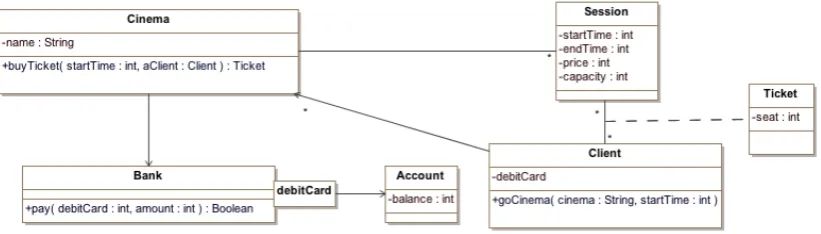
Figure 1: Class diagram for the cinema example.
model, specified as a rewriting theory in Maude. Exploiting the metalevel capabilities of Maude, the strategy controls the execution of the rewrite rules specifying the behavior of the system and checks the corresponding OCL constraints on the appropriate states.
We are aware that end users are interested in validating UML diagrams, not in the validation process itself. In practice, mOdCL users do not need any knowledge on the internals of our vali-dation tool, the evaluator and the strategy remains hidden to them. Furthermore, the integration of the facilities proposed here into generic development environments is a goal for us. This is, e.g., the case in the use of mOdCL in e-Motions, where an ATL transformation is used to get mOdCL Maude configurations from Ecore object models, using mOdCL as a backend tool to evaluate OCL expressions.
The paper is structured as follows. Section 2 introduces a running example, which will be used in the rest of the paper to illustrate our approach. Section3 serves as a brief introduction to rewriting logic and Maude, with emphasis on its support for object-oriented systems, and covering those features of Maude relevant to understanding the current paper. Section4discusses how UML concepts must be represented in Maude to be used by the mOdCL validator. Section5
then shows how to validate OCL constraints with mOdCL. Section6gives some details on the implementation of the validator. Finally, Section7draws some conclusions and future work.
2
Our Running Example
Figure1shows a class diagram which models part of a very simple ticket sale system for cinemas, to be used along the paper.
ACinemahas anameand offers a number of sessions, for which it sells tickets, managing the payment through a single bank. A Sessionhas a capacity, a ticketprice, start-ing/ending times (startTime/endTime), and the tickets sold to clients. AClientknows some cinemas, pays with adebitCardand has access to the tickets he has bought. The asso-ciation classTicketrepresents a ticket bought by a client for a given session; each ticket has a
seatnumber. ABankknows the accounts that support the debit cards, modeled as a qualified association with thedebitCardnumber as key. EachAccounthas abalance.
to buy one ticket for the session starting at a given time; andpay, in theBankclass, allows to charge a givenamountto the account associated to a givendebitCard.
We impose the avoid-overlappingOCL invariant to the Client class, which states that a client cannot buy two tickets for overlapping sessions, and theseats-in-session
invariant to theSessionclass, which states that the number of tickets sold for a session does not exceed its capacity.
context Client inv avoid-overlapping :
ticket -> forAll(T1 | ticket -> forAll(T2 | (T1 = T2)
or (T1.session.endTime < T2.session.startTime) or (T2.session.endTime < T1.session.startTime)))
context Session inv seats-in-session : capacity >= ticket -> size()
The buyTicketmethod assumes, as a pre-condition, that the cinema must offer a session at the requested time and, as a post-condition, that the returned value is eithernull or a new ticket, which is the only ticket added to the tickets of the requested session.
context Cinema::buyTicket(st:Integer, cl:Client): Ticket
pre: session->select(S | S.startTime = st)->size() = 1
post: (result = null) or
(session->select(S | S.startTime = st).ticket -> includes(result)
and
((session>select(S | S.startTime = st).ticket>asSet()) -(session->select(S | S.startTime = st).ticket@pre->asSet()))
-> size() = 1)
3
Rewriting Logic and Maude
Membership equational logic (MEL) [Mes98] is a Horn logic whose atomic sentences are equal-itiest=t0 andmembership assertionsof the formt:S, stating that a termt has sortS. Such a logic extends order-sorted equational logic, and supports sorts, subsort relations, subsort poly-morphic overloading of operators, and definition of partial functions with equationally defined domains.
Rewriting logic (RL) [Mes92] is a logic of change that can naturally deal with state and with highly nondeterministic concurrent computations. In RL, the state space of a distributed system is specified as an algebraic data type in terms of an equational specification(Σ,E), whereΣis a signature of sorts (types) and operations, andEis a set of equational axioms. The dynamics of a system in RL is then specified by rewriterulesof the formt→t0, wheretandt0areΣ-terms. This rewriting happens modulo the equationsE, describing in fact local transitions[t]E →[t0]E
abstraction at which systems may be specified, to perform, e.g., rewriting modulo associativity or associativity-commutativity.
RL is parameterized by its underlying equational logic. In what follows, we will use the syntax of Maude [CDE+02,CDE+07], a wide spectrum programming language directly based on RL, with MEL as its underlying equational theory, to present rewrite theories. Thus, Maude integrates an equational style of functional programming with RL computation.
Maude supports the modeling of object-based systems by providing sorts representing the es-sential concepts of object (Object), message (Msg), and configuration (Configuration). A configuration is a multiset of objects and messages (with the empty syntax, associative com-mutative, union operator__) that represents a possible system state.
Although the user is free to define any syntax for objects and messages, several additional sorts and operators are introduced as a common notation. Maude provides sortsOidfor object identi-fiers,Cidfor class identifiers,Attributefor attributes of objects, andAttributeSetfor multisets of attributes (with_,_as union operator). Given a classCwith attributesai of types Si, the objects of this class are then record-like structures of the form
<O:C|a1:v1,...,an:vn>
whereOis the identifier of the object, andviare the current values of its attributes (with
appropri-ate types). See [CDE+07] for additional details on how object-oriented systems are represented in Maude, including explanations on how to represent inheritance, syntax for object-oriented modules, different forms of object communication, etc.
The following Maude definitions specify a classAccountof bank accounts, with messages
withdrawandtransferto operate with such bank accounts. TheAccountclass is defined with a single attribute balance, of sort Int, representing the balance of an account. The
withdrawmessage has two parameters, namely the addressee of the message and the amount of money to withdraw from the account. Thetransfer message will make the amount of money specified as its third argument to be transferred from the account given as first argument to the one given as second argument.
sort Account .
subsort Account < Cid . op Account : -> Account .
op balance :_ : Int -> Attribute . op withdraw : Oid Int -> Msg . op transfer : Oid Oid Int -> Msg .
Rulesdebit andtransferbelow represent local transitions of the system that specify the behavior of bank accounts upon the reception of such messages. E.g., if anAccount object receives awithdrawmessage and the amount of money to withdraw is smaller or equal than the balance of the account receiving the message, then the message is ‘consumed’ and the balance of the account is decremented by such an amount. Notice the synchronization ofAccountobjects in thetransferrule.
vars A B : Oid .
crl [debit] :
< A : Account | balance : BalA > withdraw(A, M)
=> < A : Account | balance : BalA - M > if BalA >= M .
crl [tranfer] :
< A : Account | balance : BalA > < B : Account | balance : BalB > transfer(A, B, M)
=> < A : Account | balance : BalA - M > < B : Account | balance : BalB + M > if BalA >= M .
Notice that, since the__operator is declared associative, commutative, and with identity ele-ment, we do not need to worry about the order in which objects and messages appear in the rules. And since rules describe local transitions, we do not need to worry about the rest of the objects and messages in the configuration either.
Well-formedness of objects may be automatically checked by Maude’s typing system. For example, we can add declarations constrainingAccountobjects:
sort AccountObject .
subsort AccountObject < Object .
var O : Oid . var Bal : Int .
mb < O : Account | balance : Bal > : AccountObject .
Notice that with these declarations, an object < O : Account | >is a valid term of sort
Object, but since the membership cannot be applied on it, it is not of typeAccountObject.
4
The mOdCL Representation of UML Class and Object Diagrams
4.1 OCL Basic Types and Expressions
OCL basic predefined types are directly mapped on predefined Maude sorts. Thus, the basic OCL typesBoolean,Integer,RealandStringare, respectively, mapped into the Maude predefined sorts
Bool, Int, Float, and String. User-defined types are mapped on the Maude predefined sortOid. OCL predefined collection types are mapped into sorts Set, Bag, OrderedSet, andSequence. All these sorts are subsorts ofOclType, which defines any predefined OCL type.
OCL expressions are represented as terms in theOclExpsort, providing syntax for the OCL operators. Thus, we can represent, e.g., theseats-in-sessionOCL invariant presented in Section2as:
op seats-in-session : -> OclExp . eq seats-in-session
= context Session inv : capacity >= ticket -> size() .
Notice that the syntax for OCL expressions in mOdCL is close to the syntax of OCL. However, they are defined in equations, being declared as constants for later reference. And because of Maude limitations to define the lexical level, spaces must be left around operators to break tokens. Invariants, pre- and post-conditions are then specified by operatorsinv,pre andpost, to build theOclExpto be checked when the validation process requires to check invariants, pre-or post-conditions of a given method, respectively.
op inv : -> OclExp .
ops pre post : OpName -> OclExp .
The inv operator defines (the conjunction of) the class invariants in the system. For our example, given the aboveseats-in-sessionexpression and theavoid-overlapping
expression,
op avoid-overlapping : -> OclExp . eq avoid-overlapping
= context Client inv :
ticket -> forAll(T1 | ticket -> forAll(T2 | (T1 = T2)
or (T1 . session . endTime < T2 . session . startTime) or (T2 . session . endTime < T1 . session . startTime))))
theinvconstant can be defined as:
eq inv = seats-in-session and avoid-overlapping .
Thepreandpostoperators must be defined for each method. For example, for the method
buyTicketin our running example we have:
eq pre(buyTicket)
eq post(buyTicket) = (result = null)
or
(--- tickets of the session must include the result ticket session -> select(S | S . startTime = startTime) . ticket
-> includes(result) . and
--- the number of tickets increases in 1 unit
((session -> select(S | S . startTime = startTime) . ticket) > asSet()
-(session -> select(S | S . startTime = startTime) . ticket @pre) -> asSet()) -> size() = 1) .
4.2 The mOdCL Representation of the System Structure
In this section, we show how to represent in mOdCL the elements of given UML class models, providing the mapping of each element in the class diagram.
Classes are represented following the standard representation of classes in Maude (see Sec-tion3and [CDE+07]). TheAttributesort provides the syntax for attributes and associations in the objects, given by its name, of sortAttributeName, and its type, of sortOclType.
op _:_ : AttributeName OclType -> Attribute [ctor] .
The only difference with the standard way to represent classes in Maude is that attributes and associations are represented as constants of the mOdCL sortAttributeName. Thus, for the
Cinemaclass in our running example we have:
sort Cinema .
subsort Cinema < Cid .
op Cinema : -> Cinema [ctor] .
ops name bank session : -> AttributeName [ctor] .
Associations with multiplicity 1 are represented as attributes of sortOid, and associations with multiplicity*as attributes of sortSet(forOidsets). Constraints as ordered, unique,
multiplic-ities, etc. on the associations will adjust this rule appropriately; e.g., if the association is ordered, a sequence will be used instead of a set.
An operationop(arg1:type1,. . .,argn:typen):typeis represented as a constantop,
of sort OpName(of operation names), and constants arg1, . . . , argn, of sort Arg (of argu-ments).
Thus, e.g., for thebuyTicketoperation we have declarations
op buyTicket : -> OpName [ctor] .
ops startTime aClient : -> Arg [ctor] .
4.3 The System Behavior
system. We assume a single thread of execution and synchronous method invocation: when a given methodm1 invokes a methodm2, the caller gets blocked until the completion of the in-voked method. To manage the chaining of method invocations—an inin-voked method can invoke another one (or recursively to itself)—the validator uses an execution stack in which the nec-essary information is stored. A multithreaded execution would only require to handle multiple stacks and to identify each method invocation with the corresponding thread.
The behavior of each method will be represented as a sequence of Maude rules, and to allow the management of the stack and transparently gather the data implied in the validation of in-variants, and pre- and post-conditions, these rules are assumed to follow a basic scheme which requires the use of specific messages. The use of these messages allows us to detect and han-dle the invocation and completion of a method (call andreturn messages) and, once an invoked method has been completed, to reactivate the caller (with aresumemessage), which was blocked after invoking the method. This is the only assumption, the modeler can implement the rest of the prototype according to his preferences.
The Maude rules modeling a method may need to access some information related to its in-vocation, as the object invoking the method or the actual parameters used in the invocation. We assume that such information is stored in an object of classContext, representing the execution context with the appropriate information for the running method, with the form
< ctx : Context | op : m, self : id, args : vars >
wherectxis the identifier of the object,mis the name of the active method,idis the identifier of the current object, andvarsis a set of variable name - value pairs corresponding to the ar-guments of the method invocation and local variables. The validator infrastructure is responsible for transparently creating and handling such objects, so that the modeler can make use of it in the rules representing the behavior of methods when the value of an argument variable or a local variable is required.
The scheme for method definitions is as follows. First, although Maude allows any syntax for message declarations, we assume that messages are sent using the call operator. Thus, when the user wants to send an m(args-list) message to an object O, acall(m, O,
args-list)term is placed in the configuration of objects and messages representing the sys-tem state. Thiscallmessage is transparently processed by the validator infrastructure, which will create an object of classContext, with the name of the invoked method, the self object, and the actual parameters. This object is the initial execution context to be used by the specification of the methodm.
When a callmessage is sent in a rule to invoke a given methodm, the flow of control has to be blocked until the execution of the requested method is completed. To this end, the blocked rule waits for aresume(m, Result)message with the result of the invoked method.
Finally, the last rule of the implementation of a method m is assumed to send a message
return(result)with the result of such a method. Thisreturnmessage will be transpar-ently handled by the validator infrastructure, which will send aresumemessage to unblock the caller.
stack. Upon the detection of areturnoperator, mOdCL replaces the current context with the one at the top of the stack, and places a resumemessage to proceed with the execution. We sketch theCALL andRETURNinfrastructure rules that manage these messages. Since aCALL
rule is executed after a method invocation, and aRETURNrule is executed after a method com-pletion, it can be used from the execution strategy to determine when to validate OCL constraints.
rl [CALL] :
call(op-nm, self, args-list)
stack(... contents of the stack ...)
=> < context : Context | ... > --- new execution context
stack(... new contents of the stack ...) .
rl [RETURN] : return(R:OclType)
< context : Context | ... > --- old execution context
stack(< new-context : Context | ...>
... rest of the contents of the stack ...) => resume(op-nm, R:OclType)
< new-context : Context | ... > --- new execution context
stack(... new contents of the stack ...) .
As an example, we show below some of the Maude rules to represent the system behavior in our running example. ThegoCinemamethod begins by sending abuyTicket message to the cinema specified as argument for the given start time. Depending on whether there are tickets available or not for that session, aTicketobject or anullwill be returned. And then, depending on the result of this message, the ticket would be paid. We illustrate the approach by giving a few rules.
The GO-CINEMA-1 rule is the first rule to be executed for the goCinema method (see Section2). Upon the occurrence of a
call(goCinema, Self, (arg(cinema, Cn), arg(startTime, St))
theCALLrule above handles the stack as appropriate and puts in the configuration an object
< ctx : Context | op : goCinema, self : Self,
args : arg(cinema, Cn), arg(startTime, St))
This rule receives the execution context in theContextobject and invokes thebuyTicket
method on a given cinema, to get a ticket for the session.
rl [GO-CINEMA-1] :
< ctx : Context | op : goCinema, self : Self,
args : arg(cinema, Cn), arg(startTime, St)) < Self : Client | cinema : Set{C, LC}, Atts1 >
< C : Cinema | name : Cn, session : Set{S, LS}, Atts2 > < S : Session | startTime : St, Atts3 >
=> < Self : Client | cinema : Set{C, LC}, Atts1 >
< ctx : Context | op : goCinema, self : Self,
args : arg(cinema, Cn), arg(startTime, St)) call(buyTicket, C, (arg(startTime, St), arg(client, Self))) .
The BUY-TICKET-1-NO-FREE-SEATSrule below models the first execution step in the implementation of thebuyTicketmethod. This rule is applied if there are no free seats in the chosen session, in which case the method execution ends, returning anullticket in areturn
message.
crl [BUY-TICKET-1-NO-FREE-SEATS] :
< ctx : Context | op : buyTicket, self : Self,
args : arg(startTime, St), arg(client, Cl)) < Self : Cinema | session : Set{S, LS}, Atts1 >
< S : Session | startTime : St, ticket : TS, capacity : C, Atts2 > => < Self : Cinema | session : Set{S, LS}, Atts1 >
< S : Session | startTime : St, ticket : TS, capacity : C, Atts2 >
< ctx : Context | op : buyTicket, self : Self,
args : arg(startTime, St), arg(client, Cl)) return(null)
if size(TS) >= C .
TheGO-CINEMA-2-FAILrule is the second rule in the implementation of thegoCinema
method. The flow of control is blocked after calling thebuyTicketmethod, and it is released when the resume message, is received. Furthermore, as this rule ends the execution of the
goCinemamethod, it sends areturnmessage with the result. In this case we do not use any information of the execution context, and therefore, we do not use theContextobject.
rl [GO-CINEMA-2-FAIL] : resume(buyTicket, null) => return(false) .
5
Validation of OCL Constraints
The mOdCL evaluator is the component responsible for evaluating OCL expressions on config-urations representing given system states. It provides theevalfunction, which specifies how to interpret each valid OCL expression on a givenConfigurationrepresenting the system state.
op eval : OclExp Configuration -> OclType .
For example, given the following state configuration, of sort Configuration, corre-sponding to a given object diagram for theCinemamodel,
op state : -> Configuration . eq state
< s1 : Session | startTime : 1100, endTime : 1230,
ticket : Set{t2}, capacity : 40, price : 5 >
< s2 : Session | startTime : 1300, endTime : 1430,
ticket : Set{t1}, capacity : 20, price : 6 > < j : Client | cinema : Set{c}, ticket : Set{t1}, debitCard : 4 > < m : Client | cinema : Set{c}, ticket : Set{t2}, debitCard : 7 > < b : Bank | debitCards : qas(4, a1) $$ qas(7, a2) >
< a1 : Account | balance : 100 > < a2 : Account | balance : 1000 >
< t1 : Ticket | seat : 1, session : s2, client : j > < t2 : Ticket | seat : 1, session : s1, client : m > .
we can use theevalfunction as follows to statically validate, e.g., the above OCL expression
seats-in-session:2
Maude> red in CINEMA : eval(seats-in-session, state) . result: true
To dynamically validate an UML model, we must provide both the Maude representation of the system behavior and the mOdCL representation of the OCL constraints. Given the module
CINEMA, which implements our model example, according to the scheme proposed in Sec-tion4.3, and definesstateas an initial configuration, and given theCINEMA-CONSTRAINTS
module, which defines functionsinv,preandpost, as in Section4.1, we can use the mOdCL
validatecommand to validate the execution of the prototype of our system as follows:
Maude> (validate CINEMA with CINEMA-CONSTRAINTS from state .)
This way, the modeler can specify a Maude prototype as usual object-oriented modules, but taking into account that the system structure for the model must be specified according to the description in Section4.2, and the rules which specify the system behavior must use the basic scheme proposed in Section4.3, concerning the invocation of methods.
If, as in this case, the system can be executed without violating any restriction, we get its final configuration as result. Otherwise, the execution is aborted and an error message is given, reporting on the the state and the constraint involved in such an error.
6
The mOdCL Validator Architecture
The mOdCL validator lays on two components, the OCL evaluator and themetaOCLRewrite
strategy. In the following sections we sketch the rationale of these components.
6.1 The mOdCL Evaluator
The evaluator component has been designed as a shallow embedding of OCL in Maude. For this purpose, it provides OCL syntax to Maude and defines anevaloperator to evaluate valid OCL
expressions. This is completed with the libraryCOLLECTION, which supports the implementa-tion of the OCL Standard Library.
The evaluator pivots around the definition of sorts OclType, to represent any predefined OCL type, andOclExp, to represent valid OCL expressions, and works on system states rep-resented as object configurations (of sortConfiguration), where the elements in the UML class diagram have been represented as explained in Section4.2.
As we mentioned in Section 4.1, predefined OCL types are directly mapped on predefined Maude types, and furthermore, collection types are built by using the facilities provided by the
COLLECTIONlibrary. All these types are subsorts ofOclType.
subsort Int Float String Bool Oid < BasicType .
subsort Set Bag OrderedSet Sequence < Collection .
subsort BasicType Collection < OclType .
The SYNTAX module provides definitions for all valid OCL expressions as terms of sort
OclExp, and the EVAL module provides equations to evaluate them. The evaluation of ex-pressions in the context of pre- and post-conditions of operations requires two system states, one representing the state before executing the operation and another representing the state after its completion, whereas others expressions only require the current state. Thus, we provide two
evalfunctions:
op eval : OclExp Configuration Configuration -> OclType . op eval : OclExp Configuration -> OclType .
Only to provide some intuition on the general scheme used, we show the syntactic definitions in Maude for theincludesoperator on OCL collections:
op _-> includes(_) : OclExp OclExp -> Bool .
vars E1 E1 : OclExp .
var C : Configuration .
eq eval(E1 -> includes(E2), C) = eval(E1, C) in eval(E2, C) .
where the infix operator_in_is provided by theCOLLECTIONlibrary to determine if a given element is contained in a given collection.
6.2 Implementation of themetaOCLRewriteStrategy
Maude provides key metalevel functionality for metaprogramming and for writing strategies to control the execution of systems. In general, strategies are defined in extensions of the pre-defined META-LEVEL module by using predefined functions in it as building blocks. The
META-LEVEL module also provides sortsTerm and Module, so that the representations of a term T and of a module M are, respectively, a term T of sort Term and a term M of sort
’true.Bool(resp. ’B:Bool). Then, a term is constructed in the usual way, by applying an operator symbol to a comma-separated list of terms. For example, the termeval(S, true)
of sortOclExpis metarepresented as the term’eval[’S:State, ’true.Bool]of sort
Term. In what follows, we will use the over-line notation to denote the metarepresentation of modules and terms.
Of particular interest for our purposes are theMETA-LEVELpartial functionsmetaReduce
andmetaXapply:3
op metaReduce : Module Term ˜> Term . op metaXapply : Module Term Qid ˜> Term .
metaReducetakes a moduleMand a termT, and returns the metarepresentation of the normal form ofT inM, that is, the result of reducingT as much as possible using the equations inM.
metaXapply takes as arguments a moduleM, a term T, and a rule label L, and returns the metarepresentation of the term resulting from applying the rule with labelLinMon the termT
once.
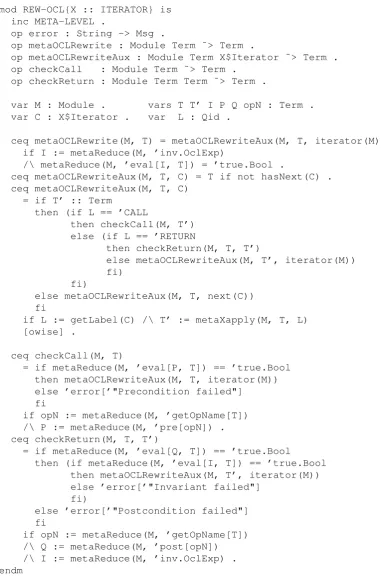
Rewrite systems can be executed in Maude with commands rewriteandfrewrite, which use different built-in strategies to control the way to apply the rules on the current state. However, since we want to validate OCL constraints, we need a different way to control the rule application that allow to detect the system states to validate, and to check the required OCL constraints. To this end, we define ametaOCLRewritestrategy (see Figure2), which is responsible for monitoring rule execution.
ThemetaOCLRewritestrategy executes the rules modeling the system until a reached term, representing a system state, cannot be further rewritten, or violates given constraints. In each execution step, the strategy tries to apply all rules in the module. Once a rule can be applied, and the corresponding constraints are satisfied, the resulting term becomes the current term and it starts again. Otherwise, an error message is generated.
To try all the possible rules in some given order, the REW-OCLmodule in Figure2 has an
ITERATORtheory as parameter. This theory defines a sort Iterator, which comes with a functioniteratorthat returns an iterator on the labels of a module, and functions that allow us to iterate on them: hasNext, which determines whether there are remaining labels in the structure; next, which returns the iterator with the next label set to be the current one; and
getLabel, which return the current label in the sequence.
The metaOCLRewrite operator uses the inv function to get the class invariants. After using theevalfunction to check them on the initial state, it calls themetaOCLRewriteAux
auxiliary function to execute and validate the system according to the constraints defined. ThemetaOCLRewriteAuxuses the iterator to get a candidate rule. If it is not possible (not hasNext(C)), the execution stops. Otherwise, it gets a rule label and it uses the predefined
metaXapplyfunction to execute the rule. If it can be applied (notice theT’ :: Termto check that the result is of a valid sort), the system state is validated; otherwise, it gets an error term inT’, and it resumes the execution to try the next rule.
As we explained in Section 4.3, the mOdCL evaluator uses an execution stack to manage method invocations. Basically, it executes aCALLrule after a method invocation and aRETURN
mod REW-OCL{X :: ITERATOR} is inc META-LEVEL .
op error : String -> Msg .
op metaOCLRewrite : Module Term ˜> Term .
op metaOCLRewriteAux : Module Term X$Iterator ˜> Term .
op checkCall : Module Term ˜> Term .
op checkReturn : Module Term Term ˜> Term .
var M : Module . vars T T’ I P Q opN : Term .
var C : X$Iterator . var L : Qid .
ceq metaOCLRewrite(M, T) = metaOCLRewriteAux(M, T, iterator(M)) if I := metaReduce(M, ’inv.OclExp)
/\ metaReduce(M, ’eval[I, T]) = ’true.Bool .
ceq metaOCLRewriteAux(M, T, C) = T if not hasNext(C) . ceq metaOCLRewriteAux(M, T, C)
= if T’ :: Term
then (if L == ’CALL
then checkCall(M, T’) else (if L == ’RETURN
then checkReturn(M, T, T’)
else metaOCLRewriteAux(M, T’, iterator(M)) fi)
fi)
else metaOCLRewriteAux(M, T, next(C)) fi
if L := getLabel(C) /\ T’ := metaXapply(M, T, L) [owise] .
ceq checkCall(M, T)
= if metaReduce(M, ’eval[P, T]) == ’true.Bool then metaOCLRewriteAux(M, T, iterator(M)) else ’error[’"Precondition failed"]
fi
if opN := metaReduce(M, ’getOpName[T]) /\ P := metaReduce(M, ’pre[opN]) . ceq checkReturn(M, T, T’)
= if metaReduce(M, ’eval[Q, T]) == ’true.Bool
then (if metaReduce(M, ’eval[I, T]) == ’true.Bool then metaOCLRewriteAux(M, T’, iterator(M)) else ’error[’"Invariant failed"]
fi)
else ’error[’"Postcondition failed"] fi
if opN := metaReduce(M, ’getOpName[T]) /\ Q := metaReduce(M, ’post[opN]) /\ I := metaReduce(M, ’inv.OclExp) . endm
rule on its completion. They are infrastructure rules, hidden to the user, but we make use of them in themetaOCLRewriteAux operation to detect a method invocation (when the label of the executed rule is’CALL) or a method completion (when it is’RETURN). In these cases, the suitable validation is performed by using the checkCall or checkReturn operators, respectively.
Now, we can validate the dynamics of our example. Assuming a REW-OCLmodule which defines themetaOCLRewriteexecution strategy, and given the moduleCINEMA, which im-plements our model example and definesstateas an initial configuration, and given the mod-uleCINEMA-CONSTRAINTS, which defines functionsinv,preandpostas above, we can create theCINEMA-TESTmodule as follows:
mod CINEMA-TEST is
inc REW-OCL{IteratorSeq} + CINEMA + CINEMA-CONSTRAINTS . endm
And we can execute the system from its initial configuration as follows:
Maude> red metaOCLRewrite(CINEMA-TEST, state) .
This is in fact the computation that takes place when using thevalidatecommand, which hides all references to meta-representations, stategies, etc., which are kept hidden to the user.
7
Conclusions and future work
We have presented the mOdCL system, which can both evaluate OCL expressions on given sys-tem configurations and validate OCL constraints on the execution of Maude syssys-tem prototypes.
Our validator lays on both an OCL expression evaluator and an execution strategy, which is responsible for controlling when and how to validate each OCL constraint. The user only has to specify the system behavior and the constraints to fulfill. The strategy is independent of the system to validate, and this level of modularity allows us to extend the strategy if we are interested on experimenting with new validation approaches.
We provide guidelines to represent UML class and object diagrams in mOdCL. Furthermore, we provide a basic scheme to represent the method related concepts. The system behavior repre-sentation must comply with the scheme proposed, but we do not impose any further restriction: the user can complete the system according to his preferences.
We are currently working on the automatic generation of mOdCL representations from UML class and object diagrams, and on the use of UML behavior diagrams to (semi-)automate the Maude representation of the system behavior. Different authors have previously explored such a approach for different purposes. First steps on the use of sequence diagrams to systematically obtain skeletons for the system behavior representation, which can be later completed by the modeler, have already been taken.
Bibliography
[BCR] A. Boronat, J. A. Cars´ı, I. Ramos. Algebraic Specification of a Model Transfor-mation Engine. In Baresi and Heckel (eds.), Fundamental Approaches to Software Engineering, FASE 2006, Vienna. Proceedings. LNCS 3922, pp. 262–277. Springer.
http://dx.doi.org/10.1007/11693017 20
[BM08] A. Boronat, J. Meseguer. An Algebraic Semantics for MOF. Pp. 377–391 in [FI08].
http://dx.doi.org/10.1007/978-3-540-78743-3 28
[BW08] A. D. Brucker, B. Wolff. HOL-OCL: A Formal Proof Environment for UML/OCL. Pp. 97–100 in [FI08].
http://dx.doi.org/10.1007/978-3-540-78743-3 8
[CCR07] J. Cabot, R. Claris´o, D. Riera. UMLtoCSP: A Tool for the Formal Verification of UML/OCL Models Using Constraint Programming. In Stirewalt et al. (eds.), Pro-ceedings of the Twenty-Second IEEE/ACM International Conference on Automated Software Engineering, ASE ’07. Pp. 547–548. ACM, 2007.
http://doi.acm.org/10.1145/1321631.1321737
[CDE+02] M. Clavel, F. Dur´an, S. Eker, P. Lincoln, N. Mart´ı-Oliet, J. Meseguer, J. F. Quesada. Maude: Specification and Programming in Rewriting Logic.Theoretical Computer Science285(2):187–243, 2002.
http://dx.doi.org/10.1016/S0304-3975(01)00359-0
[CDE+07] M. Clavel, F. Dur´an, S. Eker, P. Lincoln, N. Mart´ı-Oliet, J. Meseguer, C. L. Talcott (eds.).All About Maude - A High-Performance Logical Framework, How to Specify, Program and Verify Systems in Rewriting Logic. LNCS 4350. Springer, 2007.
http://dx.doi.org/http://dx.doi.org/10.1007/978-3-540-71999-1
[CDH+07] M. Clavel, F. Dur´an, J. Hendrix, S. Lucas, J. Meseguer, P. C. ¨Olveczky. The Maude Formal Tool Environment. In Mossakowski et al. (eds.),Algebra and Coalgebra in Computer Science, Second International Conference, CALCO 2007, Bergen, Nor-way, August 20-24, 2007. LNCS 4624, pp. 173–178. Springer, 2007.
http://dx.doi.org/10.1007/978-3-540-73859-6 12
[CPC+04] D. Chiorean, M. Pasca, A. Cˆarcu, C. Botiza, S. Moldovan. Ensuring UML Models Consistency Using the OCL Environment.ENTCS102:99–110, 2004.
http://dx.doi.org/10.1016/j.entcs.2003.09.005
[FI08] J. L. Fiadeiro, P. Inverardi (eds.).Fundamental Approaches to Software Engineering, 11th International Conference, FASE 2008, Budapest. Proceedings. LNCS 4961. Springer, 2008.
[FT01] J. L. Fern´andez-Alem´an, A. Toval- ´Alvarez. Seamless Formalizing the UML Seman-tics through Metamodels. InUnified Modeling Language: Systems Analysis, Design and Development Issues. Pp. 224–248. 2001.
[GBR07] M. Gogolla, F. B¨uttner, M. Richters. USE: A UML-based Specification Environment for Validating UML and OCL.Science of Computer Programming69(1-3):27–34, 2007.
http://dx.doi.org/10.1016/j.scico.2007.01.013
[Kna00] A. Knapp. Generating Rewrite Theories from UML Collaborations. In Futatsugi et al. (eds.), CAFE: An Industrial-Strength Algebraic Formal Method. Pp. 97–120. Elsevier, 2000.
[MB09] F. Mokhati, M. Badri. Generating Maude Specifications From UML Use Case Dia-grams.Journal of Object Technology8(2):319–136, 2009.
http://dx.doi.org/10.5381/jot.2009.8.2.a2
[Mes92] J. Meseguer. Conditional Rewriting Logic as a Unified Model of Concurrency. The-oretical Computer Science96:73–155, 1992.
http://dx.doi.org/10.1016/0304-3975(92)90182-F
[Mes98] J. Meseguer. Membership Algebra as a Logical Framework for Equational Specifi-cation. In Parisi-Presicce (ed.),Recent Trends in Algebraic Development Techniques. LNCS 1376, pp. 18–61. Springer, 1998.
http://dx.doi.org/10.1007/3-540-64299-4 26
[MM02] N. Mart´ı-Oliet, J. Meseguer. Rewriting Logic as a Logical and Semantic Framework. In Gabbay and Guenthner (eds.). Volume 9, pp. 1–87. Kluwer Academic Publishers, second edition, 2002.
[OCLa] Object Management Group. Object Constraint Language (OCL) Specification .
http://www.omg.org/cgi-bin/doc?formal/2010-02-01
[OCLb] OCL Portal.http://st.inf.tu-dresden.de/oclportal/.
[RDV09] J. E. Rivera, F. Duran, A. Vallecillo. A Graphical Approach for Modeling Time-Dependent Behavior of DSLs. InProceedings of the 2009 IEEE Symposium on Vi-sual Languages and Human-Centric Computing (VL/HCC). VLHCC ’09, pp. 51–55. IEEE Computer Society, Washington, DC, USA, 2009.
http://dx.doi.org/10.1109/VLHCC.2009.5295300
[RDV10] J. E. Rivera, F. Dur´an, A. Vallecillo. On the Behavioral Semantics of Real-Time Domain Specific Visual Languages. In lveczky (ed.), WRLA. Rewriting Logic and Its Applications. LNCS 6381, pp. 174–190. Springer, 2010.
http://dx.doi.org/10.1007/978-3-642-16310-4 12
[RRDV07] J. R. Romero, J. E. Rivera, F. Dur´an, A. Vallecillo. Formal and Tool Support for Model Driven Engineering with Maude. Journal of Object Technology 6(9):187– 207, 2007.
http://dx.doi.org/10.5381/jot.2007.6.9.a10
[Thea] The Dresden OCL Team. The Dresden OCL toolkit. Available athttp://dresden-ocl. sourceforge.net/.
[Theb] The MOVA Group. The MOVA tool: a validation tool for UML. Available athttp: //maude.sip.ucm.es/mova/.