ACCESSIBILITY OF ZWITTERIONIC COMPOUNDS FROM
PRIMARY AMINES AND
2,5-DIHYDROXY-1,4-BENZOQUINONE
Farba Bouyagui Tamboura,
[a]*Modou Lo,
[b]Abdi Ould Kaihil,
[c]Issa Samb,
[a]Papa Samba Camara
[a]and Mohamed Gaye
[b]Keywords: C–N activation; hydrogen bonds; quinones; amination; zwitterions
Following the discovery of an unprecedented transamination reaction between primary alkylamines and a quinonoid molecule of the type C6H2(NHCH2R)2(=O)2 (I), obtained from commercially available diaminoresorcinol.2HCl, we have extended this method to the use of
primary arylamines and found that, in contrast, secondary amines led to a different outcome. Whereas functionalized molecules of type I, which are best described as 6π +6π zwitterions, were obtained with aniline or 4-methoxyaniline, no transamination was observed with tBuNH2 in ethanol. However, a reaction which afforded salt 2-methylpropan-2-aminium
4-(methylamino)-3,6-dioxocyclohexa-1,4-dien-1-olate (2b) took place in water and resulted from hydrolysis of the imine group and deprotonation of 5-hydroxy-2-(methylamino)-4-(methylimino)-cyclohexa-2,5-dienone (1a). Under similar conditions, secondary amines led to comparable results. The cations associated with the anionic quinonoid are readily exchanged in the presence of a primary amine. Whereas for the transamination reaction, basic amines react under mild conditions, slightly harsher conditions are needed for less basic amines such as piperidine, diisopropylamine, or diethylamine. Transamination reactions were also performed with 5-hydroxy-2-(methylamino)-4-(methylimino)-cyclohexa-2,5-dienone (1a), which is more soluble in organic solvents than 2-amino-5-hydroxy-4-iminocyclohexa-2,5-dienone (compound I
)
This led to the first examples of quinonoidal zwitterions functionalized with different alkyl groups on the nitrogen atoms. A number of compounds were characterized by X-ray diffraction, which allowed a better understanding of their electronic situation, and in many cases, the presence of multiple hydrogen-bond donors and acceptors results in crystal packings dominated by these interactions.*Corresponding Authors
E-Mail: [email protected]
[a] Department of Chemistry, University Alioune DIOP, Bambey, Sénégal
[b] Department of Chemistry, University Cheikh Anta DIOP, Dakar, Sénégal
[c] Department of Chemistry, University Nouakchott Al-Aasriya, Nouakchott, Mauritanie.
Introduction
Organic compounds containing a quinonoid fragment are of great interest because of their intrinsic properties and their numerous applications in chemistry, physical chemistry and biology.1-26 In particular, benzoquinonemonoimines have been found to display unique properties in various areas such as coloring,27 organic,28,29 supramolecular,30 coordination, organometallic chemistry30,31,38,39 and homogeneous catalysis.32-37 Previous studies have shown that the reactions between alkylamines or arylamines and benzoquinone gave a trans-dialkylaminobenzoquinone or trans-diarylamino-benzoquinone and monoarylamino products.40-41 Similar reactions with 2,5-dihydroxybenzoquinone have been achieved yielding trans-dialkylaminobenzoquinone and diarylaminobenzoquinone products whose nickel complexes are very active in catalysis.42 Benzoquinonemonoimines were obtained by transamination reaction of alkyl and arylamines with specific reactants like diaminoresorcinol dihydrochloride or by esterification reaction followed by reduction.38 The aim of this paper is to show that trans-dialkylaminobenzoquinone and diarylaminobenzoquinones can be obtained with 2,5-dihydroxybenzoquinone at high temperature. Benzoquinonemonoimines products can be
obtained by classical condensation reaction followed by nucleophilic substitution of alkylamines with 2,5-dihydroxybenzoquinone.
Scheme 1. A zwitterion 6π + 6 π electrons (I) and a precursor of zwitterion 12π electrons (2,5-dihydroxy benzoquinone) (II).
The first member of this family of 12π-electron quinine was the dianion ligand resulting from deprotonation of compound II. The compound I is a zwitterion type involving 6π + 6 π electrons chemically not but electronically connected (Scheme 1).
From these reactions, it’s possible to convert I to II by hydrolysis reactions with bulky primary amines or secondary amines in water. The zwitterionic products obtained by reaction of I with primary alkylamines were isolated from the reactions of II and primary alkylamines at room temperature. The para aminoalkyl-1,4-benzoquinone were obtained after reflux or a long time reaction from II.
Result and discussion
Scheme 2. Amination and hydrolyzed reactions on the parent quinonmonimine zwitterion
The first alkylamine selected for the synthesis of functionalized 2,5-dihydroxy-1,4-benzoquinone was t -butylamine. Using a large excess of t-butylamine, a dianionic salt was obtained with a yield of 93 % (Scheme 3). The reaction of 2,5-dihydroxy-1,4-benzoquinone II with the bulky primary and secondary amine, respectively (NH2-tBu) and NH(i-Pr)2 resulted in the deprotonation of the dihydroxybenzoquinone (Scheme 3).
Scheme 3. Encumbered primary amine and secondary amines effect on the 2,5-dihydroxy-1,4-benzoquinone
On the course, except the t-butylamine, all primary alkylamines react by transamination on the parent zwitterion
I. Probably the steric effect of these amines is low. In the alcohol solution, tBuNH2 react with
2,5-dihydroxy-1,4-benzoquinone to afford an organic salt IIb. The NMR data show one singlet for O…C…CH group at 5.74 ppm for IIb,
5.15 ppm for the first dialkylamine IIa (76% yield). The 13C{1H} NMR spectra reveal signals at 115.29 ppm for IIb and 101.46 ppm for IIa for CH group (O…C…CH). The
chemical shift of O…C group was shown at 181.88 ppm for
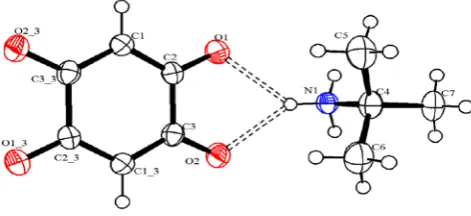
IIb and 181.75 ppm for IIa, which was confirmed by single-crystal X-ray diffraction (Figure 1). All crystal structures determined in the course of this work are discussed in a separate paragraph (see below).
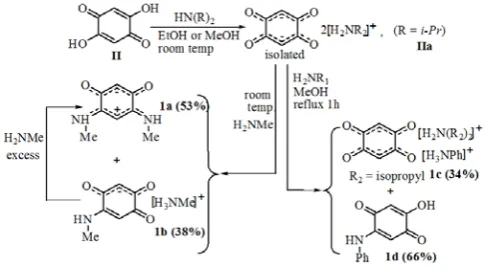
Surprisingly, when organic salt IIa was treated with MeNH2, a complete transamination product 1a and uncomplete transamination product 1b was observed. In alcohol or water, 1b can react with the excess of MeNH2 to afford the product 1a (see Scheme 2). The NMR spectra of these two products were described in analog reaction in our previous work.44 In this optic, the organic salt IIa was treated by an excess of aniline under reflux in methanol.
Figure 1. Partially labeled plot of compound IIa. Dashed lines indicate H-bonding interactions. The thermal ellipsoids are shown at 50% probability.
Two products were isolated. The organic diammonium salt [NH2(i-Pr)2(PhNH3)(C6H2O4)] (1c) was observed as a solid compound while the filtrate solution afforded the monoamino derivative (2-hydroxy-5-(phenylamino)-cyclohexa-2,5-diene-1,4-dione [(PhNHC6H3O3)] (1d) (Scheme 4). The 1H NMR spectra contain two signals at 5.74 and 5.84 ppm, which are characteristic of the CH groups of the substituted benzoquinone fragment (N-C=CH and O=CH-C, respectively). 13C{1H} NMR spectroscopic data show two signals for the CH groups, and the one corresponding to N-C=CH shift to 95.80 ppm, downfield with respect to that of the zwitterion. The O=C-CH=C-OH resonance was found at 103.97 ppm. The quaternary carbon atoms give rise to five singlets, two of them corresponding to the two O=C carbon atoms with very close chemical shifts to 180.38 and 182.68 ppm. One of the single bond HO-C is shifted to 161.03 ppm. In the aromatic ring, the quaternary carbon atoms give two singlets corresponding to N-C= and =C-N bonds shifted to 146.11 and 137.71 ppm respectively.
Scheme 4. Mono and di-condensation reactions between organic salt and methyl and arylamine
The IIa was reacted at room temperature during 3 h with methylamine to form 1a and with the (2-hydroxyethyl)amine to give 2a. Both zwitterions 1a and 2a
salt [(NH3-tBu)(C7H6O3)] (2b). The 2b compound can be obtained by hydrolysis reaction of 1a with tert-butylamine in water from a mixture of 2b and [(NH3-Me)(C7H6O3)] (1b) (Scheme 5). In dichloromethane solution, it's possible that the 1b exchange the methylammonium cation by tert-butylammonium cation yielding 2b. Surprisingly, 1b reacts by condensation and transamination reaction with methylamine to afford 1a. The same compound was obtained by condensation reaction between the organic salt
IIa or IIb and alkyl amines. From the compound IIa, it's possible to access the zwitterionic compounds by condensation reactions between IIa and primary alkyl amines (methylamine) (1a) or (2-aminoethanol) (2a). It’s an interesting route to access from the quinonemonoimines to products obtained exclusively by transamination reactions or by a more efficient synthesis subsequently developed, which involved the diaminoresorcinol acylation followed by reduction by LiAlH4.26
Scheme 5. Reactivity of monoalkylamines on the organic salts by direct condensation reaction
Herein, we report that the scope of this reaction can be extended to primary arylamine. In contrast, secondary amines afforded only organics salts. Gratifyingly, tBuNH2
reacted at room temperature in methanol, within 1 h, to yield the corresponding salt of type IIb, in 93 % yield. Its 1H and 13C{1H} NMR spectroscopic data are consistent with the expected structure, which was confirmed by single-crystal X-ray diffraction (Figure 2).
Figure 2. Partially labeled plot of compound IIb. Dashed lines indicate H-bonding interactions. The thermal ellipsoids are shown at 50 % probability.
The reaction of II with methylamine was performed under reflux within 3 h, whereas the reaction with diisopropylamine afforded IIa at room temperature. The monoanionic salt 1b which was previously isolated acts as a reaction intermediate in the conversion of 1a into 1e
(Scheme 6).
Scheme 6. Reactivity of methylamine on the 2,5-dihydroxy-1,4-benzoquinone giving free different products
Knowing that 1a reacts with primary amines by transamination reaction, we verified that aniline is not basic enough to perform this transformation. Upon crystallization of the reaction mixture, 1a was indeed recovered, but the composition of the crystals was found to be [(1a)2PhNH2].44 Another zwitterionic benzoquinonemonoimine was obtained by a condensation reaction between the corresponding alkylamine and the organic salt IIb (Scheme 7). The sec-butylamine and organic salt IIb react under reflux for overnight to yield three products 3a, 2d and 2e. The main product 3a was obtained after dissolved the crude product in chloroform solution. The 1H NMR of 3a reveal signals of the quinonoid fragment at 5.14 (s, 1H, N…C…CH), 5.48 (s, 1H, O…C…CH), 8.10 (br s, 2H, 2NH). 13C{1H} NMR 80.52 (s, N…C…C), 98.85 (s, O…C…C), 155.73 (s, N…C), 172.23 (s, O…C). For 2d, two singlets at 5.42 (s, 1H, N-C=CH) and 5.90 (s, 1H, O=C-CH) were revealed, while one singlet is obtained for the 2e product at 5.97 (s, 2H, O=C-CH).
Scheme 7. Obtaining symmetrical zwitterionic and two neutrals organics products
The reaction of II with excess of aniline yield the monoarylamino derivative 1d after 3 hours under reflux. Progressively 1d was converted into the zwitterionic 3- hydroxy-4-(phenylamino)-6-(phenylimino)cyclohexa-2,4-di-enone derivative 4a (Scheme 8).
Scheme 8. Effect of reflux time on condensation between aniline and 2,5-dihydroxy-1,4-benzoquinone
This species 4a was only observed from II and aniline reaction. Other similar reactions give p-diamino-1,4-benzoquinone products. It's observed that the substituted arylamines have high reactivity with the reagent II. The product 4a was obtained56 from the other transamination reaction between the parent zwitterion I and an excess of aniline in the ethanol solution under reflux. The products 1d
3d and at 5.57 (s, 1H, N-C=CH); 5.81 (s, 1H, O=C-CH) for
4d (Scheme 9).
These monoaminohydroxybenzoquinones products were considered like intermediaries of reactions synthesis between reagent II and alkylamines. For a long time or under reflux, these reactions lead only the trans-diarylamino-1,4-benzoquinones. When II was reacted with substituted anilines, such as o-MeC6H4NH2, o-BrC6H4NH2,
o-ClC6H4NH2, and (p-MeO)C6H4NH2 the corresponding disubstituted diamino benzoquinones respectively 3e, 4e and
5e were isolated. The yield was respectively, 57; 42 and 93 %. We noted from the NMR spectra that the monoamino derivatives 3d and 4d were found to be intermediates in the synthesis of 4e and 5e respectively. A mechanism of the monocondensation is achieved in Scheme 10.
Scheme 9. Obtaining different products under reflux and at room temperature
Scheme 10. Mechanism of monocondensation with the formation of 2-hydroxy-5-(arylamino)-1,4-benzoquinone
X-ray crystal structure determination for IIa and IIb
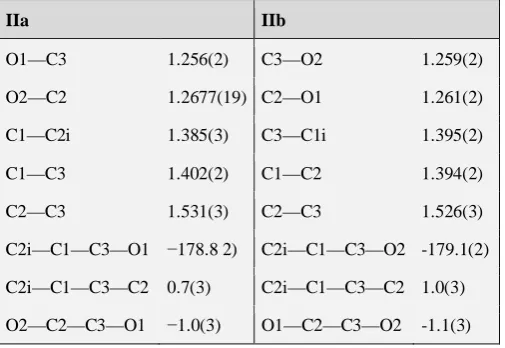
The title compounds IIa and IIb crystallize in the monoclinic space group P21/c, with one complete zwitterion comprising the asymmetric unit. The two ammonium groups are orientated trans with respect to the plane of the central 3,6-dioxocyclohexa-1,4-diene-1,4-bis(olate) ring. Intramole-cular interactions within the solid-state structure of the zwitterion are between the two oxygen atoms of each side of the central ring and one H atoms of the nitrogen atom of the ammonium groups. The distances C—O, which are in the range 1.256(2)–1.2667(19) Å are indicative of a bond character slightly different from a double bond (Table 1). In both rings, two moieties of O…C…C…C…O which contain a fully delocalized 6π electrons system are connected by two single bonds with distances of 1.531(3) Å and 1.526(3) Å respectively in IIa and IIb. These facts show that the non-conjugation of the two 6π electrons systems in the central rings of the zwitterions. As shown by the torsion angles (Table 1) whole atoms of the rings are quasi- coplanar. The torsions angles are slightly different from the ideal angle of 180° and 0° in the planar ring.
Experimental
Chemical reagents in high purity were purchased from Merck and Aldrich and were used without further purification.
Table 1. Selected bond lengths (Å) and torsions angles (°) for the central ring IIa and IIb
IIa IIb
O1—C3 1.256(2) C3—O2 1.259(2)
O2—C2 1.2677(19) C2—O1 1.261(2)
C1—C2i 1.385(3) C3—C1i 1.395(2)
C1—C3 1.402(2) C1—C2 1.394(2)
C2—C3 1.531(3) C2—C3 1.526(3)
C2i—C1—C3—O1 −178.8 2) C2i—C1—C3—O2 -179.1(2) C2i—C1—C3—C2 0.7(3) C2i—C1—C3—C2 1.0(3)
O2—C2—C3—O1 −1.0(3) O1—C2—C3—O2 -1.1(3)
The 1H NMR spectra were recorded at 300 MHz and 13C{1H} NMR spectra at 75 MHz on a Bruker AC-300 instrument. Mass spectra were recorded with a Bruker Daltonics microTOF (ESI; positive and/or negative mode; capillary voltage: 4.8 kV; nebulizer pressure: 0.2 bar; desolvation temperature: 180°C; desolvation gas flow rate: 4.5 L/min). Elemental analysis was performed by the Service de Microanalyse, Université de Strasbourg (Strasbourg, France) and the Service Central d’Analyse (Lyon, France).
X-ray data collection, structure determination and refinement
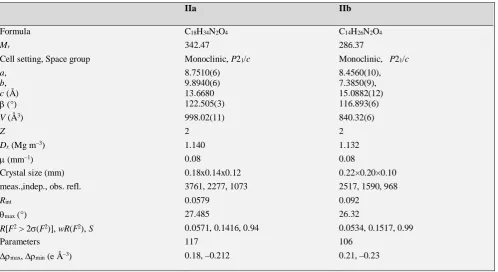
Single crystals of IIa and IIb were grown by slow evaporation of MeOH solution. A suitable crystal was selected and mounted on a Bruker APEX-II CCD diffractometer with graphite monochromatized MoKα
radiation (λ = 0.71073 Å). The crystal was kept at 173(2) K
during data collection. Details of the X-ray crystal structure solution and refinement are given in Table 1. The structure was solved with the SHELXT45 structure solution program using direct methods and refined with the SHELXTL46 Software Package. Molecular graphics were generated using
ORTEP-3.47
Synthesis of the compounds
Compound Ia: dipiperidinium 3,6-dioxocyclohexa-1,4-diene-1,4-bis(olate)
Piperidine (0.43 g, 5.07 mmol) was added to a water (30 mL) solution of 2-amino-5-hydroxy-4-iminocyclohexa-2,5-diènone (0.1 g, 0.724 mmol). The mixture was heated to reflux for five hours. After cooling the solution was washed with dichloromethane solution (3 x 10 mL) then the excess of piperidine was eliminated. The aqueous phase was evaporated and a red solid was obtained (0.178 g, 79 %)
Table 2. Data collection and refinement parameters for IIa and IIb
IIa IIb
Formula C18H34N2O4 C14H26N2O4
Mr 342.47 286.37
Cell setting, Space group Monoclinic, P21/c Monoclinic, P21/c a,
b,
c (Å)
8.7510(6) 9.8940(6) 13.6680
8.4560(10), 7.3850(9), 15.0882(12)
β (°) 122.505(3) 116.893(6)
V (Å3) 998.02(11) 840.32(6)
Z 2 2
Dx (Mg m–3) 1.140 1.132
µ (mm–1) 0.08 0.08
Crystal size (mm) 0.18x0.14x0.12 0.22×0.20×0.10
meas.,indep., obs. refl. 3761, 2277, 1073 2517, 1590, 968
Rint 0.0579 0.092
θmax (°) 27.485 26.32
R[F2 > 2σ(F2)], wR(F2), S 0.0571, 0.1416, 0.94 0.0534, 0.1517, 0.99
Parameters 117 106
∆ρmax, ∆ρmin (e Å–3) 0.18, –0.212 0.21, –0.23
13C (75 MHz, dmso-d6), δ(ppm): 179.275 (O...C...CH...C...O); 99.86 (O...C...CH); 43.84(s, CH2-N-CH2-); 22.09 (s, CH2-CH2-CH2-); 22.54 (s, CH2-CH2-CH2-). RMN 13C-DEPT 135 (75 MHz, dmso-d6), δ(ppm): 99.86 (O...C...CH...C...O); 43.84 (s, N-); 22.09 (s, CH2-CH2-CH2-); 22.54 (s, CH2-CH2-CH2-). Anal. Found C, 50.82; H, 6.91; N, 7.26. Calc. for C17H26N2O4.CH2Cl2 C, 51.65; H, 7.14; N, 7.09.
Compound IIa: diisopropylammonium 3,6-dioxocyclohexa-1,4-diene-1,4-bis(olate)
Diisopropylamine (1.53 g, 15.16 mmol) was added to an ethanol (10 mL) solution of 2,5-dihydroxy-1,4-benzoquinone 1 (0.304 g, 2.17 mmol). Immediately a precipitate appeared in the mixture which is stirred for 3h. The pink solid product was filtered, washed with diethyl ether (2 x 40 mL) and then dried. The product was obtained as a pink solid (0.57 g, 1.66 mmol, 76 %). Suitable crystals for X-ray diffraction were obtained by slow evaporation of an ethanol solution of the product. From the zwitterionic reactant, this product was obtained after reflux in water.
1H NMR (300 MHz, dmso-d6), δ(ppm): 5.15 (s, 2H, O…C…CH); 3.24-3.25 (m, 4H, -CH-NH2+); 1.14 (d, 24H, CH3iPr). 13C{1H} NMR (75 MHz, D2O), δ(ppm): 18.28 (s, CH3ipr); 47.22(s, CHipr); 101.46 ( s, O…C…CH); 181.75 ( s, O…C). These ammonium salts react with primary amines to lead symmetric zwitterionic compounds.
Compounds IIb: 2-methylpropan-2-aminium 3,6-dioxocyclo-hexa-1,4-diene-1,4-bis(olate)
Tert-butylamine (1.096 g, 14.98 mmol) was added to an ethanol (20 mL) solution of
2,5-dihydroxy-1,4-benzoquinone 1 (0.3 g, 2.14 mmol). Red precipitate was immediately formed. The reaction mixture was stirred at room temperature for 3h and then filtered. The red solid was washed with diethyl ether (4 x 20 mL) and air dried (0.57 g, 1.99 mmol, 93 %). Suitable crystals for X-ray diffraction were obtained by slow evaporation of an ethanol solution of the product.
1H NMR (300 MHz, dmso-d6), δ(ppm): 5.74 (s, 2H, O…C…CH); 1.20 (s, 18H, -CH3). 13C{1H} NMR (75 MHz, dmso-d6), δ(ppm: 26.57 (s, CH3); 51.86 (s, CtBu) 115.29 ( s, O…C…CH); 181.88 ( s, O…C).
Compound 1a: 5-hydroxy-2-(methylamino)-4-(methylimino)-cyclohexa-2,5-dienone and compound 2b: 2-methylpropan-2-aminium 4-(methylamino)-3,6-dioxocyclohexa-1,4-dien-1-olate from the tert-butylammonium salt (IIb):
Methylamine (0.152 g, 4.89 mmol) was added to an ethanol (20 mL) solution of the salt 2 (0.2 g, 0.698 mmol). The mixture was stirred for 24 hours at room temperature. The mixture was checked by NMR 1H analysis after the solution was evaporated under reduced pressure. A brown solid was analyzed by NMR 1H, which shows the formation of two products 1a (67%) and 1b (33 %). After stirring for three nights, 1a was afforded.
Compound 1a: 4-(methylamino)-6-(methylimino)-3-oxocyclo-hexa-1,4-dien-1-olate and 1b: methylammonium 6-(methylami-no)-3,4-dioxocyclohexa-1,5-dien-1-olate from the 2,5-dihyd-roxy-1,4-benzoquinone (II):
Methylamine (0.31 g, 10 mmol) was added to an ethanol (20 mL) solution of 2,5-dihydroxy-1,4-benzoquinone 1 (0.2 g, 1.43 mmol). Immediately a precipitate was formed (acid-basic reaction). The reaction mixture was stirred under reflux during 3h and a clear red solution is obtained. After cooling, the red solution was reduced by slow evaporation. The product was precipitated in diethyl ether (2x30 mL). The crude brown solid was obtained by filtration then dried under reduced pressure. The crude mixture was composed of two products 1a and 1b. The 1HNMR analysis shows results in accordance with those reported above for 1a.
Compound 1b: 1H NMR (300 MHz, dmso-d6),
δ(ppm): 2.37 (s, 3H, CH3); 2.69-2.70 (d, 3H, 3J = 4.83 Hz, CH3); 4.94 (s, 1H, N-C=C-H); 4.99 (s, 1H, O...C...C-H); 7.28 (s, 1H, NH); 7.67 (br s, 3H, NH3).
The diethyl ether solution was evaporated and a small quantity of product was obtained. The 1H NMR analysis of this product revealed to be a mixture of 1a and 1e. The crude product was suspended in dichloromethane (20 mL) and stirred at room temperature during 1 h. The solid obtained after filtration is essentially constituted by 1a (0.14 g, 0.76 mmol, 53 %). The product 1b (0.09 g, 0.54 mmol, 38 %) was obtained by evaporation of dichloromethane solution.
Compound 1a: 4-(methylamino)-6-(methyliminio)-3-oxocyclo-hexa-1,4-dien-1-olate
Methylamine (0.125 g, 4.08 mmol) was added to an ethanol (20 mL) solution of the diisopropylammonium salt of 3,6-dihydroxy-1,4-benzoquinone (IIa) (0.2 g, 0.58 mmol). The reaction mixture was stirred at room temperature for two days. The solvent was evaporated and the remaining solid was washed with diethyl ether (2x10 mL). The product was obtained as a brown solid (0.08 g, 0.48 mmol, 83 %). The 1H NMR spectrum analysis revealed that this product contained essentially the compound 1a.
Direct synthesis of compound 1d: 2-hydroxy-5-(phenyl amino) cyclohexa-2, 5-diène-1, 4-dione
Aniline (0.46 g, 4.97 mmol) was added to a methanol (20 mL) solution of 2,5-dihydroxy-1, 4-benzoquinone II (0.1 g, 0.71 mmol). The reaction mixture was heated to reflux during 3h. The solvent was removed in vacuum, and the crude solid was washed with pentane (4 x 20 mL). The product was obtained as a purple solid 1d (0.15 g, 0.697 mmol, 98 %).
1H NMR (300 MHz, dmso-d6), δ(ppm): 5.74 (s, 1H, N-C=C-H); 5.84 (s, 1H, O=C-C-H); 7.20-7.22 (t, 1H,CH) ; 7.36-7.42 (m, 4H, CHAr) ; 9.24 (s, 1H, NH); 11.21 (s, br 1H, OH). 13C{1H} NMR (75 MHz, dmso-d6), δ(ppm): 95.80(s, C-C=N) ; 103.97 (s, O=C-C-H) ; 123.49 (s, CH) ; 125.36 ( s, CH); 129.14(s, CH); 137.71(s, Cq); 146.11 (s, C-N) ; 161.03 (s, C-O) ; 180.38(s, C=O); 182.68 (s, C=O). The mass
spectrum indicates different fragments corresponding to cationic molecules MS (ESI+): m/z = 222.074(15) {[M+Li]+, 15 %, [C12H9LiNO3]+}; m/z = 228.082 ([{(M-H)+Li}+Li]+, 11 %, {C12H9Li2NO3}+); m/z = 238.048 ([M+Na]+, 9 %, {C12H9NaNO3}+); m/z =244.056 ([{(M-H) + Li} + Na]+, 2 %, {C12H9LiNaNO3}+). Anal. Calcd. for C12H9NO3.4/3H2O: C, 60.25; H, 4.92; N, 5.86; found C, 60.92; H, 4.95; N, 5.65.
Compounds 3a: 4-(butan-2-ylamino)-6-(butan-2-yliminio)-3-oxocyclohexa-1,4-dien-1-olate , 2d: 2-(sec-butylamino)-5-hyd-roxycyclohexa-2,5-diene-1,4-dione and 2e: 2,5-bis(sec-butylamino)cyclohexa-2,5-diene-1,4-dione
Sec-Butylamine (0.620 g, 8.43 mmol) was added to a methanol (20 mL) suspension of the organic salt IIb (0.172 g, 0.602 mmol). The reaction mixture was heated to reflux for two days, allowed to cool to room temperature and after removal of the solvent; the crude red product was obtained and suspended in chloroform (20 mL). The suspension was stirred a room temperature for two hours. The solid was separated by filtration and the red filtrate was evaporated. The product was obtained as a red solid (0.080 g, 0.32 mmol, 53 %). For the NMR analysis, two minor products were detected. 1H NMR (300 MHz, chloroform-d1), δ(ppm): 5.42 (s, 1H, N-C=CH), 5.90 (s, 1H, O=C-CH) monoalkylamino- hydroxybenzoquinone 2d. 1H NMR (300 MHz, chloroform-d1), δ(ppm): 5.97 (s, 2H, O=C-CH) trans-dialkylamino-1, 4-benzoquinone 2e.
Compound 3a: 1H NMR (300 MHz, chloroform-d1),
δ(ppm): 0.98 (t, 3J= 7.5 Hz, 6H, CH2CH3), 1.31 (d, 3J=6.5Hz, 6H, CHCH3), 1.69 (pent, 3J=7.2 Hz, 4H, CH2), 3.62 (m, 2H, NCH), 5.14 (s, 1H, N…C…CH), 5.48 (s, 1H, O…C…CH), 8.10 (br s, 2H, NH); 13C NMR (75 MHz, chloroform-d1), δ(ppm): 10.40 (s, CH2CH3), 19.55 (s, CHCH3), 29.16 (s, CH2), 50.87 (s, NCH), 80.52 (s, N…C…C), 98.85 (s, O…C…C), 155.73 (s, N…C), 172.23 (s, O…C).
Compound 4a: 3-oxo-4-(phenylamino)-6-(phenylimino)cyclo-hexa-1,4-dienolate
Aniline (4.65 g, 49.96 mmol) was added to a methanol (100 mL) solution of the 2,5-dihydroxy-1,4-benzoquinone II
(1 g, 7.14 mmol). The reaction mixture was heated to reflux for 19 h. The solvent was partially removed, then the solid product was isolated by precipitation with the addition of pentane (200 mL). The crude solid was obtained as a brown mixture containing two products 4a and 1d.
The 1H NMR spectrum indicates that the brown solid was a mixture of two products: the monoaniline 1d and the bis-aniline 4a in the respective proportions 26 % and 74 %.
for C18H14N2O2·1/6H2O: C, 73.71; H, 4.93; N, 9.55; Found: C, 73.72; H, 5.23; N, 9.77.
After several washing with acetonitrile solvent, the compound 4a was obtained with a majority proportion (the estimated percentage of monoamine (1d) by 1H NMR was <15 %).
Compound 1d: 2-hydroxy-5-(phenylamino)cyclohexane-1,4-dione and 1c: benzenaminium diisopropylammonium 3,6-di-oxocyclohexa-1,4-diene-1,4-bis(olate)
Aniline (0.29 g, 3.08 mmol) was added to a methanol (20 mL) solution of diisopropylammonium salt of 3,6-dihydroxy-1,4-benzoquinone IIa (0.077 g, 0.22 mmol). The reaction mixture was heated to reflux during 1 h. The solvent was removed in vacuum and the crude solid was washed with pentane (2x10 mL). The product was obtained as a red solid. The 1H NMR analysis reveals that the crude solid was a mixture of two products. A sample was suspended in the dichloromethane (20 mL) and stirred at room temperature during 1 h, and filtered. The orange solid precipitate is identified as 1d (0.031 g, 0.14 mmol, 66 %). The remaining solution was evaporated to afford compound
1c (0.025 g, 0.074 mmol, 34 %).
Compound 1c: 1H NMR (300 MHz, dmso-d6) δ(ppm): 1.10-1.13 ( d, 12H, CH3isop) ; 3.14-3.23 (m, 2H, CHipr) ; 5,15(s, 2H, O...C...C-H); 6.44-7.0142 (m, 5H, CHAr); 8.65 (br, 3H, NH); 9.31 (br, 2H, NH) .
Compound 2a: 4-[(2-hydroxyethyl)amino]-6-[(2-hydroxyethyl)iminio]-3-oxocyclohexa-1,4-dien-1-olate
Ethanolamine (0.125 g, 2.04 mmol) was added to an ethanol (10 mL) solution of the diisopropylammonium salt of 2,5-dihydroxy-1,4-benzoquinone 3 (0.1 g, 0.29 mmol). The reaction mixture was stirred during 20 h at room temperature under nitrogen atmosphere. The solvent was removed under vacuum and then the solid product was washed with pentane (2x10 ml) and diethyl ether (10 mL). The product was obtained as a brown solid (0.05 g, 0.22 mmol, 76 %).
1H NMR (300 MHz, dmso-d6), δ(ppm): 7.70 (s, 2H, 2HN-); 5.59 (s, 1H, CH...C...O); 4.97 (m, 3H, CH…C…N, 2OH); 3.62 (t, 4H CH2O); 3.46 (t, 4H, CH2N). 1H NMR (300 MHz, water-d2): δ(ppm): 5.55 (s, 1H, CH...C...O); 5.28 (s, 1H, CH…C…N); 3.77 (t, 4H, 3J = 5.2 Hz, CH2O); 3.56 (t, 3J = 5.2 Hz, 4H, CH2N).
Compound 3d: 2-(2-bromophenylamino)-5-hydroxycyclohexa-2,5-diene-1,4-dione
2-Bromoaniline (1.28 g, 7.44 mmol) was added to a methanol (50 mL) solution of 2,5-dihydroxy-1,4-benzoquinone II (0.15 g, 1.07 mmol). The reaction mixture was firstly stirred for 6 h but the conversion was very small. Then the reaction mixture was heated to reflux during 1 h and cooled to room temperature. After reduction of the solvent by evaporation, the product was precipitated with addition of diethyl ether (20 mL). The compound 3d was obtained as pink solid (0.2 g, 0.68 mmol, 64%). 1H NMR (300 MHz, dmso-d6), δ(ppm) : 5.13 (s, 1H, N-C=CH); 5.87
(s, 1H, O=C-CH) ; 7.24-7.30 (m, 1H, CH) ; 7.41-7.51 (m, 2H, CH) ; 7.75-7.78 (m, 1H, CH); 9.05 (s, 1H, NH); 11.56 (br,1H, OH). 13C NMR (75 MHz, dmso-d6), δ(ppm) = 99.53(s, CH); 104.04 (s, CH); 120.03 (s, CqAr); 127.67 (s, CHAr); 128.63 (s, CHAr), 128.86 (s, CHAr); 133.32 (s, CHAr); 135.97 (s, CqAr); 146.61 (s, CqAr); 160.78 (s, =C-OH); 180.12 (s, C=O); 182.54 (s, C=O).
Compound 4d: 2-hydroxy-5-(4-methoxyphenylamino)cyclo-hexa-2,5-diene-1,4-dione
4-Methoxyaniline (0.92 g, 7.49 mmol) was added to a methanol (50 mL) solution of 2,5-dihydroxy-1,4-benzoquinone II (0.15 g, 1.07 mmol). The reaction mixture was stirred a room temperature for 3 days. After reduction of the solvent by slow evaporation, the suspension was precipitated by addition of diethyl ether (20 mL), then filtered. The product was obtained is dried into the air, resulting in brown solid (0.16 g, 0.65 mmol, 61 %). The remaining solution obtained after filtration contained essentially 4-methoxyaniline.
1H NMR (300 MHz, dmso-d6), δ(ppm): 5.57 (s, 1H, N-C=CH); 5.81 (s, 1H, O=C-CH); 6.97 - 6.99 (d, 2H, =CH); 7.25-7.28 (d, 2H, =CH) ; 9.20 (s, 1H, NH); 11.12 (br, 1H, OH). The 1H NMR spectrum further shows a singlet proton
signal is observed at 5.61 ppm, this signal is attributed to the protons of the para-substituted product. 13C NMR (75 MHz, dmso-d6), δ(ppm): 55.23 (s, CH3); 94.85 (s, CH); 103.79 (s, CH); 114.37 (s, CH); 125.28 (s, CHAr); 130.28 (s, CHAr); 146.83 (s, CHAr); 156.95 (s, CHAr); 179.83 (s, C=O).
Compound 3e: 2,5-bis(methylamino)cyclohexa-2,5-diene-1,4-dione
2-Methylaniline (4.12 g, 38.49 mmol) was added to a methanol (20 mL) solution of 2,5-dihydroxy-1,4-benzoquinone II (0.77 g, 5.49 mmol). The reaction mixture was stirred to reflux 20 h, allowed cool to room temperature. The precipitate was recovered by filtration and washed with diethyl ether (2x15 mL) to obtain a brown solid (1g, 3.14 mmol, 57 %). The melting point of the compound 3e is in the range 252-254 °C. 1H NMR (300 MHz, dmso-d6), δ(ppm): 2.20 (s, 6H, 2CH3); 5.01 (s, 2H, N-C=CH); 7.22-7.36 (m, 8H, CH) ; 8.85 (s, 2H, NH). 13C{1H} DEPT (75 MHz, dmso-d6), δ(ppm): 16.71 (s, CH3); 94.14(s, O=C-CH C-) ; 125.60 (s, O=C-CHAr) ; 126.32(s, O=C-CHAr); 126.65 (s, CHAr); 130.51 (s, CHAr ); 133.51 (s, Cq, CAr ); 135.60 (s, Cq, CAr); 148.95 (s, C-N); 178.48 (s, C=O). MS (ESI+): m/z = 341.13 ([(M+Na)]+, 51%, {C20H18N2O2Na}+); m/z = 318.14 ([(M)], 28 %, {C20H18N2O2}+). Anal. Calcd. for C20H18N2O2: C, 75.45; H, 5.70; N, 8.80: found C, 75.36, H, 5.80; N, 8.78.
Compound 4e: 2,5-bis(2-bromophenylamino)cyclohexa-2,5-diene-1,4-dione
obtained as pink solid (0.2 g, 0.45 mmol, 42 %). 1H NMR (300 MHz, dmso-d6), δ(ppm): 5.31 (s, 2H, N-C=CH); 7.32-7.29 (m, 2H, CH) ; 7.50-7.46(m, 4H, CH); 7.80-7.77 (m, 2H, CH); 8.94 (s, 2H, NH). 13C{1H} DEPT (75 MHz, dmso-d), δ(ppm): 95.45 (s, -C=CH-C-) ; 126.80 (s, CHAr) ; 128.11(s, CHAr); 128.52 (s, CHAr); 133.0 (s, CHAr). 13C{1H} NMR (75 MHz, dmso- d6), δ(ppm): 95.70 (s, -C=CH-C-); 119.30 (s, Cq , CAr); 126.80 (s, CHAr); 128.12 (s, CHAr); 128.52 (s, CHAr); 133.0 (s, CHAr); 135.66 (s, Cq, CAr); 147.31 (s, Cq, Ar); 178.92 (s, Cq, C=O). MS (ESI+): m/z = 454.94 ([(M+2H) +Li]+, 87 %, [C18H14Br2N2O2Li]+). Anal. Calcd. for C18H12Br2N2O2: C, 48.25; H, 2.70; N, 6.25: found C, 48.31, H, 2.44; N, 6.18.
Compound 5e: 2,5-bis(4-methoxyphenylamino)cyclohexa-2,5-diene-1,4-dione
4-Methoxyaniline (0.92 g, 7.49 mmol) was added to a methanol (50 mL) solution of 2, 5-dihydroxy-1, 4-benzoquinone II (0.15 g, 1.07 mmol). The reaction mixture was heated to reflux 20h. After cooling, the product precipitated and the solvent was slowly evaporated. The precipitate was washed with acetone then dried in air. The product was obtained as a brown solid (0.35 g, 0.99 mmol, 93 %). 1H (300 MHz, dmso-d6) at room temperature, δ(ppm): 3.67 (s, 6H, OCH3); 5.61 (s, 2H, N-C=C-H); 6.98-7.01 (d, 4H, 3JHH =9.95 Hz, CH); 7.27-7.29 (d, 4H, 3JHH =9.95 Hz, CH); 9.25 (s, 2H, NH). 1H and 13C NMR was achieved at temperature near (~80 °C). 1H NMR (300 MHz, dmso-d d6), δ(ppm): 3.80 (s, 6H, -OCH3); 5.63 (s, 2H, N-C=C-H); 6.99-7.01 (d, 4H, 3JHH =9.95 Hz, CH); 7.27-7.29 (d, 4H, 3JHH =9.95 Hz, CH); 8.89 (s, 2H, NH). 13C{1H} DEPT (75 MHz, dmso-d d6), δ(ppm) = 54.98 (s, OCH3); 94.11 (s, -C=CH-C-); 114.23 (s, CHAr); 124.73 (s, CHAr). 13C{1H} NMR (75 MHz, dmso-d d6), δ(ppm) = 54.98 (s, OCH3); 94.11 (s, -C=CH-C-) ; 114.23 (s, CHAr) ; 124.73 (s, CHAr); 130.08 (s, CqAr); 147.71 (s, CqAr); 156.84 (s, N-C=C) ; 178.72 (s, C=O). The infrared analysis revealed absorption bands around: 1635(s, C=O), 1610(s, C=N) , 1557(s, C=C), 1515(s, C=C), 1481 (s), 1460 (s), 1413 (s) , 1358 (s), 1288 (s), 1257 (s), 1188 (s), 1172 (s), 1110 (m), 1030 (s), 822 (s), 776 (s), 718 (s). MS(ESI+) m/z = 351.13([M+H]+, 62 %). Anal. Calcd. for C20H18N2O4.CH2Cl2: C, 57.94; H, 4.63; N, 6.44; found C, 58.21; H, 4.36; N, 6.67. MS(ESI+) m/z(%) = 351.13(62) ([M+H]+
Conclusions
We have shown that the scope of the reaction leading to the functionalization of the 2,5-dihydroxy-1,4-benzoquinone can be extended from the alkyl to aryl groups. Furthermore, by performing a condensation reaction on the 2,5-dihydroxy-1,4-benzoquinone bearing substituent on the hydroxyl group, the organics salts were obtained. Further extension of the scope of these reactions to secondary amines has proved impossible because 2,5-dihydroxy-1,4-benzoquinone undergoes total acid-base reactions, leading to a series of ionic salts. Finally, we showed that these salts react with primary alkyl amines or aryl amines to generate à zwitterionic structure which can be hydrolyzed, leading to a new series of ionic salts or to give dianionic salts. Two crystals structures have been determined which provide a
firm basis for the description of electronic situation in these molecules.
Supplementary material
CCDC 1914357 and 769670 contain the supplementary crystallographic data for the reported complex. These data can be obtained free of charge via http://www.ccdc.cam.ac.uk/conts/retrieving.html, or from the Cambridge Crystallographic Data Centre, 12 Union Road, Cambridge CB2 1EZ, UK; fax: (+44)-1223-336-033; e-mail: [email protected]. or www: http://
www.ccdc.cam.ac.uk).
Reference
1Patai, S., Rappoport, Z. The Chemistry of the Quinonoid
Compounds, Wiley, New York, Vol. 2 (two parts) 1988, 1711 vols. 1 and 2. DOI:10.1002/recl.19881071207
2Lee, Y., Sayre, L. M., Model Reactions for the
Quinone-Containing Copper Amine Oxidases. Anaerobic Reaction Pathways and Catalytic Aerobic Deamination of Activated Amines in Buffered Aqueous Acetonitrile, J. Am. Chem. Soc. 1995, 117(11), 3096. DOI: 10.1021/ja00116a014
3Thomson, R. H., Naturally Occurring Quinones IV, Blackie
Academic and Professional, London, 1997. DOI: 10.1007/ 978-94-009-1551-0
4Sawicka, A., Skurski, P., Simons, An excess electron binding to
the `purple' zwitterion quinonoid, J.Chem. Phys. Lett. 2002,
362(5-6), 527. DOI: 10.1016/S0009-2614(02)01078-3
5Chan, H.-L., Liu, H.-Q., Tzeng, B.-C., You, Y.-S., Peng, S.-M.,
Yang, M., Che, C.-M., Synthesis of Ruthenium(II) Quinonediimine Complexes of Cyclam and Characterization of Their DNA-Binding Activities and Cytotoxicity, Inorg. Chem. 2002, 41(12), 3161. DOI: 10.1021/ic0112802
6Le, H. T., Nam, P. C., Dao, V. O., Veszprémi, T., Nguyen, M. T.,
Molecular and electronic structure of zwitterionic diamino-meta-quinonoid molecules, Mol. Phys. 2003, 101(15), 2347. DOI: 10.1080/0026897031000108032
7Delaere, D., Nam, P.-C., Nguyen, M. T., Electronic structure of
zwitterionic diamino-meta-quinonoid molecules: the identity of UV absorption bands, Chem. Phys. Lett. 2003, 382(3-4), 349. DOI: 10.1016/j.cplett.2003.10.095
8Largeron, M., Neudorffer, A., Fleury, M.-B., Oxidation of
Unactivated Primary Aliphatic Amines Catalyzed by an Electrogenerated 3,4‐Azaquinone Species: A Small‐Molecule Mimic of Amine Oxidases, Angew. Chem. Int. Ed. 2003,
42(9), 1026. DOI: 10.1002/anie.200390263
9Coliman, R. S., Felpin, F. X., W. Chen, Mitomycin Synthetic
Studies: Stereocontrolled and Convergent Synthesis of a Fully Elaborated Aziridinomitosane, J. Org. Chem. 2004,
69(21), 7309. DOI: 10.1021/jo048924i
10Haas, Y., Zilberg, S., Charge Separation in Ground-State
1,2,4,5-Tetra-Substituted Benzene Derivatives, J. Am. Chem. Soc. 2004, 126(29), 8991. DOI: 10.1021/ja048872e
11Elhabiri, M., Siri, O., Sornosa-Tent, A., Albrecht-Gary, A.-M.,
Braunstein, P., Acid–Base Sensors Based on Novel Quinone‐Type Dyes, Chem. Eur. J., 2004, 10(1), 134. DOI: 10.1002/chem.200305206
13Braunstein, P., Demessence, A., Siri, O., Taquet, J.-P., Relocalisation of the π system in benzoquinonediimines
induced by metal coordination, C. R. Chimie, 2004, 7(8), 909. DOI: 10.1016/j.crci.2004.02.012
14Noro, S.-I., Chang, H.-C., Takenobu, T., Murayama, Y., Kanbara,
T., Aoyama, T., Sassa, T., Wada, T., Tanaka, D., Kitagawa, S., Iwasa, Y., Akutagawa, T., Nakamura, T., Metal-Organic Thin-Film Transistor (MOTFT) Based on a Bis(o -diiminobenzosemiquinonate) Nickel(II) Complex, J. Am. Chem. Soc. 2005, 127(28), 10012. DOI: 10.1021/ja052663s
15Son, S. U., Kim, S. B., Reingold, J. A., Carpenter, G. B., Sweigart, D. A., An Anionic Rhodium η4-Quinonoid
Complex as a Multifunctional Catalyst for the Arylation of Aldehydes with Arylboronic Acids, J. Am. Chem. Soc. 2005,
127(35), 12238. DOI: 10.1021/ja0537981
16Kar, S., Sarkar, B., Ghumaan, S., Janardanan, D., van Slageren, J.,
Fiedler, J., Puranik, V. G., Sunoj, R. B., Kaim, W., Lahiri, G. K., 2,5‐Dioxido‐1,4‐benzoquinonediimine (H2L2−), A
Hydrogen‐Bonding Noninnocent Bridging Ligand Related to Aminated Topaquinone: Different Oxidation State
Distributions in Complexes [{(bpy)2Ru}2(μ‐H2L)]n (n=0,+,2+,3+,4+) and
[{(acac)2Ru}2(μ‐H2L)]m (m=2−,−,0,+,2+), Chem. Eur. J.,
2005, 11(17), 4901. DOI:10.1002/chem.200500202
17Taquet, J.-P., Siri, O., Collin, J.-P., Messaoudi, A., Braunstein, P.,
One-electron oxidation-induced dimerizing C–C coupling of a 2,5-diamino-1,4-benzoquinonediimine: a chemical and electrochemical investigation, New J. Chem. 2005, 29, 188. DOI: 10.1039/B408762C
18Siri, O., Taquet, J.-P., Collin, J.-P., Rohmer, M.-M., Bénard, M.,
Braunstein, P., Tunable Charge Delocalization in Dinickel Quinonoid Complexes, Chem. Eur. J., 2005, 11(24), 7247. DOI:10.1002/chem.200500283
19Mustroph, H., Stollenwerk, M., Bressau, V., Current
developments in optical data storage with organic dyes,
Angew. Chem. Int. Ed. 2006, 45(13), 2016. DOI: 10.1002/anie.200502820
20Kokatam, S.-L., Chaudhuri, P., Weyhermüller, T., Wieghardt, K.,
Molecular and electronic structure of square planar complexes [PdII(tbpy)(LIP
N,O)]0, [PdII(tbpy)(LISQN,O)](PF6), and
[PdII(tbpy)(LIBQ
N,O)](PF6)(BF4)·2CH2Cl2: an o-iminophenolato
based ligand centered, three-membered redox series, Dalton Trans. 2007, 0, 373. DOI: 10.1039/B614745C
21Siri, O., Braunstein, P., Taquet, J.-P., Collin, J.-P., Welter, R.,
Tetranuclear palladium complexes with benzoquinonediimine ligands: synthesis, molecular structure
and electrochemistry, Dalton Trans. 2007, 0, 1481. DOI: 10.1039/B618567C
22Carter, S. M., Sia, A., Shaw, M. J., Heyduk, A. F., Isolation and
Characterization of a Neutral Imino-semiquinone Radical, J. Am. Chem. Soc. 2008, 130(18), 5838-5839. DOI: 10.1021/ja711185s
23Therrien, B., Süss-Fink, G., Govindaswamy, P., Renfrew, A. K.,
Dyson, P. J., The “Complex‐in‐a‐Complex” Cations [(acac)2M⊂Ru6(p‐iPrC6H4Me)6(tpt)2(dhbq)3]6+: A Trojan
Horse for Cancer Cells, Angew. Chem. Int. Ed. 2008, 47(20), 3773. DOI: 10.1002/anie.200800186
24Seillan, C., Braunstein, P., Siri, O., Selective Reduction of
Carbonyl Amides: Toward the First Unsymmetrical Bischelating N‐Substituted 1,2‐Diamino‐4,5‐diamidobenzene,
Eur. J. Org. Chem. 2008, 18, 3113. DOI: 10.1002/ejoc.200800087
25Huang, Y.-B., Tang, G.-R., Jin, G.-Y., Jin, G.-X., Binuclear
Nickel and Copper Complexes with Bridging 2,5-Diamino-1,4-benzoquinonediimines: Synthesis, Structures, and Catalytic Olefin Polymerization, Organometallics, 2008,
27(2), 259. DOI: 10.1021/om700901x
26Wenderski, T., Light, K. M., Ogrin, D., Bott, S. G., Harlan, C. J.,
Pd catalyzed coupling of 1,2-dibromoarenes and anilines: formation of N,N-diaryl-o-phenylenediamines, ChemInform. 2004, 35(52), 6851. DOI: 10.1002/chin.200452064
27Braunstein, P., Siri, O., Steffanut, P., Winter, M., Yang, Q.-Z.,
Synthesis and properties of copper quinonoid complexes for optical recording application, C. R. Chimie 2006, 9(11-12), 1493. DOI: 10.1016/j.crci.2006.09.005
28Braunstein, P., Siri, O., Taquet, J.-P., Yang, Q.-Z., Regioselective
Carbon-Carbon Bond Formation Reactions between TCNE or TCNQ and a Quinonoid Ring, Angew. Chem. Int. Ed. 2006,
45(9), 1393. DOI: 10.1002/anie.200502547
29Siri, O., Braunstein, P., Unprecedented zwitterion in quinonoid
chemistry, Chem. Commun. 2002, 0, 208.DOI: 10.1039/b107828n
30Oh, M., Carpenter, G. B., Sweigart, D. A., Supramolecular Metal−Organometallic Coordination Networks Based on Quinonoid π-Complexes, Acc. Chem. Res. 2004, 37(1), 1. DOI: 10.1021/ar030175o
31Braunstein, P., Siri, O., Taquet, J.-P., Rohmer, M-M., Bénard, M., Welter, R., A 6π + 6π Potentially Antiaromatic Zwitterion Preferred to a Quinoidal Structure: Its Reactivity Toward
Organic and Inorganic Reagents, J. Am. Chem. Soc. 2003,
125(40), 12246. DOI: 10.1021/ja0354622
32Taquet, J.-p., Siri, O., Braunstein, P., Welter, R., Stepwise
Synthesis, Structures, and Reactivity of Mono-, Di-, and
Trimetallic Metal Complexes with a 6π + 6π Quinonoid
Zwitterion, Inorg. Chem. 2004, 43(22), 6944. DOI: 10.1021/ic049263a
33Yang, Q.-Z., Siri, O., Braunstein, P., Tunable N‐substitution in
Zwitterionic Benzoquinonemonoimine Derivatives: Metal Coordination, Tandem like Synthesis of Zwitterionic Metal Complexes, and Supramolecular Structures, Chem. Eur. J., 2005, 11(24), 7237. DOI: 10.1002/chem.200500704
34Cotton, F. A., Jin, J.-Y., Li, Z., Murillo, C. A., Reibenspies, J. H.,
Exceptionally strong electronic coupling between [Mo2] units
linked by substituted dianionic quinones, Chem. Commun. 2008, 211. DOI: 10.1039/B710804D
35Poddel’sky, A. I., Cherkasov, V. K., Abakumov, G. A.,
Transition metal complexes with bulky 4,6-di-tert-butyl-N -aryl(alkyl)-o-iminobenzoquinonato ligands: Structure, EPR and magnetism, Coord. Chem. Rev., 2009, 253(3-4), 291. DOI: 10.1016/j.ccr.2008.02.004
36Yang, Q.-Z., Kermagoret, A., Agostinho, M., Siri, O., Braunstein,
P., Nickel Complexes with Functional Zwitterionic N,OBenzoquinonemonoimine-Type Ligands: Syntheses, Structures, and Catalytic Oligomerization of Ethylene,
Organometallics 2006, 25(23), 5518.
DOI: 10.1021/om060600s
37Taquet, J.-P., Siri, O., Braunstein, P., Dinuclear Nickel and
Palladium Complexes with Bridging
2,5-Diamino-1,4-benzoquinonediimines: Synthesis, Structures, and Catalytic
Oligomerization of Ethylene, Inorg. Chem. 2006, 45(12), 4668. DOI: 10.1021/ic060019o
38Decurins, S., Schneuwly, H. W., Zheng, L.-M., Two
2,5-Dihydroxy-1,4-benzoquinonate-O,O'-Containing
Mononuclear Complexes: [Cu(C6H2O4)(C8H6N4)(H2O)].5H2O and
[Ni(C6H2O4)(C12H12N2)2].H2O (C8H6N4 = 2,2'-Bipyrimidine,
C12H12N2 = 4,4'-Dimethyl-2,2'-bipyridine), Acta Cryst.1996, C52(3), 561. DOI: 10.1107/S0108270195010298
39Spyroudis, S., Hydroxyquinones: Synthesis and Reactivity, Molecules 2000, 5(12), 1291. DOI: 10.3390/51201291
40Wrobleski, J. T., Brown, D. B., Synthesis, magnetic susceptibility,
and Moessbauer spectra of iron(III) dimers and iron(II) polymers containing 2,5-dihydroxy-1,4-benzoquinones,
Inorg. Chem. 1979, 18(2), 498. DOI: 10.1021/ic50192a066
41Bayen, S., Barooah, N., Sarma, R. J., Sen, T. K., Karmakar, A.,
Baruah, J. B., Synthesis, structure and electrochemical properties of 2,5-bis(alkyl/arylamino)1,4-benzoquinones and 2-arylamino-1,4-naphthoquinones, Dyes Pigm. 2007, 75(3), 770. DOI:10.1016/j.dyepig.2006.07.033
42Bergman, J., Wahlstrôm, N., Yidina, L. N., Tholander, J.,
aryl hydrocarbon receptor ligands, Tetrahedron2002, 58(7), 1443. DOI: 10.1016/S0040-4020(02)00006-6
43Zhang, D., Jin, G.-X., Novel, Highly Active Binuclear
2,5-Disubstituted Amino-p-benzoquinone−Nickel(II) Ethylene Polymerization Catalysts, Organometallics 2003, 22(14),
2851. DOI: 10.1021/om030068y
44Tamboura, F. B., Cazin, C. S. J., Pattacini, R., Braunstein, P.,
Reactions of Amines with Zwitterionic Quinoneimines: Synthesis of New Anionic and Zwitterionic Quinonoids, Eur. J. Org. Chem. 2009, 20, 3340. DOI: 10.1002/ejoc.200900154
45Sheldrick, G.M., Integrated space-group and crystal-structure
determination, Acta Crystallogr. 2015, A71, 3–8. DOI: 10.1107/S2053273314027685
46Sheldrick, G. M., Crystal structure refinement with ıt SHELXL, Acta Crystallogr. 2015, C71, 3–8. DOI: 10.1107/S2053229614024218