Language Awareness of Teacher Trainees
Osnat Argaman
Gordon College of Education, Israel
Vered Vaknin-Nusbaum Western Galilee College, Israel; Gordon College of Education, Israel
Abstract—Knowledge of language is the basis of every teacher’s daily work. After completing their training, teacher trainees will utilize their knowledge of language as both the basis and the setting for their future educational decisions regarding reading, writing, and language communication. Insights into the importance of language in teaching indicate that teaching language knowledge should occupy a prominent position in teacher-training programs. Accordingly, courses in applied linguistics have been added to courses on academic writing and constitute an essential part of teacher-training programs throughout the world. However, despite the acknowledged importance of language classes in teacher training, there is little systematic research into the changes that occur in teacher trainees’ language knowledge following completion of these courses in applied linguistics. This study investigates the change in teachers’ phonological and morphological awareness in Hebrew following their participation in a course entitled "Language Sound and Form". In a test conducted at the beginning and end of each year, teacher trainees were asked to choose the correct morpho-phonemic structure out of two or three options. The words were inserted into sentences consisting of pseudo-words and real words. Significant improvements were found between students’ skills at the beginning of the academic year and its end, indicating that participation in the course apparently helped augment teacher trainees’ linguistic knowledge. Furthermore, this improvement was shown to enable the application of this knowledge to new forms. These findings form the basis of a discussion about the importance of linguistic knowledge in teachers’ training.
Index Terms—language awareness, language learning, language education, knowledge about language, first
language learning, teacher training, teacher trainees, Hebrew
I. THEORETICAL BACKGROUND
The prior literature indicates that there is a connection between a literacy environment and linguistic knowledge and academic achievement at school and at academic institutions. Students with poor literacy backgrounds are generally expected to encounter difficulties utilizing both spoken and written language (Carlisle, 2003; 2010; Green, 2009), which indicates that linguistic development and language awareness should be core subjects in the educational curricula of teacher training and that such programs should be accompanied by evaluation and research (Fillmore & Snow, 2002; Van Essen, 1997). Language and reading researchers currently recommend that all teachers, regardless of their specialty, should exhibit clear mastery of language (Fillmore & Snow, 2002). Because many of these teachers will be required to teach language lessons (language, linguistics, reading, reading comprehension – language arts), they must have complete basic command of a language’s grammatical rules, usage, structure, and historical changes. Moreover, when students become teachers, they may not be called on to teach these subjects directly; instead, they will use them as basic knowledge or as the setting for educational decisions involved in teaching reading, writing, and oral communication (Andrews, 2008; Attardo & Brown, 2005; Bigelow & Ranney, 2005; Hislam & Cajkler, 2005; Harper & Rennie, 2009). For example, knowledge about language (KAL) will help a teacher make intelligent choices regarding study materials, tasks and teaching goals, including adjustments for students’ overall literacy capabilities and their morpho-syntactical skill levels (Bigelow & Ranney, 2005; Fillmore & Snow, 2002).
writing (Wright & Bolitho, 1993, 1997), and they will be able to more successfully analyze their students’ knowledge and to use their language to advance their students’ learning (Cots, 2008; Fillmore & Snow, 2000).
However, although researchers agree that language and KAL are keys to teaching, some teachers know little about the development of the applicable language, its changes over time, or its structure. From that perspective, it is easy to understand the importance of teaching these subjects to all teacher trainees, regardless of specialty. Researchers in this area agree that language training programs should be developed that probe sensitivity and awareness to linguistic structure (Baca & Escamilla, 2003; Fillmore & Snow, 2002). This special importance arises from the fact that schoolchildren’s language knowledge largely depends on their teachers in general and not solely on their language teachers (Andrews, 2008). These considerations highlight the function of teaching language knowledge in teacher training programs (Attardo & Brown, 2005; Lantolf, 2009). Thus, it is not surprising that courses in applied linguistics are an integral part of teacher training programs worldwide; moreover, theories abound that posit what level of KAL or language competence (Cots & Arnó, 2005) should be required of teachers engaged in language, and what type of teaching practice will help them develop this knowledge (Bartels, 2005). Nonetheless, although substantial theoretical work on KAL has been widely undertaken (Stern, 1983; Widdowson, 1990; Bardovi-Harlig & Hartford, 1997; Fillmore & Snow 2002), only a small amount of systematic research has investigated how teacher trainees’ studies have influenced their theoretical and practical knowledge (Bartels & Borg, 2003; Angelova 2005). It is possible that some of the language knowledge taught to teacher trainees may indeed not be of use to them (Bartels, 2003, 2006; Bolitho, 1987; Clarke, 1994) and may thus constitute an unnecessary burden (Bartels, 2006). Accordingly, any change in teacher trainees’ language knowledge resulting from their applied language courses must be assessed (Angelova, 2005) by an array of research methods aimed at collecting and analyzing quantitative and qualitative data (Bartels, 2002, 2005; Borg, 2011). In Israel, much has been written on the semantic aspects of language education, on students’ vocabulary and on the written discourse of students, and these have been tested mainly on students’ academic writing (see, e.g., Schwarzwald, 1996; Ben Shahar, 2003; Argaman, 2010); thus, the phonological-morphological field has not yet been examined and neither has its relation to teaching abilities.
The few studies that have examined changes in teacher trainees’ KAL (Peacock, 2001; Brown & McGannon 1998; Breen, 1991) have commented that a follow-up is warranted on the development of the trainees’ and new teachers’ KAL and on their attitudes toward the use of language. This follow-up might reveal changes in teacher trainees' language awareness (Horwitz, 1985) and changes in their beliefs about the importance of KAL for the teacher in the classroom.
Similar findings have been obtained by studies with teachers of a second language: KAL, i.e., explicit knowledge of the language system and its rules, was shown to greatly influence the practical side of their teaching and pedagogical systems (Andrews, 1999; Borg, 1999, 2003). Andrews (1997) argued that KAL included teachers’ declarative knowledge about language and their procedural knowledge of language awareness. The combination of these two types of knowledge is called meta-linguistic awareness, and it plays a decisive role in language teaching and learning (Xiao, 2005).
This study probes the changes in student teachers’ language knowledge and awareness (their ability to apply knowledge about new language structures). In addition, it examines these student teachers’ positions on the use of language in teaching after they have completed a course on the structure and pronunciation of Hebrew.
Rationale of the present study
As discussed above, linguists and researchers in the field of applied linguistics maintain that teachers should study theories and research findings on language and on its use in the classroom to be able to transmit language knowledge to language activities and to teaching in the classroom. The problem with this argument is that academic institutions use it as a rationale for instituting language courses in the teacher-training program without empirical tests to determine the effectiveness of these courses (Freeman, 1994; Bartels & Borg, 2003; Bartels, 2005; Borg, 2011). It has been suggested that systematic studies should be conducted on students’ and teachers’ language education (Borg 2011). The contribution of the present study is its systematic empirical examination of the change in language knowledge experienced by teacher trainees – and of their views regarding language – following completion of an applied language course.
The knowledge examined in this study includes phonological and morphological aspects, including formal knowledge about the structures of Hebrew words and their pronunciation. The ability to use morphological characteristics, which also includes conscious phonological changes, is called morphological awareness (Carlisle, 2003, 2010; Kuo & Anderson, 2006), which merits a central place in the language preparation of teacher trainees (Baca & Escamilla, 2003; Fillmore & Snow, 2002). Grasping linguistic knowledge of a word’s phonological and morphological structure will in the end help to process high language levels (Bick, Frost & Goelman, 2010; Carlisle, 2010; Green, 2009; Kuo & Anderson, 2006). This processing is one of the aims of language education because it makes more efficient instructional work available to the teacher who is emerging from the educational-linguistic discourse.
precisely for language. For example, Borstein (2010) holds that “the function of the teacher is to serve as a role model for speech… The teacher’s rich, exact and correct language greatly influences her students who listen to her…” In the same issue, Margolin and Merav (2010) likewise aver that language is an essential and fine-tuned tool in educational work, so "the teacher’s language is the foremost in teacher training".
Maintaining this perception, despite the reduction in the number of hours for language teaching in teacher-training colleges, the means to better language knowledge remain part of the new framework of academic colleges for education. To achieve the objective of nurturing language as part of educators’ preparation, students are required to take two hours per week in academic year language courses in the field of “language education.” In all these colleges, this framework also contains a course titled 'Language Sound and Form' or 'Phonological and Morphological Awareness', whose primary aim is to heighten trainees’ awareness of the structure of words in the language. The assumption is that development of phonological and morphological awareness will in the end result in correct pronunciation and precise use of linguistic structures and will thus form the basis for correct language usage (see Appendix 1 for syllabus).
The aim of this study was to test whether – and the extent to which – a change occurred in student teachers’ phonological and morphological language awareness following completion of the Language Sound and Form course as a result of the KAL acquired in the course. The test was conducted using real words from Hebrew to allow the application of language knowledge to be examined and by using pseudo-words to allow language awareness to be examined, i.e., application of the learned rules of language to new forms that do not actually exist (see more on this technique in the Method section). Use of pseudo-words enables an in-depth examination of the ability to transpose the language rules learned in the course to new and unknown language forms. Another question was whether there was any change in students’ views regarding the importance of the correct usage of language in social and professional interactions that might be attributed to their participation in the Language Sound and Form course.
II. METHOD
Research population
The participants included 110 students at the beginning of the academic year and 74 at its end, and 95% of these participants were women. The age range spanned 20-41 years, with an average age of 24.56 years (SD = 3.35). All of the participants reported that Hebrew was their mother tongue. The students were from five different classes; there were 19 to 40 students in each class, and there was an average of 28 students per class.
Of these participants, 44 (40% of the participants at the beginning of the year) completed the test papers at the beginning and at the end of the year, before and after the course, and were identified. All these participants were women, aged 20-35 years, with an average age of 23.44 years (SD = 2.53).
Instruments
A two-part word test was administered involving pseudo-words and real words. Participants were asked to choose the correct morpho-phonemic form out of two or three possibilities. The incorrect forms represented common errors by Hebrew speakers in routine uses of words in different language categories. The words were inserted into sentences consisting of 32 pseudo-words and real words as detailed below. The score for each measure was calculated according to the number of correct answers and was given across a range of 0 to 1, where a higher score signified higher accuracy, i.e., more knowledge.
At the conclusion of the test, the students were asked to grade their perception of the importance of the use of proper language in social interactions with friends as opposed to professional interactions at work. Grading was on a scale from 1 (not important at all) to 5 (very important).
Lists of words a. Real words
Altogether, 16 words representing 4 categories, i.e., 4 words in each category: formative letters, influence of gutturals, verbal types and dagesh lene (a dot in certain consonants denoting their occlusive phonation).
1. Formative letters: words that contain formative letters are voweled according to these rules: conjunctive vav before sheva with shuruq; and lamed and bet before sheva with hiriq, e.g., vemevugarim – umevugarim ('and adults').
2. The influence of gutturals: words in which there is an influence of gutturals: vowel lowering with gutturals and non-lowering with other consonants. E.g., koraxat/korexet ('is wrapping').
3. Verb types: quiescent lamed-he group/quiescent lamed-alef group, where there is a tendency to confuse these two groups and to make incorrect analogies in their usage. E.g., lemalot/lemale.
4. Dagesh lene: words containing letters that have dagesh lene according to the rules of the latter (bet, gimel, dalet, kaf, pe, tav). These letters always appear with dagesh at the beginning of the word and after quiescent sheva; there is no reason to stress these letters when they are not at the beginning of a word or syllable: e.g., ktav/xtav.
b. Pseudo-words
A total of 16 words were presented, representing the four categories discussed above, where real words formed the basis for devising pseudo-words by means of transposing one root letter.
Here is an example of pseudo-words invented in this way: 1. Formative letters: vemetugarim/umetugarim
3. Verbal types: ledalot/ledale 4. Dagesh lene: knaš/xnaš Procedure
The study was conducted within the Language Sound and Form course. This course is required for each first-year student teacher and involves learning correct pronunciation, which is one of the requirements of an educator. In this framework, basic Hebrew language rules are taught and learned, such as the four categories above.
The course is offered by a team of four lecturers, who teach according to a standard program with an identical syllabus (see Appendix 1). The syllabus was drawn up by the lecturer team jointly, and the contents of the course were determined after general discussion and joint decision making.
The test was given at two time points (experiment/intervention: before-after), i.e., at the beginning of the academic year, before the course, and at end of the year, following completion of the course.
The two lists of words inserted into the sentences were handed to the participants as one part of one test in a larger test consisting of two parts. The pseudo-words list always appeared first, and only after the participants had completed this part of the test did the experimenter ask them to move on to the following part of the test, which contained the real words.
Before answering the test paper, participants were given the following instructions:
This test paper is part of a research project and is not connected to your score for the course.
We ask for your full name only because in the future we may want to compare more test papers that you will answer. In front of you are Pseudo-Words that do not exist in the Hebrew language. Choose the word that sounds to you more natural/suitable for Hebrew (make use of vowel signs to show correct pronunciation).
The test had no time limit. In addition to their full names, the participants were asked to add several particular pieces of information: mother’s name, their age, and a name for identification (see Appendix). Test papers of participants whose mother tongue was not Hebrew were removed from the study.
III. FINDINGS
The findings below apply solely to the data of the students who submitted identified test papers at both the beginning and end of the year (N=44). Nevertheless, similar findings were obtained for all test papers collected in the different course groups (N=184).
Students with complete data according to time of test
Table 1 shows means and SDs of the research variables for students with complete data according to word type and time. To examine the differences between word types and according to time, these were defined as intra-testee variables. No correlations were found between participants’ age and the study variables. A Multivariate analysis of variance (MANOVA) was conducted according to word type and time (2x2) for the four measures (voweling formative letters, gutturals, verbal root stems (lamed heh/lamed alef), dagesh lene), and an ANOVA for the overall score was also conducted, as presented in Table 1.
TABLE 1.
MEANS,SDS AND F VALUES FOR THE STUDY VARIABLES, ACCORDING TO WORD TYPE AND TIME (N=44) Pseudo-words Real words
Word type Time
Word type x time
Before M (SD) After M (SD) Before M (SD) After M (SD) F(1,43)
(2) F(1,43)
(2) F(1,43)
(2)
0.54 (0.30) 0.79 (0.27) 0.73 (0.27) 0.86 (0.20) 18.30*** (.299) 21.03*** (.328) 3.97* (.085) Voweling formative letters 0.44 (0.24) 0.68 (0.25) 0.69 (0.20) 0.81 (0.18) 45.41*** (.514) 27.88*** (.393) 4.09* (.002) Guttural letters 0.74 (0.21) 0.67 (0.20) 0.73 (0.17) 0.72 (0.15) 0.74 (.017) 3.71 (.079) 1.16 (.026) Verb types 0.72 (0.26) 0.80 (0.22) 0.67 (0.21) 0.76 (0.20) 2.65 (.058) 6.11* (.124) 0.15 (.001) Dagesh lene 0.60 (0.14) 0.74 (0.16) 0.70 (0.11) 0.79 (0.10) 33.36*** (.437) 29.79*** (.409) 2.33 (.051) Total
*p<.05, **p<.01, ***p<.001
The Multivariate analysis of variance (MANOVA) for the four measures was significant for word type (F (4, 40) = 20.09, p < .001, 2 = .668) and for time (F(4, 40) = 9.28, p < .001, 2 = .481), but non-significant for interaction between word type and time (F(4, 40) = 2.15, p = .092, 2 = .177). Likewise, the ANOVA for the overall score was significant for word type and time, but non-significant for the interaction between word type and time.
The improvement in knowledge of pseudo-words from the beginning of the course to its end was significantly greater than the improvement in knowledge of real words (voweling of formative letter in pseudo-words 2 = .302 as against 2 = .198 in real words, and guttural letter in pseudo-words 2 = .332 as against 2 = .207 in real words).
For the verb types (lamed heh/lamed alef), no significant differences were found for word type or time. Regarding dagesh lene, an overall difference was found for time, with a significant rise from the year’s beginning to its end, with no size difference between pseudo-words and real words.
The overall student body and the students with complete data were found to exhibit a similar pattern in the differences between the pseudo-words and the real words, as well as in the pattern of change between the year’s beginning and its end.
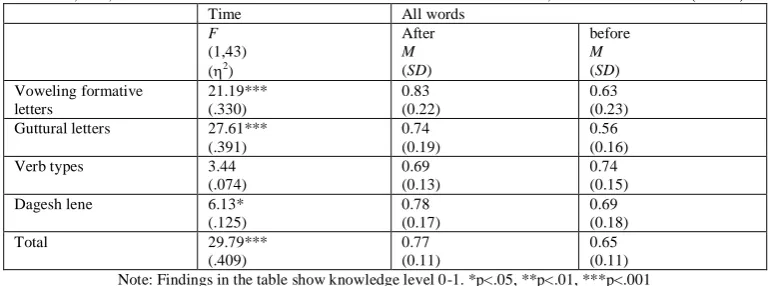
Table 2 shows means and SDs for the study variables for students with complete data, according to time, regardless of word type. Time was defined as a within-subject variable. A Multivariate analysis of variance was conducted for time for the four measures (voweling formative letters, gutturals, verbal types (lamed hehh/lamed alef), dagesh lene) and an ANOVA for overall score, as shown in Table 2.
TABLE 2.
MEANS,SDS, AND F VALUES FOR STUDY VARIABLES REGARDLESS OF WORD TYPE, ACCORDING TO TIME (N=44) All words
Time
before M (SD) After
M (SD) F
(1,43) (2)
0.63 (0.23) 0.83 (0.22) 21.19*** (.330) Voweling formative letters 0.56 (0.16) 0.74 (0.19) 27.61*** (.391) Guttural letters 0.74 (0.15) 0.69 (0.13) 3.44 (.074) Verb types 0.69 (0.18) 0.78 (0.17) 6.13* (.125) Dagesh lene 0.65 (0.11) 0.77 (0.11) 29.79*** (.409) Total
Note: Findings in the table show knowledge level 0-1. *p<.05, **p<.01, ***p<.001
The Multivariate analysis of variance for the four measures proved significant for time (F(4, 40) = 9.25, p<.001, 2 = .481), as did the ANOVA for time. For the overall score, voweling of formative letters, gutturals, and dagesh lene, knowledge level at the end of the year was higher than at the beginning. No difference was found between the start and end of the year in the knowledge level for verb types (lamed heh/lamed alef). The overall student body and the students with complete data evinced a similar pattern of changes from the year’s beginning to its end.
The importance of correct language usage
As noted above, measurements were taken of the students’ perception of the importance of correct usage in language with friends and at work, on a scale from 1 (not at all important) to 5 (very important).
Table 3 shows the distribution of the perceptions of students with complete data regarding the importance of correct language usage, at the beginning and at the end of the year.
TABLE 3.
PERCEPTION OF STUDENTS WITH COMPLETE DATA OF THE IMPORTANCE OF CORRECT USAGE OF LANGUAGE (%), BY TIME
Before (n=41) After (n=44)
Not important
Quite important
Important Very important
Not important
Quite important
Important Very important With friend 2 (4.5) 10 (22.7) 12 (27.3) 20 (45.5)
-- 5
(12.2)
18 (43.9)
18 (43.9)
At work -- -- 4
(11.4) 39 (88.6)
-- -- 7
(17.1) 34 (82.9)
No significant correlations were found between the degree of importance ascribed to the use of correct language and students’ age or level of knowledge of words generally, whether for pseudo-words or real words.
IV. DISCUSSION
The purpose of the present study was to test whether and the extent to which a change occurred in language awareness (phonological and morphological) of student teachers who completed the Language Sound and Form course. This test examined language knowledge learned during the course (application) and the ability to use this knowledge with new forms that do not exist in the language (transposition).
The findings indicate that regardless of word type (real word/pseudo-word), students who took the course differed significantly in their achievement from the beginning of the year to its end; thus, the course may have contributed to the student teachers’ KAL. The interaction between word type (real word/pseudo-word) and time (before/after the course) was found to be non-significant. This finding demonstrates that attending the course influenced the students’ achievements similarly with respect to both real words (application of language knowledge) and pseudo-words (knowledge transposition). There was a significant improvement in the students’ achievements at the end of the year compared with the beginning of the year in both word types regardless of category (formative words / gutturals / verb types / dagesh lene). Thus, in general, students’ achievements were greater with real words than with pseudo-words at both the beginning and the end of the course.
As for the category (regardless of the word type), for voweling formative letters, gutturals, and dagesh lene, the knowledge level at the end of the year was significantly higher than at the beginning of the year. No significant difference appeared between the beginning and the end of the year in knowledge level for verb types (lamed heh/lamed alef). These findings were also obtained for each word group (pseudo-words/real words) separately.
These findings run counter to those of Bigelow and Ranney (2005), who examined the degree of change in linguistic knowledge and phonological awareness of students after completion of a course in teaching Spanish. That study found that the students did not remember the material learned in the course when they were asked about its content at its end, and these students did not perceive the relevance of the linguistic knowledge studied in the course for their future teaching. In our study, conversely, the students certainly did improve their linguistic knowledge. Thus, it may be said that the course achieved its goal because it heightened sensitivity to the language structure of Hebrew words, which is considered a major and important component of knowledge in teacher training (Baca & Escamilla, 2003; Fillmore & Snow, 2002). This component proved significant because it ultimately enabled flexibility in language usage and its adaptation to students’ needs and encouragement of their learning (Fillmore & Snow, 2000; Cots, 2008).
With respect to students’ attribution of importance to correct use of language with friends and at work, significant differences were found between the two situations: correct language use at work was deemed more important. However, participation in the course does not seem to have changed the students’ opinions regarding this matter, which remained the same at the end of the year.
The improvement in students’ achievements due to their participation in the Language Sound and Form course matches Andrews’ (1997) claim about teachers’ language knowledge structure – which includes factual knowledge and applied knowledge of language awareness – as their achievements were better in both real words and in pseudo-words. This improvement attests to the fact that the students integrated the linguistic knowledge they acquired throughout the course with the ability to use it outside the inbuilt contexts of the course. This combination reflects the development of meta-linguistic awareness in the teacher trainees (Xiao, 2005), which consists of, among other things, both phonological and morphological awareness, which were specifically examined in this study. The fact that the improvement in pseudo-words was similar to that in real words indicates that the students not only acquired linguistic knowledge but also developed awareness of this knowledge and were able to use it in new and unfamiliar contexts.
The students’ application of their linguistic knowledge to real words was higher than to pseudo-words at both the beginning and at the end of the course. The task during the course was with real words, so this difference in application of their knowledge is natural. However, the very improvement in linguistic knowledge application to pseudo-words, which the students were not used to analyzing, attests to their understanding of the phonological and morphological structure of Hebrew words and to their awareness of these structures. The improvement exhibited with respect to the pseudo-words due to the students’ participation in the course was in fact significantly greater than their improvement in real words in voweling formative letters and the influence of gutturals, and this finding indicates the depth of learning and the awareness that developed in these subjects. In addition, the very success in contending with pseudo-words highlights an ability to understand the structure of the language and to perform linguistic analysis so that the future teacher can explain language features to others (Andrews, 2008; Cots & Arnó, 2005; Cots, 2008; Fillmore & Snow, 2000).
1), and it is possible that on that account there was relatively little practice time on this subject, and therefore no improvement was found in students’ achievements in this category.
To test this issue, the lecturers who taught the Language Sound and Form course in the different groups of research participants were asked to grade the different subjects according to the amount of time dedicated to each category. The results supported the possibility that the verb types category was accorded the least time of all. A further possibility is that the students’ achievements in this category were higher from the outset (see Tables 1, 3) and that the knowledge acquired on the course thus did not add to prior knowledge.
The students found the correct use of language highly important from the start of the course. Most ranked its importance among friends or at work as important or very important (see Table 3). Nevertheless, the importance they attributed to correct language use varied with respect to use with friends and at work as teachers and educators, and they ranked the importance of the latter higher than that of the former. This difference was found to be significant at both the beginning and at the end of the year. No change occurred in the students’ perception of the importance of correct language use as a consequence of their participation in the course. Their positive perceptions regarding correct language use form the basis of their professional development, and can serve the teachers with respect to improving their future teaching (Owen & Edwards, 2005; Gerb, Stroller & Tandy, 2000).
To summarize, at the beginning of the year and the course there was a wider gap between their positions on the importance of correct language usage and in their language knowledge and in their ability to use it. Although the students graded correct use of language as important and very important, both with friends and at the workplace, they had inadequate knowledge of correct linguistic usages on a relatively high level. This gap narrowed following their completion of the course and the improvement in their achievements. According to Andrews and McNeill (2005), teachers’ language awareness covers not only their language knowledge but also their beliefs as to its importance. These beliefs can guide the teacher to success in the manner in which he or she uses language in teaching and therefore to successful teaching in general.
In conclusion, the present study presented an opportunity to evaluate the change in language knowledge of student teachers as a result of their participation in an applied linguistics course. The importance of conducting such an evaluation has been noted by several researchers in the field (Angelova, 2005; Bartels, 2011; Bartels & Borg, 2003). Our study showed that the course imparted to its participants the skill to handle language challenges in a manner that gives practical expression to the instruments mastered during the course.
This research project is of applied importance with respect to its evaluation of change in knowledge acquired in a language course. Although there is ample theoretical engagement in the importance of linguistic qualification of future teachers, no systematic empirical test has been conducted on the efficacy of the courses for their participants (Bartels 2005, 2006). Researchers (e.g., Angelova, 2005; Bartels, 2002; Borg, 2011) have suggested that any change in the language knowledge of student teachers due to their participation in applied linguistics courses must be assessed by a range of research means and tools. Another unique aspect of this study is how it combined an evaluation of a program (a language course for student teachers) with linguistics measures, which include addressing phonological and morphological awareness of native speakers of the language.
The present study has educational importance for both theory and practice. For theory, the study examined the broad question of whether it is possible to change language patterns in the mother tongue of adult speakers, whereas for practice, it investigated whether a course in language education improves student teachers’ language awareness. The research findings can also indicate the weak points of the course and can thus serve for designing future courses on language nurturing. Nonetheless, one should also consider that students are exposed to a variety of academic content during their first year of academic studies, and these other types of academic content may also contribute to a change in the trainee students' language knowledge and awareness. It might be interesting to compare this change with students who did not participate in this obligatory course (which cannot be found in the current trainee courses' program).
As further study, we propose tracing students’ language knowledge and language awareness three years following completion of the course, and testing whether and to what extent the knowledge gained is preserved in the long term. It is also important to investigate how student teachers use the tools and language awareness developed in this course in the framework of their classroom teaching and throughout their work as teachers advancing in their careers.
APPENDIX 1
Syllabus for Language Sound and Form – a year’s course: 2013 Course name: Theory of Sound and Form
Lecturer’s name: xxx
Number of weekly hours per year: 2 Admission requirements: None Type of course: Lesson and practice Course classification: Language Education Course aims:
The student will nurture language correctness in the domain of pronunciation The student will know the modes of expanding language in the present day Study subjects:
First Semester
1. Phonology theory – basic concepts: consonants, vowels (names and types) forms of sheva, dagesh, stress, syllables 2. Rules of syllable voweling
3. Word patterns
4. Language processes in contemporary Hebrew: rules of stress separation, breaking consonant cluster, added dagesh 5. Pointing formative particles and formative letters
6. Rules of use of name of number 7. Correct pronunciation
Second semester
1. Morphology theory – basic concepts: forms of inflection and forms of verb types 2. Modes of enlarging the language
3. Word transparency
4. The strong verb: root groups 5. The verb system: root groups 6. Verb derivation
7. Correction of pronunciation
8. Fluent reading of modern voweled and non-voweled texts Requirements:
Active participation in classes Attendance (80%)
A test each semester (20% of the semester score)
An examination at the end of the semester (80% of the semester score) Passing score for the course: 70
Bibliography – all works are in Hebrew (*obligatory reading)
*Bahat, S. (1987), The methods of the Hebrew Language Academy with neologisms, Leshonenu La’am, 38, 506-551. Ben-Tolila, Y. (1990). Spoken Hebrew, a book for the language year, 40-41.
Berger, A. (1993). Knowledge of language, pronunciation and noun. Jerusalem: Mishlav. Nir, R. (1993). Ways of lexical creation in contemporary Hebrew. Tel Aviv: Open University. Netzer, N. (1976). Vowelization in theory and practice. Ramat Gan: Masada.
Rozen, M. (1993) Issues in our language. Even Yehuda: Rekhes.
Schwarzwald (Rodrigue), O. (2002). Issues in Hebrew Morphology. Tel Aviv: Open University.
REFERENCES
[1] Andrews, S. (1997). Metalinguistic awareness and teacher explanation. Language Awareness, 6(2/3), 145–161.
[2] Andrews, S. (1999). “All these little name things”: A comparative study of language teachers’ explicit knowledge of grammar and grammatical terminology. Language Awareness, 8(3/4), 143–159.
[3] Andrews, S. (2008). Teacher language awareness. In J. Cenoz & N.H. Hornberger (Eds), Encyclopedia of language and education, vol. 6: Knowledge about language, pp. 287-298. Springer Science & Business Media LLC.
[4] Andrews, S. & McNeill, A. (2005). Knowledge about language (KAL) and the “good language teacher.” In N. Bartels (Ed.),
Applied linguistics and language teacher education, pp. 159-178. New York: Springer.
[5] Angelova, M. (2005). Using Bulgarian mini-lessons in an SLA course to improve the KAL of American ESL teachers. In N. Bartels (Ed.), Applied linguistics and language teacher education, pp. 27-42. New York, NY: Springer.
[6] Argaman, O. (2010). The gap between knowledge and use of “fancy words” in the education system. Journal of the Mofet Institute, 44, 53-57 (in Hebrew).
[7] Attardo, S. & Brown, S. (2005). Understanding language structure, interaction and variation (2nd ed.). Michigan: University of
Michigan Press.
[8] Baca, L. & Escamilla, K. (2003). Educating teachers about language. In C.T. Adger, C.E. Snow & D. Christian (Eds.) What teachers need to know about language, pp. 71-83. Washington DC: Center for applied linguistics.
[9] Bardovi-Harling, K. & Hartford, B. (1997). Beyond methods: Components of second language teacher education. New York: McGraw-Hill.
[10] Bartels, N. (2002). Professional preparation and action research: Only for language teachers? TESOL Quarterly, 36(1), 71-79. [11] Bartels, N. (2003). How teachers and researchers read academic articles. Teaching and Teacher Education, 19(7), 737-753. [12] Bartels, N. (2005). Researching applied linguistics in language teacher education. In Applied linguistics and language teacher
education, pp. 1-26, US: Springer.
[13] Bartels, N. (2006). Applied linguistics and language teacher education, vol. 4. US: Springer Science & Business Media. [14] Ben Shahar, R. (2003). Is Hebrew a hated language? Panim, 24, 29-42 (in Hebrew).
[16] Bigelow, M. H. & Ranney, S. E. (2005). Pre-service ESL teachers’ knowledge about language and its transfer to lesson planning. In Applied linguistics and language teacher education, pp. 179-200. US: Springer.
[17] Bolitho, R. (1987). Teaching, teacher training and applied linguistics. In V. Bickley (Ed.), Re-exploring CELT: Continuing Education for Language Teachers, pp. 26-32. Hong Kong: Institute for language in Education.
[18] Borg, S. (1999). Studying teacher cognition in second language grammar teaching. System, 27(1), 19-31.
[19] Borg, S. (2003). Teacher cognition in language teaching: A review of research on what language teachers think, know, believe, and do. Language teaching, 36, 81-109.
[20] Borg, S. (2011). The impact of in-service teacher education on language teachers' beliefs. System, 39: 370-380.
[21] Borstein, R. (2010). Language studies in the sixty years of the state of Israel: Retreat or Progress? Journal of the Mofet Institute, 44, 10-15 (in Hebrew).
[22] Breen, M. P. (1991). Understanding the language teacher. In R. Phillipson, E. Kellerman, L. Selinker, M. Sharwood Smith, & M. Swain (Eds.), Foreign/second language pedagogy research. Clevedon, UK: Multilingual Matters.
[23] Brown, J., & McGannon, J. (1998). What do I know about language learning? The story of the beginning teacher. Retrieved September 20, 2001, from http://www.cltr.uq.edu.au/alaa/proceed/bro-mcgan.html.
[24] Carlisle, F.J. (2010). Effects of instruction in morphological awareness on literacy achievement: An integrative review.
Reading Research Quarterly, 45 (4), 464 – 487.
[25] Carlisle, J.F. (2003). Morphology matters in learning to read: A commentary. Reading Psychology, 24, 291 – 322. [26] Clarke, M. A. (1994). The dysfunctions of the theory/practice discourse. Tesol Quarterly, 28(1), 9-26.
[27] Cots, J. M. (2008). Knowledge about language in the mother tongue and foreign language curricula. In Encyclopedia of language and education, pp. 1782-1797. US: Springer.
[28] Cots, J. M. & Arnó, E. (2005). Integrating language teachers’ discipline knowledge in a language course. In Applied linguistics and language teacher education, pp. 59-78. US: Springer.
[29] Edwards, C. & Owen, C. (2005). The impact on teachers of language variation as a course component. In Applied linguistics and language teacher education, pp. 43-58. US: Springer.
[30] Fillmore, L. & Snow, C. (2000). What teachers need to know about language. Washington DC: US Department of Education, Office of Educational Research and Improvement (http://files.eric.ed.gov/fulltext/ED444379.pdf). Retrieved on February, 26, 2015.
[31] Fillmore, L. & Snow, C. (2002). What teachers need to know about language. In C. A. Adger, C. E. Snow & D. Christian (Eds.),
What teachers need to know about language (pp. 113-122). McHenry, IL: Delta Systems; Washington, DC: Center for Applied Linguistics.
[32] Freeman‚ D. (1994). The use of language data in the study of teachers’ knowledge. In I. Carlgren‚ G. Handal & S. Vaage (Eds.)‚ Teachers’ minds and actions. London: Falmer.
[33] Glasgow, G. (2008). Language awareness, metapragmatics and the L2 Teacher. Accents Asia [Online], 2(2), 1-16.
[34] Grabe, W., Stoller, F. & Tardy, C. (2000) Disciplinary knowledge and teacher development. In J. K. Hall (Ed.), The sociopolitics of English language teaching. Great Britain: Multilingual Matters.
[35] Green, L. (2009). Morphology and literacy: Getting our heads in the game. Language, Speech and Hearing Services in School, 40, 283-285.
[36] Harper, H. & Rennie, J. (2009). “I had to go out and get myself a book on grammar”: A study of pre-service teachers' knowledge about language. Australian Journal of Language and Literacy,32(1), 22-37.
[37] Hislam, J. & Cajkler, W. (2005). Teacher trainees’ explicit knowledge of grammar and primary curriculum requirements in England. In Applied Linguistics and Language Teacher Education, pp. 295-312. US: Springer.
[38] Horwitz, E.K. (1985). Using student beliefs about language learning and teaching in the foreign language methods class.
Foreign Language Annals, 18(4), 333-340.
[39] Kuo, L. & Anderson, R. C. (2006). Morphological awareness and learning to read: A cross language perspective. Educational Psychologist, 41, 161-180.
[40] Lantolf, J. P. (2009). Dynamic assessment: The dialectical integration of instruction and assessment. Language Teaching, 42, 355-368.
[41] Margolin, B. & Merav, N. Hebrew language studies at Levinsky College: The state of the art. Journal of the Mofet Institute, 44, 32-35.
[42] Peacock, M. (2001). Pre-service teachers’ beliefs about second language learning: A longitudinal study. System, 29, 177-195. [43] Schwartzwald, A. (1996). Needs and goals in teaching language in colleges. Dappim, 22, 7-18 (in Hebrew).
[44] Stern, H. H. (1983). Fundamental concepts of language teaching. Oxford: Oxford University Press
[45] Van Essen (1997). Language awareness and knowledge about language: An overview. In L.V. Lihr & D. Corson (Eds.),
Encyclopedia of knowledge and education, vol. 6: Knowledge about Language, pp. 163-172, Dordrecht: Kluwer Academic Publishers.
[46] Widdowson, H.G. (1990). Aspects of language teaching. Oxford: Oxford University Press.
[47] Wright T. & Bolitho R. (1993). Language awareness: A missing link in language teacher education? ELT Journal, 47(4), 292-304.
[48] Wright T. & Bolitho R. (1997). Language awareness in in-service programmes. In L.V. Lihr & D. Corson (Eds.), Encyclopedia of knowledge and education, vol. 6: Knowledge about language, pp. 173-182, Dordrecht: Kluwer Academic Publishers. [49] Wright, T. (2002). Doing language awareness: Issues for language study in language teacher education. In H. Trappes‐Lomax
& G. Ferguson (Eds.), Language in language teacher education, pp. 113-130. London: John Benjamin.
Osnat Argaman, Ph.D. (Hebrew Language Department, Haifa University, 2006), is a Senior lecturer and a researcher in the department of Hebrew Language, Gordon College of Education. She is also the Dean of Graduate Studies and Vice President in the College. Her Research interest areas are Language Education, The Psychology of language: Language and emotion, Language and cognition; Language and society, the research of Hebrew as a mother tongue, the research of discourse as a reflection of culture and Lexical Semantics.