International Journal Advances in Social Science and Humanities
Available Online at: www.ijassh.com
RESEARCH ARTICLE
Pattern of Inland Water Transport in Lokoja, Kogi State of Nigeria
Aper JA*, Kogi HA
1Department of Geography, Benue State University, Makurdi and Onuche. 2State Polytechnic, Lokoja.
*Corresponding Author: Aper JA
Abstract
Inland water transport in Nigeria has declined because of completion from other means of transport like air, rail, and roads. The construction of bridges over River Niger has posed some challenges to the prospects of inland water transport in the area. Yet this means of transport holds some potential for socio-economic development in the study area. This research has examined the status of inland water transportation in Lokoja to determine the pattern of commuters, spatial interaction, variations in crafts, freight, commuters and economic benefits of inland water transport in Lokoja inland port. Using a survey approach, the study interviewed 182 randomly selected commuters at Lokoja inland station using questionnaire. Traffic data (January-December, 2007) was collected from the National Inland Water Ways Authority (NIWA). The study notes that the major commuters are traders (56%) and the spatial interaction of inland transport is driven by threshold demand, reduced friction in interaction and ease of access. Thus, 79% of the commuters prefer water transport as it offers less cost and more benefits for exchange of goods and services. The volume of inland transport is higher (64%) on market days than on non-market days (36%) and seasonal variation in transport flow is not significant. The study concludes that there is a need to improve the water transport system in Lokoja as it has the potential to boost existing socio-economic activities in the region.
Keywords: Inland, Water, Lokoja, Transport, Ullman, Pattern.
Introduction
Inland water transport involves the use of territorial water to link the hinterland [1].Water transport is the oldest means of transport used by man in moving goods and persons from one point to another. This has been so because two-third of the earth is covered with water and as such provides a natural medium through which persons and goods can be transported with ease [2].
In Nigeria, inland water transportation has played a key role in the nation’s socio-economic and political development. It serves as a factor for exchange of goods and services, human interaction, sub-national integration and inland communication which are essential not only for economic and social development but also for the welfare of people living in isolated communities and remote riverine areas. Besides, inland transport is considered a safer and cheaper means of transportation when compared to others like road and air [3-4]. Nigeria is blessed with an extensive network of rivers,
creeks and lagoons. Its developed portion of inland waters for transportation is far from the best that could be obtained from the present potential. However the water ways system remains very useful in the movement of goods, services and persons internally and externally. It is observed that it is only in Lagos, and other parts of coastal Nigeria, that the inland water mass transit system of transport has been developed to ease transportation problems.
extent to which it facilitates socio-economic activities in the region and satisfy the needs of the commuters. The research has examined the capacity and types of crafts used for inland water transportation in Lokoja region, the seasonal and periodic variations in the volume of passenger and freight, the routes travelled by commuters and volume of traffic flow along such routes as well as the determinants of the volume of interaction in the inland water transport system in the study area.
Theoretical Framework
The process and pattern of inland water transport can be explained using the Ullman’s theory of spatial interaction. Ullman explains that for there to be spatial interaction in a region in whatever form, there are three basic requirements that must be present such as complimentarily, intervening opportunity and transferability. This means for areas, towns, districts and transport points in a particular region to be complementary; there must be demand for what is being produced or what is readily available in a particular place by another place or area. Also, where there are alternative sources of supply or routes of
interaction of goods and services or close substitutes apart from the original place of origin, the alternative source becomes an
intervening opportunity. According to
Ullman, time and cost are two important factors to be considered when selecting a form of spatial interaction. In his view, spatial interaction will take place between two different points or places where the cost is low and it is faster to link up than where it involves high cost and more time. Thus, the cost of boarding boat from one point to another within Lokoja inland water system, for example will facilitate movement of goods, services and passenger (transferability). Thus the Ullman’s theory is used in analysing inland water transport in Lokoja town.
Materials and Methods
Lokoja is situated along the river bank at the confluence of River Niger and River Benue. It is geographically and historically significant, being in the centre of Nigeria and formerly the administrative headquarters of the country, and now as the capital town of Kogi State. Lokoja is located between latitude 70.301 - 70.401 N and longitude 60 00- 60.441 E, with an elevation of 144.0 ft absl (Fig. 1).
The terrain of Lokoja region is undulating with isolated hills like Mount Patti and some rock outcrops dotting the crystalline
basement complex and sedimentary
geological formations. River Benue is one of the major tributaries that drain into River Niger at a confluence in Lokoja town. Lokoja lies within the tropical savannah (Koppen AW) with dry and wet seasons. The wet season stretches between April-October, while the dry season begins from November to March.
The seasonal pattern of rainfall influences volume of water in the transport channel. As the commercial nerve centre of the country, Lokoja has become very famous, with the River Niger and River Benue playing very important role in moving persons, goods and services associated with the various socio-economic activities such as weaving, fishing,
farming, irrigation agriculture,
transportation, hunting and mining. Lokoja has major markets of five-day cycles and smaller daily markets.
Data collection for this study covered 26 alternate weeks from January to December, 2007. Information was generated on craft types, routes covered, volume of transport flow into Lokoja inland port. Inland water routes coverd in the study Lokoja to Adike, Gbegede, Irenedu, Edumusi and Mozu on Koto route in Karfi LGA; Gande and Gbobe, and Shintaku on Bassa route in Bassa LGA;
Geregu, Nkelegwu and Ichewe on Ajaokuta route to Bassa LGA; Kpata (Old Lokoja Port), and Ganaja in Lokoja LGA all of Kogi State; Loko in Nasarawa State and Agatu in Benue State. Data on volume of goods was estimated using standard bag and baskets as some produce like okra and pepper that are packaged in small baskets. Other primary data on inland transport were collected using
questionnaires and observations
administered on 180 randomly sampled commuters at the Lokoja inland water station.
Result and Discussion
Demographic Pattern of Commuters in the Study
According to Table 1, most of the inland water commuters are between 18-53 years old. Thus non-adults and the elderly hardly use inland water transport in the study area may be because of the hazards associated with the open canoes and boats that ply without life safety facilities. There are more male commuters (58%) than female (42%). Also 67 % commuters have no formal education, 5 % have attended primary education 18% and 10% respectively have attended secondary and tertiary education. Also, 53% of the commuters are traders, 22% farmers, 18% students and few artisans (5%) and civil servants (2%). This implies that inland water transport in Lokoja is used by traders who move bulky agricultural goods from the hinterland.
Table 1: Demographic pattern of commuters at Lokoja port
Demography Frequency %
Age Below 18
18-35 36-53 54-71 72 above
58 67 39 9 9
Total 182
Gender Male
Female 106 76 58 42
Total 182 100
Education None formal Education
Primary Secondary
Tertiary
122 9 33 18
67 5 18 10
Total 182 100
Source: Author, 2009
Spatial Pattern of Inland Transport in Lokoja
Based on Table 2, the highest mean daily commuter flow is between Lokoja and Kogi in Kogi L.G.A (50.5%) while the least flow is
and non market days to into Lokoja while those from Ajaokuta Local Government Area, Nasarawa Toto and Owe to interact with Lokoja mostly on the market days. A similar pattern is found in the passenger flow except that Ajaokuta inland water way. From the information, there is a higher frequency of
goods and services into Lokoja town from the surrounding villages in Kogi and Bassa LGAs, than any other hinterland routes i.e Owe to and Nasarawa Toto. This situation is similar to the proposition of Odumeru [8] that areas closer to each other will interact more as movement is made easier.
Table 2: Percentage volume of traffic on routes at the Lokoja inland water system
Route River craft (%) Passengers (%)
Kogi 50.5 45.3
Bassa 40.6 24.7
Ajaokuta 4.6 11.2
Nasarawa Toto 2.8 12.2
Oweto (Agatu) 1.5 6.5
100 100
Source: Author, 2009
Commuting Pattern in the Inland Water Transport
Analysis of the pattern of inland commuting by passengers indicate that 95.1% of the total number of commuters use water transport twice daily, 1.6% commute thrice a day and the lowest percentage of commuters are those who move once a day(3.3%). This pattern of commuting indicates a high frequency of daily interaction between the hinterland and Lokoja inland port. Also 81.8% of the commuters travel in the mornings and evenings while 9.9% commuters use inland travel in morning and afternoon only and
very few persons use the mode either in the afternoon or morning (0.1%) and the remaining 6% use it at any time of the day. Most passengers in the mornings or evenings are either returning or going to markets, schools or places of work. Lokoja is the centre of the activity space that pulls the commuters in the morning to carry out their daily socio-economic activity and there after return to their homes at the close of their activities. Those who use it once a day either in the morning, afternoon or evening only, use it as an intermediary transport on travelling to or return from some other parts of Lokoja or Nigeria across the inland port to and from the hinterland.
Table 3: Number of daily trips by commuters
Trip Frequency Commuters %
I II III
6 173
3
3.3 95.1
1.6
Total 182 100.0
Source: Author, 2009
Reasons for Choice of Mode of Inland Water Transport
According to Fig.2, 79% of the commuters prefer water transport because it saves time, it is cheaper and safer, while 15% use this mode because it is cheaper and safer and the
remaining 7% and 2% use it either because it is the only means available to them. This means that the commuters have identified water transport as a mode with which they can overcome the friction of distance in both time and money easily.
0 10 20 30 40 50 60 70 80
Safe, Cheap & safe time
Cheap & safe Only means Others
Percentage
Percentage
River Craft in the Inland Transport in the Area
The types of river craft used for inland water transport in Lokoja include the wooden canoes, the small engine or motorized boats (barges). The canoes are made of woods and do not use engines, cost less to buy and are cheaper to board than the other types of boats but are very slow in speed.
Canoes are commonly used for transporting firewood, and vegetables-pepper, okra, tomatoes and fish. The canoes have the capacity of conveying about 10 persons on very short distance journeys, the small engine boats have a carrying capacity of 50 persons and good on short and relatively far journeys, the big engine boat on the other hand have a carrying capacity of 200 persons in with goods and are used for distant journeys. All the boats in the study area are owned by individual private operators. Lokoja residents own 15 motorized boats and over 150 canoes that are used for
transporting both goods and persons and for fishing. The National Inland Waterways Authority owns one ferry which is not in use presently [9]. The small motorized boats are made of wood, powered with an engine, are faster than canoe, but are more costly to buy and expensive to board.
The motorised boats are made from wood, powered by engine, more expensive than both the small motorized boat and canoe, has the capacity of conveying 200 persons and about 150 bags of grains. Most goods are conveyed by this type of craft in the Lokoja inland water port. According to Table 3, the small motorized boat was the most used for transporting goods and persons from and to the Lokoja port accounting for 42.5% of the total volume of craft which is because it is faster (speed) than the canoe and gets filled up faster than the big engine boat which is the least used.
Table 3: Distribution of craft type in the inland transport in Lokoja
River Craft/Route Number %
Canoe 2724 35.6
Small Boat 3260 42.5
Big Boat 1679 21.9
Total 7663 100.0
Source: Author, 2009
Pattern of Goods Transported in the Inland Waterway
Much of the goods transported in the inland transport are agricultural produce (57%), fuel/firewood (26%), manufactured goods (19%) and domestic animals (5%) and other unclassified goods (2%). This shows that the
commuters mostly move agricultural produce who are also farmers who especially move their produce for sales in Lokoja town. There
is however a lower percentage of
manufactured goods in the inland transport which are goods moved to the hinterland either for sale in local markets or bought by local commuters from the hinterland.
Table 4: Types of goods transported in the Lokoja water syatems
Goods Passengers %
Agricultural goods 93 57
Fuel/firewood 47 26
Manufactured goods 35 19
Animals/Birds 5 5
Others(unclassified) 2 2
Total 182 100
Source: Author, 2009
Based on table 4.8, the total volume of goods transported was 49,561,400 kilograms of which the small motorized boat carried the highest amount 19, 560,000 kilograms and the canoe carried the lowest amount 13,211, 400 kilograms while the Big motorized boat conveyed 16, 790,000 which is almost 2.8 million kilograms less the small motorized boat. This is because the small motorized
Apart from this the Big Motorized Boat is
mostly used on market days only while the small motorized boat is used on both occasions.
Table 5: Estimated volume of freight (kg) transported by various crafts
Type of craft Volume of good (Kg) Percentages (%)
Canoe 13, 211, 400 26.7
Small Boat 19, 560, 000 39.5
Big Boat 16, 790, 000 33.9
Total 49, 561, 400 100.1
Source: Author, 2009
Volume of Traffic in the Inland Waterway in Lokoja
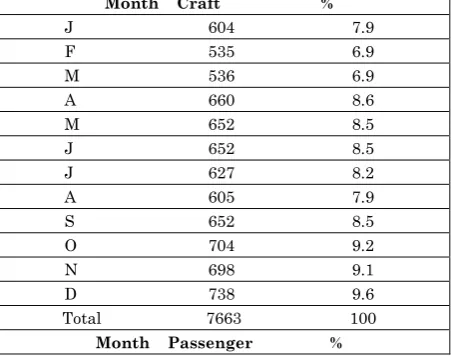
The annual volume of 184, 848 passengers were transported using 7, 663 crafts to and from Lokoja in the study period. The highest volume of passenger traffic was in the month of October (21, 607) and the lowest in the month of February (8,515), while the highest volume of river craft traffic was recorded in the month of December (738) and the lowest in February (535) almost as the human traffic. Seasonally, the highest volume of craft traffic was in the rainy season, April-October (59.4%) while the lowest is in the dry season, November-March (40.6). This is due to the fact that all boat types can move at this period, moving agricultural products to the market while in the dry season, fewer large boats travel at this time of the year.
Table 6: Annual pattern of craft and passenger traffic flow at Lokoja inland port
Month Craft %
J 604 7.9
F 535 6.9
M 536 6.9
A 660 8.6
M 652 8.5
J 652 8.5
J 627 8.2
A 605 7.9
S 652 8.5
O 704 9.2
N 698 9.1
D 738 9.6
Total 7663 100
Month Passenger %
J 11840 6.4
F 8515 4.6
M 10842 5.9
A 10468 5.7
M 9912 5.4
J 11611 6.3
J 17215 9.3
A 18926 10.2
S 20983 11.4
O 21607 11.7
N 21512 11.6
D 21417 11.6
Total 184848 100
Similarly, 59.9% of passengers plied the port in the rainy season as against 40.1% in the dry season. This is because the passengers who are mostly farmers and food traders have more goods for exchange to the market during the wet season and probably because the rainy season period is longer than the dry season.
Volume of Water Transport on Market and Non-Market Days
Here the volume of river craft and passenger traffic on market and non-market day at the
Lokoja port is discussed. Lokoja Township has a four (4) day interval market which is known as the market day. During the data analysis it was discovered that some months had 7 market days and others 8 market days. While the non-market days are those days that are not major market days for the year a total of 91 days was identified as market days while the remaining 274 days as non-market days. This is to say that non-market days stand for about ¼ of the total number of days in a year.
Table 7: Volume of water traffic in Lokoja on market days and non- market days
Month Passengers: Market and Non-Market
days River Craft: Market Days Non-market days
January 7208 4632 261 343
February 4510 4005 204 331
March 5703 5139 229 307
April 5803 4665 351 309
May 5155 4757 278 374
June 6749 4862 351 301
September 14679 6304 371 281
October 15310 6297 400 304
November 15117 6395 332 366
December 14488 6929 403 335
Total 117804 67077 3814 3849
% 63.7 36.3 49.8 50.2
The Lokoja market which is a periodic market has some influence on traffic flow however the difference in volume of traffic on market days and non-market days at the Lokoja crossing point is not significant. This implies that almost the same number of craft are used every day and or because the numbers of days in the non-market days are higher than those of the market days, 274 against 91. Based on table 4.12, the volume of passengers on the Lokoja market days were higher than those on the non-market day.
Those on the market day accounted for 64% of the total number of passengers transported while the remaining 36% fall on the market days. Volume of passenger on non-market days is almost two times the volume of passengers on market days. This is to say that the people are drawn to travel more on market days either carrying goods to sell or buying goods on market days or doing both, indicating that most of the users are business minded persons (traders) and also that there is demand for goods more on market days
Conclusion
From the above pattern, inland water transportation is an important means of moving bulky goods, services and persons from one point to another within Lokoja axis. It is a means for economic and social development but also for the welfare of people living in isolated hinterland isolated communities in the region. The commuters in the study area and catchment hinterland chose this inland water transport system because of its cost and benefits over other modes of transport.
The past under-investment in inland transport development in Nigeria and undue investment in road and air transport network has reduced the importance and viability of this system of transportation. Inland transport can overcome friction of distance in terms of time of travel and money, traffic jams and potholes when compared to the bad roads in the country. Water routes have no construction cost, have cheap maintenance as
natural water ways, thus they offer potentials for inland movement of vast agricultural goods and services in riverine communities. It is in view of this the government is currently carrying out a dredging activity along the River Niger generally as this will boost water transport and increase socio-economic activities along the lower River Niger.
Also government needs to allocate more funds to the general development of inland water transport. The cleaning up of the debris and weeds on waterways regularly, provision of users with good jetty, modern boats with comfort, safety gadgets and
creating awareness on the various
advantages of inland water transport. Based on the findings of this study it is recommended that apart from the analysis of volume of traffic; craft, passengers and goods from Lokoja to other areas and those from other areas to Lokoja could be compared to find out or test the level of complementarities of those areas to Lokoja and vice versa. Further studies could be carried out to really establish the safety level and cost benefit when compared to other modes of transportation.
References
1. Weshall Birk, Newell History (2007) Inland Water Transport in Minnesota. Adapted from: The Shipwrecks of Minnesota’s Inland Lakes and Rivers, Minnesota Historical Society. 2. Abubakar AA (1989) “Evolution of Ferry
Services in Mass Transit” in S.G. Ikya (Ed)Urban Passenger Transportation in Nigeria (Heinemann Educational Books, Ibadan). 3. Deplaix JM (1988) Inland Water
Transportation: “An economic and efficient Mode” in Haraty, M.J. (ed) Developing World Transport, Grosvenor press, London, 291-293. 4. Ikporukpo CO (1994)”The Development and
Utilization of Nigeria’s Inland Water System: Status and Ideals”. The Nigeria Geographical Journal.1:187-200.
5. Azagba PJI (2004) Transportation and National Development in Nigeria NITT, Zaria, Nigeria. 6. Olomoda IA(2001) “Variability of River Niger
Hydrology and its Impact on Navigation”. A paper presented at a 3-day international conference on Navigation activities within the Niger River Basin in West and Central Africa Sub-region, Held at Abuja on the 26th -28th. 7. Douglas IE (2001) Impact of Navigation on
Socio-economic Development of West and Central Africa sub-region and as a veritable tool for the promotion of tourism and sports”. A paper presented at a 3-day international conference on Navigation activities within the Niger River Basin in West and Central Africa Sub-region, held at Abuja on the 26th- 28th.
8. Odumeru RY (2002) Operation and Management of ferry services in Lagos State. Unpublished BSC. Project, Department of Geography and Planning Lagos State University Ojo, Lagos State.
9. Alhaji Baba Yusuf (2007) Chairman River Transportation Association Lokoja Branch Interview.
10. Abbas AM (2005) Inland Waterway Transport Development in Nigeria. A case S tudy of Lokoja. Unpublished Project Work.
11. Abdulkadir M (1994) Activities and Achievement of Kogi Local Government of Kogi State. A field Course Attachment report.
12. Adurodija E (2005) A Developmental Perspective of Kogi State. Unpublished text Book.
13. Akpoghomeh OS (2000) River craft Accident and Safety in Eastern Niger Delta Region of Nigeria”. The Nigeria Geographical Journal, New Series, 3(4):132-146.
14. Amos P (2005) Medieval Trade and Industry. Student Seminar Report.
15. Anoyo IA (2003):The Week: Imperatives of a transport policy Lagos. Sub Saharan Pres Ltd., 14.
16. Anyaoku BO (1990) “The development of Nigeria Inland Waterways” in Adegbeni et al (eds) Transport and National Development in Nigeria.
17. Anyaoku BO (2001)“Overview of Inland Waterways Transportation in West and Central Africa. The Nigerian Experience”.A paper presented at a 3-day International Conference on Navigation Activities within the Niger River Basin in West and Central Africa Sub-region, held at Abuja on the 26th -28th.
18. Areola OO, Filani M (1978) A Geography of Nigerian Development, (2nd ed.). Heinemann, Ibadan, .45-70.
19. Barau AD (1992) Transport Economics. Lecture delivered on the course on “Transport Planning and Management” organized by NITT, Zaria 1992 Business lines “Logistics”
20. Barrette R (1989) Urban Transportation in West Africa. The World Bank, Washington DC, USA.
21. Focus on Inland Water Transport to Boost Growth (2001) From the Hindu Group of Publications Friday, 28.
22. De Gramont S (1975) “The Strong Brown God” The Story of the Niger River, Houghton Mifflin Company, USA.
23. Edokpayi SI (1961)The Niger and The Benue in Nigeria Economy: Past, Present and Future”. Nigeria Journal of Economic and Social Studies, 3(1):68-77.
24. El-Rufai NA (2001) “The Imperative of Privatization of inland Waterways Development and Operations”. A paper presented at a 3-day international Conference on Navigation activities within the Niger River Basin in West and Central Africa Sub-region, held at Abuja on the 26th -28th.
25. Habibou HM (2001) “Niger Policy on River Transport”. A paper presented at a 3- day international conference on Navigation activities within the Niger River Basin in West and Central Africa Sub-region, held at Abuja on the 26th- 28th.
26. Hartshorn and Alexander (2000): “Transportation in Nigeria National Development” NISER, Ibadan.
27. Hoyle BS, Hilling D (1963) Seaports and Development in Tropical Africa. London: Longman Publishers Ltd.
Nigerian Geographical Journal. New Series, 3(4):29-40.
29. Koppen W (1936) Die Klimale Der Erde Welferde Giruyte Berlin.
30. Laboyrie JH, Pearson S, El- Rufai NA (2001)Dredging of River Niger as a Catalyst for Socio-economic Growth and Development” A paper presented at a 3-day international conference on Navigation activities within the Niger River Basin in West and Central Africa Sub-region, held at Abuja on the 26th -28th. 31. Oguntoyinbo JS (1983) “CLIMATE” In
Oguntoyinbo J. S. Areola O. O. and Filani M. (eds). A geography of Nigeria Development, (2nd ed.). Heinemann, Ibadan. 45-70
32. Ojo O (1977) the Climate of West Africa. Heinemann, Ibadan, Nigeria.
33. Osanwuta DA (2006) Geo-informatics as a Tool for Improved Navigation in the Nigeria Inland Waterways. Unpublished.
34. Owen ID (1987) Transport and Development. Hutchinson, London.
35. Pratt (1970) A History of Inland Transport and Communication. David and Charles Publisher London.
36. Senior M, Okunrotifa P O (1983) A Regional Geography of Africa. Longman, Lagos. 49-56. 37. Udo RK (1981) Geographical Regions of Nigeria.