ISSN-L: 2501 - 1235 Available on-line at: www.oapub.org/edu
doi: 10.5281/zenodo.3779299 Volume 6 │ Issue 3 │ 2020
THE EFFECT OF STRENGTH EXERCISES ON VERTICAL JUMP
IN HANDBALL PLAYERS WITH AGES BETWEEN 15 AND 17
Mustafa Said Erzeybek1i,
Irfan Gülmez2
1High school of Physical Education and Sports, Kütahya Dumlupınar University,
Kütahya, Turkey 2Faculty of Physical Education and Sports, Marmara University,
İstanbul, Turkey
Abstract:
In our study, we tried to investigate the effect of strength exercises with handball players on vertical jump. 24 athletes (n = 12 Experiment A group, n = 12 Experiment B group), who struggled with the handball league infrastructure with the ages between 15 and 17, participated in our research. In addition to the technical and tactical exercises 3 days a week for 8 weeks, the experimental group A carried out the Olympic lifts 2 days a week. In addition to the technical tactical exercises 3 days a week, the experimental group B carried out 2 days of force exercises without Olympic lifts. As a result of the pre-test and post test data of the Experiment A and Experiment B groups, the statistical analysis of the values obtained was made according to the paired group t-test and independent group t-test, and the correlations of the measurements were interpreted. There was no significant difference in the weight and measurements of the Experiment Group A before and after the training (p <0.05). A significant difference in vertical jump, fat percentage and height measurements were found (p <0.05). In the Experiment Group B, no significant difference was found in weight, fat percentage measurements (p <0.05). However, there was a significant difference in height, vertical jump measurements (p <0.05). When the independent group t-test results between the two groups were examined, no significant difference was found in height, weight, fat percentage measurements (p <0.05). However, the significant difference between the experimental A group vertical jump 1st and 2nd measurement averages was found to be significantly larger than the Experiment Group B vertical jump 1st and 2nd measurement averages (p <0.05). As a result, it was observed that the strength exercises performed with the Olympic lifts in the handball players of the 15 - 17 age group increased the vertical jump force more than the other strength exercises without the Olympic lifts. In addition, there
was a significant difference in height measurements in both groups. We think that the reason for this may be due to the fact that the subjects were still in the development age. A significant difference was found in Experiment A group fat percentage measurements and body fat percentage was lower than before. We think this is due to muscle hypertrophy.
Keywords: strength, vertical jumping, Olympic style weightlifting
1. Introduction
The maximum power produced by a muscle or muscle group in the shortest time is called an explosive force. Since vertical jump is a force that affects the formation of movement in the vertical direction, there is a high relationship between explosive force and vertical jump (Akgün, 1994: 28). One of the most popular activities for power development is plyometric exercises. This method uses body weight to increase the effect on training (Chu, 1998). Today, exercises to increase the jump force are plyometric exercises with low weights and body weight. These exercises have been proven to improve the jump force (Brown, 1986). In addition, suggested that athletes who want to improve their jumping ability should also include jump force exercises with Olympic lifts (Garmammer, J., R. Groger, Res.6(3), 1992).
The importance of Olympic style trials in the development of low body strength and vertical jump ability has also been proven by Stoussel. On the vertical jump performance of Stoussel, 14 national female weightlifters and 13 unemployed university students have worked on it and as a result proved a 50% increase in their performance (Stoessel, 1991).
In handball force exercises, firstly, the throwing force and the jumping force should be developed. This is an important condition for the acquisition of movement and playing skills. In particular, there is a need to improve the jump force in jumping shots, goal shots, long distance passes, multi-speed shots, defence and offensive positions. In handball strength exercises, techniques for the operation of the single joint and associated muscle groups are used (for example, arm bending involves only working the elbow joint and the muscles attached to it). On the other hand, the most used method for increasing the jump force is plyometric exercises and jump exercises with low weights. However, lifting a weight from the ground provides strengthening, supporting each other and great body coordination of many joints and muscles attached to it. In this regard, we believe that the exercises done by the Olympic lifts in order to increase the jump force of handball players, accordingly, exercises involving many joints are needed. In our study, we tried to statistically find out that force exercises involving Olympic lifts improved the jump force more.
players was greatly accomplished. However, besides these, condition related features should be improved.
A big start and sprint are required for fast attacks that are very common in handball. A fast run is required in jumps and goal shots. In jumping, falling, rotating and twisted shots, other factors such as body deceptions, shooting force, continuity in force and mobility are prominent.
Reaction speed in holding and throwing balls, anaerobic and aerobic endurance are the features that an athlete should improve for a 2x30 minutes game. However, speed and various elements of speed; start speed, passing speed or reaction speed and successfully defending opponent’s shoots are other motoric features.
In handball, strength is a feature that is needed at every stage of the game and the force of shooting during shooting becomes important as the force of jumping during jumping.
In particular, the mobility or flexibility of the shoulders, trunk and hips are necessary for taking the ball, fighting with the opponent player and a successful goal throw. The handball player has to be quick first of all. All game actions in defence and offense require a maximum speed. In trot shooting movements, besides rapid force, general force has an important effect. Endurance should be considered the basis for the development of speed in all sports games.
2. Method
24 athletes (n = 12 Experiment A group, n = 12 Experiment B group), who struggled with the handball league infrastructure with the ages between 15 and 17, participated in our research. In addition to the technical and tactical exercises 3 days a week for 8 weeks, the Experiment Group A carried out the Olympic lifts 2 days a week. In addition to the technical tactical exercises 3 days a week, the Experiment Group B carried out 2 days of force exercises without Olympic lifts.
2.1 Materials Used A. Olympic Bar
218.4 cm. length Olympic bar was used in Experiment A group weight exercises.
B. Health Ball
In Experiment Group B strength exercises, 3 kg weight, swelling, standard health ball was used.
Figure 1: Health Ball
C. Plyometric Case
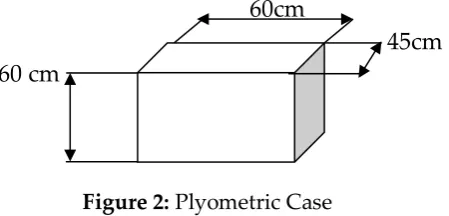
In the Experiment Group B strength exercises, a standard wooden case measuring 60x45 cm and a height of 60cm was used.
60cm
45cm 60 cm
Figure 2: Plyometric Case
D. Training Cone
In the Experiment Group B strength exercises, a standard plastic cone with a height of 60 cm. was used.
60 cm
Figure 3: Training Cone
E. Dumbbell
Figure 4: Dumbbell
2.2 Measurement Methods
A. Height-Weight Measurement
Height measurements of Experiment A and Experiment B group athletes were done in the morning with a stadiometer. The subject stood barefoot on the flat ground towards the stadiometer and was asked to distribute his/her weight equally to both feet. The moving part of the stadiometer was brought to the top of the head and the hair was tightened sufficiently and the measurement was measured in cm (Özer, 1993: 41). Body weight measurement was carried out with shorts using scales and it was recorded in terms of in kilograms.
B. Body Fat Measurement
Body fat percentage measurements were measured with the Harpenden skinfold caliper, which applies pressure of 10g / mm2 between the tips, with a precision of 0.1mm in
accordance with international standards.
Since an equation for handball players was not developed in determining the body fat ratio, Lange's formula for% fat was used (Özer, 1993: 60).
% fat = (biceps + triceps + supscapula + suprailiak + chest + thigh) x 0.097 + 3.64
C. Vertical Jump Measurement
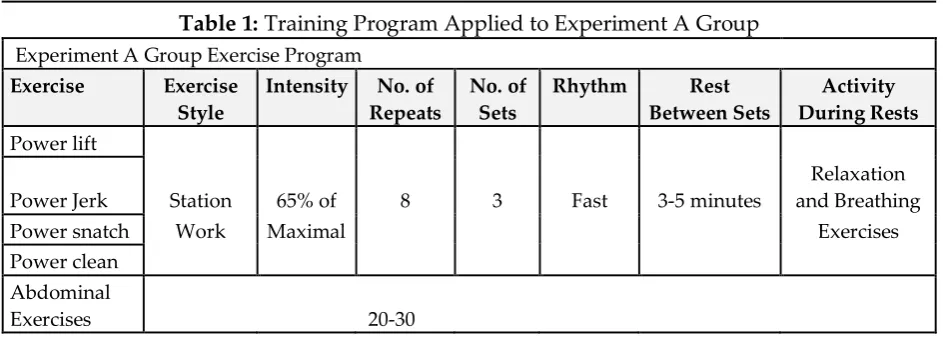
Table 1: Training Program Applied to Experiment A Group
Experiment A Group Exercise Program
Exercise Exercise
Style
Intensity No. of
Repeats No. of Sets Rhythm Rest Between Sets Activity During Rests Power lift
Power Jerk Station 65% of 8 3 Fast 3-5 minutes
Relaxation and Breathing
Power snatch Work Maximal Exercises
Power clean Abdominal
Exercises 20-30
Table 2: Training Program Applied to Experiment B Group
Experiment B Group Exercise Program
Exercise No. No. of Repeats No. of Sets Rest Between Sets Exercise Style Rhythm Activity During Rests
1 1,3,5,7,11 2 2,4,6,8,10
3 1,4,9,11,12 65% of
Relaxation and Breathing
4 1,2,4,6,9 Maximal 3 3-5 minutes
Station
Work Fast Exercises
5 3,6,7,10,12
6 1,3,5,8,10
7 4,6,7,11,12
8 5,6,8,9,12
In addition to the technical-tactical work 3 days a week, Experiment A group was subjected to rapid strength training with the Olympic lifts aimed at increasing the jump force for 2 days. The training intensity was taken as 65% of the maximum weight that the Experiment A group could bear since the training period was the transition period. Since the maximum strength of the subjects would change at the end of the 4 weeks exercise, the maximum weight of the subjects could be determined again, and the intensity of the training was regulated accordingly.
2.3 Experiment A Group Training Program 1) power lifts (lift lifts),
2) power jerk lifts (pushing with toes and arms),
3) power snatch (snatch),
4) power clean (jerk),
The following abdominal exercises were performed in each set.
• abdominal crunch,
• knees twisted straight crunch,
• pulling the trunk with the knees,
• reaching to feet,
• side crunch,
• reaching elbow to the cross knee,
2.4 Experiment B Group Training Program
For the Experiment B Group to improve the jump force, attack and defence drills, shooting and passing exercises, tactical set practices 3 days a week, as well as rapid strength training, and exercises in the form of station work with their own body weights and small weights for 2 days were carried out.
1) continuous jump over the case,
2) knee bend with a health ball,
3) cross jumping with dumbbells,
4) rising at fingertips with dumbbells,
5) side jump over the towers,
6) jumping by pulling the knees up,
7) double feet long jump,
8) jump with health ball between legs,
9) cross jump with body weight,
10)crouching and jumping with a health ball,
11)jumping over the cases,
12)vertical jump by pulling the heels over the hip.
3. Findings
3.1 Experiment A and Experiment B Group Findings
In this study, paired group t-test and independent group t-test were applied in SPSS packet program to detect differences between Experiment A group and Experiment B groups before and after the 8-week training program. The arithmetic means, correlation, standard deviations, significance levels of the data we obtained as a result of this test were found and the results were tabulated by revealing whether they were significant according to the significance level of p <0.05.
Table 3: Physical characteristics of the participants M (SD)
Group Age (year) Height (cm) Body weight (kg)
Experiment A
(n=12) 16.17 (.83) 178.75 (4.22) 68.42 (6.37)
Experiment B
(n=12) 16.00 (.85) 179.00 (5.17) 69.00 (6.06)
Total
(N=24) 16.08 (.83) 178.88 (4.62) 68.71 (6.09)
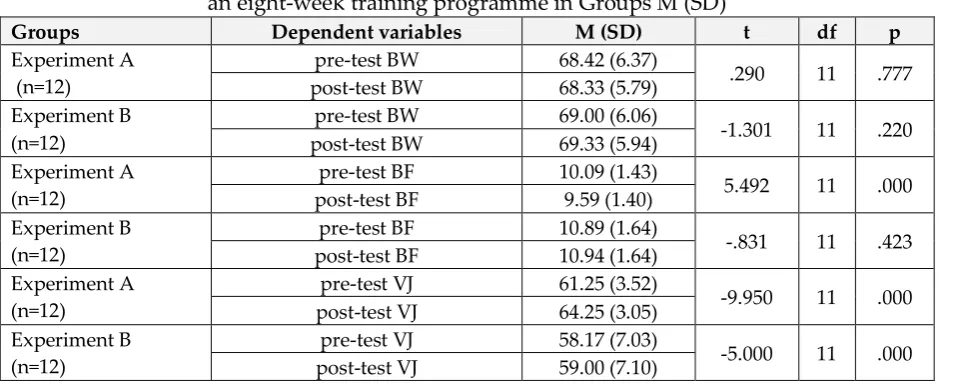
Table 4: Changes in dependent variables after an eight-week training programme in Groups M (SD)
Groups Dependent variables M (SD) t df p
Experiment A (n=12)
pre-test BW 68.42 (6.37)
.290 11 .777 post-test BW 68.33 (5.79)
Experiment B (n=12)
pre-test BW 69.00 (6.06)
-1.301 11 .220 post-test BW 69.33 (5.94)
Experiment A (n=12)
pre-test BF 10.09 (1.43)
5.492 11 .000 post-test BF 9.59 (1.40)
Experiment B (n=12)
pre-test BF 10.89 (1.64)
-.831 11 .423 post-test BF 10.94 (1.64)
Experiment A (n=12)
pre-test VJ 61.25 (3.52)
-9.950 11 .000 post-test VJ 64.25 (3.05)
Experiment B (n=12)
pre-test VJ 58.17 (7.03)
-5.000 11 .000 post-test VJ 59.00 (7.10)
There was no statistically significant difference between the pre-test and post-test BW (kg) scores of the Experimental A and Experimental B groups, respectively t (11) = 0.290, p> 0.05; t (11) = - 1.000, p> 0.05).
While the BF (%) scores of the Experiment Group A changed significantly from the pre-test to the post-test scores of Experiment Group A [t (11) = 4.864, p <0.01], there was no change in the Experiment Group B [t (11) = - 0.831, p> 0.05].
Figure 5: BF (%) scores of the treatment group decreased significantly from pre-test to post-test (**=p<0.01). (+/-1 SE)
Figure 6: VJ (cm) scores of both groups increased significantly from pre-test to post-test, (**=p<0.01). (+/-1 SE)
4. Discussion
the subjects compared to before (Stoessel, 1991: 87-95). Both weight training and plyometric exercises have been found to be individually effective in improving vertical jumping performance. But if these two working methods are combined, better results can
be obtained. In the study titled “The study of the effect of plyometric exercises related to
the Rock Technique on some motoric parameters in wrestlers”, 37 randomly selected
athletes who consistently trained for two hours a week for 5 hours a day, 20 athletes as a control group, 37 wrestlers participated voluntarily as a result of 8-week training, hand grip strength, back force and V02 max values increased significantly.
In the study by (Kaya I. vol. 9, issue 1, 2015) ‘’The effect of plyometric exercises
related to Rock Technique on some motoric parameters in wrestlers’’, Technique, 17
randomly selected athletes who regularly train two hours a week for 5 hours a day, 20 athletes as a control group, 37 wrestlers participated voluntarily as a result of 8-week
training in vertical jumps. , hand grip strength, back force and V02 max values increased
significantly.
In the study by (Adams K. et al, 1992 : 36-41 )while vertical jumping performance improved (3.30 and 3.81 cm) with the application of weight training or plyometric exercises alone, the best results for non-athlete subjects were obtained with the combination of weight and plyometric exercises. These subjects performed the weight and plyometric exercises for 6 weeks and 2 times a week. According to the tests carried out at the end of 6 weeks, the vertical jump of these subjects reached an average of 10.67 cm. Similar solutions have been seen in the works of (Duke, S. and D. Ben Eliyahu. 6-1: 10-15: 1992) They divided 10 high school athletes into two groups as weight training and weight + plyometric training. Athletes worked 3 times a week for 6 weeks. According to the tests performed after 6 weeks, only the weight- training group showed a 3% improvement (1.52cm.) The weight + plyometric training group showed a vertical jump performance of 11% (6.35cm.), (Clutch D. et al, volume 54 issue 1, 1983) also provided a basis to further strengthen all these claims. 32 subjects were randomly selected. While 16 of these were volleyball players studying in college, the other 16 were children from the weight training class. The first group performed both weight and plyometric exercises, and the second group applied only weight exercises. The plyometric study consisted of in-depth jumps, while weight training consisted of deadlift, bench-press and parallel law. Subjects trained twice a week on a 16-week program. Finally, it was seen that only those who participated in weight training without participating in plyometric training or volleyball exercises could not achieve a significant success in the vertical jump ability. In contrast, a significant increase was observed in the vertical jump ability of the subjects who added plyometric training or volleyball training to the weight training.
cm was observed in our Experiment A group, which made handball-specific jumps along with the Olympic-style lift.
What is seen from all the studies is that both training with Olympic lifts and plyometric exercises shave positive effects on vertical jump (Stoessel, 1991), (Hedrick, 1996: 7-12). However, as can be seen in both our study and recommends in the literature, if these two exercises are carried out together, the vertical jump height will increase more.
5. Conclusion
In the 15 - 17 age group handball players, the strength exercises performed with the Olympic lifts and plyometric jumps specific to handball are more effective than the other strength exercises. However, we think that the increase in the height in both groups may be due to the fact that the subjects are at the stage of development age. We are of the opinion that the lower fat percentage in the post-test of the Experiment A Group was caused by muscle hypertrophy as the Experimental A group did weight training. There is no change in other parameters. Our study is in parallel with the studies in the literature.
References
Kent Adams, John O’Shea, Katie L. O’Shea and Mike Climstein (1992). The Effect of six
weeks of squat, Plyometric and squat-Plyometric Training on power production, Journal of applied sport science research, volume 6 number 1.pp.36-41.
Akgün, Necati, Egzersiz Fizyolojisi (1994). Cilt: 1, Ege Üniversitesi Basımevi, Bornova İzmir.
Brown, M. E., et al. (1986). Effects of Plyometric Training on Vertical Jump Performance
İn High School Basketball Players, J. of Sports Med. Phys. Fitness, Turin 26.
Chu, D. A. (1998). Jumping İn to Plyometrics, Human Kinetics, California.
David Clutch, Mike Wilton, Carl McGown and G. Rex Bryce (1983). The Effect of Depth Jumps and Weight Training on Leg Strength and Vertical Jump, Research
quarterly for exercise and sport, Volume 54, Issue 1,
https://doi.org/10.1080/02701367.1983.10605265.
Garmammer, J., R. Groger (1992). Propulsion Forces as a Function of Intensity for Weightlifting and Vertical Jumping, Sports Science Res.6(3), Colorado
Hedrick, A., J. C. Anderson (1996). The Vertical Jump: A Review of the Literature and the Team Case Study, Strength and Conditioning, National Strength & Conditioning Association, s.7-12, Colorado.
Kaya İsmail (2015). Analysis of the effect of technique related plyometric exercises on the
motoric properties of wrestlers, Niğde University Journal of Physical Education
Stoessel, L., et al. (1991). Selected Physiological, Psychological and Performance Characteristics of National-Caliper United States Women Weightlifters, Sports Science, Res.5(2), s. 87-95, Colorado.
Özer, Kamil (1993). Antropometri Sporda Morfolojik Planlama, Kazancı Matbaacılık
Sanayii A.Ş., İstanbul.
Sevim, Yaşar, (1997). Training Information Book, Ankara.
Creative Commons licensing terms