ISSN: 2501 - 1235 ISSN-L: 2501 - 1235 Available on-line at: www.oapub.org/edu
doi: 10.5281/zenodo.2593225 Volume 5 │ Issue 7 │ 2019
EFFECT OF PROPRIOCEPTIF NEUROMUSCULAR
FACILITATION AND LUMBAR STABILIZATION EXERCISES
ON MUSCLE STRENGTH AND MUSCLE ENDURANCE
IN PATIENTS WITH LUMBAR DISC HERNIA
Mustafa Gulsen1,
Mitat Koz2
1Pt Phd, Department of Therapy and Rehabilitation,
Vocational School of Health Sciences, Baskent University, Ankara, Turkey
2Prof. Dr., Faculty of Sport Sciences,
Ankara University, Ankara, Turkey
Abstract:
Background/Objective: This study investigates the effect of lumbar stabilization and
proprioceptive neuromuscular facilitation (PNF) training on muscle strength and muscle endurance. Methods: Sixty-four participants between the ages of 15 and 69 years, graded “protrusion and bulging lumbar herniation” according to the Macnab Classification, were divided into four groups of 16: lumbar stabilization training (strength training, 5 days/week for 4 weeks); PNF training (5 days/week for 4 weeks); physical therapy (hot pack, TENS, ultrasound, 5 days/week for 4 weeks); and control (without any application). Sociodemographic features were recorded and muscle strength tested. Before and after exercise, a visual analog scale (VAS) and Oswestry Disability Index (ODI) were measured by a physical therapist. After 4 weeks, the evaluations were repeated. Results: There were significant increases in muscle strength and muscle endurance in the lumbar stabilization group, who also showed significant improvement in pain intensity at rest and during activity, and in ODI (p<0.05). Similar results were observed in the PNF group (p<0.05), although not to the same extent. Patients undergoing physical therapy showed significant differences only in pain intensity at rest, at activity, and in ODI (p<0.05). There were no significant differences in the control group. Conclusion: Undertaking an appropriate physiotherapy and rehabilitation program aiming to reduce waist circumference of patients with low muscle strength and low muscle endurance will help to increase muscle strength and endurance and reduce pain, and contribute toward the correction of functional disabilities.
1. Introduction
Lumbar disc herniation (LDH) is a clinical entity characterized by compression of the spinal nerve roots and resultant back and leg pain. Though uncommon, LDH has been reported as a cause of recurrent low back pain (1).
Although more than 100 risk factors have been identified for LDH, it is difficult to determine a specific etiology. The most important risk factors are intense sporting activity, heavy lifting, frequent rotation of the body, exposure to vibrations, age, tall stature, obesity, smoking, and psychological and genetic factors (2).
It has been shown that in LDH patients; the strength and endurance of the back and abdominal muscles are reduced, and this aspect has been reported as a major predisposing factor for low back pain (3). Hence, an exercise program as part of conservative treatment of low back pain and after surgery would be of potential benefit for patients. Twomey and Taylor (4) have shown that behavioral and cognitive principles combined with exercise programs can be effective in reducing disability in patients with chronic low back pain.
The severity of symptoms in disc herniation depends not only on the amount of herniated disc pressure but also on nervous irritability. To reduce the sensitivity of nerve fibers to pain, symptomatic initiatives that include drugs, physical therapy, and psychological methods can be successful (5). The primary purpose of physical therapy is control of pain and inflammation, and secondarily to improve symptoms such as stiffness in the joints and muscle spasms. Physical therapy also delivers psychological effects. Agents used in physical therapy are generally administered in a combined regimen (6). We undertook this study to investigate the effect of lumbar stabilization training and proprioceptive neuromuscular facilitation (PNF) training on muscle strength and muscle endurance.
2. Methods
inflammatory disease affecting the spine, tumor, fracture, spondylolysis, spondylolisthesis, or scoliosis were excluded from the study.
After recording the subject’s age, height, and weight, the body mass index (BMI) was calculated. The Oswestry Disability Questionnare (7) was used to assess pain. The maximum score in this questionnaire is 50, which represents 100% disability. A standard visual analog scale (VAS) was also used to assess pain. The patients graded their low back pain on a 10-point scale, anchored with the descriptors “no pain” at one end and “pain as bad as it could possibly be” at the other. Maximum pain severity was assessed by a blind-testing physician using the standard VAS (8).
Trunk muscle strength of all subjects was measured using a computerized isokinetic dynamometer (Cybex 770 Norm; Lumex, Ronkonkoma, NY, USA). Isokinetic studies were performed at Cybex 770 Norm 60°/sec, 90°/sec, and 120°/sec velocities before and after treatment. All measurements were made with the subject standing and stabilized at the knees, lower back, and chest, with the dynamometric axis positioned at the third lumbar vertebral body. For each subject, trunk flexion and extension contractions with maximal effort were performed with five repetitions at each velocity. Between each test repetition, the subjects rested for 20 seconds. Muscle strength was expressed using the peak torque (PT) given in foot pounds (ft lb): PT 60 (PT value at 60°/sec), PT 90 (PT value at 90°/sec), and PT 120 (PT value at 120°/sec) were used for evaluation.
Trunk muscle endurance of all subjects was measured using curl-up and dynamic back extension tests. Participants’ abdominal muscle endurance (curl-up) was tested in the supine position. Lower limbs were in abduction and knees in semiflexion. Participants were asked to stand up and touch the knees with their hands using body flexion. In this position, the number of trunk flexions completed in 1 min by the participants was recorded (9). Participants’ dynamic back extension endurance was tested in the prone position. Knees were in extension. Participants raised their heads and shoulders to the sternal notch level. In this position, the number of trunk extensions completed in 1 minute was recorded (10).
2.1 Treatment protocol
A. Lumbar stabilization exercises
Exercises were made in supine, prone, and standing positions. During each exercise, an abdominal corset was provided to enable isometric contraction of all muscles of the abdominal wall without any change in the position of the trained muscles (11).
B. PNF techniques (pelvis patterns)
Pelvic patterns can be performed in a side-lying, crawling, sitting, or standing positions. The side-lying position is ideal because it allows the pelvis to move freely and provides power dissipation for trunk motions (12).
C. Physiotherapy
2.2 Data analysis
The results were analyzed using the Statistical Package for Social Sciences (SPSS) Version 17.0 for Windows (SPSS, Chicago, IL, USA). Descriptive statistical methods were used to evaluate sociodemographic characteristics. A p value of less than 0.05 was considered statistically significant. The Wilcoxon test was used to compare the treatment of intra-group parameters before and after treatment. The Kruskal-Wallis test was used to compare parameters between multiple groups. The Mann-Whitney U test was used for comparison of two groups of inter-related parameters. Within-group relationships of measurement parameters were evaluated by Spearman correlation analysis.
3. Results
The groups showed no difference in demographic and clinical characteristics (Table 1;
p>0.05).
Table 1: Demographic characteristics of the groups
Stabilization mean±SD
PNF mean±SD
PT mean±SD
Control mean±SD
Kruskal-Wallis p
Age (years) 52.75±12.49 56.81±12.31 57.12±15.33 46.12±15.33 7.984 0.052
Height (cm) 170.37±9.30 166.25±12.39 168.18±11.09 169.43±10.11 0.620 0.891
Weight (kg) 76.12±10.32 75.81±9.28 79.06±12.85 76.31±10.87 0.827 0.827
BMI (kg/cm2) 26.21±2.92 27.58±4.15 27.92±3.22 26.68±4.01 2.007 0.570
BMI = body mass index; PNF = proprioceptive neuromuscular facilitation; PT = physical therapy; SD = standard deviation.
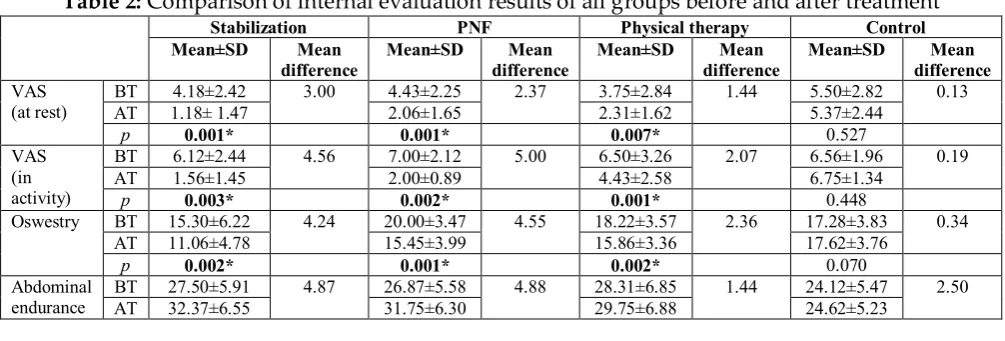
When groups’ evaluations before and after treatment were compared, statistically significant differences were found in VAS after treatment (at rest), VAS (at activity), Oswestry Disability Index (ODI), abdominal strength, endurance of back extensor, left hip flexion flexibility, sit and reach flexibility, 60°/sec trunk flexion, 90°/sec trunk extension, 90°/sec trunk flexion, 120°/sec trunk flexion, and 120°/sec trunk extension (Table 2).
Table 2: Comparison of internal evaluation results of all groups before and after treatment
Stabilization PNF Physical therapy Control
Mean±SD Mean
difference
Mean±SD Mean
difference
Mean±SD Mean
difference
Mean±SD Mean
difference
VAS
(at rest) BT AT 1.18± 1.47 4.18±2.42 3.00 4.43±2.25 2.06±1.65 2.37 3.75±2.84 2.31±1.62 1.44 5.50±2.82 5.37±2.44 0.13
p 0.001* 0.001* 0.007* 0.527
VAS (in activity)
BT 6.12±2.44 4.56 7.00±2.12 5.00 6.50±3.26 2.07 6.56±1.96 0.19
AT 1.56±1.45 2.00±0.89 4.43±2.58 6.75±1.34
p 0.003* 0.002* 0.001* 0.448
Oswestry BT 15.30±6.22 4.24 20.00±3.47 4.55 18.22±3.57 2.36 17.28±3.83 0.34
AT 11.06±4.78 15.45±3.99 15.86±3.36 17.62±3.76
p 0.002* 0.001* 0.002* 0.070
Abdominal endurance
BT 27.50±5.91 4.87 26.87±5.58 4.88 28.31±6.85 1.44 24.12±5.47 2.50
p 0.001* 0.003* 0.063 0.108 Back
extension endurance
BT 27.43±4.51 5.00 25.75±6.67 10.12 27.06±7.92 1.12 25.37±2.96 0.31
AT 32.43±6.45 35.87±8.07 28.18±7.81 25.06±3.02
p 0.003* 0.001* 0.065 0.058
60°/s trunk extensors
BT 46.12±43.99 15.06 34.06±23.58 7.31 55.56±31.40 0.94 35.31±7.43 0.69
AT 61.18±41.65 41.37±25.59 56.50±31.01 36.00±7.33
p 0.003* 0.002* 0.458 0.204
60°/s trunk flexors
BT 71.18±68.45 36.19 54.93±68.81 29.75 75.18±50.84 4.69 40.56±21.34 4.78
AT 107.37±56.84 84.68±60.70 79.87±44.43 45.31±15.08
p 0.013 0.002* 0.573 0.654
90°/s trunk extensors
BT 46.81±32.96 5.19 26.75±10.58 4.87 34.68±11.94 2.31 29.87±10.27 0.006
AT 52.00±33.69 31.62±11.57 32.37±14.66 29.81±11.42
p 0.021 0.063 0.037 0.646
90°/s trunk flexors
BT 43.00±33.57 38.36 36.37±22.98 12.13 52.25±27.29 4.12 32.12±4.27 0.56
AT 81.68±53.43 48.50±20.01 56.37±28.70 32.68±3.73
p 0.000* 0.002* 0.361 0.220
120°/s trunk extensors
BT 35.87±18.25 3.44 33.50±16.70 5.18 37.87±16.02 0.81 24.68±5.36 0.07
AT 39.31±20.54 38.68±12.62 38.68±15.47 24.75±5.73
p 0.233 0.015 0.213 0.781
120°/s trunk flexors
BT 35.62±17.08 26.13 46.75±37.90 12.37 37.50±20.17 3.13 34.37±7.25 0.06
AT 61.75±31.96 59.12±33.89 34.37±19.58 34.31±7.73
p 0.003* 0.001* 0.542 0.725
AT = after treatment; BT = before treatment; VAS = visual analog scale. *p<0.05
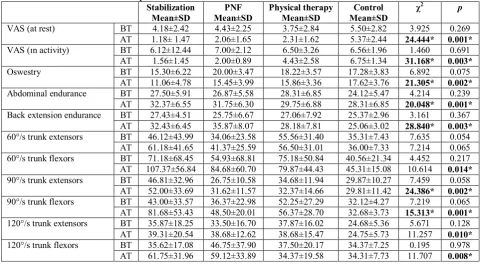
When pairwise comparisons of groups were conducted, there were significant differences in the stabilization group’s ODI, left hip flexion flexibility, sit and reach flexibility, 90°/sec trunk extension, and 90°/sec trunk flexion muscle strength values when compared with values in the PNF group (Table 3).
Table 3: Comparison of evaluation results before and after treatment
Stabilization Mean±SD PNF Mean±SD Physical therapy Mean±SD Control Mean±SD
χ2 p
VAS (at rest) BT 4.18±2.42 4.43±2.25 3.75±2.84 5.50±2.82 3.925 0.269 AT 1.18± 1.47 2.06±1.65 2.31±1.62 5.37±2.44 24.444* 0.001*
VAS (ın activity) BT 6.12±12.44 7.00±2.12 6.50±3.26 6.56±1.96 1.460 0.691 AT 1.56±1.45 2.00±0.89 4.43±2.58 6.75±1.34 31.168* 0.003*
Oswestry BT 15.30±6.22 20.00±3.47 18.22±3.57 17.28±3.83 6.892 0.075 AT 11.06±4.78 15.45±3.99 15.86±3.36 17.62±3.76 21.305* 0.002*
Abdominal endurance BT 27.50±5.91 26.87±5.58 28.31±6.85 24.12±5.47 4.214 0.239 AT 32.37±6.55 31.75±6.30 29.75±6.88 28.31±6.85 20.048* 0.001*
Back extension endurance BT 27.43±4.51 25.75±6.67 27.06±7.92 25.37±2.96 3.161 0.367 AT 32.43±6.45 35.87±8.07 28.18±7.81 25.06±3.02 28.840* 0.003*
60°/s trunk extensors BT 46.12±43.99 34.06±23.58 55.56±31.40 35.31±7.43 7.635 0.054 AT 61.18±41.65 41.37±25.59 56.50±31.01 36.00±7.33 7.214 0.065 60°/s trunk flexors BT 71.18±68.45 54.93±68.81 75.18±50.84 40.56±21.34 4.452 0.217 AT 107.37±56.84 84.68±60.70 79.87±44.43 45.31±15.08 10.614 0.014*
90°/s trunk extensors BT 46.81±32.96 26.75±10.58 34.68±11.94 29.87±10.27 7.459 0.058 AT 52.00±33.69 31.62±11.57 32.37±14.66 29.81±11.42 24.386* 0.002*
90°/s trunk flexors BT 43.00±33.57 36.37±22.98 52.25±27.29 32.12±4.27 7.219 0.065 AT 81.68±53.43 48.50±20.01 56.37±28.70 32.68±3.73 15.313* 0.001*
120°/s trunk extensors BT 35.87±18.25 33.50±16.70 37.87±16.02 24.68±5.36 5.671 0.128 AT 39.31±20.54 38.68±12.62 38.68±15.47 24.75±5.73 11.257 0.010*
120°/s trunk flexors BT 35.62±17.08 46.75±37.90 37.50±20.17 34.37±7.25 0.195 0.978 AT 61.75±31.96 59.12±33.89 34.37±19.58 34.31±7.73 11.707 0.008*
3.1 Discussion
Musculoskeletal system diseases have a negative impact on the quality of life of individuals and the nation’s economy. Approximately 80% of individuals in a society are likely to experience low back pain at some period in their lives (13).
Although there are many reasons for low back pain, LDH is a major cause. In the treatment of LDH, different approaches involving surgery and physiotherapy are utilized. Many studies have reported reduced symptoms in a significant number of cases through non-surgical methods (14).
The main purpose of the various treatment modalities used in LDH therapy is to reduce pain, inflammation, muscular symptoms, and joint stiffness. In non-controlled studies, the efficacy of these modalities has been demonstrated in the treatment of low back pain (15).
When the physical properties of participants enrolled in this study were examined, there was no statistically significant difference in age, height, weight, and BMI, consistent with previous findings in the literature (16).
With regard to muscle strength, muscle endurance, and flexibility, when individuals with back pain are compared with unaffected counterparts as determined by numerous test protocols, they show low functional performance and physical fitness (17). Low physical fitness of the muscles that support the spine (insufficient strength, endurance, flexibility, and body composition) is a significant risk factor for low back pain (10).
The aim of therapeutic exercises is to improve muscle strength, endurance, and flexibility. Reduced muscle strength, endurance, and flexibility cause limitations in functional activity (18). A major finding of our study is the notable improvement in muscle strength, endurance, and flexibility after stabilization and PNF exercise programs. The assessments made in the lumbar region before the start of the treatment program show markedly lower muscle strength in both groups. At the end of the treatment program, there was a statistically significant increase in muscle strength in the lumbar region in the stabilization and PNF groups in comparison with physical therapy and control participants.
A sizeable number of individuals who have LDH also have chronic back pain. Long-term low back pain restricts the activity causes muscle atrophy. It has been shown that atrophy occurs in the lumbar region of the muscle in LDH patients (19).
weeks in the clinic is effective in significantly enhancing lumbar muscle strength and endurance.
In 2014, Kwang et al. (22) compared 15 obese patients with chronic low back pain with 15 control individuals. The exercise program for the experimental group consisted of the scapular depression pattern of anterior-posterior pelvic elevation and the elevation pattern of the application of anterior-posterior depression. The control group undertook back-strengthening exercises. As a result, significant progress and significant improvements were observed in the experimental group’s flexibility of lumbar flexion and extension, as well as ODI. Significant improvements in pain were also observed. The difference between our study and this one is that we used pelvis patterns applied to patients with LDH, which to our knowledge has not previously been reported.
Regarding pain and disability, most studies report that exercise is an effective method to treat chronic low back pain (23). These data are in agreement with our present results, wherein significant improvements were observed in pain intensity at rest and activity, and in ODI values, in both the stabilization and PNF groups.
Franca et al. (24) conducted a study comparing the effects of exercises to strengthen abdominal and trunk muscles and lumbar stabilization exercises on pain, functional disability, and transverse abdominal muscle activation. The study included 30 patients randomly divided into two groups. Patients were evaluated according to pain (VAS and McGill pain questionnaire), functional disability (Oswestry Inability Survey), and transverse abdominal muscle activation capacity (pressure biofeedback device), and exercised for 30 min twice per week for 6 weeks. Pain reduction and functional recovery from baseline in both groups significantly increased (p<0.001). In the lumbar stabilization group, significant improvements were found in comparison with the strengthening group (p<0.001). In the lumbar stabilization exercise group there was a significant increase in transverse abdominal muscle activation when compared with the strengthening group. These results are consistent with those of the present study.
Tuğcu et al. (25) studied 37 patients with chronic mechanical low back pain. They separated patients into two groups, applying exercise therapy to one group and hot pack, TENS, and ultrasound to the other. In the early stages, they found in both groups a statistically significant decrease in functional disability and patients' pain sensation. Similar to the results of our current study, in the hot pack/TENS/ultrasound group a statistically significant reduction was found in the pain and disability values.
alongside ultrasound therapy, resulting in significant improvement in patients’ disability (26).
The efficacy of TENS for acute pain is controversial. In randomized controlled studies, positive short-term effects on chronic pain were apparent using TENS. It is proposed that the effect of TENS is created by a gate-control mechanism. In studies of hot and cold applications, application of heat was reported to be effective in reducing pain in patients with acute or subacute low back pain (27). In our study, we also found a statistically significant decrease in pain levels when such physical therapy modalities were applied.
We consider the small number of patients in the groups and the short follow-up time to be the main limitations of our study. A larger population with a longer follow-up period should increase the statistical power. The lack of isometric muscle strength measurements is another limitation. We did not use this as an evaluation criterion because in their study, Renkawitz et al. (28) showed that isometric muscle strength had no influence on patients with low back pain. In addition, in future studies the long-term effects of treatment on quality of life and recurrence of low back pain in LDH patients should be investigated.
Lumbar stabilization exercises are more effective when compared with PNF exercises. These exercises have the advantage of being easily applicable and efficient. Therefore, these exercise programs seem superior in this context. However, it is possible that the effectiveness of both programs may depend on the fact that they were carried out in hospital conditions under supervision. Therefore, we believe that comparative studies in the future should include a group of exclusively home-exercise training programs. Such studies would assuredly help in determining exercise protocols for the treatment of low back pain in LDH.
3.2 Clinical messages
Lumbar stabilization exercises have more efficacy than PNF exercises in the treatment of individuals with lumbar disc hernia.
The standard lumbar stabilization exercises program proved to be easily performable and inexpensive, and is the preferred option for exercise when treating pain arising from LDH.
References
1. Dundar U., Kavuncu V. Diagnosis and treatment of lumbar disc herniation.
Journal of Current Clinical Medicine. 2007;11:45–53. [in Turkish]
3. Casso G., Cachin C., Van M.G., et al. Return-to-work status 1 year after muscle reconditioning in chronic low back pain patients. Joint Bone Spine. 2004;71:136– 139.
4. Twomey L., Taylor J. Exercise and spinal manipulation in the treatment of low back pain. Spine. 1995;20:615–619.
5. Yıldız O. Low back pain. In: Beyazova M., Kutsal Y.G., eds. Physical Medicine and Rehabilitation, Volume 2. Ankara: Sun Publications Section; 2000:1465–1483. [in Turkish]
6. Ozcan E. Conservative Treatment of Low Back Pain Patients. Istanbul: Nobel Bookstore; 2002:187–219. [in Turkish]
7. Yakut E., Duger T., Oksuz C., et al. Validation of the Turkish version of the Oswestry disability index for patients with low back. Spine. 2004;29(5):581–585. 8. Yılmaz F., Yılmaz A., Merdol F., et al. Efficacy of dynamic lumbar stabilization
exercise in lumbar microdiscectomy. J Rehabil Med. 2003;35:163–167.
9. Mälkiä E. Muscular performance as a determinant of physical ability in Finnish adult population. Helsinki (Finland): Publications of the Social Insurance Institution 1983: Report No. AL:23.
10.Nicholeison T., Jorgensen K. Trunk strength, back muscle endurance and low back trouble. Scand J Rehabil Med. 1985;17:121–127.
11.Kavcic N., Grenier S., McGill SM. Quantifying tissue loads and spine stability while performing commonly prescribed low back stabilization exercises. Spine. 2004;29:2319–2329.
12.Adler S.S., Beckers D., Buck M. PNF in Practice. 3rd ed. Germany: Springer, 2008. 13.Ozbayır T. Neurological trauma. In: Karadakovan A, Aslan FE, eds. Maintenance
of Internal Medicine and Surgery. Adana: Nobel Bookstore; 2010:1245–1274. [in Turkish]
14.Boos N., Semmer N., Elfering A. Natural history of individuals with asymptomatic disc abnormalities in magnetic resonance imaging: predictors of low back pain-related medical consultation and work incapacity. Spine. 2000;25:1484–1492.
15.Nordin M., Compella M. Exercises and the modalities. When, what and why?
Neurol Clin North Am. 1999;17:75–111.
16.Tuzun C., Yorulmaz I., Cindas A., et al. Acute and chronic low back pain in patients with clinical and radiological findings. Turkish Journal of Physical Medicine and Rehabilitation. Volume 44, Issue 6. Galen Publishing; 1998. [in Turkish]
17.Durand M.J., Brassard B., Hong Q.N. Responsiveness of the physical work performance evaluation, a functional capacity evaluation, in patients with low back pain. J Occup Rehabil. 2008;18:58–67.
19.Mattila M., Hurme M., Alaranta H., et al. The multifidus muscle in patients with lumbar disc herniation. A histochemical and morphometric analysis of intraoperative biopsies. Spine. 1986;11(7):732–738.
20.Dolan P., Greenfield K., Nelson R.J., et al. Can exercise therapy improve the outcome of microdiscectomy. Spine. 2000;25:1523–1532.
21.Barr K.P., Griggs M., Cadby T. Lumbar stabilization: core concepts and current literature, Part 1. Am J Phys Med Rehabil. 2005;84:473–480.
22.Kwang Y., Park M.S., Kyochul S. The effects on the pain ındex and lumbar flexibility of obese patients with low back pain after PNF scapular and PNF pelvic patterns. J Phys Ther Sci. 2014;26:1571–1574.
23.Henchoz Y., Kai-lik So A. Exercise and nonspecific low back pain: a literature review. Joint Bone Spine. 2008;75:533–539.
24.França F.R., Burke T.N., Hanada E.S., et al. Segmental stabilization and muscular strengthening in chronic low back pain—a comparative study. Clinics (Sao Paulo). 2010;65:1013–1017.
25.Tuğcu I., Onder M.E., Yazıcıoglu K., et al. Chronic mechanical low back functional effectiveness of school-administered with exercise and physical therapy modalities in pain. Turkish Journal of Physical Medicine and Rehabilitation. 2008;54:63–68. [in Turkish]
26.Grubisic F., Grazio S., Jajic Z., et al. Therapeutic ultrasound in chronic low back pain treatment. Reumatizam. 2006;53:18–21.
27.Shahbandar L., Press J. Diagnosis and nonoperative management of lumbar disk herniation. Oper Tech Sports Med. 2005;13:114–121.
Creative Commons licensing terms