ISSN: 2501 - 1235 ISSN-L: 2501 - 1235 Available on-line at: www.oapub.org/edu
doi: 10.5281/zenodo.2581594 Volume 5 │ Issue 6 │ 2019
ANALYSIS OF LEADERSHIP TYPES BY UNIVERSITY,
GENDER AND DEPARTMENT VARIABLES
Onur Oral1i, Nazan Kavas2, Gamze Ertürk1
1Ege University,
Faculty of Sports Sciences, Izmir, Turkey
2Ege University,
Ege Higher Vocational School, Izmir, Turkey
Abstract:
Purpose: The aim of this study is to examine whether the types of leadership make a statistically significant difference in terms of university, department and gender variables. Materials and Methods: A total of 100 university students, 37 (37.0%) female and 63 (63.0) male, participated in the study. The sample of the study includes 46 (46%) from Ege University and 54 (54%) students from Celal Bayar University. 67 (67%) of the students study Sports Teaching and 33 (33%) of them were students of Sport Management. There are 35 items in the scale. The items are coded as “Always ”, ”Very Frequent”, “Sometimes”, “Occasionally” and ”Never”. The reliability coefficient calculated by the researcher is 0.86. The Leadership Orientation Inventory of Luthans was used as data collection tool. Gender, university and department (Physical Education and Sports Teaching & Sports Management) variables were statistically analysed using SPSS 21.0 program. Results: When the results were analysed, it was determined that there was no significant difference in terms of gender, university and department (p> .05) variables. Conclusions: In conclusion, it was seen that the students' leadership types were not affected by gender, university and departmental variables.
Keywords: leadership, physical education and sports teaching, sports management
1. Introduction
common elements are that all leaders draw interest and play key roles in each achievement or failure. (Meindl et al., 1985; Schyns et al., 2016).
A leader must be practical and provide an establishment or a team whatever it requires including innovation, cultural diversity, decent communication, technical information and work teams. Work teams are a must for any establishment and leader is the person who makes sure these teams work efficiently.
According to Northhouse, leadership is an operation where a person affects the actions of an organisation or a group in order to meet a certain goal (Northhouse, 2010). There are three main parts of leadership: leadership process, affecting other people, and achieving the goal.
Leaders must respond effectively to the new needs of organizations: innovation, cultural diversity, work-based knowledge, communication, and work groups. Work groups play a central role in organizations, and leadership is essential for the effectiveness of these teams (Imbroda-Ortiz et al., 2015; Judge & Piccolo, 2004; O`Reilly, Caldwell, Chatman, Lapiz & Self, 2010). Leadership is a must for any group, team or establishment in order it to work effectively and efficiently (Baquero Pecino & Sánchez Santa-Bárbara, 2000).
The leaders have always attracted attention because they affect the lives of societies and change the course of history. Leadership concept has gained importance together with the concept of manager and organization. Not every manager may have leadership skills, but they need leadership to become a good manager. There are many definitions of leadership. Leadership affects employees in a subject related to the organization, to enable them to act voluntarily. Leadership is the process of influencing and directing the activities of others in order to realize personal or group goals under certain conditions. Leadership is the process of influencing the group to create and realize the objectives. The main duties of the leader are to determine the organizational goals and to give the organization the structure and atmosphere to realize these goals. In addition leader is responsible to ensure that the organization continues according to these aims and to see the conflicts within the organization.
Being a leader is a challenging position. A leader has to face many problems regarding his/her talents. In addition, at the end of each problem, another one comes up. This is an inevitable situation even if the person is very good at handling problems. Yet the reaction of the leader in this type of situations is quite important. True challenges bring forwards the true capabilities of a leader. Each problem is a chance for one to push themselves beyond limits and develop their characters. In another words, every problem is a step towards a better leadership. These problems happen rapidly, every day is a new challenge. Yet, a good leader may foresee the serious problems before they occur and take necessary precautions in order to settle the problem flawlessly. Many studies indicate that the balance between achievement and failure depends highly on leadership. Leaders are one of the core elements of any establishment (Ibrahim, 2016).
manager should be liable to coordinate and help their workers and teams to become successful. A manager’s leadership ability directly affects the consequences of their and their team’s actions (Naidoo et al., 2015; Herrera & Lim, 2003). There are different types of roles of managers. Mintzberg categorises them into three groups: interpersonal, informational and decisional (Greathouse, 2013; Mintzberg, 1990).
1.1.Leader Types
In authoritarian leader type, the authority has been appointed to the leader. It may be considered as a negative type of leadership, because communication between subordinates and the leader is one-way, only communicating the leader's orders, and followers are not aware of the work. But in democratic and participatory leaders, the leader takes decisions in consultation with viewers and referring to their opinions. Followers have information about the work because communication is bi-directional.
For humanist leader, he acts to protect his subordinates. He sometimes takes the decision trusting the middle level of subordinates but takes the decision himself where liberal leader’ followers are completely free. Determining objectives and making decisions are left to group members. The leader acts as one of the group members.
Charismatic leader carries a charisma that can be defined as a superhuman or exceptional feature that differentiates one from others. And the natural leader: who is elected by any higher authority. It is the leader adopted by the group. (Çetin & Beceren, 2007)
2. Material and Methods
2.1. Participants
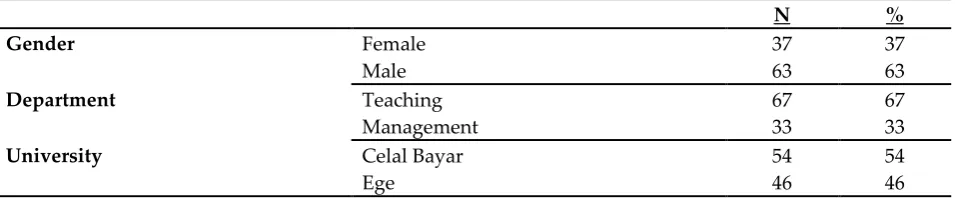
In the study 37 (37.0%) female, 63 (63.0) male, and in total 100 Ege University students participated. The mean age of the participants was 38.3 ± 2.40 and 23.37 ± 2.85. The sample of the study consists of 46 (46%) Ege University and 54 (54%) Celal Bayar University students. 67 (67%) of the students participated in the study were Physical Education and Sports Teaching students while 33 (33%) of them were students of Sports Management.
Table 1: Sample
N %
Gender Female 37 37
Male 63 63
Department Teaching 67 67
Management 33 33
University Celal Bayar 54 54
Ege 46 46
2.2. Data Collection Tools
“Sometimes”, “Occasionally” and ”Never”. The reliability coefficient calculated by the researcher is 0.86.
2.3.Data Analysis
The Leadership Orientation Inventory of Luthans was used as data collection tool. There are 35 items in the scale. The items are coded as “Always ”, ”Very Frequent”, “Sometimes”, “Occasionally” and ”Never”. The reliability coefficient calculated by the researcher is 0.86.
3.Results
Table 2: Analysis of Leadership Types by Gender Variable
Variables Gender n X Ss T P
Total F 37 2,67 -.41 -.38 .70
M 63 2,70 .40
When the results of the T-test that conducted to determine whether the types of leadership differ according to the gender variable of the students participating in the study, no significant difference was found in terms in terms of total mean scores (Table 2).
Table 3: Analysis of Leadership Types by Department Variable
Variables Department n X Ss T P
Total Teaching 67 2,70 .39 -.43 .67
Management 33 2,66 .43
When the results of the T-test that conducted to determine whether the types of leadership differ according to the department variable of the students participating in the study, no significant difference was found in terms in terms of total mean scores (Table 3).
Table 4: Analysis of Leadership Types by University Variable
Variables University n X Ss T P
Total Ege 46 2,73 .42 -.84 .40
Celal Bayar 54 2,66 .39
4.Discussion
The aim of this study is to examine whether the types of leadership make a statistically significant difference in terms of university, department and gender variables. According to the results obtained in the research which was conducted in order to determine the leadership types of the students in the sports management and physical education and sports teaching departments, there was no statistically significant difference between the female and male participants.
When the other studies in the literature are examined, the study that was conducted by Kurudirek (2011) is consistent with our present study. In the study that Kurudirek has done, while the male students have more averages than female students, it was seen that the difference is not statistically significant (P> 0.05). This result can be explained by the fact that our society loads more responsibility onto male students than female students. The fact that they can use more initiatives with this sense of responsibility may be due to the fact that they are more dominant than women because they are freer in making decisions on their own.
Özcan (2006) in his work, compared the the leadership behaviours of primary teachers according to their genders and no significant difference was found. Durukan et al. (2006) compared the leadership behaviors of School of physical education and sports students at Selçuk University depending on the gender, and consequently did not find any meaningful difference. Similarly, Turan and Elbiçoğlu (2002) compared the leadership behaviours of school headmasters according to gender and did not find any significant difference. Atar and Özberk (2009) compared the leadership behaviours of the students of School of physical education and sports according to gender and consequently did not find any meaningful difference. These findings support the findings of our study.
In her research on teachers, Günbayı (2005) found that averages of male teachers' leadership characteristics were higher than the female teachers. In one study, Seifert searched the relationship between gender and leadership. The study included an experiment where female and male subjects were given directions that they work for a female leader. The aim was to analyse the cliché understanding in public that females don’t contain enough ability to become effective leaders. The results of the study verified this prejudice towards female leaders in sports. (Seifert, 1989) These studies do not coincide with the findings at the level of significance. The situation may be because the studies included different participant characteristics than our study.
5.Conclusion
Considering the situation in terms of the teaching department; The pedagogical formation, which is the main lessons of the teachers differentiating them from the management department, provides teacher to be compassionate to students, treats them almost as a parent, may be the cause of difference. At this point, it is not possible to expect from the teacher to consider herself/himself only as the manager. He/she is not only the manager of the class, but also the instructor. However, management unlike teaching is a concept that is formed by guiding employees in a coordinated manner in a common denominator of existing gains. In other words, it does not create a direct gain such as education, and activates the existing gains.
References
Atar E. and Özberk O., 2009. Beden Eğitimi ve Spor Yüksekokulu Öğrencilerinin Liderlik Davranışları. Spormetre Dergisi, 7:51-59.
Baquero Pecino C. & Sánchez Santa-Bárbara E., 2000. Análisis de la fiabilidad del lead (descripción de la efectividad y adaptabilidad del líder). Anales de Psicología, 16(2), 167175
Billsberr, J., et al., 2017. Reimagining leadership in sport management: lessons from the social construction of leadership. Journal of Sport Management, 32 (2), pp.170-182.
Çetin, N.G., & Beceren, E. (2007). Lider Kişilik: Gandhi. Süleyman Demirel Üniversitesi Sosyal Bilimler Enstitüsü Dergisi, (5), 111-132.
Dexter J. & Davis D.J., 2002. An analysis of perceived leadership styles and levels of satisfaction of selected junior college athletic directors and head coaches. The Sport Journal, 23(2), 22-27.
Durukan E., 2003. Selçuk Üniversitesi Beden Eğitimi ve Spor Yüksekokulu I. Ve IV. Sınıf Öğrencilerinin Liderlik Davranışlarının Karşılaştırılması, Yüksek Lisans Tezi, Selçuk Üniversitesi Sağlık Bilimleri Enstitüsü, Konya.
Greathouse J., 2013. Don’t wait for the starting Gun. The Accelerators (the Wall Street Journal); Retrieved 7 October
Günbayı İ., 2005. “Women and Men Teachers’ Approaches to Leadership Styles”, Social Behavior and Personality, 33(7), 685-698.
Herrera R. & Lim J., 2003. Job satisfaction among athletic trainers in NCAA division Iaa institutions. The Sport Journal, 24(1), 1-7.
Ibrahim L.Y., 2016. Effective Managerial Leadership and Challenges in Sport Organization. IOSR Journal of Sports and Physical Education (IOSR-JSPE) e-ISSN: 2347-6737, p-e-ISSN: 2347-6745, Volume 3, Issue 5 (Sep. – Oct. 2016), PP 73-80 www.iosrjournals.org
Judge T.A. & Piccolo R.F., 2004. Transformational and Transactional Leadership: A MetaAnalytic Test of Their Relative Validity. Journal of Applied Psychology, 89(5), 755–768.
Kurudirek M.A., 2011. Spor Yöneticiliği İle Beden Eğitimi ve Spor Öğretmenliği Bölümü Öğrencilerinin Eğitim Seviyelerinin Liderlik Düzeylerine Etkisi, Yüksek Lisans Tezi, Atatürk Üniversitesi, Sağlık Bilimleri Enstitüsü, Erzurum
Meindl J.R., Ehrlich S.B., & Dukerich J.M., 1985. The romance of leadership. Administrative Science Quarterly, 30, 78–102.
Mintzberg H., 1990. The manager’s job: Folklore and fact, Harvard Business Review, 53 (1), pp. 49-61, 1975)
Naidoo P., Coopoo Y., & Surujlal J., 2015. Perceived leadership styles of sport administrators and the relationship with organisational effectiveness. African Journal for Physical, Health Education, Recreation and Dance, November (Supplement 1), 167-181
Northhouse P.G., 2010. Leadership – Theory and Practice (5th ed). Thousand Oaks, CA: Sage.
O`Reilly C., Caldwell D., Chatman J., Lapiz M. & Self W., 2010. How leadership matters: The effects of leaders alignment on strategy implementation. The Leadership Quartely, 21(1), 104-113.
Özcan Y., 2006. İlköğretim Öğretmenlerinin İş Tatmini İle Yöneticileri İçin Algıladıkları Liderlik Davranışları Arasındaki İlişki Düzeyi. İstanbul, Yayınlanmış Yüksek Lisans Tezi: T.C. Yeditepe Üniversitesi Sosyal Bilimler Enstitüsü.
Schyns B., Gilmore S., & Dietz G., 2016. What lessons can we learn from football about leadership and management? In Leadership lessons from compelling contexts (pp. 95-127). Emerald Group Publishing Limited.
Seifert C.M., 1989. Reactions to leaders: Effects of sex of leader, sex of subordinate, method of leader selection and task outcome. Dissertations Abstracts International, 45(1), 3999-4021.
Creative Commons licensing terms