ARTIGO ORIGINAL
RESUMO
Introdução: O tabagismo é um importante fator de risco para o desenvolvimento, recorrência e progressão do cancro da bexiga. Este estudo pretendia analisar os hábitos tabágicos após o diagnóstico em doentes com cancro da bexiga. Adicionalmente, foi avaliado o reconhecimento do tabagismo como fator de risco e a atuação médica na promoção da cessação tabágica.
Material e Métodos: Estudo transversal, observacional e descritivo realizado em doentes com cancro da bexiga, diagnosticados entre janeiro de 2013 e setembro de 2015 (n = 160) no Hospital de Braga.
Resultados: História tabágica estava presente em 71,9% da amostra, com 21,9% de tabagismo atual (40,7% de abstinência após o diagnóstico). O tabagismo foi reconhecido como fator de risco por 74,4% dos doentes, mas apenas 51,3% dos doentes com história tabágica e 24,4% dos não fumadores referem o tabagismo como a principal causa etiológica (p = 0,008). A presença de outros fumadores em casa foi significativamente maior em doentes que mantiveram tabagismo (40%) do que em ex-fumadores após o diagnóstico (4,2%) (p = 0,005). A maioria dos fumadores (83,1%) refere ter sido aconselhada a deixar de fumar, mas apenas um (1,7%) recebeu apoio específico para a cessação.
Discussão: O tabagismo não é adequadamente reconhecido como a principal etiologia de cancro da bexiga. Este desconhecimento, aliado à reconhecida dificuldade na abstinência tabágica e ao défice de estratégias promotoras de cessação tabágica observados, poderá justificar a elevada prevalência de fumadores atuais, todavia, em linha com outros estudos.
Conclusão: Este estudo evidencia a necessidade de programas de cessação tabágica eficientes dirigidos a doentes com cancro da bexiga.
Palavras-chave: Cessação Tabágica; Neoplasias da Bexiga; Tabagismo
Smoking Cessation after Bladder Cancer Diagnosis
Cessação Tabágica após o Diagnóstico de Cancro da
Bexiga
1. Surgical Sciences Research Domain. Life and Health Sciences Research Institute, ICVS/3B’s. PT Government Associate Laboratory. The Clinic Academic Center – Braga. Association (2CA-Braga). School of Medicine. University of Minho. Braga. Portugal.
2. Department of CUF Urology. Service of Urology. Hospital de Braga. Braga. Portugal.
Autor correspondente: Paulo Mota. [email protected]
Recebido: 22 de abril de 2017 - Aceite: 19 de janeiro de 2018 | Copyright © Ordem dos Médicos 2018
Paulo MOTA1,2, Pedro Miguel SOUSA1, Francisco BOTELHO2, Emanuel CARVALHO-DIAS1,2, Agostinho CORDEIRO2, João Pimentel TORRES1,2, Nuno MORAIS2, Sara ANACLETO2, Estevão LIMA1,2
Acta Med Port 2018 Feb;31(2):101-108 ▪ https://doi.org/10.20344/amp.9106 ABSTRACT
Introduction: Smoking is an important risk factor for the development, recurrence and progression of bladder cancer. Our aim was to analyze smoking habits after diagnosis in bladder cancer patients. Additionally, we evaluated patient knowledge about smoking as a risk factor and the urologist role in promoting abstinence.
Material and Methods: A cross-sectional, observational and descriptive study was performed in bladder cancer patients, diagnosed between January 2013 and September 2015 (n = 160) in Braga Hospital, in Portugal.
Results: Smoking history was present in 71.9% of the sample, with 21.9% current smokers, (40.7% of abstinence after diagnosis). Smoking was acknowledged as a risk factor by 74.4% of the sample, with only 51.3% of ever smokers and 24.4% of non-smokers recognizing smoking as the leading risk factor (p = 0.008). The presence of other household smokers were significantly higher in patients who continued smoking (40%) than in ex-smokers after diagnosis (4.2%) (p = 0.005). The majority of smokers at diagnosis (83.1%) were advised to quit by their urologist, but only one smoker (1.7%) was offered any specific intervention to aid in cessation.
Discussion: Smoking is not recognized as the leading risk factor for bladder cancer. This limited awareness, associated with the known difficulties in quitting smoking and the observed lack of smoking cessation interventions, may account for the high current smoking prevalence, albeit in line with other studies.
Conclusion: This study highlights the need for efficient smoking cessation programs directed to bladder cancer patients.
Keywords: Smoking; Smoking Cessation; Urinary Bladder Neoplasms
INTRODUCTION
Bladder cancer (BC) is one of the leading urinary system cancers, with an incidence 3 - 4 times higher in male vs. fe-male patients.1-3 It is the seventh leading cancer worldwide, with approximately 336,000 new cases per year, particularly in developed countries,2,4 with the eighth-highest incidence rate in Portugal, according to the national report on cancer diseases and related to the death of 940 patients in 2014, showing an increasing trend when compared to the previ-ous years.5
BC is also one of the leading smoking-related cancers; epidemiologic studies have shown a consistent relationship
between smoking and the risk of BC, which is involved in more than 50% of the cases in developed countries.1,6-9 The risk of BC is two and four-times higher in former and in cur-rent smokers, respectively, with an increasing risk accord-ing to smokaccord-ing intensity and duration.7,9
ARTIGO ORIGINAL particularly in non-muscle-invasive BC (NMIBC).
10,11A lower
efficacy of chemotherapy in smokers has also been shown, with higher incidence of adverse effects and poorer quality of life.9,14,15The additional risk for secondary tumours and cardiovascular diseases is also worth mentioning in smok-ers with cancer.12,13
Unfortunately, the benefits of smoking cessation have been poorly widespread and the efforts aimed at smoking cessation in the presence of BC are unknown or disappoint-ing. A recent study involving survivors from 10 types of can-cer showed that patients with BC presented with the highest smoking prevalence rate (17.2%), similar to the prevalence in general population.16
This study is aimed at the analysis of smoking charac-teristics in patients with BC and the level of awareness of smoking as a risk factor in patients with BC, as well as the action of urologists by using the opportunity represented by a diagnosis of cancer.
MATERIAL AND METHODS
This was a cross-sectional, observational and descrip-tive study involving all the adult patients diagnosed with BC having attended the Urology Outpatient Clinic at the Hos-pital de Braga between Jan 2013 and Sep 2015. Non-au-tonomous patients, diagnosed at less than six months, with cognitive impairments, unaware of the diagnosis or having refused to participate were excluded from the study. A total of 264 patients were identified on a first analysis. From these, 47 patients had died and 21 patients presented with exclusion criteria, leaving 196 eligible patients.
In-person interviews took place at the Department
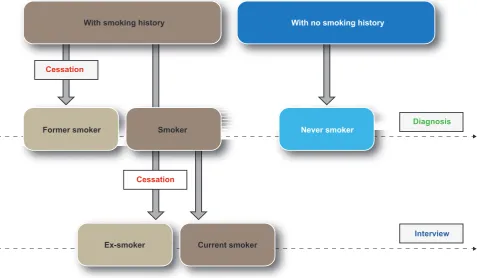
of Urology of the Hospital de Braga or were obtained by phone, from Sep 2015 to March 2016. Patients were divid-ed into the following groups, according with their smoking status (Fig. 1):
1. Smokers: when having smoked ≥ 100 cigarettes in life-time and smoking at the life-time of diagnosis. These pa-tients were subdivided into current smokers (remaining as smokers at the time of the interview) and ex-smokers (having managed to quit smoking at the time of the inter-view);
2. Former smokers: when having smoked ≥ 100 ciga-rettes in lifetime and having managed to quit smoking before diagnosis;
3. Never smokers: when having smoked < 100 cigarettes in lifetime.
All the patients having smoked at least 100 cigarettes in lifetime were considered as patients with a ‘smoking history’.
The following information was collected from all the pa-tients: age, gender, marital status, level of education. Two multiple choice questions aimed at the assessment of the patient’s awareness of smoking as a risk factor for BC and nine questions aimed at the definition of patient’s smoking status were submitted.
Clinical data and additional instruments were used for the analysis of patient’s smoking status at diagnosis. As all the quitters have described this status throughout the first six months upon diagnosis, only clinical variables regard-ing this period of time were included: stagregard-ing, histological grade, therapy approach according with the initial diagno-sis; number of surgeries over that period of time.
Figure 1 – Smoking status
With smoking history
Former smoker Smoker Never smoker
Ex-smoker Current smoker
With no smoking history
Cessation
Cessation
Diagnosis
ARTIGO ORIGINAL The following instruments were also applied [(Appendix 1)
https://www.actamedicaportuguesa.com/revista/index.php/ amp/article/view/9106/5345]:
1. Validated version of the Fagerström Test for Nicotine De-pendence (FTND) for the Portuguese language: higher scores corresponded to higher nicotine dependence. The ‘Tempo até o primeiro cigarro’ (‘Time to first ciga-rette’) item, which has been described by some studies as predictive of a successful outcome regarding smok-ing cessation, has been removed from the responses to the FTND.17-19
2. Qualitative questionnaire (two-item: True / False) re-garding the medical approach to the promotion of smok-ing cessation.
3. Portuguese translation of the Brief-Illness Perception Questionnaire (BIPQ): ‘Consequences’ (BIPQ-C) and ‘Concern’ (BIPQ-P) subscale items regarding the dis-ease were applied. Both subscale items were scored on a 0-10 Likert scale and higher scores corresponded to a higher impact of the disease.
4. Portuguese version of the Hospital Anxiety and Depres-sion Scale (HADS)20 allowing for the screening of in-patient anxiety and depression.
Collected data were analysed by using the Statistical Package for the Social Sciences (SPSSv23) software for a 5% level of significance.
Chi-square or Fisher’s exact test have been used
when-ever adequate. A post hoc analysis for Chi-square test has been carried out for the comparison of standardised residu-als (SR) in each cell of the contingency table, with z > ± 2 considered as significant.
Mann-Whitney, Kruskal-Wallis and Wilcoxon Signed-Rank tests were used for the identification of statistical dif-ferences between continuous variables. Post hoc analysis after the Kruskal-Wallis test has been used with Mann-Whit-ney test and Bonferroni correction for multiple comparisons.
RESULTS
A total of 160 patients were interviewed; 36 patients re-fused to participate or were unreachable, corresponding to an 81.6% participation rate.
Patient characteristics are shown in Table 1, divided by different groups according to the presence of smoking habit at diagnosis. A standard patient would be described as male (83.8%), elderly [median (Mdn) age = 67 years], basic education (52.5%), with a partner (77.5%) and initially diagnosed with non-invasive BC (83.8%). A percentage of 71.9% of our patients had a smoking history; from these, 51.3% were current smokers at diagnosis.
A significant female predominance (SR: z = +5.4; p < 0.001), older age at diagnosis (Mdn = 75 years; p < 0.001) and lower incidence of invasive carcinoma (SR: z = -2.3; p < 0.05) has been found in never smokers. An intermedi-ate result between current and never smokers in all these
Table 1 – Social, demographic and clinical characteristics of the patients according with the smoking status at diagnosis
Total no.
of patients Smokers Former smokers Never smokers p
(n = 160) (n = 59) (n = 56) (n = 45)
Gender, n (%) < 0.001*
Male 134 (83.8%) 56 (94.9%) 55 (98.2%) 23 (51.1%)
Female 26 (16.2%) 3 (5.1%) 1 (1.8%) 22 (48.9%)
Age, years,Mdn (IQR) 67 (17) 61 (12) 68.5 (14) 75 (15) < 0.001¥
Level of education,n (%) 0.036*
Illiteracy/Incomplete BE 27 (16.9%) 5 (8.5%) 11 (19.6%) 11 (24.4%) Basic education (BE) 84 (52.5%) 30 (50.8%) 27 (48.2%) 27 (60.0%)
Higher education 49 (30.6%) 24 (40.7%) 18 (32.1%) 7 (15.6%)
Marital Status,n (%) 0.115*
With partner 124 (77.5%) 49 (83.1%) 45 (80.4%) 30 (66.7%)
With no partner 36 (22.5%) 10 (16.9%) 11 (19.6%) 15 (33.3%)
Staging, n (%) 0.003*
NMIBC 134 (83.8%) 43 (72.9%) 47 (83.9%) 44 (97.8%)
MIBC 26 (16.2%) 16 (27.1%) 9 (16.1%) 1 (2.2%)
Grade, n (%) 0.247*
Low 77 (48.1%) 32 (54.2%) 22 (39.3%) 23 (51.1%)
High 83 (51.9%) 27 (45.8%) 34 (60.7%) 22 (48.9%)
* Chi-square test; ¥ Kruskal-Wallis test; Mdn: median; IQR: interquartile range; BE: basic education; NMIBC: non-muscle-invasive bladder cancer; MIBC: muscle-invasive bladder cancer.
ARTIGO ORIGINAL variables has been found in former smokers. No significant differences between the different smoking statuses were found as regards the histological grade.
Awareness of smoking as a risk factor for bladder can-cer
Smoking was mainly linked by patients to lung cancer (99.4%), cardiovascular diseases (95.6%), stroke (86.9%) and BC (74.4%), in descending order. Conversely, most patients rejected smoking as a risk factor for skin cancer (81.9%), diabetes (80.6%) and colorectal cancer (69.4%). Namely, when considering the link between smoking and BC and the patients by smoking categories, current smokers were in fact those who more frequently have linked smoking as a risk factor (p < 0.001; Table 2).
Smoking and alcohol were the most frequently de-scribed risk factors (43.8 and 21.3%, respectively) by pa-tients, when questioned on which is the most relevant risk factor for BC. Smoking was described by 51.3% of the pa-tients with a smoking history and by approximately 25% of never smokers as BC’s main aetiology (p = 0.008; Table 3). A wider response distribution was found in never smokers, with a similar relevance assigned to smoking, alcohol and genetics.
No significant differences in awareness were found be-tween current and ex-smokers, regarding both the identifi-cation of smoking as a risk factor (p = 0.679) and the identi-fication of smoking as the most relevant risk factor for BC (p = 0.637).
Characteristics of the smoking context before and upon bladder cancer diagnosis
At diagnosis, most patients with a smoking history were male (96.5%) with early smoking onset (Mdn = 15 years), long smoking duration (90.4% with ≥ 20 years) and the me-dian number of cigarettes smoked was one pack/day. At the interview, 24 current smokers at diagnosis (n =
59) had quitted (40.7%) and 35 continued smoking (59.3%), corresponding to a current smoking prevalence rate of 21.9% (35/160 patients) at the interview.
A total of 26 from all the current smokers (n = 35) had re-duced their consumption (74.3%) upon diagnosis, 8 contin-ued (22.9%) and 1 had increased (2.9%). Current smokers who had reduced their consumption had more frequently described smoking as the major risk factor than those who did not reduce (57.7% vs. 22.2%), even though no statisti-cal significance has been found (p = 0.121; Table 4).
Current versus ex-smokers: univariate analysis
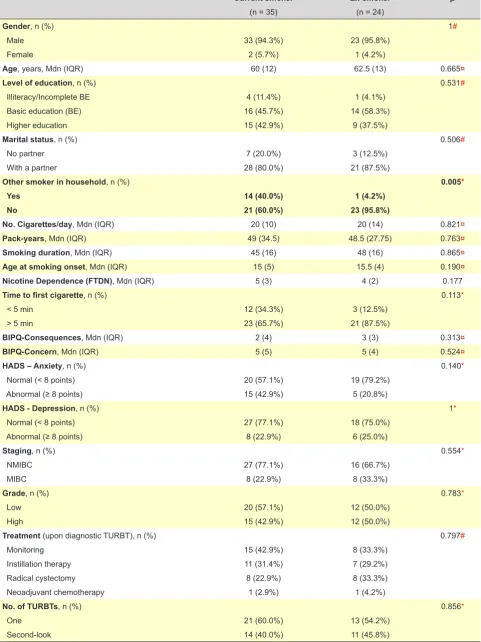
A similar smoking context has been found in current smokers when compared to ex-smokers, with higher nico-tine dependence and anxiety, even though with no signifi-cant differences (Table 5).
Slightly poorer medical contexts were found in ex-smok-ers, with a higher percentage of invasive tumours (33.3% vs. 22.9%; p = 0.554), higher histological grade (50.0% vs. 42.9%; p = 0.783) and the subsequent need for cystectomy (33.3% vs. 22.9%; p = 0.797), even though none of these clinical variables had reached significance, nor regarding any of the socio-demographic variables.
The presence of smoker in the household (sec-ond-hand smoke) was the only variable showing sta-tistically significant differences (found in 40% of cur-rent smokers vs. 4.2% in ex-smokers (p = 0.005;
Φ = 0.404).
Medical action for the promotion of smoking cessation Most smokers at diagnosis have described having re-ceived medical advice from urologists (83.1%) regarding smoking cessation. However, only one patient (1.7%) had received a more comprehensive support, specifically the referral to a smoking cessation medical unit. No significant differences were found in terms of action between current and ex-smokers (p = 0.506).
Table 4 – Relationship between smoking and the awareness of smoking as main risk factor for bladder cancer in current smokers
With smoking reduction With no smoking reduction p
(n= 26) (n= 9) 0.121#
Correct identification of the main risk factor, n (%) 15 (57.7%) 2 (22.2%)
Incorrect identification of the main risk factor, n (%) 11 (42.3%) 7 (77.8%)
# Fisher’s exact test. p = 0.121; OR – 4.773 (95%CI 0.826 – 27.562).
Table 2 – Smoking as risk factor for bladder cancer according to smoking classes
Yes No p
< 0.001*
Smoker, n (%) 53 (89.8%) 6 (10.2%)
Former smoker, n (%) 41 (73.2%) 15 (26.8%)
Never smoker, n (%) 25 (55.6%) 20 (44.4%)
Total 119 (74.4%) 41 (25.6%)
* Chi-square, χ2 (2) = 15.797; p = < 0.001; Cramer’s V = 0.314.
Table 3 – Main risk factor for BC according to smoking classes
Smoking Other risk factor p
0.008*
Smoker, n (%) 31 (52. 5 %) 28 (47.5 %)
Former smoker,n (%) 28 (50.0 %) 28 (50.0 %)
Never smoker, n (%) 11 (24. 4 %) 34 (75. 6 %)
Total 70 (43.8%) 90 (56.2%)
* Chi-square test. χ2 (2) = 9.557; p = 0.008; Cramer’s V = 0.224. Significant post hoc (χ2)
ARTIGO ORIGINAL
Table 5 – Univariate analysis between current and ex-smokers
Current smoker Ex-smoker p
(n = 35) (n = 24)
Gender, n (%) 1#
Male 33 (94.3%) 23 (95.8%)
Female 2 (5.7%) 1 (4.2%)
Age, years, Mdn (IQR) 60 (12) 62.5 (13) 0.665¤
Level of education, n (%) 0.531#
Illiteracy/Incomplete BE 4 (11.4%) 1 (4.1%)
Basic education (BE) 16 (45.7%) 14 (58.3%)
Higher education 15 (42.9%) 9 (37.5%)
Marital status, n (%) 0.506#
No partner 7 (20.0%) 3 (12.5%)
With a partner 28 (80.0%) 21 (87.5%)
Other smoker in household, n (%) 0.005*
Yes 14 (40.0%) 1 (4.2%)
No 21 (60.0%) 23 (95.8%)
No. Cigarettes/day, Mdn (IQR) 20 (10) 20 (14) 0.821¤
Pack-years, Mdn (IQR) 49 (34.5) 48.5 (27.75) 0.763¤
Smoking duration, Mdn (IQR) 45 (16) 48 (16) 0.865¤
Age at smoking onset, Mdn (IQR) 15 (5) 15.5 (4) 0.190¤
Nicotine Dependence (FTDN), Mdn (IQR) 5 (3) 4 (2) 0.177
Time to first cigarette, n (%) 0.113*
< 5 min 12 (34.3%) 3 (12.5%)
> 5 min 23 (65.7%) 21 (87.5%)
BIPQ-Consequences, Mdn (IQR) 2 (4) 3 (3) 0.313¤
BIPQ-Concern, Mdn (IQR) 5 (5) 5 (4) 0.524¤
HADS – Anxiety, n (%) 0.140*
Normal (< 8 points) 20 (57.1%) 19 (79.2%)
Abnormal (≥ 8 points) 15 (42.9%) 5 (20.8%)
HADS - Depression, n (%) 1*
Normal (< 8 points) 27 (77.1%) 18 (75.0%)
Abnormal (≥ 8 points) 8 (22.9%) 6 (25.0%)
Staging, n (%) 0.554*
NMIBC 27 (77.1%) 16 (66.7%)
MIBC 8 (22.9%) 8 (33.3%)
Grade, n (%) 0.783*
Low 20 (57.1%) 12 (50.0%)
High 15 (42.9%) 12 (50.0%)
Treatment (upon diagnostic TURBT), n (%) 0.797#
Monitoring 15 (42.9%) 8 (33.3%)
Instillation therapy 11 (31.4%) 7 (29.2%)
Radical cystectomy 8 (22.9%) 8 (33.3%)
Neoadjuvant chemotherapy 1 (2.9%) 1 (4.2%)
No. of TURBTs, n (%) 0.856*
One 21 (60.0%) 13 (54.2%)
Second-look 14 (40.0%) 11 (45.8%)
ARTIGO ORIGINAL DISCUSSION Despite the well-known benefits of smoking cessation, a significant part of the patients with BC continued smoking, with the risk of a poorer outcome, poorer quality of life and the presence of secondary cancers.
Our study population is in line with previous studies, mostly involving male, elderly patients with a long smoking history and non-invasive carcinoma.7,21,22 Female patients were mostly never smokers, reflecting the former smoking patterns in which women were usually never smokers. The fact that smoking at diagnosis seems as having an influ-ence on earlier onset and more invasive BC is worth men-tioning, in support to the association found in epidemiologic studies between smoking and muscle-invasive tumours.23,24 The awareness of the association between smoking and its consequences is crucial to change behaviour, as it enhances patient’s motivation towards its correction.13 The awareness of smoking as a risk factor for BC ranged between 58.4 and 86% in the different groups of patients involved in previous studies.25-27 In this study, 74.4% of the patients have described an association between smoking and BC, with a significant difference regarding awareness in smokers vs. never smokers (89.8% vs. 55.6%). The recom-mendations and alerts made by urologists, who usually are the major source of information for smokers, probably have had an impact on this difference.7,25 Previous studies have found that patients established a more straightforward re-lationship between smoking and other pathologies, namely with lung cancer and cardiovascular diseases, when com-pared to their own pathology.7,25,27This is possibly due to the low dissemination of the relationship between smoking and BC in general population.7,25,26
A relationship between cancer and smoking is frequent-ly established by the population, even regarding non-smok-ing-related cancers. Therefore, the question on which is the major risk factor for this cancer was used for the assess-ment of the real relevance assigned by patients to smoking in BC aetiology. Smoking was described as the main aetiol-ogy by only 51.3% of the patients with a smoking history and by around 25% of never smokers, below what has been found in literature.27 These low values may explain the fact that many patients continued smoking. No association has been shown in our study between the awareness of the risk factors and smoking cessation upon diagnosis.
A current 21.9% smoking prevalence rate has been found in this study, higher when compared to the general population,28 even though in line with previous studies both on BC,16,22,27as on other smoking-related cancers.29-31 Dif-ferent explanations for this result were advanced by Ostroff et al.21namely including: history of heavy smoking load; patients mostly diagnosed with non-invasive BC, with sig-nificant cure and survival potential; suboptimal awareness of the importance of smoking in BC development and pro-gression; suboptimal education and promotion of cessation made by urologists. According to McBride et al.,13 a diagno-sis of cancer, particularly when smoking-related, provides for an opportunity for the promotion of smoking cessation,
considering the increased perception of risk by patients. Nevertheless, different studies have found that less than half of the smokers with cancer remain as quitters at diag-nosis.32-35 Vilensku et al.22 and Bassett et al.7 found post-diagnosis smoking cessation rates of 42 and 48%, respec-tively. In our study and in line with these, a 40.7% smoking cessation rate in smokers with cancer was found at diagno-sis, a low rate that seems that such teachable moment has not been adequately used by patients regarding smoking cessation as by physicians regarding a more comprehen-sive action.
The psychological impact of diagnosis is mostly initial and while treatment takes place, with a propensity to fade as the acute sense of risk is decreasing. In this study, most patients were on monitoring, which may explain for the high percentage of active smoking. Most smoking relapses have occurred over the peri-diagnostic period and a quitter at six months may be considered as having a lower chance of a future relapse.33,36,37 Therefore, the relevance of the context and the initial action seemed crucial as in this study all ex-smokers have described having quitted smoking up to six months post-diagnosis.
ARTIGO ORIGINAL the present study.
Cessation advice has been made available to most smokers at diagnosis and, nevertheless, only one of these (1.7%) has received supplementary support (pharmaco-logic, nicotine replacement or behavioural therapy). These results were in line with those found in previous studies in which a suboptimal assistance to smokers by urologists has been found, based only on medical advice regarding
BC.27,45-47 Time-constrained urologists and general
practi-tioners considered that promotion of smoking cessation is suboptimal and disappointing, which may explain for their low investment into clinical daily practice.46-49
Some limitations are worth mentioning, apart from those previously described, which should be considered when conclusions are analysed: i) the assignment of data cau-sality is usually impaired by the cross-sectional design, ii) patients who did not participate in the study were older and female, two characteristics that were associated to never smokers – this fact may have overestimated smoker’s rate, iii) data regarding patient’s smoking history were based on interviews, with no biochemical confirmation of smok-ing cessation, with a potential risk of underestimation of the number of current smokers50,51 and (iv) an heterogeneous period of time between diagnosis and the interview has oc-curred, involving a risk of memory bias.
CONCLUSION
A significant issue related to the approach to the patient with BC has remained from this first study with Portuguese patients. Smoking is still not adequately recognised as the main aetiology of BC which, together with the recognised
difficulty regarding smoking cessation and with the deficit of strategies for the promotion of smoking cessation may have had a contribution to the high prevalence of current smok-ers.
In conclusion, urologists should have a more active role in the promotion of smoking cessation and therefore the in-clusion of protocols of action into the clinical practice may be an advisable recommendation, considering the family smoking context for the maximization of smoking cessation. As a future perspective, a post-diagnosis assessment of patient’s smoking behaviour in Portuguese patients with other cancer pathologies seems advisable, considering the scarce information available.
HUMAN AND ANIMAL PROTECTION
The authors declare that the followed procedures were according to regulations established by the Ethics and Clini-cal Research Committee and according to the Helsinki Dec-laration of the World Medical Association.
DATA CONFIDENTIALITY
The authors declare that they have followed the proto-cols of their work centre on the publication of patient data.
CONFLICTS OF INTEREST
The authors declare that there were no conflicts of inter-est in writing this manuscript.
FINANCIAL SUPPORT
The authors declare that there was no financial support in writing this manuscript.
REFERENCES
1. Miyazaki J, Nishiyama H. Epidemiology of urothelial carcinoma. Int J Urol. 2017;24:730-4.
2. Eble JN, Sauter G, Epstein JI, Sesterhenn IA, editores. World Health Organization pathology and genetics of tumours of the urinary system and male genital organs 2004. Lyon: IARC Press; 2004. [Consultado 2016 jun 07]. Disponível em: http://www.iarc.fr/en/publications/pdfs-online/pat-gen/bb7/BB7.pdf.
3. Cheung G, Sahai A, Billia M, Dasgupta P, Khan MS. Recent advances in the diagnosis and treatment of bladder cancer. BMC Med. 2013;11:13. 4. Ploeg M, Aben KK, Kiemeney LA. The present and future burden of
urinary bladder cancer in the world. World J Urol. 2009;27:289-93. 5. Miranda N, Portugal C, Nogueira P, Farinha C, Oliveira A, Soares A,
et al. Portugal- doenças oncológicas em números 2015. Lisboa; 2016. Direção Geral de Saúde. [Consultado 2016 Mar 02]. Disponível em: www.dgs.pt/estatisticas-de-saude/estatisticas-de-saude/publicacoes/ portugal-doencas-oncologicas-em-numeros-2015.aspx.
6. Burger M, Catto JW, Dalbagni G, Grossman HB, Herr H, Karakiewicz P, et al. Epidemiology and risk factors of urothelial bladder cancer. Eur Urol. 2013;63:234-41.
7. Bassett JC, Gore JL, Chi AC, Kwan L, McCarthy W, Chamie K, et al. Impact of a bladder cancer diagnosis on smoking behavior. J Clin Oncol. 2012;30:1871-8.
8. Sylvester RJ. Natural history, recurrence, and progression in superficial bladder cancer. Scientific World Journal. 2006;6:2617-25.
9. Rink M, Crivelli JJ, Shariat SF, Chun FK, Messing EM, Soloway MS. Smoking and bladder cancer: a systematic review of risk and outcomes. Eur Urol Focus. 2015;1:17-27.
10. Rink M, Furberg H, Zabor EC, Xylinas E, Babjuk M, Pycha A, et al. Impact of smoking and smoking cessation on oncologic outcomes in
primary non-muscle-invasive bladder cancer. Eur Urol. 2013;63:724-32. 11. Parsons A, Daley A, Begh R, Aveyard P. Influence of smoking cessation
after diagnosis of early stage lung cancer on prognosis: systematic review of observational studies with meta-analysis. BMJ. 2010;340:b5569. 12. Gritz ER, Fingeret MC, Vidrine DJ, Lazev AB, Mehta NV, Reece GP.
Successes and failures of the teachable moment: smoking cessation in cancer patients. Cancer. 2006;106:17-27.
13. McBride CM, Ostroff JS. Teachable moments for promoting smoking cessation: the context of cancer care and survivorship. Cancer Control. 2003;10:325-33.
14. Ostroff J, Dhingra L. Smoking cessation and cancer survivors. In: Feuerstein M, editor. Handbook of Cancer Survivorship. Washington: Springer; 2007. p. 303-22.
15. Rink M, Xylinas E, Babjuk M, Pycha A, Karakiewicz PI, Novara G, et al. Smoking reduces the efficacy of intravesical bacillus Calmette-Guerin immunotherapy in non-muscle-invasive bladder cancer. Eur Urol. 2012;62:1204-6.
16. Westmaas JL, Alcaraz KI, Berg CJ, Stein KD. Prevalence and correlates of smoking and cessation-related behavior among survivors of ten cancers: findings from a nationwide survey nine years after diagnosis. Cancer Epidemiol Biomarkers Prev. 2014;23:1783-92.
17. Castaldelli-Maia JM, Carvalho CF, Armentano F, Frallonardo FP, Alves TC, Andrade AG, et al. Outcome predictors of smoking cessation treatment provided by an addiction care unit between 2007 and 2010. Rev Bras Psiquiatr. 2013;35:338-46.
18. Ferreira PL, Quintal C, Lopes I, Taveira N. Teste de dependência à nicotina: validação linguística e psicométrica do teste de Fagerström. Rev Port Saúde Pública. 2009;27:37-56.
ARTIGO ORIGINAL
Time to first cigarette in the morning as an index of ability to quit smoking: implications for nicotine dependence. Nicotine Tob Res. 2007;9:S555-70.
20. Pais-Ribeiro J, Silva I, Ferreira T, Martins A, Meneses R, Baltar M. Validation study of a Portuguese version of the Hospital Anxiety and Depression Scale. Psychol Health Med. 2007;12:225-35.
21. Ostroff J, Garland J, Moadel A, Fleshner N, Hay J, Cramer L, et al. Cigarette smoking patterns in patients after treatment of bladder cancer. J Cancer Educ. 2000;15:86-90.
22. Vilensky D, Lawrentschuk N, Hersey K, Fleshner NE. A smoking cessation program as a resource for bladder cancer patients. Can Urol Assoc J. 2012;6:E167-73.
23. Sturgeon SR, Hartge P, Silverman DT, Kantor AF, Linehan WM, Lynch C, et al. Associations between bladder cancer risk factors and tumor stage and grade at diagnosis. Epidemiology. 1994;5:218-25.
24. Jiang X, Castelao JE, Yuan JM, Stern MC, Conti DV, Cortessis VK, et al. Cigarette smoking and subtypes of bladder cancer. Int J Cancer. 2012;130:896-901.
25. Bassett JC, Gore JL, Kwan L, Ritch CR, Barocas DA, Penson DF, et al. Knowledge of the harms of tobacco use among patients with bladder cancer. Cancer. 2014;120:3914-22.
26. Anastasiou I, Mygdalis V, Mihalakis A, Adamakis I, Constantinides C, Mitropoulos D. Patient awareness of smoking as a risk factor for bladder cancer. Int Urol Nephrol. 2010;42:309-14.
27. Guzzo TJ, Hockenberry MS, Mucksavage P, Bivalacqua TJ, Schoenberg MP. Smoking knowledge assessment and cessation trends in patients with bladder cancer presenting to a tertiary referral center. Urology. 2012;79:166-71.
28. Nunes E, Narigão M, Nogueira PJ, Farinha C, Somsen E, Soares A, et al. Portugal - Prevenção e controlo do tabagismo em números – 2014. Lisboa: DGS; 2014.
29. Underwood JM, Townsend JS, Tai E, White A, Davis SP, Fairley TL. Persistent cigarette smoking and other tobacco use after a tobacco-related cancer diagnosis. J Cancer Surviv. 2012;6:333-44.
30. Ostroff JS, Jacobsen PB, Moadel AB, Spiro RH, Shah JP, Strong EW, et al. Prevalence and predictors of continued tobacco use after treatment of patients with head and neck cancer. Cancer. 1995;75:569-76. 31. Burris JL, Studts JL, DeRosa AP, Ostroff JS. Systematic review of
tobacco use after lung or head/neck cancer diagnosis: results and recommendations for future research. Cancer Epidemiol Biomarkers Prev. 2015;24:1450-61.
32. Aveyard P, Adab P, Cheng KK, Wallace DM, Hey K, Murphy MF. Does smoking status influence the prognosis of bladder cancer? A systematic review. BJU Int. 2002;90:228-39.
33. Hopenhayn C, Christian WJ, Christian A, Studts J, Mullet T. Factors associated with smoking abstinence after diagnosis of early stage lung cancer. Lung Cancer. 2013;80:55-61.
34. Kim H, Kim MH, Park YS, Shin JY, Song YM. Factors that predict persistent smoking of cancer survivors. J Korean Med Sci. 2015;30:853-9.
35. Tseng TS, Lin HY, Moody-Thomas S, Martin M, Chen T. Who tended to continue smoking after cancer diagnosis: the national health and nutrition
examination survey 1999-2008. BMC Public Health. 2012;12:784. 36. Simmons VN, Litvin EB, Jacobsen PB, Patel RD, McCaffrey JC, Oliver
JA, et al. Predictors of smoking relapse in patients with thoracic cancer or head and neck cancer. Cancer. 2013;119:1420-7.
37. Walker MS, Vidrine DJ, Gritz ER, Larsen RJ, Yan Y, Govindan R, et al. Smoking relapse during the first year after treatment for early-stage non-small-cell lung cancer. Cancer Epidemiol Biomarkers Prev. 2006;15:2370-7.
38. Berg CJ, Thomas AN, Mertens AC, Schauer GL, Pinsker EA, Ahluwalia JS, et al. Correlates of continued smoking versus cessation among survivors of smoking-related cancers. Psychooncology. 2013;22:799-806.
39. Chandola T, Head J, Bartley M. Socio-demographic predictors of quitting smoking: how important are household factors? Addiction. 2004;99:770-7.
40. Kashigar A, Habbous S, Eng L, Irish B, Bissada E, Irish J, et al. Social environment, secondary smoking exposure, and smoking cessation among head and neck cancer patients. Cancer. 2013;119:2701-9. 41. Kim HE, Song YM, Kim BK, Park YS, Kim MH. Factors associated
with persistent smoking after the diagnosis of cardiovascular disease. Korean J Fam Med. 2013;34:160-8.
42. Caponnetto P, Polosa R. Common predictors of smoking cessation in clinical practice. Respir Med. 2008;102:1182-92.
43. Quaife SL, McEwen A, Janes SM, Wardle J. Smoking is associated with pessimistic and avoidant beliefs about cancer: results from the International Cancer Benchmarking Partnership. Br J Cancer. 2015;112:1799-804.
44. Schnoll RA, Malstrom M, James C, Rothman RL, Miller SM, Ridge JA, et al. Correlates of tobacco use among smokers and recent quitters diagnosed with cancer. Patient Educ Couns. 2002;46:137-45. 45. Coleman T. ABC of smoking cessation. Use of simple advice and
behavioural support. BMJ. 2004;328:397-9.
46. Sosnowski R, Przewozniak K. The role of the urologist in smoking cessation: why is it important? Urol Oncol. 2015;33:30-9.
47. Bjurlin MA, Goble SM, Hollowell CM. Smoking cessation assistance for patients with bladder cancer: a national survey of American urologists. J Urol. 2010;184:1901-6.
48. Strope SA, Montie JE. The causal role of cigarette smoking in bladder cancer initiation and progression, and the role of urologists in smoking cessation. J Urol. 2008;180:31-7.
49. Farley A, Koshiaris C, Oke J, Ryan R, Szatkowski L, Stevens R, et al. Physician support of smoking cessation after diagnosis of lung, bladder, or upper aerodigestive tract cancer. Ann Fam Med. 2017;15:443-50. 50. Thong AE, Petruzella S, Orlow I, Zabor EC, Ehdaie B, Ostroff JS, et
al. Accuracy of self-reported smoking exposure among bladder cancer patients undergoing surveillance at a tertiary referral center. Eur Urol Focus. 2016;2:441-4.