Language and Power: The Use of Persuasive
Techniques in Iran and U.S. President
Speeches
Sohrab Rezaei
Allameh Tabataba’i University, Iran
Niloofar Nourali
Allameh Tabataba’i University, Iran
Abstract—The present article is about language and power, focuses on the speechmaking skills, and using persuasive techniques such as Simile and metaphor, Mixed metaphor or simile, Extended metaphor, Allusion, Lists of three, Repetition, Parallelism, Puzzled or redundant questions, Alliteration and Wordplay. For the sake of better analysis certain elements of this ability, a comparison between Iran President Mr. Rouhani and U. S. President Mr. Obama is made. Two speeches of two presidents are selected. The first two are in the same topic and the second two are in different topics. Each president is a strong personality in his own right, both leaders have manifested this ability and managed to persuade the masses about the correctness of their political steps; however their using of persuasive techniques differ dramatically, as it is attempted to support by analysis in this article. The results show that, usually they use the same techniques but Dr. Rouhani use more persuasive techniques than President Obama does. Dr. Rouhani uses Alliteration and President Obama uses Metaphor more than other techniques in their speeches. It can be said that using persuasive techniques is culture based.
Index Terms—political language, persuasive techniques, Iran President, Hassan Rouhani, U.S. President, Barack Obama
I. INTRODUCTION
Chilton (as cited in Rozina & Karapetjana, 2009) defined language “as the universal capacity of humans in all societies to communicate while by politics he means the art of governance”. Hay (1997) believed that power is the most fundamental and universal concept of political analysis Rozina and Karapetjana (2009) had taken it for granted that the strategy which one person takes to get the other person do what s/he intends to be done is linguistic strategy.
Politicians may archive their political goals through physical coercion but there is another way that is more tactful. Using persuasive techniques to persuade people to act in special way they intend (Jalilifar & Alavi, 2011). A speech can function as an effective weapon if it is effectively given and the person wants to give a speech is prepared to present arguments. How to make it, reflects his or her ability (Kasanova, 2013).
Fairclough (1996) considered discourse as social practice because he believed that language is a part of society, is a social practice and is a socially conditioned process. On the other hand, Murcia & O’Donnell (2011) defined “Power” as the ability of an entity such as company,
Individual, social group, etc. to make change or to keep things as they are. They also believed that two different uses of language should be considered when discussing the power of language, the first one is language as public discourse and the second one is language as interpersonal communication. The former refers to the language used in public print media, television and radio and the web. The latter refers to the language used for communication between people.Fairclough (2001) stated that there are two ways of exercise power – through physical force and manufacture of consent. The first one is time-consuming, but the other one “relates to convincing people to accept things as they are” is preferred for exercising power. The public media uses the manufacturing consent as the most important vehicle for exercising power because the media let contact with large numbers of people. A political leader’s idiolect as Kasanova (2013) stated encompasses his or her communication policies and strategies, metaphors, repetitive mechanisms, obfuscation methods, etc. This article is going to explore various persuasive techniques used in the speeches of the two presidents of Iran and United states.
II. LITERATURE REVIEW
power of language means language in the service of power but it also means language can undermine power. On the other hand, language conveys power of domination and at the same time undermines it. The relation of language and power is ambivalent (Weib & Schwietring, 2015). As Bev (2008) stated language is a powerful tool in politics and politicians are its users for bad and good purposes. The study of language and power has advantages. It helps people to interact more effectively and if one be aware of power strategies cannot be influenced by them (Murcia, 2011). For understanding how power transfers through language, one should be aware of theoretical approach, which includes pragmatics and speech act theory, lexis and semantics, structures, forms of address and phatic tokens (Moore, 2003). Thompson (2005) believed that the more words are used to say something the less power those words have. For using lexis formal, informal are important, mood and tone can be very persuasive. In using grammar standard or non-standard can be powerful and persuasive in different contexts (“language and power”, 2015). Thompson (2005) said that "I" is a super-charged word I have, I choose, I love, and when someone feels powerful employs these kinds of “I” and when s/he feels less powerful waters down his/her words by saying, “I do not know” or “I am not sure”. Moore (2003) introduced ten persuasive techniques that include Simile and metaphor, Mixed metaphor or simile, Extended metaphor, Allusion, Lists of three, Repetition, Parallelism, Puzzled or redundant questions, Alliteration and Wordplay. Metaphor is a figure of speech that for rhetorical effect relates two unrelated things (“Metaphor”, 2015).On the other hand simile is a figure of speech that directly compares two things through the use connecting words (“Simile”. n.d.). Extended metaphor is developing a metaphor to make an argument. The powerful technique, which is referring to a phrase that the audience already knows, is called allusion. Lists of three refer to three- part structures that are memorable. Repeating a key idea is a useful technique, which is called repetition. When a sentence being divided into two parts is called parallelism, which may be synonymous or antithetic. It is a good idea to ask a question or series of questions to introduce a topic for speech this technique, which is a common technique, is called puzzled or redundant questions. When somebody uses the same initial consonant, it can be more effective and is called alliteration. The last technique using same words but with slight differences is called wordplay. (Moore, 2003). Kansanove (2013) in his research selected two U.S. Presidents, George Walter Bush and Barack Obama, the mother tongue of them is English, therefore he had to consider specific style of the language that used by English- speaking politicians.
Speeches by George W. Bush set him apart from his opponents’ postures and highlighted issues he deemed important. He frequently included in his speeches the American public and American citizens. He liberally used metaphors galore that subliminally impacts U.S. citizens, and used them for his selfish purpose. On the other hand, Obama does not attempt to manifest the correctness of his political moves by strictly sequestering himself from his opponents or partners; he is rather conciliatory in expressing his positions (Kasanova, 2013, p.72).
In another study, Horvath (2009) examines the persuasive strategies of President Obama in his speeches the results show that President Obama mostly uses pragmatism, liberalism, inclusiveness, acceptance of religious and ethnic diversity and unity. The most important words used by him are nation, new and America. He used personal pronoun we, which is an evidence of his perception of the American society and a need for unity, perceived in the time of national peril.
The characteristic of language that is used by politicians is different because its purpose is different. When they interact with society, their purposes may vary. Sometimes they want to persuade voters to vote, to make people accept their politics or they may use particular language when they are answering journalists. Parliamentary language also has some features such as special lexicon and forms of address, special structures, rules for taking and holding turns. But in some cases, parliamentary language violet maxims of conversation in this case other participants do not assume that speakers are telling the truth, speaking clearly or with relevance (Moore, 2003).
Dennis (1996) defined language power as a measure of one’s ability to communicate effectively in a given language, usually in a language rather than native one. Language power means ability to speak and be understood and to listen and understand (“language power”, n.d.).Kroes (2012) believed that the power of rhetoric caused Barack Obama enter into White house. For American people, as Alimand Geneva (2012) stated, it did not matter how many times President Obama said that he was not a Muslim. Or how many times he showed his birth certificate. On the other hand, they did not want to know what he said they want to know how he said it, Loh (2012) stated that Obama in his speeches usually uses stories and personal anecdotes, gratitude and over-flowing humility, inspiration and amazing sense of intimacy, rallies for solidarity and empathy for diversity. Bev (2008) compared two US presidents’ speech, President Barack Obama and president George W. Bush. He understood politicians’ rhetoric might serve good and bad intentions. President Barack Obama was able to use hopeful rhetoric while rising political star, but Bush’s rhetoric completely sounded self-righteous that placed the United States at its lowest points of popularity. Thompson (2005) believed that by understanding the power of language, we could make conscious, insightful choices about how we interpret others and express ourselves. Murcia (2011) stated that power in public discourse refers to the power of institutions within the society, and how these institutions keep their dominance using language. One of the important powers is to control the information. For example, one should decide on what gets into the press, how it should be presented. Public media shapes public opinion and personal power stems from personal language competence, social roles and social relationships. Moore (2003) introduced two kinds of power influential power such as advertising, politics, media, and culture and Instrumental power such as law, education business, and management. Weib and Schwietring (2015) stated all power must finally use language. This understanding of language is defined as instrumental power, which means using language for applying power. In this sense, the command of language can become a means of power such as political rhetoric, ideology. This power may extend from large political context, from the style of speaking and thinking to the small senses of everyday life such as the arts of persuading through advertising.
Rozinaand Karapetjana (2009) conducted a research to explore allusion, metonymy, and metaphor in political rhetoric. He concluded that linguistic manipulation can be regarded as an influential instrument of political rhetoric.
Moor (2003) believed that people should be able to refer to real examples when they want to know how power is exercised through language.
Andy Hamilton in an episode of a radio sitcom set in Hell said that one of the characters is “shaking like Millennium Bridge” which is a simile and the other has the “willpower of Bill Clinton at a cheerleaders convention” that is metaphor. Both examples were topical in 2000, which are assumed to know by audience. Sometimes speakers may mix metaphors intentionally. Shakespeare did this, when Hamlet suggested, “to take arms against a sea of troubles” the people may see it as a metaphor of an impossible struggle. In another example, John F. Kennedy used extended metaphor by saying, “The energy, the faith, the devotion which we bring to this endeavour will light our country and all who serve it, and the glow from that fire can truly light the world.” Ronald Reagans used allusion when he borrowed an image from John Gillespie Magge’s poem “surly bonds of earth” to explain disaster in 1986.King James Version (as cited in Moor, 2003) used lists of three when he said “And now abide the faith, hope, charity, these three...”. Harold Wilson (as cited in Moor, 2003) used Repetition technique when during the 1974 UK General Election Campaign, said “this election is not about the miners; not about the militants; not about the power of the unions…” The following is an example of synonymous parallelism from George W. Bush’s speech about US history “…the story of a power that went into the world to protect but not possess, to defend but not to conquer”. When it is read, it should have a pause after possess.
This question is example of puzzled or redundant questions “How can I get involved?” which is asked in the Welcome to the Labour party a booklet that gives information to a new member. Alliteration is the technique, which was used by Winston Cherchill in his speech on Nazi party as “the grisly gang who work your wicked will.” When Vladimir Nabokov in his essay on a book used this sentence “… is just low enough to provoke a past master’s chuckle and just high enough not to make a post-master frawn.” He uses word play technique.
III. PURPOSE OF THE STUDY
This article is going to show how power is communicated through language. To do so, the authors investigate two speeches given by each of presidents of Iran, U.S. one speech is in the same topic, and the other is in different one. Kasanova (2013) believed that although the strategies and the language of each president may differ widely, the goal of the political communication is the same; all of them try to gain public support for their views. “In the long run politicians crave for political power” (p. 62). By imposing laws, taxes, and bureaucratic systems, politicians use instrumental power, but by trying to influence people to vote for them, they use influential power. Rozina and Karapetjana (2009) proposed that in some social activities such as politics and law both kinds of power may be used at the same time.
Authors want to know:
4- Among the persuasive techniques, which of them is mostly used by Dr. Rouhani and which of them is mostly used by President Obama?
“Every human being’s personality, and thus also politics is unique, and the same holds true of every person’s language” (Kasanova, 2013, p.62).
IV. METHOD
Procedure
The theoretical framework has been derived from Moore (2003) and the methodology of this research has applied general principles of qualitative research, and it has been based on the discourse analysis. As this research intends to analyze selected persuasive techniques applied in political speeches, it focuses on Simile and metaphor, Mixed metaphor or simile, Extended metaphor, Allusion, Lists of three, Repetition, Parallelism, Puzzled or redundant questions, Alliteration and Wordplay. For the purposes of this study, the researcher has made use of speeches of two presidents. Two speeches of two presidents (Iran and United States) are selected. The first two speeches are in the same topic on Iran Nuclear Agreement and the second two are in the different topics, Dr. Rouhani’s speech on 27th book fair and President Obama’s speech on American hostages. The speeches are listened completely to choose the persuasive techniques precisely after that the transcribed version of each speech are investigated. The analysis is done to analyze the corpus. The findings compared to find that whether employing persuasive techniques differ by Iran’ president and United States’ president. For comparing the number and drawing chart Excel software has been used.
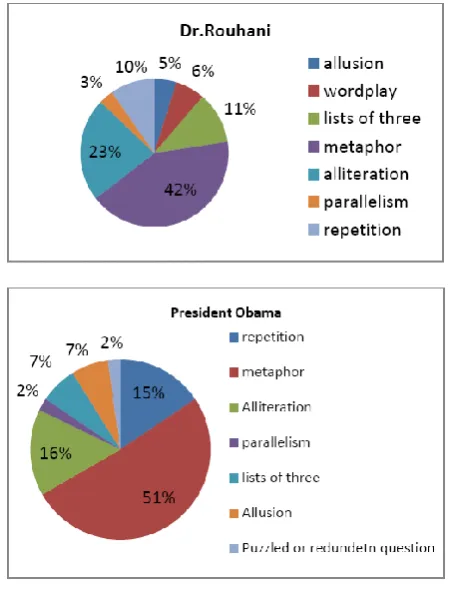
Figure 1: Dr. Rouhani’s speech and President Obama’s speech given in the same topic
Figure 3: President Obama’s speech on American hostages
V. RESULTS AND DISCUSSION
Power in this research refers to the power of dominant institutions within society, and how they use this power through language. Persuasive techniques as Moore (2003) introduced are simile and metaphor, mixed metaphor or simile, extended metaphor, allusion, lists of three, repetition, parallelism, puzzled or redundant questions, alliteration and wordplay.
In order to answer the research questions, results obtained from the analysis are demonstrated as follows:
TABLE 1:
THE FREQUENCY OF MOST USED OF PERSUASIVE TECHNIQUES IN THE SAME TOPIC
tech allu wo li me alli pa re puz
Iran 3 4 7 26 14 2 6
US 3 3 23 7 1 7 1
TABLE 2:
THE FREQUENCY OF MOST USED OF PERSUASIVE TECHNIQUES IN THE DIFFERENT TOPICS
tech Allu wo li me alli pa re
Iran 11 4 11 9 28 1 13
US 9 9 1 3 9 1 3
TABLE 3:
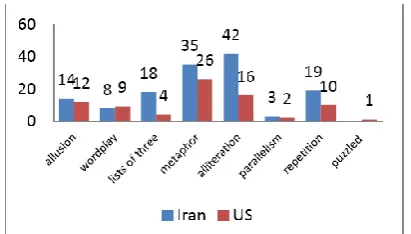
THE DIFFERENCES BETWEEN TWO PRESIDENTS IN USING PERSUASIVE TECHNIQUES
tech allu wo li me alli pa re puz
Iran 14 8 18 35 42 3 19
US 12 9 4 26 16 2 10 1
There is no significant difference between the two presidents in using persuasive techniques. Both of them used allusion, wordplay, lists of three, metaphor, alliteration, parallelism, repetition and none of them used simile and extended metaphor. The only difference is in the using of puzzled or redundant questions that president Obama used but Dr. Rouhani did not. On the same topic the Table 1 shows that they use almost the same technique with rather the same frequencies. Metaphor is the technique with the highest frequency for both of them. While on different topics Table 2 shows that although they employ same techniques, the frequencies are a bit different.
Figure 4: the comparison between two presidents in using persuasive techniques
VI. CONCLUSION
It is not surprising which the language applied in the political speech is rich in the use of persuasive technique. The two presidents, selected for the purpose of present article, are singular personalities capable of influencing developments on the national and international politics. “nothing else could be in place of a right and appropriate use of language in order to achieve the purpose of informing or stirring up the emotion of listeners or readers and making a striking impression on them” (Dorcas, 2011). The results show that both presidents use almost the same techniques when they are giving speech and Dr. Rouhani uses persuasive techniques more than president Obama does. The technique, which is mostly used by Dr. Rouhani is Alliteration and for president Obama is Metaphor. In addition, the results show that using persuasive techniques is to some extent culture based. It has to be said that to understand the political discourse the listener should have political background, to comprehend the situational context especially to find the meaning of Allusion that may use in speechesbecause no indication of the source is offered.
One cannot understand the political speeches without enough knowledge of metaphor when using a metaphor it is supposed that language user know how they are used in communication and what is intended to be understood (Rozina & Karapetjana, 2009).
The authors also found that the linguistic manipulation is considered as influential instrument of political speech because its primary goal is to persuade people to take political action. Today politics dominates in the mass media. The broad ranges of rhetorical devices such as textual levels, pragmatic, lexical, semantic, syntactic and phonological also are important. Language plays an important role in conveying ideology of the speakers.
REFERENCES
[1] Alim, S. H., Geneva, S., (2012). Articulate while black: Barack Obama, language, and race in the U.S. United States: Oxford University Press. American rhetoric. Historic nuclear agreement with Iran. [online]. 2015. [cit. 02.04.2015]. Available on the website: http://www.americanrhetoric.com/speeches/barackobama/barackobamairannuclearagreement.htm.
[2] Bev, J. S., (2008). The power and abuse of language in politics. Retrieved from http://www.thejakartapost.com/news/2008/02/20/power-and-abuse-language-politics.html. (accessed14/9/2015).
[3] Chilton, P., A. (1998). Politics and language. In Concise Encyclopedia of Pragmatics, London: Elsevier.
[4] Dennis, R. (1996). An examination of English as a second language assessment tools utilized by adult literacy providers in Pennsylvania. PACCE Journal of Lifelong Learning, 5, 1-13.
[5] Dorcas, B. O. (2011). A Stylistic analysis of a selected campaign speech of President Goodluck Jonathan. Retrieved from unilorin. Edu.ng. (accessed 20/9/2015).
[6] Fairclough, N. (1996). Language and power. London: Longman.
[7] Fairclough, N. (2001). Language and power. (2nd Ed.). Harlow: Pearson Education.
[8] Hay, C. (1997). Divided by a common language: Political theory and the concept of Power. Politics, 17(1).45-52.
[9] Horvath, J. (2009). Critical discourse analysis of Obama’s political discourse. Published Online.URL: http://www.pulib.sk/elpub2/FF/ Ferencik2/pdf_doc/6.Pdf access date: May 19, 2011.
[10] Irinn. Tavafoghe Lozan. [Lausanne Agreement] [online]. 1394. [cit. 1394.01.14]. Available on the website:http://www.irinn.ir/nes.(accessed14/9/2015).
[11] Jalilifar, A. R., & Alavi, M. (2011). Power and Politics of language use: A survey of Heging devices in political interview. The
journal of teaching language skills (JTLS), 3(3).43-66.
[12] Kasanova, P. & Kocnerova, M. (2013). Analysis of the idiolects of U.S. Presidents. The language of George W. Bush and comparison with his successor, Barack Obama. Annual of language & politics of identity, (7), 61-76.
[13] Kroes, R., (2012). The power of rhetoric and rhetoric of power: exploring a tension within the Obama presidency. European
Journal of American studies, 7(2). document14.https://ejas.revues.org/9578 (accessed 14/9/2015).
[14] Language and power. (2015). Retrieved from http://www.revisionworld.com. (accessed14/9/2015).
[15] Language power. (n.d.). In Wikipedia. Retrieved September 14, 2015, from https://en.wikipedia.org/wiki/Language_Power. [16] Loh, B. (2012). 8 Powerful speech techniques that president Barack Obama used to “Wow” the world in his presidential victory
speech 2012. Retrieved from http://www.benjaminloh.sg. (accessed14/9/2015).
[18] Moore, A. (2003). Language and power. Retrivedfromhttp://www.universalteacher.org.uk/lang/power.htm. (accessed14/9/2015).
[19] Morand, D. A. (2000). Language and power: an empirical analysis of linguistic strategies used in superior- subordinate communication. Journal of organizational behavior, (21), 235-248.
[20] Murcia, S., & O’ Donnell M. (2011). Language and power in English texts. Course material developed for a PhD program at the Universidad Autonomade Madrid. Retrieved from http://web.uam.es/departmentos/filoyeletras/filoinglesa/Courses/LFC-SFL/PowerDoctoradoV9-readingsweek2.pdf. (accessed14/9/2015).
[21] President. Bistohaftominnamayeshgahe Beinolmelaliyeketab. [Twenty- seventh International book fair]. [online]. 1393. [cit. 1393.02.09]. Available on the website:http://www.president.ir/fa/7717(accessed 14/9/2015).
[22] Rozina, G., &Karapetjana, I. (2009). The use of language in political rhetoric: Linguistic manipulation. Sosyalbilimlerdergist,
19. 111-122.
[23] Simile. (n.d.). In Wikipedia. Retrieved from https://en.wikipedia.org/wiki/Simile. (accessed14/9/2015). [24] Thompson, C. (2005).The power of language. Retrieved from http://experiencelife.com (accessed 14/9/2015).
[25] Weib, J., & Schwietring, T. (2015). The power of language: A philosophical- sociological reflection. Retrieved from www.goethe.de/lhr/prj/mac/msp/en1253450.htm (accessed 14/9/2015).
Sohrab Rezaei was born in Khalkhal, Iran, 1968. He received his PH.D Degree in Teaching English as a Foreign Language from Istanbul University, Turkey in 2005.He is currently an assistant professor in Allame Tabataba’i University, Tehran, Iran. His research interests include sociolinguistics, TEFL and education. He has taught in different universities in Iran. At the same time he has many years of experience in Iranian ministry of education and ministry of science research and technology. He is also working in higher education institute of Tehran municipality.
Niloofar Nourali, was born in Tehran, Iran in 1981. She received her B.A. degree in Library and Information science from Allameh Tabataba' i University, Iran in 2007. She is M.A. student of teaching English at Allameh Tabataba'i University, Iran.