Sharif University of Technology
Scientia IranicaTransactions F: Nanotechnology www.scientiairanica.com
Solvothermal synthesis of CuMS2
(M=Al, In, Fe)
nanoparticles and eect of coordinating solvent on the
crystalline structure
Y. Vahidshad
a,b, R. Ghasemzadeh
a;, A. Iraji Zad
c, S.M. Mirkazemi
aand
A. Masoud
ba. School of Metallurgy and Material Engineering, Iran University of Science and Technology, Tehran, P.O. Box 16844, Iran. b. Department of Material Research, Engineering Research Institute, Tehran, P.O. Box 1344575-411, Iran.
c. Department of Physics, Sharif University of Technology, Tehran, P.O. Box 11155-9161, Iran. Received 19 February 2014; received in revised form 14 October 2014; accepted 17 November 2014
KEYWORDS Chalcopyrite; Wurtzite;
Structural properties; Optical properties; Solvothermal.
Abstract. CuMS2 (M=Al, In, Fe) ternary compounds were synthesized via the facile
polyol method in autoclave. Depending on the functional groups of solvent and surfactant, the structure of the nanocrystals can be controlled in the form of wurtzite or chalcopyrite. The chalcopyrite structure was obtained when the precursors solved in the mixture of diethylene glycol, polyethylene glycol 600 and ammonium hydroxide. When the solvent was replaced by ethylene diamine, the wurtzite was obtained along with chalcopyrite (polytypism). The products were characterized by X-Ray Diraction (XRD) for analysis of structural properties, Transmission Electron Microscopy (TEM) for studying morphological properties, and absorbance spectrophotometer (UV-Vis-NIR) and photoluminescence (PL) for analysis of optical properties. The dierent optical band gap for CuAlS2 (3.48 eV),
CuInS2(1.51 eV) and CuFeS2(0.65 eV) could be utilized for absorbance material in a whole
range of sunlight wavelengths. The possible formation mechanism was also discussed. © 2014 Sharif University of Technology. All rights reserved.
1. Introduction
I-III-VI2 ternary compounds are known as important
semiconductors that can be utilized as in photovoltaic, optic, electronic and bioimaging applications. The CuMS2 ternary compounds (M=Al, Ga, In and Fe),
due to a high absorption coecient (> 105 cm 1),
changeable electrical conductivity (p-type or n-type) and tunable band gap (0.6-3.5 eV), can be ideally utilized in thin lm solar cells as absorbance materials in all the wavelength ranges of sunlight [1-5]. There are two general approaches to producing these ternary compounds. Using H2S gas to pass through the
produc-*. Corresponding author. Tel.: +98 21 7724540; Fax: +98 21 77240480
E-mail address: [email protected] ( R. Ghasemzadeh)
tion of intermetallic compounds (in a vacuum chamber) is the rst method. The wet chemical method (non-vacuum) to produce ternary CuMS2 compounds is the
second. Low time-consumption, low cost, and low ma-terial waste, besides well-controlled stoichiometry, are advantages of the wet chemical process [6-12]. Among wet chemical synthesis, the solvothermal process is one of the best wet chemical methods, because the control of stoichiometry is simple for the synthesis of nanocrystals (NCs) along with good crystalline quality, without any post heat treatment [13-19]. This method proposes the use of temperatures well above their boiling solvent to produce high pressure, which can be helpful to easily dissolve and complete the formation of chemical compounds with the solvent in the presence of a capping agent (polyethylene glycol, oleic acid, etc.) [20-21]. Sulde chalcogenides compounds, such
as CuInxGa1 xS2, CuInS2, CuAlS2 and CuFeS2, are
more environmentally friendly than selenium com-pounds. Currently, monodisperse nanoparticles with small particle size and narrow distribution, with regard to low cost techniques for the synthesis of non-toxic CuMS2 compounds, play a key role in photovoltaic
or light emitting diode industries [22-34]. In our previous work, we studied the various conditions of synthesis for CuAlS2 and CuInS2 [25-27]. The aim
of this study is to understand the ternary compound formation for the alloying of these compounds in the future. Therefore, it is important to investigate the common rules or mechanisms behind this process, which contribute to the controllable synthesis of these compounds. In this research, we use the solvothermal reaction in an autoclave for synthesis of CuMS2ternary
compounds, where M is Al, In and Fe. The eect of dierent functional groups on the structural and optical properties of CuAlS2, CuInS2 and CuFeS2 is
investigated. 2. Experimental
All used chemicals were analytical grade: Copper chlo-ride (for analysis EMSURE®ACS, Merck), aluminum trichloride (anhydrous powder sublimed for synthe-sis, Merck), indium sulfate (anhydrous for synthesynthe-sis, Merck), iron trichloride (for analysis EMSURE®ACS, Merck), and thiourea (GR for analysis ACS, Merck); diethylene glycol ((CH2CH2OH)2O), polyethylene
gly-col 600 (HO(C2H4O)nH) and ammonium hydroxide
(NH4OH) were used as initial materials provided by
the Merck company. The CuAlS2, CuInS2and CuFeS2
NCs were synthesized by a solvothermal approach in an autoclave. First, stoichiometric amounts of metal salts (AlCl3or InCl3or FeCl3and CuCl) were dissolved
into 10 cc PEG and 30 cc DEG. Then, the solution was heated under argon until 140C in a three neck
ask and stirred for at least 60 min to obtain a dark blue solution. In another vessel, the 40 mmol thiourea (SC(NH2)2) and amount of reducing agent were
dis-solved into 10 cc DEG at 30C and stirred for at least
60 min to obtain a transparent solution. Subsequently, the second solution was injected into the rst solution (including metal cations) at the dened temperatures (140C) and stirred for 15 min. The solution in the
ask quickly turned black. Then, the solution was moved into the autoclave and sealed. After that, the temperature rose to 210-220C for a specied time,
and the crystallinity was quite good. After processing completion, the autoclave was cooled down to room temperature, the products were centrifuged, washed several times with distilled water and ethanol and, nally, dried at 60C for 10 h under air condition (see
Table 1 for details concerning solution preparation). As can be seen, the sample codes that were used in this study were in the CIAFS-WA-n format. The C, I, A, F and S symbols indicate Cu, In, Al, Fe and S elements, while the W and A symbol showed the \with autoclave" synthesis, and n indicated the
Table 1. Experimental detail of polyol synthesis method. Sample
no.
NH2/
(OHDEG
+ OHPEG)
EDAa DEGb PEGc (Cu:In:
Al:Fe)
Cation
temp. Plane Intensity Structure CAS-WA-14 0.45/0.1620 30 cc 15 cc 15 cc (1:0:1:0) 70C (112) 671 CHd-CuAlS
2
CAS-WA-19 0/0.5815 0 cc 55 cc 10 cc (1:0:1:0) 140C (112) 1200 CH-CuAlS 2
CFS-WA-2 0.45/0.1620 30 cc 15 cc 15 cc (1:0:0:1) 70C (112) 424 (We+CH)-CuFeS 2
CFS-WA-3 0/0.5815 0 cc 55 cc 10 cc (1:0:0:1) 140C (112) 1218 CH-CuFeS 2
CIS-WA-1 0.45/0.1620 30 cc 15 cc 15 cc (1:1:0:0) 70C (103) 918 (W+CH)-CuInS 2
CIS-WA-6 0/0.5815 0 cc 55 cc 10 cc (1:1:0:0) 140C (112) 750 CH-CuInS 2
CIS-WA-1 0.45/0.1620 30 cc 15 cc 15 cc (1:1:0:0) 70C (103) 918 (W+CH)-CuInS 2
CIS-WA-2 0.45/0.1610 30 cc 15 cc 7.5 cc (1:1:0:0) 70C (103) 1082 (W+CH)-CuInS 2
CIS-WA-3 0.45/0.1630 30 cc 15 cc 22.5 cc (1:1:0:0) 70C (103) 784 (W+CH)-CuInS 2
CIS-WA-4 0.67/0.1600 45 cc 15 cc 0 cc (1:1:0:0) 70C (103) 1024 (W+CH)-CuInS 2
CIS-WA-5 0.88/0.0 60 cc 0 cc 0 cc (1:1:0:0) 70C (103) 1156 (W+CH)-CuInS 2
CIS-WA-6 0/0.5815 0 cc 55 cc 10 cc (1:1:0:0) 140C (112) 750 CH-CuInS 2
CIS-WA-7 0/0.4728 0 cc 45 cc 20 cc (1:1:0:0) 140C (112) 975 CH-CuInS 2
CIS-WA-8 0/0.3740 0 cc 35 cc 30 cc (1:1:0:0) 140C (112) 990 CH-CuInS 2
CIS-WA-9 0/0.6500 0 cc 65 cc 0 cc (1:1:0:0) 140C (112) 1000 CH-CuInS 2 aEDA: Ethylne diamine,bDEG: Diethylene glycol,cPEG: Polyethylene glycol,dCH: Chalcopyrite,eW: Wurtzite
sample number. The structures and optical properties of the CuMS2 NCs were characterized using an
X-ray diraction spectrometer (Panalytical MPD), a transmission electron microscope (TEM, Hitachi S-4800), a UV{Vis-NIR spectrophotometer (Ocean Op-tics In. USB-4000) and photoluminescence (Fluoro-max).
3. Results and discussion
The Al3+is a one of the strongest Lewis acids, and the
reduction potential of Al3+is highly negative compared
to Fe3+, In3+ and Cu+. As a result, the aluminum
salt dissolves and reduces really hard in reaction, in comparison to copper, iron and indium precursors. For proper solving and reducing of aluminum salts, the oxidation/reduction reaction of AlCl3 needs a strong
reducer solvent, such as NH4OH. The high chemical
potential gap of the two half reactive species, and the high pressure and high temperature of the media provide energy to overcome a prohibitive activation energy barrier. Also, the amount of reducer is very important because the standard reduction potential for Al3+ is highly negative compared to NH4OH, and
adequate amounts of ammonium hydroxide are needed to reduce the aluminum ions (Eq. (1)):
E0
2NH4OH!N2+H2O+6H+= 0:092 V;
E0
Cu+!Cu= +0:5180 V;
E0
Al3+!Al= 1:660 V;
E0
In3+!In= 0:3382 V;
E0
Fe3+!Fe= 0:037 V;
E0= E0
reduction Eoxidation0 0: (1)
Recent research [2-10,27-29] explains the formation mechanism of the complex for copper, aluminum, indium and iron, as below. If the precursors react with the amine functional group to form the complex, the mechanism of the reaction can be described as follows: In2(SO4)3+ 3=2C2H4(NH2)2! [In(EDA)3]3+; (2)
AlCl3+ 3=2C2H4(NH2)2! [Al(EDA)3]3+; (3)
FeCl3+ 3=2C2H4(NH2)2!! [Fe(EDA)3]3+; (4)
CuCl + 3=2C2H4(NH2)2! [Cu(EDA)]1+: (5)
If the metal salts react with the hydroxyl functional group to form the complex, the mechanism of the
reaction can be described as follows:
In2(SO4)3+ 3(HOCH2CH2)2O ! [In(DEG)3]3+; (6)
AlCl3+ 3(HOCH2CH2)2O ! [Al(DEG)3]3+; (7)
FeCl3+ 3(HOCH2CH2)2O !! [Fe(DEG)3]3+; (8)
CuCl + 3(HOCH2CH2)2O ! [Cu(DEG)]1+: (9)
Also, the extra DEG, PEG and EDA can be used as a capping agent with the surface of the nanocrystal, which protects it from the agglomeration particles. At solution 2, thiourea and NH4OH are used as sulfur ions
and reducing agent, respectively:
4SC(NH2)2+ 3(HOCH2CH2)2O + 8NH4OH
! 4S2 8H++ 16NH
3+ 4CO2
+ 3(HOCH2CH2)2O: (10)
When the anions solution (sulfur included) was injected into solution 1 (metal cations), fast nucleation was followed by the slow growth of the nanocrystal:
Cu1++ Al3++ 2S2 ! CuAlS2+ by products: (11)
After forming the nanocrystal, the high temperature along with high pressure, in the autoclave, caused it to reach a good crystallinity phase.
The extra DEG, PEG, EDA and thiourea played the role of capping agent by reacting to the nanopar-ticles surface (amine NH2, hydroxyl OH and thiol SH
ligands). The capping agent controlled agglomeration with steric repulsion between particles.
The results indicate that the crystal structure of CuAlS2, CuInS2 and CuFeS2 compounds are aected
by dierent functional groups. This eect of the solvent is investigated for these three compounds, as well as the synthesis of CuInS2, with the various molar ratios
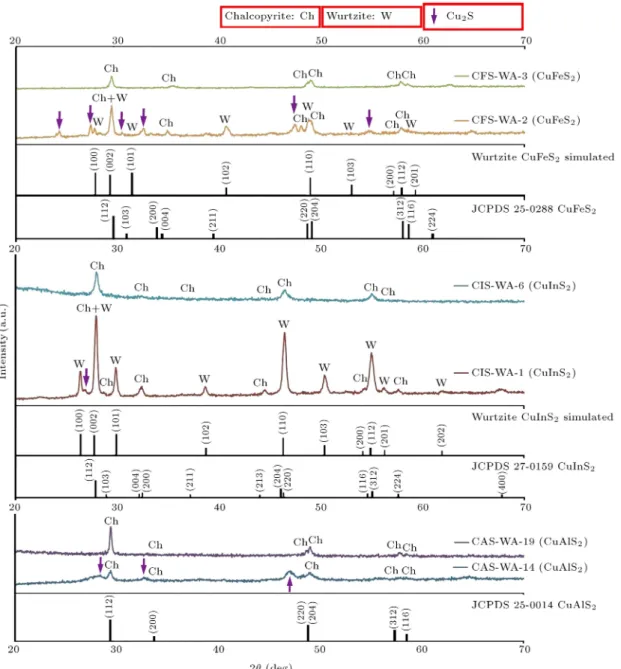
of functional groups. Figures 1 and 2 represent the XRD patterns of NCs that were synthesized by the amine and hydroxyl based solvents. Since Al3+ is a
hard Lewis acid, the chemical reaction system needs to be extremely strong, coordinating and reducing the solvent in the synthesis of CuAlS2. Dierent
functional groups in the solvent can be investigated on the CuAlS2 structural formation. A close study
of the X-ray diraction in Figure 1 shows that the intensity of the WA-19 sample is more than CAS-WA-14. It seems that the hydroxyl group can dissolve and reduce better in comparison with the amine based solvent. The structure of the synthesized CuAlS2
is chalcopyrite, which matches well with the JCPDS 25-0014 card (Joint Committee of Powder Diraction Standard). The main peaks for CAS-WA-14 are lo-cated in 29.370, 46.845, 58.090, and for CAS-WA-19 are
Figure 1. X-ray diraction patterns of CuAlS2, CuFeS2and CuInS2 samples synthesized in the same conditions.
located in 29.331, 46.795, 57.803, which are assigned to (112), (204), (312) reections of chalcopyrite CuAlS2,
respectively.
In contrast, the structure formation in the CuInS2
compound is dierent to CuAlS2. In the amine
based solvent, the wurtzite structure forms beside the chalcopyrite structure. In fact, there is a polytypism in the CuInS2 nanocrystalline, while, in the glycol
based solvent, just the chalcopyrite structure exists. The main peaks of the wurtzite structure for the CIS-WA-1 sample are located in 26.3201, 27.8732, 29.8115, 38.6071 and 46.4041, which are assigned to (100), (002), (101), (102) and (110). Also, the chalcopyrite structure, along with the wurtzite structure, is also deduced from the XRD pattern of this sample (depicted in Figure 1). The (002) and (110) reections of
the wurtzite overlap to (112) and (204) reections of chalcopyrite. For the glycol based solvent, the main peaks of the chalcopyrite structure for the CIS-WA-6 sample are located in 27.8919, 33.4151, 4CIS-WA-6.484 and 54.9632, which are assigned to (112), (200), (204) and (312). There is no wurtzite structure in this sample. The evolution of the XRD pattern (Fig-ure 1) reveals that polytypism exists in the CFS-WA-2 sample (amine based solvent). Major diraction peaks for CuFeS2 (NCs) are observed at 2 values
of 27.300, 29.355, 32.520, 40.560 and 54.740, which are assigned to (100), (002), (101), (102) and (103). Also, the (002), (110) and (112) reections of wurtzite are overlapped to (112), (204) and (312) reections of chalcopyrite. For the glycol based solvent, the main peaks of the chalcopyrite structure for the
CFS-Figure 2. X-ray diraction patterns of CuInS2 samples synthesized in dierent ratios of functional groups.
WA-3 sample are located in 29.355, 35.375, 48.920, and 57.775 and 62.685 are assigned to (112), (200), (204), (312) and (224). In previous research, Kumar and coworkers [30] and Korgel and coworkers [31] investigated the polytypism of synthesized CuInS2and
CuFeS2 NCs.
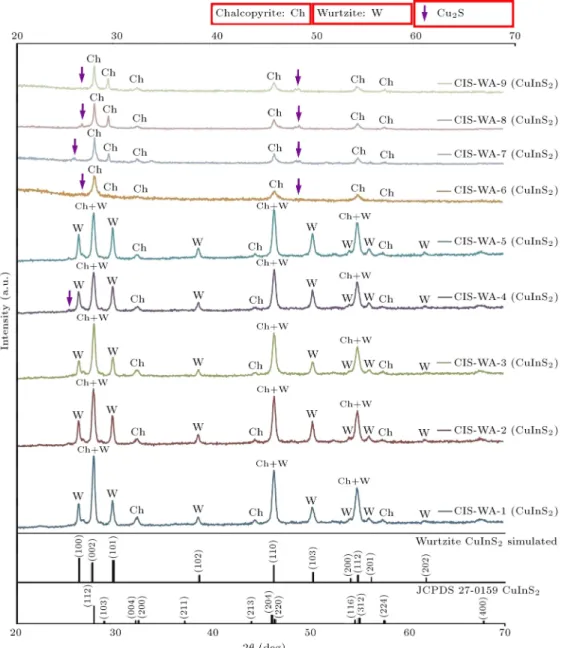
Figure 2 shows the XRD patterns of synthesized CuInS2 NCs of dierent functional group
concentra-tions (ratio of amine to hydroxyl) that are eective in chalcopyrite or wurtzite structure formation. To investigate the formation mechanism of the wurtzite CIS NCs, the concentration ratio of NH2 to OH was
carried out, which can be expressed as follows: CIS-5>CIS-4>CIS-2>CIS-1>CIS-3. It can be seen that the intensity of wurtzite reections is enhanced by increasing NH2 concentration. Contrariwise, when
the hydroxyl concentration increases, the chalcopyrite
reections enhance (as proof, increasing the intensity of the (103) reection of wurtzite to the intensity of the (200) reection of chalcopyrite). The intensity of the wurtzite main peaks can approximately demonstrate the amount of wurtzite structure formation. The (100), (101), (102) and (103) reections are just for the wurtzite structure.
Table 1 conrms the (103) reection for the wurtzite structure that is the maximum and the min-imum for the CIS-WA-5 and CIS-WA-3, respectively, among the synthesized samples.
The lattice constants of the chalcopyrite and wurtzite structure (Scheme 1) of synthesized NCs can be calculated using the following formula [32]:
1 d2 =
4 3
h2+ hk + k2
a2
Scheme 1. The unit cells of wurtzite and chalcopyrite structures.
1 d2 =
h2+ k2
a2 +
l2
c2 (Chalcopyrite): (13)
For the second batch of CuInS2 samples, by synthesis
with a glycol based solvent, the chalcopyrite structure is major. In these samples, the main peaks are just (112), (211), (204) and (312), and there are no main peaks for the wurtzite structure. Also, the crystallinity is enhanced by the increased amount of the hydroxyl functional group (Table 1). In fact, the types of functional groups in the reaction system are really eective on the formation of a major structure such as CIS-WA-9. On the other hand, the functional group properties of organic solvents are crucial to form a type of crystal structure. Both chalcopyrite and wurtzite structures are formed (polytypism) if there are both amine and hydroxyl in the reaction system (CIS-WA-1 to 5). It seems that the dierences in strength of coordination and interaction of the solvent with the cations are critical to forming the crystal structure. The coordinating strength between EDA and DEG to metal ions is dierent to the formation of complexes. Besides, the low boiling point of EDA compared to DEG is really important. For EDA, the boiling point
is 116C. So, the reaction should proceed vigorously
and the mixture may even be under a supercritical condition. The reaction conditions with DEG (high boiling point of 246C) are quite dierent in these
solvents, leading to the formation of dierent crystal phases [33-36]. It is interesting to see how mixtures of these solvents aect the produced crystal structures. By increasing contents of EDA from 30 cc to 60 cc, the wurtzite phase gradually increases.
Figure 3 shows typical TEM images obtained for three chalcopyrite compounds of CuAlS2, CuInS2
and CuFeS2 samples, which are synthesized under the
same conditions. As shown in Figure 3(a)-(f), the morphology of the particles seems cloud-like, which are attached to each other. It means that the cloud-like particles consist of aggregates of many nanoparticles with dierent sizes or morphology, or, probably, a dierent compound (lateral phase), which are loosely bound or interconnected with each other. In order to understand the growth mechanism of the CuMS2
(M=Al, In and Fe) nanoparticles via the solvothermal method, on the basis of the obtained results, the aggre-gation morphology can be observed from Figure 3(a)-(f). The TEM images of samples CuAlS2, CuInS2 and
CuFeS2 are shown in Figure 3((a) and (d)), ((b) and
(e)), ((c) and (f)), respectively. The average nanoparti-cle size of the aggregation products ranges from around 5-10 nm for CuAlS2, 10-15 nm for CuFeS2 to 20-50 nm
for CuInS2. This aggregation of nanoparticles in the
solvothermal method can be obtained by high pressure in an autoclave, polymerization of the capping agent or solvent, an inappropriate capping agent (the length of hydrocarbon chains or natural capping agent), cross-linking molecules with two end groups and inadequate capping agents [37-48].
Figure 3. Representative TEM images of CuAlS2 ((a) and (d)), CuInS2((b) and (e)) and CuFeS2 ((c) and (f))
Scheme 2. The possible mechanism for synthesis of nanoparticles in autoclave.
A relative discussion of the aggregation model shown in Scheme 2 is suggested. In our reaction system, it seems that the aggregation has been resulted from the polymerization of the capping agent at a high pressure of the autoclave, and the small hydrocarbon chain length of glycols in comparison with the primary amine of the alkene (such as oleylamine).
The optical properties of CuMS2 (M=Al, In and
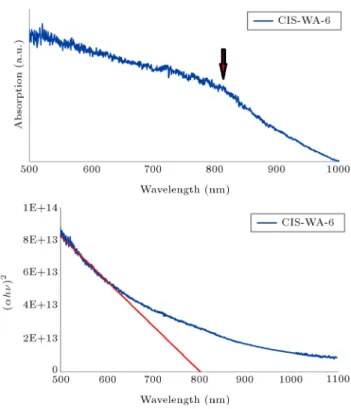
Fe) compound dispersed in Ethanol are measured at room temperature with UV-Vis absorption and PL spectra. The derived data from the pictures (Figures 4-7) shows that the edge of the absorption spectrum is around 356 nm for CAS-WA-19, 820 nm for CIS-WA-6 and 1880 nm for CFS-WA-3. Two absorption edges at 486 nm and 693 nm for CuAlS2
(CAS-WA-19) are lateral phase (Cu2 xS, x = 0 1). The
optical band gaps for chalcopyrite NCs can be cal-culated from extrapolation of the linear portion of the (h)2 plots versus h to = 0. According to
Figures 4-6, the absorption spectrum of the CuAlS2,
CuInS2 and CuFeS2 synthesized NCs show that all
the samples have high absorption in the ultraviolet, visible and infrared regions, respectively. The band gap can be calculated to be 1.53 eV, 3.54 eV and 0.65 eV for CAS-WA-19, CIS-WA-6 and CFS-WA-3, respectively, with regard to the function of the photon energy h (a=absorption coecient, h=Plank's constant and =frequency). Figure 7 shows the room temperature photoluminescence (PL) spectra of CuAlS2 and CuInS2 synthesized NCs dispersed in
ethanol. A strong emission centered at 383 nm and 822 nm is observed in the photoluminescence (PL) spectrum upon exciting the sample at = 260 nm and = 790, respectively. The observed emission band can be assigned to the emission from the recom-bination of electrons and holes being conducted to the valence band. Besides, the weak emission peak can be assigned to trap surface states located in the
Donor-Figure 4. Optical absorption spectrum and band gap of CAS-WA-19 sample dispersed in ethanol.
Figure 5. Optical absorption spectrum and band gap of CIS-WA-6 sample dispersed in ethanol.
Acceptor (DA) region of the band-gap (due to intrinsic defect).
4. Conclusion
In conclusion, a solvothermal approach has been devel-oped for enhancing CuAlS2formation or for controlling
Figure 6. Optical absorption spectrum and band gap of CFS-WA-3 sample dispersed in ethanol.
Figure 7. Photoluminescence spectrum of CAS-WA-19 and CIS-WA-6 sample dispersed in ethanol.
chalcopyrite and wurtzite formation in ternary CuInS2
and CuFeS2 compounds. For all these products, a
pure chalcopyrite structure can be synthesized if strong coordinating solvents such as DEG are used, while the wurtzite phase, besides the chalcopyrite of these com-pounds, is favorable when using weaker coordinating solvents. It was also found that more wurtzite struc-tures form when the amine group is used more than the hydroxyl group. By following the characterization of the optical, we nd that high absorption occurs in the wavelength of the ultraviolet, visible and near infrared regions, respectively, for CuAlS2, CuInS2 and CuFeS2
NCs. References
1. Poulose, A.C., Veeranarayanan, S., Aravind, A., Na-gaoka, Y., Yoshida, Y., Maekawa, T. and Kumar, D.S. \Synthesis of CuAlS2 nanocrystals and their
application in bio-imaging", Mater. Express, 2(2), pp. 94-104 (2012).
2. Harichandran, G. and Lalla, N.P. \Facile synthesis of CuAlS2 nanorods", Mater. Lett., 62(8-9), pp.
1267-1269 (2008).
3. Caglar, M., Ilican, S. and Caglar, Y. \Structural, morphological and optical properties of CuAlS2 lms
deposited by spray pyrolysis method", Opt. Commun., 281(6), pp. 1615-1624 (2008).
4. Yue, G.H., Wang, X., Wang, L.S., Wang, W. and Peng, D.L. \Synthesis of single crystal CuAlS2nanowires via
a low temperature direct polyol route", Phys. Lett. A, 372(38), pp. 5995-5998 (2008).
5. Wang, Y.H.A., Bao, N. and Gupta, A. \Shape-controlled synthesis of semiconducting CuFeS2
nanocrystals", Solid State Sci., 12(3), pp. 387-390 (2010).
6. Chen, G., Wang, L., Sheng, X., Liu, H., Pi, X. and Yang, D. \Chemical synthesis of Cu(In) metal inks to prepare CuInS2 thin lms and solar cells", J. Alloys
Compd., 507(1), pp. 317-321 (2010).
7. Chen, G., Wang, L., Sheng, X. and Yang, D. \Direct synthesis of indium nanoparticles and their application to prepare CuInS2 thin lms and solar cells", J.
Sol-Gel Sci. Technol., 58(1), pp. 162-169 (2011).
8. Luo, P., Yu, P., Zuo, R., Jin, J., Ding, Y., Song, J. and Chen, Y. \The preparation of CuInSe2 lms
by solvothermal route and non-vacuum spin-coating process", Phys. B, 405(16), pp. 3294-3298 (2010).
9. Park, M.S., Han, S.Y., Lee, E.J., Chang, C.H. and Ryu, S.O. \Synthesis and characterization of poly-crystalline CuInS2 thin lms for solar cell devices at
low temperature processing conditions", Curr. Appl. Phys., 10(3), pp. S379-S382 (2010).
10. Wei, H., Guo, W., Sun, Y., Yang, Z. and Zhang, Y. \Hot-injection synthesis and characterization of
quaternary Cu2ZnSnSe4 nanocrystals", Mater. Lett.,
64(13), pp. 1424-1426 (2010).
11. Youse, M., Sabet, M., Salavati-Niasari, M. and Hosseinpour-Mashkani, S.M. \Microwave approach for synthesis of copper-indium sulde nanoparticles and study of their behavior in solar cell", J. Clust. Sci., 23(2), pp. 491-502 (2012).
12. Pop, A.E., Popescu, V., Danila, M. and Batin, M.N. \Optical properties of CuxS nanopowders",
Chalco-genide Lett., 8(6), pp. 363- 370 (2011).
13. Cushing, B.L., Kolesnichenko, V.L. and O'Connor, C.J. \Recent advances in the liquid-phase syntheses of inorganic nanoparticles", Chem. Rev., 104(9), pp. 3893-3946 (2004).
14. Vahidshad, Y., Tahir, M.N., Iraji-Zad, A., Mirkazemi, S.M., Ghasemzadeh, R., Huesmann, H. and Tremel, W. \Structural and optical study of Ga3+substitution
in CuInS2nanoparticles synthesized by a one-pot facile
method", J. Phys. Chem. C, 118(42), pp. 24670-24679 (2014).
15. Long, F., Wang, W.M., Tao, H.C., Jia, T.K., Li, X.M., Zou, Z.G. and Fu, Z.Y. \Solvothermal synthesis, nanocrystal print and photoelectrochemical properties of CuInS2thin lm", Mater. Lett., 64(2), pp. 195-198
(2010).
16. Wei, Q. and Mu, J. \Synthesis of CuInS2nanocubes by
a wet chemical process", J. Dispersion Sci. Technol., 26(5), pp. 555-558 (2005).
17. Kuzuya, T., Hamanaka, Y., Itoh, K., Kino, T., Sumiyama, K., Fukunaka, Y. and Hirai, S. \Phase control and its mechanism of CuInS2 nanoparticles",
J. Colloid Interface Sci., 388(1), pp. 137-143 (2012).
18. Dutta, D.P. and Sharma, G. \A facile route to the syn-thesis of CuInS2 nanoparticles", Mater. Lett., 60(19),
pp. 2395-2398 (2006).
19. Sabet, M., Salavati-Niasari, M., Ashjari, M., Ghan-bari, D. and Dadkhah, M. \CuInS2/CuS
nanocom-posite: Synthesis via simple microwave approach and investigation its behavior in solar cell", J. Inorg. Organomet. Polym. Mater., 22(5), pp. 1139-1145 (2012).
20. Sheng, X., Wang, L. and Yang, D. \Shape and size controlled synthesis of CuInS2 particles in polyalcohol
system used as \printable ink" for thin lms", J. Sol-Gel Sci. Technol., 62(1), pp. 87-91 (2012).
21. Mousavi-Kamazani, M., Salavati-Niasari, M. and Ghanbari, D. \A facile solvothermal method for syn-thesis of CuInS2nanostructures", J. Nanostruct., 2(3),
pp. 363-368 (2012).
22. Steinhagen, C., Panthani, M.G., Akhavan, V., Good-fellow, B., Koo, B. and Korgel, B.A. \Synthesis of Cu2ZnSnS4 nanocrystals for use in low-cost
photo-voltaics", J. Am. Chem. Soc., 131(35), pp. 12554-12555 (2009).
23. Pei, L.Z., Wang, J.F., Tao, X.X., Wang, S.B., Dong, Y.P., Fan, C.G. and Zhang, Q.F. \Synthesis of CuS and Cu1:1Fe1:1S2 crystals and their electrochemical
properties", Mater. Charact., 62(3), pp. 354-359 (2011).
24. Aldakov, D., Lefrancois, A. and Reiss, P. \Ternary and quaternary metal chalcogenide nanocrystals: Synthe-sis, properties and applications", J. Mater. Chem. C, 1(24), pp. 3756-3776 (2013).
25. Vahidshad, Y., Ghasemzadeh, R., Irajizad, A., Mirkazemi, M. and Masoud, A. \Synthesis and char-acterization of CuAlS2 nanoparticles by facile heat
arrested method", J. Nanostruct., 2(3), pp. 369-377 (2012).
26. Vahidshad, Y., Irajizad, A., Ghasemzadeh, R., Mirkazemi, M. and Masoud, A. \Structural and optical characterization of nanocrystalline CuAlS2
chalcopy-rite synthesized by polyol method in autoclave", Int. J. Mod. Phys. B, 26(31), pp. 1250179-1250191 (2012).
27. Vahidshad, Y., Ghasemzadeh, R., Irajizad, A. and Mirkazemi, M. \Synthesis and characterization of copper indium sulde chalcopyrite structure with hot injection method", J. Nanostruct., 3(2), pp. 145-154 (2013).
28. Alwan, T.J. and Jabbar, M.A. \Structure and optical properties of CuAlS2 thin lms prepared via chemical
bath deposition", Turk. J. Phys., 34(2), pp. 107-116 (2010).
29. Permadi, A., Fahmi, M.Z., Chen, J.K., Chang, J.Y., Cheng, C.Y., Wang, G.Q. and Ou, K.L. \Prepa-ration of poly(ethylene glycol) methacrylate coated CuInS2/ZnS quantum dots and their use in cell
stain-ing", RSC Adv., 2(14), pp. 6018-6022 (2012).
30. Kumar, P., Uma, S. and Nagarajan, R. \Precursor driven one pot synthesis of wurtzite and chalcopyrite CuFeS2", R. Chem. Commun., 49(66), pp. 7316-7318
(2013).
31. Koo, B., Patel, R.N. and Korgel, B.A. \Wurtzite-chalcopyrite polytypism in CuInS2 nanodisks", Chem.
Mater., 21(9), pp. 1962-1966 (2009).
32. Cullity, B.D., Elements of X-ray Diraction, pp. 95-135, Addision-Wesley Publishing Company Inc., Lon-don, UK (1978).
33. Huang, W.C., Tseng, C.H., Chang, S.H., Tuan, H.Y., Chiang, C.C., Lyu, L.M. and Huang, M.H. \Solvothermal synthesis of zincblende and wurtzite CuInS2 nanocrystals and their photovoltaic
applica-tion", Langmuir, 28(22), pp. 8496-8501 (2012).
34. Li, Y., Han, Q., Kimb, T.W. and Shi, W. \Synthesis of wurtzite-zincblende Cu2ZnSnS4 and Cu2ZnSnSe4
nanocrystals: Insight into the structural selection of quaternary and ternary compounds inuenced by binary nuclei", Nanoscale, 6(7), pp. 3777-3785 (2014).
35. Qi, Y., Liu, Q., Tang, K., Liang, Z., Ren, Z. and Liu, X. \Synthesis and characterization of nanostructured
wurtzite CuInS2: A new cation disordered polymorph
of CuInS2", J. Phys. Chem. C, 113(10), pp. 3939-3944
(2009).
36. Bao, N., Qiu, X.H.Y., Wang, A., Zhou, Z., Lu, X., Grimes, C.A. and Gupta, A. \Facile thermolysis syn-thesis of CuInS2nanocrystals with tunable anisotropic
shape and structure", Chem. Commun., 47(33), pp. 9441-9443 (2011).
37. Alander, E.M., Penttila, M.S.U. and Rasmuson, A.C. \Agglomeration of paracetamol during crystallization in pure and mixed solvents", Ind. Eng. Chem. Res., 43(2), pp. 629-637 (2004).
38. Talapin, D.V., Lee, J.-S., Kovalenko, M.V. and Shevchenko, E.V. \Prospects of colloidal nanocrystals for electronic and optoelectronic applications", Chem. Rev., 110(1), pp. 389-458 (2010).
39. Zhou, Y., Zhou, W., Li, M., Du, Y. and Wu, S. \Hierarchical Cu2ZnSnS4particles for a low-cost solar
cell: Morphology control and growth mechanism", J. Phys. Chem. C, 115(40), pp. 19632-19639 (2011).
40. Zhou, Y.L., Zhou, W.H., Du, Y.F., Li, M. and Wu, S.X. \Sphere-like kesterite Cu2ZnSnS4 nanoparticles
synthesized by a facile solvothermal method", Mater. Lett., 65(11), pp. 1535-1537 (2011).
41. Zaberca, O., Gillorin, A., Durand, B. and Ching, J.Y.C. \A general route to the synthesis of surfactant-free, solvent-dispersible ternary and quaternary chalco-genide nanocrystals", J. Mater. Chem., 21(18), pp. 6483-6486 (2011).
42. Gong, M., Kirkeminde, A. and Ren, S. \Symmetry-defying iron pyrite (FeS2) nanocrystals through
ori-ented attachment", Sci. Rep., 3(2092), pp. 1-6 (2013).
43. He, L., Wang, M., Ge, J. and Yin, Y. \Magnetic assembly route to colloidal responsive photonic nanos-tructures", Acc. Chem. Res., 45(9), pp. 1431-1440 (2012).
44. Abargues, R., Albert, S., Vald, J.L., Abderra, K. and Martinez-Pastor, J.P. \Molecular-mediated assembly of silver nanoparticles with controlled interparticle spacing and chain length", J. Mater. Chem., 22(41), pp. 22204-22211 (2012).
45. Dang, C., Lee, J., Breen, C., Steckel, J.S., Coe-Sullivan, S. and Nurmikko, A. \Red, green and blue lasing enabled by single-exciton gain in colloidal quan-tum dot lms", Nat. Nanotechnol., 7(5), pp. 335-339 (2012).
46. Ip, A.H., Thon, S.M., Hoogland, S., Voznyy, O., Zhitomirsky, D., Debnath, R., Levina, L., Rollny, L.R., Carey, G.H., Fischer, A., Kemp, K.W., Kramer, I.J., Ning, Z., Labelle, A.J., Chou, K.W., Amassian, A. and Sargent, E.H. \Hybrid passivated colloidal quantum dot solids", Nat. Nanotechnol., 7(5), pp. 577-582 (2012).
47. Xia, Y. and Tang, Z. \Monodisperse inorganic supra-particles: Formation mechanism, properties and
ap-plications", Chem. Commun., 48(51), pp. 6320-6336 (2012).
48. Yang, P., Arfaoui, I., Cren, T., Goubet, N. and Pileni, M.P. \Unexpected electronic properties of micrometer-thick supracrystals of Au nanocrystals", Nano Lett., 12(4), pp. 2051-2055 (2012).
Biographies
Yaser Vahidshad was born in Kashan, Iran, in 1979, and received BS and MS degrees in Materials Science from Sahand University of Technology, Tabriz, Iran, in 2002 and the University of Tehran, Iran, in 2008, respectively. He is currently pursuing his PhD degree at Iran University of Science and Technology. His research interests include semiconducting material synthesis applicable in photovoltaic.
Reza Ghasemzadeh obtained his PhD degree from Imperial College, England, in 1973, and became a faculty member of Iran University of Science and
Technology, in 1973. His research interests include extractive metallurgy, transport phenomena, fuels, en-ergy, and furnaces.
Azam Iraji Zad obtained her PhD degree in Surface Physics from Sussex University, Brighton, UK, in 1990, and became a faculty member of Sharif University of Technology, Tehran, Iran, in 1990. Her research inter-ests include thin lms deposition and characterization, and electrical, magnetic and optical properties of thin lms.
Seyed Mohammad Mirkazemi obtained his PhD degree in 2005 from Iran University of Science and Technology, Iran, where he is currently faculty member. His research interests include glass-ceramics, nano-materials, magnetic nano-materials, and advanced ceramic materials.
A. Masoud. His/her biography was not available at the time of publication.