A Novel Distributed Load Scheduling Algorithm for
Electrical Vehicles in Smart Grid
Ubaid ur Rehman
Department of Electronics and Electrical Systems, University of Lahore, Pakistan
Corresponding Author: Email: [email protected]
Abstract
This paper explains the implementation of a load scheduling technique developed to schedule the electric vehicles (EVs) charging and discharging using optimal control in the distributed power network. We have assumed that the power flow between EVs and the utility grid is multi-directional, i.e., EV can supply power to grid in reverse as the distributed energy source as well as it could be charged from the grid, this phenomena is known as vehicle to grid (V2G) system. The optimal load scheduling algorithm has been developed as a varied discrete program (VDP) constraint, which is NP-hard and extremely complex to compute. Therefore, to overcome this complexity we have proposed a technique to compute the VDP constraint by altering the basic load profile curve of the night hours, and designed a distributed algorithm to reiterate water-filling. This algorithm executes in the distributed manners and effectively schedules EVs charging/discharging in local areas where the aggregation structure is already established. Owner’s security enhancement and reduced computational load are the major benefits of our proposed algorithm; the performance of this algorithm is verified by simulations.
Key Words:
Smart grid, Distributed Control, Load Diversion, Optimum Load scheduling, Electric vehicles1.
Introduction
Due to massive release of greenhouse gasses (GsG) and consistently depleting fossil fuel reserves, it is anticipated that the survival of future generations will be very difficult due to growing ecological pollution and without conventional energy resources. Therefore, it is considered that renewable resources and electric vehicles (EVs) are the best alternative of conventional power generation means and internal combustion engine vehicles (ICEVs) [1]. Despite of severe atmospheric disadvantages, the fossil fuels are more expensive than electricity, which immensely affects the economy of developing countries. It is projected that EV numbers will increase rapidly in the near future, because it exhibits better efficiency than a ICEV car [2].
Although, the growing use of EV will severely affect the reliability of the power grid. The random EVs charging could increase the load in peak hours, or it can disturb the prevailing power demand. Consequently, it can cause severe destruction within the power grid, as well as damaging the household appliances [3]. Conversely, by using the demand side management (DSM) technique we can intelligently schedule EVs charging by considering the needs of each stakeholder connected to the power grid. This can be achieved by the installation of autonomous DSM based charging stations, advance metering
setups, and by deploying efficient communication means [4].
Massive research has been carried out to upgrade EVs interior for DSM collaboration. It depends on which direction the power is flowing between EVs and grid. The contemporary carried out research might be divided into two classifications, 1) accommodation of those EVs who are just charging and only availing grid to vehicle (G2V) facility, 2) research about facilitating those EVs who are using both G2V and V2G facility. In [5]-[10], multiple algorithms have been formulated to schedule EVs charging to implement G2V. In [5], researchers created a charging constraint as limited time horizon vibrant game, and proposed a scattered charging method.
In [6] an inclusive investigation for load shifting constraints has been carried out using EVs, in this research, an optimal distributed algorithm has been proposed. In [7]-[9], multiple concept of distributed algorithm are illustrated, mainly use non-centralized water filling technique, to stabilize the demand profile for low power transformers to attain the best scheduling for EVs charging. In these approaches, network controlled EVs have been penetrated to regulate the grid supply in an American state with the mixture of renewable resources using the phenomena of consistently
varying electricity prices [10]. In [11], autonomous power inverters for V2G enabling EVs are used to supply energy in return to the grid, this study allowed researchers to deploy both V2G and G2V systems. In [12], authors are intended to reduce the EVs aggregation cost. Therefore, they have proposed an optimal load scheduling algorithm for both global and local load management, which can efficiently manage the random charging of multiple EVs beside it can level the load curve for conventional households. In [13], an optimal programming based charging/discharging scheduling algorithm is proposed, which controls uncertainties of renewable power production in smart grid. In [14], a stochastic process is deployed to reduce the known management cost of the grid considering the arbitrary EVs actions. In [15], researches regulated the overall load demand of multiple households along with managing the entire grid using EVs by deploying efficient load aggregation models. In [16], a dynamic central load scheduling technique is proposed to simultaneously manage the EVs and household power consumption, which enhances the sustainability and reliability of the smart grid.
A smart grid is a vibrant and consistently expanding network, which could not be controlled by penetrating a centralized algorithm, because it is impossible to attain exact information about each and every part of the power grid in real time, which usually occurs due to massively growing renewable penetration, therefore the scalability and information analysis of the global power networks is becoming difficult. Thus, the distributed management is the alternate solution to overcome these constraints [17]. By using modern technologies it is leniently possible to deploy distributed algorithm to manage the grid, this grid managing approach is also enforced by various researches. Normally, besides the viability and advantages of broader implementation of optimization techniques, the incentives of distributed algorithm have been analyzed by comparing the results with centrally optimized networks to check the robustness, reduction in communication burden, optimization of the load constraints, as well as enabling the stable flow of energy between stakeholders [18].
In articles [19] and [20], authors have proposed different models for controlling grid operations and introduced charging scheduling schemes for battery swapping stations. As analyzed, although in these studies the optimization constraints related to real time and day-ahead scheduling have been effectively analyzed and these research studies have
successfully developed the charging optimization techniques suitable for single charging stations or for a solo aggregator, but the optimization scheme for interactively connected numerous charging stations is missing. In ref [21] authors have developed an optimal scheduling algorithm for distributed EVs charging by deploying valley filling technique, and in article [22] author further expended the deployment of electric vehicles as a demand side management tool, which is generally considered as future of the power grids optimization where higher penetration of renewable power generation is anticipated. In ref [23], researcher proposed a local power managing scheme and defined an optimization strategy which efficiently coordinates with scattered EVs and manage their charging and it also controls the operation of battery switching stations. In ref [24], authors identified a robust charging constraint for plugged-in E-taxis which are anticipated as future of public transportation this constraint contains time anecdotal profits. In ref [25] a real time charging scheduling scheme for managing EVs aggregation process has been proposed to make EVs a permanent part of the energy markets.
In ref [26], [27], authors mainly focused to model schemes used to control uncertainties of the day-ahead markets while assuming that the short-term price forecasts in real time markets are precise. Although, these EVs charging scheduling schemes and optimization problems ignore the existing grid models and neglect their operational constraints, therefore, achieved results are potentially impractical. Practically the optimal EVs charging scheduling problems for mega charging stations could be formulated as an optimum-power-flow (OPF) problem having diverse objectified functions in a power distribution network to precisely counter the operational constraints. In [28] a study about the impact of vehicle to grid integration on voltage management in the existing distribution grids has been carried out. In [29], author propose an EV charging scheduling problem as a retreating horizon optimization model, the main objective of this model is to divert the EV charging from peak to off-peak hours. Several optimization model for instance linear optimization model which uses linear programming has been proposed in ref [30], in addition the particle swarm optimization has been proposed in [31] which work efficiently while coping network optimization constraints. Ref [32], [33], presents the most recent studies about convex relaxation models used to formulate the OPF optimization problem under precise relaxing scenarios. The following relaxation models are able to generate concise solutions for the actual formulations which are
globally optimal and have the frequent computational capabilities, especially for those distribution networks where relaxation accuracy could be achieved leniently
The highly esteemed success and fame of EVs has been anticipated in the upcoming decade, in this research, we have developed an autonomous load diverting method for night hours by employing both V2G and G2V enabling EVs. However, previous work, i.e. [12], also illustrates a distributed load scheduling technique by penetrating both V2G and G2V concepts, we appreciate these researchers approach, since this research article is the first one introduces the concept of stabilizing the load demand curve by utilizing optimum solutions, it configures the multi-directional power dispatch through decentralized algorithm. The main contributions of our research paper are as follows;
• We have developed an optimal load shifting constraint as VDP constraint; the basic objective of this constraint is to stabilize the load curve accordingly satisfying the EV charging and discharging requirements. By considering the NP-hardness of the optimal VDP constraint, we have proposed a robust and leniently computable constraint estimation technique which efficiently forecasts the nominal load demand profile curve for the night hours. The actual objective of this load profile estimation constraint is to divide the total time of a day into two distinct time slots through optimum time brinks, after implementing this method an EV will only charge or discharge following the defined schedule.
• In order to efficiently execute the load profile estimation constraint, we have proposed an optimal distributed load scheduling algorithm, which uses the bilateral water filling technique for load leveling. It is distributed in such manners that an EV performs local load calculations itself and individually communicates this information to the central control station, in order to accommodate the aggregation process which also reduces the computational burden. We have illustrated the brief convergence analysis of the proposed model in upcoming sections. • The simulation results show that our
proposed algorithm can efficiently anticipate the nominal load demand profile for night hours, even when it is projected that multiple EVs would be simultaneously
charging, moreover it can also define charging and discharging schedules for EVs and it also ensures the information privacy for each EV.
To prove relevancy and effectiveness of the proposed algorithm, the simulation results have been compared with the existing BONMIN method, the intensive performance comparison shows that our proposed algorithm exhibits extremely fast computation speed. In addition extremely complex research comparisons proves that, as compared to the BONMIN load scheduling method our algorithm can anticipate the load demand curve within seconds while BONMIN requires hours to perfume similar task.
This paper is arranged in the following manners; Section II, covers the single EV optimization model, network formulation, and defines the distributed water filling algorithm. Section III, explains the estimation of the primordial optimization, constraint, and illustrates a distributed optimal load scheduling algorithm. Section IV presents the simulation results, and discusses the performance analysis of the proposed algorithm, whereas section V concludes this paper.
2.
Mathematical Model Formulation
This section covers the initial formulation of the dynamic model framework for an individual EV and explains the basic structure of the proposed constraint besides, the detailed description of the distributed water filling based load scheduling technique is also given in this section. Note that, actually this model is the extension of our previously proposed research work [4], [5]. .2.1. Dynamic Model Framework for
an Individual EV
We presume that each EV contains Lithium-ion battery modules which are capable enough to perform V2G and G2V operations. Assume 𝑡 =
0 ,1, … represents the time period containing
multiple sampling intervals ∆𝑇 …. The battery state of charge (SOC) at time interval 𝑡, given by 𝑒(𝑡)(%), it also denotes the current charge state of a battery and defined as;
𝑒(𝑡) = 𝐺(𝑡)
𝐺𝑚𝑎𝑥 (1)
where 𝐺𝑚𝑎𝑥 is the overall battery capacity in (kWh), and 𝐺(𝑡) is the current charging state of a battery at time 𝑡.
Assume 𝑎(𝑡) represents the energy flow from EV to gird in kW. Let’s presume that the
charging/discharging ratio of an EV is stable as 𝑎(𝑡) is in the hiatus form, from 𝑡 to 𝑡 + 1. 𝑎(𝑡) > 0 it shows that an EV is being charged at time instant t, and 𝑎(𝑡) < 0 denotes the EV discharging. Moreover 𝑎(𝑡) = 0 denotes the absence of energy flow from EV to the grid. Thus, we can get the following unequal problem;
−𝑎−𝑜𝑢𝑡≤ 𝑎(𝑡) ≤ 𝑎−𝑖𝑛 (2)
where 𝑎−𝑖𝑛 is the highest power supplied for charging an EV, while −𝑎−𝑜𝑢𝑡 is the highest discharging ratio of an EV battery. For G2V operation let, multiple EVs are connected to intelligent chargers, which are capable enough to alter EV numbers from 0 to 𝑎−𝑖𝑛. conversely, for V2G operation; various EVs are connected to intelligent inverters, which exhibits the capability of supplying energy to the grid from EVs with the ratio of 0 to −𝑎−𝑜𝑢𝑡.
We characterize 0 < 𝜂𝑖𝑛, 𝜂𝑜𝑢𝑡< 1, in order to represent the power supplying efficiency of an EV during charging/discharging, so that we get the updated SOC as;
𝜂(𝑡) = {𝜂
𝑖𝑛< 1, 𝑓𝑜𝑟 𝑎(𝑡) ≥ 0. 𝜂𝑜𝑢𝑡1 > 1 𝑓𝑜𝑟 𝑎(𝑡) ≤ 0.
(3) Moreover, to extend the battery life, it is proposed that the SOC should remain within 25% out of 90% range [33]. Assume that an EV shall be disconnected at time interval 𝑇, then we get following problem.
𝑒 ≤ 𝑒(0) + ∆𝑇∑ 𝜂(𝑡)𝑎(𝑡)
𝜏−1 𝑡=0
𝐺𝑚𝑎𝑥 ≤ 𝑒,
𝜏 = 1, ⋯ , 𝑇
(4)
where 𝑎(0) is the initialization of the EV charging outlets at time 0. We have restricted the EV battery discharging and charging at 𝑒 = 25% to 𝑒 = 90%. An EV owner is capable to select its preferred SOC represented by 𝑒∗ this is the desired SOC at time slot T. It should be noted that 𝑒∗∈ [𝑒, 𝑒]. In this case we can get the following homologous problem.
𝑒(0) + +∆𝑇∑ 𝜂(𝑡)𝑎(𝑡)
𝜏−1 𝑡=0
𝐺𝑚𝑎𝑥 = 𝑒
∗ (5)
2.2. Constraint Initialization
In this research, we have only considered EVs having the capability of both V2G and G2V operations to stabilize the nominal load profile
curve during the night hours. For simplification, we presume that all EVs connect to the grid at 8 pm (20:00) and disconnects at 8 am in the next morning. The nominal demand curve of common households (exempting EVs) from 8 pm to 8 am is given in Fig. 1.
The basic power demand is represented by
𝑃(𝑡), ∀𝑡 = 0 ⋯ 𝑇 − 1. Assume that there are
𝑐 number of EVs, characterized from 1 to 𝑐. The general specifications of an EV as well as the charging/discharging amount variables have been characterized by 𝑑 = 1 ⋯ 𝑐, where 𝑑 illustrates the 𝑑′𝑡ℎ EV. The variable 𝑋 represents the common structural specifications of an EV fleet. The optimum load diverting constraint has been initialized as presented.
𝑚𝑖𝑛 ∑ (𝑃(𝑡) + ∑ 𝑎𝑑(𝑡)
𝑐
𝑑=1 )
2 𝑇−1
𝑡=0
(6) • Repression
-Impartiality repression on 𝑎𝑑(𝑡)′𝑒
𝑒𝑑= 𝑒𝑑(0) + ∆𝑇
∑𝑇−1𝑡=0𝜂𝑑(𝑡)𝑎𝑑(𝑡) 𝐺𝑑𝑚𝑎𝑥
= 𝑒𝑑∗, ∀𝑑.
(7)
-disparity repression on 𝑎𝑑(𝑡)′𝑒
−𝑎𝑑−𝑜𝑢𝑡≤ 𝑎𝑑(𝑡) ≤ 𝑎𝑑−𝑖𝑛, ∀𝑑, 𝑡 (8) -disparity repression on 𝑒𝑑(𝑡)′𝑒
𝑒 ≤ 𝑒𝑑(𝑡) ≤ 𝑒, ∀𝑑, 𝑡. (9)
-discrete repression on 𝜂𝑑(𝑡)′𝑒 𝜂𝑑(𝑡)
= {
𝜂𝑑𝑖𝑛 < 1 𝑓𝑜𝑟 𝑎𝑑(𝑡) ≥ 0, 𝜂𝑑
1
𝑜𝑢𝑡> 1 𝑓𝑜𝑟 𝑎
𝑑(𝑡) < 0,
(10)
Assertion 1: We have analyzed that the particular load scheduling constraint which has been executed using formulations (6)-(10) is the optimization integer which does not only consider 𝑎𝑑(𝑡)′𝑒 besides, it also inherits 𝜂𝑑(𝑡)′𝑒. Since, 𝜂𝑑(𝑡)′𝑒 can only inherent discrete values, whereas 𝑎𝑑(𝑡)′𝑒 could work on continuous values, note that the formulations (6)-(10) are the VDP constraints. In total there are just 3cT optimization integers. Although, if we only consider charging constraint, i.e. the task completion in [5], then 𝜂𝑑(𝑡) is a constant integer, parallel to 𝜂𝑑𝑖𝑛, which is not permitted to change.
Our objective is to manage the optimum load shifting in a distributed network with the help of aggregator. It is assumed that the aggregator is forecasting the basic load demand before 24 hours. The communication medium between aggregator and EVs is the star network, in which the aggregator has the central node, while EVs are connected through tree leaf nodes. All EVs perform two way communications with the aggregation center. By implementing our proposed algorithm an aggregator will have the leverage that it is not compulsory to be computationally strong, since the computational burden will be consistently shared with the EVs which are scattered. Moreover, as aforementioned it is not essential for an aggregator to have all the specifications information about each EV, so that the owners' privacy is ensured.
2.3. Water Filling based
Decentralized Algorithm
Before illustrating the proposed algorithm for scattered EVs scheduling, initially we will enlighten our previously proposed algorithm which works on water filling technique [5].
Diverse from (2), the disparity repression used for EVs in [5] is as follows;
0 ≤ 𝑎𝑑≤ 𝑎𝑑𝑖𝑛 ∀𝑑, 𝑡.
Fig 1: Basic load profile of 100 house-holds served in California Edison region from 20:00 on September 10, 2018 to 8 am September 11, 2018 [24]
In case, if owners have leverage to select SOCs according to their own requirements, then the Impartiality repression is equal to (5).
𝑒𝑑(0) + 𝜂𝑑𝑖𝑛∆𝑇
∑𝑇−1𝑡=0𝑎𝑑(𝑡)
𝐺𝑑𝑚𝑎𝑥 = 𝑒𝑑
∗, ∀𝑑.
The tariff function is similar to (6), and the integral constraint initialization is represented as;
𝑚𝑖𝑛 ∑(𝑃(𝑡) + ∑ 𝑎𝑑(𝑡)
𝑐
𝑑−1
)2, 𝑇−1
𝑡=0
𝑒. 𝑡. 0 ≤ 𝑎𝑑
≤ 𝑎𝑑𝑖𝑛 ∀𝑑, 𝑡.
𝑒𝑑(0) + 𝜂𝑑
𝑖𝑛∆𝑇∑𝑇−1𝑡=0𝑎𝑑(𝑡) 𝐺𝑑𝑚𝑎𝑥 = 𝑒𝑑∗, ∀𝑑.
(11)
Defining the projected map
Γ𝑑[𝑟] = {
𝑎𝑑−𝑖𝑛 𝑟 > 𝑎𝑑−𝑖𝑛 𝑟 0 ≤ 𝑟 ≤ 𝑎𝑑−𝑖𝑛
0 𝑟 < 0
(12)
Algorithm 1: Distributed Water Filling Requisites:𝑎𝑑−𝑖𝑛, 𝑒𝑑(0), 𝑒𝑑∗, ∈ 𝑎𝑛𝑑 𝑃(𝑡), ∀𝑑, 𝑡;
Assure: 𝑎𝑑(𝑡), ∀𝑑, 𝑡;
1. The expected total load forecast shared with aggregator 𝑃(𝑡);
2. for 𝑑 = 0, 1, 2, ⋯ , 𝑐do
3. Each aggregator calculates 𝑃𝑖(𝑡) = ∑𝑑−1𝑠=1𝑎𝑠+
𝑃(𝑡), ∀𝑡, 𝑑 ≥ 2; 𝑃𝑑= 𝑃(𝑡), ∀𝑡, 𝑑 = 1;
4. Aggregator transmits 𝑃𝑑(𝑡)′𝑒 to the d’th EV; 5. For d’th EV;
6. Boot 𝛾𝑑= 𝑎𝑑 𝑖𝑛
+ 𝑚𝑎𝑥𝑑 𝑃𝑑(𝑡) and 𝛾𝑑= 𝑚𝑖𝑛𝑑𝑃𝑑; 7. while𝛾𝑑− 𝛾𝑑> 𝜖 do
8. execute 𝛾𝑑= (𝛾𝑑+ 𝛾𝑑)/2;
9. run 𝑎𝑑= Γ𝑑[𝛾𝑑− 𝑃𝑑(𝑡)] and ∑𝑇−1𝑡=0𝑎𝑖(𝑡); 10. upgrade 𝛾𝑑 and 𝛾𝑑 accordingly
{
𝛾𝑑= 𝛾𝑑 𝛾𝑑= 𝛾𝑑
𝑓𝑜𝑟 𝜂𝑑𝑖𝑛∆𝑇
∑𝑇−1𝑡=0𝑎𝑑(𝑡) 𝐺𝑑𝑚𝑎𝑥 ≥ 𝑒𝑑
∗− 𝑒 𝑑(0),
𝛾𝑑= 𝛾𝑑, 𝛾𝑑= 𝛾𝑑 alternatively; 11. end while
12.the d’th EV forwards 𝑎𝑑(𝑡)′ to aggregator; 13.end for
Since, in the case of smart grid network multiple algorithms are being used to reduce the chance of complete system failure. We will redefine the algorithm proposed in our prior research work [5] (Algorithm 1).
The eventual water level is represented by 𝛾∗, in fact it has been used to stabilize the 𝛾∗= −𝜆∗, here 𝜆∗ is the optimum Lagrange multiplier. The altering ∈ has been represented as the tolerating difference between higher and lower water level that is the tiny positive number. Initializing 𝐻 as the figure of bisectional requirement, we get;
∈≥ 2𝐻(𝛾 − 𝛾), (13)
or
𝐻 ≥ 𝑙𝑜𝑔2(
𝛾 − 𝛾
∈ )
From (14) it could be evaluated that a higher ∈ intended to produce a severe deviation to the eventual result, conversely it minimizes the computing period. Regardless of this, a tiny ∈ intends to rise the computing period, and it increases the preciseness of the proposed algorithm. Hence, the strength of ∈ depends on the accuracy of different scenarios. In a particular case where accuracy is the main priority of an algorithm as compared to its efficiency, a higher ∈ is selected respectively for more details visit [5].
Assertion 2: In [4] we execute the load managing constraint by using the charging mechanism of EVs. The EVs are connected to smart charging points which are only able to accomplish G2V task. In such scenario, in [5] just valley filling (instead of peak shaving) has been accomplished. The algorithm 1 is denoting the water filling model due to the eventual result which seems much similar to the natural concept of water filling, here 𝑃(𝑡) is genuinely water surface, whereas 𝛾𝑐 is the resultant water level after water filling.
3.
Results
The following section explains the estimation of the primal optimization, constraint (6)-(10), which is relative to the proposed distributed scheduling algorithm; in addition, we have also defined the overview of the convergence capability of our proposed algorithm.
3.1. Constraint Estimation
This subsection illustrates the estimation of the primal VDP constraints (6)-(10). Before going into the detailed analysis, initially we examine the problems faced by the primal optimization constraints (6)-(10) by directly computing the projected load profiles.
• The optimization integer 𝑎𝑑(𝑡)′ 𝑒within the primal optimization constraints (6)-(10) is firmly attached, the main reason of the following firm attachment is the disparity constraint (9). The simultaneous charging/discharging of multiple EVs forced us to overcome the problems which are related to SOCs. Although whenever the alterations are the main focus, then the constraint (9) turns into redundant, which enable us to solve equation (11) leniently.
• The optimization integers 𝜂𝑑(𝑡)′ 𝑒 in the primal optimization constraint (6)-(10) executes during receiving discrete values. To resolve the complication caused by the discrete integers 𝜂𝑑(𝑡)′ 𝑒 ; we define the
constraints (6)-(10) in such manners, that these formulations could also be analyzed consistently as confined integrating nonlinear programming (CINLP) constraint, which is NP hard [36]. Further, 𝜂𝑑(𝑡)′ 𝑒 depends on 𝑎𝑑(𝑡)′ 𝑒, hence these are also firmly attached.
From the aforementioned description, it has been proved that it is enormously complex to directly compute constraints (6)-(10), nor these constraints could be solved using decentralized approach, thus these analytics compel us to search for a confined and computable estimation for the constraints (6)-(10). Since, we are mainly focusing on flattering the load profile curve during the night hours. Therefore, we recall the statistics of Fig. 1, which helps us to evaluate the following core features of the basic load curve.
• 20:00 is the peak demand time.
• The basic load demand reduces monotonously till 4:00 am,
• Whilst the basic demand is minutely raised from 4 to 8 am.
Several types of load demand data have been collected from different authorities and institutions, i.e., the real time data in hourly slots have been collected from British ISO [34], [35]. In addition, the data collected from Midwest ISO [36] has shown the same results as shown in Fig. 1. Hence, it is imperative to explain that the basic load demand curve, without EVs in night hours flattens the given assumptions as follows;
Assumption 1; 𝑃(𝑡) is monotonously enhancing [0, 𝑡𝑦] and reaches at its peak value at time instance 𝑡𝑦 , Moreover, [𝑡𝑦, 𝑡𝑧], 𝑃(𝑡) is monotonously declining, and gains its highest value at time instance 𝑡𝑧. In [𝑡𝑧, 𝑇], 𝑃(𝑡) which is monotonously rising. It should be clear that, in Fig.1. the 𝑡𝑦= 0, and 𝑡𝑧denotes the lowest load demand
The G2V ability of an EV makes valley filling possible, whereas V2G make peak shaving possible. It could be interpreted as, we can synchronize EVs in such manner that EVs supply power to the grid during those periods when the basic load demand is at its peak, and it charges in those hours when the basic load demand is in valley. By such coordination, the load profile curve has been stabilized. Since, it is usual that the maximum load demand rises before the valley demand, therefore we are intended to compute the threshold 𝑡†, so that EVs discharges at [0, 𝑡†] and charge at [𝑡†, 𝑇] after that it computes the
optimum load scheduling for EVs
We divide 𝑋 set into two subsets 𝑋1 and 𝑋2 , where 𝑋1= {𝑑 ∶ 𝑒𝑑(0) > 𝑒𝑚𝑖𝑛} , and 𝑋2= {𝑑 ∶ 𝑒𝑑(0) ≤ 𝑒𝑚𝑖𝑛}. After recalling our previous evaluation given in [5], we suggest following estimations for the primal constraints (6)-(10).
𝑚𝑖𝑛 ∑ (𝑃(𝑡) ∑ 𝑎𝑑(𝑡)
𝑐
𝑡=1 )
2 𝑇−1
𝑡=0
𝑒. 𝑡. −𝑎𝑑−𝑜𝑢𝑡≤ 𝑎𝑑∗ (𝑡) ≤ 0, ∀𝑡 = 0, ⋯ , 𝑡†− 1, 𝑑 ∈ 𝑋1,
𝑎𝑑 = 0, ∀𝑡 = 0, ⋯ , 𝑡†− 1, 𝑑 ∈ 𝑋2, 0 ≤ 𝑎𝑑(𝑡) ≤ 𝑎𝑑−𝑖𝑛, ∀𝑡 = 𝑡†, ⋯ , 𝑇 − 1, 𝑑, 𝑒𝑑(0) + ∆𝑇
∑𝑡 𝜂𝑑(𝑡)𝑎𝑑(𝑡)
†−1 𝑡=0
𝐺𝑑𝑚𝑎𝑥 = 𝑒
𝑚𝑖𝑛, ∀𝑑 ∈ 𝑋
1,
𝑒𝑑(0) + ∆𝑇
∑𝑇−1𝑡=0𝜂𝑑(𝑡)𝑎𝑑(𝑡) 𝐺𝑑𝑚𝑎𝑥 = 𝑒𝑑∗, ∀𝑑,
(15)
where 𝑒𝑚𝑖𝑛, 𝑡†, 𝜂
𝑑(𝑡)′𝑒, and 𝑎𝑑(𝑡)′𝑒 are the optimization integers, and 𝑒𝑚𝑖𝑛 is interpreted as the required SOC after full discharge, which is often shared by each EV integrated within a EV fleet. Alongwith for EVs, the available subset 𝑋2 never discharges at [0, 𝑡†], since this subset is only concerned about the current state of charging prior to 𝑡†.
It should be noted that, in e.q (15), 𝜂𝑑(𝑡) depend on 𝑎𝑑(𝑡), and they are firmly connected In case we set definites 𝑡† and 𝑒𝑚𝑖𝑛, we can expend (15) into two further sub constraints, in this case 𝜂𝑑(𝑡)′𝑒 is deterministic;
• For discharging state;
𝑚𝑖𝑛 ∑ (𝑃(𝑡) + ∑ 𝑎𝑑(𝑡)
𝑑∈𝑋1
) 2 𝑡†−1
𝑡=0
𝑒. 𝑡. − 𝑎𝑑−𝑜𝑢𝑡≤ 𝑎𝑑(𝑡) ≤ 0, ∀𝑡 = 0, ⋯ , 𝑡†− 1, 𝑑 ∈ 𝑋1
𝑒𝑑(0) + 1 𝜂𝑑𝑜𝑢𝑡∆𝑇
∑𝑡 𝑎𝑑(𝑡)
†−1 𝑡=0
𝐺𝑑𝑚𝑎𝑥 = 𝑒
𝑚𝑖𝑛,
∀𝑑 ∈ 𝑋1
(16) • For charging state
𝑚𝑖𝑛 ∑ (𝑃(𝑡) + ∑ 𝑎𝑑(𝑡)
𝑐
𝑑=1 )
2 𝑇−1
𝑡=𝑡†
𝑒. 𝑡. 0 ≤ 𝑎𝑑(𝑡) ≤ 𝑎𝑑−𝑖𝑛, ∀𝑡 = 𝑡†, ⋯ , 𝑇 − 1,
𝑒𝑚𝑖𝑛+ 𝜂
𝑑𝑖𝑛∆𝑇
∑𝑇−1𝑡=𝑡†𝑎𝑑(𝑡)
𝐺𝑑𝑚𝑎𝑥 = 𝑒𝑑
∗, ∀𝑑 ∈ 𝑋 1,
𝑒𝑚𝑖𝑛+ 𝜂
𝑑𝑖𝑛∆𝑇
∑𝑇−1𝑡=𝑡†𝑎𝑑(𝑡) 𝐺𝑑𝑚𝑎𝑥
= 𝑒𝑑∗, ∀𝑑 ∈ 𝑋2
(17)
The optimized integers of e.q (16) and (17) are the only 𝑎𝑑(𝑡)′𝑒. For pre-set 𝑡† and 𝑒𝑚𝑖𝑛, we can evaluate the equivalent optimal solutions 𝑎𝑑∗(𝑡)′𝑒 for (16) and (17). The e.q (15) is, however converted into multi-level programming constraint (MLPC).
Assertion 3; the tariff function in (15) is similar to (6). The estimated constraint is different from the primal optimization constraints (6)-(10) in the following problems only. The disparity problem (9) are not present in (15), making (15) lenient to compute as compared to the equations (6)-(10).
3.2. Distributed Load Scheduling
Algoirthm
In this subsection we have proposed a distributed load scheduling algorithm for optimum load diversion constraint by employing EVs charging/discharging, this algorithm works on the distributed water filling technique. The basic approach is to compute 𝑡† and 𝑒𝑚𝑖𝑛 in the distributed prospective, after that 𝑎𝑑(𝑡)′𝑒 is readily achieved. The computing procedure of our proposed algorithm is explained next, in which for initialization we have assumed 𝑒𝑚𝑖𝑛= 𝑒.
Step 1; All EVs employ the distributed water filling technique to compute the following constraint.
𝑚𝑖𝑛 ∑ (𝑃(𝑡) + ∑ 𝑎𝑑(𝑡)
𝑐
𝑑=1 )
2 𝑇−1
𝑡=𝑡†
𝑒. 𝑡. 0 ≤ 𝑎𝑑(𝑡) ≤ 𝑎𝑑−𝑖𝑛, ∀𝑡 = 0, ⋯ , 𝑇 − 1,
𝑒𝑚𝑖𝑛+ 𝜂
𝑑
𝑖𝑛∆𝑇∑ 𝑎𝑑(𝑡) 𝑇−1 𝑡=𝑡†
𝐺𝑑𝑚𝑎𝑥 = 𝑒𝑑
∗, ∀𝑑 ∈ 𝑋
1,
𝑒𝑑+ 𝜂𝑑𝑖𝑛∆𝑇
∑𝑇−1𝑡=𝑡†𝑎𝑑(𝑡) 𝐺𝑑𝑚𝑎𝑥 = 𝑒𝑑∗,
∀𝑑 ∈ 𝑋2,
(18)
That represents the optimal solution for (18) through 𝑎𝑑𝑖𝑛′𝑒. After executing these constraints, the aggregator will receive a time slot 𝑡𝑖𝑛 so that,
𝑎𝑑𝑖𝑛(𝑡) = 0, ∀𝑡 < 𝑡𝑖𝑛, 𝑎𝑛𝑑 𝑎 𝑑 𝑖𝑛(𝑡𝑖𝑛)
> 0, ∀𝑑. (19)
where we have an executing water level which is represented by 𝛾𝑖𝑛, and defined as;
𝛾𝑖𝑛 = 𝑃(𝑡𝑖𝑛) ∑ 𝑎𝑑(𝑡𝑖𝑛) 𝑐
Step 2; Since, only EVs are available in the subset 𝑋1 Therefore, we are activating the discharging state. Assume those EVs which are included in the subset 𝑋1 use the distributed water filling technique to compute the following constraint;
𝑚𝑖𝑛 ∑ (𝑃(𝑡) + ∑ 𝑎𝑑(𝑡)
𝑑∈𝑋1
)
2 𝑇−1
𝑡=0
𝑒. 𝑡. − 𝑎𝑑−𝑜𝑢𝑡≤ 𝑎𝑑(𝑡) ≤ 0, ∀𝑡 = 0, ⋯ , 𝑇 − 1, 𝑑
∈ 𝑋1
𝑒𝑑(0) +
1 𝜂𝑑𝑜𝑢𝑡
∆𝑇∑ 𝑎𝑑(𝑡)
𝑇−1 𝑡=0
𝐺𝑑𝑚𝑎𝑥
= 𝑒𝑚𝑖𝑛, ∀𝑑 ∈ 𝑋1,
(20)
where we have fixed 𝑒𝑚𝑖𝑛= 𝑒 . It represents the optimum solution of the constraint (20) through 𝑎𝑑𝑜𝑢𝑡′𝑒. For EVs in 𝑋
2, fix 𝑎𝑑𝑜𝑢𝑡= 0, ∀𝑡. After converging the aggregator we achieve a time instance 𝑡𝑜𝑢𝑡 so that;
𝑎𝑑𝑜𝑢𝑡(𝑡) = 0, ∀𝑑 > 𝑡𝑜𝑢𝑡, and 𝑎𝑑𝑜𝑢𝑡(𝑡𝑜𝑢𝑡)
< 0, ∀𝑑 ∈ 𝑋1 (21)
Although at this stage we have executed the water filling algorithm, but, the result is similar to the peak shaving, or it can be considered as invert water filling. The correspondent water level has been represented by 𝛾𝑜𝑢𝑡, as given;
𝛾𝑜𝑢𝑡= 𝑃(𝑡𝑜𝑢𝑡) + ∑ 𝑎
𝑑(𝑡𝑜𝑢𝑡) 𝑑∈𝑋1
Step 3; In this stage, a local EV aggregator compares two different water levels. By assumption 1, we get satisfactory 𝑡𝑖𝑛 and 𝑡𝑜𝑢𝑡, which will descend during the intervals [𝑡𝑦, 𝑡𝑧]. Due to declining monotonous, either evaluation 𝛾𝑜𝑢𝑡 ≥ 𝛾𝑖𝑛 is similar to this evaluation if 𝑡𝑜𝑢𝑡≤ 𝑡𝑖𝑛.
𝑡†∈ [𝑡𝑜𝑢𝑡, 𝑡𝑖𝑛], 𝑒𝑚𝑖𝑛 = 𝑒, and
𝑎𝑑∗(𝑡) = 𝑎𝑑𝑜𝑢𝑡(𝑡) + 𝑎𝑑𝑖𝑛(𝑡), ∀𝑡, 𝑑.
Some of the details of the proposed algorithm are explained here.
• Supposedly, there are some possibilities which could not be achieved [𝑡𝑖𝑛 or 𝑡𝑜𝑢𝑡] such as (19) or (21) dominances, respectively. Let we infer 𝑡𝑜𝑢𝑡 as an example; there are two possibilities for 𝑡𝑜𝑢𝑡 which does not even exists; 1) The EVs discharging trims the complete load profile curve, as well as valley section, i.e., (𝑚𝑖𝑛𝑡(𝑃(𝑡) + ∑𝑑∈𝑋1𝑎𝑑𝑜𝑢𝑡) < 𝑚𝑖𝑛𝑡𝑃(𝑡). 2). While the possibility 𝑡𝑖𝑛
′ > 𝑡𝑖𝑛 could be somehow possible, but its
occurring possibility is extremely low,, therefore EVs can discharge within the time intervals [𝑡𝑖𝑛, 𝑡𝑖𝑛′] . Although, in actual implementation, both of these possibilities are ruled out. Preliminarily, EVs does not contain extreme residual power, therefore, their discharging could not trim the overall load profile curve. Secondly, the actual difference between the peak load demand and valley filling is significantly huge, which assures that the stage 2) would never execute either. • The optimally regulated load demand profile
will be in a straight line which is not possible in practical case, since, the rate of discharging and charging of an EV is limited, as well as only few number of EVs usually penetrates with the grid for peak shaving. However, by implementing optimum techniques for scheduling EVs charging/discharging, it is possible to regulate water levels, when if EVs are in discharging state which usually occurs in minimum rate as compared to the charging state, then 𝛾𝑜𝑢𝑡≥ 𝛾𝑖𝑛 should be maintained.
• In Stage 3; if 𝑡𝑜𝑢𝑡> 𝑡𝑖𝑛, then we can assume that EVs are able to supply enough power back to the grid which can be used for peak shaving. Therefore, in this scenario we should enhance 𝑒𝑚𝑖𝑛 so that 𝛾𝑜𝑢𝑡 = 𝛾𝑖𝑛, thus, we get 𝑒𝑚𝑖𝑛 by the adaptation of vibrant bi-section in the distributed network prospective. Assertion 4: the proposed algorithm in this research work is actually depending on the water filling technique implemented in our previous paper [5], it is leniently established that this algorithm works in a distributed manner. Moreover, on one side our distributed algorithm minimizes the computational load of an aggregator, while on the other side it maintains the owner’s privacy. Therefore, it is not essential for an aggregator to know about each EV specifications. Assertion 5: To persuade assumption 1, there is a need of extremely high amount of load, so that the proposed algorithm can manage aggregator performance effectively, hence the load of each household can be managed properly by strictly following the specified load scheduling outline, it is also analyzed that if an individual household performs unsatisfactory or it suddenly get out of business, even then it cannot influence the aggregator performance. In such scenario we assume that the assumption 1, could not be contented for fewer load amounts.
For instance, it is anticipated, that the load demand on a micro grid during night hours could have various peak spikes and valleys. Therefore, to tackle these situations, the load demand curve could be divided into various sub demand curves, and the phase targeted SOCs are assigned in such manners that each assignment is optimum and specifically targeting a phase for SOC accomplishment, therefore, this sub demand curve should be equal to the required SOC within a complete curve. Hence, the proposed algorithm could have been implemented for each individual sub curve to achieve the optimal solution for the whole curve.
3.3. The Convergence Evaluation
In this subsection we will have explained the analysis of the convergence results of our proposed scheduling algorithm.Lemma 1; Let 𝑡𝑖𝑛 and 𝑡𝑜𝑢𝑡 exists in such scenario that the conditions (19) and (21) holds when 𝑡𝑜𝑢𝑡≤ 𝑡𝑖𝑛, after that the proposed algorithm converges to the optimum solution for the constraint (15).
To prove theorem 1; the following lemmas are required. Lemma 1 is related to the optimal water filling by penetrating a single EV.
𝑚𝑖𝑛 ∑(𝑃(𝑡) + 𝑎(𝑡) − 𝜔)2,
𝑇−1
𝑡=0
𝑒. 𝑡 0 ≤ 𝑎(𝑡) ≤ 𝑎−𝑖𝑛, ∀𝑡
𝑒(0) + 𝜂𝑖𝑛∆𝑇∑ 𝑎(𝑡)
𝑇−1 𝑡=0
𝐺𝑚𝑎 = 𝑒
∗ (22)
It is interpreted as;
𝑎∗(𝑡) = Γ[−λ∗− P(t)], ∀t,
where 𝜔 denotes the optimally aggregated load demand, which remains stable for all 𝑡, and 𝑎∗(𝑡) is the optimum solution for the constraint (22), where λ∗ represents the optimum Lagrange multiplier, note variable Γ[∙] is presented in e.q., (12).
Lemma 2; The optimum solution for the constraint (22) is not considered as the optimal load demand 𝜔.
Proof; we comprise
∑𝑇−1(𝑃(𝑡) + 𝑎(𝑡) − 𝜔)2
𝑡=0 = ∑𝑇−1𝑡=0(𝑃(𝑡) +
𝑎(𝑡))2+ 2𝜔 ∑𝑇−1𝑎(𝑡) + 𝑇𝜔2
𝑡=0 (23)
As narrated impartiality constraint at 𝑎(𝑡)′𝑒 exhibits the following condition as follows;
∑ 𝑎(𝑡)
𝑇−1
𝑡=0
= (𝑒∗− 𝑒(0))𝐺𝑚𝑎𝑥/(𝜂𝑖𝑛∆𝑇) (23)
it is a stable constraint, Thus, by merging (23) and (24), we get
∑(𝑃(𝑡) + 𝑎(𝑡) − 𝜔)2
𝑇−1
𝑡=0
= ∑(𝑃(𝑡) + 𝑎(𝑡))2+ 𝜌(𝜔),
𝑇−1
𝑡=0 while
𝜌(𝜔) = 2𝜔 (𝑒∗− 𝑒(0)𝐺𝑚𝑎𝑥/(𝜂𝑖𝑛∆𝑇)) + 𝑇𝜔2,
Consequently 𝜔 only regulates the stable terms of the tariff function, thus the Lemma 2 has been proved.
• Now we will prove Lemma 1.
Validation of the Lemma 1; initially we delineate
𝑔𝑡(𝑎(𝑡), 𝜔) = (𝑃(𝑡) + ∑ 𝑎𝑑(𝑡) − 𝜔
𝑐
𝑑=1
)
2
𝐺(𝑎, 𝜔) = ∑ 𝑔𝑡(𝜔).
𝑇−1
𝑡=0
It is followed by the tariff equation (6) which is similar to 𝐶(𝑎, 0). Subsequent to the convergence of the proposed algorithm; there would be 2 types of results;
A: Initially we prove that 𝑡† is the optimum solution despite having some contradictions. We assume that, there is a possibility of 𝑡‡< 𝑡𝑜𝑢𝑡and 𝑡‡ which establishes that the overall tariff is fewer than 𝑡† has, It is represented by 𝑎𝑑‡(𝑡) which has the optimum solution for 𝑡‡. As given in Lemma 2, we change the preliminary cost function by 𝐺(𝑎, 𝛾𝑜𝑢𝑡) despite imposing any replacement to the optimum solution. The charging and discharging procedures could be divided into three sections respectively.
• In case of 𝑡 ∈ {0, 𝑡‡}, we compute constraint (16) by employing our algorithm 1, in which we have replaced 𝑡† by 𝑡‡. It denotes the resultant subsequent water level by 𝛾‡𝑜𝑢𝑡. Since it is relative to the natural contrary water filling function, 𝑡‡< 𝑡† which leads to 𝛾‡𝑜𝑢𝑡< 𝛾𝑜𝑢𝑡, because we have shrieked the EVs discharging duration, when it is still possible to implement load leveling constraint. from Lemma 1; there should be some 𝑡 left for 𝑎𝑑∗ > −𝑎𝑑−𝑜𝑢𝑡 due to this shrieking, in such scenario we get;
{𝑎𝑑
‡(𝑡) = −𝑎
𝑑
−𝑜𝑢𝑡, if 𝑎 𝑑
∗(𝑡) = −𝑎
𝑑 −𝑜𝑢𝑡
𝑎𝑑‡(𝑡) < 𝑎𝑑∗, (𝑡) if𝑎𝑑∗ > −𝑎𝑑−𝑜𝑢𝑡 which leads to 𝑡 ∈ {0, 𝑡‡},
𝑃(𝑡) + ∑ 𝑎𝑑‡(𝑡) 𝑐
𝑑=1
≤ 𝑃(𝑡) + ∑ 𝑎𝑑∗(𝑡), 𝑐
𝑑=1
here the impartiality just stands at 𝑡 when 𝑎𝑑∗(𝑡) = −𝑎𝑑−𝑜𝑢𝑡(𝑡). Further, we also have the information that some 𝑡 exists in this case;
𝑃(𝑡) + ∑ 𝑎𝑑∗(𝑡) 𝑐
𝑑=1
− 𝛾𝑜𝑢𝑡 = 0
𝑃(𝑡) + ∑ 𝑎𝑑‡(𝑡) 𝑐
𝑑=1
− 𝛾𝑜𝑢𝑡< 0, So that we get
∑ 𝑔𝑡(𝑎‡(𝑡), 𝛾𝑜𝑢𝑡) 𝑡‡−1
𝑡=0
> ∑ 𝑔𝑡(𝑎∗, 𝛾𝑜𝑢𝑡) 𝑡‡−1
𝑡=0
,
(24)
• In case of 𝑡 ∈ {𝑡‡, 𝑡𝑖𝑛}, we gain −𝑎 𝑑
∗(𝑡) ≤
𝑎𝑑∗(𝑡) < 0 moreover 𝑎 𝑑 ‡
(𝑡) = 0 . since
𝑃(𝑡) + ∑𝑐𝑑=1𝑎𝑑∗(𝑡) = 𝛾𝑜𝑢𝑡 , thus it is followed by;
∑ 𝑔𝑡(𝑎‡(𝑡), 𝛾𝑜𝑢𝑡) 𝑡𝑖𝑛−1
𝑡‡
> ∑ 𝑔𝑡(𝑎∗, 𝛾𝑜𝑢𝑡) 𝑡‡−1
𝑡=0
,
(25)
• In case of 𝑡 > 𝑡𝑖𝑛 , due to 𝑡‡< 𝑡𝑖𝑛 , as mentioned in Lemma 1, we get 𝑎𝑑‡(𝑡) = 𝑎𝑑∗(𝑡), which is followed by;
∑ 𝑔𝑡(𝑎‡(𝑡), 𝛾𝑜𝑢𝑡) 𝑇−1
𝑡=𝑡𝑖𝑛
> ∑ 𝑔𝑡(𝑎∗, 𝛾𝑜𝑢𝑡) 𝑇−1
𝑡=𝑡𝑖𝑛
,
(26)
By the equations (25)-(27) we get; 𝐺(𝑎‡, 𝛾𝑜𝑢𝑡) > 𝐺(𝑎∗, 𝛾𝑜𝑢𝑡)
This statement is contradictory as compared to the initial assumption.. Correspondingly we are
able to confine this statement, since, there is no possibility of 𝑡‡> 𝑡𝑖𝑛, therefore the overall tariff is additionally minimized. So that 𝑡‡ is the optimum selection.
B; In this scenario, we will prove that 𝑒𝑚𝑖𝑛 is also the optimal choice due to contradictions. We assume, there is a possibility of 𝑒⋄> 𝑒𝑚𝑖𝑛 in this case the overall tariff is further decreased. It is represented by 𝑎𝑑⋄(𝑡) which is the optimum solution for 𝑒⋄. Therefore, we are again using tariff function 𝐺(𝑎, 𝛾𝑜𝑢𝑡) for the following case.
The implementation of 𝑒⋄ could lead towards new settlements referred as differentiation points, which are represented by 𝑡⋄,𝑖𝑛and 𝑡⋄,𝑜𝑢𝑡 correspondingly. Two new water levels have been added at this stage, which are denoted by 𝛾⋄,𝑖𝑛and 𝛾⋄,𝑜𝑢𝑡 . In such scenario, EVs are supplying minimum power to the grid. It is possible due to the specialty of the water filling algorithm; it could be verified easily from following formulations;
[𝑡⋄,𝑜𝑢𝑡< 𝑡𝑜𝑢𝑡< 𝑡𝑖𝑛 < 𝑡⋄,𝑖𝑛], [𝛾⋄,𝑜𝑢𝑡 > 𝛾𝑜𝑢𝑡 > 𝛾𝑖𝑛> 𝛾⋄,𝑖𝑛]
In the following narration, these two novel water levels 𝛾⋄,𝑖𝑛 and 𝛾⋄,𝑜𝑢𝑡 equally shift away from the initial water level which is 𝛾𝑜𝑢𝑡. By implementing the similar algorithm employed in scenario A, we get;.
{
∑ 𝑔𝑡(𝑎⋄,(𝑡), 𝛾𝑜𝑢𝑡) > ∑ 𝑔𝑡(𝑎∗, 𝛾𝑜𝑢𝑡) 𝑡𝑜𝑢𝑡−1
𝑡=0 𝑡𝑜𝑢𝑡−1
𝑡=0
∑ 𝑔𝑡(𝑎⋄ (𝑡), 𝛾𝑜𝑢𝑡) = ∑ 𝑔𝑡(𝑎∗, 𝛾𝑜𝑢𝑡) 𝑡𝑖𝑛−1
𝑡=0𝑡𝑜𝑢𝑡 𝑡𝑖𝑛−1
𝑡=𝑡𝑜𝑢𝑡
∑ 𝑔𝑡(𝑎⋄ (𝑡), 𝛾𝑜𝑢𝑡) > ∑ 𝑔𝑡(𝑎∗, 𝛾𝑜𝑢𝑡) 𝑡𝑜𝑢𝑡−1
𝑡=𝑡𝑖𝑛 𝑇−1
𝑡=𝑡𝑖𝑛
(27)
By (28) we get
𝐺(𝑎⋄,, 𝛾𝑜𝑢𝑡) > 𝐺(𝑎∗, 𝛾𝑜𝑢𝑡)
Even this possibility is also a contradictory statement which is inverse from our initial assumption. Thus, we can conclude the eventual result that 𝑒⋄ < 𝑒𝑚𝑖𝑛 does not exists so that the overall tariff is further reduced. Note that in this case 𝑒𝑚𝑖𝑛 is the optimal solution.
4.
Simulation Results
In the following section we have briefly presented the simulation results, these simulations has been carried out to evaluate the performance of our proposed algorithm. Initially we have only penetrated five EVs to regulate the load demand of 100 household appliances, after that we have applied this algorithm by introducing 10 assorted EVs. In last, we have compared the results of our
proposed algorithm with the existing techniques to evaluate the robustness of the proposed algorithm.
4.1. Scenario 1: Penetrating 5 EVs
In this case, we have used 5 EVs to power 100 households. This basic power requirement and load demand are presented in Fig. 1. Let each EV coordinates with the grid at 20:00, and disconnects at 8 am in the next morning. The EVs specifications are as follows 𝑎𝑑−𝑖𝑛= 5kW, while
𝑎𝑑−𝑜𝑢𝑡 = 5kW, 𝐺𝑑𝑚𝑎𝑥 = 25kWh, 𝜂𝑖𝑛 = 95% 𝑒 =
25%, 𝑒 = 90%, and the output efficiency of EVs are 1
(𝜂𝑜𝑢𝑡)= 105%, whereas 𝑒𝑑
∗ = 90%. We fix
the sampling duration ∆𝑇 = 20 min. The initial SOCs of EVs are heterogeneous and denoted by
𝑒1= 33.1149% , 𝑒2= 20.7143% , 𝑒3=
36.9827%, 𝑒4= 38.6800%, 𝑒5= 33.5747%.
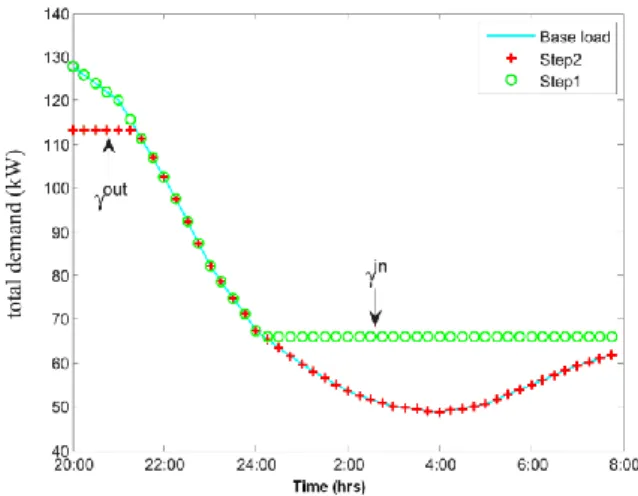
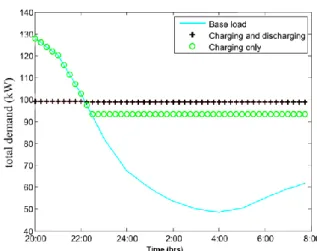
We fix 𝑒𝑚𝑖𝑛= 𝑒 = 25%. The eventual gain of step 1 and step 2 is presented is Fig. 2. It could be analyzed that after executing two initial steps, the water level during EV discharging is high as compared to the fixed discharging model, i.e, 𝛾𝑜𝑢𝑡 > 𝛾𝑖𝑛. As it is also given in step 3, it is not required to select 𝑠𝑚𝑖𝑛 again, because we can get the optimal load scheduling by easily performing the charging/discharging tasks, as presented in Fig. 3.
Fig 2: The results of case 1 and case 2, while penetrating 5 EVs
We have also compared the peak load diversion by introducing collective EVs charging/discharging, this process has been carried out using optimal valley filling technique to perform the charging task by penetrating Algorithm 1. It is easily verified from simulation analysis, despite of the “invariant water filling” from 20:00 to 22:00, when all EVs are charging, the response of our algorithm is identical since it is consistently maintaining water level, which is the
optimal solution. This is also proved when results compared to the theoretical results of Algorithm 1, we can deduce that the load profile curve is much smoother when EVs was performing charging or discharging tasks.
4.2. Scenario 2; Penetrating 10 EVs
In this scenario, we have evaluated multiple EVs performance with the slightly higher penetration ratio. This is different from scenario 1, as 10 EVs has been penetrated in this particular test. The parameters of the proposed algorithm are given here, and the non-mentioned details are same, as used in scenario 1.
𝑎−𝑖𝑛= 𝑎−𝑜𝑢𝑡(𝐾𝑊)
= 6.7054 9.4229 8.5235 6.72122 7.3913 8.1400 9.5630 9.5765 6.8055 9.6059, 𝑒(0)(%)
= 33.124 30.832 36.892 38.769 33.484
35.245 34.753 27.755 33.290 23.533
𝐺𝑚𝑎𝑥(𝑘𝑊ℎ)
= 42.649 58.387 52.737 41.890 45.640
50.927 59.250 59.387 43.253 59.312,
𝜂𝑖𝑛(%) = 95.620 90.240 93.900 86.670 89.750
95.250 92.820 95.660 92.320 85.290 1
𝜂𝑜𝑢𝑡(%)
= 112.75 108.66 110.03 115.67 107.83
111.88 116.77 109.87 108.55 108.66 Initially we have selected 𝑒𝑚𝑖𝑛= 𝑒 = 25%. The performance of scenario 1 and scenario 2 is presented in Fig. 4. It can be analyzed, that after executing two initial steps, the water level of the battery discharging is minimum when it is compared with the initial discharging process, i.e. 𝛾𝑜𝑢𝑡< 𝛾𝑖𝑛. It shows that it is not essential for EVs to evaluate the optimal 𝑒𝑚𝑖𝑛 by using third step which adopts the optimization of the bi-section. The eventual result is given in Fig. 5. it is evident that 𝑒𝑚𝑖𝑛 is 22.04%.
It is also analyzed that our algorithm not only controls the homogeneous EVs, it also manages the heterogeneous once. This test show that, the overall regulated load demand profile curve is in a stable form, and it could be further analyzed that optimum load shifting while EVs charging/discharging is very effective as compared to the valley filling charging technique.
Fig 3: Optimal load diversion by implementing EVs charging and discharging
Fig 4: The results of case 1 and case 2, while penetrating 5 EVs
4.3. Scenario 3: Perfromance
evaluation of the Proposed
Algorithm with Bonmin
In this scenario, we compared the results of our proposed algorithm with the existing integral programming algorithm. Because the constraints (6)-(10), could be categorized as MINLP constraint, therefore we have used the open source, non-linear mixed integral programming (BONMIN) which solves the general MINLP constraints very effectively, which has been actually used to compute the original constraint [37], [38]. Particularly, a hybrid approximation based algorithm (usually called B-Hyb) is selected for the implementation of BONMIN. In [39] a detailed description of this algorithm is presented.
The comparison of BONMIN executer and our proposed algorithm has been carried out by penetrating 1 to 10 homogenous EVs. We infer that each EV connects to the grid at 20:00, and leaves at 8 am in the next morning, (similar to the
previous cases). The other simulated EVs parameters are same as scenario 1.
Fig 5: Optimal load diversion by implementing EVs charging and discharging
To eliminate the uncertainty factor, both algorithms are simulated in MATLAB, during testing, both algorithms converged successfully to the optimal solution; however their computational performances are totally different. The convergence time of the BONMIN and our proposed algorithm with different EV numbers is presented in Table 1.
Table 1: The Computational Time Comparison of our Algorithm with Bonmin
Algorithm
Time (sec) Numbers
Our
Algorithm BONMIN
1 0.00899 39.71
2 0.01087 204.89
3 0.01125 159.94
4 0.01148 1652.58
5 0.01205 4288.35
10 0.01250 93495.85
It could be leniently analyzed that thecomputational speed of our proposed algorithm is significantly faster as compare to the BONMIN algorithm. Our algorithm takes only microseconds for computation, and this computational time do not exceed much, even when more EVs have been penetrated. Conversely, the computation time acquired by the BONMIN algorithm is significantly higher and gradually increases as more EVs penetrates. In order to govern the charging/discharging process of only 10 EVs it
actually took 93583.83 seconds, which is around 26 hours in total, but our proposed algorithm took just 12.3 microseconds to perform the similar process. If we consider more practical case, then in near future, it is projected that a conventional grid will face thousands of EVs each day, so we can conclude that BONMIN could not be implemented for EVs scheduling on broader scale.
5. Conclusion
In this research work, we have investigated the constraints restricting the broader deployment of EVs. Preliminarily we have formulated a load scheduling problem to manage the EVs charging/discharging, and this load scheduling problem has been defined as VDP constraint, which is extremely difficult to compute directly. Therefore, by altering the features of basic load profile of the night hours, we have formulated a computable estimation model for the VDP constraint, moreover, to leniently govern the computation of the following constraint; we have proposed a distributed algorithm to achieve optimal load scheduling for EVs. By implementing this algorithm, each EV is charged to the required SOC while keeping the overall power demand stable.
This algorithm is distributed in such manners that, primarily all EVs are locally managed before forwarding this information to the aggregator. In future, the electricity distributors would need to work for developing methodologies to maintain assumption 1, in those scenarios our pre-proposed load scheduling model can be employed. Otherwise numerous dynamic EVs networks would be required for this purpose. In addition to promote the use of EVs, a robust system is required where an EV should be allowed to easily connect and disconnect for charging. Moreover, in near future it is anticipated that existing conventional grids will also face extremely inconsistent energy generation penetration through intermittent renewable resources which is known as distributed generation even in this case our algorithm can be used to stabilize the grid by enabling the V2G facility.
6.
References
[1] U. ur Rehman and M. Riaz, "Vehicle to grid system for load and frequency management in smart grid," 2017 International Conference on Open Source Systems & Technologies (ICOSST), Lahore, 2017.
[2] U. u. Rehman, "Feasibility and Challenges of the Demand Side Management Implementation in Pakistan," 2018 14th International Conference on Emerging Technologies (ICET), Islamabad, 2018. [3] U. u. Rehman and M. Riaz, "Feasibility of
the Smart Grid Implementation for Better Load Management in Pakistan," 2018 5th International Multi-Topic ICT Conference (IMTIC), Jamshoro, 2018.
[4] U. ur Rehman and M. Riaz, "Real time controlling algorithm for vehicle to grid system under price uncertainties," 2018 1st International Conference on Power, Energy and Smart Grid (ICPESG), Mirpur Azad Kashmir, 2018.
[5] U. ur Rehman, "Profitable Load Scheduling Scheme for Plugged in Hybrid Electric Vehicles BESs in Smart Grid," 2019 2nd International Conference on Computing, Mathematics and Engineering Technologies (iCoMET), Sukkur, Pakistan, 2019.
[6] V. Gupta, S. R. Konda, R. Kumar and B. K. Panigrahi, "Multiaggregator Collaborative Electric Vehicle Charge Scheduling Under Variable Energy Purchase and EV Cancelation Events," in IEEE Transactions on Industrial Informatics, vol. 14, no. 7, pp. 2894-2902, July 2018.
[7] V. del Razo and H. Jacobsen, "Smart Charging Schedules for Highway Travel With Electric Vehicles," in IEEE Transactions on Transportation Electrification, vol. 2, no. 2, pp. 160-173, June 2016.
[8] H. Mohsenian-Rad and M. ghamkhari, "Optimal Charging of Electric Vehicles With Uncertain Departure Times: A Closed-Form Solution," in IEEE Transactions on Smart Grid, vol. 6, no. 2, pp. 940-942, March 2015.
[9] Y. Xu, F. Pan and L. Tong, "Dynamic Scheduling for Charging Electric Vehicles: A Priority Rule," in IEEE Transactions on Automatic Control, vol. 61, no. 12, pp. 4094-4099, Dec. 2016.
[10] Z. Liu, Q. Wu, S. Huang, L. Wang, M. Shahidehpour and Y. Xue, "Optimal Day-Ahead Charging Scheduling of Electric Vehicles Through an Aggregative Game Model," in IEEE Transactions on Smart Grid, vol. 9, no. 5, pp. 5173-5184, Sept. 2018.
[11] Y. Li and K. Li, "Incorporating Demand Response of Electric Vehicles in Scheduling of Isolated Microgrids With Renewables Using a Bi-Level Programming Approach," in IEEE Access, vol. 7.
[12] X. Zhu, H. Han, S. Gao, Q. Shi, H. Cui and G. Zu, "A Multi-Stage Optimization Approach for Active Distribution Network Scheduling Considering Coordinated Electrical Vehicle Charging Strategy," in IEEE Access, vol. 6, pp. 50117-50130, 2018.
[13] X. Tan, G. Qu, B. Sun, N. Li and D. H. K. Tsang, "Optimal Scheduling of Battery Charging Station Serving Electric Vehicles Based on Battery Swapping," in IEEE Transactions on Smart Grid, vol. 10, no. 2, pp. 1372-1384, March 2019.
[14] A. Mehrabi and K. Kim, "Low-Complexity Charging/Discharging Scheduling for Electric Vehicles at Home and Common Lots for Smart Households Prosumers," in IEEE Transactions on Consumer Electronics, vol. 64, no. 3, pp. 348-355, Aug. 2018.
[15] Q. Kang, S. Feng, M. Zhou, A. C. Ammari and K. Sedraoui, "Optimal Load Scheduling of Plug-In Hybrid Electric Vehicles via Weight-Aggregation Multi-Objective Evolutionary Algorithms," in IEEE Transactions on Intelligent Transportation Systems, vol. 18, no. 9, pp. 2557-2568, Sept. 2017.
[16] D. Wang, X. Guan, J. Wu, P. Li, P. Zan and H. Xu, "Integrated Energy Exchange Scheduling for Multimicrogrid System With Electric Vehicles," in IEEE Transactions on Smart Grid, vol. 7, no. 4, pp. 1762-1774, July 2016.
[17] H. Xing, M. Fu, Z. Lin and Y. Mou, "Decentralized Optimal Scheduling for Charging and Discharging of Plug-In Electric Vehicles in Smart Grids," in IEEE Transactions on Power Systems, vol. 31, no. 5, pp. 4118-4127, Sept. 2016.
[18] A. Gusrialdi, Z. Qu and M. A. Simaan, "Distributed Scheduling and Cooperative Control for Charging of Electric Vehicles at Highway Service Stations," in IEEE Transactions on Intelligent Transportation Systems, vol. 18, no. 10, pp. 2713-2727, Oct. 2017.
[19] H. Xing, M. Fu, Z. Lin and Y. Mou, "Decentralized Optimal Scheduling for Charging and Discharging of Plug-In Electric Vehicles in Smart Grids," in IEEE Transactions on Power Systems, vol. 31, no. 5, pp. 4118-4127, Sept. 2016.
[20] A. Gusrialdi, Z. Qu and M. A. Simaan, "Distributed Scheduling and Cooperative Control for Charging of Electric Vehicles at Highway Service Stations," in IEEE Transactions on Intelligent Transportation Systems, vol. 18, no. 10, pp. 2713-2727, Oct. 2017.
[21] Maigha and M. L. Crow, "Electric Vehicle Scheduling Considering Co-optimized Customer and System Objectives," in IEEE Transactions on Sustainable Energy, vol. 9, no. 1, pp. 410-419, Jan. 2018.
[22] J. Zhao, C. Wan, Z. Xu and J. Wang, "Risk-Based Day-Ahead Scheduling of Electric Vehicle Aggregator Using Information Gap Decision Theory," in IEEE Transactions on Smart Grid, vol. 8, no. 4, pp. 1609-1618, July 2017.
[23] K. Maalej, S. Kelouwani, K. Agbossou, Y. Dubé and N. Henao, "Long-Trip Optimal Energy Planning With Online Mass Estimation for Battery Electric Vehicles," in IEEE Transactions on Vehicular Technology, vol. 64, no. 11, pp. 4929-4941, Nov. 2015.
[24] South California Edison [Online]. Available:
https://www.sce.com/005_regul_info/eca/D OMSM11.DLP.
[25] B. Kim, S. Ren, M. van der Schaar and J. Lee, "Bidirectional Energy Trading and Residential Load Scheduling with Electric Vehicles in the Smart Grid," in IEEE Journal on Selected Areas in Communications, vol. 31, no. 7, pp. 1219-1234, July 2013.
[26] H. Chung, W. Li, C. Yuen, C. Wen and N. Crespi, "Electric Vehicle Charge Scheduling Mechanism to Maximize Cost Efficiency and User Convenience," in IEEE Transactions on Smart Grid, vol. 10, no. 3, pp. 3020-3030, May 2019.
[27] T. L. Vu, A. A. Ayu, J. S. Dhupia, L. Kennedy and A. K. Adnanes, "Power Management for Electric Tugboats Through Operating Load Estimation," in IEEE Transactions on Control Systems
Technology, vol. 23, no. 6, pp. 2375-2382, Nov. 2015.
[28] Xiangyu Chen ; Ka-Cheong Leung ; Albert Y. S. Lam ; David. J. Hill “Online Scheduling for Hierarchical Vehicle-to-Grid System: Design, Formulation, and Algorithm” IEEE Transactions on Vehicular Technology 2019.
[29] V. Monteiro, B. Exposto, J. C. Ferreira and J. L. Afonso, "Improved Vehicle-to-Home (iV2H) Operation Mode: Experimental Analysis of the Electric Vehicle as Off-Line UPS," in IEEE Transactions on Smart Grid, vol. 8, no. 6, pp. 2702-2711, Nov. 2017. [30] B. Sah, P. Kumar, R. Rayudu, S. K. Bose
and K. P. Inala, "Impact of Sampling in the Operation of Vehicle to Grid and Its Mitigation," in IEEE Transactions on Industrial Informatics, vol. 15, no. 7, pp. 3923-3933, July 2019.
[31] A. Y. S. Lam, J. J. Q. Yu, Y. Hou and V. O. K. Li, "Coordinated Autonomous Vehicle Parking for Vehicle-to-Grid Services: Formulation and Distributed Algorithm," in IEEE Transactions on Smart Grid, vol. 9, no. 5, pp. 4356-4366, Sept. 2018.
[32] z. liu, Q. Wu, M. Shahidehpour, C. Li, S. Huang and W. Wei, "Transactive Real-Time Electric Vehicle Charging Management for Commercial Buildings With PV On-Site Generation," in IEEE Transactions on Smart Grid, vol. 10, no. 5, pp. 4939-4950, Sept. 2019.
[33] L. Samaranayake and S. Longo, "Degradation Control for Electric Vehicle Machines Using Nonlinear Model Predictive Control," in IEEE Transactions on Control Systems Technology, vol. 26, no. 1, pp. 89-101, Jan. 2018.
[34] Maigha and M. L. Crow, "Electric Vehicle Scheduling Considering Co-optimized Customer and System Objectives," in IEEE Transactions on Sustainable Energy, vol. 9, no. 1, pp. 410-419, Jan. 2018.
[35] J. Zhao, C. Wan, Z. Xu and J. Wang, "Risk-Based Day-Ahead Scheduling of Electric Vehicle Aggregator Using Information Gap Decision Theory," in IEEE Transactions on Smart Grid, vol. 8, no. 4, pp. 1609-1618, July 01.
[36] K. Maalej, S. Kelouwani, K. Agbossou, Y. Dubé and N. Henao, "Long-Trip Optimal Energy Planning With Online Mass Estimation for Battery Electric Vehicles," in IEEE Transactions on Vehicular Technology, vol. 64, no. 11, pp. 4929-4941, Nov. 2015.
[37] M. Ansari, A. T. Al-Awami, E. Sortomme and M. A. Abido, "Coordinated bidding of ancillary services for vehicle-to-grid using fuzzy optimization," in IEEE Transactions on Smart Grid, vol. 6, no. 1, pp. 261-270, Jan. 2015.
[38] B. Kim, S. Ren, M. van der Schaar and J. Lee, "Bidirectional Energy Trading and Residential Load Scheduling with Electric Vehicles in the Smart Grid," in IEEE Journal on Selected Areas in Communications, vol. 31, no. 7, pp. 1219-1234, July 2013.
[39] H. Chung, W. Li, C. Yuen, C. Wen and N. Crespi, "Electric Vehicle Charge Scheduling Mechanism to Maximize Cost Efficiency and User Convenience," in IEEE Transactions on Smart Grid, vol. 10, no. 3, pp. 3020-3030, May 2019.
[40] T. L. Vu, A. A. Ayu, J. S. Dhupia, L. Kennedy and A. K. Adnanes, "Power Management for Electric Tugboats Through Operating Load Estimation," in IEEE Transactions on Control Systems Technology, vol. 23, no. 6, pp. 2375-2382, Nov. 2015.
![Fig 1: Basic load profile of 100 house-holds served in California Edison region from 20:00 on September 10, 2018 to 8 am September 11, 2018 [24]](https://thumb-us.123doks.com/thumbv2/123dok_us/8385612.2228021/5.892.464.786.108.383/basic-profile-served-california-edison-region-september-september.webp)