Language acquisition guide
For use from September 2014 or January 2015Language acquisition guide
For use from September 2014 or January 2015Published May 2014
Published on behalf of the International Baccalaureate Organization, a not-for-profit educational foundation of 15 Route des Morillons, 1218 Le Grand-Saconnex, Geneva,
Switzerland by the
International Baccalaureate Organization (UK) Ltd Peterson House, Malthouse Avenue, Cardiff Gate
Cardiff, Wales CF23 8GL United Kingdom Website: www.ibo.org
© International Baccalaureate Organization 2014
The International Baccalaureate Organization (known as the IB) offers four high-quality and challenging educational programmes for a worldwide community of schools, aiming to create a better, more peaceful world. This publication is one of a range of materials produced to support these programmes.
The IB may use a variety of sources in its work and checks information to verify accuracy and authenticity, particularly when using community-based knowledge sources such as Wikipedia. The IB respects the principles of intellectual property and makes strenuous efforts to identify and obtain permission before publication from rights holders of all copyright material used. The IB is grateful for permissions received for material used in this publication and will be pleased to correct any errors or omissions at the earliest opportunity.
All rights reserved. No part of this publication may be reproduced, stored in a retrieval system, or transmitted, in any form or by any means, without the prior written permission of the IB, or as expressly permitted by law or by the IB’s own rules and policy. See http://www.ibo.org/copyright.
IB merchandise and publications can be purchased through the IB store at http://store.ibo.org.
Email: [email protected]
Published through a generous donation from Sinarmas World Academy and Jakarta World Academy, Indonesia.
Middle Years Programme
Language acquisition guide
IB mission statement
The International Baccalaureate aims to develop inquiring, knowledgeable and caring young people who help to create a better and more peaceful world through intercultural understanding and respect. To this end the organization works with schools, governments and international organizations to develop challenging programmes of international education and rigorous assessment.
These programmes encourage students across the world to become active, compassionate and lifelong learners who understand that other people, with their differences, can also be right.
Contents
Introduction
1
Purpose of this guide 1
Language acquisition in the MYP
2
Programme model 2
Nature of language acquisition 4
Language acquisition across the IB continuum 5
Aims 7
Objectives 8
Planning a progression of learning 11
Interdisciplinary learning 16
MYP projects 17
Written and taught curriculum
18
Requirements 18
Planning the language acquisition curriculum 20
Teaching and learning through inquiry 36
Subject-specific guidance 42
Assessed curriculum
47
Alignment of objectives and criteria 47
Assessment criteria overview 48
Language acquisition assessment criteria: Phase 1 49
Language acquisition assessment criteria: Phase 2 56
Language acquisition assessment criteria: Phase 3 64
Language acquisition assessment criteria: Phase 4 71
Language acquisition assessment criteria: Phase 5 79
Language acquisition assessment criteria: Phase 6 86
eAssessment 93
Appendices
94
Related concepts in language acquisition 94
Language acquisition glossary 96
MYP command terms for language acquisition 102
Purpose of this guide
IntroductionThis guide is for use from September 2014 or January 2015, depending on the start of the school year.
This document provides the framework for teaching and learning in language acquisition in the Middle Years Programme (MYP) and must be read and used in conjunction with the document MYP: From principles
into practice (May 2014), which includes:
• general information about the programme
• the MYP unit planner, with guidance for developing the curriculum that is relevant for all subject groups
• detailed information about approaches to learning
• advice that supports access and inclusion (including accommodations for students with learning support requirements)
• a statement on academic honesty.
In MYP subject guides, requirements appear in a text box like this one.
Additional resources
Teacher support materials (TSM) are available in the online curriculum centre (http://occ.ibo.org). The TSM for language acquisition contains support for developing the written, taught and assessed curriculum. It provides examples of good practice; including subject group overviews, assessment tasks and markschemes, as well as student work with teacher comments.
An optional process of externally moderated assessment can lead to MYP results for language acquisition, and these results can contribute to the awarding of an MYP certificate. More information is available in the annual publication Handbook of procedures for the Middle Years Programme.
A range of publications that support the MYP are available at the IB store (http://store.ibo.org).
Acknowledgment
The IB gratefully acknowledges the generous contributions of IB World Schools and a global community of educators who collaborate in the development of the MYP.
Programme model
Language acquisition in the MYP
Figure 1
Middle Years Programme model
The MYP is designed for students aged 11 to 16. It provides a framework of learning that encourages students to become creative, critical and reflective thinkers. The MYP emphasizes intellectual challenge, encouraging students to make connections between their studies in traditional subjects and the real world. It fosters the development of skills for communication, intercultural understanding and global engagement—essential qualities for young people who are becoming global leaders.
The MYP is flexible enough to accommodate the demands of most national or local curriculums. It builds upon the knowledge, skills and attitudes developed in the IB Primary Years Programme (PYP) and prepares students to meet the academic challenges of the IB Diploma Programme (DP) and the IB Career-related Certificate (IBCC).
Programme model
The MYP:
• addresses holistically students’ intellectual, social, emotional and physical well-being
• provides students with opportunities to develop the knowledge, attitudes and skills they need in order to manage complexity and take responsible action for the future
• ensures breadth and depth of understanding through study in eight subject groups
• requires the study of at least two languages to support students in understanding their own cultures and those of others
• empowers students to participate in service with the community
Nature of language acquisition
Language acquisition in the MYP
Learning to speak another’s language means taking one’s place in the human community. It means reaching out to others across cultural and linguistic boundaries. Language is far more than a system to be explained. It is our most important link to the world around us. Language is culture in motion. It is people interacting with people.
Savignon (1983)
The ability to communicate in a variety of modes in more than one language is essential to the concept of an international education that promotes multilingualism and intercultural understanding, both of which are central to the IB’s mission.
The study of additional languages in the MYP provides students with the opportunity to develop insights into the features, processes and craft of language and the concept of culture, and to realize that there are diverse ways of living, behaving and viewing the world.
The acquisition of the language of a community and the possibilities to reflect upon and explore cultural perspectives of our own and other communities:
• is valued as central to developing critical thinking, and is considered essential for the cultivation of intercultural awareness and the development of internationally minded and responsible members of local, national and global communities
• is integral to exploring and sustaining personal development and cultural identity, and provides an intellectual framework to support conceptual development
• greatly contributes to the holistic development of students and to the strengthening of lifelong learning skills
• equips students with the necessary multiliteracy skills and attitudes, enabling them to communicate successfully in various global contexts and build intercultural understanding.
To assist in achieving these broader goals, this guide provides both teachers and students with clear aims and objectives for MYP language acquisition, as well as details of internal assessment requirements.
Language acquisition across the IB continuum
Language acquisition in the MYP
MYP language acquisition builds on experiences in language learning that students have gained during their early years. In IB World Schools offering the PYP, all students have the opportunity to learn more than one language from at least the age of 7. In the MYP, students learn at least two languages and are encouraged to learn more. Knowledge, conceptual understanding and skills will have been developed in the PYP through transdisciplinary units of inquiry or independent language inquiry. The six skill areas in PYP language— listening, speaking, reading, writing, viewing and presenting—are further developed through the MYP years. Students wishing to continue on to the DP will be grounded in at least one additional language, and will have developed an inquiring, reflective approach to language learning.
The DP offers a comprehensive range of language courses in two groups.
• Group 1—studies in language and literature
• Group 2—language acquisition
Students may study one group 1 and one group 2 subject, or two group 1 subjects. The MYP language acquisition subject group and the DP group 2 courses share some common aims, namely to:
• encourage students to gain competence in an additional language with the long-term goal of multilingualism
• enable students to develop lifelong learning skills
• encourage students to develop an awareness and understanding of the perspectives of people from other cultures.
Language acquisition in the MYP aims to develop a respect for, and understanding of, other languages and cultures, and is equally designed to equip the student with a skills base to facilitate further language learning.
In all four IB programmes, language learning is recognized as a developmental process in which students have opportunities to build on prior knowledge and skills in order to help them progress to the next phase of language development.
The MYP structures additional language learning in phases so that the complexity and range of language profiles that students bring to their MYP classroom is acknowledged and fostered. Students beginning their MYP studies may have exited from any of the five phases of PYP language or may have no prior knowledge or experience of the language to be studied in the MYP.
The pathways to further study are multiple. Phases 4, 5 and 6 allow for a smooth transition from MYP language acquisition courses to DP group 2 courses—and, for a number of students, to group 1 courses. The MYP framework for the language acquisition subject group reflects the concepts and skills of the presumed knowledge for these DP courses.
MYP students continuing on to the DP will have developed not only an inquiring and reflective approach to language learning but also multiliteracy skills that they will be able to apply and extend in their DP language courses.
MYP language acquisition courses should be planned with consideration of the students’ possible pathways to the DP and further study. In IB World Schools that also offer the DP and/or the IBCC, the courses should
Language acquisition across the IB continuum
course, students should be empowered for success in further formal study of languages. The knowledge, skills and attitudes that students develop in language acquisition courses provide a meaningful foundation for these further studies and the world of work in global economies and international business.
For a comprehensive outline of the continuum of language and learning within the four IB programmes, as well as a common pedagogy for language and learning, please see Language and learning in IB programmes (updated August 2012).
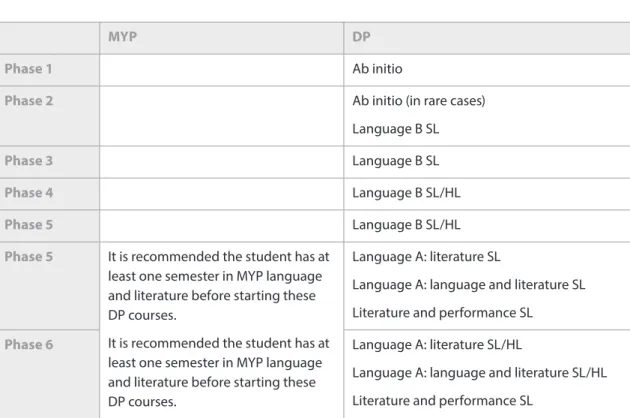
Table 1 shows the IB continuum pathways from MYP through to DP studies in language.
Note: This is an indication only—it is up to schools to decide the minimum requirements for progression from MYP to DP language courses.
MYP DP
Phase 1 Ab initio
Phase 2 Ab initio (in rare cases)
Language B SL
Phase 3 Language B SL
Phase 4 Language B SL/HL
Phase 5 Language B SL/HL
Phase 5 It is recommended the student has at least one semester in MYP language and literature before starting these DP courses.
It is recommended the student has at least one semester in MYP language and literature before starting these DP courses.
Language A: literature SL
Language A: language and literature SL Literature and performance SL
Phase 6 Language A: literature SL/HL
Language A: language and literature SL/HL Literature and performance SL
Table 1 IB continuum pathways
Aims
Language acquisition in the MYP
The aims of all MYP subjects state what a teacher may expect to teach and what a student may expect to experience and learn. These aims suggest how the student may be changed by the learning experience. An overarching aim of teaching and learning languages is to enable the student to become a critical and competent communicator.
The aims of the teaching and learning of MYP language acquisition are to:
• gain proficiency in an additional language while supporting maintenance of their mother tongue and cultural heritage
• develop a respect for, and understanding of, diverse linguistic and cultural heritages
• develop the student’s communication skills necessary for further language learning, and for study, work and leisure in a range of authentic contexts and for a variety of audiences and purposes
• enable the student to develop multiliteracy skills through the use of a range of learning tools, such as multimedia, in the various modes of communication
• enable the student to develop an appreciation of a variety of literary and non-literary texts and to develop critical and creative techniques for comprehension and construction of meaning
• enable the student to recognize and use language as a vehicle of thought, reflection, self-expression and learning in other subjects, and as a tool for enhancing literacy
• enable the student to understand the nature of language and the process of language learning, which comprises the integration of linguistic, cultural and social components
• offer insight into the cultural characteristics of the communities where the language is spoken
• encourage an awareness and understanding of the perspectives of people from own and other cultures, leading to involvement and action in own and other communities
Objectives
Language acquisition in the MYP
In the context of the language acquisition subject group framework, to be multiliterate is defined as being able to understand and use print-based and digital spoken, written and visual text. Meaning in text is constructed and presented in linguistic mode but also in visual, auditory, gestural and spatial mode (Evans et al. 2008a: 2). These various modes must all be understood in combination with each other and are increasingly combined to construct meaning. The current generation of students are required to integrate a variety of literacy skills and to have an awareness of increasingly complex and diverse linguistic and cultural contexts in which to communicate and negotiate meaning. Therefore, to be multiliterate not only requires an understanding of spoken, written and visual text but also an understanding of the interplay of these various modes in a text.
The objectives of any MYP subject state the specific targets that are set for learning in the subject. They define what the student will be able to accomplish as a result of studying the subject.
The objectives of MYP language acquisition encompass the factual, conceptual, procedural and metacognitive dimensions of knowledge. The student’s knowledge and understanding will be developed through:
• learning language
• learning through language
• learning about language (Halliday 1985).
This, in turn, helps students learn how to learn. The cognitive, linguistic and sociocultural aspects of communication are intertwined in each of the four objectives. The student is expected to develop the competencies to communicate appropriately, accurately and effectively in an increasing range of social, cultural and academic contexts, and for an increasing variety of purposes.
“Processes are what help mediate the construction of new knowledge and understandings and play an especially important role in language and communication.” (Lanning 2013: 19). They are designed to enable students to become multiliterate by developing their oral literacy (oracy), visual literacy (visuacy) and written literacy (literacy).
The language acquisition subject group objectives represent some of the essential processes of language and have been organized under the same four communicative processes for each of the six phases in order to assist teachers with planning, teaching and assessing. They are as follows.
A Comprehending spoken and visual text B Comprehending written and visual text
C Communicating in response to spoken, written and visual text D Using language in spoken and written form
In order to meet these objectives, teachers will need to concentrate on each of the macro-skills of language: listening, speaking, reading, writing, viewing and interpreting. These skills are very much interactive and interrelated, though in some instances teachers may wish to deal with them as discrete skills.
Objectives
The objectives for the six phases of the language acquisition subject group are provided in this guide and their use is mandatory. When planning units of work, the objectives specific to the phase should be referenced.
Each objective is elaborated by a number of strands; a strand is an aspect or indicator of the learning expectation. The strands are subsets of each whole objective and must be considered when planning, teaching, assessing and reporting on the student’s language development and communicative competence. These aspects focus on purpose, context, language control and accuracy.
All strands in each objective should be addressed through the units planned for each phase of the course, at a conceptually and linguistically appropriate level for that phase. All strands of the unit’s objectives should also be addressed in the task(s) that are part of that unit.
The objectives for each phase relate directly to the assessment criteria for the corresponding phase and are found in the “Assessed curriculum” section of this guide.
Subject groups must address all strands of all four objectives at least twice in each year of the MYP.
A Comprehending spoken and visual text
Comprehending spoken and visual text encompasses aspects of listening and viewing, and involves the student in interpreting and constructing meaning from spoken and visual text to understand how images presented with oral text interplay to convey ideas, values and attitudes. Engaging with text requires the student to think creatively and critically about what is viewed, and to be aware of opinions, attitudes and cultural references presented in the visual text. The student might, for example, reflect on feelings and actions, imagine himself or herself in another’s situation, gain new perspectives and develop empathy, based on what he or she has understood in the text.
As appropriate to the phase, the student is expected to be able to:
• listen for specific purposes and respond to show understanding
• interpret visual text that is presented with spoken text
• engage with the text by supporting opinion and personal response with evidence and examples from the text.
B Comprehending written and visual text
Comprehending written and visual text encompasses aspects of reading and viewing, and involves the student in constructing meaning and interpreting written and visual text to understand how images presented with written text interplay to convey ideas, values and attitudes. Engaging with text requires the student to think creatively and critically about what is read and viewed, and to be aware of opinions, attitudes and cultural references presented in the written and/or visual text. The student might, for example, reflect on feelings and actions, imagine himself or herself in another’s situation, gain new perspectives and develop empathy, based on what he or she has understood in the text.
Objectives
As appropriate to the phase, the student is expected to be able to:
• read for specific purposes and respond to show understanding
• interpret visual text that is presented with written text
• engage with the text by supporting opinion and personal response with evidence and examples from the text.
C Communicating in response to spoken, written
and visual text
In the language acquisition classroom, students will have opportunities to develop their communication skills by interacting on a range of topics of personal, local and global interest and significance, and responding to spoken, written and visual text in the target language.
As appropriate to the phase, the student is expected to be able to:
• interact and communicate in various situations
• express thoughts, feelings, ideas, opinions and information in spoken and written form
• speak and write for specific purposes.
D Using language in spoken and written form
This objective relates to the correct and appropriate use of the spoken and written target language. It involves recognizing and using language suitable to the audience and purpose, for example, the language used at home, the language of the classroom, formal and informal exchanges, social and academic language. When speaking and writing in the target language, students apply their understanding of linguistic and literary concepts to develop a variety of structures, strategies (spelling, grammar, plot, character, punctuation, voice) and techniques with increasing skill and effectiveness.
As appropriate to the phase, the student is expected to be able to:
• organize thoughts, feelings, ideas, opinions and information in spoken and written form
Planning a progression of learning
Language acquisition in the MYP
Teaching and learning in the language acquisition subject group is organized into six phases. The phases represent a developmental continuum of additional language learning. Depending on their prior additional language-learning experiences, students may commence their language acquisition course in any phase on the continuum and may exit from any phase on the continuum.
Phase-specific language acquisition objectives
Phase 1 Phase 2 Phase 3 Phase 4 Phase 5 Phase 6
In order to reach the aims of language acquisition, students should be able to:
In order to reach the aims of language acquisition, students should be able to:
In order to reach the aims of language acquisition, students should be able to:
In order to reach the aims of language acquisition, students should be able to:
In order to reach the aims of language acquisition, students should be able to:
In order to reach the aims of language acquisition, students should be able to: Objective A i. identify basic facts, messages, main ideas and supporting details in everyday situations show under-standing of messages, main ideas and supporting details in familiar situations show under-standing of information, main ideas and supporting details, and draw conclusions in familiar and some unfamiliar situations construct meaning and draw conclusions from information, main ideas and supporting details in familiar and unfamiliar situations analyse and draw conclusions from information, main ideas and supporting details in social and some academic situations evaluate and draw conclusions from information, main ideas and supporting details in social and academic situations ii. recognize basic conventions recognize basic conventions understand conventions interpret conventions analyse conventions interpret the author’s choice of style, format and ideas to suit an intended audience and purpose
Planning a progression of learning
Phase 1 Phase 2 Phase 3 Phase 4 Phase 5 Phase 6
iii. engage with the spoken and visual text by identifying ideas, opinions and attitudes and by making a personal response to the text. engage with the spoken and visual text by identifying ideas, opinions and attitudes and by making a personal response to the text. engage with the spoken and visual text by identifying ideas, opinions and attitudes and by making a response to the text based on personal experiences and opinions.
engage with the spoken and visual text by identifying ideas, opinions and attitudes and by making a response to the text based on personal experiences and opinions.
engage with the spoken and visual text by analysing ideas, opinions and attitudes and by making a response to the text based on personal experiences and opinions from a global perspective.
engage with the spoken and visual text by evaluating ideas, opinions and attitudes and by making a response to the text based on personal experiences and opinions from a global perspective. Objective B i. identify basic facts, messages, main ideas and supporting details identify basic facts, main ideas and supporting details, and draw conclusions show under-standing of information, main ideas and supporting details, and draw conclusions construct meaning by identifying stated and implied information, main ideas and supporting details, and draw conclusions analyse and draw conclusions from information, main ideas and supporting details evaluate and draw conclusions from information, main ideas and supporting details ii. recognize basic aspects of format and style, and author’s purpose for writing recognize basic conventions including aspects of format and style, and author’s purpose for writing understand basic conventions including aspects of format and style, and author’s purpose for writing interpret basic conventions including aspects of format and style, and author’s purpose for writing analyse basic conventions including aspects of format and style, and author’s purpose for writing interpret the author’s choice of style, format and ideas to suit an intended audience and purpose
iii. engage with the written and visual text by identifying ideas, opinions and attitudes and by making a personal response to the text. engage with the written and visual text by identifying ideas, opinions and attitudes and by making a personal response to the text. engage with the written and visual text by identifying ideas, opinions and attitudes and by making a response to the text based on personal experiences and opinions.
engage with the written and visual text by identifying ideas, opinions and attitudes and by making a response to the text based on personal experiences and opinions.
engage with the written and visual text by analysing ideas, opinions and attitudes and by making a response to the text based on personal experiences and opinions from a global perspective.
engage with the written and visual text by evaluating ideas, opinions and attitudes and by making a response to the text based on personal experiences and opinions from a global perspective.
Planning a progression of learning
Phase 1 Phase 2 Phase 3 Phase 4 Phase 5 Phase 6
Objective C
i. respond appropriately to simple short phrases respond appropriately to spoken, written and visual text in a limited range of familiar situations respond appropriately to spoken, written and visual text in a range of familiar and some unfamiliar situations respond appropriately to spoken, written and visual text in a range of familiar and unfamiliar situations respond appropriately to spoken, written and visual text in a range of social and some academic situations respond appropriately to spoken, written and visual text in a wide range of social and academic situations ii. interact in
simple and rehearsed exchanges, using verbal and non-verbal language interact in basic structured exchanges on a limited variety of aspects within familiar situations interact in rehearsed and unrehearsed exchanges on a limited variety of aspects within familiar and some unfamiliar situations engage in rehearsed and unrehearsed exchanges to share ideas on topics of personal and global significance engage in rehearsed and unrehearsed exchanges to share ideas on a range of topics of personal and global significance engage in unrehearsed and complex exchanges on a wide range of topics of personal and global significance
iii. use basic phrases to communicate ideas, feelings and information on a variety of aspects of everyday topics
use phrases to communicate ideas, feelings and information in familiar situations express ideas and feelings, and communicate information in familiar and some unfamiliar situations express ideas and feelings, and communicate information in simple and complex texts in familiar and unfamiliar situations express ideas, opinions and feelings, and communicate information in a wide range of situations
express a wide range of ideas, opinions and feelings, and communicate information in a wide range of social and academic contexts iv. communicate
with a sense of audience.
communicate with a sense of audience.
communicate with a sense of audience and purpose.
communicate with a sense of audience and purpose.
communicate with a sense of register, purpose and style.
communicate with a sense of register, purpose and style.
Objective D
i. write and speak using a basic range of vocabulary, grammatical structures and conventions; when speaking, use clear pronun-ciation and intonation write and speak using a basic range of vocabulary, grammatical structures and conventions; when speaking, use clear pronun-ciation and intonation write and speak using a range of vocabulary, grammatical structures and conventions; when speaking, use clear pronun-ciation and intonation write and speak using a range of vocabulary, grammatical structures and conventions; when speaking, use clear pronun-ciation and intonation write and speak using a range of vocabulary, complex grammatical structures and conventions; when speaking, use intonation and fluency write and speak using a wide range of vocabulary, complex grammatical structures and conventions; when speaking, uses oratory technique
Planning a progression of learning
Phase 1 Phase 2 Phase 3 Phase 4 Phase 5 Phase 6
ii. organize basic information and use a range of basic cohesive devices
organize information and ideas and use a range of basic cohesive devices
organize information and ideas and use a range of basic cohesive devices
organize information and ideas into a structured text; use a wide range of cohesive devices
organize information and ideas; use a wide range of cohesive devices
organize information and ideas; use a wide range of cohesive devices
iii. use language to suit the context.
use language to suit the context.
use language to suit the context.
use language to suit the context.
use language to suit the context.
use language to suit the context.
Progression along the continuum
For the purpose of planning, teaching and assessment, the language acquisition objectives are also mapped on continuums to show clearly the expectations for each phase. Learning targets have been set for each phase, and underneath the expectations are examples of what constitutes evidence to indicate the student is ready to progress to the next phase of learning.
As students progress through the six phases, they are expected to develop the competencies to communicate appropriately and effectively in an increasing range of social, cultural and academic contexts, and for an increasing variety of audiences and purposes. This is demonstrated by:
• the variety and sophistication of vocabulary and structures used
• the scope of situations in which the language is used
• the increasing length of text spoken, read and written
• the increasing complexity of text spoken, viewed, read and written
• the increasing variety of forms of both fiction and non-fiction handled.
As students develop their understanding, increasing cognitive and skills demands are also set. These are expressed as command terms. Table 2 illustrates this progression along the additional language learning continuum.
Phase 1 Phase 2 Phase 3 Phase 4 Phase 5 Phase 6
In a limited range of everyday situations
In a limited range of familiar situations In familiar and some unfamiliar situations
In familiar and unfamiliar situations In social situations and some academic situations
In social and academic situations Some aspects of register Some aspects of register Appropriate register Appropriate register Appropriate register Appropriate register A very limited
range of interpersonal and cultural contexts A limited range of interpersonal and cultural contexts A limited range of interpersonal and cultural contexts
A range of interpersonal and cultural contexts
A range of interpersonal and cultural contexts A wide range of interpersonal and cultural contexts
Planning a progression of learning
Phase 1 Phase 2 Phase 3 Phase 4 Phase 5 Phase 6
Use basic vocabulary
Use basic language
Use language accurately
Use language accurately
Use language accurately and effectively
Use oratory technique
Simple short texts
Simple texts A limited range of texts
A range of texts
A range of texts
A wide range of texts Interact in
simple and rehearsed exchanges
Interact in basic rehearsed and some unrehearsed exchanges
Interact in rehearsed and unrehearsed exchanges
Engage actively
Engage actively
Engage actively
Understand and respond
Understand and respond
Understand and respond
Interpret and respond
Analyse and respond
Evaluate and respond Identify and
recognize
Recognize and understand
Understand Construct meaning/ interpret
Construct meaning/ analyse
Evaluate
Table 2
Interdisciplinary learning
Language acquisition in the MYP
Interdisciplinary teaching and learning is grounded in individual subject groups and disciplines, but extends disciplinary understanding in ways that are:
• integrative—bringing together concepts, methods, or modes of communication from two or more
subject groups, disciplines or established areas of expertise to develop new perspectives
• purposeful—connecting disciplines to solve real-world problems, create products or address
complex issues in ways that would have been unlikely through a single approach.
Interdisciplinary teaching and learning builds a connected curriculum that addresses the developmental needs of students in the MYP. It prepares students for further academic (inter)disciplinary study and for life in an increasingly interconnected world.
The MYP uses concepts and contexts as starting points for meaningful integration and transfer of knowledge across subject groups and disciplines. Fostering interdisciplinary teaching and learning in MYP schools (2014) contains more information, including a detailed process for planning and recording interdisciplinary units.
MYP schools are responsible for engaging students in at least one collaboratively planned interdisciplinary unit for each year of the programme.
Language acquisition offers many opportunities for interdisciplinary teaching and learning. Possible interdisciplinary units in this subject group could include inquiries into:
• visual and performing art forms from the culture of the language being studied (arts)
• interactive multimedia products that can be used to communicate linguistic concepts (design)
• sports and games from the culture of the language being studied (physical and health education)
• the interpretation of concepts such as time, place and space in the cultural context of the language being studied (individuals and societies).
Interdisciplinary learning can take place through large- and small-scale learning engagements. Authentic interdisciplinary learning often requires critical reflection and detailed collaborative planning. However, teachers and students can also make interdisciplinary connections through spontaneous learning experiences and conversations.
All MYP subject group teachers are responsible for developing meaningful ongoing opportunities for interdisciplinary teaching and learning.
MYP projects
Language acquisition in the MYP
The MYP community project (for students in years 3 or 4) and MYP personal project (for students in year 5) aim to encourage and enable sustained inquiry within a global context that generates new insights and deeper understanding. In these culminating experiences, students develop confidence as principled, lifelong learners. They grow in their ability to consider their own learning, communicate effectively and take pride in their accomplishments.
Courses in language acquisition help students to develop key approaches to learning (ATL) that lead to success and enjoyment in the MYP projects. In language acquisition, students have important opportunities to practise ATL skills, especially communication skills. Being able to read for comprehension, and critically, are essential aspects of language acquisition.
Language acquisition offers many opportunities for learning through action. Language acquisition could inspire community projects and personal projects that have as their goal:
• to develop a series of language lessons for a self-taught language course for the target language being studied by the student
• to create an awareness campaign on an issue of personal, local or global significance and to conduct and communicate the campaign in multiple languages, including the target language being studied by the student
• to write a storybook and initiate a buddy-reading programme in the target language with younger learners in the school community
• to create a recipe book that represents the cultural heritage of the target language being studied by the student.
Requirements
Written and taught curriculum
MYP language acquisition is a compulsory component of the MYP in every year of the programme.
It is a requirement that schools provide sustained language learning in at least two languages for each year of the MYP.
Students must be able to study at least:
• one additional language (or a second language from the language and literature subject group) sustained across the entire year in each year of the MYP
• the same additional language in each year of the MYP, or achieve a satisfactory proficiency in phase 4 in order to transfer to another language. (It is up to each individual school to determine the grade deemed as satisfactory for the transfer to be approved.)
The IB strongly recommends that, wherever possible, students should work towards being multilingual by:
• achieving the objectives for language and literature in both languages
• maintaining and developing their mother tongue by studying it as one of the language options. Schools must allocate the teaching hours necessary to meet the requirements of MYP language acquisition.
The MYP requires at least 50 hours of teaching time for each subject group in each year of the programme.
For students pursuing MYP results that can contribute to the awarding of the MYP certificate, language acquisition courses should include at least 70 teaching hours in each of the final two years of the programme (MYP year 4 and MYP year 5).
In practice, more time is often necessary to meet subject group aims and objectives and to provide for the sustained, concurrent teaching that enables interdisciplinary study.
Considering the objectives and standards expected for each phase in MYP language acquisition, more hours than the minimum figure per year are recommended, though this may vary depending on school location, student background and whether the additional language studied is also the language of instruction of the school. (If the language studied is not the language of instruction, schools may need to consider allocating more time.) Schools must ensure that students are given sufficient time and continuous instruction to allow them the opportunity to meet the objectives for language acquisition.
The language acquisition course should provide a linguistic and academic challenge for students in order to give them the best possible educational experience. Students should be given the opportunity to develop their language skills to their full potential, as well as the possibility of progressing through the phases over the course of the MYP.
Requirements
Where there are students for whom the school’s language of instruction and the language studied in the language acquisition course are additional languages, schools should provide an effective strategy to support language development. Please see the document Learning in a language other than mother tongue
in IB programmes (April 2008) for further information.
In order to establish a course structure and implement the language acquisition subject group courses in the school, teachers should use their discretion when determining placement, progression and pathways for their students.
“Languages carousel” courses
The IB encourages schools to counsel students about their choices for language acquisition courses before the start of the MYP. Examples of good practice include:
• giving students a placement test to determine in which phase they will continue with language acquisition from a previous educational experience
• organizing an “Introduction to the MYP” orientation as part of the enrolment process that includes information about language acquisition courses
• setting up a “languages carousel” in the final year of primary education, during which students can experience a brief introduction to each language acquisition course offered in the MYP.
If local circumstances require, schools may offer introductory MYP language acquisition courses. If necessary, the course(s) can be structured as a “languages carousel”, under the following conditions.
• The introductory course(s) can only be offered in MYP year 1.
• The introductory course(s) must in total meet the minimum number of hours required for the subject group (50 hours).
• Each language in the carousel must have an equal number of teaching hours, and all languages ideally will be taught concurrently.
• All introductory language courses must conclude before students choose their language acquisition course for the remainder of the MYP.
After the introductory courses are completed, students must choose one of the languages from the carousel and continue with that language throughout the programme, or until they demonstrate a satisfactory proficiency in phase 4 and begin the study of another language.
Planning the language acquisition curriculum
Written and taught curriculum
Integrating knowledge, understanding and skills in
language acquisition
When planning units of work to address the objectives in MYP language acquisition, teachers will need to detail what students will know (factual knowledge such as grammar rules, topic-specific vocabulary, cultural facts and artifacts) and what students will understand (conceptual knowledge such as the principles and big ideas arising from the subject matter studied or the features and processes of language) in order to communicate in the target language. The concepts become the building blocks students need to transfer and apply their knowledge and understanding to a variety of contexts, and to communicate this knowledge and understanding in familiar and unfamiliar situations.
The purposes and targets for learning language engage students in various productive, receptive and interactive processes of oral, visual and written communication. These processes are often carried out as interactional and transactional processes, simultaneously rather than as discrete skills. The student is receiving, constructing, creating and sharing meaning, using language to relate to others, to relate their experiences to others, as well as to communicate a message. Although teachers may plan and teach the specific skills separately and explicitly (as organized in the objectives), students will demonstrate their understanding by applying and using various language processes in combination with each other, and in a range of authentic situations, such as:
• requesting and providing information
• giving and receiving ideas and opinions
• creating and sharing a suggestion, a solution or a story
• understanding and responding to a message or an idea
• listening to, and discussing, a problem
• viewing and interpreting an idea or issue presented.
In order to meet the language acquisition subject group objectives, teachers will need to concentrate on each of the macro-skills of language—listening, speaking, reading, writing and viewing—and to ensure that units planned provide ample opportunities for students to practise and develop all these skills.
Phases
Teaching and learning in the language acquisition subject group is organized in six phases. The phases do not correspond to particular age groups or MYP years. When planning the language acquisition curriculum, teachers will need to decide the most suitable phase in which to place individual students or a group of students, as informed by the achievable exit point for the students and the language learning pathways available to the students.
It is at the school’s discretion to group students in the six phases. However, it is essential to consider first and foremost a reasonable differentiation and manageable combination of proficiencies in one class. The school should take into account the demands on the teacher to concentrate on the needs of all
Planning the language acquisition curriculum
the students and to plan appropriate teaching strategies and learning experiences for all. Teachers should take note of the following recommendations.
• Students should be grouped in no more than two consecutive phases in one class together.
• Students with no prior knowledge of the additional language they wish to study in the MYP should start in phase 1.
• In most cases, students exiting from phase 4 will have had the equivalent of at least four years of additional language learning.
• Students should spend time in the phase 5 or 6 language acquisition classroom to develop some of the foundation skills needed in the language and literature course.
• Phase 6 will not be the typical exit level for most students. For example:
• beginner students of the language could be grouped in a phase 1 and 2 class together
• intermediate students of the language could be grouped in a phase 2 and 3 class together or a phase 3 and 4 class together
• proficient students could be grouped in a phase 4 and 5 class together or a phase 5 and 6 class together.
Schools could also decide to offer only phases 2, 4 and 6, or only phases 1, 3 and 5. This will depend on:
• whether the school has a three-, four- or five-year programme, and
• whether the students are beginners in the additional language when they start the MYP.
Teachers may find it helpful to place students in an earlier phase as a transitional step before grouping them in two broader consecutive phases. For example:
• a number of students follow phase 1 objectives and learning experiences grouped in the class with phases 2 and 3. After a period of time within the school term or semester, the phase 1 students merge with the phase 2 and 3 group.
It is possible for a student to exit the programme from any phase based on individual progress and achievement throughout each school year. Schools should choose the phase that offers the student:
• an academically challenging course
• the most opportunities to achieve in the subject
• the most suitable pathways for further study.
Placement
Placement is informed by knowledge of the student’s language profile. Schools should create a language portrait template that students and their families can complete when they join the MYP. This will help language teachers and all teachers to know and understand the language background, the language experience and the language needs of the student. Schools could also design a placement test to determine the phase and/or the language courses the student will follow at the school. The language portrait could be the first document collected and collated in a language portfolio.
The language acquisition continuums and the MYP language acquisition global proficiency table (in this section) are two useful tools for grouping students in their appropriate language courses.
Planning the language acquisition curriculum
Progression
Once students are grouped in phases, teachers will need to plan and articulate the course vertically to ensure units of work will enable students to:
• realize the aims of learning the target language
• reach the objectives for the phase
• achieve the proficiency levels required by the phase at the point of exit from the MYP.
The language acquisition continuums will help teachers with this planning and mapping. Teachers should also consider the vertical mapping created by the school, as well as considerations from other areas of the curriculum.
Learning experiences that have been formatively assessed using the language acquisition continuums, and performances of understanding that have been summatively assessed using the assessment criteria rubrics (in the “Assessed curriculum” section), provide crucial evidence of students’ progress and achievement.
Pathways
When structuring and planning the course, teachers should keep in mind:
• the options for language learning in the DP, the IBCC or other further education
• the school’s minimum requirements for progression from school year to school year
• possible progression to MYP language and literature
• MYP certification requirements.
The language acquisition continuums, MYP language acquisition global proficiency table and assessment criteria rubrics are all important tools when considering these points.
Tools to assist in planning the language acquisition
curriculum
The language acquisition continuums, the MYP language acquisition global proficiency table and the assessment criteria rubrics are essential tools for teachers to use when determining placement, marking progression and establishing language learning pathways for their students. The diagram below illustrates at what point in the process of planning, teaching and learning, and assessment these decisions will be made, and the tools that will be most helpful for teachers to use.
Planning the language acquisition curriculum
Determining
placement
progression
Marking
Establishing
pathways
Continuums
Assessment
criteria rubrics
MYP global
proficiency
table
pl
an
ni
ng
teac
hin
g a
nd
le
arn
in
g
assessing
Figure 2
Tools to assist in planning the language acquisition curriculum
MYP language acquisition global proficiency table
The purpose of the MYP language acquisition global proficiency table (see Table 3 below) is to provide teachers with statements indicating the competencies expected of students in each phase of the MYP language acquisition subject group. The table provides six holistic statements describing a student’s achievement against the course objectives towards being an emergent communicator, a capable communicator and a proficient communicator. The characteristics of a communicator in each phase of the course are described through a statement explaining what the student should be able to do by the end of the phase.The MYP language acquisition global proficiency table is both a reference and a tool. It states the language acquired in a broad sense and can help teachers:
• to determine the possible language acquisition course groupings for each year of the MYP
Planning the language acquisition curriculum
• to identify a realistic exit phase for a student or a group of students by the final year of the MYP (whether the school is offering a three-, four- or five-year programme), taking into consideration each school’s unique context and structure
• to interpret and report on students’ achievements in their language acquisition course: – at the end of a phase or MYP year
– on completion of the MYP
– when transferring to or from another school or programme.
When devising the MYP language acquisition global proficiency table, the following international standards were used as reference points.
• Council of Europe. 2001. Common European Framework of Reference for Languages: Learning, Teaching,
Assessment.
• American Council on the Teaching of Foreign Languages. 2011. Standards for Foreign Language Learning
Planning the language acquisition curriculum Em er ge nt c om m un ica tor Cap ab le c omm un ic ato r Pr of ic ie nt c omm un ic ato r Ph as e 1 Ph as e 2 Ph as e 3 Ph as e 4 Ph as e 5 Ph as e 6 Em er ge nt c om m un ic at or s in p ha se 1 u nd er st an d an d r es po nd t o s im pl e ph ra se s, s tat em en ts an d q ue st io ns . T he y id en tif y b as ic m es sa ge s, fa ct s, o pi ni ons , f ee lin gs an d i de as p re se nt ed in o ra l, v is ua l a nd w rit te n l an gu ag e, a nd de m ons tr at e t he ir com pr eh en si on in si m pl e o ra l a nd w rit te n ph ra se s. T he y c on ve y ba si c i nf or m at io n i n a l im ite d r an ge o f ev er yd ay s itu at io ns , us in g o ra l a nd w rit te n la ng ua ge a ppr op ria te to a v er y l im ite d r an ge o f in te rp er so na l an d c ul tu ra l co nt ex ts . T he y b eg in t o be a w ar e t hat l an gu ag e us e i s c on ne ct ed t o a pu rp os e a nd a n a ud ie nc e. Em er ge nt c om m un ic at or s in p ha se 2 u nd er st an d an d r es po nd t o s im pl e sp ok en a nd w rit te n te xt s. T he y i de nt ify m es sa ge s, f ac ts , o pi ni ons , fe el in gs a nd i de as pr es en te d i n o ra l, v is ua l an d w rit te n l an gu ag e, an d d em ons tr at e t he ir com pr eh en si on in sh or t o ra l a nd w rit te n fo rm . T he y i nt er ac t t o sh ar e i nf or m at io n i n a lim ite d r an ge o f f am ili ar si tu at io ns , u si ng b as ic la ng ua ge a ppr op ria te
to a l
im ite d r an ge o f in te rp er so na l an d c ul tu ra l co nt ex ts . T he y a re a w ar e th at l an gu ag e v ar ie s ac co rd in g t o p ur po se a nd au di enc e. Cap ab le c omm uni ca to rs in p ha se 3 u nd er st an d an d r es po nd t
o a l
im ite d va rie ty o f s po ke n a nd w rit te n t ex ts . T he y unde rs ta nd s pe ci fic in fo rm at io n, m ai n ide as a nd som e de ta il pr es en te d i n o ra l, v is ua l an d w rit te n l an gu ag e, an d d em ons tr at e t he ir co m pr eh ens io n i n a lim ite d r an ge o f o ra l an d w rit te n f or m s. T he y en ga ge i n c on ve rs at io n an d w rit e s tr uc tu re d t ex t to e xp re ss t he ir i de as , opi ni on s a nd e xp eri enc es
in a r
an ge o f f am ili ar an d s om e u nf ami liar si tu at io ns , i
n a l
im ite d ra nge o f i nt er pe rson al an d c ul tu ra l c on te xt s. Th ey u nd er st an d t hat th ey c an s pe ak a nd w rit e in d iffer en t wa ys fo r dif fer en t p ur po se s a nd au di enc es . Cap ab le c omm uni ca to rs in p ha se 4 u nd er st an d a nd re sp on d t
o a v
ar ie ty o f sp ok en a nd w rit te n t ex ts . Th ey i nt er pr et s pe ci fic in fo rm at io n, m ai n i de as and so m e de ta il p re se nt ed in c om pl ex o ra l, v is ua l a nd w rit te n l an gu ag e, d ra w co nc lu si ons a nd r ec og ni ze im pl ie d o pi ni ons a nd at tit ud es in t ex ts r ea d a nd v ie we d. Th ey e ng ag e i n c on ve rs at io n an d w rit e s tr uc tu re d t ex t to share in fo rm at iv e an d or ga ni ze d i de as o n t op ic s of p er so na l i nt er es t a nd gl ob al s ig ni fic an ce , i n a ra nge o f i nt er pe rson al a nd cu ltu ra l c on te xt s. T he y c an co m m un ic at e s ub st an tia l inf or m ati on c on ta in in g re le va nt a nd de ve lop ed ide as an d j us tif ie d o pi ni ons o n ev en ts , e xp eri enc es a nd s om e co nc ep ts e xp lo re d i n c la ss . Th ey i de nt ify a sp ec ts o f f or m at an d s ty le , a nd s pe ak a nd w rit e w
ith a c
le ar s ens e o f a ud ie nc e an d pu rp ose . Pr of ic ie nt c om m un ic at or s in p ha se 5 a na ly se s pe ci fic in for m at ion , i de as , op in io ns an d at tit ud es p re se nt ed in o ra l, v is ua l a nd w rit te n la ng ua ge. T he y d ra w co nc lu si ons , i nf er i nf or m at io n an d re co gn iz e i mp lie d op in io ns a nd a tt itude s. Th ey r es po nd a nd r ea ct t o qu es tio ns a nd i de as i
n a r
an ge of s po ke n, v is ua l a nd w rit te n te xt s. T he y e ng ag e a ct iv el y in c on ve rs at io ns i n s oc ia l a nd so m e a ca de m ic s itu at io ns to c on tr ib ut e s ub st an tia l inf or m ati on c on ta in in g re le va nt a nd f oc us ed i de as su pp or te d b y e xa m pl es a nd ill us tr at io ns . T he y o rg an iz e in fo rm at io n a nd i de as i nt o a cl ea r a nd e ff ec tiv e s tr uc tu re t o ex pr es s t he ir u nde rs ta nd in g and o pi ni on s on top ic s o f pe rson al in te re st a nd g lo ba l si gn ifi ca nc e. T he y i nt er pr et an d a re a bl e t o a da pt a sp ec ts of f or m at , r eg is te r a nd s ty le o f lan gu ag e. Pr of ic ie nt c om m un ic at or s in p ha se 6 e va lu at e t he im po rt an t i nf or m at io n, d et ai ls an d i de as p re se nt ed i n s po ke n, w rit te n a nd v is ua l l an gu ag e in s oc ia l a nd a ca de m ic co nt ex ts . T he y a na ly se t he in fo rm at io n, d ra w c on cl us io ns an d m ak e i nf ere nc es ab ou t ide as , op in ion s a nd a tt itude s im pl ie d i
n a w
id e r an ge o f sp ok en , v is ua l a nd w rit te n te xt s. T he y e ng ag e a ct iv el y in c on ve rs at io ns i n s oc ia l an d a ca de m ic s itu at io ns to c on tr ib ut e s ub st an tia l in fo rm at io n a nd g iv e d et ai le d ana ly si s an d e xp lana tio n. Th ey o rg an iz e i nf or m at io n and ide as lo gi ca lly a nd ef fe ct iv el y t o c om m un ic at e th ei r u nde rs ta nd in g, op in ion s an d p er sp ec tiv es t
o a w
id e ra ng e o f a ud ie nc es , a nd f or a va rie ty o f s oc ia l a nd a ca de m ic pu rp ose s. Ta bl e 3 M YP l an gu ag e a cq ui sit io n glo ba l p ro fic ie nc y t ab le
Planning the language acquisition curriculum
Language acquisition continuums
The IB recognizes that students in IB World Schools have rich, complex and diverse language profiles. They come to the MYP with a range and variety of language learning experiences. Students may:
• already have knowledge of another language and skills for language learning that they bring to the classroom
• have studied the additional language in their PYP or other primary curriculum and wish to continue studying the same language
• have studied an additional language in their PYP or other primary curriculum but wish to commence the study of another additional language
• be learning in the MYP in a country where the target language is the host language but not the first language of the student
• be learning in the MYP where the medium of instruction at school is the second or third language of the student
• have no previous experience of learning another language prior to starting in the MYP
• have lived in a country where the target language was spoken prior to joining the MYP
• have started in the MYP in a later year (MYP year 2, 3 or 4) and be commencing a new language or continuing with another language studied previously
• have an identified learning support requirement and require special consideration for their language learning.
Continuums as a tool for planning and monitoring
progress
Continuums provide visual representations of developmental stages of learning, and can be very useful for teachers and students when applied to skills development. They show a progression of achievement and can identify where a student has reached in relation to that learning process.
MYP: From principles into practice (May 2014)
Continuums are useful as:
• a diagnostic tool, to assist teachers in planning language learning experiences and in placement of students in groups
• a formative assessment tool, to monitor and assess students’ language progress
• a planning tool, to refer to when designing a unit of work.
The continuums make explicit the specific expectations in each area of communication in each phase. They state the learning targets that can be set for the students to support them to progress to the next phase. The expectations take into account the limited content, context and proficiency in the target language in the earlier phases. Learning outcomes and learning experiences should be conceptually and linguistically appropriate for that phase.
The “evidence” list is not exhaustive, nor is it a prescribed list of operations to be performed and assessed. They should be used as indicators or examples of suitable evidence to guide planning of teaching strategies and learning experiences in the unit, and through which the appropriate concepts and content will be
Planning the language acquisition curriculum
taught. They are indicators of the types of actions, behaviours and skills students will demonstrate as evidence of the knowledge, understanding or skill acquired from the learning experiences.
The developmental phases do not reflect progressions organized by age or year of the MYP. For the reasons listed previously, a student in MYP year 5 may be studying the target language in phase 1 or in phase 6. The overall expectation is a generic statement that encapsulates the expected learning in a broad, holistic sense. This is given in each of the continuum tables that follow in this section.
The three areas of communication (oral, visual and written) are represented by four continuums.
• Listening and speaking
• Viewing and interpreting
• Reading comprehension
• Writing
Oral communication (listening and speaking) is represented on one continuum to emphasize the interactive and reciprocal aspect of this objective, while still allowing for the tracking of listening as a distinct receptive skill.
Visual interpretation is represented on one continuum to acknowledge the close connection between understanding the meaning in visual text and interpreting that meaning to convey ideas or opinions in oral or written form. The focus for this objective is to construct meaning from visual text that is presented with spoken and/or written text.
Students’ learning experiences in reading comprehension and writing will involve them in analysing text, engaging with ideas and opinions in the text, structuring their ideas, responding to—and sharing—ideas and opinions, whether orally or in written form, as well as reading for enjoyment in the target language. These two complex skills are represented on separate continuums to facilitate planning and teaching the specific strategies and techniques, as well as comprehensively tracking the development of these two skills.