36
FINANCE SECTOR SEGMENTS AND ITS HUMAN
RESOURCES DEVELOPMENT IN LITHUANIA
Arturas Balkevicius, Gintaras Cernius
Abstract
The purpose of the article is to analyse and discuss the Lithuanian financial sector, it segments and its human resources evolution and dependence to Sustainable National Economic development.
Article use general scientific methods, especially analysis, synthesis, comparison, induction and deduction. Essential sources of information were professional publications, data of state Statistics Department, Bank of Lithuania and the Ministry of Finance documents.
This article gives an overview of the Lithuanian financial sector, it segments and its human resources, analysis of the evolution, structure and their perspective. The article analyses Financial and insurance activities (banking sector, credit union, insurance, Monetary intermediation, Insurance, reinsurance and pension funding), as is currently the most important financial chain. It analyses the evolution of the financial sector segments and its human resources in Lithuanian economy recovery. This paper analyses the financial sector staff efficiency indicators and its evolution. Article examines the changes in personnel costs with the economic growth and after the crisis. The crisis has had an impact on the financial sector and it has been forced to cut costs. Article examines the financial sector and its future human resource development, improvement perspective. Information technology advances have changed not only the finance's strategy, but also promoted the evolution of the finance system and its human capital. Due to the changes in knowledge economy, the finance specialist’s profession competence changes as well.
Key words: Financial sector, Human Resources, Human Development, Economic Development.
37
Introduction
The twenty first century brought major changes in the global financial dynamics. Human capital plays an important role in economic growth theory, because economic and social development of the state is closely connected with investments into human capital.
This article gives an overview of the Lithuanian financial sector, it segments and its human resources, analysis of the evolution, structure and their perspective. The article analyses Financial and insurance activities (banks, credit union, insurance, payment institutions, Electronic money institutions, financial brokerage firms, investment companies, Pension funds, Financial leasing enterprises), Monetary intermediation, Insurance, reinsurance and pension funding, as is currently the most important financial chain. It analyses the evolution of the financial sector segments and its human resources in Lithuanian economy recovery. After the restoration of independence (1990.03.11) Lithuania did not have own finance sector. It was one functioning state insurance company. No stocks, no bonds, no leasing, no credit union, no Stock Exchange.
Global change forced the Europe Union (EU) to review the cornerstones in its economic policy. Information Technology (IT) revolution, the knowledge society development, a political instability and integration trends are common factors which are causing the changes in global finance. Human capital plays an important role in economic growth theory, because economic and social development of the state is closely connected with investments into human capital.
The crisis 2008 has highlighted the impact of globalization on the financial sector. The financial crisis has caused credit-worthiness, liquidity, and the dramatic downturn in equity markets were affected by the essential sectors of the economy. The article research object is the Lithuanian financial sector and human resource development in 2004 – 2014.
The first paragraph is dedicated overview of the Lithuania finance sector evolution from 2004 to 2014. Information technology advances have changed not only the financial and insurance enterprises strategy, but also promoted the evolution of the financial and insurance system and its human capital.
The second paragraph is dedicated Human resources evolution in Lithuania financial sector. Human capital plays an important role in economic growth theory. Formerly economic
38
efficiency was measured only according to the criteria of physical capital. Human capital is a broad concept, which covers plenty of components.
1
Lithuania finance sector evolution from 2004 to 2013
Information technology advances have changed not only the state's strategy, but also promoted the evolution of the finance sector and its human capital. Due to the changes in knowledge economy, the finance specialist’s profession competence changes as well. XXI a. the finance sector is no longer able to bring such a success, which would bring up to 2000, because the banks, financial and insurance enterprises to their customers, competitors enables anytime, anywhere in the world just a computer mouse or smart phone click to perform most of the finance, banking operations (Balkevicius, 2012, 2013). Therefore, it can be said that increasing competition between financial and insurance enterprises for the creation of such service, which are most convenient to the customer. Popularity of electronic commerce, the rapid development of information and communication technology developments have role in enabling of an increasing number of financial and insurance enterprises in Lithuania started to provide online services in the beginning twenty-first century.
When Lithuania became a member Europe Union (EU) in May 2004 and introduce the finance sector modern supervisory system, the finance sector became more stable. From the beginning of 2008, commercial banks in Lithuania are subject to new capital adequacy calculation requirements elaborated according to directives of the EU.
An efficient financial market participants’ supervision system, which complies with international practices, has been created in our country. This is the assessment of such a highly competent global financial institution as the International Monetary Fund. As a supervisory authority, the Bank of Lithuania monitors the compliance of financial market participants with laws and requirements set by legal acts of the Bank of Lithuania, International Financial Reporting Standards, requirements recommended by international organisations for safe and sound activities. The supervision of branches established by banks of EU Member States in Lithuania is performed by the supervisory authority of the state under whose jurisdiction the foreign bank falls.
39
A new unit of the Bank of Lithuania, the Supervision Service, which started its operation in the beginning of 2012, supervises commercial banks and other credit and payment institutions, securities and insurance markets, and investigates disputes between consumers and financial institutions. Up till now, these functions were performed by the liquidated Securities Commission and Insurance Supervisory Commission, as well as the Credit Institutions Supervision Department of the Bank of Lithuania.
Tab. 1: Composition of the Lithuania financial system
Composition of the financial system
2013
Number Assets,
LTL million Assets, %
Annual change in assets, %
Assets as % of GDP
Banks 15 77,426 81.4 4.3 64.8
Banks, excluding foreign bank branches 7 62,599 65.8 7.4 52.4
Foreign bank branches 8 14,828 15.6 -7.2 12.4
Credit unions 76 2,144 2.3 4.3 1.8
Central credit union 1 367 0.4 -1.0 0.3
Leasing companies 9 4,588 4.8 -21.1 3.8
Insurance companies 10 2,970 3.1 7.7 2.5
Life assurance companies 5 1,954 2.1 9.9 1.6
Non-life insurance companies 5 1,017 1.1 3,6 0.9
Capital market participants 110 2,065 2.2 12.1 1.7
Financial brokerage firms 7 21 0.0 -14.5 0.0
Management companies 14 82 0.1 5.4 0.1
Collective investment undertakings 33 838 0.9 30.7 0.7
Foreign collective investment
undertakings 56 1,123 1.2 2.3 0.9
Pension funds 38 5,575 5.9 13.4 4.7
Second pillar pension funds 28 5,444 5.7 13.2 4.6
Third pillar pension funds 10 130 0.1 20.0 0.1
Financial system 259 94,808 100.0 3.4 79.6
Equity market capitalization - 17,168 - 6.0 14.4
Listed equities - 10,036 - -2.8 8.4
Listed debt securities - 7,132 - 21.6 6.0
Sources: Association of Lithuanian banks, NASDAQ OMX Vilnius, Statistics Lithuania and Bank of Lithuania calculations.
40
Let us analyse Composition of the Lithuania financial system Tab. 1. It consist of Monetary intermediation enterprises or Credit and Payment Institutions: Banks, Credit unions, financial undertakings controlled by foreign banks, payment institutions, Payment institutions of EU member states, Electronic money institutions, and Electronic money institutions of EU member states. Electronic money institution — a public limited Liability Company or private limited liability company which has been issued a license with the right to issue electronic money. A payment institution is an economic entity providing payment services, which is neither a credit institution nor an electronic money institution and may not accept deposits or other repayable funds from unprofessional market participants and issue electronic money. In addition to payment services, payment institutions have a right to provide additional services closely related with these services and they are also permitted to perform other activities not associated with payment services.
Next important Insurance segment: Life assurance companies (5), Non-life insurance companies (5), Life assurance branches of EEA insurers, reinsurance intermediaries. Independent insurance intermediaries—insurance broker companies—represent the interests of consumers by acting as intermediaries during the acquisition of insurance protection. Insurance broker companies are licensed by the Bank of Lithuania and must comply with the requirements established for this activity (capital adequacy, professional indemnity insurance, separate bank account, information provision to consumers and establishment of their needs).
Participants of the financial instruments market are: financial brokerage firms, financial advisor companies, management companies, investment companies, banks providing investment services financial brokerage departments, Investment funds, Pension funds, regulated markets and their members, Stock Exchange, the Central Securities Depository of Lithuania and account managers. At present the Bank of Lithuania has licensed seven commercial banks, 8 foreign bank branches. The bank assets consists of 77.42 billion LTL (1EUR=3.45LTL), and was 64.8 per cent of GDP, and more than 81 per cent of the total financial system assets in 2013. Lithuania's economy is recovering, but the financial sector and in particular banks, insurance segment still not recovering. The banking assets continue to decline with the economic growth. Their weight and influence in the economy decreases. This is a cause for concern. The bank assets 64.8 per cent of GDP, insurance segment 2.5 per cent of GDP, Pension funds 4.7 per cent of GDP is too low compeer to EU average. Lithuania now has all XXI a. Finance sector segments, but some
41
make just first steps, like Electronic money institutions. The euro implementation in 2015 will ensure stability, growth of the financial system.
2
Human resources evolution in financial sector segments
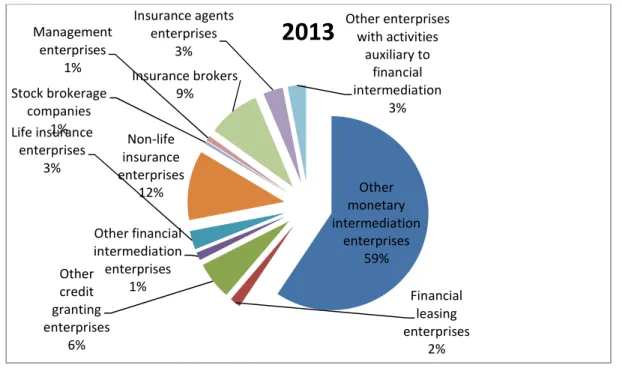
Human resources in financial sector segments are educated, with abilities of knowledge and skills. Customer capital is considered to be as the key source of competitive advantage in the economy of knowledge (Cabrita and Bontis, 2008) and it is an essential element of structural fund for any kind of company, especially for the know-how companies, which include financial services industry, such as financial enterprises, insurance companies. The globalization processes increase the value of human capital as the most essential factor of economy; thus offering priority to human capital, consisting of knowledge, abilities and skills, against material or financial resources (Gizienė, 2012). Human capital effects economic growth, increases advantageous national competitiveness (Balkevicius 2013). Let us analyse Human resources Composition of the Lithuania financial system (Tab. 2). The largest segments: „Monetary intermediation enterprises“(8929), Non-life insurance enterprises (1740), Insurance brokers (1311), Life insurance enterprises (469), other credit granting enterprises (948).
Tab. 2: Number of employees of financial and insurance enterprises 2013 Segments of financial and insurance enterprises Number of
employees
Number as % of total
Monetary intermediation enterprises 8929 59
Financial leasing enterprises 276 2
Other credit granting enterprises 948 6
Other financial intermediation enterprises 201 1
Life insurance enterprises 469 3
Non-life insurance enterprises 1740 12
Stock brokerage companies 73 1
Management enterprises 129 1
Insurance brokers 1311 9
Insurance agents enterprises 497 3
Other enterprises with activities auxiliary to financial intermediation 460 3 Total Number of employees of financial and insurance enterprises 15033 100 Sources: Statistics Lithuania
Human resources composition of the financial system segments we see as per cent employees of total presented in Fig. 1. The largest segments: „Monetary intermediation enterprises“(59%), Non-life insurance enterprises (12%), Insurance brokers (9%). Financial
42
leasing enterprises have 2% of the employees (Fig. 1, Tab. 2), but 4.8% of assets (Tab. 1), so the employees are more efficiency.
Fig. 1: Number of employees of financial and insurance enterprises 2013 (as % of total)
Sources: Statistics Lithuania
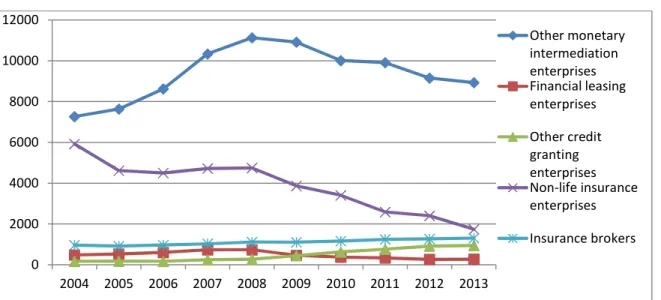
We see Fig.2 the evolution of the financial and insurance sector segments in human resources, evolution number of the employees in main segments of the financial sector. The number of employees in the financial and insurance enterprises increased at economic growth and reached a maximum in 2008.
Other monetary intermediation
enterprises 59%
Financial leasing enterprises
2% Other
credit granting enterprises
6%
Other financial intermediation
enterprises 1% Life insurance
enterprises 3%
Non-life insurance enterprises
12% Stock brokerage
companies 1% Management
enterprises
1% Insurance brokers 9% Insurance agents
enterprises 3%
Other enterprises with activities
auxiliary to financial intermediation
3%
43
Fig. 2: Number of employees of financial and insurance enterprises 2004-2013
Sources: Statistics Lithuania
The largest segments „Other monetary intermediation enterprises“, Non-life insurance enterprises number of the employees is decreasing. Number of the employees is growing in Insurance brokers and “Other credit granting enterprises”. We watched number of the employees in financial leasing enterprises slowly decreasing. The Monetary intermediation enterprises have 59 per cent employees of finance sector (Fig. 1, Tab. 2) and more than 81 per cent assets (Tab. 1). The crisis has significantly responded to the financial sector, workers' number decreased by 13.6 per cent. Eemployees number in the banking sector, in 2010 decreased by 8.7 per cent. Process lasting and in 2012 decreased by 24 per cent (Balkevicius, 2013).
Enlarged supply of professionals in the financial labour market allowed financial enterprises to improve the quality of human resources and reduce number of employees. After all, what is a bigger asset for every company than educated, professional, motivated and thus retained employees (Němečková, 2012)? A prevailing majority of the motivation theories were created by American psychologists (Landy, Conte, 2010). Article “Improving Employee Productivity” (Joo, Grable, 2000), conclusions is a direct link between productivity and education. Any action, that increases the productivity of labour market, may be considered as the investment into human capital. In case of Lithuania direct link between productivity and education. Employees of finance sector are more educated and good paid. Average earnings of Financial and insurance activities are double.
0 2000 4000 6000 8000 10000 12000
2004 2005 2006 2007 2008 2009 2010 2011 2012 2013
Other monetary intermediation enterprises Financial leasing enterprises Other credit granting enterprises Non-life insurance enterprises Insurance brokers
Fig. 2:Staff Efficiency mln. LTL
Sources: Statistics Lithuania,the author's calculations.
Let us examine the finance sector employees work efficiency 201 measured in million LTL assets in respect of staff. It
brokerage companies up to 16.6
(Fig.2). Another indicator of the work efficiency is measured by the number of clients owed by the employee to serve, but in different
different what it has no sense. Bank of Lithuania decided to close the two banks and several credit unions, during the considered period. Insurance companies segment took place mergers and acquisitions. Therefore the company and the employee number
Conclusions
Lithuania financial sector is very small. the financial and insurance enterprises
and insurance sector and its human capital.
finance specialist’s profession competence changes as well.
The Monetary intermediation enterprises have 59 per cent employees of finance sector and more than 81 per cent assets.
The number of employees in the financial and insurance enterprises increased at economic growth and reached a maximum in 2008.
0 5 10 15 20 44
mln. LTL Assets per employee
the author's calculations.
Let us examine the finance sector employees work efficiency 2013. Work efficiency is measured in million LTL assets in respect of staff. It is very different, from 0.28
6 million LTL assets per employee financial leasing enterprises ). Another indicator of the work efficiency is measured by the number of clients owed by
different finance sector segments product and service specific is so Bank of Lithuania decided to close the two banks and several credit unions, during the considered period. Insurance companies segment took place mergers
the company and the employee number are reducing
financial sector is very small. Information technology advances have changed not only financial and insurance enterprises strategy, but also promoted the evolution of the
sector and its human capital. Due to the changes in knowledge economy, the finance specialist’s profession competence changes as well.
The Monetary intermediation enterprises have 59 per cent employees of finance sector n 81 per cent assets.
The number of employees in the financial and insurance enterprises increased at economic growth and reached a maximum in 2008.
. Work efficiency is 28 million Stock financial leasing enterprises ). Another indicator of the work efficiency is measured by the number of clients owed by segments product and service specific is so Bank of Lithuania decided to close the two banks and several credit unions, during the considered period. Insurance companies segment took place mergers
reducing.
Information technology advances have changed not only strategy, but also promoted the evolution of the financial Due to the changes in knowledge economy, the
The Monetary intermediation enterprises have 59 per cent employees of finance sector
The number of employees in the financial and insurance enterprises increased at Efficiency mln. LTL per employe
45
The crisis has significantly responded to the banking sector, employees' number in 2010 decreased by 8.7 per cent in Lithuania. Process lasting and in 2012 decreased by 24 per cent.
The largest segments „Other monetary intermediation enterprises“, Non-life insurance enterprises number of the employees is decreasing. Number of the employees is growing in Insurance brokers and “Other credit granting enterprises”.
Today Lithuania is one of the fastest growing economies in the EU. Human capital effects economic growth, increases advantageous national competitiveness. We have new challenges for the financial sector workers and their knowledge.
The euro implementation in 2015 will ensure stability, growth and investor confidence and it is important for Lithuania to have a common currency with its main trade partners.
Now financial and insurance enterprises are looking how to reduce costs. Enlarged supply of professionals in the financial labour market allowed them to improve the quality of human resources and reduce number of employees.
References
Balkevicius A. (2012) Lithuanian financial sector development of post-crisis period.
International Scientific Conference “Whither Our Economies” October 15-16, 2012, 105-109. ISSN (online) 2029-8501
Balkevicius A. (2013) Financial sector and its human resources evolution in Baltic States // RELIK 2013. Praha : Vysoká škola ekonomická v Praze, p. 1-10.
.
Cabrita, M., Bontis, N. (2008). Intellectual capital and business performance in the Portuguese banking industry. International Journal of Technology Management, 43, (1-3), 212–237. Gižienė V., Simanavičienė Ž.(2012). Concept of human capital evaluation. Business systems
and economics, 2 (1), 116-133. ISSN 1822-6515
Joo, S. H., Grable, J. E. (2000). Improving Employee Productivity: The Role of Financial Counselling and Education. Journal of Employment Counselling. 37(1), 2-15.
Landy, F. J., Conte, J. M. (2010). Work in the 21st Century: an Introduction to Industrial and Organizational Psychology. Malden: Blackwell Publishing.
Němečková, I. (2012). Education as an employee motivation and retention factor of banks and financial companies operating in the Czech Republic. Central European business review, volume 1, Number 1, July 2012, p. 33-37
46
The Bank of Lithuania (2014). Lithuanian economy review. Vilnius.
The Lithuanian Statistics Department (2014).Statistical indicators to monitor economic and financial developments in Lithuania. Vilnius.
Contacts
Dr. Arturas Balkevicius
Mykolas Romeris University Faculty of Economics and Finance Management Address: Ateities g. 20, LT-08303 Vilnius, Lithuania.