Chapter 3
Probability
Every Day, each us makes decisions
based on uncertainty.
Should you buy an extended warranty for
your new DVD player?
It depends on the likelihood that it will fail during
the warranty.
Should you allow 45 min to get to 1
stperiod
Lesson 3-1/3-2
Fundamentals
Rare Event Rule
If, under a given assumption (such as a lottery
being fair), the probability of a particular
observed event (such as five consecutive lottery
wins) is extremely small, we conclude that the
assumption is probably not correct
Probability
The probability of an event is the proportion of
times the event is expected to occur in repeated
experiments.
Sample Space (S)
The set of all possible outcomes of an event
is the
sample space S
of the event.
Example: For the event “roll a die and observe
what number it lands on” the sample space
contains all possible numbers the die could land on.
1, 2,3, 4,5, 6
Event
An event is an outcome (or a set of outcomes) from a sample space
Example 1: When flipping three coins, an event
may be getting the result HTH. In this case, the event is one outcome from the sample space.
Example 2: When flipping three coins, an event
may be getting two tails. In this case, the event is a set of outcomes (HTT, TTH, THT, …) from the sample space
An event is usually denoted by a capital letter.
Example: Call getting two tails event A. The probability of event A is denoted P(A).
Probability Properties
P
denotes probability
The probability of an event, say event
A
, is
denoted P(A)
.
All probabilities are between 0 and 1.
(i.e. )
The sum of the probabilities of all possible
outcomes must be 1.
The probability of an impossible event is 0.
The probability of an event that is certain to
occur is 1.
Assigning Probabilities to Events
Rule 1: Relative frequency approach
Rule 2: Classical approach
Rule 3: Personal opinion approach
Rule #1 – Relative Frequency
If an experiment is repeated n times under essentially
identical conditions, and if the event A occurs m times, then as n grows large the ratio of m/n approaches a fixed limit, namely, the probability of A.
( )
P A
number of times A occurred
Example – Relative Frequency
P(tack lands pointed down)
we must repeat the
procedure of tossing the tack many times and then find the ratio of the number of times the tack lands with the point down to the number of
Rule #2 – Classical Approach
Assume that a given procedure has n different simple events and that each those simple events has a equal chance of occurring. If event A can occur in s of these
n ways then:
( )
P A number of ways A can occur
number of different simple events
s n
Example – Classical
When trying to determineP(2) with a balanced and fair dice, each of the six faces has an equal chance of occurring
1 (2)
6
Rule #3 – Subjective
P(A), the probability of event A, is found by simply guessing or estimating its value based on knowledge of the relevant circumstances.
Example – Page 128, #6
In a study of 420,000 cell phones users in Denmark, it was found that 135 developed cancer of the brain or nervous system. Estimate the probability that a randomly selected cell phone user will develop such a cancer. Is the result very different from the probability 0.000340 that was found for the general population? What does this suggest about
cell phones as a cause of such cancers, as has been claimed?
135
( ) 0.000321
420,000
P cancer
No, this is not very different from the general population value of 0.000340. This suggests that cell phones are not the cause of cancer.
Law of Large Numbers
As a procedure is repeated again and again, the
relative frequency (from Rule 1) of an event
Example – Page 128, #4
Identifying Probability ValuesA. What is the probability of event that is certain to occur?
P(A) = 1
B. What is the probability of an impossible event?
Example – Page 128, #4
C. A sample space consists of 10 separate events that are equally likely. What is the probability of each?
D. On a true/false test, what is the probability of answering the question correctly if you make a random guess?
1 ( )
10
P A
1 ( )
2
Example – Page 128, #4
E. On a multiple-choice test with five possible answers for each questions, what is the probability of answering the questions correctly, if you make a random guess?
1 ( )
5
Example – Page 129, #10
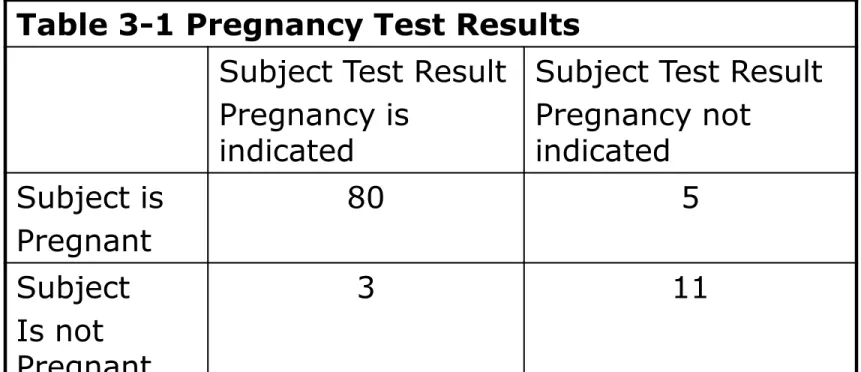
Probability of a Wrong Result. Table 3-1 shows that among 14 women who were not pregnant, the test for pregnancy yielded the wrong conclusions 3 times.
Table 3-1 Pregnancy Test Results
Subject Test Result Pregnancy is
indicated
Subject Test Result Pregnancy not indicated Subject is Pregnant 80 5 Subject Is not Pregnant 3 11
Example – Page 129, #10
A. Based on the available results, find the probability of wrong test conclusions for a women who is not pregnant.
3
( ) .214 14
P W
Let W = The test wrongly concludes a woman is not pregnant Probability of a Wrong Result. Table 3-1 shows that
among 14 women who were not pregnant, the test for pregnancy yielded the wrong conclusions 3 times.
Example – Page 129, #10
B. Is it “unusual” for the test conclusion to be wrong for women who are not pregnant?
3
( ) .214 14
P W
Probability of a Wrong Result. Table 3-1 shows that among 14 women who were not pregnant, the test for pregnancy yielded the wrong conclusions 3 times.
No, since 0.214 > 0.05, it is not unusual for the test to be wrong for women who are not pregnant.
Complement
The complement of an event
A
, denoted
by
A
cor
Ā
, is the set of outcomes that are
not in
A
.
Ac means A does not occur P(Ac) = 1 – P(A)
Example:
When flipping two coins, the
probability of getting two heads is 0.25.
The probability of not getting two heads is
Odds
Actual odds against event A occurring
Is the ratio P(Ac)/P(A), usually expressed in the form of
a:b (or “a to b”), where a and b are integers having no common factors.
Actual odds in favor of a event A
Is the reciprocal of the actual odds against that event
P(A)/P(Ac), then odds in favor of A are b:a.
Payoff odds against event A
Represents the ratio of net profit (if you win) to the
amount bet.
Example – Page 131, #26
A roulette wheel has 38 slots. One slot is 0, another is 00, and the others are numbered 1 through 36
respectively. You are placing a bet that the outcome is an odd number.
A. What is the probability of winning?
18
( ) 0.474 38
Example – Page 131, #26
A roulette wheel has 38 slots. One slot is 0, another is 00, and the others are numbered 1 through 36
respectively. You are placing a bet that the outcome is an odd number.
B. What are the actual odds against winning? actual odds against odd = P(not odd)P(odd) =
20 38 18 38 20 38 20 10
10 : 9 38 18 18 9
Example – Page 131, #26
C.When you bet the outcome is an odd number, the payoff odds are 1:1. How much profit do you make if you bet $18 and win?
1:1 means a profit of $1 for every $1 bet. A winning bet of $18 means a profit of $18.
Example – Page 131, #26
D. How much profit would you make if on the $18 bet if you could somehow convince the casino to change its payoff odd so they are the same as the actual odds against winning?
Payoff odds of 10:9 mean a profit of $10 for every $9 bet.
Lesson 3-3
Addition Rule
Compound Event
A compound event is any event combining
two or more simple events.
Compound probability are used to answer
the following question:
In rolling a single dice what is the probability
of “rolling even number” or “rolling a 1 or 2”
When finding the probability that event
A
occurs
or event
B
occurs, find the total number of ways
A
can occur and the number of ways
B
can
occur, but
find the total in such a way that no
outcome is counted more than once.
Addition Rule
The
addition rule
is used to find probabilities
involving the word
“
or
”
.
Rule – For any two events A and B
P(A P) = (A or B) = P(A) + P(B) – P(A and B) where P(A and B) denotes the probability that A
and B both occur at the same time as an outcome in a trial or procedure.
Example – Page 138, #6
Refer to figure 3-3. Find the probability of randomly selecting one of the peas and getting one with a yellow pod or a
purple flower.
P(Y or P) = P(Y) +P(P) – P(Y and P)
6
9
4
0.786
14
14
14
Example – Page 138, #10
If one of the Titanic passengers is randomly selected, find the probability of getting a man or someone
who survived the sinking.
P(M or S) = P(M) + P(S) – P(M and S)
1692 706 332
0.929 2223 2223 2223
Men Women Boys Girls Total Survived 332 318 29 27 706
Died 1360 104 35 18 1517
Mutually Exclusive
If events
A
and
B
have no simple events in
common or cannot occur simultaneously,
they are said to be disjoint or mutually
exclusive.
For two disjoint events
A
and
B
, the
probability that one or the other occurs is
the sum of the probabilities of the two
events.
Example – Page 137, #2
Determine whether events are disjoint. Are the two events disjoint for a single trial?
a) Randomly selecting a head of household watching NBC on television at 8:15 tonight.
Randomly selecting a head of household watching CBS on television at 8:15 tonight.
Example – Page 137, #2
Determine whether events are disjoint. Are the two events disjoint for a single trial?
b) Receiving a phone call from a volunteer survey subject who opposes all government taxation. Receiving a phone call from a volunteer survey
subject who approves all government taxation. Yes
Example – Page 137, #2
Determine whether events are disjoint. Are the two events disjoint for a single trial?
c) Randomly selecting a United States Senator currently holding office
Randomly selecting a female elected official No
Rule of Complementary Events
Complement Rule is used when you know
the probability that some event will occur
and you want to know the opposite:
the
chance it will not occur
.
Rules
P(A) + P(AC) = 1 P(AC) = 1 – P(A) P(A) = 1 – P(AC)
P(A) and P(A
C) are mutually exclusive
Example – Page 138, #4
Finding the complements A. Find given that ( C )
P A P A( ) 0.0175
( C ) 1 0.0175 0.9825
Example – Page 138, #4
B. A Reuters/Zogby poll showed that 61% of Americans say they believe that life exists somewhere in the galaxy. What is the
probability of randomly selecting someone not having that belief?
Let B = selecting an American who believes that life exists elsewhere in the galaxy
( C ) 1 0.61 0.39
Example – Page 138, #8
If someone is randomly selected, find the probability that his or her birthday is not October. Ignore leap years.
Let O = a person’s birthday falls in October
31 ( )
365
P O
( ) 1 ( )
31 334
1 0.915
365 365
C
P O P O
Example – Page 138, #20
Refer to the accompanying figure, which describes the blood groups and Rh types of 100 people.
In each case assume that 1 of the 100 is randomly selected and find the indicated probability.
Group AB 4 Rh+
1 Rh
-Group O 39 Rh+
6 Rh
-Group A 35 Rh+
5 Rh
-Group B 8 Rh+
2 Rh
Example – Page 138, #20
Group AB 4 Rh+
1 Rh
-Group O 39 Rh+
6 Rh
-Group A 35 Rh+
5 Rh
-Group B 8 Rh+
2 Rh
-P(group A or O or type Rh+)
Rh Factor
+ – Total
Group
A 35 5 40
B 8 2 10
AB 4 1 5
O 39 6 45
Example – Page 138, #20
P(group A or O or type Rh+) =
Rh Factor
+ – Total
Group
A 35 5 40
B 8 2 10
AB 4 1 5
O 39 6 45
Total 86 14 100
P(A) + P(O) + P(Rh+) – P(A and Rh+) – P(O and Rh+) =
40 45 86 35 39 97
0.97 100 100 100 100 100 100
Lesson 3-4
Independent
Events
A
and
B
are independent
because the probability
A
does not
change the probability of
B
.
Example:
Roll a yellow die and a red
die. Event
A
is the yellow die
landing on an even number, and
event
B
is the red die landing on an
odd number.
Multiplication Rule
The multiplication rule is used to find
probabilities involving the word
“
and
”
.
Rule – For any two events
A
and
B
P(A B) = P(A and B) = P(A occurs in a 1st
trial and event B occurs in a 2nd trial
For two independent events
A
and
B
, the
probability that both
A
and
B
occur is the
product of the probabilities of the two
events.
Dependent
If event A and event B are not independent, they are said to be dependent.
The probability for the second event B should
take into account the fact that the first event A has already occurred.
The probability that event B occurs if we know
for certain that event A will occur is called conditional probability.
The conditional probability of B given A is:
P(B|A) which reads “the probability of event B
given event A has occurred.”
Rule – For any two events A and B
Example – Page 146, #2
Identify events as independent or dependent. For each pair of events, classify the two events as
independent or dependent.
a) Finding that you calculator is not working. Finding that your refrigerator is not working.
Example – Page 146, #2
Identify events as independent or dependent. For each pair of events, classify the two events as
independent or dependent.
b) Finding that your kitchen light is not working. Finding that your refrigerator is not working.
Example – Page 146, #2
Identify events as independent or dependent. For each pair of events, classify the two events as
independent or dependent.
c) Drinking until your driving ability is impaired. Being involved in a car crash.
Example – Page 146, #4
A new computer owner creates a password consisting of two characters. She randomly selects a letter of the alphabet for the first character and a digit (0, 1, 2, 3, 4, 5, 6, 7, 8, 9) for the second character. What is the probability that her
password is “K9”? Would this password be effective as a
deterrent against someone trying to gain access to her computer?
Let A = Alphabet and N = Number P(A and N) P A P N( ) ( )
1 1 1 0.0038 26 10 260
Example - Page 147, #8
A study of hunting injuries and the wearing of
“hunter” orange clothing showed that among
123 hunters injured when mistaken for game, 6 were wearing orange. If a follow-up study begins with
the random selection of hunters from this sample of 123, find the probability that the first two
selected hunters were both wearing orange.
A. Assume that the first hunter is replaced before the next one is selected.
P O( )1 P O O( | )2 1
1 2
( )
P O and O
6 6 0.00238 123 123
Example - Page 147, #8
B. Assume that the first hunter is not replaced before the next one is selected.
P O( )1 P O O( | )2 1
1 2
( )
P O and O
6 5 0.00200 123 122
C. Given a choice between selecting with
replacement and selecting without replacement, which choice makes more sense in this
situation?
Selecting with replacement could lead to re-interviewing
Example – Page 148, #14
It is common for the public opinion polls to have a “confidence
level” of 95%, meaning that there is a 0.95 probability that the
poll results are accurate within the claimed margins of error. If five different organizations conduct independent polls, what
is the probability that all five of them are accurate within the claimed margin of error? Does the result suggest that with a confidence level of 95%, we can expect that almost all polls will be within the claimed margin of error?
A = a poll is accurate as claimed
( ) 0.95
P A for each poll
5
1 2 5
( , ... ) (0.95) 0.774 P A A A
No, the more polls one considers, the less likely
Example – Page 148, #16
Remote sensors are used to control each of two
separate and independent values, denoted by p and q, that open to provide water for emergency cooling of a nuclear reactor. Each value has a 0.9968
probability of opening when triggered. For the given configuration, find the probability that when both
sensors are triggered, water will get through the
system so that cooling can occur. Is this result high enough to be considered safe?
Let O = the value opens properly P(O) = 0.9968, for each value
Example – Page 148, #16
Let O = the value opens properly P(O) = 0.9968, for each value
P(water gets through) = P(O1 and O2) = P(O1) P(O2)
= (0.9968) (0.9968) = 0.9936
Example – Page 148, #16
P(water gets through) = 0.9936
Is this result high enough to considered safe?
Yes; since the systems is used in emergencies, and not on a routine basis – but because the probability of failure is 0.0064 (1 – 0.9936), the system can be expected to fail about 64 times in every 10,000 uses. That means if it is used 28 times a day
[28 365 = 10,220 times a year], we expect about 64 failures annually – and after one such failure in a nuclear reactor, there might not be a next time for anything.
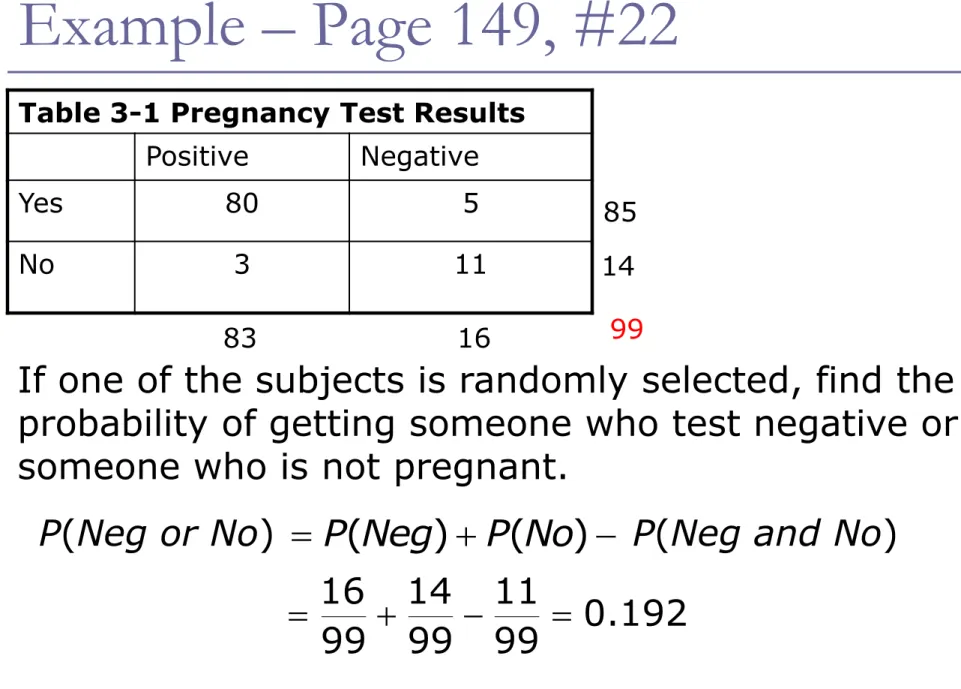
Example – Page 149, #22
Table 3-1 Pregnancy Test Results
Positive Negative
Yes 80 5
No 3 11
If one of the subjects is randomly selected, find the probability of getting someone who test negative or someone who is not pregnant.
P Neg( ) P No( )
16 14 11 0.192 99 99 99
85 14
83 16 99
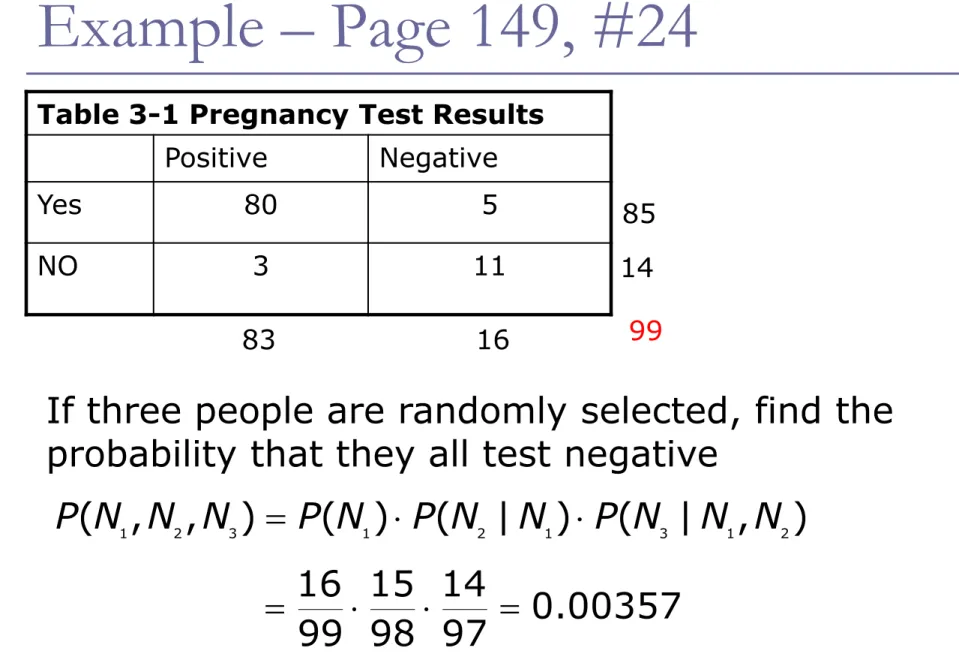
Example – Page 149, #24
Table 3-1 Pregnancy Test Results
Positive Negative
Yes 80 5
NO 3 11
If three people are randomly selected, find the probability that they all test negative
1 2 3 1 2 1 3 1 2
( , , ) ( ) ( | ) ( | , ) P N N N P N P N N P N N N
16 15 14 0.00357 99 98 97
85 14
Lesson 3-5
Multiplication Rule
Complements and Conditional
Probability
Complements: The Probability of
“At Least One”
“At least one” is equivalent to “one or
more”
The complement of getting at least one
item of a particular type is that you get no
item of that type.
To find the probability of
at least one
of
something, calculate the probability of
none
, then subtract that result from 1.
That is,
Example – Page 153, #2
Provide a written description of the complement of the given event.
Quality Control: When 50 HDTV units are shipped, all of them are free of defects.
Example – Page 153, #4
Provide a written description of the complement of the given event.
A Hit with the Misses: When Mike ask five different women for a data, at least one of them accepts.
Example – Page 154, #8
If a couple plans to have 12 children, what is the probability that there will be at least one girl? If the couple eventually has 12 children and they are all boys, what can the couple conclude?
Let B = a child is a boy P(B) = 0.5, for each birth
P(at least one girl) = 1 – P(all boys)
1 2 12
1 P B( ) P B( ).... (P B )
12
1 (.5) .999756
Either a very rare event has occurred or some
genetic factor is causing the likelihood of boy to be much greater than 0.5
Example – Page 154, #10
If you make random guesses for four multiple-choice test questions (each with five possible answers), what is the probability of getting at least one correct? If a very
nondemanding instructor says that passing the test occurs if there is a least one correct answer, can you reasonably expect to pass by guessing?
Let W = guessing a wrong answer ( ) 4 5
P W P(at least one correct) = 1 – P(all wrong)
1 P W( )1 P W( )... ( )2 P W4
4 4 1 0.590 5
Example – Page 154, #10
Since 0.590 > 0.50, you are more likely to pass than fail – whether or not you can “reasonably
expect” to pass depends on your perception of
Conditional Probability
A conditional probability of event occurs when the probability is affected by the knowledge of other circumstances.
P(A and B) P A P B A( ) ( | )
P(A)
P(A)
P(B|A)= P(A and B) P(A)
Example – Page 154, #12
Refer to figure 3-3 in section 3-3 for the peas used in genetics experiment. If one of the peas is
randomly selected and is found to have a green pod, what is the probability that is has a purple flower.
P(Purple|Green) = P(G and P)
P(G)
5 8 5 14 0.625 14 14 14 8
Example – Page 155, #20
If we randomly select some who died, what is the is the probability of getting a man?
P(M|D)
Men Women Boys Girls Total Survived 332 318 29 27 706
Died 1360 104 35 18 1517
Total 1692 422 64 45 2223
1360
( and )
2223
1360
0.965
1517
( )
1517
2223
P M
D
Example – Page 155, #22
What is the probability of getting a man or women, given that the randomly selected person is someone who died.?
P([M or W]|D) = P(D and [M or W]) P(D)
Men Women Boys Girls Total Survived 332 318 29 27 706
Died 1360 104 35 18 1517
Example – Page 155, #22
P([M or W]|D) = P(D and [M or W]) P(D)
[1360 104]
[1360 104] 1464
2223
0.965
1517
1517
1517
2223
Men Women Boys Girls Total
Survived 332 318 29 27 706
Died 1360 104 35 18 1517
Testing for Independence
In Section 3-4 we stated that events
A
and
B
are
independent if the occurrence of one does not
affect the probability of occurrence of the other.
This suggests the following test for independence:
Two events
A
and
B
are Independent if:
P(B|A) = P(B) or
P(A and B) = P(A) P(B)
Two events
A
and
B
are dependent if:
P(B|A) ≠ P(B) or
Lesson 3-6
Probabilities Through
Simulations
Simulation
A simulation of a procedure is a process
that behaves the same way as the
procedure, so that similar results are
produced.
The numbers used in a simulation must be
generated in such a way that they are
equally likely
Obtaining Randomly Generated
Numbers
A table of random digits
TI-83 graphing calculator
Example – Page 160, #2
Assume that you want to use the digits in the accompanying list to simulate the rolling of singe die. If the digits 1, 2, 3, 4, 5, 6 are used while all other digits are ignored, list the outcomes from the first two rows.
46196 99438 72113 44044 86763 00151 64703 78907 19155 67640 98746 29910 82855 25259 14752 85446 75260 92532 87333
Example – Page 160, #8
When Mendel conducted his famous hybridization experiments, he used peas with green pods, and yellow pods. One experiment involved crossing
peas in such a way that 25% of the offspring peas were expected to have yellow pods. Use the random digits in the margin to develop a simulation for finding the probability that when two offspring peas are
produced, at least one of them has a yellow pods.
How does the result compare to the correct probability of 7/16. (Hint: Because 25% of the offspring are
expected to have yellow pods and the other 75% are expected to have green pods, let digit 1 represent
yellow pods and let digits 2, 3, 4 represent green pods and ignore any other digits)
Example – Page 160, #8
46196 99438 72113 44044 86763 00151 64703 78907 19155 67640 98746 29910 82855 25259 14752 85446 75260 92532 87333 558481 – yellow pods
2, 3, 4 – green pods
41, 43, 21, 13, 44, 44, 31, 14, 31, 14, 42, 12, 22, 14, 24, 42, 22, 32, 33, 34
Example – Page 160, #8
1 – yellow pods
2, 3, 4 – green pods
41, 43, 21, 13, 44, 44, 31, 14, 31, 14, 42, 12, 22, 14, 24, 42, 32, 33, 34
Find the number of yellow pods
0 – no yellow
1 – yellow
2 – yellow 1, 0, 1, 1, 0, 0 , 1, 1, 1, 1, 0
Example – Page 160, #8
Find the number of yellow pods 0 – no yellow
1 – yellow
2 – yellow
1, 0, 1, 1, 0, 0 , 1, 1, 1, 1, 0 1, 0, 1, 0, 0, 0, 0, 0, 0
x Frequency Relative Frequency
0 11 11/20 = 0.55
1 9 9/20 = 0.45
2 0 0/20 = 0.00
Total 20 1.00
From the simulation we estimate P(x ≥ 1) ≈ 9/20 = 0.45 This compares very favorable with 7/16 = 0.437.
Example – Page 161, #10
Simulating Three Dice: In exercise 6 we used the digits in the margin to simulate the rolling of dice.
Simulate the rolling of three dice 100 times. Describe the simulation, then use it to estimate the probability of getting a total of 10 when three dice are rolled
Example – Page 161, #10
P(Sum 10) = 11/100 = 0.11
This compares very favorable to the true value of 0.125, and in this instance the simulation produced a good estimate.
Example – Page 161, #12
In Exercise 8 we used the digits in the margin as a basis for simulating the hybridization of peas.
Again assume 25% of offspring peas are expected
to have yellow pods, but develop you own simulation generating 100 pairs of offspring. Based on your
results, estimate the probability of getting at least one pea with yellow pods when two offspring are obtain.
1 – yellow pod
Example – Page 161, #12
P(at Least 1 yellow pod) = 10041 0.41
Compares favorable with the true probability of 0.4375
Lesson 3-7
Counting
Fundamental Counting Rule
For a sequence of two events in which the
first event can occur
m
ways and the
second event can occur
n
ways, the
events together can occur a total of
m
n
Example
Counting the number of possible meals
The fixed priced lunch at Sarasota High School provides the following chooses:
Appetizer: soup or salad
Entrée: baked chicken, pizza, sandwich, or hotdog
Dessert: ice cream or cookie
2 4 2 16
Example – Airport Codes
The International Airline Transportation Association uses 3 – letter codes to assign airports. How many
different airport codes
Example – Arranging Groups
Arrange the sequence of 6 groups.
Factorial Rule
A collection of
n
different items can be arranged
in order
n
! different ways.
This factorial rule reflects the fact that the first
item may be selected in
n
different ways, the
second item may be selected in
n
– 1 ways, and
so on.
Factorial symbol !
Denotes the product of decreasing positive
whole numbers.
Example: 4! = 4 3 2 1 = 24 By special definition: 0! = 1
Example – Factorial
6!
6 5 4 3 2 1 720
Number of Permutations of
n
Distinct
Objects Taken
r
at a Time
The number of arrangements of r objects chosen from n objects in which:
The n objects are distinct
once an object is used it cannot be repeated order is important
Notation
nPr = the number of permutations of r objects
selected from n objects. Formula
n rn
P
n
r
!
!
Example - Permutations
Evaluate the following
P
7 5
7! 7! 7 6 5 4 3
7 6 5 4 3 2,520 7 5 ! 2! 2
2 1 1
Example – Page 170, #18
Singing legend Frank Sinatra recorded 381 songs. From a list of his top-10 songs, you must select three that will be sung in a medley as a tribute at the next MTV Music Awards ceremony. The order of the songs is important so that they fit together well. If you select three of Sinatra’s top-10
songs, how many different sequences are possible.
n
r
10
Number of Combinations of
n
Distinct
Objects Taken
r
at a Time
The number of arrangements of n objects using r ≤ n of them in which:
The n objects are distinct
once an object is used it cannot be repeated order is not important
Notation
nCr = Represents the number of combinations n
distinct objects taken r at a time Formula
n r
n
C
r
n
r
!
Example - Combinations
Evaluate the following
C
6 4
6! 6! 6 5 30
15 4! 6 4 ! 4! 2! ! 2 1 2
4! 4
Example – Page 169, #12
Find the probability of winning the New York
Take Five: the winning five numbers from 1, 2,..,39
n r
39
5 39C5 575,757
P W( ) 1
575,757
Example – Page 171, #26
Five Card Flush: A standard deck of cards contains 13 clubs, 13 diamonds, 13 hearts, and 13 spades.
If five cards are randomly selected, find the probability of getting a flush. (A flush is obtained when all five
cards are of the same suit. That is, they are all clubs, or all diamonds, or all hearts or all spades.
Method #1 Counting Technique
The total number of possible 5 card selections is
52 5
52!
2,598,960
47!5!
Example – Page 171, #26
The total number of possible 5 card selections from one particular suit is
13 5
13!
1287
8!5!
C
The total number of possible 5 card selections from any of the 4 suits is
4 1287
5148
P(getting a flush)
5148
0.00198
2598960
Example – Page 171, #26
Method #2 Probability Formulas
Let F = selecting a card favorable for getting a flush.
1
52
( )
52
P F
since the 1st card could be anything2
12
(
)
51
P F
since the 2same suit as the firstnd card must be from theP(getting a flush) = P(F1 and F2 and F3 and F4 and F5) = P(F1) P(F2) P(F3) P(F4) P(F5)