Shibboleth Architecture
1
Technical Overview
2
Working Draft 02, 8 June 2005
3
Document identifier:
4
draft-mace-shibboleth-tech-overview-02
5
Location:
6
http://shibboleth.internet2.edu/shibboleth-documents.html
7
Editors:
8
Tom Scavo ([email protected]), NCSA
9
Scott Cantor ([email protected]), The Ohio State University
10
Contributors:
11
Nathan Dors ([email protected]), University of Washington
12
Abstract:
13
This non-normative document gives a technical overview of Shibboleth.
14
This is a working draft and the text may change before completion. Please submit
15
comments to the shibboleth-dev mailing list (see http://shibboleth.internet2.edu/ for
16
subscription details).
17
Table of Contents
18
1
Introduction
... 3
19
1.1
Background
... 3
20
1.2
Notation
... 3
21
1.3
Outline
... 4
22
2
Shibboleth Components
... 5
23
2.1
Identity Provider
... 5
24
2.1.1 Authentication Authority
... 5
25
2.1.2 Single Sign-On Service
... 5
26
2.1.3 Inter-Site Transfer Service
... 5
27
2.1.4 Artifact Resolution Service
... 5
28
2.1.5 Attribute Authority
... 6
29
2.2
Service Provider
... 6
30
2.2.1 Assertion Consumer Service
... 6
31
2.2.2 Attribute Requester
... 6
32
2.3
WAYF Service
... 6
33
3
SAML Assertions
... 7
34
3.1
Authentication Assertions
... 7
35
3.2
Attribute Assertions
... 9
36
3.3
Multiple Assertions
... 9
37
3.4
Signed Assertions
...11
38
4
Shibboleth SSO Profiles
...13
39
4.1
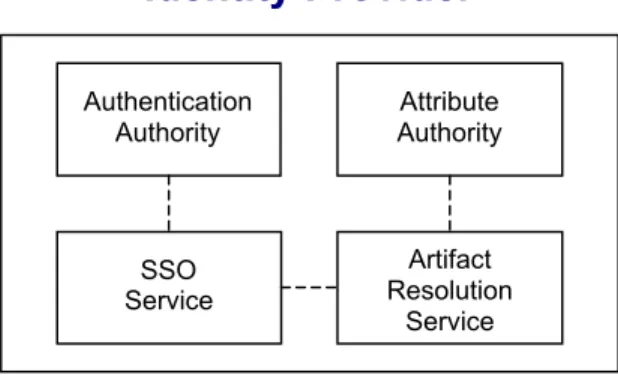
Authentication Request Profile
...13
40
4.2
Browser/POST Profile
...13
41
4.2.1 Browser/POST Profile with WAYF Service
...15
42
4.3
Browser/Artifact Profile
...17
43
4.3.1 Browser/Artifact Profile with WAYF Service
...20
44
5
Attributes
...21
45
5.1
Browser/POST Profile with Attribute Exchange
...21
46
5.2
Browser/Artifact Profile with Attribute Exchange
...23
47
5.3
Directory Schema
...24
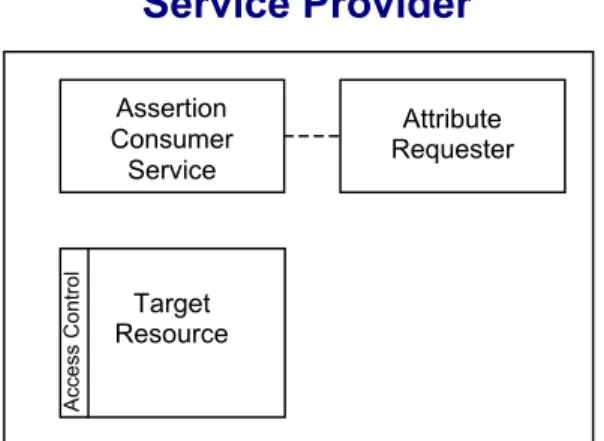
48
6
Metadata
...26
49
6.1
Identity Provider Metadata
...26
50
6.1.1 SSO Service Metadata
...27
51
6.1.2 Attribute Authority Metadata
...28
52
6.2
Service Provider Metadata
...29
53
6.2.1 Assertion Consumer Service Metadata
...29
54
7
References
...31
55
7.1
Normative References
...31
56
7.2
Non-Normative References
...31
57
1 Introduction
59
The Shibboleth Architecture [ShibProt] extends the SAML 1.1 single sign-on and attribute
60
exchange mechanisms by specifying service-provider-first SSO profiles and enhanced
61
features for user privacy. This document provides a technical overview of Shibboleth and as
62
such is an extension of [SAMLTech].
63
1.1 Background
64
The Shibboleth Architecture is built upon the following standards:
65
• Hypertext Transfer Protocol (HTTP)
66
• Extensible Markup Language (XML)
67
• XML Schema
68
• XML Signature
69
• SOAP1
70
• Security Assertion Markup Language (SAML)
71
Definitive references for each of these standards are found in section 7 of this Overview.
72
1.2 Notation
73
Conventional XML namespace prefixes are used throughout the listings in this Overview,
74
whether or not a namespace declaration is present in the listing:
75
• The prefix saml: stands for the SAML 1.1 assertion namespace:
76
urn:oasis:names:tc:SAML:1.0:assertion
77
• The prefix samlp: stands for the SAML 1.1 request-response protocol namespace:
78
urn:oasis:names:tc:SAML:1.0:protocol
79
• The prefix md: stands for the SAML 2.0 metadata namespace:
80
urn:oasis:names:tc:SAML:2.0:metadata
81
• The prefix ds: stands for the W3C XML Signature namespace:
82
http://www.w3.org/2000/09/xmldsig#
83
• The prefix xsd: stands for the W3C XML Schema namespace:
84
http://www.w3.org/2001/XMLSchema
85
• The prefix xsi: stands for the W3C XML Schema namespace for schema-related
86
markup that appears in XML instances:
87
http://www.w3.org/2001/XMLSchema-instance
88
The following typographical conventions for displayed text are used:
89
HTTP requests appear like this.
90
HTTP responses appear like this.
91
HTML code listings appear like this.
92
JavaScript code listings appear like this.
93
XML code listings appear like this.
94
SAML code listings appear like this.
95
1 Originally, SOAP was an acronym for "Simple Object Access Protocol", but this turned out to be a
misnomer since SOAP has nothing to do with "object access" in the object-oriented programming sense of the phrase. So today we no longer think of "SOAP" as an acronym although the capitalization persists.
URNs appear like this.
96
URLs appear like this.
97
Likewise the following typographical conventions for in-line text are used: <XMLelement>,
98
<HTMLelement>, XMLattribute, HTMLattribute, LDAPattribute, HTTPparameter,
99
OtherCode. Finally, variable placeholders in code fragments (both displayed and in-line)
100
are italicized (e.g., artifact).
101
1.3 Outline
102
Immediately following this introduction, in section 2 we describe the components comprising
103
the Shibboleth System. Section 3 is a general introduction to Security Assertion Markup
104
Language (SAML) with special emphasis on those SAML constructs used by Shibboleth. In
105
section 4, the Shibboleth browser profiles are described in detail, while the Shibboleth
106
attribute profiles are outlined in section 5. Also in section 5, we emphasize the importance of
107
directory schema using eduPerson as the canonical example of a directory in higher
108
education. An introduction to SAML metadata is given in section 6, and finally in section 7
109
we provide a list of definitive references for further study.
110
2 Shibboleth Components
111
The functional components of a conforming Shibboleth implementation include an identity
112
provider, a service provider, an optional “Where are you from?” (WAYF) service, and various
113
interacting subcomponents.
114
2.1 Identity Provider
115
An identity provider (formerly called an origin) maintains user credentials and attributes.
116
Upon request the identity provider (IdP) will assert authentication statements or attribute
117
statements to relying parties, specifically service providers. IdP subcomponents are depicted
118
in Figure 1 and discussed in the following subsections.
119
120
Figure 1: Shibboleth Identity Provider
121
2.1.1 Authentication Authority
122
The authentication authority issues authentication statements to other components. The
123
authentication authority is integrated with the IdP's authentication service (the details of
124
which are out of scope).
125
2.1.2 Single Sign-On Service
126
A single sign-on (SSO) service is the first point of contact at the IdP. The SSO service
127
initiates the authentication process at the IdP and ultimately redirects the client to the
inter-128
site transfer service (unless the function of the SSO service and inter-site transfer service are
129
combined, which is encouraged). Note: The SSO service is not defined by SAML 1.1, which
130
specifies only identity-provider-first SSO profiles.
131
2.1.3 Inter-Site Transfer Service
132
The inter-site transfer service issues HTTP responses conforming to the Browser/POST and
133
Browser/Artifact profiles. The inter-site transfer service interacts with the authentication
134
authority behind the scenes to produce the required authentication assertion. Note: The
135
concept of an inter-site transfer service has been removed in SAML 2.0, so we assume that
136
the functions of the SSO service and the inter-site transfer service are combined, and
137
therefore ignore the latter in all that follows.
138
2.1.4 Artifact Resolution Service
139
If the Browser/Artifact profile is used, the IdP sends an artifact to the SP instead of the actual
140
assertion. (An artifact is a reference to an authentication assertion.) The SP then sends the
141
Identity Provider
SSO Service Authentication
Authority AuthorityAttribute
Artifact Resolution
artifact to the artifact resolution service at the IdP via a back-channel exchange. In return, the
142
IdP sends the required authentication assertion to the SP.
143
2.1.5 Attribute Authority
144
The attribute authority processes attribute requests; that is, it issues attribute assertions. The
145
attribute authority authenticates and authorizes any requests it receives.
146
2.2 Service Provider
147
A service provider (formerly called a target) manages secured resources. User access to
148
resources is based on assertions received by the service provider (SP) from an identity
149
provider. SP subcomponents are shown in Figure 2. Note that the service provider has
150
access control in place that prevents access by clients without a security context.
151
152
Figure 2: Shibboleth Service Provider
153
2.2.1 Assertion Consumer Service
154
The assertion consumer service (formerly called a SHIRE) is the service provider endpoint of
155
the SSO exchange. It processes the authentication assertion returned by the SSO service (or
156
artifact resolution service, depending on the profile used), initiates an optional attribute
157
request (see section 5), establishes a security context at the SP, and redirects the client to
158
the desired target resource.
159
2.2.2 Attribute Requester
160
An attribute requester (formerly called a SHAR) at the SP and the attribute authority at the
161
IdP may conduct a back-channel attribute exchange once a security context has been
162
established at the SP. That is, the SP and IdP interact directly, bypassing the browser.
163
2.3 WAYF Service
164
An optional WAYF service is operated independent of the SP and IdP. The WAYF can be
165
used by the SP to determine the user's preferred IdP, with or without user interaction. The
166
WAYF is essentially a proxy for the authentication request passed from the SP to the SSO
167
service at the IdP.
168
Service Provider
Assertion Consumer Service
Target Resource
Attribute Requester
3 SAML Assertions
169
This section provides some background material on SAML assertions that sets the stage for
170
the profiles to follow. In Shibboleth, SAML assertions are transferred from identity providers
171
to service providers. Assertions contain statements that service providers can use to make
172
access control decisions. Three types of statements are specified by SAML:
173
1. Authentication statements
174
2. Attribute statements
175
3. Authorization decision statements
176
Authentication statements assert to the service provider that the principal did indeed
177
authenticate with the identity provider at a particular time using a particular method of
178
authentication. The examples in section 3.1, for instance, are assertions containing
179
authentication statements typically used in the Browser/POST and Browser/Artifact profiles
180
(section 4), respectively.
181
Attribute statements provide additional information about a principal so that service providers
182
can make access control decisions. For example, the attribute assertion given in section 3.2
183
is the result of the attribute exchange described in section 5.1.
184
Authentication statements and attribute statements may be combined in a single assertion.
185
Alternatively, multiple assertions may be issued by the IdP, each containing its own
186
statement. A variation of the Browser/Artifact profile (section 5.2), for instance, relies on a
187
pair of assertions, both obtained as the result of a single message exchange. The example
188
in section 3.3 illustrates the corresponding pair of assertions.
189
In some situations, it may be preferable for the application to delegate an access control
190
decision to another component or service. In this case, the service provider indicates to the
191
service the resource being accessed where after the service asserts an authorization
192
decision statement that dictates whether or not the principal is allowed access to the
193
resource. In Shibboleth, such statements are out of scope, but the interested reader is
194
referred to [GSIsecurity] for a relevant example.
195
Finally, SAML assertions may be digitally signed. An XML element such as that given in
196
section 3.4 is inserted into those assertions where additional message integrity is required.
197
3.1 Authentication Assertions
198
The following authentication assertion (sometimes called an SSO assertion) contains a
199
<saml:AuthenticationStatement> element (but no attributes):
200
<saml:Assertion
201
xmlns:saml="urn:oasis:names:tc:SAML:1.0:assertion"
202
MajorVersion="1" MinorVersion="1"
203
AssertionID="a75adf55-01d7-40cc-929f-dbd8372ebdfc"
204
IssueInstant="2004-12-05T09:22:02Z"
205
Issuer="https://idp.example.org/shibboleth">
206
<saml:Conditions
207
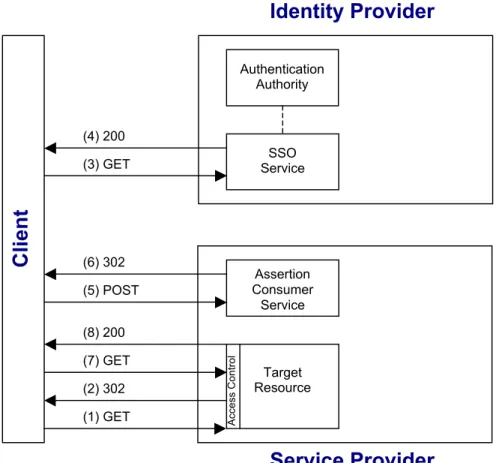
NotBefore="2004-12-05T09:17:02Z"
208
NotOnOrAfter="2004-12-05T09:27:02Z">
209
<saml:AudienceRestrictionCondition>
210
<saml:Audience>http://sp.example.org/shibboleth</saml:Audience>
211
</saml:AudienceRestrictionCondition>
212
</saml:Conditions>
213
<saml:AuthenticationStatement
214
AuthenticationInstant="2004-12-05T09:22:00Z"
215
AuthenticationMethod="urn:oasis:names:tc:SAML:1.0:am:password">
216
<saml:Subject>
217
<saml:NameIdentifier
218
Format="urn:mace:shibboleth:1.0:nameIdentifier"
219
NameQualifier="https://idp.example.org/shibboleth">
220
3f7b3dcf-1674-4ecd-92c8-1544f346baf8
221
</saml:NameIdentifier>
222
<saml:SubjectConfirmation>
223
<saml:ConfirmationMethod>
224
urn:oasis:names:tc:SAML:1.0:cm:bearer
225
</saml:ConfirmationMethod>
226
</saml:SubjectConfirmation>
227
</saml:Subject>
228
</saml:AuthenticationStatement>
229
</saml:Assertion>
230
The value of the <saml:NameIdentifier> element in the preceding example is called a
231
Shibboleth handle: an opaque, transient identifier associated with the authenticated user.
232
Further messages regarding this user (such as the one in the next section) explicitly refer to
233
this handle instead of the actual identity of the user.
234
Note that the above assertion (called a bearer assertion) assigns the following value to the
235
<saml:ConfirmationMethod> element:
236
urn:oasis:names:tc:SAML:1.0:cm:bearer
237
Whereas the preceding assertion is used in the Browser/POST profile (section 4.2), the
238
following assertion is used in the Browser/Artifact profile (section 4.3):
239
<saml:Assertion
240
xmlns:saml="urn:oasis:names:tc:SAML:1.0:assertion"
241
MajorVersion="1" MinorVersion="1"
242
AssertionID="003c6cc1-9ff8-10f9-990f-004005b13a2b"
243
IssueInstant="2004-12-05T09:22:05Z"
244
Issuer="https://idp.example.org/shibboleth">
245
<saml:Conditions
246
NotBefore="2004-12-05T09:17:05Z"
247
NotOnOrAfter="2004-12-05T09:27:05Z">
248
<saml:AudienceRestrictionCondition>
249
<saml:Audience>http://sp.example.org/shibboleth</saml:Audience>
250
</saml:AudienceRestrictionCondition>
251
</saml:Conditions>
252
<saml:AuthenticationStatement
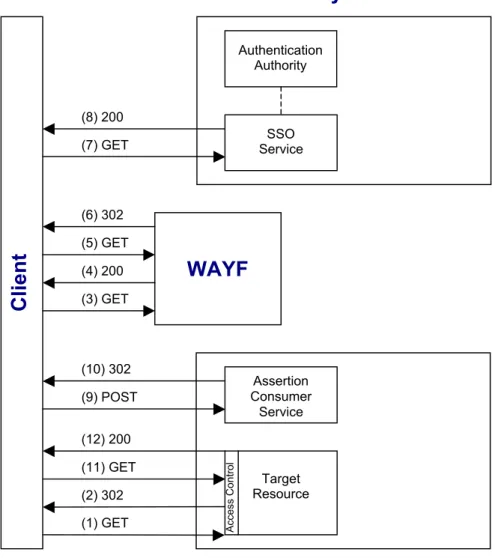
253
AuthenticationInstant="2004-12-05T09:22:00Z"
254
AuthenticationMethod="urn:oasis:names:tc:SAML:1.0:am:password">
255
<saml:Subject>
256
<saml:NameIdentifier
257
Format="urn:oasis:names:tc:SAML:1.1:nameid-format:emailAddress"
258
NameQualifier="https://idp.example.org/shibboleth">
259
260
</saml:NameIdentifier>
261
<saml:SubjectConfirmation>
262
<saml:ConfirmationMethod>
263
urn:oasis:names:tc:SAML:1.0:cm:artifact
264
</saml:ConfirmationMethod>
265
</saml:SubjectConfirmation>
266
</saml:Subject>
267
</saml:AuthenticationStatement>
268
</saml:Assertion>
269
In this case, the value of the <saml:ConfirmationMethod> element is
270
urn:oasis:names:tc:SAML:1.0:cm:artifact
271
which indicates the Browser/Artifact profile was used to retrieve the assertion.
272
Some use cases require more than an opaque identifier, so for the sake of illustration the
273
value of the <saml:NameIdentifier> element in the preceding example is an email
274
address. Presumably this uniquely identifies the authenticated user to the SP.
275
Note that an authentication assertion may include additional information about the subject,
276
such as attributes.
277
3.2 Attribute Assertions
278
The following attribute assertion contains a <saml:AttributeStatement> element only:
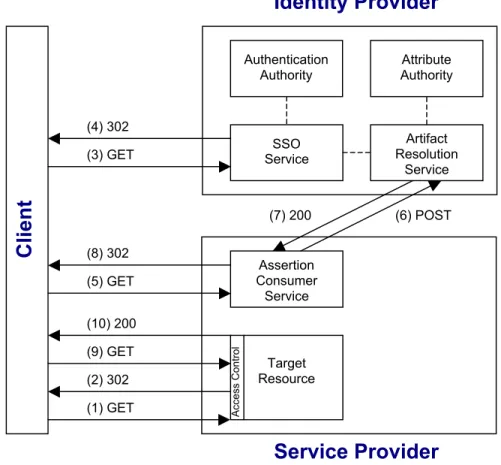
279
<saml:Assertion
280
xmlns:saml="urn:oasis:names:tc:SAML:1.0:assertion"
281
MajorVersion="1" MinorVersion="1"
282
AssertionID="a144e8f3-adad-594a-9649-924517abe933"
283
IssueInstant="2004-12-05T09:22:05Z"
284
Issuer="https://idp.example.org/shibboleth">
285
<saml:Conditions
286
NotBefore="2004-12-05T09:17:05Z"
287
NotOnOrAfter="2004-12-05T09:52:05Z">
288
<saml:AudienceRestrictionCondition>
289
<saml:Audience>http://sp.example.org/shibboleth</saml:Audience>
290
</saml:AudienceRestrictionCondition>
291
</saml:Conditions>
292
<saml:AttributeStatement>
293
<saml:Subject>
294
<saml:NameIdentifier
295
Format="urn:mace:shibboleth:1.0:nameIdentifier"
296
NameQualifier="https://idp.example.org/shibboleth">
297
3f7b3dcf-1674-4ecd-92c8-1544f346baf8
298
</saml:NameIdentifier>
299
</saml:Subject>
300
<saml:Attribute
301
AttributeName="urn:mace:dir:attribute-def:eduPersonPrincipalName"
302
AttributeNamespace="urn:mace:shibboleth:1.0:attributeNamespace:uri">
303
<saml:AttributeValue Scope="example.org">
304
userid
305
</saml:AttributeValue>
306
</saml:Attribute>
307
</saml:AttributeStatement>
308
</saml:Assertion>
309
Note that the value of the <saml:NameIdentifier> element is the same as that in the first
310
example in section 3.1, which implies that the attribute statement is obtained subsequent to
311
and as a consequence of the previous authentication statement.
312
3.3 Multiple Assertions
313
The following pair of assertions contain <saml:AuthenticationStatement> and
314
<saml:AttributeStatement> elements, respectively:
315
<saml:Assertion
316
xmlns:saml="urn:oasis:names:tc:SAML:1.0:assertion"
317
MajorVersion="1" MinorVersion="1"
318
AssertionID="00305ed1-a1bd-10f9-a2d0-004005b13a2b"
319
IssueInstant="2004-12-05T09:22:05Z"
320
Issuer="https://idp.example.org/shibboleth">
321
<saml:Conditions
322
NotBefore="2004-12-05T09:17:05Z"
323
NotOnOrAfter="2004-12-05T09:27:05Z">
324
<saml:AudienceRestrictionCondition>
325
<saml:Audience>http://sp.example.org/shibboleth</saml:Audience>
326
</saml:AudienceRestrictionCondition>
327
</saml:Conditions>
328
<saml:AuthenticationStatement
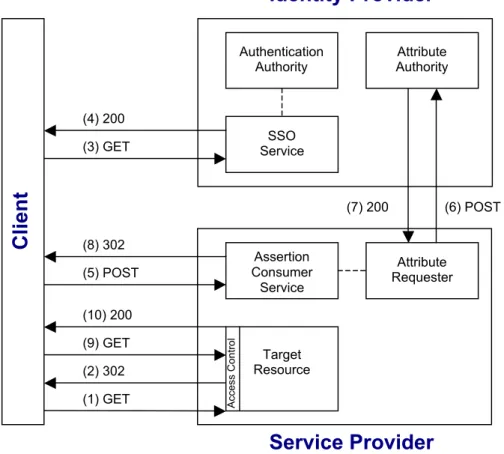
329
AuthenticationMethod="urn:oasis:names:tc:SAML:1.0:am:password"
330
AuthenticationInstant="2004-12-05T09:22:00Z">
331
<saml:Subject>
332
<saml:NameIdentifier
333
Format="urn:mace:shibboleth:1.0:nameIdentifier"
334
NameQualifier="https://idp.example.org/shibboleth">
335
082dd87d-f380-4fd6-8726-694ef2bb71e9
336
</saml:NameIdentifier>
337
<saml:SubjectConfirmation>
338
<saml:ConfirmationMethod>
339
urn:oasis:names:tc:SAML:1.0:cm:artifact
340
</saml:ConfirmationMethod>
341
</saml:SubjectConfirmation>
342
</saml:Subject>
343
</saml:AuthenticationStatement>
344
</saml:Assertion>
345
<saml:Assertion
346
xmlns:saml="urn:oasis:names:tc:SAML:1.0:assertion"
347
xmlns:xsd="http://www.w3.org/2001/XMLSchema"
348
xmlns:xsi="http://www.w3.org/2001/XMLSchema-instance"
349
MajorVersion="1" MinorVersion="1"
350
AssertionID="008c6181-a288-10f9-b6d6-004005b13a2b"
351
IssueInstant="2004-12-05T09:22:05Z"
352
Issuer="https://idp.example.org/shibboleth">
353
<saml:Conditions
354
NotBefore="2004-12-05T09:17:05Z"
355
NotOnOrAfter="2004-12-05T09:52:05Z">
356
<saml:AudienceRestrictionCondition>
357
<saml:Audience>http://sp.example.org/shibboleth</saml:Audience>
358
</saml:AudienceRestrictionCondition>
359
</saml:Conditions>
360
<saml:AttributeStatement>
361
<saml:Subject>
362
<saml:NameIdentifier
363
Format="urn:mace:shibboleth:1.0:nameIdentifier"
364
NameQualifier="https://idp.example.org/shibboleth">
365
082dd87d-f380-4fd6-8726-694ef2bb71e9
366
</saml:NameIdentifier>
367
</saml:Subject>
368
<saml:Attribute
369
AttributeName="urn:mace:dir:attribute-def:eduPersonScopedAffiliation"
370
AttributeNamespace="urn:mace:shibboleth:1.0:attributeNamespace:uri">
371
<saml:AttributeValue Scope="example.org">
372
member
373
</saml:AttributeValue>
374
<saml:AttributeValue Scope="example.org">
375
faculty
376
</saml:AttributeValue>
377
</saml:Attribute>
378
<saml:Attribute
379
AttributeName="urn:mace:dir:attribute-def:eduPersonEntitlement"
380
AttributeNamespace="urn:mace:shibboleth:1.0:attributeNamespace:uri">
381
<saml:AttributeValue xsi:type="xsd:anyURI">
382
urn:mace:oclc.org:100277910
383
</saml:AttributeValue>
384
<saml:AttributeValue xsi:type="xsd:anyURI">
385
https://sp.example.org/entitlements/123456789
386
</saml:AttributeValue>
387
<saml:AttributeValue xsi:type="xsd:anyURI">
388
urn:mace:incommon:entitlement:common:1
389
</saml:AttributeValue>
390
</saml:Attribute>
391
</saml:AttributeStatement>
392
</saml:Assertion>
393
3.4 Signed Assertions
394
Many SAML assertions, especially assertions that pass through a browser, are digitally
395
signed (see section 5 of [SAMLCore]). Here we give an example of a <ds:Signature>
396
element (with visual formatting, which invalidates the signature) used to sign the
397
authentication assertion obtained via the Browser/POST profile in section 4.2:
398
<ds:Signature xmlns:ds="http://www.w3.org/2000/09/xmldsig#">
399
<ds:SignedInfo>
400
<ds:CanonicalizationMethod
401
Algorithm="http://www.w3.org/2001/10/xml-exc-c14n#"/>
402
<ds:SignatureMethod
403
Algorithm="http://www.w3.org/2000/09/xmldsig#rsa-sha1"/>
404
<ds:Reference URI="#c7055387-af61-4fce-8b98-e2927324b306">
405
<ds:Transforms>
406
<ds:Transform
407
Algorithm="http://www.w3.org/2000/09/xmldsig#enveloped-408
signature"/>
409
<ds:Transform
410
Algorithm="http://www.w3.org/2001/10/xml-exc-c14n#">
411
<InclusiveNamespaces
412
PrefixList="#default saml samlp ds xsd xsi"
413
xmlns="http://www.w3.org/2001/10/xml-exc-c14n#"/>
414
</ds:Transform>
415
</ds:Transforms>
416
<ds:DigestMethod
417
Algorithm="http://www.w3.org/2000/09/xmldsig#sha1"/>
418
<ds:DigestValue>TCDVSuG6grhyHbzhQFWFzGrxIPE=</ds:DigestValue>
419
</ds:Reference>
420
</ds:SignedInfo>
421
<ds:SignatureValue>
422
x/GyPbzmFEe85pGD3c1aXG4Vspb9V9jGCjwcRCKrtwPS6vdVNCcY5rHaFPYWkf+5
423
EIYcPzx+pX1h43SmwviCqXRjRtMANWbHLhWAptaK1ywS7gFgsD01qjyen3CP+m3D
424
w6vKhaqledl0BYyrIzb4KkHO4ahNyBVXbJwqv5pUaE4=
425
</ds:SignatureValue>
426
<ds:KeyInfo>
427
<ds:X509Data>
428
<ds:X509Certificate>
429
MIICyjCCAjOgAwIBAgICAnUwDQYJKoZIhvcNAQEEBQAwgakxCzAJBgNVBAYTAlVT
430
MRIwEAYDVQQIEwlXaXNjb25zaW4xEDAOBgNVBAcTB01hZGlzb24xIDAeBgNVBAoT
431
F1VuaXZlcnNpdHkgb2YgV2lzY29uc2luMSswKQYDVQQLEyJEaXZpc2lvbiBvZiBJ
432
bmZvcm1hdGlvbiBUZWNobm9sb2d5MSUwIwYDVQQDExxIRVBLSSBTZXJ2ZXIgQ0Eg
433
LS0gMjAwMjA3MDFBMB4XDTAyMDcyNjA3Mjc1MVoXDTA2MDkwNDA3Mjc1MVowgYsx
434
CzAJBgNVBAYTAlVTMREwDwYDVQQIEwhNaWNoaWdhbjESMBAGA1UEBxMJQW5uIEFy
435
Ym9yMQ4wDAYDVQQKEwVVQ0FJRDEcMBoGA1UEAxMTc2hpYjEuaW50ZXJuZXQyLmVk
436
dTEnMCUGCSqGSIb3DQEJARYYcm9vdEBzaGliMS5pbnRlcm5ldDIuZWR1MIGfMA0G
437
CSqGSIb3DQEBAQUAA4GNADCBiQKBgQDZSAb2sxvhAXnXVIVTx8vuRay+x50z7GJj
438
IHRYQgIv6IqaGG04eTcyVMhoekE0b45QgvBIaOAPSZBl13R6+KYiE7x4XAWIrCP+
439
c2MZVeXeTgV3Yz+USLg2Y1on+Jh4HxwkPFmZBctyXiUr6DxF8rvoP9W7O27rhRjE
440
pmqOIfGTWQIDAQABox0wGzAMBgNVHRMBAf8EAjAAMAsGA1UdDwQEAwIFoDANBgkq
441
hkiG9w0BAQQFAAOBgQBfDqEW+OI3jqBQHIBzhujN/PizdN7s/z4D5d3pptWDJf2n
442
qgi7lFV6MDkhmTvTqBtjmNk3No7v/dnP6Hr7wHxvCCRwubnmIfZ6QZAv2FU78pLX
443
8I3bsbmRAUg4UP9hH6ABVq4KQKMknxu1xQxLhpR1ylGPdiowMNTrEG8cCx3w/w==
444
</ds:X509Certificate>
445
</ds:X509Data>
446
</ds:KeyInfo>
447
</ds:Signature>
448
SAML metadata elements are also signed. The examples in section 6, for instance, implicitly
449
include a <ds:Signature> element similar to the one above.
450
4 Shibboleth SSO Profiles
451
Shibboleth specifies two browser-based single sign-on (SSO) profiles:
452
1. Browser/POST Profile
453
2. Browser/Artifact Profile
454
These profiles extend the SAML 1.1 profiles of the same name [SAMLBind]. While the
455
SAML 1.1 profiles begin with a request to the IdP, the Shibboleth profiles are
service-456
provider-first and therefore more complex.
457
4.1 Authentication Request Profile
458
To accommodate SP-first profiles, Shibboleth introduces the notion of an authentication
459
request. A Shibboleth authentication request is a URL-encoded message sent to an SSO
460
service endpoint at the IdP. The following parameters are included in the query string:
461
• providerId
462
The providerId parameter is the unique identifier (usually a URI) of the SP. The IdP
463
may use the providerId to perform special handling or processing of the authentication
464
request.
465
• shire
466
The shire parameter (so named for historical reasons) is the location of the assertion
467
consumer service endpoint at the SP. When using the Browser/POST profile, this URL
468
becomes the value of the <form> element's action attribute. For the Browser/Artifact
469
profile, the value of the shire parameter is a prefix of the redirect URL used by the SSO
470
service.
471
• target
472
The target parameter is a state maintenance parameter, possibly the location of the
473
target resource. Regardless of the profile used, the target parameter must be
474
preserved by the IdP and included in the response to the SP.
475
• time
476
The (optional) time parameter is the current time in seconds past the epoch. It is used to
477
assist the IdP in detecting stale requests from the client. It is important that the time
478
parameter not be used as any kind of security measure.
479
Here is an example of a Shibboleth authentication request (without URL encoding for clarity):
480
https://idp.example.org/shibboleth/SSO?
481
target=https://sp.example.org/myresource&
482
shire=https://sp.example.org/shibboleth/SSO&
483
providerId=https://sp.example.org/shibboleth&
484
time=1102260120
485
Detailed handling of this request is outlined in the subsections below.
486
4.2 Browser/POST Profile
487
The Shibboleth Browser/POST profile is a combination of two profiles, the Shibboleth
488
Authentication Request profile [ShibProt] and the SAML 1.1 Browser/POST profile
489
[SAMLBind]. The message flow associated with the Shibboleth Browser/POST profile is
490
depicted in Figure 3. As with both Shibboleth SSO profiles, the message flow begins with a
491
request for a secured resource at the SP.
492
493
Figure 3: Shibboleth Browser/POST Profile
494
(1) The client requests a target resource at the SP:
495
https://sp.example.org/myresource
496
The SP performs a security check on behalf of the target resource. If a valid security context
497
at the SP already exists, skip steps 2–7.
498
(2) The SP redirects the client to the single sign-on (SSO) service at the IdP. Three
499
parameters are appended to the redirect URL (the optional time parameter is omitted in this
500
example).
501
(3) The client requests the SSO service at the IdP:
502
https://idp.example.org/shibboleth/SSO?
503
target=https://sp.example.org/myresource&
504
shire=https://sp.example.org/shibboleth/SSO/POST&
505
providerId=https://sp.example.org/shibboleth
506
The SSO service processes the authentication request and performs a security check. If the
507
user does not have a valid security context, the IdP identifies the principal (details omitted).
508
Once the principal has been identified, the SSO service obtains an authentication statement
509
from the authentication authority.
510
(4) The SSO service responds with a document containing an HTML form:
511
<form method="post"
512
action="https://sp.example.org/shibboleth/SSO/POST" ...>
513
<input name="TARGET" type="hidden"
514
value="https://sp.example.org/myresource" />
515
<input name="SAMLResponse" value="response" type="hidden" />
516
Service Provider
Identity Provider
SSO Service Authentication
Authority
Assertion Consumer Service
Target Resource
Client
(1) GET (2) 302 (7) GET (8) 200 (5) POST (6) 302 (3) GET (4) 200
...
517
<input type="submit" value="Submit" />
518
</form>
519
The value of the TARGET parameter has been preserved from step 3. The value of the
520
SAMLResponse parameter is the base64 encoding of a digitally signed
521
<samlp:Response> element such as the one below:
522
<samlp:Response
523
xmlns:samlp="urn:oasis:names:tc:SAML:1.0:protocol"
524
MajorVersion="1" MinorVersion="1"
525
IssueInstant="2004-12-05T09:22:02Z"
526
Recipient="https://sp.example.org/shibboleth/SSO/POST"
527
ResponseID="c7055387-af61-4fce-8b98-e2927324b306">
528
<!—- insert ds:Signature element here (section 3.4) -->
529
<samlp:Status><samlp:StatusCode Value="samlp:Success"/></samlp:Status>
530
<!-- insert SAML assertion here (section 3.1) -->
531
</samlp:Response>
532
(5) The client issues a POST request to the assertion consumer service at the SP. To
533
automate the submission of the form, the following line of JavaScript (or its equivalent) may
534
appear in the HTML document containing the form in step 4:
535
window.onload = function() { document.forms[0].submit(); }
536
This assumes that the page contains a single HTML <form> element.
537
(6) The assertion consumer service processes the authentication response, creates a
538
security context at the SP and redirects the client to the target resource.
539
(7) The client requests the target resource at the SP (again):
540
https://sp.example.org/myresource
541
(8) Since a security context exists, the SP returns the resource to the client.
542
4.2.1 Browser/POST Profile with WAYF Service
543
In general, the SP does not know the user's preferred IdP at step 2 of the Browser/POST
544
profile. The process whereby the SP determines the appropriate IdP is called identity
545
provider discovery (generally, a very difficult problem). Shibboleth specifies an (optional)
546
WAYF service to aid the SP in IdP discovery.
547
A WAYF ("Where are you from?") service is an intermediary between the SP and the IdP.
548
The SP sends its authentication request to the WAYF, which somehow determines the user's
549
preferred IdP (through unspecified means) and then subsequently redirects the client to the
550
desired IdP. In the process, the WAYF preserves the values of all parameters except the
551
time parameter, which is updated.
552
In practice, the first time the client accesses an SP, the WAYF might present the user with a
553
form containing a list of all available IdPs. The user selects an IdP from the list and submits
554
the form, after which the WAYF redirects the client to the selected IdP. At the same time, the
555
client stores a reference to the IdP in a client-side cookie such that subsequent visits to the
556
same SP are redirected straight through to the corresponding IdP by the WAYF.
557
As a hypothetical example, suppose that a WAYF service resides at domain example.org
558
and that the SP redirects the client to this WAYF as follows:
559
https://wayf.example.org/?
560
target=https://sp.example.org/myresource&
561
shire=https://sp.example.org/shibboleth/SSO/POST&
562
providerId=https://sp.example.org/shibboleth
563
In response, the WAYF returns a form to the client with the following elements:
564
<form method="get" action="https://wayf.example.org/" ...>
565
<input name="target" type="hidden"
566
value="https://sp.example.org/myresource" />
567
<input name="shire" type="hidden"
568
value="https://sp.example.org/shibboleth/SSO/POST" />
569
<input name="providerId" type="hidden"
570
value="https://sp.example.org/shibboleth" />
571
...
572
<input type="submit" value="Submit" />
573
</form>
574
Presumably the form contains additional controls that allow the user to select an IdP, after
575
which the form is submitted to the WAYF. The WAYF processes the form, sets the cookie
576
and redirects the client to the selected IdP.
577
The message flow of the Shibboleth Browser/POST profile with WAYF service is outlined in
578
Figure 4. (The flow of the corresponding Browser/Artifact profile is similar.) In step 4 of that
579
flow, the WAYF returns an HTML form to the user who chooses an IdP from a list. After the
580
form is submitted at step 5, the client is redirected to the SSO service of the chosen IdP
581
where after the flow is identical to the ordinary Browser/POST profile.
582
583
Service Provider
Identity Provider
SSO Service Authentication
Authority
Assertion Consumer Service
Target Resource
Client
Access Control
(1) GET (2) 302 (11) GET (12) 200 (9) POST (10) 302 (7) GET (8) 200
(3) GET (4) 200 (5) GET (6) 302
Figure 4: Shibboleth Browser/POST Profile with WAYF Service
584
(1) The client requests a target resource at the SP:
585
https://sp.example.org/myresource
586
The SP performs a security check on behalf of the target resource. If a valid security context
587
at the SP already exists, skip steps 2–11.
588
(2) The SP redirects the client to the WAYF. Three parameters are appended to the redirect
589
URL (the optional time parameter is omitted in this example).
590
(3) The client requests the WAYF service:
591
https://wayf.example.org/?
592
target=https://sp.example.org/myresource&
593
shire=https://sp.example.org/shibboleth/SSO/POST&
594
providerId=https://sp.example.org/shibboleth
595
The WAYF service processes the authentication request and performs a cookie check. If the
596
user has the required cookie, skip steps 4 and 5. Otherwise an HTML form is returned to the
597
client.
598
(4) The WAYF returns an HTML form to the client. The parameters of the authentication
599
request (shown in the previous step) are encoded as hidden fields in the form as illustrated
600
above.
601
(5) The user selects an IdP from the list and submits the form, which causes the browser to
602
issue a GET request to the WAYF. (Depending on the particular WAYF implementation,
603
multiple HTTP transactions may occur at this step.)
604
(6) The WAYF updates the cookie with the user’s preferred IdP and redirects the client to the
605
SSO service. Three parameters are appended to the redirect URL.
606
(7) The client requests the SSO service at the IdP:
607
https://idp.example.org/shibboleth/SSO?
608
target=https://sp.example.org/myresource&
609
shire=https://sp.example.org/shibboleth/SSO/POST&
610
providerId=https://sp.example.org/shibboleth
611
The SSO service processes the authentication request and performs a security check. If the
612
user does not have a valid security context, the IdP identifies the principal (details omitted).
613
Once the principal has been identified, the SSO service obtains an authentication statement
614
from the authentication authority.
615
(8) The SSO service responds with an HTML form as in step 4 of the ordinary Browser/POST
616
profile.
617
(9) The client issues a POST request to the assertion consumer service at the service
618
provider as in step 5 of the ordinary Browser/POST profile.
619
(10) The assertion consumer service processes the authentication response, creates a
620
security context at the SP and redirects the client to the target resource.
621
(11) The client requests the target resource at the SP (again):
622
https://sp.example.org/myresource
623
(12) Since a security context exists, the SP returns the resource to the client.
624
4.3 Browser/Artifact Profile
625
The Shibboleth Browser/Artifact profile is a combination of the Shibboleth Authentication
626
Request [ShibProt] profile and the SAML 1.1 Browser/Artifact profile [SAMLBind]. The
627
message flow associated with the Shibboleth Browser/Artifact profile is shown in Figure 5.
628
Note the back-channel exchange of the SAML artifact in steps 6 and 7. This is the
629
distinguishing characteristic between the Browser/Artifact and Browser/POST profiles.
630
631
Figure 5: Shibboleth Browser/Artifact Profile
632
(1) The client requests a target resource at the SP:
633
https://sp.example.org/myresource
634
The SP performs a security check on behalf of the target resource. If a valid security context
635
at the SP already exists, skip steps 2–9.
636
(2) The SP redirects the client to the single sign-on (SSO) service at the IdP. Three
637
parameters are appended to the redirect URL (the optional time parameter is omitted in this
638
example).
639
(3) The client requests the SSO service at the IdP:
640
https://idp.example.org/shibboleth/SSO?
641
target=https://sp.example.org/myresource&
642
shire=https://sp.example.org/shibboleth/SSO/Artifact&
643
providerId=https://sp.example.org/shibboleth
644
The SSO service processes the authentication request and performs a security check. If the
645
user does not have a valid security context, the IdP identifies the principal (details omitted).
646
Once the principal has been identified, the SSO service obtains an authentication statement
647
from the authentication authority.
648
(4) The SSO service redirects the client to the assertion consumer service at the SP. A
649
TARGET parameter and a SAMLart parameter are appended to the redirect URL prefix given
650
by the shire parameter in step 3.
651
Service Provider
Identity Provider
SSO Service Authentication
Authority
Assertion Consumer Service
Target Resource
Client
Attribute Authority
Artifact Resolution
Service
Access Control
(1) GET (2) 302 (9) GET (10) 200 (5) GET (8) 302 (3) GET (4) 302
(6) POST (7) 200
(5) The client requests the assertion consumer service at the SP:
652
https://sp.example.org/shibboleth/SSO/Artifact?
653
TARGET=https://sp.example.org/myresource&
654
SAMLart=AAEwGDwd3Z7Fr1GPbM82Fk2CZbpNB1dxD%2Bt2Prp%2BTDtqxVA78iMf3F23
655
where the value of the TARGET parameter is preserved from step 3 and the value of the
656
SAMLart parameter is a SAML artifact of type 0x0001 defined in [SAMLBind].
657
(6) The assertion consumer service validates the request and dereferences the artifact by
658
sending a SAML Request to the artifact resolution service at the IdP:
659
POST /shibboleth/Artifact HTTP/1.1
660
Host: idp.example.org
661
Content-Type: text/xml
662
Content-Length: nnn
663
SOAPAction: http://www.oasis-open.org/committees/security
664
665
<?xml version="1.1" encoding="ISO-8859-1"?>
666
<SOAP-ENV:Envelope
667
xmlns:SOAP-ENV="http://schemas.xmlsoap.org/soap/envelope/">
668
<SOAP-ENV:Header/>
669
<SOAP-ENV:Body>
670
<samlp:Request
671
xmlns:samlp="urn:oasis:names:tc:SAML:1.0:protocol"
672
MajorVersion="1" MinorVersion="1"
673
RequestID="f81d4fae-7dec-11d0-a765-00a0c91e6bf6"
674
IssueInstant="2004-12-05T09:22:04Z">
675
<samlp:AssertionArtifact>
676
AAEwGDwd3Z7Fr1GPbM82Fk2CZbpNB1dxD+t2Prp+TDtqxVA78iMf3F23
677
</samlp:AssertionArtifact>
678
</samlp:Request>
679
</SOAP-ENV:Body>
680
</SOAP-ENV:Envelope>
681
where the value of the <samlp:AssertionArtifact> element is the SAML artifact at
682
step 5.
683
(7) The artifact resolution service at the IdP returns a <samlp:Response> element
684
(containing an authentication statement) to the assertion consumer service at the SP:
685
HTTP/1.1 200 OK
686
Content-Type: text/xml
687
Content-Length: nnnn
688
689
<?xml version="1.1" encoding="ISO-8859-1"?>
690
<SOAP-ENV:Envelope
691
xmlns:SOAP-ENV="http://schemas.xmlsoap.org/soap/envelope/">
692
<SOAP-ENV:Header/>
693
<SOAP-ENV:Body>
694
<samlp:Response
695
xmlns:samlp="urn:oasis:names:tc:SAML:1.0:protocol"
696
MajorVersion="1" MinorVersion="1"
697
Recipient="https://sp.example.org/shibboleth/SSO/Artifact"
698
ResponseID="00099cf1-a355-10f9-9e95-004005b13a2b"
699
InResponseTo="f81d4fae-7dec-11d0-a765-00a0c91e6bf6"
700
IssueInstant="2004-12-05T09:22:05Z">
701
<samlp:Status>
702
<samlp:StatusCode Value="samlp:Success"/>
703
</samlp:Status>
704
<!-- insert SAML assertion here (see section 3.1) -->
705
</samlp:Response>
706
</SOAP-ENV:Body>
707
</SOAP-ENV:Envelope>
708
(8) The assertion consumer service processes the authentication response, creates a
709
security context at the SP and redirects the client to the target resource.
710
(9) The client requests the target resource at the SP (again):
711
https://sp.example.org/myresource
712
(10) Since a security context exists, the SP returns the resource to the client.
713
4.3.1 Browser/Artifact Profile with WAYF Service
714
Like the Browser/POST profile, an SP that supports the Browser/Artifact profile may also
715
utilize the services of a WAYF. The resulting Browser/Artifact profile with WAYF service is
716
analogous to the Browser/POST case (section 4.2.1).
717
5 Attributes
718
Shibboleth specifies the use of a standard SAML attribute request protocol to facilitate
719
attribute sharing among IdPs and SPs. In this section we augment the SSO profiles of
720
sections 4.2 and 4.3 with an attribute exchange that permits the SP to make an informed
721
access control decision. Such an attribute exchange is optional since the SP may choose to
722
provide a security context based solely on an authentication assertion. In practice, however,
723
the SP may need to know more about the authenticated user before access to a resource
724
may be granted.
725
5.1 Browser/POST Profile with Attribute Exchange
726
Although attributes may be embedded in the authentication assertion transferred from IdP to
727
SP, Shibboleth specifies an optional back-channel exchange using a SAML protocol binding
728
such as the SOAP 1.1 binding. The attribute exchange is a simple two-step process initiated
729
towards the end of the ordinary Browser/POST profile (see Figure 6).
730
731
Figure 6: Shibboleth Browser/POST Profile with Attribute Exchange
732
The first five steps of the ordinary Browser/POST profile proceed as before. Before access
733
to the resource is granted, however, an attribute exchange is required.
734
(1–5) Same as the ordinary Browser/POST profile.
735
(6) The assertion consumer service parses the POST request, validates the signature on the
736
<samlp:Response> element, creates a security context at the SP and passes control to the
737
Service Provider
Identity Provider
SSO Service Authentication
Authority
Assertion Consumer Service
Target Resource
Client
Attribute Authority
Attribute Requester
Access Control
(1) GET (2) 302 (9) GET (10) 200 (5) POST (8) 302 (3) GET (4) 200
(6) POST (7) 200
attribute requester to initiate the attribute exchange. The attribute requester POSTs a SAML
738
SOAP message to the attribute authority (AA) at the IdP:
739
POST /shibboleth/AA/SOAP HTTP/1.1
740
Host: idp.example.org
741
Content-Type: text/xml
742
Content-Length: nnn
743
SOAPAction: http://www.oasis-open.org/committees/security
744
745
<?xml version="1.1" encoding="ISO-8859-1"?>
746
<SOAP-ENV:Envelope
747
xmlns:SOAP-ENV="http://schemas.xmlsoap.org/soap/envelope/">
748
<SOAP-ENV:Header/>
749
<SOAP-ENV:Body>
750
<samlp:Request
751
xmlns:saml="urn:oasis:names:tc:SAML:1.0:assertion"
752
xmlns:samlp="urn:oasis:names:tc:SAML:1.0:protocol"
753
MajorVersion="1" MinorVersion="1"
754
IssueInstant="2004-12-05T09:22:04Z"
755
RequestID="aaf23196-1773-2113-474a-fe114412ab72">
756
<samlp:AttributeQuery
757
Resource="https://sp.example.org/shibboleth">
758
<saml:Subject>
759
<saml:NameIdentifier
760
Format="urn:mace:shibboleth:1.0:nameIdentifier"
761
NameQualifier="https://idp.example.org/shibboleth">
762
3f7b3dcf-1674-4ecd-92c8-1544f346baf8
763
</saml:NameIdentifier>
764
</saml:Subject>
765
<saml:AttributeDesignator
766
AttributeName="urn:mace:dir:attribute-def:eduPersonPrincipalName"
767
AttributeNamespace="urn:mace:shibboleth:1.0:attributeNamespace:uri"/>
768
</samlp:AttributeQuery>
769
</samlp:Request>
770
</SOAP-ENV:Body>
771
</SOAP-ENV:Envelope>
772
(7) The AA at the IdP processes the request and returns the required attributes to the
773
attribute requester:
774
HTTP/1.1 200 OK
775
Content-Type: text/xml
776
Content-Length: nnnn
777
778
<?xml version="1.1" encoding="ISO-8859-1"?>
779
<SOAP-ENV:Envelope
780
xmlns:SOAP-ENV="http://schemas.xmlsoap.org/soap/envelope/">
781
<SOAP-ENV:Header/>
782
<SOAP-ENV:Body>
783
<samlp:Response
784
xmlns:samlp="urn:oasis:names:tc:SAML:1.0:protocol"
785
InResponseTo="aaf23196-1773-2113-474a-fe114412ab72"
786
IssueInstant="2004-12-05T09:22:05Z"
787
MajorVersion="1" MinorVersion="1"
788
ResponseID="b07b804c-7c29-ea16-7300-4f3d6f7928ac">
789
<samlp:Status>
790
<samlp:StatusCode Value="samlp:Success"/>
791
</samlp:Status>
792
<!-- insert SAML assertion from section 3.2 here -->
793
</samlp:Response>
794
</SOAP-ENV:Body>
795
</SOAP-ENV:Envelope>
796
(8) The assertion consumer service filters the attributes, updates the security context and
797
redirects the client to the target resource.
798
(9) The client requests the target resource at the SP (again):
799
https://sp.example.org/myresource
800
(10) Since a security context exists, the SP returns the resource to the client.
801
5.2 Browser/Artifact Profile with Attribute Exchange
802
Recall that the Browser/Artifact profile of section 4.3 incorporates its own back-channel
803
exchange to dereference the artifact. To obtain attributes, an additional back-channel
804
exchange might be used (as in section 5.1). Alternatively, attributes could be retrieved at the
805
same time the artifact is dereferenced, which we illustrate in this section. The resulting flow
806
is identical to the previous flow associated with the Browser/Artifact profile (see Figure 5).
807
As observed in section 3, an attribute statement may be combined with an authentication
808
statement in one of two ways: both statements may be wrapped in a single assertion or
809
separate assertions may contain individual statements. The latter approach is illustrated
810
here.
811
Two assertions require two artifacts, which is the primary difference between this example
812
and the example of section 4.3. Steps 4–7 of the latter example are modified for two artifacts
813
as follows:
814
(1–3) Same as the ordinary Browser/Artifact profile.
815
(4) The SSO service redirects the client to the assertion consumer service at the SP. A
816
TARGET parameter and twoSAMLart parameters are appended to the redirect URL.
817
(5) The client requests the assertion consumer service at the SP:
818
https://sp.example.org/shibboleth/SSO/Artifact?
819
TARGET=https://sp.example.org/myresource&
820
SAMLart=AAEwGDwd3Z7Fr1GPbM82Fk2CZbpNB7YuJ8gk%2BvmCjh9Y4Wsq6H5%2BKU4C&
821
SAMLart=AAEwGDwd3Z7Fr1GPbM82Fk2CZbpNB8tb%2By6YOO40XGfl4QfLKq9xZ8UW
822
where one of the artifacts references an authentication assertion while the other artifact
823
corresponds to an attribute assertion (order does not matter).
824
(6) The assertion consumer service validates the request and dereferences both artifacts by
825
sending a single SAML Request to the artifact resolution service at the IdP:
826
POST /shibboleth/Artifact HTTP/1.1
827
Host: idp.example.org
828
Content-Type: text/xml
829
Content-Length: nnn
830
SOAPAction: http://www.oasis-open.org/committees/security
831
832
<?xml version="1.1" encoding="ISO-8859-1"?>
833
<SOAP-ENV:Envelope
834
xmlns:SOAP-ENV="http://schemas.xmlsoap.org/soap/envelope/">
835
<SOAP-ENV:Header/>
836
<SOAP-ENV:Body>
837
<samlp:Request
838
xmlns:samlp="urn:oasis:names:tc:SAML:1.0:protocol"
839
MajorVersion="1" MinorVersion="1"
840
RequestID="f81d4fae-7dec-11d0-a765-00a0c91e6bf6"
841
IssueInstant="2004-12-05T09:22:04Z">
842
<samlp:AssertionArtifact>
843
AAEwGDwd3Z7Fr1GPbM82Fk2CZbpNB7YuJ8gk+vmCjh9Y4Wsq6H5+KU4C
844
</samlp:AssertionArtifact>
845
<samlp:AssertionArtifact>
846
AAEwGDwd3Z7Fr1GPbM82Fk2CZbpNB8tb+y6YOO40XGfl4QfLKq9xZ8UW
847
</samlp:AssertionArtifact>
848
</samlp:Request>
849
</SOAP-ENV:Body>
850
</SOAP-ENV:Envelope>
851
where the values of the <samlp:AssertionArtifact> elements are the SAML artifacts
852
at step 5.
853
(7) The artifact resolution service at the IdP returns a <samlp:Response> element
854
(containing two assertions) to the assertion consumer service at the SP:
855
HTTP/1.1 200 OK
856
Content-Type: text/xml
857
Content-Length: nnnn
858
859
<?xml version="1.1" encoding="ISO-8859-1"?>
860
<SOAP-ENV:Envelope
861
xmlns:SOAP-ENV="http://schemas.xmlsoap.org/soap/envelope/">
862
<SOAP-ENV:Header/>
863
<SOAP-ENV:Body>
864
<samlp:Response
865
xmlns:samlp="urn:oasis:names:tc:SAML:1.0:protocol"
866
MajorVersion="1" MinorVersion="1"
867
Recipient="https://sp.example.org/shibboleth/SSO/Artifact"
868
ResponseID="00099cf1-a355-10f9-9e95-004005b13a2b"
869
InResponseTo="f81d4fae-7dec-11d0-a765-00a0c91e6bf6"
870
IssueInstant="2004-12-05T09:22:05Z">
871
<samlp:Status>
872
<samlp:StatusCode Value="samlp:Success"/>
873
</samlp:Status>
874
<!-- insert SAML assertions from section 3.3 here -->
875
</samlp:Response>
876
</SOAP-ENV:Body>
877
</SOAP-ENV:Envelope>
878
(8–10) Same as the ordinary Browser/Artifact profile.
879
5.3 Directory Schema
880
Shibboleth, by virtue of SAML, has a well-defined attribute exchange mechanism, but neither
881
specification defines any attributes per se. Instead it is left to individual implementations to
882
define their own attributes. In a cross-domain federated environment, in particular, a
883
standard approach to user attributes is crucial. In the absence of such standards, federation
884
on a large scale will be difficult if not impossible.
885
To address this issue within the higher education community, Internet2 and EDUCAUSE
886
have jointly developed a set of attributes and associated bindings called eduPerson
887
[eduPerson]. The LDAP binding of eduPerson is derived from the standard LDAP object
888
class called inetOrgPerson [RFC 2798] which itself is based on other standard LDAP
889
classes (see e.g., [RFC 2256]).
890
Of all the attributes defined by this hierarchy of object classes, approximately 40 attributes
891
have been defined by InCommon as common identity attributes [InCommonAttribs]:
892
Common Attributes Highly recommended 6
Suggested 10
Optional 25
41
For example, here are InCommon's six "highly recommended" attributes:
893
Attribute Name Attribute Value
givenName
Marysn
(surname)
Smithcn
(common name)
Mary SmitheduPersonScopedAffiliation
[email protected]eduPersonPrincipalName
[email protected]eduPersonTargetedID
—The attribute eduPersonTargetedID does not have a precise value syntax. See the
894
EduPerson Specification [eduPersonSpec] for more information about
895
eduPersonTargetedID.
896
6 Metadata
897
Both IdPs and SPs publish information about themselves in special XML files called
898
metadata files. Since metadata precisely identify the provider and the services it offers,
899
metadata files are digitally signed for integrity protection.
900
A SAML metadata specification was first published as part of SAML 2.0 [SAML2Meta]. Since
901
that time, the OASIS Security Services Technical Committee has considered adopting a
902
minimal subset of SAML 2.0 metadata for use with SAML 1.x as specified in [SAMLMeta].
903
Shibboleth further constrains this profile in [ShibProt].
904
Only four metadata descriptors are defined for use within Shibboleth:
905
1. <md:IDPSSODescriptor>
906
2. <md:SPSSODescriptor>
907
3. <md:AuthnAuthorityDescriptor>
908
4. <md:AttributeAuthorityDescriptor>
909
These metadata elements correspond to the SSO service (IdP), the assertion consumer
910
service (SP), the authentication authority (IdP), and the attribute authority (IdP), respectively.
911
We will omit the <md:AuthnAuthorityDescriptor> element in what follows since the
912
authentication authority operates behind the scenes in a typical Shibboleth deployment, in
913
which case it need not publish metadata about itself.
914
Multiple <md:EntityDescriptor> elements may be grouped together in a single
915
<md:EntitiesDescriptor> element:
916
<md:EntitiesDescriptor
917
xmlns:md="urn:oasis:names:tc:SAML:2.0:metadata"
918
xmlns:saml="urn:oasis:names:tc:SAML:2.0:assertion"
919
xmlns:ds="http://www.w3.org/2000/09/xmldsig#"
920
xmlns:xsi="http://www.w3.org/2001/XMLSchema-instance"
921
xsi:schemaLocation="urn:oasis:names:tc:SAML:2.0:metadata ..."
922
Name="urn:mace:shibboleth:examples"
923
validUntil="2010-01-01T00:00:00Z">
924
<!-- insert ds:Signature element (section 3.4) -->
925
<!-- insert md:EntityDescriptor elements here -->
926
</md:EntitiesDescriptor>
927
Note that an <md:EntitiesDescriptor> element may be signed (see section 3.4).
928
Alternatively, the individual <md:EntityDescriptor> elements may be signed (see the
929
examples in the following subsections).
930
6.1 Identity Provider Metadata
931
An identity provider publishes data about itself in an <md:EntityDescriptor> element:
932
<md:EntityDescriptor
933
xmlns:md="urn:oasis:names:tc:SAML:2.0:metadata"
934
xmlns:saml="urn:oasis:names:tc:SAML:2.0:assertion"
935
xmlns:ds="http://www.w3.org/2000/09/xmldsig#"
936
entityID="https://idp.example.org/shibboleth">
937
<!-- insert ds:Signature element (section 3.4) -->
938
<!-- insert md:IDPSSODescriptor element (section 6.1.1) -->
939
<!-- insert md:AttributeAuthorityDescriptor element (section 6.1.2) -->
940
<md:Organization>
941
<md:OrganizationName xml:lang="en">
942
Shibboleth Identity Provider