W H I T E P A P E R
Introduction ... 2
Managing the Cloud with
Zenoss Enterprise ... 3
Functional Architecture ... 4
Agentless Monitoring ... 4
Summary ... 6
Using Zenoss to Manage
Cloud Services
Managing cloud services is a fundamental challenge in today’s datacenter. Whether you are consuming or delivering cloud services, you’ve probably found that legacy management tools fall short.
Zenoss Enterprise is a single product that provides full stack coverage of networks, servicers, applications, services, and virtualization. Its model-driven architecture seamlessly integrates management of cloud services, so that you’ll be able to report availability and performance of cloud-provided services and traditional device-based services using uniform metrics.
And since it’s built with open source technology, it has the reliability, cost, and support benefits that come with an active community of thousands of users. As the Unlegacy product, Zenoss enables successful cloud management. This paper outlines what Zenoss can do today.
2
Introduction
Managing cloud services is a fundamental challenge in today’s dynamic data center. Whether you are consuming or delivering cloud services, you’ve probably found that legacy management tools fall short.
If you’re consuming services from an external cloud or hosting provider you’ve probably found that you need to contend with issues like these:
• Limited visibility of management information from cloud
resources
• Lack of management information from outsourced
applications
• Limited ability to install and use traditional management agents
• Requirement to install additional management tools to achieve
visibility
• Dynamic expansion and contraction of resources taxes
manual deployment and configuration processes When you’re delivering cloud services to internal or external customers you’ve found another set of issues:
• Providing customer visibility into the operations of their resources
• Helping customers manage servers running a wide variety of
software
• Rapidly determining if issues are internal or external to your resources
Zenoss ™ Enterprise addresses all these issues. Zenoss is a single product that provides full stack coverage of networks, servers, applications, services, and virtualization. Its model-driven architecture seamlessly integrates management of cloud services, so that you’ll be able to report availability and performance of cloud-provided services and traditional device-based services using uniform metrics. And since it’s built with open source technology it has the reliability, cost, and
support benefits that come with an active community of thousands of users.
As the Unlegacy product, Zenoss enables successful cloud management. This paper outlines what Zenoss can do today.
Cloud Options According to Forrester
Research
There are actually three infrastructure-as-a-service cloud deployment options available to enterprises today, each with unique
characteristics and economics that can help optimize application and service deployment objectives.
Public clouds can deliver the best economies of scale, but their shared infrastructure model can limit configuration, security, and SLA specificity, making them a less-than-ideal fit for services using sensitive data that is subject to compliancy or safe harbor regulations.
Internal clouds sit within your data center and behind company-built protections, but they typically have modest economies of scale due to funding limitations and tend to be less
automated.
Hosted clouds lie between these two, providing more custom protections like an internal cloud but with the greater economies of scale of being a service from a cloud provider. Hosted clouds are walled off with enterprise-class protections but managed as a pool.
Managing the Cloud with Zenoss
Enterprise
Zenoss is designed for the dynamic datacenter. It automatically discovers and models networks and devices, then applies precise monitoring templates to collect consistent data. Across real and virtual servers, networks, and applications it uniformly measures availability and performance, monitors key events and faults, executes synthetic transactions, provides alerting and remediation, even integrates cross-object reporting. A modern, interactive web user interface ties all these functions together with precise security controls.
Managing the Public Cloud
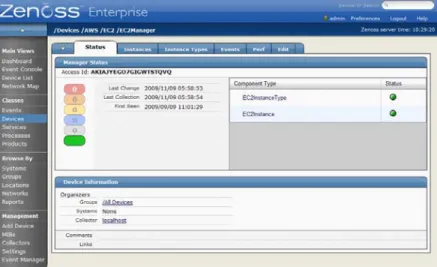
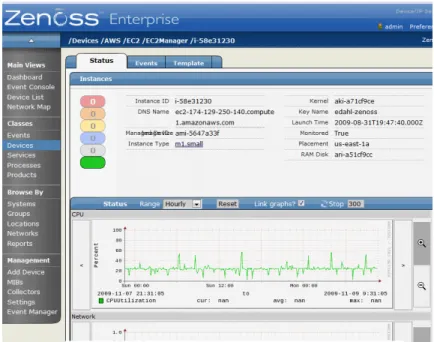
Zenoss provides integrated support for public clouds based on Amazon EC2. Zenoss monitors individual instances and the collective performance of an account. You can navigate from an EC2 account view, to an individual instance, to the guest operating system running within the instance. At the EC2 account level, Zenoss aggregates the total performance, giving you understanding of the total resource provided by the cloud. At the instance level, Zenoss tracks CPU utilization, network traffic in and outbound, and disk read/write by both bytes and operations. You can also examine aggregated performance at the EC2 instance type level.
Zenoss modeling automatically discovers new instances; you won’t need to manually configure Zenoss for each new or removed instance.
With Zenoss, you’ll be able to perform detailed comparisons of the performance of applications running in the cloud and data center, ensuring your enterprise makes the right choices.
Managing the Private Cloud
Integrated support for private clouds is included with Zenoss. Zenoss includes supported monitoring for VMware ESX and Citrix XenServer. The Zenoss Community has contributed additional private cloud support for Microsoft Virtual Server. With Zenoss, you’ll be able to view performance of virtual servers, guests, and guest operating systems in one product. It’s easy to identify whether a virtual server is overloaded by looking at aggregated performance metrics, determine exactly how much resource is being used by an individual guest, or drill deep into a guest operating system to identify the root cause of an issue. The Zenoss model links virtual servers, guests, and guest operating systems automatically so you can shift your viewpoint instantly.
4
Functional Architecture
Discovery and Modeling
For your physical devices, Zenoss automatically discovers and models network-attached devices. For many cloud resources automated discovery is still very effective. However, for certain situations Zenoss uses alternate discovery methods:
• Zenoss automatically detects new guests on virtual hosts. It identifies the link between the guest and the guest OS as part of the discovery and modeling process, saving you configuration time and ensuring accuracy.
• When you model an Amazon EC2 installation, Zenoss identifies each running instance. It identifies the link between Amazon instance and guest OS as well.
For some cloud services automated discovery cannot be performed. For example Amazon EC2 requires a private set of authentication credentials. As another example, to monitor availability and performance of Salesforce.com you’ll need to provide a specific URL to test. With Zenoss, as you create a new cloud device you’ll add the necessary information directly into the Zenoss model, enabling Zenoss to immediately begin monitoring.
Model-driven Management
When Zenoss models a device it collects and stores configuration information in its model. This information drives Zenoss monitoring policy. For example, Zenoss automatically identifies all the file systems on each device so you won’t miss a low disk space event.
The model drives the application of Zenpacks – sets of monitoring templates specific to a device, operating system, or application – to provide precisely relevant monitoring. More than 150 Zenpacks provide a broad range of function, helping you provide immediate support for new applications your users begin using. It’s also easy to extend Zenoss with your own monitoring templates.
Agentless Monitoring
A core architectural tenet behind Zenoss is agentless monitoring. Without agents, it’s easy for Zenoss to deal with dynamically complex cloud and virtualized environments where servers come and go very quickly. There’s no need for you to spend time installing, upgrading, and configuring
agents when a new server instance is brought online. As soon as it discovers each new server, Zenoss begins monitoring it.
Availability Monitoring
For physical devices, Zenoss provides multiple availability tests, including network presence, http, and TCP service monitoring. It creates an event when resources are unavailable and automatically clears the event when availability is restored. These functions can be used directly with cloud resources. A standard report allows you to compare availability of cloud resources, SaaS applications, and physical devices using uniform metrics, making it easy to understand tradeoffs.
Performance Monitoring
Collecting and monitoring performance metrics is a vital tool in both problem detection and capacity management. Zenoss collects and stores performance metrics, analyzes the data for threshold violations, and provides analytical charts and reports.
Zenoss-collected information from cloud servers is identical to information collected from physical servers. You simply work, without needing to understand the underlying differences.
For cloud applications, Zenoss automatically tracks the response time of http transactions. You’ll be able to track user-perceived performance over time to identify issues. Complex multi-step transactions can be recorded and their performance tracked as well.
Identifying problem thresholds can be difficult when you’re tracking user metrics instead of using well-documented operating system thresholds. Zenoss predictive thresholds use statistical analysis to automatically identify situations where values are trending out-of-normal, providing your team with immediate visibility and ensuring the highest levels of productivity.
Event Management
Zenoss provides a single event console bringing together events from all managed devices with Zenoss-generated alerts. Excellent notification and escalation management ensures that the right people become aware of critical problems. Zenoss captures events generated by cloud resources directly into its event management system. Performance thresholds and availability status changes generated by Zenoss are incorporated into the same event console.
Integrated Management
Zenoss monitors physical and cloud resources, devices, networks, and applications from a single console. You can place collections of internal and external resources into a single group, helping you to quickly identify the impact of a failure and determine whether the root cause of an issue is associated with an internal system, an external system, or an external application.
Customer Visibility
Zenoss will help you provide customers visibility into their application’s status and performance. You can give customers a view-only console limited to specific, relevant devices or applications, or mail standard or custom reports on a regular schedule.
The Community Advantage
As an open source product with an active community, Zenoss delivers more than just a product. It delivers the collective wisdom of more than 75,000 users. Our users contribute expertise, techniques, and code while helping guide the future development of the product. Amazon EC2 support was informed by the needs of community members posted in the active forums; Microsoft Virtual Server support was contributed by member tseward.
6
Summary
Zenoss is ready to help you manage dynamic data centers today. It’s one system that monitors real and virtual servers, cloud resources and applications, network devices and applications. With Zenoss you’ll get a unified view of availability, performance, configuration, and events and rapidly identify problem causes.