MODEL SELECTION FOR NONNESTED LINEAR MIXED MODELS
Ch´
e L. Smith
A dissertation submitted to the faculty of the University of North Carolina at Chapel Hill
in partial fulfillment of the requirements for the degree of Doctor of Philosophy in the
Department of Biostatistics in the Gillings School of Global Public Health.
Chapel Hill
2015
Approved by:
Lloyd
J.
Edwards
Peggye
Dilworth-Anderson
Bahjat
Qaqish
Pranab
K.
Sen
c
2015
Ch´
e L. Smith
ABSTRACT
Ch´
e L. Smith: Model Selection for Nonnested Linear Mixed Models
(Under the direction of Lloyd J. Edwards)
To my loving parents:
Patricia Kornegay Smith and Calvin Miles Smith, Jr.;
and to my late grandparents:
Dr. Hobert Kornegay, Jr. & Mrs. Ernestine Price Kornegay,
ACKNOWLEDGMENTS
TABLE OF CONTENTS
LIST
OF
TABLES
.
.
.
.
.
.
.
.
.
.
.
.
.
.
.
.
.
.
.
.
.
.
.
.
.
.
.
.
.
.
.
.
.
.
.
.
x
1
1.1
Introduction
.
.
.
.
.
.
.
.
.
.
.
.
.
.
.
.
.
.
.
.
.
.
.
.
.
.
.
.
.
.
.
.
.
.
.
.
1
0.2
The Linear Mixed Effects Model . . . .
2
1.3
Model
Selection
in
the
Linear
Mixed
Model
(LMM)
.
.
.
.
.
.
.
.
.
.
.
.
.
.
4
1
.3.1
Selecting
among
Nested
Models
.
.
.
.
.
.
.
.
.
.
.
.
.
.
.
.
.
.
.
.
.
7
1
.3.2
Selecting
among
Nonnested
Models
.
.
.
.
.
.
.
.
.
.
.
.
.
.
.
.
.
.
.
8
1
.4
Testing
Separate
Hypotheses
in
the
Linear
Mixed
Model
.
.
.
.
.
.
.
.
.
.
.
11
1
.4.1
The
Cox
Test
of
Separate
Hypotheses
.
.
.
.
.
.
.
.
.
.
.
.
.
.
.
.
.
.
11
1
.4.2
Multivariate
Linear
Regression
.
.
.
.
.
.
.
.
.
.
.
.
.
.
.
.
.
.
.
.
.
.
24
1
.5
Using
Information
Criteria
to
Distinguish
Nonnested
LMMs
.
.
.
.
.
.
.
.
.
28
1
.5.1
Commonly
used
information
criteria
.
.
.
.
.
.
.
.
.
.
.
.
.
.
.
.
.
.
29
1
.5.2
The
Extended
Information
Criterion
(EIC)
.
.
.
.
.
.
.
.
.
.
.
.
.
.
33
1
.6
Summary
.
.
.
.
.
.
.
.
.
.
.
.
.
.
.
.
.
.
.
.
.
.
.
.
.
.
.
.
.
.
.
.
.
.
.
.
.
35
0.7
Introduction
.
.
.
.
.
.
.
.
.
.
.
.
.
.
.
.
.
.
.
.
.
.
.
.
.
.
.
.
.
.
.
.
.
.
.
.
37
0.8
Review
of
Cox
methodology
.
.
.
.
.
.
.
.
.
.
.
.
.
.
.
.
.
.
.
.
.
.
.
.
.
.
.
40
2.3
Formulating
the
Cox
Test
of
Nonnested
Hypotheses
for
LMMs with nonnested fixed effects . . . .
43
2.3
.2
Deriving
T
2,
computing
V
ar(T
2),
and
deriving
the distribution of
T2
. . . .
50
2.4
Application
to
Data
.
.
.
.
.
.
.
.
.
.
.
.
.
.
.
.
.
.
.
.
.
.
.
.
.
.
.
.
.
.
.
.
53
2.4
.1
Comparing
nonnested
fixed
effects
models
in the NC EPESE data . . . .
54
0.10.2 Specification of LMMs with nonnested fixed effects . . . .
55
2.4.3
Results
.
.
.
.
.
.
.
.
.
.
.
.
.
.
.
.
.
.
.
.
.
.
.
.
.
.
.
.
.
.
.
.
.
.
.
56
2.5
Discussion
and
Conclusions
.
.
.
.
.
.
.
.
.
.
.
.
.
.
.
.
.
.
.
.
.
.
.
.
.
.
.
58
3.1
Introduction
.
.
.
.
.
.
.
.
.
.
.
.
.
.
.
.
.
.
.
.
.
.
.
.
.
.
.
.
.
.
.
.
.
.
.
.
60
3.1.1
Common
covariance
structures
in
the
LMM
.
.
.
.
.
.
.
.
.
.
.
.
.
.
62
3.1.2
Selecting
among
nonnested
covariance
structures
.
.
.
.
.
.
.
.
.
.
.
.
65
3.2
Cox
Test
of
Separate
Hypotheses
for
LMMs
with
Nonnested Random Effects . . . .
66
3.2.1
Application
to
Data
.
.
.
.
.
.
.
.
.
.
.
.
.
.
.
.
.
.
.
.
.
.
.
.
.
.
.
71
3.3
Discussion
.
.
.
.
.
.
.
.
.
.
.
.
.
.
.
.
.
.
.
.
.
.
.
.
.
.
.
.
.
.
.
.
.
.
.
.
.
74
4.1
Introduction
.
.
.
.
.
.
.
.
.
.
.
.
.
.
.
.
.
.
.
.
.
.
.
.
.
.
.
.
.
.
.
.
.
.
.
.
75
4.2
Applying
the
EIC
to
nonnested
models
arising
from
repeated
measures
data
.
.
.
.
.
.
.
.
.
.
.
.
.
.
.
.
.
.
.
.
.
.
.
.
.
.
.
.
.
.
76
4.3
EIC
for
Nonnested
Models
from
Sections
2.4.2
and
3.2.1
.
.
.
.
.
.
.
.
.
.
.
79
LIST OF TABLES
1
Cox test Decision Rules
. . . .
42
2
Summary of NC EPESE data . . . .
56
3
Fit statistics for Models 1 and 2 . . . .
57
4
Model Estimates, SEs, and
p-values . . . .
57
5
Estimates of
T
1and
T
2. . . .
58
6
Common LMM covariance structures . . . .
62
7
Model fit statistics . . . .
72
8
Model Estimates, SEs, and
p-values . . . .
73
9
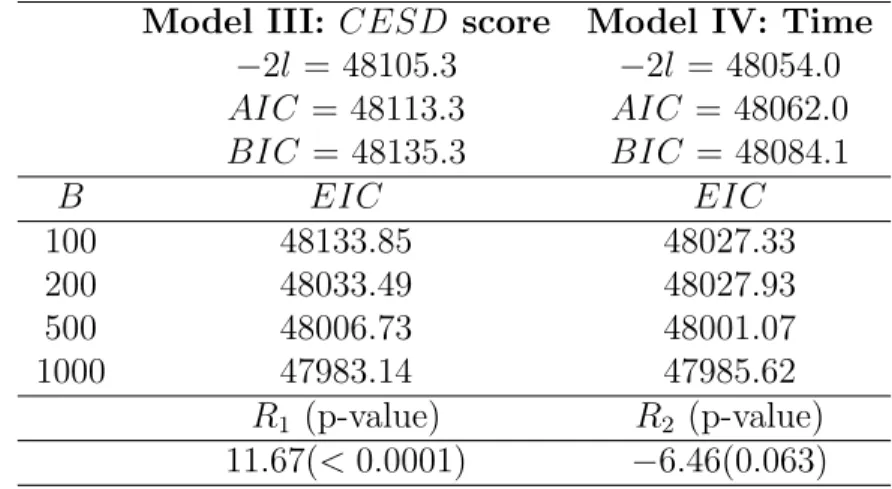
Estimates of
R
1and
R
2. . . .
74
10
EIC
values for models with nonnested fixed effects . . . .
81
CHAPTER 1: INTRODUCTION AND LITERATURE
REVIEW
1.1
Introduction
Selecting an adequate and parsimonious model is an important, yet often neglected,
aspect of data analysis and research. Over the past few decades, the majority of research
in model selection has centered around linear regression and other univariate linear models.
Any work beyond that class of models has involved the extension of existing model selection
methods applied to regression and univariate linear models (e.g., likelihood ratio tests,
R
2coefficient, information criteria) to more complex types of models, with little investigation
of the robustness of these methods after extension. Even more rarely have model selection
techniques for the linear mixed model been thoroughly examined. Here, an attempt to
extend the capability to select among nonnested linear mixed models is made.
of these two components. Well-developed techniques exist for comparing models with nested
mean and/or covariance structures, mostly following from Neyman-Pearson (Neyman and
Pearson, 1933) theory. On the other hand, formal approaches to compare models lacking
this nested structure (or
nonnested
models) have not been developed.
This review highlights important findings from the literature on model selection for the
linear mixed model - with special attention given to the case of nonnested models - and
illuminates some opportunities for methodological improvement.
In the next section, a
detailed specification of the linear mixed model is introduced with specific notation to be
used throughout this document. Subsequent sections review the history of model selection
techniques for univariate linear models, and their extension to multivariate and correlated
data. Special attention is paid to the case of comparing nonnested linear mixed models,
which has received little attention. Specifically, two general approaches to model building
and selection among nonnested linear mixed models are highlighted - hypothesis testing
and the use of information criteria. Particularly for the hypothesis testing approach, ties
are made from the econometrics literature which contains applications of selecting among
nonnested models of a similar structure to linear mixed models. Finally, the most important
findings from the literature review are summarized.
1.2
The
Linear
Mixed
Effects
Model
The Linear Mixed Effects Model (referred to hereafter as the
linear mixed model
) is used
to analyze multivariate continuous data, particularly longitudinal data. Consider the linear
mixed model for repeated measures data specified below (Edwards et al., 2008):
matrix
X
X
X
iis the known and fixed design matrix for person
i, with full column rank
p.
(p
×
1) vector
β
is a vector of unknown, constant population parameters, common to all
subjects. Matrix
Z
Z
Zi, of dimension (ni
×
q), is a known, constant design matrix with rank
q
for person
i
corresponding to the (q
×
1) vector of unknown random effects,
b
i, while
e
iis an
(n
i×
1) vector of unknown random errors. Random effects are assumed to be independent
of random errors, and together they are assumed to follow a normal distribution with mean
0
and variance
V
b
ie
i
=
Σ
bi(τ
b)
0
0
Σ
ei(τ
e)
.
In the equation above,
V
(·) is the covariance operator, while both
Σ
bi(τ
b) and
Σ
ei(τ
e)
are positive-definite, symmetric covariance matrices. Therefore,
V
(y
y
yi) may be expressed as
Σ
i=
Z
Z
Z
iΣ
bi(τb)
Z
Z
Z
0i
+
Σ
ei(τe). We assume that
Σ
ican be characterized by a finite set of
parameters represented by an (r
×
1) vector
τ
, which consists of the unique parameters in
τ
band
τ
e.
For simplicity, we will assume here that all subjects have the same number of repeated
measurements, so that
n
i=
n
for all subjects, such that
e
i∼
N
n(
0
,
Σ
e(τ
e)), where the
(n
×
1) vector
τ
ecollects the
n
unique parameters of
Σ
e(τ
e).
Alternatively, we may specify the linear mixed model for all subjects in a stacked
formu-lation as follows:
y
y
y
=
X
X
Xβ
+Z
Z
Z
b
+
e
where
y
y
y
= (y
y
y
01. . . y
y
y
0N)
0; design mnatrix
X
X
X
= (X
X
X
01. . . X
X
X
0N)
0;
vector
β
is as specified before;
Z
Z
Z
=
diag
(Z
Z
Z
1, . . . , Z
Z
Z
N); vector
b
is as specified before; and
e
= (
e
01. . .
e
0N)
0.
Note the dimensions of
y
y
y, X
X
X, Z
Z
Z, and
e
are (N n
×
1), (N n
×
p), (N n
×
q), and (N n
×
1),
respectively. Further,
b
∼ N
q(
0
,
Σ
bi(τ
b)
⊗
I
b) and
e
∼ N
Nn(
0
,
Σ
e). We have
Σ
e=
diag
[
Σ
e1(τ
e)
, . . . ,
Σ
eN(τ
e)]; thus
y
y
y
∼ N
(X
X
Xβ,
Σ
) with
Σ
=
V
(y
y) =
y
diag
(
Σ
1, . . . ,
Σ
N).
collection of its complete parameter space
θ, where
θ
= (β
0,
τ
0)
0is a (s
×
1) vector, with
s
=
p
+
r.
1
.
3
Model
Selection
in
the
Linear
Mixed
Model
(LMM)
The selection of an adequate model among suitable candidate models is an essential part
of the model-building process and has been widely studied for the univariate linear model and
other types of models arising from cross-sectional data. Most commonly for linear regression
models, researchers employ forward, backward, and stepwise variable selection procedures.
Ngo and Brand (2002) discussed how the extension of these procedures to the linear mixed
model introduces problems of multiple testing, further complicated by the use of an arbitrary
level of significance. Some methods are ad hoc, and have not been well developed or studied.
This is especially true for the linear mixed model, which requires selection of both a mean
model and a covariance model.
1. Specify the maximum model to be considered (both in fixed and random effects).
2. Specify a criterion of goodness of fit of a given model.
3. Specify a predictor selection strategy.
4. Conduct the analysis.
5. Evaluate the reliability of the model chosen.
Cheng et al. emphasize that these steps are also appropriate for building univariate,
mul-tivariate, linear, and nonlinear models, along with models for any type of response variable
distribution. Their discussion also follows the assumption that the ’best’ model is contained,
or
nested
, within a maximum model. Of particular interest here is the third item in the above
list. It is important to predetermine a strategy that will lead to fitting a select few models
with as few predictors as necessary to characterize the outcome variable(s). In most cases,
the maximal model rarely ends up being the final model. Ideally, one would implement a
well-planned strategy to select a small number of predictors based on the size of the data
and knowledge of the subject area. For linear regression, it is straightforward to employ
techniques such as forward, backward, or stepwise variable selection. Model selection for the
linear mixed model, however, is more complex and requires attention to its two models - the
mean structure, and selection of random effects and variance components (Liu and Yang,
2008). In the linear mixed model, it is common to keep one aspect of the model fixed in
both models, while using techniques to refine the other model. For example, one may assign
a common covariance matrix to both models and compare models with different sets of fixed
effects.
and different covariance structures. These categories may be expanded to more specifically
outline the types of linear mixed models that may be compared. One may compare:
1) Nested mean models with:
a. the same covariance structure;
b. different (but nested) covariance structures; or
c. nonnested covariance structures, or
2) Nonnested mean models with:
a. the same covariance structure;
b. different (but nested) covariance structures; or
c. nonnested covariance structures.
The first case listed above - comparing nested mean models - is most commonly considered
(Diggle et al., 1994; Wolfinger et al., 1993). Selection of a favored model is largely based
on extensions of techniques used for univariate linear models, such as likelihood ratio tests,
goodness of fit measures, predictive criteria (R
2,
P RESS, etc.), and information criteria
(AIC,
BIC, etc.). Existing techniques rely on theories developed by Neyman and Pearson
(1933) or Kullback and Leibler (1951). theory. Virtually all recent reviews of variable/model
selection in the linear mixed model only consider cases of mean models that are nested (Wang
and Schaalje, 2009; Dziak and Li, 2007; Dimova et al., 2011). Here, models are considered
1.3.1
Selecting
among
Nested
Models
The vast majority of model selection techniques were developed to make comparisons
between pairs of models that follow a nested structure. Models are considered nested when
one model can be obtained by imposing a set of linear constraints on another more general
model. In terms of the linear mixed model, one may consider models with nested fixed
and/or random effects. Models with nested fixed effects are typically compared under
maxi-mum likelihood estimation using likelihood ratio tests,
t
tests, or
F
tests. Models with nested
covariance structures are compared under restricted maximum likelihood (REML)
estima-tion using
χ
2tests. Wang and Schaalje (2009) reviewed several model selection techniques
involving predictive criteria that were originally designed for selecting among ordinary linear
models. The authors summarize the history of the adjusted
R-squared
R
adj21.3.2
Selecting
among
Nonnested
Models
The second case, where models are nonnested, is seldom addressed. There are varied
scenarios in which candidate models could be considered nonnested. One may consider
comparing models with
nonnested sets of explanatory variables
, where non-linear restrictions
to parameter vectors from both models are required to establish a nested structure between
competing models. Most commonly seen is the case of alternative, positively correlated,
measures of the same concept in nonnested parametric form, where both of which are assumed
to influence some outcome (Cole et al., 2005). For example, Dameus et al. (2002) compared
models with rival econometric theories to expain the same phenomenon. Additionally, one
could compare models with the partially overlapping sets of main effects and with nonested
interactions among explanatory variables. Another manifestation of nonnested models of this
type occurs in models having additive vs. multiplicative interactions; that is, testing absolute
(additive) risk difference vs relative (multipicative) risk (Kalilani and Atashili, 2006). One
may also compare models with
nonnested functional forms
; an example of this case is the
comparison of linear vs. log-linear functions of a continuous outcome variable. One would use
a linear mixed model under the assumption of a Normal distribution for the first function, and
a gamma link for the nonlinear model under the assumption of a non-Normal distribution.
One could also use a generalized estimating equations (GEE) approach in both, but this case
is not explored here.
the
R
2statistic is most commonly used to compare nonnested models, though traditionally it
is a goodness-of-fit statistic. Edwards et al. (2008) developed an extension of this technique
to the linear mixed model to determine an association between repeated measurements and
fixed effects. Watnik and Johnson (2002) discuss using a relative efficiency approach to
com-pare nonnested linear regression models and considers globally non-nested models, in which
neither design matrix is a subset of the other. Timm et al. (2002) compared nonnested
models arising from a meta-analysis of six studies investigating the effect of academic
coach-ing on students’ SAT scores. They use a modified Wald test statistic developed in a prior
investigation (Timm et al., 2001) which was shown to be more powerful than the hypothesis
test developed by Cox (1961). The authors do not consider repeated measures data, but they
acknowledge that the use of an information-theoretic approach (using information criteria)
as a suitable alternative to their methodology. That approach is considered here as well, and
discussed in more detail in a later section.
magnitude of difference between models.
Other notable investigations of comparing nonnested models include Ette (1996), who
compared nonnested (or non-hierarchical) nonlinear mixed models arising from longtiduinal
observations of pharmacokinetic data; particularly, he compared models with the same
co-variates, but one having a different parametric form in each model; the two candidate models
were thus highly correlated, but not nested by earlier definitions. Ette bootstrapped the
log-likelihood difference betweeen candidate models. His investigation illuminates the need
for more research related to bootstrapping correlated data and comparing nonnested models
arising from longitudinal data. Haskard et al. (2010) discussed ways to compare linear mixed
models with nonnested - or
non-stationary
random effects, and used the
AIC
to compare
models. These data were not repeated observations, but rather each vector of observations
contained soil samples from nearby locations so that clusters of observations were correlated
spatially. In another example using linear mixed models, Morrell et al. (2009) describe
how changes in parameterization of time-dependent covariates (mainly, subject’s age) can
influence results of longitudinal models. The authors compared models with nonnested fixed
and random effects, using the
AIC
and
BIC
as selection criteria, noting that models with
nonnested fixed effects cannot be compared using these criteria under REML estimation.
1.4
Testing
Separate
Hypotheses
in
the
Linear
Mixed
Model
While recent literature has given much attention to model selection for nonnested
regres-sion models and econometrics models, the case of selecting among nonnested linear mixed
models remains severely underexplored. Seminal works of Cox beginning in 1961 and 1962
highlight tests of
separate
families of hypotheses, meaning that one hypothesis (or model)
cannot be obtained as a simple limit of the other; before his works, ad hoc methods were
em-ployed to test separate hypotheses. Since then, Pesaran (1974), Pesaran and Deaton (1978)
and several others have also studied this methodology extensively. Parallel approaches have
also been developed, employing theories such as the encompassing approach Mizon and
Richard (1986), including the J-test (Davidson and MacKinnon, 1993) and Vuong’s Test
(Vuong, 1989). One major disadvantage of these approaches is that the assumption of an
all-encompassing model can become tedious for the linear mixed model, since one must
consider both the mean model and covariance structure. Here, we describe Cox’s Test of
Separate Hypotheses in more detail, providing examples of its implementation, and
outlin-ing some considerations for applyoutlin-ing this approach to compare separate, or nonnested, linear
mixed models.
1.4.1
The
Cox
Test
of
Separate
Hypotheses
are considered separate due to the definitions of the hypotheses. Conventional techniques
for comparing nested models, such as Wald’s
F
test, do not apply for the comparisons of
nonnested models, as they require restrictions on the models’ parameter spaces that do not
exist, thus making it more difficult to estimate the distribution of the ratio of likelihood
functions. Cox recognized the need to make modifications to recenter the likelihood ratio
and standardize a test statistic with an asymptotically normal distribution. Pesaran and
Weeks (2000) provide a good summary of the motivation behind Cox’s formulation. The
literature following Cox’s two papers has been extensive, but few well-developed techniques
and extensions have been studied or recommended, especially for the linear mixed model.
In the following section, Cox’s methodology is defined and described in more detail.
Notation and Setup
Let
y
y
y
= (y
1, y
2, . . . y
m) be an (m
×
1) observed random vector and suppose we are
in-terested in testing the composite null hypothesis,
H
1, that the probability density function
(pdf) is
f
(y
y
y,
θ
1) against the composite alternative,
H
2, that the pdf is
g
(y
y
y,
θ
2), where
θ
1and
θ
2are vectors of dimension (k
1×
1) and (k
2×
1), respectively. That is
H
1:
f
(y
y
y,
θ
1)
H2
:
g(y
y
y,
θ2)
where
θ
1∈
Ω
1⊂
R
k1×1and
θ
2∈
Ω
2⊂
R
k2×1, where
k
1, k
2>
1. Note the following
assumptions:
(i) the parameters
θ
1and
θ
2may be treated as varying continuously even when a
compo-nent of say
θ2
is the serial number of the observation at which a discontinuity occurs;
(ii) the values of
θ
1, or
θ
2, are interior to Ω
1, or Ω
2, so that the type of distribution problem
Let
l
1( ˆ
θ
1) be the maximized log-likelihood function of the model proposed under
H
1and
l
2( ˆ
θ
2) be the maximized log-likelihood function under
H
2, where ˆ
θ
1and ˆ
θ
2are the
maximum likelihood estimates of
θ1
and
θ2, respectively. Cox proposed using the following
test statistic:
T
1=
l
1( ˆ
θ
1)
−
l
2( ˆ
θ
2)
−
E
h
l
1( ˆ
θ
1)
−
l
2( ˆ
θ
2)
i
θ1= ˆθ1
,
(1)
which compares the observed difference of log-likelihoods with an estimate of the
ex-pected difference between log-likelihoods, with expectation taken under
H
1. In the expected
difference
θ
1is replaced with its maximum likelihood estimate, ˆ
θ
1, under
H
1; other unknown
paramters are also replaced with estimates under the null. Under the null hypothesis, Cox
(1961; 1962) showed the value of
T
1should be nearly zero, while under
H
2,
T
1is presumed to
be negative. Thus, a large negative value of
T1
leads to the rejection of the null hypothesis,
H
1.
Alternatively, a simplified specification of
T
1is given by
T
1= ˆ
l
12−
E
h
ˆ
l
12i
θ1= ˆθ1
where ˆ
l
12=
l
1ˆ
θ
1−
l
2ˆ
θ
2Furthermore, a different specification of
T
1is given by
T
1= ˆ
l
12−
N
plim
N→∞ˆ
l
12N
!
θ1= ˆθ1
.
Replacing the expectation in the second term with a probability limit (plim) allows for
more flexibility when working with complex expressions, especially those involving products
and quotients of random variables. (Dougherty, 2011;
Appendix A
)
A few general remarks are in order (White, 1982):
assump-tion of separate families, this inequality - representative of the models having nested
structures - may not hold.
(ii) When the components of
y
y
y
are independent,
l12
is the sum of
n
independent terms and
an application of the central limit theorem will usually prove the asymptotic normality
of
l
12. Approximations to the percentage points of
l
12can then be obtained under both
H
1and
H
2.
(iii) The hypotheses
H
1and
H
2are considered asymmetrically, and are not assumed to be
the only possible hypotheses.
(iv) The roles of
H1
and
H2
can be interchanged, yielding corresponding test statistic
T2,
where
T
2=
l
2( ˆ
θ
2)
−
l
1( ˆ
θ
1)
−
E
h
l
2( ˆ
θ
2)
−
l
1( ˆ
θ
1)
i
θ2= ˆθ2
.
(2)
Here, expectation is taken under the new null,
H
2, and
θ
2is replaced by its maximum
likelihood estimate under
H
2, ˆ
θ
2, while all other unknown parameters are replaced by
their estimates under
H
2.
In order to make inferences using
T
1and/or
T
2, one must derive the distribution of these
statistics. Cox established that both test statistics have a limiting distribution that is Normal
with mean 0 and Cox denoted the variances of
T1
and
T2,
V ar(T1) and
V ar(T2), respectively,
by:
V ar(T
1) =
V
1(l
12)
−
G
01I
−1
1
G
1and
V ar(T
2) =
V
2(l
21)
−
G
02I
−12
G
2, where
V
1(l
12) is the
variance of the log-likelihood ratio taken under the null hypothesis, and
V
2(l
21) is defined
correspondingly for the case where the null and alternative hypotheses are interchanged,
G
1=
N
∂
∂θ
1plim
N→∞ˆ
l
12N
G
2=
N
∂
∂θ
2and
I
1and
I
2are the information matrices corresponding to
θ
1and
θ
2, respectively.
Thus, for any pair of hypotheses, two tests may be constructed.
In the following sections, we derive
T1
and
T2
and their corresponding distributions for a
pair of linear mixed models with nonnested fixed effects.
Coulibaly and Brorsen (1999) first proposed using a parametric bootstrap to estimate
the distribution of test statistics under the corresponding null hypothesis, showing that this
technique helped achieve correct test size and higher power, especially in small samples.
Dameus et al. (2002), Monfardini (2003), and Godfrey (2007) also establish a need for
bootstrapping the distributions of statistics for comparing various types of models applied
to econometrics analyses. Huber (1967) discusses the behavior of maximum likelihood
es-timates under nonstandard conditions, but not much of the literature following Cox’s work
adequately addresses the distribution of test statistics and their limitations under different
variance estimates.
Definition of Separate Families
The hypotheses,
H
1and
H
2, are separate in the sense that an arbitrary simple hypothesis
H1
cannot be obtained as a simple limit hypothesis in
H2. That is,
f
(y, θ1) and
g(y, θ2)
represent separate families in that an arbitrary value of
θ
1cannot be approximated arbitrarily
closely by
g(y, θ
2).
Existing examples
In his seminal works, Cox presented several scenarios in which one could apply his
method; selected examples are described below.
Lognormal vs. Exponential
In this example, the null hypothesis assumes a model
fol-lowing a lognormal distribution; that is,
f
(y) =
1y √
2πσ2
e
(lny−µ)22σ2
. The alternative
T
1=
n
log
ˆ ββˆα
, where
β
αˆ=
e
ˆ α1+α2
2
, and
V ar(T
1) =
n e
α2ˆ−
1
−
α
ˆ
2−
1 2α
ˆ
2 2
. Not shown here
or in other examples, it is trivial to derive the statistic
T
2which assumes
g(y) is the null
hypothesis,
f(y) as the alternative, along with an expression for its variance.
Alternative
forms of independent variables
Consider comparing the following sets of models
y
=
aα
y
=
bβ
or
y
=
α
1+
α
2x
y
=
β
1+
β
2log
x
Cox (1961) explained that the two pairs of models above are from a problem considered
by Hotelling (1940), and expounded upon in Williams (1959); Cox demonstrated the need
for more theoretical exploration for nonnested models of this type.
Alternative forms of the dependent variable
E
(log
y) =
aα
E
(y) =
aβ
Poisson vs. Geometric distributions
f
Y(y) =
e
−αα
yy!
(y
= 0,
1,
2, . . .) ;
g
Y(y) =
β
y(1 +
β)
y+1(y
= 0,
1,
2, . . .)
Cox (1962) explained that this example, demonstrating the comparison of exact versus
asymptotic statistical theory, results in a test statistic
T
1=
−Σ log
Y
i! +
nl
fY
¯
, where
l
f(·)
is the log-likelihood function of
fY
(y), which assumes the model
fY
(y) is the null hypothesis
and
g
Y(y) is the alternative.
Demand analysis models with nonnested functional forms
Dameus et al. (2002) explored comparisons of nonnested demand analysis models (US meat
demand), and showed that using a Cox test with a parametric bootstrap was more powerful
than using encompassing tests. The authors compared the following two demand analysis
models.
First-difference AIDS model:
∆s
i=
τ
i+
4X
k=1
θ
ikD
k+
4X
j=1
γ
ij∆ ln (p
j) +
β
i[∆ ln (x)
−
∆ ln (P
)]
,
i
= 1, . . . ,
4
Rotterdam model:
¯
s
i∆ ln (y
i) =
τ
i+
4X
k=1
θ
ikD
k+
4X
j=1
γ
ij∆ ln (p
j) +
β
i"
∆ ln (x)
−
4X
j=1
¯
s
j∆ ln (p
j)
#
Multinomial Probit vs. Multinomial Logit Model
Multinomial probit model:
u
pij= x
0iα
j+
ν
ij(ν
i) = (ν
i1, . . . , ν
iJ−1)
0≈
i.i.d.N
(0,
Σ)
, j
= 1, . . . , J
−
1,
Multinomial logit model:
u
lij= x
0iδj
+
ηij
(ηi) = (ηi1, . . . , ηiJ−1)
0≈
i.i.d.Logistic
(0,
Λ)
, j
= 1, . . . , J
−
1,
To date, this methodology has not been extended to the case of comparing linear mixed
models with nonnested fixed and/or random effects. The last two of the extensions outlined
below (Pesaran (1974) and Araujo et al. (2005)) provide the most adequate framework for
developing test statistics for nonnested linear mixed models. We consider these extensions
in more detail in the sections below.
Univariate Linear Regression
Pesaran (1974) derived test statistics to compare two univariate linear regression models
with nonnested fixed effects. This section summarizes the formulation. Suppose there are
data for
N
independent subjects; consider the following hypotheses:
H
1:
y
y
y
=
X
X
Xβ
1+
eee
1;
eee
1∼ N
(
0
, σ
12I
N)
H2
:
y
y
y
=
W
W
W
β2
+
eee2;
eee2
∼ N
(
0
, σ
22I
N).
design matrix
W
W
W
and random errors also distributed normally with mean
0
and variance
σ
22I
N, with
I
Ndefined as before. Furthermore, assume that
X
X
X
and
W
W
W
are not nested; that
is, all of columns of
X
X
X
cannot be obtained from those of
W
W
W
and vice versa. For simplicity,
we assume that
X
X
X
and
W
W
W
have the same dimensions. Recall from the discussion of Levy
and Hancock (2007) that most often considered is the case of partially overlapping models,
where there may be some variables in common between the models but neither design matrix
is a subset of the other. We denote the collections of unknown parameters of each model
as
θ
1= (β
10, σ
12)
0
and
θ
2= (β
20, σ
22)
0, both vectors having dimension (p
+ 1
×
1). Pesaran
required that the following three limits exist and are finite.
lim
N→∞1
N
X
X
X
0
X
X
X
=
Σ
X0Xlim
N→∞
1
N
W
W
W
0
W
W
W
=
Σ
W0Wlim
N→∞
1
N
X
X
X
0
W
W
W
=
Σ
X0Wwhere the matrices
Σ
X0Xand
Σ
W0Ware nonsingular and
Σ
X0W6=
0
. All matrices are of
dimension (N
×
N
).
Formulation of expressions for
T1
and
V ar(T1)
First, the log-likelihood functions corresponding respectively to the linear models given
in hypotheses
H
1and
H
2are defined below:
l
1(θ
1) =
−
N
2
log (2πσ
12
)
−
1
2σ
12(y
y
y
−
X
X
Xβ
1)
0(y
y
y
−
X
X
Xβ
1)
l2
(θ2) =
−
N
2
log (2πσ2
2)
−
1
2σ
22(y
y
y
−
W
W
W
β2)
0(y
y
y
−
W
W
W
β2)
,
and the maximum log-likelihood ratio (or difference in log-likelihood functions) by ˆ
l
12=
l
1ˆ
θ
1−
l
2ˆ
θ
2, recall the formula for
T
1given by:
T
1= ˆ
l
12−
N
h
plim
N→∞ˆ
l
12/N
i
θ= ˆθ1
,
with
plim
taken under the assumption of
H
1. The maximum likelihood estimates of
θ
1and
θ
2, given by ˆ
θ
1and ˆ
θ
2, respectively, are defined as follows.
First, ˆ
θ
10=
ˆ
β
10,
σ
ˆ
12, where
ˆ
β
1= (X
X
X
0X
X
X)
−1X
X
X
0y
y
y,
ˆ
σ
12=
y
y
y
0(I
N
−
M
X)
y
y
y
N
.
(N
×
N
) matrix
I
Nis defined as before, and (N
×
N) matrix
M
Xis given by
M
X=
X
X
X
(X
X
X
0X
X
X)
−1X
X
X
0.
Next, ˆ
θ2
=
ˆ
β2
,
σ
ˆ
22, where
ˆ
β
2= (W
W
W
0W
W
W
)
−1W
W
W
0y
y
y,
ˆ
σ
22=
y
y
y
0(
I
N
−
M
WWW)
y
y
y
N
.
Here, (N
×
N
) matrix is defined by
M
W=
W
W
W
(W
W
W
0W
W
W
)
−1W
W
W
0.
Now,
l
12=
N
2
log (σ
2 2/σ
12
) +
1
2
σ
2−2(y
y
y
−
W
W
W
β
2)
0(y
y
y
−
W
W
W
β
2)
−
σ
1−2(y
y
y
−
X
X
Xβ
1)
0(y
y
y
−
X
X
Xβ
1)
.
likelihood estimates as defined above.
ˆ
l
12=
N
2
log (ˆ
σ
2 2
/ˆ
σ
2 1
) +
1
2
ˆ
σ
2−2y
y
y
−
W
W
W
β
ˆ
2 0y
y
y
−
W
W
W
β
ˆ
2−
σ
ˆ
−21y
y
y
−
X
X
X
β
ˆ
1 0y
y
y
−
X
X
X
β
ˆ
1=
N
2
log (ˆ
σ
2 2
/ˆ
σ
2 1
) +
1
2
(y
y
y
0(
I
−
M
W)
y
y
y)
−1
y
y
y
−
W
W
W
β
ˆ
2 0y
y
y
−
W
W
W
β
ˆ
2−
(y
y
y
0(
I
−
M
X)
y
y
y)
−1
y
y
y
−
X
X
X
β
ˆ
1 0y
y
y
−
X
X
X
β
ˆ
1=
N
2
log (ˆ
σ
2 2
/ˆ
σ
2 1
) +
1
2
(y
y
y
0(
I
−
M
W)
y
y
y)
−1(y
y
y
0(
I
−
M
W)
y
y
y)
−
(y
y
y
0(
I
−
M
X)
y
y
y)
−1
(y
y
y
0(
I
−
M
X)
y
y
y)
=
N
2
log
ˆ
σ
22ˆ
σ
21
Determining the second term of
T
1requires finding the probability limit (plim) of ˆ
l
12under the assumption that the null hypothesis is the true model. First, by definition, we
know that plim
N→∞(ˆ
σ
21
) =
σ
12. Assuming
H
1is the true model, Pesaran (1974) determined
the expected value of ˆ
σ
22
, denoted by ˆ
σ
212as follows.
ˆ
σ
212=
1
N
(MW
e1
+
MW
X
X
Xβ1)
0(MW
e1
+
MWX
X
Xβ1)
Now taking the probability limit of the above quantity, we have
plim
N→∞ˆ
σ
221=
σ
21+
β
10lim
N→∞1
N
X
X
X
0
M
WX
X
X
β
1We also have
σ
212=
σ
12+
β
10Hβ
1H
=
Σ
X0X−
Σ
X0WΣ
−1W0W
Σ
W0XNow, since under
H
1σ
ˆ
12is a consistent estimator of
σ
12, using the above results
N
plim
N→∞ˆ
l
21N
!
=
N
2
log
σ
21
+
β
0 1
Hβ
1σ
21
Combining the two terms, Pesaran (1974) gave an expression for
T
1as follows:
T
1=
N
2
log
ˆ
σ
2 2ˆ
σ
2 1−
N
2
log
ˆ
σ
21
+ ˆ
β
0 1H
β
ˆ
1ˆ
σ
2 1!
(3)
=
N
2
log
ˆ
σ
2 2ˆ
σ
21
+ ˆ
β
10H
β
ˆ
1!
(4)
Distribution of
T1
Pesaran (1974) noted that the distribution of
T
1depends on unknown parameters, since
replacing ˆ
σ
21
and ˆ
σ
22with expressions of their estimates listed above produces a complicated
function of the unknown vector
β
1. As a result, the exact distribution of
T
1cannot be
derived. The only way to eliminate the dependence on unknown parameters is to compare
models that are nested, such that
M
WX
X
X
=
0
, which is the case for which a hypothesis test
is well-defined.
To obtain an asymptotic variance of
T1, denoted by
V ar
d
(T1), we must derive the two
terms according to the formula defined in equation 8.
Pesaran defined the first term as follows:
ˆ
V
ˆ
l
12=
N
2
1
σ
2 21−
1
σ
2 1 2σ
14+
σ
2 1σ
4 21(X
X
Xβ
1−
W
W
W
β
21)
0The second term is given by:
1
N
G
0
1
plim
N→∞N I
−1G
1=
N
σ
4 21σ
21β
10H
Σ
−1X0XHβ
1+
1
2
(β
0 1
Hβ
1)
2
Combining the two terms and replacing all unknown parameters with their consistent
estimates (under
H
1), Pesaran’s estimate of
V ar(T
d
1) is given by
d
V ar(T1) =
σ
ˆ
2 1ˆ
σ
421
ˆ
β
01X
X
X
0MW
MX
MW
X
X
X
β1
ˆ
Finally, when
H1
is true, we have that
T1[
V ar(T1)d]
1/2
approx
N
(0,
1)
Expressions for
T
2and
V ar(T
2)
When two models are nested, then the choice of a null hypothesis is fairly intuitive;
one typically sets the most parsimonious (or
reduced
) model as the null hypothesis. When
models are not nested, one must consider that either candidate model can be set as the null
hypothesis. In order to implement Cox’s test of separate hypotheses, one must consider the
case that the second model is the true model. Thus, in this case, one can interchange the
models given in each hypothesis and formulate test statistic
T
2and its variance given by
V ar
(T
2).
H1
:
y
y
y
=
W
W
W
β2
+
eee2
;
eee2
∼ N
0
, σ
22I
NH
2:
y
y
y
=
X
X
Xβ
1+
eee
1;
eee
1∼ N
0
, σ
12I
NRecall the expression for
T
2given by:
T
2= ˆ
l
21ˆ
θ
2,
θ
ˆ
1−
N
h
plim
N→∞ˆ
l
21/N
i
θ= ˆθ2
,
where ˆ
l
21=
l
1ˆ
θ
2−
l
2ˆ
θ
1.
Following similarly to the formulation of
T
1, it can be shown that an expression for
T
2is
given by
T2
=
N
2
log
σ
2 1σ
21
+
β
0 2
Hβ
˜
2,
where ˜
H
=
Σ
W0W−
Σ
W0XΣ
−1X0X
Σ
X0Wwith
Σ
W0W,
Σ
W0X, and
Σ
X0Xdefined as before.
Also following similarly from previous sections, an asymptotic expression for
V ar(T
2) is
given by
d
V ar(T
2) =
σ
22
σ
4 12ˆ
β
02W
0M
XM
WM
XW
β
ˆ
2Finally, it is also true that
T2 dV ar(T2)1/2
approx
∼ N
(0,
1).
1.4.2
Multivariate
Linear
Regression
Another extension of Cox’s methodology for comparing nonnested models was introduced
by Araujo et al.
(2005).
Following from the previous example by Pesaran (1974) and
subsequent works involving the same author, the authors developed test statistics to compare
nonnested multivariate regression models. Consider the following set of hypotheses:
H
1:
Y
Y
Y
=
X
X
X
B
1+
E
E
E
1H
2:
Y
Y
Y
=
W
W
W
B
2+
E
E
E
2B
1and
B
2are, respectively,
p
×
k
and
q
×
k
matrices of parameters. Matrices
E
E
E
1and
E
E
E
2are
N
×
k
matrices whose rows are independent and identically distributed normal random
vectors with means equal to zero and
N
×
N
covariance matrices
Σ
1and
Σ
2, respectively.
So, it follows that
E1
E
E1
1∼ N
(
0
,
I
N⊗
Σ
1) and
E
E2
E2
2∼ N
(
0
,
I
N⊗
Σ
2), and that
Y
Y
Y
∼
N
(X
X
X
B
1,
I
N⊗
Σ
1) under
H
1and
Y
Y
Y
∼ N
(W
W
W
B
2,
I
N⊗
Σ
2) under
H
2. That is,
Y
Y
Y , E
E
E
1, E
E
E
2follow multivariate Normal distributions.
The models represented in each hypothesis are nonnested in that one cannot obtain the
columns of
X
X
X
from the columns of
W
W
W
, and vice versa. As in Pesaran’s example, further
assumptions to justify the models being nonnested include the following:
lim
N→∞1
N
X
X
X
0
X
X
X
≡
Σ
X0Xlim
N→∞1
N
W
W
W
0
W
W
W
≡
Σ
W0Wlim
N→∞1
N
X
X
X
0
W
W
W
≡
Σ
X0W.
Further, it is assumed that
Σ
X0Xand
Σ
W0Ware nonsingular, and that
Σ
X0Wis a non-zero
matrix.
We may collect the unknown parameters from each model into ((pk
+
N k)
×
1) vectors
θ
1= (vec
B
1, vec
Σ
1)
0
and
θ
2= (vec
B
2, vec
Σ
2)
0corresponding respectively to the models
given in
H
1and
H
2.
Note that the log-likelihood functions corresponding respectively to the two nonnested
models under consideration are given by
l1
(θ1) =
−
N
2
log
Σ
−11−
kN
2
log (2π)
−
1
2
tr
(Y
Y
Y
−
X
X
X
B
1)
0(Y
Y
Y
−
X
X
X
B
1)
Σ
−11l
2(θ
2) =
−
N
2
log
Σ
−12−
kN
2
log (2π)
−
1
2
tr
(Y
Y
Y
−
W
W
W
B
2)
0Formulation of Expressions for
T
1and
V ar(T
1) To compute an expression for
T
1,
as defined in equation 7, Araujo et al. first define ˆ
l
12=
N2log
ˆ
Σ
2−
log
ˆ
Σ
1, where
ˆ
Σ
1=
N1E
E
E
ˆ
01
E
E
E1
ˆ
and ˆ
Σ
2=
N1E
E
E
ˆ
02
E
E
E2. Under
ˆ
H1, ˆ
E
E
E1
=
MXE
E
E1
and ˆ
E
E
E2
=
M
WE
E
E
1+
M
WX
X
X
B
1,
where
M
X=
I
N−
X
X
X
(X
X
X
0X
X
X)
−1
X
X
X
0and
M
W=
I
N−
W
W
W
(W
W
W
0W
W
W
)
−1W
W
W
0.
So it follows that,
ˆ
Σ
2=
1
N
ˆ
E
E
E
02E
E
E
ˆ
2=
1
N
(
M
WE
E
E
1+
M
WX
X
X
B
1)
0(
M
WE
E
E
1+
M
WX
X
X
B
1)
=
1
N
(E
E
E
01
M
WE
E
E
1+
B
01X
X
X
0M
WE
E
E
1+
E
E
E
01M
WX
X
X
B
1+
B
01X
X
X
0M
WXB
1)
.
Now, under
H
1, the expectation of ˆ
Σ
2is given by
Σ
21=
E
ˆ
Σ
2H1
=
Σ
1+
B
0 1ΣB
¯
1,
where ¯
Σ
=
Σ
X0X−
Σ
X0WΣ
−1W0W