DEVELOPMENT AND EVALUATION OF A SMARTPHONE APPLICATION TO PROMOTE EARLY CHILDHOOD ORAL HEALTH EDUCATION
Amanda Ashley Allen
A thesis submitted to the faculty at the University of North Carolina at Chapel Hill in partial fulfillment of the requirements for the degree of Master of Science in Dentistry in the UNC
Adams School of Dentistry (Pediatric Dentistry).
Chapel Hill 2020
Approved by:
Rocio B. Quiñonez
J. Timothy Wright
Sigurdur R. Saemundsson
© 2020
ABSTRACT
Amanda Ashley Allen: Development and Evaluation of a Smartphone Application to Promote Early Childhood Oral Health Education
(Under the direction of Rocio Quiñonez)
Educational technologies offer opportunities to enhance learning and outcomes in
pediatric dental education. This project aimed to develop an instructional smartphone
application (app) and determine its acceptability and effectiveness for early childhood oral health
education.
App design followed established processes. Participants for evaluation were 64
third-year dental students, randomly allocated to two groups, with assessment at two time points.
Level of significance set at p<0.05.
In all examined learning outcome domains, substantial improvements were evident in the
app group, whereas positive changes of smaller magnitude were found in the control group.
Gains in certain constructs (knowledge acquisition, comfort, and clinical reasoning) were
significantly higher in the app versus the control group. Most students commented favorably on
smartphone app utility and functionality.
Dental students perceived smartphone app-based education positively. Its educational
benefits with regards to knowledge acquisition, comfort, and clinical reasoning are superior
To my husband, Mike,
our children, and the entire Allen family for their patience and support, encouragement,
ACKNOWLEDGEMENTS
This project would not have been possible without my research advisor, Dr. Rocio B.
Quiñonez. Thank you for showing me what dedication, passion and creativity look like - working
with you has been a joy!
I would also like to thank my thesis committee members, Dr. J. Tim Wright, Dr. Sigurdur
R. Saemundsson, and Dr. Kelly Ryoo for pushing me intellectually and for helping me to think
outside of the box.
Thank you to Dr. Kimon Divaris for his insight and guidance, as well as for his assistance
with data analysis. Your expertise has been invaluable.
Thank you to Pathos Ethos for their assistance in developing the educational application.
I would like to express my appreciation for the financial support for the development of
the smartphone application from the Hillsdale Fund, Greensboro, NC and the bOHP Fund,
Adams School of Dentistry, University of North Carolina at Chapel Hill.
Finally, thank you to all of the dental students, dental residents, faculty members, and
private practitioners (both general dentists and pediatric specialists). Your feedback was integral
TABLE OF CONTENTS
LIST OF TABLES ... viii
LIST OF FIGURES ... ix
LIST OF ABBREVIATIONS ...x
CHAPTER I: INTRODUCTION ...1
CHAPTER II: REVIEW OF THE LITERATURE ...3
2.1: Age 1 Dental Visit ...3
2.2: Barriers for Care ...3
2.3: Dental Education...4
2.4: Millennials & Technology ...5
2.5: Baby Oral Health Program ...6
2.6: Development of a Smartphone Application...6
Aims of Study ...7
References ...9
CHAPTER III: INTRODUCTION ...12
CHAPTER IV: METHODS ...14
4.1: Study Design and Population ...15
4.2: App Development ...17
4.3: Assessment Procedures and Instruments ...20
4.4: Analytical Strategy ...22
CHAPTER V: RESULTS ...23
CHAPTER VII: CONCLUSIONS ...29
APPENDIX 1: DEVELOPMENT – PLANNING & PROTOTYPING ...31
APPENDIX 2: INTERVIEW GUIDE FOR LEARNER TESTING ...35
APPENDIX 3: bOHP CLINICAL EDUCATION APP ...39
APPENDIX 4: SURVEY INSTRUMENTS ...42
APPENDIX 5: SCRIPT CONCORDANCE TEST ...49
APPENDIX 6: SUPPLEMENTAL FIGURES ...57
LIST OF TABLES
Table 1. Characteristics of the 63 study participants ...24
Table 2. Changes in the 63 study participants’ knowledge, comfort, stage of readiness
and clinical reasoning, overall and stratified by experimental study group ...25
Table 3. Study participants’ perceptions of the educational app’s usability
LIST OF FIGURES
Figure 1. App development and evaluation ...17
Figure 2. Examples of instructional smartphone application screens ...19
LIST OF ABBREVIATIONS
AAP American Academy of Pediatrics
AAPD American Academy of Pediatric Dentistry
ADEA American Dental Education Association
bOHP Baby Oral Health Program
CODA Commission on Dental Accreditation
ISO International Organization for Standardization
IEC International Electrotechnical Commission
SCT Script Concordance Testing
CHAPTER I: INTRODUCTION
National medical and dental guidelines call for the age 1 dental visit as a way to promote
early childhood oral health promotion, including trauma prevention and management.1–5 With
approximately 20 million children ages 0-5 years in the United States,6 there is an inadequate
number of pediatric dental specialists to handle this volume of patients needing care. General
dentists, in the United States, provide the greatest safety net for young children, as they
outnumber pediatric specialists by roughly 20:1.7 However, barriers exist that prevent general
dental practitioners from seeing the infant/toddler population, including insufficient training.8
Dental education is influential in molding the future workforce,9–12 raising the question of how
best to educate the next generation of dental providers to promote early childhood oral health
care.
Millennials, which make up the majority of the current dental student population, have
grown up constantly engaged,13 always being connected to the internet,14 and they prefer
experiential and engaging learning in an interactive environment.13,15 If educators want to
connect with this population of students, utilization of technology as a teaching and learning tool
will be imperative.16,17 The American Dental Education Association (ADEA) and the
Commission on Dental Accreditation (CODA) speak to evolving curriculum that embraces
critical thinking and problem-solving. CODA has set a standard in pre-doctoral dental education
for competency in those skills and indicate the use of prospective simulations in which students
perform decision-making as a manner to demonstrate compliance.18 With millennial learning
At the University of North Carolina at Chapel Hill (UNC), the Baby Oral Health Program
(bOHP) was developed in 2005 as a platform to educate a generation of dental providers to be
comfortable and competent at delivering preventive oral health services in early childhood.20
With the goal of shifting trajectories of health, the development of an interactive bOHP
smartphone application can continue to advance this educational platform and inspire action to
improve early childhood oral health in an interactive and engaging way. This project aimed to
(1) develop an instructional smartphone application (app) using bOHP as a framework and (2)
CHAPTER II: REVIEW OF THE LITERATURE
2.1: Age 1 Dental Visit.
The age 1 dental visit goes hand in hand with establishing a dental home. The American
Academy of Pediatric Dentistry (AAPD) encourages the establishment of a dental home by 12
months of age.5 They recognize that the dental home should model the same principles as those
of the American Academy of Pediatrics (AAP) medical home,5 including care of infants,
children, and adolescents which is accessible, continuous, comprehensive, family centered,
coordinated, compassionate, and culturally effective.21–23 The AAPD policy on the dental home
further states that a dental home should provide anticipatory guidance and a plan for managing
acute dental trauma.5 A study conducted in 2002 by Nowak et al discussed the characteristics of
a dental home ideally as a place that embraces children early and continues to follow them
periodically through life.24 He goes on to state that the dental home may begin in the office of a
pediatric dentist and then move to that of a family practitioner, once the child has matured and is
more comfortable being treated by the parents’ dentist.24 However, if a general dentist was
comfortable treating this young population from the start, it would be a mutually beneficial
relationship; the patient gets continuity of care and the practitioner acquires a new patient around
age 1 and keeps him/her for their lifetime.
2.2: Barriers for Care.
Some general dental practitioners do not see infants and toddlers in their clinical practice.
Common barriers cited in the literature include their dental practice not being geared towards
children,25 not being up-to-date on current academy guidelines,26 lack of confidence in providing
Insufficient training
Rich (2006) concluded that dental education is not preparing general dentists to treat
children.9 His study showed that 85% of the general dentists surveyed did not feel prepared to
treat the under three population with only 40% of the respondents reporting that their
undergraduate dental education had prepared them and only a third indicating that their clinical
experiences during dental school had prepared them well to treat children.9 Long (2014)
indicated that boosting confidence among general dentists in providing care for infants and
toddlers will require more educational experiences with this age group during dental school
training.26 McQuistan et. al (2005) supported this idea whereby dentists reporting adequate
training in treating children during dental school were more likely to care for children in their
practices.27 Studies by Casamassimo and Seale have shown that U.S. pediatric dentistry
pre-doctoral programs had limitations within their patient pools that adversely affected competency
and clinical training for the dental students.28,29 Rutkauskas (2015) validated these findings
identifying inadequacies in pre-doctoral education as factors in general dentists’ unwillingness to
treat certain populations of children and confirmed that many recent dental school graduates may
be entering clinical practice without skills needed to provide care to children.30 Given the gaps
in dental education, the question then becomes how best to educate the next generation of dental
providers in caring for young children.
2.3: Dental Education.
Broad questions regarding dental education are currently under examination at ADEA
through the “Advancing Dental Education in the 21st Century” project. The ultimate goal of this
project is to develop practical strategies to address long-range challenges in dental educational
institutions related to many areas, including curriculum.31 Fontana et. al (2017) speaks to the
in educating and training the ideal practitioner.17 She further comments that two of benchmarks
of student learning will be critical thinking and problem-solving.17 Furthermore, Fontana
remarks that “a focus on learning to critically think and problem-solve in any discipline,
especially across disciplines and professions, requires a different way of teaching and
assessment.”17
CODA further embraces this idea. Their Accreditation Standards for Dental Education
Programs highlight the importance of the application of technology within the Educational
Environment.18 Two of the standards set by CODA for pre-doctoral dental education include
competency in critical thinking and problem solving and competency within the scope of general
dentistry to patients in all stages of life.18 An example given by CODA of how to demonstrate
compliance for the critical thinking standard is the use of prospective simulations in which
students perform decision-making.18 The use of patient simulation would allow dental students
to hone their critical thinking and problem-solving skills and give them more exposure to clinical
concepts not focused on during pre-doctoral pediatric dental education.
2.4: Millennials & Technology.
Currently, the majority of the dental student population consists of millennials,
individuals born between early 1980s and early 2000s. This generation is molded by events and
societal trends unique to their place in history which shapes their work ethic, their thirst for
knowledge and influences both teaching and learning.32–35 Millennials are described as digital
natives,36 technologically savvy,32 and many view technology as a “defining characteristic of
their generation.”14,34 Utilization of technology will be important,16,17 as educator’s often have
limited time to deliver curricular content and require effective modes to deliver such pedagogy.19
Technology-enhanced simulation is an educational tool that students interact with to gain
or assessment.37,38 Meta-analyses conducted in 2011 and 2012 indicated in health professions
education, technology-enhanced simulation training is “consistently associated with better
learning outcomes, with larger effects for outcome of knowledge, skills and behaviors when
compared to no intervention and other traditional modalities.” 39,40
2.5: Baby Oral Health Program.
In 2005, bOHP was developed at UNC as a platform to educate a generation of dental
providers to be comfortable and competent at delivering preventive oral health services in early
childhood.20 With the goal of shifting trajectories of health, the development of an interactive
bOHP smartphone application (app) can continue to advance this educational platform and
inspire action to improve early childhood oral health in an interactive and engaging way.
2.6: Development of a Smartphone Application.
Mobile devices are being used as a platform in the educational sector.41 Developing an
app starts with a concept and moves to sketching and wireframing prior to creating a prototype
and adding design elements.42,43 Decisions are made about native app versus mobile web app
and understanding the technical aspects of platform and format requirements prior to finishing
the development process.42 A key component of a successful educational application is usability,
which includes learnability, ease of use, efficiency and effectiveness.41
A validated systems and software engineering standard, prepared and published by the
International Organization for Standardization/International Electrotechnical Commission
(ISO/IEC 25010:2011), defines two models applicable to all software products and computer
systems.44–46 The product quality model is composed of characteristics related to when the
software is in the development stage and the quality in use model addresses quality when the
software is used in the operational stage.44–46 Usability can be found within the eight
sub-characteristics to include learnability, operability, and user interface esthetics.44–46 Effectiveness,
efficiency and usefulness are found within the five characteristics and sub-characteristics of the
quality in use model.44–46
Usability testing of your target audience helps with refinement of your ideas prior to
implementation and ensures that you will meet their needs and expectations.47,48
Aims of Study.
This project aimed to (1) develop an instructional smartphone application (app) using
bOHP as a framework and (2) determine its acceptability and effectiveness for early childhood
oral health education.
Development Aims
Assess dental student preferences to facilitate student learning and enhance their
experience regarding early childhood oral health.
Develop a smartphone app using bOHP as a framework simulating a patient experience
involving fundamental tenets of early childhood oral health with a focus on primary tooth
trauma.
Determine the app’s acceptability by learners of different levels.
Evaluation Aims
Measure the smartphone app’s impact on knowledge acquisition, clinical reasoning,
comfort and stage of readiness to care for young children.
Determine superiority of app-based versus article-based learning.
Obtain feedback on dental student’s perceptions of the smartphone app’s utility to gain
Null Hypotheses
There is no difference in clinical reasoning and knowledge acquisition based on the
interactivity of the smartphone application.
The smartphone application has no benefit and no change will be seen in comfort and
REFERENCES
1. Perinatal and infant oral health care. Pediatr Dent. 2017 Sep 15;39(6):208–212.
2. Oral Health Assessment Policy [Internet]. [cited 2018 Feb 21]. Available from: http://www.aaphd.org/oral-health-assessment-policy
3. Statement on Early Childhood Caries [Internet]. [cited 2018 Feb 21]. Available from: https://www.ada.org/en/about-the-ada/ada-positions-policies-and-statements/statement-on-early-childhood-caries
4. Section On Oral Health. Maintaining and improving the oral health of young children. Pediatrics. 2014 Dec;134(6):1224–1229.
5. American Academy on Pediatric Dentistry Council on Clinical Affairs. Policy on the Dental Home. Pediatr Dent. 2018 Oct 15;40(6):29–30.
6. Howden LM, Meyer JA. Reproduction of the Questions on Sex, Age, and Date of Birth From the 2010 Census [Internet]. United States: U.S. Census Bureau; 2011 May [cited 2018 Feb 21] p. 1–16. Report No.: C2010BR-03. Available from:
https://www.census.gov/prod/cen2010/briefs/c2010br-03.pdf
7. Professionally Active Dentists by Specialty Field | The Henry J. Kaiser Family Foundation [Internet]. [cited 2018 Feb 22]. Available from:
https://www.kff.org/other/state-indicator/dentists-by-specialty- field/?currentTimeframe=0&selectedRows=%7B%22wrapups%22:%7B%22united-
states%22:%7B%7D%7D,%22states%22:%7B%22north-carolina%22:%7B%7D%7D%7D&sortModel=%7B%22colId%22:%22Pedodontist%22, %22sort%22:%22desc%22%7D
8. Garg S, Rubin T, Jasek J, Weinstein J, Helburn L, Kaye K. How willing are dentists to treat young children? The Journal of the American Dental Association. 2013
Apr;144(4):416–425.
9. Rich JP, Straffon L, Inglehart MR. General dentists and pediatric dental patients: the role of dental education. J Dent Educ. 2006 Dec;70(12):1308–1315.
10. Dao LP, Zwetchkenbaum S, Inglehart MR. General dentists and special needs patients: does dental education matter? J Dent Educ. 2005 Oct;69(10):1107–1115.
11. Smith CS, Ester TV, Inglehart MR. Dental education and care for underserved patients: an analysis of students’ intentions and alumni behavior. J Dent Educ. 2006
Apr;70(4):398–408.
13. Price C. Why Don’t My Students Think I'm Groovy?: The New “R”s for Engaging Millennial Learners. In: Meyers SA, Stowell JR, editors. Essays from e-xcellence in teaching. 2010. p. 29–34.
14. Millennials: Confident. Connected. Open to Change | Pew Research Center [Internet]. [cited 2018 Apr 19]. Available from:
http://www.pewsocialtrends.org/2010/02/24/millennials-confident-connected-open-to-change/
15. Skiba DJ, Barton AJ. Adapting your teaching to accommodate the net generation of learners. Online J Issues Nurs. 2006 May 31;11(2):5.
16. Stuart G, Triola M. Enhancing Health Professions Education through Technology:
Building a Continuously' ' Learning Health System. In: Larson T, editor. Proceedings of a conference sponsored by the Josiah Macy Jr Foundation in April 2015. New York: Josiah Macy Jr. Foundation; 2015.
17. Fontana M, González-Cabezas C, de Peralta T, Johnsen DC. Dental education required for the changing health care environment. J Dent Educ. 2017 Aug;81(8):eS153–eS161.
18. Commission on Dental Accreditation. Accreditation Standards For Dental Education Programs. 2018;1–38.
19. Global Forum on Innovation in Health Professional Education, Board on Global Health, Institute of Medicine, National Academies of Sciences, Engineering, and Medicine. Envisioning the future of health professional education: workshop summary. Washington (DC): National Academies Press (US); 2016.
20. About bOHP [Internet]. [cited 2018 May 10]. Available from:
http://www.babyoralhealthprogram.org/index.php/about/page/11/Why+bOHP
21. Medical Home Initiatives for Children With Special Needs Project Advisory Committee. American Academy of Pediatrics. The medical home. Pediatrics. 2002 Jul;110(1 Pt 1):184–186.
22. American Academy of Pediatrics Council on Children with Disabilities. Care coordination in the medical home: integrating health and related systems of care for children with special health care needs. Pediatrics. 2005 Nov;116(5):1238–1244.
23. Britton CV, American Academy of Pediatrics Committee on Pediatric Workforce. Ensuring culturally effective pediatric care: implications for education and health policy. Pediatrics. 2004 Dec;114(6):1677–1685.
24. Nowak AJ, Casamassimo PS. The dental home: a primary care oral health concept. J Am Dent Assoc. 2002 Jan;133(1):93–98.
26. Long CM, Quinonez RB, Rozier RG, Kranz AM, Lee JY. Barriers to Pediatricians’ Adherence to American Academy of Pediatrics Oral Health Referral Guidelines: North Carolina General Dentists' Opinions. Pediatric Dentistry. 2014;36(4):309–315.
27. McQuistan MR, Kuthy RA, Damiano PC, Ward MM. General dentists’ referral of children younger than age 3 to pediatric dentists. Pediatr Dent. 2005;27(4):277–283.
28. Casamassimo PS, Seale NS. Adequacy of patient pools to support predoctoral students’ achievement of competence in pediatric dentistry in U.S. dental schools. J Dent Educ. 2015 Jun;79(6):644–652.
29. Seale NS, Casamassimo PS. U.S. predoctoral education in pediatric dentistry: its impact on access to dental care. J Dent Educ. 2003 Jan;67(1):23–30.
30. Rutkauskas J, Seale NS, Casamassimo P, Rutkauskas JS. Preparedness of Entering Pediatric Dentistry Residents: Advanced Pediatric Program Directors’ and First-Year Residents' Perspectives. J Dent Educ. 2015 Nov;79(11):1265–1271.
31. Bailit H, Formicola A. Introduction to “advancing dental education in the 21st century” project. J Dent Educ. 2017 Aug 1;81(08):1004–1007.
32. Mangold K. Educating a New Generation: Teaching Baby Boomer Faculty About Millennial Students. Nurse Educ. 2007;32(1):21–23.
33. Major JAH. Beyond the blackboard: Basics of generational learning. Surgical services management. 2002;8(3):51.
34. Blue C, Henson H. Millennials and dental education: utilizing educational technology for effective teaching. J Dent Hyg. 2015 Feb;89 Suppl 1:46–47.
35. Pastorino E. Chapter 4: When Generations Collide in the Classroom. In: Saville B, Zinn T, Meyers S, Stowell J, editors. Essays from E-xcellence in Teaching, 2006. Society for the Teaching of Psychology Web site:
http://teachpsych.org/resources/ebooks/eit2006/eit2006.php; 2007. p. 16–19.
36. Millennials in Adulthood | Pew Research Center [Internet]. [cited 2018 Apr 19]. Available from: http://www.pewsocialtrends.org/2014/03/07/millennials-in-adulthood/
37. Kneebone R. Simulation in surgical training: educational issues and practical implications. Med Educ. 2003 Mar;37(3):267–277.
38. Cook DA, Hamstra SJ, Brydges R, Zendejas B, Szostek JH, Wang AT, et al.
Comparative effectiveness of instructional design features in simulation-based education: systematic review and meta-analysis. Med Teach. 2013;35(1):e867–898.
40. Cook DA, Brydges R, Hamstra SJ, Zendejas B, Szostek JH, Wang AT, et al.
Comparative effectiveness of technology-enhanced simulation versus other instructional methods: a systematic review and meta-analysis. Simul Healthc. 2012 Oct;7(5):308–320.
41. Ali A, Alrasheedi M, Ouda A, Capretz LF. A Study of The Interface Usability Issues of Mobile Learning Applications for Smart Phones from the User’s Perspective. IJITE. 2014 Dec 31;3(4):1–16.
42. What Are The Various Phases Of Mobile App Development? [Internet]. [cited 2020 Mar 10]. Available from: https://medium.com/swlh/what-are-the-various-phases-of-mobile-app-development-4f0a1748e619
43. Mobile App Development Process: A Step-by-Step Guide | Invonto [Internet]. [cited 2020 Mar 10]. Available from: https://www.invonto.com/insights/mobile-app-development-process/
44. García-Mireles G. Identifying relevant product quality characteristics in the context of very small organizations. ComSIS. 2016;13(3):875–900.
45. Schneider F, Berenbach B. A literature survey on international standards for systems requirements engineering. Procedia Computer Science. 2013;16:796–805.
46. Suitability F. Product Quality - ISO/IEC 25010 [Internet]. [cited 2018 Jul 1]. Available from:
https://edisciplinas.usp.br/pluginfile.php/294901/mod_resource/content/1/ISO%2025010 %20-%20Quality%20Model.pdf
47. How to Conduct Usability Testing for Mobile Apps [Internet]. [cited 2020 Mar 23]. Available from: https://www.abtasty.com/blog/usability-mobile-apps/
CHAPTER III: INTRODUCTION
In the United States, general dentists provide the greatest safety net for young children’s
oral health care, as they outnumber pediatric dentists by a ratio of 24:1.7 Barriers commonly
cited for general dentists’ unwillingness to care for young children include lack of confidence in
providing preventive oral health care for children younger than three years old26 and insufficient
training.8 Dental education is fundamental for molding the future workforce; however, the
current system is not adequately preparing general dentists to care for children.9–12 Rich (2006)
reported that 15% of general dentists surveyed felt prepared to treat the under three population.9
Similar concerns exist among U.S. pediatric dentistry pre-doctoral programs and the limitations
within their patient pools adversely affecting student competency and clinical training.28,29 Long
(2014) indicated that boosting confidence among general dentists in providing care for infants
and toddlers would require more educational experiences during dental school.26 This raises the
question of how best to educate the next generation of dental providers to promote early
childhood oral health care.
Millennials make up the majority of the current dental student population. They are
described as digital natives,36 technologically savvy,32 and prefer experiential and engaging
learning in an interactive environment.13,15 Technology has created a new literacy for education
beyond reading and writing. If educators want to engage this population of students, utilization
of technology as a teaching and learning tool will be imperative.16,17 The Commission on Dental
Accreditation (CODA), which sets standards for pre-doctoral dental education, recognizes the
importance of applying technology within the educational environment.18 Compliance for a
the use of prospective simulations in which students perform decision-making.18 Meta-analyses
on this topic indicate in health professions education, technology-enhanced simulation training is
“consistently associated with better learning outcomes, with larger effects for outcomes of
knowledge, skills and behaviors when compared to no intervention and other traditional
modalities.”39,40 Considering millennial learning preferences, new technologies and novel
applications of existing technologies are avenues to cultivate learning, decompress didactic time,
and increase both training and educational efficiency.19
At the University of North Carolina at Chapel Hill (UNC), the Baby Oral Health Program
(bOHP) was developed in 2005 as a platform to educate a generation of dental providers to be
comfortable and competent at delivering preventive oral health services in early childhood.20
With the goal of shifting trajectories of health, the development of an interactive bOHP
smartphone application can continue to advance this educational platform and inspire action to
improve early childhood oral health in an interactive and engaging way. This project aimed to
(1) develop an instructional smartphone application (app) using bOHP as a framework and (2)
determine its acceptability and effectiveness for early childhood oral health education.
Specifically, the study examined the impact of this novel educational technique’s effects on
knowledge acquisition, clinical reasoning, comfort, and stage of readiness to care for young
children in clinical practice. Additionally, feedback on dental student’s perceptions of the
CHAPTER IV: METHODS
4.1: Study Design and Population.
This study received exempt status by the UNC Institutional Review Board (#18-0616),
for both development and evaluation. Study participants were recruited from convenience
samples of Adams School of Dentistry pediatric dentistry faculty, pediatric dentistry residents,
two consecutive years of third-year pre-doctoral students, and a group of private practitioners,
including both general dentists and pediatric specialists.
Comprehensive smartphone app development followed established processes, including
evaluation and iterative revisions, using qualitative methods. Recruitment occurred at two time
points during app development, first for learner testing and subsequently for pilot testing.
Fifteen third-year dental students enrolled after an in-class presentation for learner testing and
participated from December 2018 to January 2019. The initial version of the app was iteratively
revised and lengthened. Nineteen individuals, spanning several learner levels (five third-year
pre-doctoral students, five pediatric dentistry residents, five general practitioners and four
pediatric dentists), enlisted for pilot testing via email. These individuals provided feedback
during pilot testing, which spanned from February 2019 to April 2019. The app prototype
served as the foundation for the bOHP Clinical Education App, which, once created, was
pilot-tested by seven additional learners (three fourth-year pre-doctoral students, two pediatric
dentistry residents and two pediatric dentistry faculty members) and edited as needed.
Emails were sent to all eighty-three members of the subsequent third-year class in
September 2019 to recruit for the educational evaluation, which occurred at the end of that
randomly allocated to the intervention (app) (n=31) or control (article-based) group (n=33).
Study participants were surveyed the week leading up to (pre-) and at the day of testing (post-),
in four domains: perceived value, knowledge, comfort, and stage of readiness to see
infants/toddlers in clinical practice. Participants’ clinical reasoning was assessed using script
4.2: App Development.
App development included stages of design, planning and prototyping (Figure 1).
Figure 1: App development and evaluation
During the design phase, investigators visualized their concept and selected a published case
report presenting the case of a 10-month-old child sustaining an avulsion of his maxillary
primary central incisors.50 In the planning phase, investigators used MindMup 51 to create the
• Select case report
Design
• Blueprinting with mind map, content-validation by 5 UNC pediatric dentistry faculty • Wireframes
• Creation of usability objectives and questions utilizing ISO/IEC 25010:2011
Planning
• Interactive prototype • Usability testing with iterative
revision, 3 rounds with 5 dental students/round
• Prototype lengthened, pilot tested with 19 individuals from multiple learner levels (5 dental students, 5 residents, 5 general dentists, 4 pediatric dentists)
Prototyping
• Prototype served as foundation for app
• Pilot-tested by 7 learners (3 dental students, 2 dental residents, 2 pediatric dentistry faculty) and revised
bOHP Clinical
Education App
• Survey construction
• SCT written, pilot-tested by 15 pediatric dentists, revised • SCT given to expert panel of 16
pediatric dentists
• Analysis of expert answers to create scoring grid
Instruments
• Survey & SCT pre- and post-for both groups
• Questions were asked of intervention group to gain insight into app user experience domains
blueprint of a storyboard with a mind map depicting the decision-making process a dentist would
engage in as he/she worked through this patient encounter. Using systematic thinking, a “correct
expert path” was forged with the intention of providing evidence-based guidance to the learner if
he/she veered off the correct path. The completed storyboard was content-validated by five
UNC pediatric dentistry faculty and subsequently converted into a static prototype using
wireframes.52
During the planning phase, investigators utilized a validated systems and software
engineering standard (ISO/IEC 25010:2011) to create test objectives and questions for usability
testing. The standard defined both a product quality model (i.e. quality when the software is in
the development stage) and a quality in use model (i.e. quality when the software is used in the
operational stage) applicable to all software products and computer systems.44–46 Of the
characteristics given for the product quality model, four were selected to be subsequently
evaluated (functional appropriateness, learnability, operability, and user interface esthetics), as
they best reflected the intent of an educational application. Similarly, three quality in use model
characteristics were chosen (effectiveness, efficiency, and usefulness) for evaluation.
The app prototyping began with transitioning the wireframe prototype to an interactive
one via the Justinmind Prototyping tool.53 Participating dental students evaluated a portion
(initial patient encounter through diagnosis) of the functional prototype through usability testing.
At the end of each round, the prototype was iteratively revised based on their feedback, and once
all three rounds were completed, the case was lengthened. Pilot testing of the entire case
involved multiple learner levels, with the revised prototype serving as the foundation for the
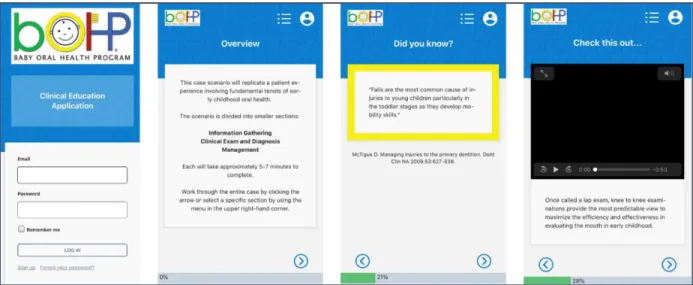
Figure 2: Examples of instructional smartphone application screens
Figure 3: Examples of instructional smartphone application screens
Prototype learner testing illuminated several themes, i.e. dental students’ preference for
technology in their education, positive feedback for the prototype’s usability, user-friendliness
and intuitiveness, appreciation for the immediate feedback the prototype provided, mixed
feelings about gaming and competition as well as the addition of animation versus use of static
images. Ideal case length recommended by 60% (9/15) of learners was approximately 15- 20
4.3: Assessment Procedures and Instruments.
Study participants received two instruments (a survey and a test) at two time points: first
the week leading up to and second, the day of testing post-educational intervention. The survey
contained close-ended items assessing aspects of the learners’ experience in four domains:
perceived value of app, knowledge, comfort, and stage of readiness to care for infants/toddlers in
clinical practice. Subsequently, participants’ clinical reasoning was objectively assessed in
comparison to that of an expert panel’s using SCT.49
Specifically, the pre-survey that all participants completed regardless of their
experimental or control group allocation, included twenty-five questions in four domains: value
of smartphone app (1 item), knowledge (10 items), comfort (13 items), and stage of readiness (1
item). Perceived value of a smartphone application was assessed with a single 4-point scale
question, including response options that ranged between 1: “no value” and 4: “a lot of value.”
This different scoring scheme was purposefully used to disallow participants from expressing
neutrality in this question. Knowledge questions contained only one best answer that
respondents were asked to identify, and were created keeping the “remember” level of Bloom’s
Taxonomy in mind.54 These questions assessed important fundamental concepts, i.e. most
predictable way of obtaining an oral exam for infants/toddlers, peak age for dental trauma in the
primary dentition, and which primary tooth is most likely involved. Of note, three knowledge
questions were removed from the initial pool of ten items, as they were later determined as
possibly favoring the application group. Comfort (5-point Likert scale) items were divided into
two parts, task-specific comfort (9 items) and overall comfort (4 items), with options ranging
between 1: “very uncomfortable” to 5: “very comfortable.” Task-specific comfort included
questions for specific clinical actions e.g. “how comfortable are you with performing a
gathering, clinical exam, diagnosis and management of primary tooth trauma. Stage of readiness
was assessed with a single 0-10 scale question: “Based on your current understanding of
diagnosis and management of primary tooth trauma, would you refer a patient who had
experienced primary tooth trauma to a specialist or treat the patient in your practice?” with 0
indicating referral to a specialist.
The intervention (app) group and the control (article-based) group each received a
tailored post-survey. Additional questions in the intervention group assessed students’
perceptions regarding the usability of the smartphone application. Two open-ended questions
were also included: “What was the best thing about the smartphone application?” and “What can
be done to make it better?” Closed-ended (5-point Likert scale) questions were used to gain
insight in app user experience domains, i.e. app’s performance, user-friendliness of the interface,
suitability of images, overall appearance, and usefulness of educational content. There was also
an opportunity for the study participants to provide recommendations for future educational
smartphone application cases in an open-ended format.
The objective assessment of participants’ clinical reasoning was done via SCT, a written
scenario-based test optimal for assessing clinical reasoning under conditions of
uncertainty.49 Once the test construction was complete, fifteen pediatric dentists piloted the SCT
and modifications were made based on their feedback. An additional sixteen pediatric dentists
composed the expert panel for the SCT, and their answers served as the scoring grid for the
participants’ SCT. The test included three clinical scenarios, each with accompanying questions,
4.4: Analytical Strategy.
Variables and measures
Participants’ demographics included gender (male/female), age (measured in years),
self-reported dental school rank (categorized in quintiles), future career plans (enter general dental
practice or pursue advanced training), and being a parent (yes/no). Domain summary scores
were created for knowledge and comfort as the sums of individual item responses. The number
of correct responses in the knowledge items was summed into a knowledge score (theoretical
range: 0-7, wherein 0 indicates the lowest and 7 the highest possible knowledge). The numeric
scale responses for comfort, for both task-specific comfort and overall comfort items (e.g. 1-5),
were summed into a task-specific comfort score (theoretical range: 9-45, wherein 9 corresponds
to the lowest and 45 to the higher possible comfort) and an overall comfort score (theoretical
range: 4-20, wherein 4 corresponds to the lowest and 20 to the highest possible comfort).
Clinical reasoning SCT scores were calculated by comparing dental students’ responses to the
answers given by the expert panel where the expert modal answer was credited with a full point,
and partial credit was given to other answers provided by the panel members.55 Scoring reflected
the degree of concordance of the participants’ judgements to those on the expert panel.
Participants’ responses regarding their perceptions of the app’s usability and value were
grouped based on their 5-point Likert scale responses - favorable (i.e. “useful” or “very useful”
or scores of 4-5), neutral (“somewhat useful” or score of 3), or unfavorable (i.e. “not useful” or
“definitely not useful” or scores 1-2). Responses to the ‘added value’ question were
dichotomized as favorable (i.e. scores 3-4) vs. unfavorable (i.e. scores 1-2). A single item (i.e.
0-10 scale) score was used to assess learners’ stage of readiness. Additionally, we extracted and
compared the times (in minutes) that participants spent interacting with either the application or
Statistical analysis
The data analysis departed from descriptive and summary statistics (i.e. proportions,
means and medians) for participants’ characteristics and favorable vs. unfavorable perceptions of
app usability and value. Not all domain scores were distributed normally and our sample size
was relatively small; for this reason, their means and standard deviations (SD) are presented for
descriptive purposes. The proportion of directional changes (i.e. increased, no change,
decreased) was compared between pre- and post- intervention scores using sign tests.
Differences in domain score changes (i.e. rank order) were tested between the app and the
control group using non-parametric Wilcoxon tests. One participant was excluded from all data
analyses due to incomplete data, resulting in analytical sample sizes of 31 for the app and 32 for
the control group. Three participants in the intervention group were excluded from the clinical
reasoning analysis due to missing SCT scores at baseline, resulting in a comparison between 28
app compared with 32 control participants in this domain. The level of significance was set at
p<0.05 for all comparisons and Stata 16.0 (StataCorp LLC, College Station, TX) was used for all
CHAPTER V: RESULTS
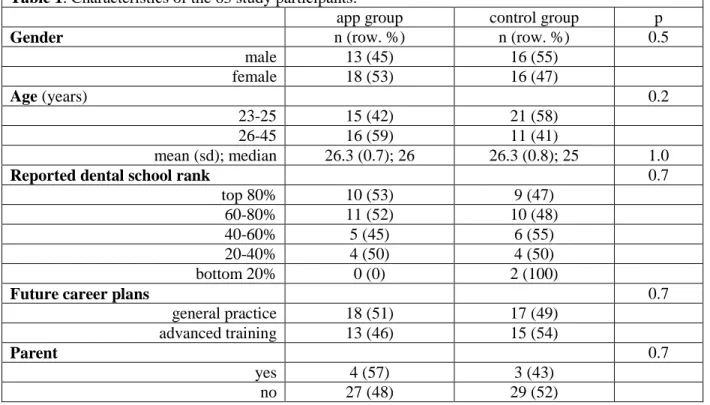
The characteristics of the study participants are presented in Table 1. The app and
control groups were balanced; there were similar proportions of male/female participants, as well
as of those planning to pursue advanced training or enter general practice. There were no
significant differences in individual characteristics between the app and the control group
participants. The intervention group spent significantly more time interacting with the
smartphone application compared to those reading the article in the control group (24 min vs. 9
min), although 2.5 minutes of that difference was due to the required viewing of seven videos
that were embedded in the app.
Table 1. Characteristics of the 63 study participants.
app group control group p
Gender n (row. %) n (row. %) 0.5
male 13 (45) 16 (55)
female 18 (53) 16 (47)
Age (years) 0.2
23-25 15 (42) 21 (58)
26-45 16 (59) 11 (41)
mean (sd); median 26.3 (0.7); 26 26.3 (0.8); 25 1.0
Reported dental school rank 0.7
top 80% 10 (53) 9 (47)
60-80% 11 (52) 10 (48)
40-60% 5 (45) 6 (55)
20-40% 4 (50) 4 (50)
bottom 20% 0 (0) 2 (100)
Future career plans 0.7
general practice 18 (51) 17 (49) advanced training 13 (46) 15 (54)
Parent 0.7
yes 4 (57) 3 (43)
no 27 (48) 29 (52)
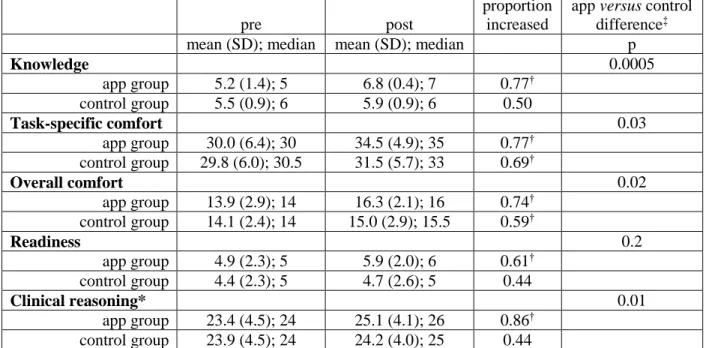
Estimates of knowledge, comfort, stage of readiness and clinical reasoning, pre- and
were evident in all domain scores apart from knowledge, stage of readiness and clinical
reasoning in the control group (sign testp>0.05). Specifically, 24 (86% of) participants
improved their clinical reasoning between pre- and post-intervention in the app group (sign test
p=0.0002), whereas 14 (45% of) participants improved it in the control group (sign test p=0.8).
The improvements were significantly higher in the app compared with the control group for
knowledge, task-specific comfort and overall comfort domains (all p<0.05)—although
participants in the app group showed more gains in the single item assessing stage of readiness
than those in the control group, this difference was not statistically confirmed (p=0.2).
Table 2. Changes in the 63 study participants’ knowledge, comfort, stage of readiness and clinical
reasoning, overall and stratified by experimental study group.
pre post
proportion increased
app versus control difference‡ mean (SD); median mean (SD); median p
Knowledge 0.0005
app group 5.2 (1.4); 5 6.8 (0.4); 7 0.77† control group 5.5 (0.9); 6 5.9 (0.9); 6 0.50
Task-specific comfort 0.03
app group 30.0 (6.4); 30 34.5 (4.9); 35 0.77† control group 29.8 (6.0); 30.5 31.5 (5.7); 33 0.69†
Overall comfort 0.02
app group 13.9 (2.9); 14 16.3 (2.1); 16 0.74† control group 14.1 (2.4); 14 15.0 (2.9); 15.5 0.59†
Readiness 0.2
app group 4.9 (2.3); 5 5.9 (2.0); 6 0.61† control group 4.4 (2.3); 5 4.7 (2.6); 5 0.44
Clinical reasoning* 0.01
app group 23.4 (4.5); 24 25.1 (4.1); 26 0.86† control group 23.9 (4.5); 24 24.2 (4.0); 25 0.44
*3 participants in the intervention group were excluded from this analysis due to missing SCT scores at baseline, resulting to a comparison between 28 participants in the app versus 32 participants in the control group
†Denotes statistically significant proportion with improved scores between pre- and post-intervention (non-parametric sign test, P<0.05)
‡Obtained with a non-parametric Wilcoxon test
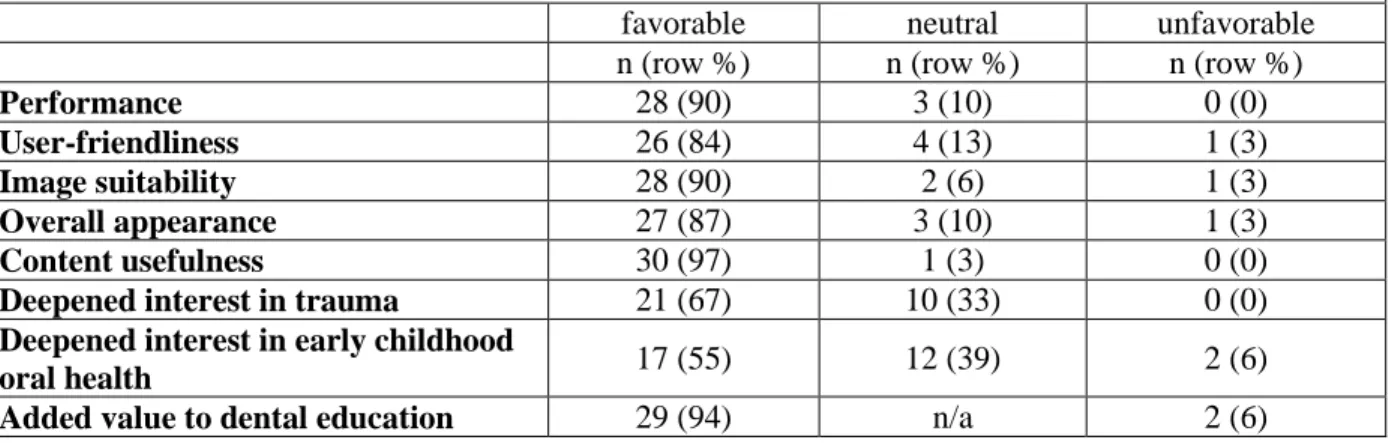
Study participants’ perceptions of the educational app’s usability and value in various
domains are illustrated in Table 3. Dental students overwhelmingly rated the smartphone
suitability of images and overall appearance, etc.). Favorable responses to the ‘overall
appearance’ question were proportionally fewer (69%) among those planning to pursue advanced
training compared with those planning to go into private practice (100%, p=0.02). Additionally,
favorable responses to the ‘deepened my interest in early childhood oral health’ question were
significantly inversely associated with class rank (p=0.02).
Table 3. Study participants’ perceptions of the educational app’s usability and value in various domains.
favorable neutral unfavorable n (row %) n (row %) n (row %)
Performance 28 (90) 3 (10) 0 (0)
User-friendliness 26 (84) 4 (13) 1 (3)
Image suitability 28 (90) 2 (6) 1 (3)
Overall appearance 27 (87) 3 (10) 1 (3)
Content usefulness 30 (97) 1 (3) 0 (0)
Deepened interest in trauma 21 (67) 10 (33) 0 (0)
Deepened interest in early childhood
oral health 17 (55) 12 (39) 2 (6)
Added value to dental education 29 (94) n/a 2 (6)
In terms of open-ended, qualitative comments regarding the app, approximately half of
the participants commented that its ease of use and user-friendliness were the best things about it.
Twenty-two percent of participants suggested that the app could be improved by making the
experience quicker by streamlining information. Other recommendations included the
development of future cases including trauma in patients of different ages, a
pediatric/orthodontic patient, behavior management, caries management, pathology, genetic
anomaly cases or cases with congenital disorders. Ninety-seven percent of participants felt more
CHAPTER VI: DISCUSSION
To the best of our knowledge, this is the first study to examine smartphone app-based
education in pediatric dentistry, both in development and operation. Dental education is critical
in helping meet the oral health needs of all children, yet educators often have limited time to
deliver curricular content and require effective modes to carry out such pedagogy. Smartphone
applications are an emerging example of technology that can help address these challenges in
dental education.19 App development allowed for the ability to customize a case-based
experience and focus learners to key concepts that, once mastered, would help them become
more competent and confident dental providers. Evaluation demonstrated substantial
improvements in all examined outcome domains in the app group, compared to smaller positive
changes found in the control group. Evaluation also demonstrated an application that was well
liked by virtually all students, with positive perceptions of app content, functionality, and added
value to their education.
Although a first in pediatric dentistry, smartphone apps have been utilized in other health
specialty areas, including medicine, nursing, and other areas of dentistry.56–60 At the University
of Florida College of Medicine, within the Department of Surgery, a smartphone app was created
and found to actively engage residents and improve participation in educational activities.56 The
use of smartphones has been examined within Ophthalmology for both education and clinical
use.57,58 Nursing is evaluating smartphones and mobile apps to determine if their use could
enhance clinical education.59 Within dentistry, a mobile learning app was developed to teach
well by dental students and proved to be an effective way to improve clinical reasoning skills for
planning prosthodontic rehabilitation.60
Bringing the bOHP platform to an interactive smartphone application could provide a
mechanism that allows oral health providers at any stage of development or location to access
these educational experiences, which may strengthen engagement to promote care for young
children. This technology could allow for fundamental knowledge of early childhood oral health
to be consumed by every dental student locally and globally, while increasing flexibility in
dental student training. Future research directions include developing multiple smartphone
app-based clinical cases spanning various topics in dental education and further evaluating the impact
of the constructs examined in this study. Evaluating knowledge retention in the app versus
article-based learning by testing at an additional time point one week post-intervention would
also be informative. Additionally, one could examine smartphone app-based education and the
ability to flip the classroom and decompress didactic time.
The findings of this study need to be considered in the context of its limitations. First,
the smartphone app was built for a larger purpose than this study and now resides on the Baby
Oral Health Program website.61 As such, there was an assessment component at the end of the
clinical case to help solidify important concepts. There was a loophole in the technological
process that allowed dental students to advance into the assessment component, which possibly
could have given those students an unfair advantage for knowledge acquisition. This should be
considered when interpreting knowledge outcome findings. Second, this novel educational tool
included only one case with only one topic. Consequently, the SCT used did not include the
number of cases or questions literature has shown to garner statistical significance.62 Third,
while dental student group allocation was random, a clearly defined method for randomization
convenience sample of third-year pre-doctoral dental students from one dental school makes it
difficult to generalize the findings to a larger audience. Finally, a smartphone application is not
easy or quick to develop or maintain and will require regular updates to keep the evidence-based
CHAPTER VII: CONCLUSION
The overarching goal of the project was to develop and evaluate the effectiveness of a
smartphone app using UNC’s bOHP as a framework to apply technology that facilitated learning
and engaged students in early childhood oral health. This tool demonstrated promise. The study
proved the concept that dental students’ perceived smartphone-app based education favorably,
and the educational benefits in terms of knowledge acquisition, comfort, and clinical reasoning
APPENDIX 1: DEVELOPMENT- PLANNING & PROTOTYPING
Planning Phase:
Blueprinting with Mindmap
Prototyping Phase:
Initial Static Prototype Wireframes
The following are a list of references that appear within the smartphone application: 1. https://www.aapd.org/media/Policies_Guidelines/R_DentalGrowth.pdf
2. https://www.babyoralhealthprogram.org/
3. https://www.aapd.org/globalassets/media/policies_guidelines/bp_childabuse.pdf
4. McTigue D. Managing injuries to the primary dentition. Dent Clin NA 2009;53:627-638. 5. https://www.aapd.org/globalassets/media/policies_guidelines/r_acutetrauma.pdf
6. https://pocketdentistry.com/16-the-airway/
7. https://www.aapd.org/media/Policies_Guidelines/BP_OralSurgery.pdf 8. https://www.aapd.org/media/Policies_Guidelines/E_Injuries.pdf
9. Kennedy A, et al. Where is the tooth? Diagnosing and managing dentoalveolar injuries during infancy. Ann Pediatr Child Health; 2:1022.
10. Singh H, Parakh A. Tracheobronchial foreign body aspiration in children. Clin Pediatr 2014;53:415-419.
11. https://i.ebayimg.com/thumbs/images/g/6qQAAOSwYZ9ZnpQj/s-l225.jpg 12. https://www.chop.edu/conditions-diseases/throat-anatomy-and-physiology
13. https://universityhealthkc.org/images/ear-nose-throat/250/ENT-Obstructive-Sleep-Apnea-Surgical-Intervention.jpg
14. Kay M, Wyllie R. Pediatric foreign bodies and their management. Curr Gastroenterol Rep 2005;7:212-218.
15. Borum M, Andreasen J. Sequelae of trauma to primary maxillary incisors. I. Complications in the primary dentition. Endod Dent Traumatol 1998;14:31-44.
16. https://www.denteractive.com/dental-terms/
17. Malmgren B. et al. International Association of Dental Traumatology guidelines for the management of traumatic dental injuries 3. Injuries in the primary dentition. 2012; 28 : 174-182.
APPENDIX 2: INTERVIEW GUIDE FOR LEARNER TESTING (IRB Study #: 18-0616)
Part 1: Prototype Development, Facilitator/Interview Guide for Learner Testing
NOTES:
ISO (International Organization for Standardization)/IEC (International Electrotechnical
Commission) 25010:2011 is a systems and software engineering standard that was last
reviewed and confirmed in 2017.1 The standard defines a product quality model and a
quality in use model that is applicable to all software products and computer systems.1
This standard establishes a quality model for software products and software-intensive
systems that guides formulation of quality requirements and metrics to measure their
satisfaction.2 The product quality model addresses quality when software is in the
development stage.3 The primary concern of the quality in use model is quality when the
software is used in the operation stage of its life cycle.3 The definitions of characteristics
and sub-characteristics that are used in this document are found within the ISO/IEC
25010 document.4
The learner testing session is user-driven and the questions asked will be for clarification
purposes.
The facilitator will have a list of questions that could be asked but depending on the
situation, the facilitator may not use all of the questions.
TEST OBJECTIVES:
To determine usability of prototype by assessing the following characteristics:
Product Quality:
Functional Appropriateness: degree to which the functions facilitate the accomplishment of specified tasks and objectives
Learnability: degree to which the prototype enables the user to learn how to use it with effectiveness and efficiency
Operability: degree to which the prototype is easy to operate, control and appropriate to use
User interface esthetics: degree to which the user interface enables pleasing and satisfying interaction for the user
Quality in Use:
Effectiveness: accuracy and completeness with which users achieve specified goals
Efficiency: resources expended in relation to the accuracy and completeness with which users achieve goals
Usefulness: degree to which a user is satisfied with their perceived achievement of pragmatic goals, including the results of use and the consequences of use
TEST QUESTIONS:
Pre-test open ended questions:
We are developing an early childhood oral health educational instructional technique with the goal that it will be turned into a smartphone application in the future; what do you expect this prototype to look like?
What is your preference for using technology within your dental school education and in particular, your early childhood oral health education?
Will the use of an interactive prototype add value to your education?
Before you look at the prototype, what do you expect to be able to do with it?
Questions that could be asked by facilitator during usability test:
How did [x] help you learn [explain specific goals you want your target learners to learn]?
While you were doing [x], what was going through your mind?
You seemed confused here. Can you tell us more about that?
What did you think it would do?
If you could change one thing here to better help dental students [learning goal], what would that be?
Post-test open ended questions:
Overall, what did you think about navigating around the prototype? (OPERAB)
Did the set of functions implemented in this prototype facilitate the accomplishment of [specified user tasks and goals]? (F APPR)
What did you feel about the way the prototype was organized? (OPERAB)
Did you feel you could easily achieve [the specified learning goals] while using this prototype? (LEARN)
Was the prototype easy to operate? (OPERAB)
Did you feel the prototype was user-friendly? Can you tell us more about that? (OPERAB)
Did the user interface enable a satisfying user interaction? (USER INTERF AESTH)
Did the prototype line up with your expectations? (USEFULNESS)
How satisfied were you with using this prototype? (USEFULNESS)
Was the patient case presented in a way that was easy to understand? (EFFECTIVENESS)
How many choices do you want to be given as the case unfolds? (EFFICIENCY)
How long would your ideal early childhood oral health case take to complete? (EFFICIENCY)
Would you like gaming elements to be incorporated into the prototype? (EFFECTIVENESS)
Would you like the prototype to be competitive against other people? (USER INTERF)
Would you like animation or video clips as opposed to static graphics or images? (LEARN)
When being linked to a reference, would you prefer the link be to the entire article or the specific concept within the article/guideline? (EFFICIENCY)
Questions to get at attractiveness of the prototype (was the font size easy to read? Background, colors and graphics appropriate?) (USER INTERF AESTH)
What is your overall impression of the appearance of the prototype? (USER INTERF)
Smart phone functionality, do you want only multiple choice? Drag and drop? Matching? Other? (USEFULNESS/EFFICIENCY)
1 https://www.iso.org/standard/35733.html
2 Schneider, Florian, Berenbach, Brian. A literature Survey on International Standards for
Systems Requiring Engineering. Procedia Computer Science. 2013; 16: 796-805.
3 Garcia-Mireles, Gabriel Alberto. Identifying Relevant Product Quality Characteristics in the
Context of Very Small Organizations. Computer Science and Information Systems. 2016; 13(3): 875-900.
4
APPENDIX 3: bOHP CLINICAL EDUCATION APP
APPENDIX 4: SURVEY INSTRUMENTS (IRB Study #: 18-0616)
(Pre-) Survey Instrument given to all participants:
Please indicate your response to the following statement by choosing one number on the Likert scale.
Please rate the value of an interactive smartphone application in your dental education.
No value A little value Some value A lot of value
1 2 3 4
Please choose the best response to each question below:
Question #1
What are the three benefits to a patient seeing a medical doctor prior to you evaluating that patient after dental trauma?
A: Get vaccinated, evaluate BMI, rule out concussion
C: Check vitals, obtain blood draw, get vaccinated
B: Discuss diet, evaluate BMI, check vitals D: Complete neurological exam, check vitals, rule out concussion
Question #2
______________ is the most predictable way of obtaining an oral examination for infants/toddlers.
A: Patient sitting upright C: Knee to knee positioning
B: Recline patient with parent in dental chair D: Stand in front of patient
Question #3
What primary tooth is most likely involved in dental trauma?
A: Mandibular central incisor C: Maxillary central incisor
Question #4
What are two common dental trauma sequelae that could occur from primary tooth trauma?
A: Buccal frenal tear and internal resorption C: Pulp canal obliteration and lip lacerations
B: Gingival ulcer and periapical pathology D: Color change and pulp necrosis
Question #5
Which one of the following definitions* describes “avulsion”?
A: An injury to the tooth supporting structures with increased mobility, but without displacement of the tooth. In acute trauma, bleeding from the gingival sulcus confirms the diagnosis.
C: Displacement of the tooth other than axially. Displacement accompanied by
comminution or fracture of either the labial or the palatal/lingual alveolar bone.
B: Partial displacement of the tooth out of its alveolar socket
D: Complete displacement of the tooth out of its socket
*definitions taken from Dental Trauma Guide
Question #6
What is a peak age for dental trauma in the primary dentition?
A: 6-9 months C: 12-18 months
B: 2-3 years D: 4-5 years
Question #7
______________ is one of the best predictors of trauma.
A: A previous history of trauma C: Overbite (OB) > 80%
B: Overjet (OJ) < 3mm D: Mandibular prognathism
Question #8
What are the two most common long-term permanent tooth sequelae after a primary tooth has been avulsed?
A: Enamel hypoplasia and enamel discoloration
C: Enamel discoloration and crown dilaceration
Question #9
What factor could significantly influence why permanent successors are affected during primary tooth trauma?
A: Supernumerary teeth are in the area C: Stage of mineralization of permanent successor
B: Delayed follow up with the dentist D: Inability to maintain hygiene after a traumatic injury
Question #10
What is the recommended timing for follow-up following a primary tooth avulsion over the course of the first 12 months?
A: 1 week, 6 months, 1 year C: 1 week, 6 weeks, 6 months, 1 year
B: 1 week, 3 months, 6 months, 9 months, 1 year
Please circle one response to each question below:
How comfortable do you think you would be with:
Very
Uncomfortable Uncomfortable
Neither Uncomfortable nor
Comfortable
Comfortable Very Comfortable
obtaining a medical history?
1 2 3 4 5
obtaining a chief complaint?
1 2 3 4 5
assessing normal development /normal eruption?
1 2 3 4 5
performing a knee-to-knee exam?
1 2 3 4 5
a young crying patient in your dental chair?
1 2 3 4 5
knowing when to refer to a specialist?
1 2 3 4 5
diagnosing primary tooth dental trauma?
1 2 3 4 5
providing primary tooth trauma counseling?
1 2 3 4 5
knowing where to access up-to-date trauma guidelines?
Please rate your overall comfort in the following areas by circling one number for each domain:
Very
Uncomfortable
Uncomfortable Neither
Uncomfortable nor
Comfortable
Comfortable Very
Comfortable
Information gathering
1 2 3 4 5
Clinical exam
1 2 3 4 5
Diagnosis of primary tooth trauma
1 2 3 4 5
Management of primary tooth trauma
1 2 3 4 5
Based on your current understanding of diagnosis and management of primary tooth trauma, would you refer a patient who had experienced primary tooth trauma to a specialist or treat the patient in your practice? If you would treat, please indicate on the scale below, your comfort with treating a patient with primary tooth trauma.
1 2 3 4 5 6 7 8 9 10
(Post-) Survey for Intervention Group Additional Questions assessing app utility & functionality:
Please circle one response to each statement below.
Please rate: Very difficult to operate Difficult to operate Neither difficult nor easy Easy to operate Very easy to operate
The smartphone application’s
performance. 1 2 3 4 5
Definitely not user-friendly Not user-friendly Somewhat user-friendly User-friendly Definitely user-friendly
The user-friendliness of the smartphone
application’s interface.
1 2 3 4 5
Very
inappropriate Inappropriate
Neither appropriate nor
inappropriate
Appropriate Very appropriate
The suitability of the images used in the smartphone application.
1 2 3 4 5
The overall appearance of the smartphone application.
1 2 3 4 5
Definitely
not useful Not useful
Somewhat
useful Useful
Definitely useful
The usefulness of the educational content of the smartphone application.
No value A little
value Some value
A lot of value
The value of an interactive smartphone application in your dental education.
1 2 3 4
Strongly
Disagree Disagree
Neither agree nor disagree
Agree Strongly Agree
The educational application deepened my interest in primary tooth trauma.
1 2 3 4 5
The educational application deepened my interest in early childhood oral health.
1 2 3 4 5
FUTURE
DEVELOPMENT:
Do you feel that more of these types of cases spanning early childhood oral health
would help/assist your education? YES NO
RECOMMENDATIONS FOR FUTURE CASES:
OPEN ENDED QUESTIONS:
What was the best thing about the smartphone application?