PEDIATRIC INTESTINAL OBSTRUCTION IN MALAWI:
CHARACTERISTICS AND OUTCOMES
Mansi Shah, MD1, Jared Gallaher, MD1, Nelson Msiska, CO2, Sean E. McLean, MD1, and Anthony G. Charles, MD, MPH☑,1
1Department of Surgery, University of North Carolina, Chapel Hill, NC
2Kamuzu Central Hospital, Lilongwe, Malawi
Introduction
Intestinal obstruction (IO) remains one of the most common causes of an acute abdomen worldwide. The pattern of intestinal obstruction varies depending on geographic region and age distribution. Unfortunately, there is a paucity of data on the patterns and outcomes of pediatric intestinal obstructions in sub-Saharan Africa. The characteristics of intestinal obstruction in the adult population have been well described in both High income and Low-Middle Income Countries.1,2,3,4,5 Similarly, IO is a common cause of pediatric surgical emergency, particularly in sub-Saharan Africa (SSA),6,7,8 accounting for approximately 42% of all abdominal emergencies and 1% of all pediatric admissions.9 In Africa, children constitute more than half of the population10; therefore, effort must be devoted to the prevention, early recognition, and treatment of childhood surgical diseases.
Pediatric surgical diseases in Africa present multiple challenges including high patient volume, delayed presentation, advanced pathology, limited resources, and the lack of trained general and pediatric surgeons.11 Currently in Africa, there is a ratio of one pediatric surgeon to approximately 2 million children (compared to 1:100,000 in North America)12. The few pediatric surgeons available are often overworked and are largely inaccessible to the overwhelming majority of the populace. The absence of appropriate surgical care in this environment results in many unnecessary pediatric deaths from curable surgical diseases and contributes to significant disability, ultimately compromising the quality of life of children in Africa.13,14
In this study, a hospital-based admission database is used to describe the characteristics and outcomes of pediatric IO at a tertiary care hospital within a pediatric ward in Lilongwe, Malawi.
The aim of this study is to determine the characteristics and outcomes of pediatric intestinal obstruction in this resource poor environment. By understanding the patterns and challenges unique to this region, we can begin to identify strategies needed to reduce IO associated morbidity and mortality in Malawi.
HHS Public Access
Author manuscript
Am J Surg
. Author manuscript; available in PMC 2016 December 08.Published in final edited form as:
Am J Surg. 2016 April ; 211(4): 722–726. doi:10.1016/j.amjsurg.2015.11.024.
A
uthor Man
uscr
ipt
A
uthor Man
uscr
ipt
A
uthor Man
uscr
ipt
A
uthor Man
uscr
Methods
This is a retrospective analysis of a pediatric surgery database at Kamuzu Central Hospital (KCH) in Lilongwe, Malawi15. The data for the pediatric surgery database was collected between February 2012 and June 2014. The database consists of all admitted patients age ≤ 18 years with a surgical diagnosis and admitted to a pediatric surgical ward, or having surgical consultation. Patients were deemed to have an IO based on either admission or final diagnosis.
KCH is a 600-bed tertiary hospital and is the referral basis of the approximately 6 million people that reside in the central region of Malawi. During the study period there were four full-time general surgeons and six clinical officers. There were also 10 Malawian general surgery residents. The main operating theatre at KCH has four fully functional operating rooms with one anesthesiologist and six clinical officer anesthetists. There are four intensive care unit beds with four adult ventilators. Available radiographic studies include plain and contrast radiography, abdominal ultrasound, and echocardiography. Computed tomography and magnetic resonance imaging were not available.
Data collected include demographic information, in addition to clinical variables, such as admission type (emergent or elective), admission and final diagnoses, type of operative intervention if performed, number of days from admission to surgery, and hospital length of stay. Furthermore, data on the use of diagnostic adjuncts such as radiography or ultrasound, and outcome (discharge, death, or missing) were collected. Mortality was defined as in-hospital death. Post in-hospitalization follow up visit was recorded if it occurred.
Patient characteristics such as mean age, gender distribution, percentage of patients receiving operative intervention, mean length of stay, and mean days to surgery are described. Chi-squared, t-tests, and ANOVA tests were then performed to analyze
differences in rates of surgery, days to surgery, and outcomes based on age group and type of obstruction (congenital vs. acquired, acquired causes including mechanical and functional causes). Congenital causes of IO included Hirschprung’s disease, anorectal malformation, gastroschisis and omphalocele. Mechanical causes of IO included causes such as
intussusception, hernia, adhesions, or fecal impaction whereas functional causes included causes such as bowel perforation or appendicitis.
Data analysis was performed using STATA v13 software. ANOVA tests were used to assess all differences based on age groups, for example number of days to surgery or overall length of stay between neonates, infants, and children. When analyzing differences based on type of obstruction, congenital versus acquired, either T-test or Chi-squared test was used, based on the factor analyzed. Chi-square test was used to compare rates of operative intervention, elective surgery or rates of discharge and death, whereas T-test was used to compare length of stay and number of days to surgery. Statistical significance was defined as a p-value less than 0.05.
Both the University of North Carolina Institutional Review Board and the National Health Sciences Research Committee of Malawi (NHSRC) approved this study.
A
uthor Man
uscr
ipt
A
uthor Man
uscr
ipt
A
uthor Man
uscr
ipt
A
uthor Man
uscr
Results
A total of 3,407 children met inclusion criteria into the pediatric surgery database during the study period. Of these, 130 (3.8%) children were found to have a diagnosis of intestinal obstruction, based on admission or final diagnosis. Of the patients with a diagnosis of IO, 74 (57%) patients were male with a mean age of 3.5± 4.1 years and the mean hospital length of stay (LOS) was 13 ± 13.7 days. Mortality rate for patients with and without IO in the database was 3% and 0.4%, respectively (Table 1).
The leading causes of intestinal obstruction were Hirschprung’s disease, 29% of patients, anorectal malformation, 18%, intussusception, 4%, hernia, 4%, and appendicitis, 3%. Overall, 44% of patients had an unspecified cause of intestinal obstruction. Other less common causes included bowel perforation, omphalocele, adhesions, midgut volvulus, cecal volvulus, fecal impaction, and gastroschisis (Table 2).
Among the intestinal obstructions, operative intervention occurred in 67 (52%) patients. The majority of the patients, 36 (54.6%), underwent an elective operative intervention. The mean time from presentation to an operation was 6.4 ± 10.2 days, with a median of 1 day.
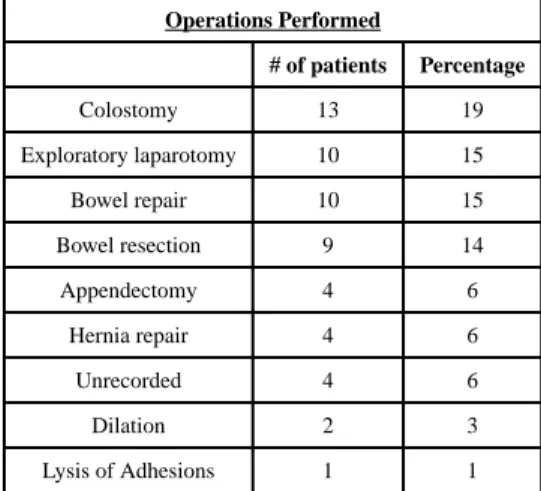
Procedures most often performed included colostomy in 13 (20%) patients, bowel resection in 9 (13.8%), and bowel repair without resection in 10 (15.4%) (Table 3).
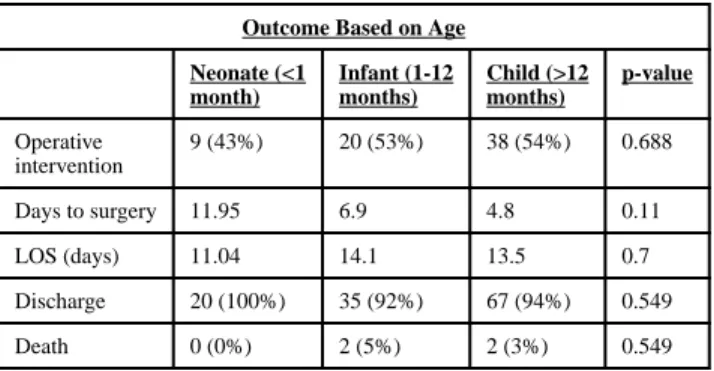
Analysis of outcomes based on age categories, neonate (<1 month old), infant (1 month – 12 months), and child (>12 months) was performed. There was no statistical difference in mortality based on age, although there was a higher mortality rate in older compared to younger patients (p=0.549). In neonates, there were 0 deaths out of 21 patients (0%), versus infants where there were 2 deaths out of 38 patients (5%). There were also 2 children that died out of 71 total (3%). Furthermore, the youngest patients had the smallest rate of surgery. Only 9 of 21 (43%) neonates had an operation whereas 20 of 38 (53%) infants underwent surgery. With a percentage similar to infants, 38 of 71 (54%) children had an operation (p=0.688). Post discharge follow up occurred in only 11 (8.5%) patients.
Time to surgery increased as the patients’ ages decreased, although not statistically significant. The average time to surgery in neonates, infants and children were 11.95, 6.9, and 4.8 days, respectively (p=0.11). The average LOS for a child was 11.04 days compared to an average of 14.1 days for neonates and 13.5 days for infants (p=0.7) (Table 4).
There was a significant difference in etiology of intestinal obstruction based on age group. As the ages of patients increased, they were more likely to have functional causes for IO, including peritonitis, ileus, perforation, Hirschprung’s, or appendicitis as compared to mechanical causes, including fecal impaction, hernia, adhesions, gastric outlet obstruction, or intussusception. Of the neonates, 3 out of 21 (14%) patients had functional causes of IO compared to infants where 9 of 38 (24%) patients had functional causes. Children on the other hand were more likely to have a functional cause, with 19 out of 71 patients (27%) (p=0.006).
Congenital etiology of IO was prominent in the study cohort accounting for 54 (41%) of children presenting with IO. Of these, 31 (57.4%) were male. Leading causes of congenital
A
uthor Man
uscr
ipt
A
uthor Man
uscr
ipt
A
uthor Man
uscr
ipt
A
uthor Man
uscr
IO included Hirschprung’s disease– 25 (19.2%) and anorectal malformation – 24 (18.5%), followed by omphalocele – 2 (1.5%) and gastroschisis - 1 (0.8%) patient. Colostomy rates were significantly higher in congenital versus acquired (including mechanical and functional causes) causes of IO. Of the 13 patients that received colostomies, 9 (69.2%) had congenital causes versus 4 (30.8%) in the acquired group (p=0.03).
There was no statistically significant difference in mortality between the congenital and acquired cohorts. There were no recorded deaths in children with congenital IO with 51 of 54 (94.4%) patients discharged. Comparatively, in those with acquired IO, 71 of 76 (93.4%) were discharged with the 4 (5.3%) deaths (p=0.13). Those with congenital sources of IO were also significantly less likely to have emergent surgery (p=0.001). In the congenital group 19 of 23 (83%) patients had elective surgery versus the acquired group where 17 of 43 (40%) patients had elective surgery.
There was no statistically significant difference in rate of surgical intervention between the congenital and acquired cohorts, though there was a lower rate of surgery in the congenital group. In the congenital group 23 of 54 patients (42.6%) had surgery as opposed to the acquired cohort where 44 of 76 (57.9%) had operative intervention. (p=0.08). However, there was a significant difference in mean days between admission and surgery in the congenital and acquired group with 12.4 and 3.2 days, respectively (p=0.0002). Despite these results there was no difference in overall LOS (p=0.94) (Table 5).
In the dataset, only 103 of 130 patients had documentation on whether adjunctive radiologic studies were obtained. 80 (77.7%) patients did not receive any radiologic imaging study. Of the 79 patients with a nonspecific admission diagnosis, 20 (25%) had radiographic imaging. Comparatively, of the 51 patients with a specific admission diagnosis, only 3 (6%) had radiographic imaging. Furthermore, when radiologic images were obtained, their benefit seemed limited. Although patients recorded to have a nonspecific admission diagnosis were more likely to have imaging during their hospitalization, definitive cause of the IO could still not be established. Of the 20 patients with a nonspecific admission diagnosis that received imaging, 13 (65%) still had a nonspecific final diagnosis.
Patients were more likely to have surgery if they had a nonspecific admission diagnosis of intestinal obstruction. 46 of the 79 (58%) patients with a nonspecific admission diagnosis underwent surgery compared to 22 of the 51 (43%) with a specific admission diagnosis.
Discussion
Intestinal obstruction is a large contributor to pediatric surgical disease in sub-Saharan Africa, and patterns of IO differ by region. In West Africa, several studies, particularly from Nigeria, reveal the varying etio-pathogenesis of IO in this region where leading causes of IO include intussusception and typhoid perforation8,16,17. This differs from our study
population where congenital causes were highest. The proportion of congenital causes in our study is similar to other regions, but we observed a higher rate of Hirschprung’s disease and anorectal malformation. This is in comparison to the large portion of duodenal and jejunal atresias as well as malformations seen in other regions.15
A
uthor Man
uscr
ipt
A
uthor Man
uscr
ipt
A
uthor Man
uscr
ipt
A
uthor Man
uscr
In this study, operative intervention rates were much lower than other studies. The lower operative intervention rate may be reflective of the diminutive surgical workforce capacity and health care infrastructure in Malawi to appropriately manage the heavy burden of pediatric surgical disease. There is an absence of a pediatric surgeons at KCH and the comfort level of general surgeons with pediatric surgical disease operative procedures is likely limited. It appears that the low rates of operative intervention, the higher length of time to surgery, and the higher likelihood to receive a colostomy with congenital causes of IO may be related to a lack of training and a level of discomfort for general surgeons in treating pediatric surgical disease.
Post-operative and post-discharge follow up rates are low on our study cohort, with only 11 (8%) patients returning to clinic after hospitalization. There is therefore a lack information regarding colostomy related morbidity such as prolapse, bleeding, or non-reversal, as well as general morbidity including post-operative growth rates, dehydration, wound infection or other post-operative concerns in pediatric patients. Furthermore, it remains unclear whether patients with congenital causes of IO that were treated non-operatively ever received any definitive care or whether they went home to die. This may account for the lower mortality rates in our patient population, especially in neonates, compared to other regions of sub-Saharan Africa. Mortality rates were similar to some areas, such as Southwestern Nigeria15, but other regions in Nigeria report mortality rates as high as 16%, with neonatal mortality as high as 33%.8
A lack of diagnostic capabilities may also be a contributor to IO morbidity and mortality. Modalities such as computed tomography and magnetic resonance imaging were not available, and opportunities for radiography or ultrasound were limited. This probably presented a challenge in appropriately obtaining a specific preoperative diagnosis. 44% of patients had a nonspecific admission diagnosis. These patients were more likely to receive operative intervention, as surgery likely becomes the diagnostic method of choice. Furthermore, the absence of radiographic support probably contributes to the high level of misdiagnosis. 22% of patients had differing admission and discharge diagnoses, with appendicitis, intussusception, and hernias most commonly misdiagnosed. Therefore, the combination of nonspecific presenting symptoms and poor radiographic capabilities likely leads to surgery becoming the method of achieving a definitive diagnosis.
The limitations to this study are those inherent to any study with a retrospective
methodology. In addition, the study is limited by a small sample size, which may affect the generalizability of the findings. The small sample size also limits this study to draw accurate conclusions about mortality as this database only captured in-hospital mortality. With only four cases of in-hospital mortality, statistical analysis comparing rates of mortality was difficult. We suspect that the large number of neonatal patients and patients with congenital abnormalities that had a low rate of operative intervention likely had a higher out-of-hospital mortality that was unable to be captured by this database. This may account for the lower rates of neonatal mortality compared to other regions in Africa. Also, the lack of follow up limited the ability to fully determine the true sequelae of IO in terms of morbidity and mortality.
A
uthor Man
uscr
ipt
A
uthor Man
uscr
ipt
A
uthor Man
uscr
ipt
A
uthor Man
uscr
Conclusion
Intestinal obstruction continues to be a rampant source of morbidity and mortality in pediatric patients in Malawi. In order to address the burden of pediatric surgical diseases, attention must be paid to increasing the surgical workforce by increasing the numbers of physician and non-physician providers in sub-Saharan Africa. It is clear that increasing the number of pediatric surgeons in this resource poor region is unlikely. Therefore, efforts must be made to fully incorporate pediatric surgical training into general surgical training. By increasing familiarity with basic pediatric diseases and surgical procedures, we may be able to address the hesitancy to treat the youngest of patients in Malawi. Additionally, improving basic health care infrastructure such that basic diagnostic adjuncts such as ultrasound and plain radiology become routinely available must be a priority. Improving on the accuracy of preoperative diagnoses will more appropriately identify those patients that need operative intervention. This we believe will help reduce the significant sequelae of IO, which rarely exists in developed countries.
Supplementary Material
Refer to Web version on PubMed Central for supplementary material.
References
1. Oladele AO, Akinkuolie AA, Agbakwuru EA. Pattern of intestinal obstruction in a semiurban Nigerian hospital. Niger J Clin Pract. Dec; 2008 11(4):347–50. [PubMed: 19320408]
2. Madziga AG, Nuhu AI. Causes and treatment outcome of mechanical bowel obstruction in north eastern Nigeria. West Afr J Med. Apr; 2008 27(2):101–5. [PubMed: 19025024]
3. Kuremu RT, Jumbi G. Adhesive intestinal obstruction. East Afr Med J. Jun; 2006 83(6):333–6. [PubMed: 16989379]
4. Lawal OO, Olayinka OS, Bankole JO. Spectrum of causes of intestinal obstruction in adult Nigerian patients. S Afr J Surg. May.2005 43(2):34, 36. [PubMed: 16035380]
5. Shittu OB, Gana JY, Alawale EO, Ogundiran TO. Pattern of mechanical intestinal obstruction in Ibadan: a ten year review. Afr J Med Med Sci. Mar-Jun;2001 30(1-2):17–21.
6. Adejuyigbe O, Fashakin EO. Acute Intestinal Obstruction in Nigerian Children. Trop Gastroenterol. 1989; 10:33–40. [PubMed: 2718254]
7. Uba AF, Edino ST, Yakubu AA, Sheshe AA. Childhood intestinal obstruction in Northwestern Nigeria. West Afr J Med. 2004; 23:314–318. [PubMed: 15730090]
8. Olumide F, Adedeji A, Adesika AO. Intestinal Obstruction in Nigerian Children. J Pediatr Surg. 1976; 11:195–204. [PubMed: 1263057]
9. Adejuyigbe O, Fashakin EO. Acute intestinal obstruction in Nigerian children. Trop Gastroenterol. Jan-Mar;1989 10(1):33–40. [PubMed: 2718254]
10. [accessed 30 September, 2015] http://www.chr.up.ac.za/index.php/ahrc-courses/childrens-rights-in-africa.html
11. Bickler SW, Kyambi J, Rode H. Pediatric surgery in sub-Saharan Africa. Pediatric Surgery International. 2001; 17(5-6):442–447. [PubMed: 11527185]
12. Mshelbwala, PM.; Nwomeh, BC. Paediatric Surgery Specialty and its Relevance to Africa. In: Ameh, E.; Bickler, S.; Lakhoo, K., et al., editors. Paediatric Surgery: A Comprehensive Text For Africa. Global HELP Organization; Seattle: 2011. p. 3-7.Available at www.global-health.org
[accessed 30 September, 2015]
13. Osifo OD, Okolo JC. Neonatal intestinal obstruction in Benin, Nigeria. Afr J Paediatr Surg. Jul-Dec;2009 6(2):98–101. [PubMed: 19661639]
A
uthor Man
uscr
ipt
A
uthor Man
uscr
ipt
A
uthor Man
uscr
ipt
A
uthor Man
uscr
14. Hajivassiliou CA. Intestinal obstruction in neonatal/pediatric surgery. Semin Pediatr Surg. Nov; 2003 12(4):241–53. [PubMed: 14655163]
15. Kendig CE, Samuel JC, Varela C, et al. Pediatric surgical care in Lilongwe, Malawi: outcomes and opportunities for improvement. J Trop Pediatr. Oct; 2014 60(5):352–7. [PubMed: 24771355] 16. Ekenze SO, Mgbor SO. Childhood intussusception: the implications of delayed presentation. Afr J
Paediatr Surg. Jan-Apr;2011 8(1):15–8. doi: 10.4103/0189-6725.78662. [PubMed: 21478580] 17. Ogundoyin OO, Afolabi AO, Ogunlana DI, et al. Pattern and outcome of childhood intestinal
obstruction at a tertiary hospital in Nigeria. Afr Health Sci. Sep; 2009 9(3):170–3. [PubMed: 20589146]
A
uthor Man
uscr
ipt
A
uthor Man
uscr
ipt
A
uthor Man
uscr
ipt
A
uthor Man
uscr
A
uthor Man
uscr
ipt
A
uthor Man
uscr
ipt
A
uthor Man
uscr
ipt
A
uthor Man
uscr
ipt
Table 1
Demographics
Gender Male: 74 (57%)
Female: 56 (43%)
Mean Age 3.5 ± 4.1 years
Mean LOS 13 ±13.7 days
Operative intervention 68 (52%)
Mean time to operation 6.4 ± 10.2 days
Mortality (with IO) 3%
A
uthor Man
uscr
ipt
A
uthor Man
uscr
ipt
A
uthor Man
uscr
ipt
A
uthor Man
uscr
ipt
Table 2
Leading causes of intestinal obstruction
Cause Number of patients Percentage
Unspecified 57 44
Hirschprung’s disease 25 29
Anorectal Malformation 24 18
Intussusception 5 4
Hernia 5 4
Appendicitis 4 3
Bowel perforation 2 1.5
Omphalocele 2 1.5
Adhesions 1 0.8
Midgut volvulus 1 0.8
Cecal volvulus 1 0.8
Fecal impaction 1 0.8
A
uthor Man
uscr
ipt
A
uthor Man
uscr
ipt
A
uthor Man
uscr
ipt
A
uthor Man
uscr
ipt
Table 3
Operations performed for intestinal obstruction
Operations Performed
# of patients Percentage
Colostomy 13 19
Exploratory laparotomy 10 15
Bowel repair 10 15
Bowel resection 9 14
Appendectomy 4 6
Hernia repair 4 6
Unrecorded 4 6
Dilation 2 3
A
uthor Man
uscr
ipt
A
uthor Man
uscr
ipt
A
uthor Man
uscr
ipt
A
uthor Man
uscr
ipt
Table 4
Outcomes of patients with intestinal obstruction by age group
Outcome Based on Age
Neonate (<1 month)
Infant (1-12 months)
Child (>12 months)
p-value
Operative intervention
9 (43%) 20 (53%) 38 (54%) 0.688
Days to surgery 11.95 6.9 4.8 0.11
LOS (days) 11.04 14.1 13.5 0.7
Discharge 20 (100%) 35 (92%) 67 (94%) 0.549
A
uthor Man
uscr
ipt
A
uthor Man
uscr
ipt
A
uthor Man
uscr
ipt
A
uthor Man
uscr
ipt
Table 5
Operative outcomes by etiology of obstruction
Outcome Based on Type of Obstruction
Congenital Acquired P-value
Operative
intervention 23 (43%) 44 (58%) 0.08
Colostomy 9 (69%) 4 (31%) 0.03
Elective surgery 19 (83%) 17 (40%) 0.001
Days to surgery 12.4 3.2 0.002
LOS (days) 12.6 12.4 0.94
Discharge 51 (94%) 71 (93%) 0.13