A COMPARISON OF INTERACTIONS ON FACEBOOK BRAND PAGES BETWEEN GLOBAL BRANDS AND PUBLICS IN INDIVIDUALISTIC AND
COLLECTIVISTIC COUNTRIES
Pitchpatu Waiyachote
A dissertation submitted to the faculty of the University of North Carolina at Chapel Hill in partial fulfillment of the requirements for the degree of Ph.D. in the School Journalism
and Mass Communication
Chapel Hill 2013
©2013
!
! iii!
ABSTRACT
PITCHPATU WAIYACHOTE: A comparison of interactions on Facebook brand pages between global brands and publics in individualistic and collectivistic countries
(Under the direction of Lois Boynton)
The present study presents a comparative analysis of how Facebook was used to build and maintain relationships between global brands and their publics in
individualistic and collectivistic cultures. Mixed methods — a quantitative content analysis and an online survey — were used. A total of 5,753 wall posts on the six global brands’ Facebook brand pages available in five selected countries were analyzed. The U.S. represented individualistic cultures, while four Southeast Asian countries
represented collectivistic cultures.
Overall, the study found that differences in cultures play an important role in the interactions on Facebook between the global brands and their publics. The global brands used Facebook to build and maintain relationships with their publics in the U.S., but used it as an integrated tool to promote products and stay in touch with their publics in
!
! v!
ACKNOWLEDGEMENT
First of all, I would like to express my gratitude to my dissertation committee members: Dr. Lois Boynton, Dr. Daniel Riffe, Dr. James Bettman, Dr. Daren Brabham, and Dr. William Ware for their guidance and support throughout the process of my dissertation work. I also want to thank my professors and cohorts at the school of Journalism for making my experience at UNC a memorable one. My gratitude also goes to all of my professors and teachers who have influenced me to want to become a teacher.
I also would like to thank my soon-to-be coworkers at UTCC. Thank you all of my friends at Maree, Traim, ISU, and H&K for cheering me on. Thanks so much, p’Jeep for being my whatsApp buddy, and n’Nui, for postcards that brought me big smiles. Special thanks to Golf for making distance seem a lot closer.
I also want to thank my entire family: my uncles, aunts, and cousins. I would like to especially thank Uncle Pra, Aunt Noi, and Aunt Ood, for always praying for my success. Most importantly, I would like to thank Mom and Dad for your love,
!
TABLE OF CONTENTS
LIST OF TABLES………..……….viii
LIST OF FIGURES……….………...xi
Chapter I. INTRODUCTION... 1
II. LITERATURE REVIEW... 7
Relationship Management ... 7
Brand Community... 17
Brand Personality... 19
Individualism vs. Collectivism ... 22
III. RESEARCH QUESTIONS & HYPOTHESES... 26
IV. METHODS... 31
Content Analysis... 31
Online Survey ... 42
V. RESULTS ... 44
Interactions between the Brands and Consumers ... 46
Dialogic Communication Features ... 48
Brand Community... 52
!
! vii!
VI. DISCUSSION... 64
Limitations and Future Research ... 79
Contributions of the Study... 81
Conclusion ... 85
TABLES………....88!
FIGURES………...107
APPENDICES……….110
REFERENCES………125 !
LIST OF TABLES
Table
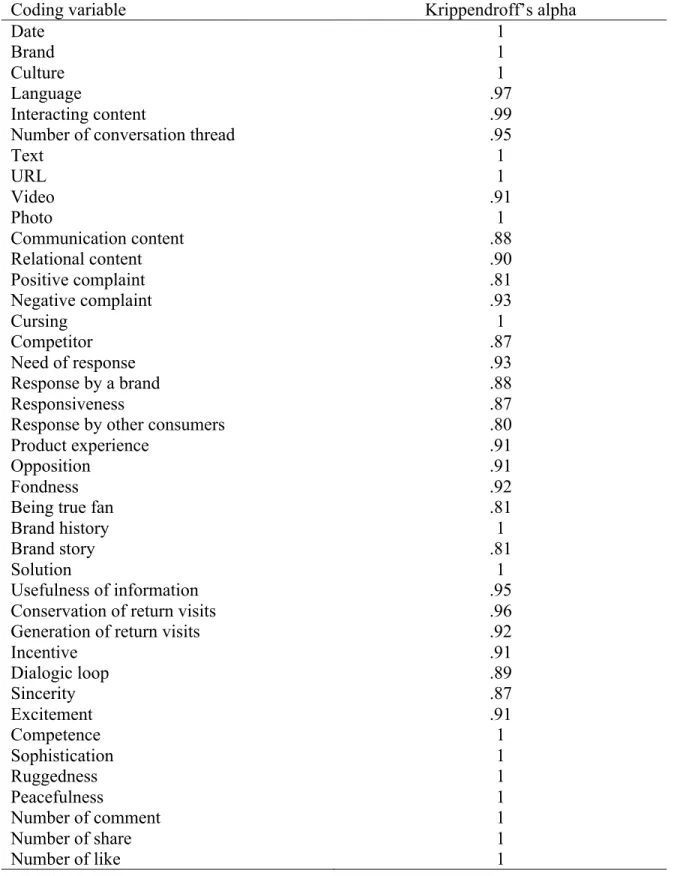
1. The numbers of fans on the selected Facebook pages………...…88 2. Intercoder reliability on actual coding of posts on Facebook…………...……89 3. Percentages and z-scores of interacting comments on Facebook brand pages in
individualistic and collectivistic countries………...…….90 4. Descriptive statistics for threads of conversation………..90 5. Descriptive statistics for the number of responding comments across culture
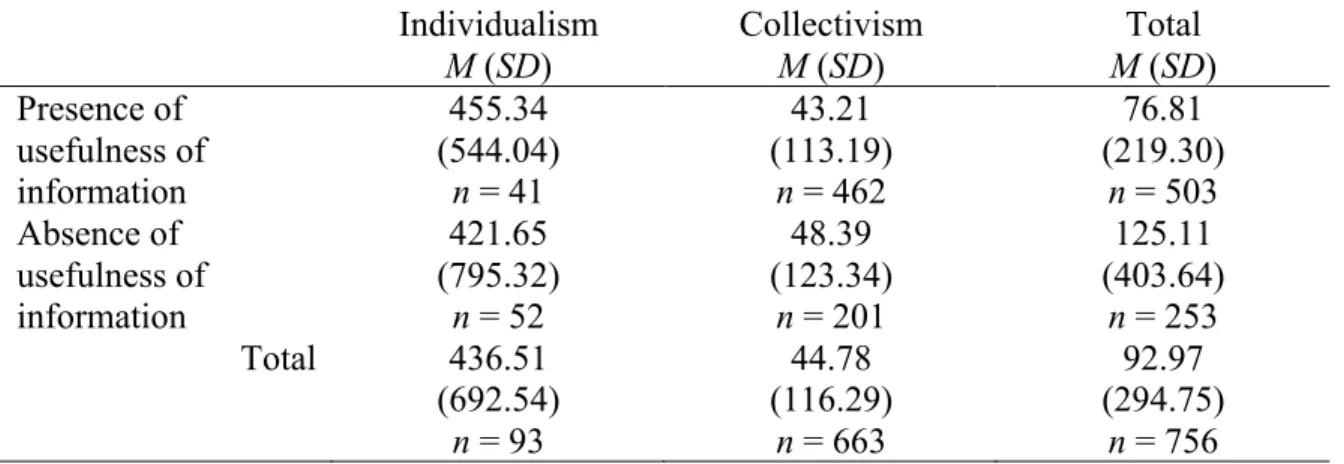
and the use of the dialogic feature of usefulness of information………...91 6. Descriptive statistics for the number of responding comments across culture
and the use of conservation of return visits………...91 7. Descriptive statistics for the number of responding comments across culture
and the use of generation of return visits………...………...91 8. Descriptive statistics for the number of responding comments across culture
and the use of an incentive……….………...92 9. Descriptive statistics for the number of responding comments across culture
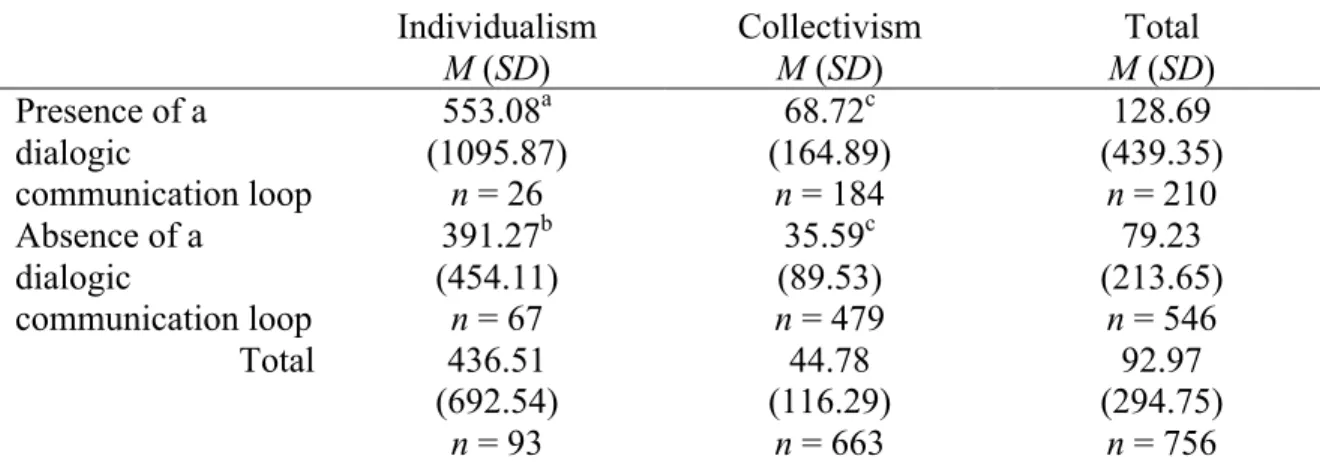
and the use of a dialogic communication loop………...………...92 10. Percentages and z-scores of communication content posted by the brands on
Facebook brand pages in individualistic and collectivistic countries……...…93 11. Percentages and z-scores of relational content posted by the brands on
!
! ix!
13. Percentages and z-scores of relational content posted by consumers on
Facebook brand pages in individualistic and collectivistic countries……...…94
14. Means of brand personality dimensions of McDonald’s on Facebook ………95
15. Means of brand personality dimensions of KFC on Facebook………...95
16. Means of brand personality dimensions of Starbucks on Facebook………….96
17. Means of brand personality dimensions of Samsung on Facebook…………..96
18. Means of brand personality dimensions of Nokia on Facebook………...97
19. Means of brand personality dimensions of Sony on Facebook……….97
20. Percentages of how often consumers visited Facebook………98
21. Percentages of the number of brands consumers “liked” on Facebook………98
22. Percentages of consumers’ most recent visit to a Facebook brand page……...99
23. Descriptive statistics of consumer perceptions of the dimensions of brand personality across both cultures………..99
24. Means of consumers’ perceptions of McDonald’s brand personality……...100
25. Means of consumers’ perceptions of KFC’s brand personality………..100
26. Means of consumers’ perceptions of Starbucks’ brand personality…………101
27. Means of consumers’ perceptions of Samsung’s brand personality………...101
28. Means of consumers’ perceptions of Nokia’s brand personality………102
29. Means of consumers’ perceptions of Sony’s brand personality………..102
30. Order of ranks of McDonald’s brand personality dimensions………103
31. Order of ranks of KFC’s brand personality dimensions………..103
32. Order of ranks of Starbucks’ brand personality dimensions………...104
!
! xi!
LIST OF FIGURES
Figure
1. Examples of comments………107 2. The response rate by the global brands to consumers’ comments
CHAPTER 1 INTRODUCTION
!
Social media are popular tools for individuals to connect with one another. Social
media sites are also commonly used among entrepreneurs, marketers, and communication
professionals to communicate with their target audiences. On social media sites, and in
particular social networking sites, brand communities exist, where individuals who share
similar interests in a certain brand or product virtually get together virtually to exchange
information and opinions in an online environment (e.g., Gummerus, Liljander, Weman,
& Pihlström, 2012).
The purpose of this study was to examine how global brands and their publics
develop and maintain their relationships through brand communities on Facebook, the
popular social media site. Global brands implement public relations activities to cultivate
relationships with their publics, including customers, consumers, media, etc., in their
homeland and foreign countries. The public relations strategy of establishing a brand
presence on Facebook, which is one public relations strategy, has spread across the
world. When practicing public relations in other countries, it also is important to take
their unique cultures into consideration (Heath & Coombs, 2006). Therefore, this study
also explored whether global brands and their publics with different cultural backgrounds
!
! 2!
practitioners applied relationship-building strategies and how publics interacted through brand communities on Facebook in different markets.
An analysis of Facebook content and an online survey was conducted to attain the goal of this study. Because the United States scored higher on the cultural dimension of individualism when compared to Asian countries (Hofstede, 1984), Facebook pages in the U.S. and American student samples were used to represent of an individualistic culture in the content analysis and the survey, respectively. Four Southeast Asian countries were chosen to represent collectivistic culture in the content analysis of
Facebook content, and Asian student samples represented consumers from a collectivistic culture in the online survey.
In terms of Facebook use, the United States is a massive market, with a
population of more than 314 million people (U.S. Census Bureau, 2012). More than half of Americans used Facebook regularly (Brenner, 2012). Southeast Asia is a local market of over half a billion people, with total trade of over US$1.4 trillion (Bhasin, 2010). The region consists of 10 countries, but for this study, the focus was on the countries where Facebook adoption rates have been relatively high, and either English or Thai language is the main language used on Facebook brand pages. Therefore, Malaysia, the Philippines, Singapore, and Thailand were selected. Altogether there were approximately 64 million Facebook users in these four countries (SocialBakers, 2012). In terms of a Facebook penetration rate (number of users compared to a country’s population), Singapore ranked highest with a penetration rate of 62.72%, followed by Malaysia (47.90%), the
research unit of Siam Commercial Bank. Thus, these social media users were more likely to be consumers of global brands.
Recently, a number of studies have examined how social media is being employed as a public relations and communication tool by for-profit corporations and not-for-profit organizations and their publics. These studies have found that social media, such as blogs and Facebook, have been used not only to disseminate information but also to develop relationships with their online publics (e.g., Ahuja & Medury, 2010; Bortree & Seltzer, 2009; Briones, Kuch, Liu & Jin, 2011; Rybalko & Seltzer, 2010).
This is not surprising because relationships are a core construct of public relations (Ledingham, 2003; see also PRSA, 2011). Grunig (1993) emphasized a two-way
symmetrical model of public relations in which an organization and its publics take part in an information exchange process. The objective of this exchange was to build a relationship that is mutually beneficial to the organization and its publics. Therefore, social media that offer two-way communication were recommended tools because of their spontaneity and ability to reach a wide range of stakeholders (Semple, 2009).
!
! 4!
communication, whereby brands and publics may interact and engage with one another on topics of mutual interest (e.g., Bortree, & Seltzer, 2009; Park, Rodgers, & Stemmle, 2011; Waters, et al., 2009). Both a global brand and its publics can generate content and respond to comments on a Facebook brand page. Therefore, Facebook is a channel that allows researchers to study two-way interaction between global brands and their publics.
Most public relations studies have emphasized that organizations use social media strategically to develop relationships with their publics. However, little is known about how the publics use social media to communicate with organizations, which would close the dialogic loop. To better understand a process of strategic communication with the goal of building mutual relationships, public relations researchers should also pay attention to how publics use social media to reach organizations. Therefore, this study examined how both parties – top global brands and their publics – used Facebook to develop and maintain their mutual relationships.
Furthermore, the content of a brand’s messages played an important role in the development of a successful consumer-brand relationship because it served as a source of a consumer’s perception of the brand (Blackston, 1993). Relational content that aimed to develop and maintain a relationship was able to generate the greatest volumes of
consumer engagement on corporate blogs among other types of content (Ahuja & Medury, 2010). From an organizational perspective, consumer engagement was
important because it would lead consumers to enter into a stronger relationship with an organization (Blackston, 1993).
advertisement is developed and measured because the content of a brand’s messages conveyed the brand image and brand personality to a consumer. However,
communication scholars have not studied the way in which brand personality is portrayed through other means, especially online media content, has not been studied by
communication scholars. Therefore, this study also examined the way in which brands utilized social media to disseminate their brand’s messages as part of public relations or marketing communication strategy.
Ledingham (2003) suggested that active participation from both the organization and its publics is an important element for the successful of relationship management. However, the majority of public relations studies have tended to focus on only one side of the two-way communication process, which was how organizations use Facebook. It only fulfilled half of the public relations concept in terms of mutual relationships. An
understanding of how publics communicate with an organization by using Facebook, especially through content analysis, is still lacking. Using a content analysis and an online survey, this study examined Facebook communication from the perspectives of global brands and their publics from different cultural backgrounds in order to bridge the gap in understanding regarding the mutual relationships that developed through brand communities on Facebook. Additionally, the study aimed to provide practical
!
! 6!
The next chapter will provide a literature review of public relations theory pertaining to relationship building and an advertising concept regarding brand
CHAPTER 2 LITERATURE REVIEW
This study provided insight into how global brands and their publics in different cultures used Facebook to communicate with each other. To better understand global brands’ strategic motivations to participate in online communication, this chapter reviews relationship management theory from public relations literature. This theory explores an understanding of an organization-public relationship established through effective two-way communication. Next, the existing literature on the applications of social media tools and content in building organization-public relationships is reviewed. Additionally, the concept of brand personality from advertising literature is reviewed as it relates to content on social media content. Finally, Hofstede’s (1984) cultural dimension of individualism is reviewed to better understand the communication behaviors of consumers and publics from different cultural backgrounds.
Relationship Management
!
! 8!
government agencies related to its products/services, activists, etc. Ledingham and Bruning (1998) suggested that public relations practitioners should develop
communication strategies around five dimensions: trust, openness, involvement, investment, and commitment. They found that these dimensions could distinguish between customers who were willing to stay with the organizations and those who were willing to switch to a new service provider when competition presented itself. They stated that an organization should demonstrate a long-term commitment to its customers
through involvement, the degree in which an organization was involved the welfare of a community, and investment, the degree to which organizations spend time and resources to ensure the welfare of a community. Furthermore, an organization had to inform its publics of its involvements in the community openly and honestly to demonstrate that an organization could be trusted and was reliable. These five dimensions, especially trust, could predict a consumer’s satisfaction toward an organization (Ledingham & Bruning, 2000). Satisfaction was the favorable attitude that a consumer has when a relationship with an organization meets or exceeds their expectations and needs. Grunig and Huang (2000) said that satisfaction was one of the important outcomes that indicate the quality of an organization-public relationship. Center and Jackson (1995) emphasized that the effective outcomes of public relations is a positive relationships with one’s publics (as cited in Broom, Casey, & Ritchey, 2000).
were key organization-public relationship dimensions: openness, trust, involvement, investment, and commitment. Ledingham and Bruning concluded that “managed communication programs can influence perceptions of the organizations-public relationship and, in that way, can impact the behavior of public members” (p. 65).
Ledingham (2003) also reinforced the importance of communication within the framework of relationship management. It found that to be successful an organization had to get involved in its community’s welfare, and it had to inform its publics about its involvement. Doing so helped organizations achieve their goals in terms of economic, social, and political benefits. Furthermore, Ledingham (2003) emphasized that both communication and behaviors were vital to building and maintaining mutual relationships between an organization and its public.
Hallahan (2008) identified concepts that measured the building of an
organization-public relationship in an online environment. These five concepts were commitment, trust, control mutuality, communality, and satisfaction. These concepts were developed based on Kent and Taylor’s (1998) dialogic principles, and they were also related to Ledingham and Bruning’s (1998) organization-public relationship dimensions.
!
! 10!
Trust was given to another party when one was confident and willing to disclose oneself to the other party (Grunig & Huang, 2000). Trust involved a feeling that an organization was believable, reliable, and consistent (Thomlison, 2000). Trust was also significant in influencing perceptions of satisfaction toward the organization (Bruning & Ledingham, 2000). To gain trust, an organization had to open itself up to its publics by means of transparent communications and providing information regarding its business openly and honestly, whether it was positive or negative. Disclosure or openness by the publics to an organization could be measured by counting suggestions, complaints, inquiries, and other contacts made by the publics, including media (Grunig & Huang, 2000). Trust could encourage consumers to seek, share, and pass information to others in an online environment (Chu & Kim, 2010).
Managing relationships with communication strategies through social media Internet-based communication allows an organization to communicate with audiences and publics and increased interactivity between them (Heath, 1998). Online communication could also generate [positive] reputation by enhancing stakeholder relationships (Aula, 2011). As relationships are a core construct of public relations
(Ledingham, 2003), many researchers have recently paid attention to how public relations practitioners in both for-profit and nonprofit sectors strategically use social media, such as Facebook and Twitter, to cultivate relationships with key publics.
Xifra and Grau (2010) examined how Twitter contributes to public relations by conducting content analysis of 653 tweets regarding public relations. The findings affirmed Twitter’s main functions that involved self-assertion of one’s idea (in this case, public relations) and the relational function between users. It indicated that users tweeted to share information with others despite the fact that a message is limited to 140
characters. Twitter users shared detailed information by tweeting links to websites, blogs, or other platforms.
!
! 12!
term relationships with the publics. They speculated that the ineffective use of social media could have resulted from lack of expertise and lack of resources, including staff and time. Similar to the findings of Briones et al. (2011), another group of researchers specifically pointed out that both nonprofits and media used Facebook profiles effectively for disseminating information, but they ineffectively used two-way communication to get the publics involved during the two weeks of relief efforts after the earthquake in Haiti (Muralidharan, Rasmussen, Patterson, & Shin, 2011).
Several studies focused on the way in which organizations have built and
maintained organizational-public relationships by taking advantage of two-way dialogue that has been facilitated by social media. Dialogue referred to “any negotiated exchange of ideas and opinions” (Kent & Taylor, 1998, p. 325). However, similar to Briones et al. (2011) and Muralidharan et al. (2011), most of them found that they had not yet used the dialogic strategies effectively to maintain relationships. Rybalko and Seltzer (2010), for example, specifically examined how Fortune 500 companies established online
Rybalko and Seltzer’s (2010) coding scheme was adapted based on Kent and Taylor’s (1998) dialogic principles to fit features of Twitter as follows: usefulness of information, conservation of return visits, generation of return visits, and dialogic loop. Results indicated that the dialogic loop principle appeared most frequently on profile pages. This principle indicated practitioners engaged in discussion with stakeholders by posting a question on Twitter to stimulate dialogue or by responding directly to a
question or comment posted by a stakeholder. This was followed by generation of return visits, conservation of return visits, and usefulness of information, respectively.
Bortree and Seltzer (2009), for instance, studied whether dialogic strategies employed by environmental advocacy groups via their social networking profiles could lead to greater dialogic engagement between organizations and visitors. Using the same dialogic communication principles employed by Rybalko and Seltzer (2010), the results suggested that using the dialogic strategies to create opportunities for dialogic
engagement could increase the number of visitors who interact with the organization. In addition, they identified outcomes of dialogic strategies, including user posts on walls, user responses to the organization or other users, and organization response to users. However, similar to several previous findings, many advocacy groups did not take advantage of the dialogic strategies provided by social networking. As a result, Bortree and Seltzer (2009) suggested that organizations should incorporate dialogic strategies such as frequently posting content that encourages responses when using an interactive social networking profile to communicate with their stakeholders. Additionally,
!
! 14!
Waters, et al. (2009) explored how nonprofit organizations adopted social media to build and maintain relationships with their publics. They found that many nonprofit organizations had their online presence through social media in addition to websites. However, they said that nonprofit organizations should use social media to their fullest extent to take advantage of the two-way communication feature to build and maintain relationships with their publics. They summarized three important concepts when using social media strategically. First is disclosure. Practitioners should disclose information regarding an organization openly through social media. Second is usefulness. A lot of organizations included their history and mission statement on social media profile pages; however, they should regularly post news releases and links to an official website to better inform their publics. The content should not limit to text. It also could include images and video files. The third key concept is interactivity. Posting a calendar of volunteer opportunities to engage online audiences with an offline environment is recommended, for example. These concepts are relatively similar to the dialogic
Recently, Zerfass, Fink, and Linke (2011) found that most of the organizations they studied did not have a dedicated social media department nor budget allocated specifically for social media communication, although a majority of communication practitioners said they used social media because they could disseminate information quickly and improve service. When social media content was not updated regularly and a consumer’s comment was left unaddressed, it could have been assumed that an
organization lacked dedicated manpower, budget, or time to manage relationships with its publics online. Bortree and Seltzer (2009) suggested that an organization should assign a staff member to take charge in responding to user posts and updating informative content. To improve the effective corporate use of social media, Zerfass et al., (2011) took another step beyond by introducing “the concept of “Social Media Governance” as a means to accelerate the establishment of social media in communication practices” (p. 1026). In addition to designated staff, Zerfass et al. suggested that the important regulatory frameworks of social media communications should include commitment of top
management, dedicated social media department, budget, guidelines, training, monitoring tools, performance measures, etc. They stated that Social Media Governance, which guides actions and responsibilities of members of an organization in using social media, serves as a key to success in using social media for corporate communication.
Managing relationships with communication content
!
! 16!
content and encouraging consumers to provide comments. They analyzed 100 blog posts across 10 Fortune 500 corporate blogs and found 27 different types of posts. Then a factor analysis was conducted to categorize 27 types of posts into three main types of content typologies: organizational, promotional, and relational. The results showed that relational content generated greater volumes of consumer engagement, which was measured in terms of the number of consumer comments, than other types of content. Furthermore, Ahuja and Medury found a positive correlation between the number of organization posts and the volume of consumer comments. The more the organizations posted content, the more consumers were likely to respond.
Unlike many studies that investigated the use of social media from only
organizations’ perspectives, McCorkindale (2010) included both comments on Facebook posted by Fortune 50 companies as well as publics or “fans” in her analysis regarding corporate communications. She found that the publics included current, former, and potential employees as well as customers. Some companies posted news releases on a wall of a Facebook page to inform their publics of updated information regarding
companies and products/services, while others did not. The publics also posted comments on a Facebook wall. Particularly, customers who had concerns or issues about products usually posted their negative concerns or complaints. When a customer posted a
cared about customers’ feedback, which were means to maintain long-term relationships with customers. She also suggested that incentives or reasons for revisiting corporate online sites should be provided to get publics engaged in communications on Facebook. For example, potential employees were likely to visit an AT&T Facebook when the company included job posting on its Facebook page.
Brand Community
In consumer behavior research, the ways the publics, especially customers, maintain relationships with brands are conceptualized as brand community. Muniz and O’Guinn (2001) explicated that in this social relationship, individuals are connected with each other because they appreciate and support a brand. Muniz and O’Guinn argued that mass media help people in the brand community to connect with each other regardless of their geographical locations. They found that brand communities exhibit three key characteristics in computer-mediated environments. First, consciousness of kind is referred to a sense of belonging to a group or a community. Second, rituals and traditions mean integrating and retaining brand members. Third, moral responsibility means that brand consumers help other brand consumers in their use of the brand.
!
! 18!
groups from seven universities located in swing states was conducted to examine what topics the students were talking about on the Facebook walls. College students focused mostly on praising the candidate whom they supported rather than criticizing him or his opponents. Additionally, the overall tone of the wall posts on these Facebook groups was positive rather than negative, with the focus on supporting the group’s candidate.
Similarly, Wallace, Buil, and De Chernatony (2012) found that consumers were likely to share positive comments with others on social networking sites about brands that allowed consumers to communicate their self-and-social images. Additionally, their findings revealed that consumers sometimes “liked” brands that expressed the lifestyle of their dreams. In reality, they might not live or sustain such lifestyle. However, brand experience is important for brand community. As McAlexander, Kim, and Roberts (2003) noted, “With [consumption] experience, customers have the opportunity to develop the additional and meaningful connections of brand community that can provide a strong bond that affects satisfaction and loyalty” (p. 7). Kaplan and Haenlein (2010) identified several social and practical benefits that consumers might gain from engaging in brand communities in social media. First, visual communication within brand communities on a Facebook wall enabled social presence of consumers who engaged in those
In fact, entertainment benefits were important in drawing visitors to online brand communities. Gummerus et al. (2012) suggested brand communities to offer entertaining elements, such as video, photos, and comic strips, on their sites on a regular basis to get consumers engaged in the online communities. Their findings revealed that most brand community members were quite passive. They were more likely to seek information from brand communities than actively share comments or click “like.” The use of entertaining materials could encourage consumers to keep visiting the sites, increasing the likelihood of reading brand and product information provided and engaging in other activities. In addition, community members should be encouraged to actively engage in online activities and rewarded for their participation, which was similar to McCorkindale’s (2010) suggestion. However, Gummerus et al. did not specify what the rewards could be. In Vorvoreanu’s study (2009) on the use of Facebook among college students, customer discounts and monetary incentives were benefits that students wanted for “liking” brands on Facebook.
Brand Personality
!
! 20!
personality. So could factors that were not directly related to the product such as marketing communication, word of mouth, CEO image, endorsers, the consumer’s past experience, user imagery, symbols, and culture (D. Aaker, 2002).
J. Aaker (1997) developed a 42-trait brand personality scale that holds five dimensions: sincerity, excitement, competence, sophistication, and ruggedness. Many studies were inspired and conducted based on J. Aaker’s Brand Personality Scale (BPS) (e.g., J. Aaker et al., 2001; Balakrishnan, Lee, Md. Shuaib, & Marmaya, 2009; Chu & Sung, 2011; Opoku & Hinson, 2006) Furthermore, J. Aaker suggested – and others found – that the brand personality framework had implications across cultures. (See, for
example, Balakrishnan et al., 2009; Chu & Sung, 2011; Opoku & Hinson, 2006). Opoku and Hinson (2005) conducted a content analysis of ten official websites of African countries by using J. Aaker’s (1997) five-dimensional Brand Personality Scale. Results revealed that these African countries did not communicate brand personality clearly and distinctly. However, competence was the brand personality that appeared most in these official national websites. Opoku and Hinson suggested that the websites could be an efficient channel for the countries to portray a strong brand personality to position themselves among potential tourists and investors. Consistent with Opoku and Hinson’s research, Chen and Rodgers (2006) found that corporate websites carried information characteristics, human, and brand personality attributes. Consumers in
different cultures perceived brand personalities differently although a brand was the same global brand. The Red Bull brand, for example, had expressed its brand personality and identity consistently across markets, but consumers perceived brand personalities
for instance, examined how symbolic and expressive attributes associated with commercial brands were organized across the cultures: Japan, Spain, and the United States. They identified a set of brand personality dimensions that carried common and culture-specific meanings. Sincerity, excitement, competence, and sophistication were the dimensions that shared similar meaning in Japan and the U.S. Peacefulness had culturally specific meaning to Japanese consumers, while ruggedness was culture-specific to
American consumers. Brand personality dimensions that carried shared meaning in both Spain and the U.S. are sincerity, excitement, and sophistication. The Passion dimension was unique to only Spanish culture. Competence and ruggedness carried specific meaning to American culture.
Sung and Tinkham (2005) conducted a similar study to examine the structure of brand personality, symbolic meaning of brands, in South Korea and the U.S. They found that six dimensions carried similar cultural meaning in both countries. These dimensions were competence, sophistication, ruggedness, likeableness, trendiness, and traditionalism. The study revealed that passive likeableness and ascendancy were culture-specific
dimensions in Korea. White Collar and Androgyny, on the other hand, were unique to the American culture. Sung and Tinkham explained that these culture-specific dimensions reflected cultural values and beliefs. For instance, passive likeableness, which
!
! 22!
Recently, the structure of brand personality was also examined in Chinese culture. Chu and Sung (2011) identified six brand personality dimensions in China. Competence, excitement, and sophistication carried shared cultural meaning in both China and in the U.S. The other three dimensions: traditionalism, joyfulness, and trendiness carried culture-specific meaning to the Chinese culture. Chu and Sung concluded that the brand personalities embedded in Chinese commercial brands in various product categories were under an influence of Western modernism and Chinese traditionalism.
Individualism vs. Collectivism
In addition to brand personality perceptions, culture was an essential matter when dealing international public relations (Heath & Coombs, 2006). Schiffman and Kanuk (1997) stated that culture also had an impact on consumer behavior, lifestyle, motivation, and purchase decision (as cited in Hossein & Hamed, 2012). One advantage of Facebook for academia was that it provided researchers an opportunity to conduct cross-cultural research (Wilson, Gosling, & Graham, 2012). Thus, this study took culture into consideration when examining dialogic interactions between brands and their publics. Many cross-cultural studies that aimed to understand cultural influences normally employed Hofstede’s key cultural dimensions: Power distance, Uncertainty avoidance, Individualism/ Collectivism, Masculinity/Femininity, and Long term/Short term orientation (Hofstede, 1984; De Mooij & Hofstede, 2010).
achievement and competition. The long term/short term orientation dimension explains the extent to which a society shows a future-oriented perspective.
In this current study, the dimension of individualism/collectivism was considered because it is specifically relevant to how people communicate with each other. The dimension explains there are cultural differences in communication between an individualistic culture and a collectivistic culture. In an individualistic culture, people give importance to themselves and their immediate family. Communication in this culture is very direct and explicit. On the other hand, people in a collectivistic culture value in-group harmony and care about opinions of other people in a society. Communication in a collectivistic culture is considered indirect and is aimed to maintain harmony of the group. They try to avoid conflict and social interactions should be conducted in a
respectful way to save everybody’s face. In other words, people in individualistic cultures are ‘I’– conscious, whereas people in collectivistic cultures are ‘we’ – conscious
(Hofstede, 1984). In this study, the United States was chosen to represent an
individualistic culture because the United States scored high on the cultural dimension of individualism, while selected Southeast Asian countries with low score on the same cultural dimension represented a collectivistic culture (Hofstede, 1984).
!
! 24!
sadness and anger, both verbal and non-verbal, than did Asians and Latin Americans.
Fernandez et al. explained that people in higher collectivistic, power distance and
masculine countries tended to suppress emotional expression, especially negative
emotions such as sadness and anger. They showed a low level of emotional expression to
avoid disrupting social relationships. Trommsdorff and Rothbaum (2008) also supported
these findings. They pointed out that people in different cultures have developed
emotional communication differently since their childhood. Children in western cultures
are encouraged to open and honest about their feelings. Expression of emotions is viewed
as emotional communication competence. In contrast, Asians are told to suppress
emotions, at least in public, formal situations, so that they do not disturb or upset others.
Asians, in particular, were found to express the lowest level of all emotions, including
positive emotions such as joy (Fernández, et al., 2000).
Based on an understanding of culture and a review of advertising works, it was
presumed that promotion in individualistic cultures should be persuasive by providing
information to serve the need of individuals who prefer to be informed. On the other
hand, promotion in collectivistic cultures where concern for relationships and a sense of
belonging is important, should have taken a different approach by establishing
relationships and trust with collectivistic consumers who respond more favorably to
indirect communication than direct communication (De Mooij & Hofstede, 2010).
Facebook offers public relations practitioners opportunities to cultivate two-way,
mutually beneficial relationships with publics. Practitioners should have aimed for
developing long-term communal relationships in which both parties work together for the
Facebook to communicate with their publics on a mass and a personal level, meaning many consumers can read every post, but brands could also direct posts to individuals, especially who post questions or concerns. The interactive nature of Facebook allows brands to communicate to their publics, and enables the publics to provide feedback to brands, creating a dialogic loop that allows organizations to use the feedback to respond to publics.
CHAPTER 3
RESEARCH QUESTIONS & HYPOTHESES
Previous studies focusing on social media uses in public relations have mostly examined how for-profit organizations, such as Fortune 500 companies, or nonprofits utilized social media strategically. Building on previous research, this study examined how top global brands and their individualistic and collectivistic publics utilized Facebook brand pages to cultivate and maintain relationships with each other. Interactions
Generally, Facebook allows connections and interactions among people. On a Facebook brand page, connections and interactions can occur between a brand and its publics, its so-called “fans,” who can be current customers, potential customers, activists, journalists, etc. A thread of conversation on a brand page that contains an initial post and responding comment(s) could indicate a dialogic interaction on Facebook. The thread of conversation with many responding comments posted by the brand and its fan(s), might demonstrate a conversational dialogue as well as a higher level of engagement in Facebook conversation than the thread of conversation containing no or only a few responding comments. Therefore, the present’s study first research question was as follows:
RQ1. How did global brands and their publics in the individualistic culture as well as the
collectivistic culture interact with each other on Facebook brand pages?
!
! 28!
RQ2. What were the relationships between dialogic communication features used by global brands on Facebook brand pages and culture on the volume of responding comments by consumers?
Not only is there a lack of in-depth research of how publics use social media for
relationship maintenance with global brands, there is little exploration of a presence of
brand community on social media sites. Thus, the third research question was as follows:
RQ3. What were the relationships between culture and brand community characteristics expressed by consumers on Facebook brand pages?
Behaviors on social network sites like Facebook could be predicted by personality
traits. Extroverts were found to use Facebook more often, and they were more engaged in
the virtual interactions on the site than introverts (Gosling, Augustine, Vazire, Holtman,
& Gaddis, 2011). Extroverts possessed personal characteristics such as sociable, open,
and assertive. Introverts, in contrast, were quiet and reserved. The American culture
seemed to favor extroversion, whereas the Eastern culture was likely to value
introversion. Therefore, these cultural differences might have been an influence on how
individuals in both cultures engaged in Facebook brand pages. According to findings of
Gosling et al., it could have been predicted that American consumers were more willing
to engage with brands on Facebook as well as share their experience about brands than
were Southeast Asian consumers. Therefore, the first hypothesis was posted to explore
H1. Brand community characteristics appear on American Facebook brand pages more often than those on Southeast Asian Facebook brand pages.
Communication Content
The following research questions and hypothesis revealed what global brands and their publics communicated with each other based on the influences of culture on
consumer behaviors. RQ4 explored whether De Mooij and Hofstede’s (2010)
recommendations pertaining to how to approach consumers in different cultures were followed. RQ5 explored whether issues the publics in different cultures were willing to communicate with the global brand were different.
RQ4. What were the relationships between culture and types of communication content that the top global brands generated on Facebook brand pages?
RQ5. What were the relationships between culture and types of communication content that consumers generated on Facebook brand pages?
!
! 30!
H2. Collectivistic consumers were less likely to post negative comments on Facebook brand pages than were individualistic consumers.
Brand personality
RQ6 and RQ6a dealt with brand personality on Facebook, consumers’ brand
personality perceptions, and consumer’s communication behavior on a Facebook brand
page.
RQ6. How well did the brand personality portrayed on a Facebook brand page match consumers’ perceptions of brand personality?
RQ6a. Did differences exist between a sense of brand community on Facebook brand pages conveying brand personality that matched consumers’ perceptions and that on Facebook brand pages with unmatched brand personality?
These questions and hypotheses were addressed using a mixed-methods research
approach. The following chapter explains how a quantitative content analysis and an
CHAPTER 4 METHODS !
This chapter provides the methods and discusses their appropriateness for addressing the research questions and hypotheses. In this study, a mixed-methods approach -quantitative content analysis and an online survey- was used. This study conducted the content analysis to answer the research questions 1, 2, 3, 4, and 5 as well as to test hypotheses 1 and 2. The analysis of the survey data together with the results from the content analysis were used to answered research questions 6 and 6a. First, procedures used in the content analysis are discussed, followed by the survey method. Content Analysis
Quantitative content analysis was described as follows:
Quantitative content analysis is the systematic and replicable examination of symbols of communication, which have been assigned numeric values according to valid measurement rules and the analysis of relationships involving those values using statistical methods, to describe the communication, draw inferences about its meanings, or infer from the communication to its context, both of production and consumption. (Riffe, Lacy, and Fico, 2008, p. 25)
!
! 32!
Seltzer, 2010; Waters, et al., 2009). Therefore, a quantitative content analysis was
appropriate to examine key variables that were to be coded for, including comment types, communication content types, dialogic features, cultural traits, brand community
characteristics, and dimensions of brand personality. This content analysis was
descriptive in nature, focusing on describing Facebook content generated by the brands and their publics. In addition to determining the type of content used in Facebook communication, this study also explored whether the strategic guidelines to get publics engaged in online dialogue and relationships were followed. For example, after Taylor, Kent, and White (2001) examined how environmental activist organizations used their websites to build relationships with their publics, they suggested that dialogue was a crucial framework for a relational approach in public relations practice. The relational approach was significant because it facilitated relationship building that was the core concept of public relations (Broom et al., 1997). By examining the types of
communication content, dialogic communication principles, and brand personality characteristics on Facebook brand pages, the five concepts of the online organization-public relationship - - commitment, trust, interactivity, communality, and satisfaction - - could be reflected.
The previous chapter presents research questions and hypotheses. This chapter covers following steps of content analysis that involved sampling, collecting data, coding, and training/reliability of coders.
Sampling procedure
the order of their revenues as a sampling frame of global brands, similar to the way that other studies have used the Fortune 500 list (e.g., Ahuja & Medury, 2010) or the Fortune 50 list (McCorkindale, 2010). Six global brands chosen for this study were McDonald’s, Samsung (Mobile), Nokia, Sony, Kentucky Fried Chicken (KFC), and Starbucks (see Table 1). These brands are consumable by male and female consumers. Moreover, these brands were purposively chosen because they provided an official Facebook page in the United States, representing an individualistic culture, and in four selected Southeast Asian countries: Malaysia, the Philippines, Singapore, and Thailand, representing a collectivistic culture. McDonald’s Philippines Facebook page was excluded from the study because the page had not been active for months.
Data collection
All Facebook posts from December 1 to 31, 2012, on the six brands’ Facebook pages available in the United States and the four Southeast Asian countries were captured prior to the analysis. The collection of the Facebook content started on December 3, 2012, and lasted until January 4, 2013, in order to allow a timeframe of 3 days, to wait for the responding comments to the content posted on December 31. The month of December was chosen because it was a holiday season that was celebrated globally. Brands usually take advantage of the joyful season to promote their sales and at the same time foster relationships with their publics. The primary reason that the researcher captured
!
! 34!
Sampling unit
Then, two constructed weeks (two Mondays, two Tuesdays, two Wednesdays,
etc.) were randomly selected to represent a month’s timeframe. All initial posts by the six
brands on Facebook brand pages along with 5% of responding comments (by the publics
or “fans”) to those initial posts were randomly selected by using a random number
generator to constitute the sampling units. Five percent of the total number of initial posts
by fans and their responding comments on each day were randomly selected and included
as the sampling units. Figure 1 presents an example of an initial comments and its
responding comment.
Unit of analysis
The unit of analysis to address all but RQ6 was a post on a wall of a Facebook
page. The number of words representing brand personality traits in each post was the unit
of analysis for RQ6, which assessed how the brand personality traits were posted by the
global brand.
Key coding variables
In terms of validity, this study attempted to minimize validity issues by adopting
and adapting the content categories for key variables from previous studies.
Interaction
Interacting comments.
Interactions between a global brand and its publics might help describe the
development and maintenance of mutual relationships. Thus, RQ1 examined dynamic
communication processes through content posted by global brands and their publics by
communication (Bortree & Seltzer, 2009), the types of interactions were operationalized as 1) a brand’s initial post, 2) a brand’s response to a fan, 3) a fan’s initial post, 4) a fan’s response to a brand, and 5) a fan’s response to other fans. Z-tests were used to compare percentages of the types of comments between the two cultures, where sample sizes might be unequal.
Responsiveness.
It had to be noted that although the types of comments showed interactivity on Facebook, they did not always represent engagement in online activities that were
favorable towards the brand, such as controversial posts generated by activists. However, the types of comments could demonstrate commitment of the brands to two-way dialogue on Facebook. Furthermore, the operational definition for this study included how
responsive a brand was to a comment that required an answer. In other words, how many days did it take a brand to respond to a consumer’s feedback, especially the one that specifically asked for the brand’s attention?
Dialogic communication features
The dialogic features, also representing brands’ engagement, were adapted from Bortree and Seltzer’s (2009) as well as Rybalko and Seltzer’s (2010) operational
!
! 36!
Usefulness of information was operationalized as content that publics, especially customers and consumers, deemed helpful, such as product information, features, discounts, sweepstakes, and general tips. Content was not limited to only a written format. It also included video, audio, images, and links to news releases, industry news, blogs, and websites.
Conservation of return visits was operationalized as content that encouraged the publics to keep following information on Facebook. Additionally, it included links that directed the publics to a brand’s official website, blog, and other social media channels such as Twitter, YouTube, and Flickr.
Generation of return visits was operationalized as content that encouraged the publics to join a brand’s online or offline activity. For example, content might invite the publics to click ‘like’ or ‘share,’ ask them to participate in a contest, or answer a trivia question.
Dialogic loop was operationalized as a brand’s engagement in online dialogue by posting questions or comments that invited the publics to share opinions, feedback, or even ask questions as well as respond directly to questions or comments generated by the publics. If no one responds to a post using the dialogic loop technique, it leads to future study to explore why the technique is ineffective.
Brand community
It was also important to examine the ways customers and consumers maintained relationships with global brands and other consumers. According to Muniz and O’Guinn (2001), the following were the operational definitions of three brand community
Consciousness of kind was operationalized as public-generated content that indicated that they were fond of the brand. If they were not customers yet, they might plan or hope to purchase a brand product. A sense of belonging to the group of brand admirers could also be expressed through opposition to competing brands such as Coke versus Pepsi (Muniz & O’Guinn, 2001).
Rituals and traditions were operationalized as comments by publics regarding brand history (e.g., a brand’s anniversary and 100,000 fans celebration), brand stories (e.g., a brand’s sponsorship event), and brand product experiences. This was not limited to written stories alone. Sometimes, brand experiences were shared through still and moving images. Comments generated by the publics could appear neutral, positive, or negative. Positive and negative comments were easily recognized. When a comment was favorable toward the brand, it could be considered positive. In contrast, a comment that was unfavorable toward the brand was considered negative. Sometimes, a comment did not explicitly indicate feeling toward the brand experience. For example, ‘I just bought the brand product.’ This comment appears neutral. However, it implied that a customer was using the brand product. Therefore, this comment was considered positive in this study.
!
! 38!
Communication content
The type of communication content was categorized into three types based on the
communication objectives of communication content (Ahuja & Medury, 2010).
First, organizational content aims to enhance a brand image. Organizational
content was operationalized as postings/responses to brand activities regarding corporate
social responsibility, employee experiences, business plans, financial growth, brand
achievements, and recognitions. For example, Brand A posted information regarding a
volunteer activity for a charitable cause, and a consumer posted a question to ask Brand
A about job opportunities.
Second, promotional content provides the publics with information about a
product (or a service) to persuade the publics to embrace the product. Promotional
content was operationalized as postings/responses regarding product features, prices,
promotional campaigns, and new product launches. The amount of promotional content
posted by a brand and its publics could indicate whether communality existed in showing
how an organization and its public identified with each other and whether they shared
similar interests (Hallahan, 2008). It could be speculated that a brand and its publics were
likely to share the same interests regarding products/services that the brand offered,
which could be seen from product releases posted by the brand and inquiries regarding a
particular product posted by publics. For example, Brand A posted a message to
introduce its new model, and a consumer posted a message to ask about the product
specifications of Brand A’s product.
Third, relational content aims to develop and maintain relationships with the
consumer praise, feedback, complaints, or controversies about the brand, product, or
service. In addition, this content included trivia questions, contests on Facebook,
relationship development activities with the publics (such as a sports day, a blogger
meeting, etc.), and general conversation topics (such as good morning, have a great
weekend, etc.). Additionally, an “other” category was added to this study in case new
content types emerged.
Initially, the conceptual definitions of the content types were defined from a
brand’s perspective. It was relevant to define content generated by the publics the same
way according to the communication purposes. When public-generated content was
concerned with a brand’s overall image, strategy, performance, and employment, it was
coded as organizational content. If the publics specifically inquired about or provided
comments regarding product information, it was coded as promotional content. Content
responding to the brands’ relational content as well as content focusing on neutral and
positive experiences with the brand or products, complaints, and suggestions was coded
as relational content. Positive feedback could indicate the publics’ satisfaction with the
brands. On the other hand, negative comments and complaints might have meant that
consumers expressed dissatisfaction toward brands. However, negative feedback and
complaints could suggest whether the publics trusted a brand, another dimension of the
organization-public relationship. Grunig and Huang (2000) suggested counting positive
feedback as well as complaints because consumers had to trust an organization to a
!
! 40!
Relational content
This study gave more emphasis to relational content than other types of content because it focused on relationship building. Thus, sub-categories of relational content were as follows: 1) positive feedback, 2) complaints, 3) solutions or support, 4) suggestions for a brand, 5) online brand activities such as trivia or contests, 6) offline brand activities such as a blogger meeting, 7) a general conversation, and 8) other relational content. These were coded individually.
Complaints, in particular, were also coded for emotional communication in case of anger. The verbal behavior of anger can be displayed in forms of verbally attacking, screaming, discussion/confrontation, and cursing (Fernández, et al., 2000). For this study, a complaint that explained a problem and sought assistance, but did not display any negative emotions, such as disappointment or anger, was considered a positive,
instructive complaint. In other words, discussion/confrontation was coded as a positive, instructive complaint. A complaint that displayed other signs of anger was coded as a negative complaint.
Brand personality
the coding protocol for the list brand personality traits.) Coder training
Two coders, who were competent in English and Thai, were involved in coding Facebook content, one being the researcher, for this study. The second coder was trained by the researcher to analyze the Facebook posts by using a coding protocol (see
Appendix A). The posts used during the training were not part of the actual data to be coded. The training period for coding was February 19 to 23, 2013.
The actual coding was carried on from February 25 to March 30, 2013. The researcher coded all posts, while the second coder was assigned random clusters of posts (by date, brand, and country page), totaling to 654 units, or about 10% of the entire sample. According to Wimmer and Dominick (2011), between 10% and 25% of all cases was an acceptable size of samples to test intercoder reliability.
Intercoder reliability of the two coders was checked using Krippendorff's alpha reliability. Although the minimum number for intercoder reliability is not defined, Krippendorff and Bock (2009) recommended that .80 is a desired intercoder reliability. However, they suggested that .667 is an acceptable level of intercoder reliability. In the first round, all but one category, a positive, instructive complaint, were satisfactory above the level of .667. A positive, instructive complaint was defined as a description of
!
! 42!
Online Survey
This study also examined brand personality from consumers’ perspectives. To
examine publics’ perceptions of brand personality, a content analysis might not be as
effective as asking the publics directly. A survey was an efficient way that many scholars
have used to explore perceptions of the publics. Therefore, a survey was an appropriate
tool to assess how consumers thought about the global brands in terms of brand
personality. An online questionnaire, which was a recommended tool to reach the
samples of college students who used the Internet regularly (Sills & Song, 2002), was
used to explore the perceptions of publics along with results from the content analysis to
answer RQ6 and RQ6a.
The online survey, which had been reviewed by the Institutional Review Board
(IRB) at the University of North Carolina at Chapel Hill, was conducted to assess
consumers’ perceptions of brand personality of the selected top global brands. The study
used convenience samples. Two groups of survey participants, 1,283 American and 1,282
Asian, were drawn from undergraduate and graduate students at the UNC at Chapel Hill
to be able to generalize findings to a population of brand consumers on culture.
According to the office of the University Registrar, 1,282 was the number of UNC
students who were self-identified as international students from Asian countries who
were enrolled during fall 2012.
The study had to use the students from Asian countries in general rather than
those from Southeast Asian countries as survey participants because there were
approximately 40 Southeast Asian students enrolled in the fall 2012. The number was
environment at UNC-Chapel Hill, they have spent most of their lifetimes growing up where people are influenced by collectivistic views. Thus, their thoughts and behaviors still reflected collectivistic values to some extent. Survey participants would have a chance to win one of six $15 iTunes gift cards. The incentives were used to enhance a survey response rate (Dillman, Smyth, & Christian, 2009).
Survey participants were asked to describe each selected global brand according to J. Aaker’s (1997) 15 brand personality facets along with the dimension of peacefulness of Aaker et al. (2001) by using a seven-point Likert scale (1 = extremely non-applicable, 7 = Extremely applicable). (See Appendix B for the survey instrument.) Also, there were several questions regarding how a person used Facebook and a few demographic
questions. The first email containing a link to the survey was sent on March 22, 2013. The first and second follow-up emails were sent to the same student samples on March 27, and April 3, 2013, respectively. The incentives were distributed to six winners on April 15, 2013.
CHAPTER 5
RESULTS
!
This study investigated six research questions and two hypotheses.
RQ1: How did global brands and their consumers in the individualistic culture as well as
the collectivistic culture interact with each other on Facebook brand pages?
RQ2: What were the relationships between culture and dialogic communication features
employed by global brands on Facebook brand pages on the volume of responding
comments by consumers?
RQ3: What were the relationships between culture and brand community characteristics
expressed by consumers on Facebook brand pages?
H1: Brand community characteristics appeared on Facebook brand pages in the U.S.
more often than those on Facebook brand pages in Southeast Asia.
RQ4: What were the relationships between culture and types of communication content
that the top global brands generated on Facebook brand pages?
RQ5: What were the relationships between culture and types of communication content
that consumers generated on Facebook brand pages?
H2: Collectivistic consumers were less likely to post negative comments on Facebook
brand pages than individualistic consumers.
RQ6:How well did the brand personality portrayed on a Facebook brand page match
RQ6a: Did differences exist between a sense of brand community on Facebook brand
pages conveying brand personality that matched consumers’ perceptions and that on
Facebook brand pages with unmatched brand personality?
Answering these questions and hypotheses involved a content analysis of postings
on 29 Facebook pages of six global brands along with an online survey. This section
provides results of the content analysis and survey using descriptive and several statistical
tactics, including z-test for proportions, Chi square, t-test, ANOVA, and Spearman’s rho.
Descriptive Statistics
A total of 6,057 wall posts on Facebook brand pages for six global brands
(McDonald’s, Samsung Mobile, Nokia, Sony, KFC, and Starbucks), available in five
selected countries (the U.S., Malaysia, the Philippines, Singapore, and Thailand), were
randomly selected to code according to the sampling plan. About five percent of these
posts appeared in other languages, such as Arabic, Spanish, Tagalog, etc., and they were
removed from further analyses. Of the remaining posts, 51% (n = 2,912) were posts from
Facebook brand pages intended for American consumers, about 10% of them generated
by the global brands, and the majority of the comments posted by their consumers. The
other half of the sample (n = 2,841) were posts from four Southeast Asian countries
combined, about 27% posted by the global brands, and the rest posted by their Southeast
!
! 46!
Interactions between the Brands and Consumers
RQ1 explored how the global brands and their consumers in the individualistic culture as well as the collectivistic culture interacted with each other on Facebook brand
pages. The question aimed to understand the interactions on Facebook brand pages.
Z-tests for proportions were used to assess the interactions. The analyses involved multiple
comparisons of five types of Facebook comments. Thus, a significance level was adjusted
to .01 to avoid Type I error, that is, to avoid concluding there is a difference when in fact
there is not. Table 3 presents the ways that the brands that interacted on Facebook were
significantly different by culture. In the U.S., representing the individualistic culture, the
brands were more likely to post comments in order to respond to consumers (6%) than
initial comments (3%). In Southeast Asia, representing the collectivistic culture, the
brands were more likely to post initial comments (23%) than responding comments (4%).
As for consumers, so-called fans, the ways they interacted on Facebook, except
for generating initial posts, were also significantly different due to culture (see Table 3).
Although the majority of the posts were comments generated by consumers to respond to
the brand’s postings in both cultures, the differences between the proportions were
significant. American consumers were likely to post a greater number of responding
comments, whether to the brands (64%) or other consumers (10%), than were Southeast
Asian consumers (52% and 7%, respectively).
When threads of conversation occurred between the brands and consumers or
among consumers themselves on Facebook pages in both cultures, they were generally
short, containing a question and an answer. The number of comments within conversation