ELECTORAL REFORM, PARTY SYSTEM EVOLUTION AND DEMOCRACY IN CONTEMPORARY INDONESIA
Sarah Shair-Rosenfield
A thesis submitted to the faculty of the University of North Carolina at Chapel Hill in partial fulfillment of the requirements of the degree of Doctor of Philosophy in the Department of Political Science.
Chapel Hill 2012
ii © 2012
iii ABSTRACT
SARAH SHAIR-ROSENFIELD: Electoral Reform, Party System Evolution and Democracy in Contemporary Indonesia
(Under the direction of Jonathan Hartlyn)
iv
v
ACKNOWLEDGMENTS
I would like to express my appreciation to the National Security Education Program for a David L. Boren fellowship, the UNC Graduate School for an Off-campus Dissertation Fieldwork fellowship, and the UNC Center for Global Initiatives for a Foreign Language and Area Studies fellowship which provided funding for me to complete my research and
vi
TABLE OF CONTENTS
LIST OF TABLES . . . viii
LIST OF FIGURES . . . x
LIST OF ABBREVIATIONS . . . xi
Chapter 1. INTRODUCTION. . . 1
2. THEORY . . . 18
The existing literature . . . 22
An integrated framework for evaluating electoral reform . . . 42
From framework to testable hypotheses . . . 66
The Indonesian case relative to broader theory . . . 74
3. INDONESIAN CASE CONTEXT . . . 79
Indonesia’s transition and consolidation . . . 81
Political changes during the reformasi period . . . 87
Legislative institutions in democratic Indonesia . . . 92
Indonesia’s party system 1999-2009 . . . 94
4. 1999-2004 REFORM PERIOD . . . 113
Transitional context of the reform period . . . 117
Procedure and sequencing in the reform process . . . 122
Outcomes in the 2004 General Elections . . . 149
vii
Political context of the reform period . . . 169
Procedure and sequencing in the reform process . . . 174
Outcomes in the 2009 General Elections . . . 201
6. QUANTITATIVE ANALYSIS OF ELECTORAL REFORM . . . 217
The dataset . . . 220
Electoral Reform as the Dependent Variable . . . 224
Electoral Reform as the Independent Variable . . . 260
7. CONCLUSION . . . 279
APPENDICES Appendix A: List of field interviews . . . 293
Appendix B: List of reform codes by case and observation . . . 297
Appendix C: The dataset codebook . . . 305
Appendix D: List of electoral and data sources . . . 311
Appendix E: Replication of previous studies . . . 318
viii List of Tables Table
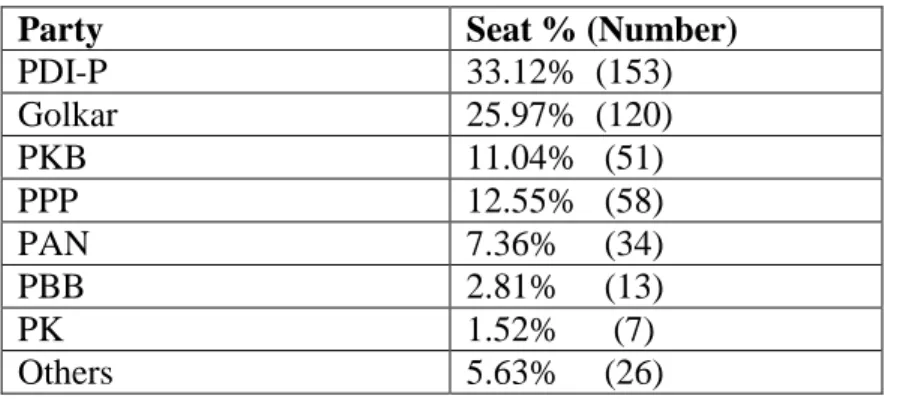
4.1 1999-2004 Party Seat Percentages . . . 120
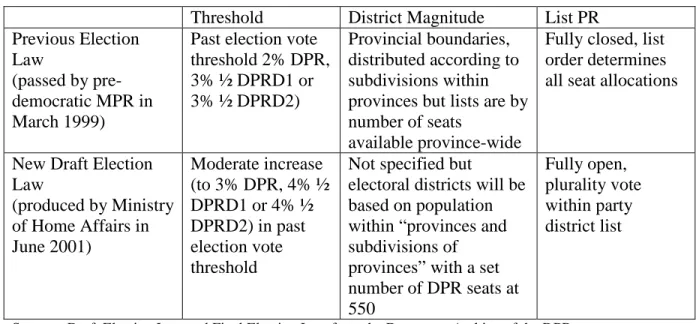
4.2 Proposed Changes in the New Draft Election Law (2001) . . . 125
4.3 Draft Election Law and Major Party Positions . . . 127
4.4 Change between Draft Law (2001) and Final Election Law (2002) . . . 146
4.5 2004 Election Outcome: Changes from 1999 . . . 150
4.6 Seat Distribution under SMD in 2004 . . . 159
5.1 2004-2009 Party Seat Percentages . . . 172
5.2 Proposed Changes in the New Draft Election Law (2007) . . . 174
5.3 2007 Draft Election Law and Major Party Preferences . . . 177
5.4 Changes from Draft Law (2007) to Final Election Law and Court Rulings (2008) . . . 195
5.5 2009 Election Outcome: Changes from 2004 . . . 203
5.6 Successful Candidates Under the Fully-Open Lists . . . 209
5.7 Seat Distributions at Different Levels of the Legislative Entry Threshold . . . 211
5.8 Individual Candidate Votes by Party . . . 213
6.1 Hypotheses of the Causes and Effects of Electoral Reform . . . 218
6.2 Cases and Observations . . . 222
6.3 Dataset Descriptive Statistics . . . 234
6.4 Replicating Estimates of Legislative Reform . . . 240
6.5 Estimates of Interparty Reform . . . 241
6.6 Estimates of Intraparty Reform . . . 244
ix 6.8 Summary of Hypotheses and Results:
Electoral Reform as Dependent Variable . . . 249
6.9 Replicating the Impact of Legislative Reform . . . 265
6.10 Including Intraparty Reform on ENPV . . . 266
6.11 Including Intraparty Reform on ENPS . . . 268
6.12 Including Intraparty Reform on Electoral Volatility . . . 270
6.13 Evaluating Reform on Disproportionality, Medium-Sized and Largest Parties’ Outcomes. . . 273
6.14 Summary of Hypotheses and Results: Electoral Reform as Independent Variable . . . 276
E1. Replicating Estimates of Electoral Reforms (Remmer 2008) . . . 320
E2. Replicating Impact of Electoral Reforms (Remmer 2008) . . . 321
x
List of Figures Figure
1.1 List of Indonesian Electoral Reforms . . . 7
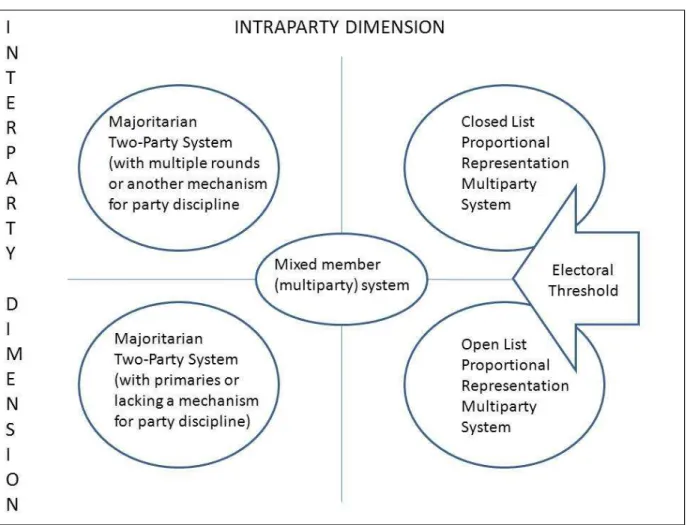
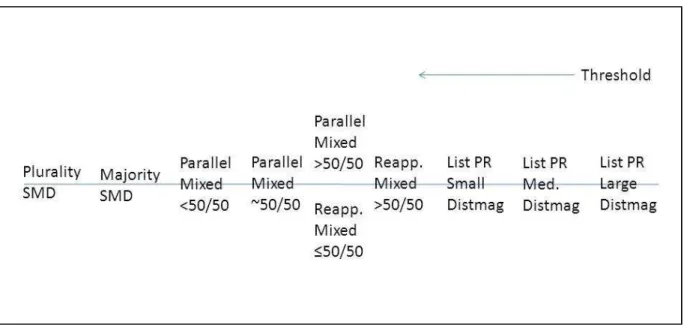
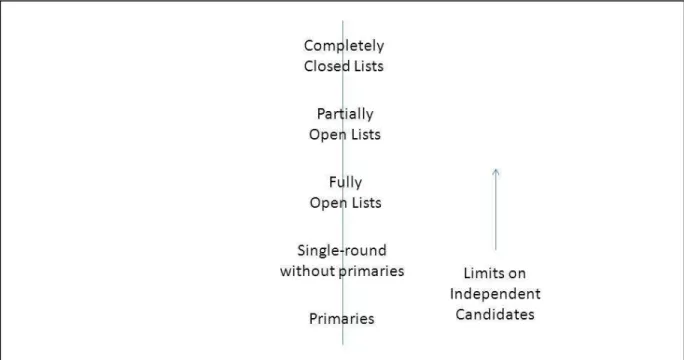
2.1 Dimensions of Electoral Reform: Intra- and Inter-party . . . 49
2.2 The Interparty Dimension of Electoral Systems . . . 50
2.3 The Intraparty Dimension of Electoral Systems . . . 54
2.4 Dimensions of Electoral Reform in Indonesia . . . 77
3.1 The Party System: The Secular Nationalist- Religious Islamist Continuum . . . 107
3.2 Percentage of National Legislative Votes by Party . . . 109
3.3 Percentage of National Legislative Seats by Party . . . 110
4.1 Change in Vote Differential by Party Size . . . 153
4.2 Average Party Magnitudes in 2004 Electoral Districts . . . 154
5.1 Change in Vote Differential by Party Size . . . 205
5.2 Average Party Magnitudes in 2009 Electoral Districts . . . 206
5.3 Small Party Seats without 2.5% Threshold . . . 210
6.1 Pre-Reform Placement of 33 Cases . . . 252
6.2 Post-Reform Placement of 33 Cases . . . 253
6.3 Single-Reform Case Trajectories . . . 254
6.4 Centrally-oriented Multiple-Iteration Cases . . . 256
xi
List of Abbreviations
Golkar Golongan Karya Party of Functional Groups
PDI-P Partai Demokrasi Indonesia Perjuangan Indonesian Democracy Party - Struggle PPP Partai Persatuan Pembangunan United Development Party
PKB Partai Kebangkitan Bangsa National Awakening Party PAN Partai Amanat Nasional National Mandate Party
PBB/PBB Partai Bulan Bintang (Bintang Bulan) Star & Moon (Moon & Star) Party PKS/PK Partai Keadilan Sejahtera (Keadilan) Prosperous Justice (Justice) Party
PD Partai Demokrat Democratic Party
PDS Partai Damai Sejahtera Prosperous Peace Party PBR Partai Bintang Reformasi Reformed Star Party
PPDK Partai Persatuan Demokrasi National Democratic Unity Party Kebangsaan
Hanura Hati Nurani Rakyat People's Conscience Party
Gerindra Gerakan Indonesia Raya Greater Indonesia Movement Party DPR Dewan Perwakilan Rakyat People's Representative Council DPD Dewan Perwakilan Daerah Regional Representative Council DPRD Dewan Perwakilan Rakyat Daerah Regional People's Representative
Council
MPR Majelis Permusyawaratan Rakyat People's Consultative Assembly
Pansus Panitia khusus Special Committee
Panja Panitia kerja Working Committee
KPU Komisi Pemilihan Umum General Election Commission Bawaslu Badan Pengawas Pemilihan Umum Election Supervisory Body Panwaslu Panitia Pengawas Pemilihan Umum Election Supervisory Committee KPK Komisi Pemberantasan Korupsi Corruption Eradication Commission Depdagri Departemen Dalam Negeri Ministry of Home Affairs
MK Mahkamah Konstitusi Constitutional Court
IFES International Foundation for Electoral Studies AUSAID Australian Agency for International Development USAID US Agency for International Development
NDi National Democratic Institute for International Affairs TAF The Asia Foundation
Chapter 1: Introduction
Why do some new democracies succeed in deepening and consolidating their political institutions and channels of representation while others fail or face severe instability? I argue that one primary reason for some states' successful democratic progress is their adaptability. When an electoral system creates instability in the political party system citizens will become frustrated with the capacity of elites to represent and govern them, but if the state can adapt its electoral system to mitigate such problems then democratization can continue. To be sure, the process of electoral reform can mitigate some problems, too much reform or reform undertaken with undemocratic goals can undermine progress. To achieve a better
understanding of the success or failure of democratization we must evaluate the process and effects of electoral reform, analyzing its potential benefits and limits.
A belief in institutional "stickiness" sustains most observers of politics: political institutions, particularly democratic ones, should be difficult to alter lest they be changed and abused at the hands of the power-hungry and powerful. The US Constitution is nearly impossible to amend and, while slow to reflect demographic and social changes in society, is highlighted as a bulwark of stability that keeps U.S. democracy out of harm's way,
2
andthreatened democratic chaos such that elites had to change the system back within a decade. The myriad of undemocratic reforms that have occurred in many transitional and consolidating democracies over the past few decades attests to the need for stability in institutional design and construction.
But democratization is a tricky business, failures are often unpredicted and the scope and breadth of failure are sometimes impossible to comprehend. The rollback of democratic practices, electoral competition, and respect for the rule of law in many countries, in addition to the erosion of political rights and civil liberties, suggest that, even when chosen with the best of intentions, democratic institutions are not perfect. When flaws are clear and exposed they should be addressed. This is not to suggest that every little problem with democratic function necessitates wholesale reform, but that some measure of flexibility can be used to rectify problems generated by the system itself. Does this open the door to a landslide of abuse by elites? Perhaps. But is there a way to navigate the narrow space between
productive, progressive reform and abuse? Undoubtedly. A handful of cases underscore this point, now the goal is to understand how and why they have succeeded, where they might have failed, and what general patterns and mechanisms we might glean from studying them.
Most scholarly work conceives of electoral reform as a strategic choice game, the byproduct of powerful elites attempting to consolidate democratic institutions in their favor.1 Such theories are frequently powerful, especially when employing large-N samples over time. These models can explain many general patterns but, in order to produce parsimonious theories, downplay or ignore the reform process and make broad assumptions regarding the knowledge and motivations of power-hungry, non-ideological actors and the competition-limiting outcomes they seek. There may in fact be cases where political elites do not enact
3
reforms for the simple power-maximizing reasons that strategic choice theories would predict.
One irony of such assumptions is that when considering the initial choice of electoral systems scholars are far less pessimistic about the nature of elites, who adopt a wide range of options from the electoral menu for a wide range of ideological reasons and logistic
constraints (Reynolds 2002; Reilly 2006). An entire field of electoral engineers have advised and consulted on constitutional revisions and rewrites over the past few decades in countries from Mongolia to Estonia to South Africa. Among the many considerations posed by advisors and adopted by elites when choosing the initial structure of institutions: will these institutions improve representation and competition and strengthen or deepen our
democracy? If scholars can accept that ideology and democratic performance matter to some degree at the initial stage of electoral system choice, why do they automatically discount its importance in the process of revisiting or revising those choices?
Additionally, the invitation to electoral engineers, international NGO advisors and domestic experts and academics suggests that many elites in new democracies are not themselves experienced or adequately prepared to make fully-informed decisions regarding the choice of electoral system rules and regulations. Indeed, the very presence of such actors indicates the likely gap between aspirations and knowledge, especially in democracies where competition previously did not exist or existed in limited fashion in the prior regime. Among the questions scholars might ask: how much do we really know about the level of knowledge and information possessed by political elites during the process of electoral reform?
4
provide little insight to the shape and scope of reforms eventually adopted. Previous literature demonstrates that ideological factors can play a role, such as in the adoption of proportionality rather than majoritarianism, and that the complexities of electoral system options can create misunderstanding or confusion among reformers in countries with limited experience with competitive electoral politics.2 In cases from Italy to Poland to Colombia politicians have adopted reforms for a diverse set of reasons, many of them reflecting ideological beliefs about the nature of elected representation, accounting for constituent demands and/or demonstrating what limited experience with electoral systems and structures can do to elite preferences and choices. I believe that Indonesia fits this type of case,
exemplifying the limits of strategic choice theories as its legislature has adopted
progressively more democratic reforms over time despite the desires of many power-hungry elites who might derail the reform process in any given period.
The foundation of seat-maximization models rests on assumptions that actors
undertaking reform: a) know exactly what they are doing, understanding not only the reform options they face but their likely effect on electoral outcomes as well; and b) only pursue reforms for resource-control/seat-accumulation reasons rather than ideological views about what might be best for democracy and the development and strengthening of democratic institutions and channels of representation.
The case in Indonesia does not fit these basic assumptions. Accordingly, I make two distinct arguments about the need for an alternative model of reform. First, in new
democracies there may be more diverse expectations about actor motivations and knowledge
2
5
to consider.3 Particularly in new democracies where many political actors have little experience with competitive elections and party politics but do have concerns about the durability of the new regime, actors themselves are likely to draw on a broader range of motivations and experience a lower degree of certainty than is the case in established
democracies. Instead of high information and seat-driven strategy, in many new democracies reformers may pursue ideological beliefs about the need for proportional representation in diverse societies or misunderstand the functional difference between parallel and
compensatory multiple tier systems.
Second, evaluating the process of reform -- how and why particular constellations of reforms are adopted at any given iteration -- is paramount to understanding the iterated nature of reform in new democracies, especially where the relationship between party system and electoral reform is endogenous. In the aggregate, reforms are often viewed in a snapshot "one case of reform at one point in time" example: the switch from an in to directly-elected executive in Israel in 1992, the switch from a list proportional representation to a mixed-electoral system in Italy in 1993, the switch from a mixed-electoral to a list
proportional representation system in Italy in 2005. Few reforms are viewed as the product of iterated processes, or as the result of multiple rounds of reforms about the same issues across election and reform periods. The Italian case is one of great importance in this regard. The return to a PR system came as the direct result of unintended consequences of the
previous switch away from PR -- a move meant to simplify the party system actually created greater fragmentation and thus reformers essentially "changed the system back" to a variation of the previous, less fragmentation-inducing, system.
3
6
Yet we rarely see analyses where a theory explains both the first round outcome and its impact on the reforms adopted in the second round, either explicitly related in terms of causal relationship or indirectly linked where the first reform constrains outcomes that lead to the second reform. In this sense, the iterated nature of the process requires conceptualization and explanation. Ratchet effects can constrain choices in later rounds of reform,
necessitating an understanding of the relationship to previous reform outcomes.
Additionally, if reforms occur over multiple periods it is important to understand why, in part because it is a relatively uncommon occurrence or may seem as such because we are making too many or incorrect assumptions about the reason reform occurs. For example, if there are new, unconventional, not exclusively strategic reasons for reform perhaps there will be more recognizable examples of iterated reform. Though institutions are typically assumed to be sticky, following the logic that once the effort to reform has been made it is difficult to make changes again, perhaps the question should be: if you can reform once why can't you reform again? If the past thirty years are any indication, with a number of countries
exhibiting iterated reform tendencies, understanding the rise of iterated reform is important, especially if there is some aspect of iterated reform that diverges from existing theory about one-time reform.
7
In addition to a richer understanding of the cause and effects of electoral reform, I extend this discussion of democratization to an important case: Indonesia. As the world's third largest democracy, the world's largest Muslim majority country, and one of the world's youngest democracies, it is surrounded mostly by countries with inconsistent, limited or non-existent democracy. Its progress has survived domestic conflicts in Aceh and Papua, ethnic and religious strife across the archipelago, and multiple large-scale natural disasters on an annual basis. Despite virtually no history of open and competitive elections before 1999 it remains Southeast Asia's most robust democracy and its path has evolved through multiple rounds of reform to the country's democratic institutions.
Figure 1.1 List of Indonesian Electoral Reforms
Pre-1999 (Regulations for the 1999 Elections) 1999-2004 (Reform from 2001-2003) 2004-2009 (Reform from 2007-2008) 2004-2009 (Constitutional Court rulings in late 2008)
2009-2014 (Reform from 2010-2012)
List Type Fully
proportional, fully closed Fully proportional, semi-open with high individual threshold Fully proportional, semi-open with moderate individual threshold Fully open, lists still ordered if voters cast their votes for just parties
Proposals: return to closed, keep open, switch to mixed or SMD District Magnitude Province-level with subdivided allocation District-level: 3-12 seats District-level: 3-10 seats
no change Proposal: district level of 2-7/8 seats Electoral Threshold Past entry threshold with low registration barriers Past entry threshold with moderate registration barriers Past entry threshold, legislative electoral threshold (2.5%) for national level Only legislative electoral threshold (2.5%) for national level Proposal: raise to 4-5% and apply to subnational levels
8
a non-ideological lens. Figure 1.1 summarizes the changes in Indonesia’s democratic electoral system.
While Indonesia's reform has occurred with each new set of elections (three since 1999) these have not been democracy-undermining changes. Indonesian democracy is arguably more robust today than it has ever been, with greater inter-branch balance (a
directly-elected president replaced the parliamentary-style executive), declining party system fragmentation (shrinking from 21 to 16 to 9 legislative parties), and peace (resulting in part from much-improved civilian control over the armed forces). Amidst the decline of
democracy across its own regional trade circle, Indonesia is the sole country to demonstrate improvement in the quality of its democratic institutions throughout the past decade. Indonesia is also unique as the world's only Muslim majority democracy not bordering the European Union, achieving Freedom House "free" status six short years after democratizing, and is the sole "free" democracy in a region full of authoritarian, electoral authoritarian and lapsed or defective democratic regimes.4
This dissertation evaluates the actor-specific motivations and structural factors that constrain and enable electoral change over time, by analyzing the ongoing process of institutional reform occurring over multiple electoral periods. In doing so, it is critical to carefully measure and evaluate, through a mixture of qualitative and quantitative methods: 1) the institutional constraints faced by elites at the time of reform initiation; 2) the assessments of elites regarding electoral reform options via their seat-maximizing self-interests and
4
9
beliefs as well as their understanding of the structure and consequences of potential reforms; 3) the choices and behavior of political elites when initiating and negotiating electoral reform packages; and 4) the balance of power among parties and elites in the decision-making process as that balance changes to reflect new electoral outcomes. In addition to
reconstruction of the reform process at each stage of negotiations up to the resulting law and election, I analyze the electoral results to assess the effect of reform on the election outcome.
A multi-method approach is necessary because explaining the process of institutional change and how new choices are made within the previously-chosen institutional structure are two closely related questions. While quantitatively measurable factors can explain much about power balance among decision makers, I argue that not only the power balance
between but also the ideological and electoral interests of such actors, as well as their level of knowledge and understanding of the issues they debate, are important to understanding the exact package of changes adopted at any one iteration of reform. Ascertaining such ideological and electoral interests requires a qualitative approach in a system where party discipline and legislative experience cannot be assumed to be high and where the interests and impact of bureaucrats and civil society leaders involved in the process of reform cannot be quantitatively measured. A quantitative approach is more appropriate for examining how reforms affect election outcomes and redistribute power among future decision-makers by altering the rules of the electoral game.
10
sought by reformers; yet reforms that happen in an iterated sequence may generate stabilizing party system effects over time. Strategic choice theories that focus on seat maximization often provide satisfactory explanations for such outcomes in the aggregate, making those models a baseline for such analysis. However, while my alternative explanations may be less parsimonious, they can offer a richer understanding of how electoral reform works in many of the world's youngest democracies, clarify why parties sometimes do not exclusively pursue seat maximizing strategies, and can inform future cases of reform as well.
I focus on two key areas of electoral reform in my approach to understand
institutional transformation: the structure of intra- and inter-party competition. The first area concerns the subjects of voter attention, or intraparty competition: how does the system define who are the competitors in elections? While it is possible for the competitors in elections to be both party and candidate, some types of electoral structures effectively remove the role of individual candidacy for legislative office. Thus, the first area under consideration when I focus on Indonesia is the changes made from a party-centric closed-list proportional representation system based on provincial-level districts inherited from the pre-democratic era to a system subsequently more open with smaller and smaller districts that have moved the focus much more to candidates while retaining priority for parties on multiple levels.
11
truncation) of the party system. Thus, the second area under consideration is changes made from an easy-entry system at both the stage of entering the electoral arena and entering the legislative arena to a system subsequently more closed on legislative entry while still open in electoral entry. These two areas – the structure of party nomination lists and the structure and application of an electoral threshold – are the sections of the election and political party laws that are the focus of this dissertation. As each area has undergone multiple changes since democratization (both were the subject of discussion and revision for the general election and political party laws in 2004 and 2009, and are both under active discussion for further revision for the 2014 elections), they represent an opportunity to evaluate multiple-iteration reforms in consecutive inter-election periods, yet have been the subject of different pressures over time.
The research design draws upon a combination of three primary types of data: archival, interview, and election-related. The process tracing of the reforms is analyzed via: a) archival documents of the draft and final versions of the laws as well as pertinent
Constitutional Court rulings related to the laws; 2) position papers submitted by each party or party coalition in reaction to the initial draft of the law and transcripts of the legislative committee proceedings during the drafting negotiation stages; 3) newspaper and journal coverage of the reform process; 4) and interviews with participants (legislative
12
elections; and 3) composition of the national legislature based on final seat allocations from the Election Commission, including both the size of each party as well as which
representatives obtained seats.
Chapter 2 reviews the literature, introduces my theoretical framework of integrated electoral reform and discusses the impact of such a reform model on the resulting political party system. Following the literature review I begin with a discussion about reforms, specifically the contrast between seat-maximizing and alternative motivations and ratchet effects that constrain choice in iterated reform. I continue to a discussion of the dimensions that reforms take as well as the complications of evaluating cross-temporal reform processes. I then introduce my framework of reform suggesting that, although seat-maximizing logic that motivates nearly all other scholarly work on reform has merits and can explain a great deal about most reforms that occur, the roles of alternative motivations and constraints must be integrated in order to evaluate their impact on the outcome of the reform process. I provide a set of testable hypotheses regarding the causes and effects of electoral reform and conclude with a brief explanation of the selection of the Indonesian case.
13
Chapters 4 and 5 cover the periods from 1999-2004 and 2004-2009, incorporating both qualitative data, reconstructing the reform process using original legislative committee transcripts and in-depth interviews with key reform actors and observers, and quantitative analysis, drawing on election outcomes to assess changes to the party system's composition. Each chapter first begins with an assessment of the existing electoral structure and party system composition resulting from that structure. Then it introduces the key actors during the reform period and explains the initial draft of proposed reforms with each major component under revision. Following a description of the initial position of key
actors/parties at the outset of reform I process trace the negotiations between the legislative commission members and their various parties as well as the input from the Ministry of Home Affairs, the government's representative in the electoral reform process, and various experts and civil society groups.
14
official party caucus (fraksi) positions on the draft laws. These were read and coded to assess the different party positions on the key sections of the laws (e.g., which parties supported the electoral threshold, which did not, which wanted a level above 3%, which wanted below 3%), as well as to assess the specific reasons given during commission review meetings to justify such positions and to negotiate over specific details (ie., the exact
percentage a party needed to cross the threshold, etc).
Third are newspaper, journal and policy report coverage of commission deliberations, party positions on the draft laws and judicial reviews, civil society views on the deliberation process and final laws. These documents were read and coded to triangulate the data yielded from the archival documents and transcripts as well as from interviews. Fourth are
interviews with: a) members of the People's Representative Council (DPR, Dewan
15
selection, and public opinion polling. The transcripts of interviews were read and coded along with interview session notes to assess specific reasons for decision-making during the reform periods and changes over time in party positions on reform and election strategies.
Chapter 5 also includes an explanation of the post-adoption Constitutional Court decisions that further altered the election law after the legislature had finished its reform process, and the impact and implications of Court decisions altering the outcome of legislative choices and the entire process of reform. All commission transcripts, position papers and adopted laws were personally obtained in Jakarta at the library and document archives of the People's Representative Council, news coverage through a variety of
university-based archives, and draft laws and court decisions through individual contacts at the Ministry of Home Affairs and Indonesian legal databases. All interviews were held in person in the Indonesian language, in the cities of Jakarta, Serang and Yogyakarta, from January through December 2010.
16
geographic trends. I also utilized election district maps, including province and district lines from 1999, 2004 and 2009, coded by party and, where applicable, individual vote and seat shares for the purpose of calculating cross-temporal vote and seat volatility for each party as well as to assess the level of regional concentration of parties failing to meet the electoral threshold in 2009. All quantitative data was personally obtained in Jakarta at the central office of the National Election Commission (KPU, Komisi Pemilihan Umum) and at the library and document archives of the People's Representative Council.
Chapter 6 presents an original dataset of 34 countries which experienced some electoral reform during the 1950 to 2010 period. I test my expectations about the causes and effects of electoral reform on this dataset, using insights drawn from the Indonesian case to illuminate limitations in the statistical analysis. I find that while seat maximization is of utmost importance to explaining reform adoptions, there is some support for the constraints of alternative motivations and ratchet effects on unfettered alterations by power-hungry elites. In addition, I find that a long-understudied element of reform, change on the intraparty dimension of electoral systems, does in fact have an impact on party system
fragmentation. The conclusions of the quantitative analysis highlight some important aspects in the Indonesian case regarding confirmation of some aspects of seat-maximization theories, as well as some limits.
17
Chapter 2: Theory
Though electoral reforms may be discussed in long-standing democracies they are rarely employed. Oftentimes constitutional framers prioritized continuity within the system and set the bar for reform very high, especially with respect to alterations in electoral
mechanisms. Experiences of recently democratized countries, notably in Latin America, the Former Soviet Union, and Southeast Asia, suggest the benefits of institutions that are not easily changed. In systems lacking institutional “stickiness” powerful executives may exert their will over legislatures too weak or slow to halt the process of institutional reform, resulting in undemocratic reforms such as the elimination of presidential term limits or central government appointment of previously-elected governors. Even in advanced
democracies the benefits of institutional stickiness can be clear: Italian reforms in the 1990s exacerbated rather than alleviated fragmentation within the party system; since those reforms achieved none of their intended benefits, subsequent revision in 2005 produced electoral rules that closely mirrored the rules of the pre-reform period in an attempt to rebalance and re-stabilize the party system.
19
the Bundestag underwent revisions in the first two elections after the East-West partition. In many of these cases, the reform processes were either directly, as they were in the case of Italian reforms of 1993 and 2005, the result of previous reforms or constrained by the outcomes of previous reforms. It is cases in which reforms occur in sequence or over time – the details that make them increasingly common and different from other examples of single-event reform processes – that will be the focus of this chapter.
There are reasons to be concerned with electoral reform for the purpose of democratic governance. First is the question of institutional stickiness: if institutions can be easily manipulated then there are implications for whether elites are really constrained by democratic rules of the game. Second is the question of effective representation: if rules constantly change then there are implications for voter understanding of the rules being used to determine representation. Third is the question of free and fair competition: while changes in the rules may not openly constrain the quality and/or quantity of election competitors, frequent or extreme changes may negatively affect some subset of the competition disproportionately or unfairly, such as minority parties.
20
First, institutional structure is important because certain electoral rules can provide limits on possible reform outcomes and general propensity to maintain the status quo or something similar (for purposes of stability, institutional stickiness, etc). For example, reforming the Electoral College in the United States requires a constitutional amendment. This is an institutional structure that constrains reform possibility because passing an amendment is extremely difficult, as 2/3 of US states must ratify the amendment after Congressional adoption and surviving a presidential veto, and not one of the 700 proposed amendments to reform or eliminate the Electoral College has passed. It is important to understand why some options are never or no longer available since rules may constrain any reform possibilities or previously adopted structures may have eliminated particular voices (ie., small parties who no longer have a voice or vote after the institution of an electoral threshold) and any ideological profiles of those voices. Previous institutional choices can limit the size and fragmentation of the party system or affect coalition incentives, making some outcomes more or less likely to occur in the process of adopting electoral reforms.
Second, motivations include electoral self-interest and power calculations as well as ideological beliefs about the nature of representation and the state. Such motivations may also be affected by how well actors understand the "menu" of electoral system options they can choose from and whether their perceptions about likely outcomes alter the nature and extent of reforms they pursue. Previous institutional choices may affect the level of party cohesion, the number of ideologically-oriented party representatives, the number of
21
likely to succeed under different electoral rules and how, once those types of legislators are removed from the decision-making process, their absence may take an entire set of reform options off the table or may deplete the institutional memory of previous reform negotiations and outcomes. For example, elites who can win a popular, candidate-centric campaign might exhibit different interests for future elections than party members who typically receive their nominations based on internal party hierarchy or legislative discipline. Additionally,
motivations may include a particular view of the nature of representation and the state or a particular view about the role of different agencies in election conduct and decision-making. Such motivations are likely to be affected by who actors feel they represent: government bureaucratic agencies, civil society, and international and domestic NGOs all may play a role in the process of reform.
22
the introduction of my framework with an in-depth discussion of the primary concepts involved in the electoral reform process, including the dimensions of reform, types of reformer and the role of time and path dependence in the process of constraining reform outcomes. Finally, I explain my expectations about the relationship between reformer motivations, relative strength and path dependent constraints, and eventual reforms adopted as a set of hypotheses to be tested in the following case study chapters and finally with an original dataset of 34 democracies across the globe.
The Existing Literature
Initial conditions were once considered the most important explanatory factor in democratic transition and consolidation, focusing on the preparedness, resources and organizational capacity of opposition members capable of wresting power away from the incumbent political elites (e.g., Vachudova 2005) or the importance of constitutional design at the time of transition to democracy (Reynolds 2002). Among others, Kitschelt (1994) and Bratton and van de Walle (1994) look to the structure of pre-democratic regimes as
23
design in conflict mitigation, but these tend to emphasize the initial choice of institutions rather than focus on the process of reform.
Now there is also a growing field of study that assesses dynamic processes in the development of democracy, focusing on evaluating and understanding the importance of the causes and consequences of institutional changes on political parties and party systems. Because the short-term effects of institutional change can be powerful in many new democracies, this type of research is essential for explaining the evolution in their party systems. The majority of the literature on institutional change focuses on two primary questions: what factors lead to institutional change and how do these changes shape political outcomes (Roett 1995; Saez 2002; Thelen 2004; Ostrom 2005)? Though the literature on party systems and electoral laws suggests a causal interactive relationship between the two (Roberts & Wibbels 1999; Marks & Wilson 2000; Hicken 2009), most studies only consider electoral laws as “sticky” independent variables that determine the shape and characteristics of the party system (Cason 2002; Dietz & Myers 2007).
In long-standing democracies, scholars have identified four causal explanations for the pursuit of reform by political elites: 1) expansion of the franchise which creates new interests in the voting population, 2) change in voter preferences regarding interests and party support, 3) public opinion favoring reform, and 4) an ineffective/inappropriate existing system of government. The first three explanations are based on largely strategic goals – as the playing field shifts among and/or within parties, winners will seek to expand and losers will seek to shore up their respective electoral slices of the pie by altering the electoral rules of the game to their advantage or acquiescing to reforms in order to appease the public.5 The
24
fourth explanation is based on largely ideological goals.6 For example, methods of representation may be viewed as insufficient or inappropriate for the state, such as a plurality-based system that drastically ignores minority issues because small parties and specific group interests go unrepresented. Another example is that methods of representation are inefficient for the state, such as a proportional system in a large and diverse state with no electoral threshold produces dozens of legislative parties that have no hope of coalition-building or consensus mechanisms to encourage efficient, expedient or effective governance.
Studies drawing upon this latter explanation focus not only an alternative causal mechanism for electoral change but also tend to focus on changes to electoral systems that were less common prior to the 1970s. An entire literature devoted to mixed-member electoral systems, which have been some of the most frequently adopted systems in both established and new democracies for the past thirty-five years, discusses change that has in fact occurred in established democracies even though they are, as noted, unlikely to reform. These theories primarily posit that systems themselves are inherently predisposed, by the lack of balance or "electoral efficiency" within the system, to reform but still often seek case-specific factors that make change inevitable or unlikely in each reform scenario and are built on power-based motivations that provide the final 'push' for reform. Scarrow (2001), Katz (2001; 2005), Rahat (2001; 2008), Reed & Thies (2001a; 2001b), and Moser and Thames (2001) are a few who address changes in both new and old democracies from majoritarian or proportional systems to ones that combine elements of both.
The logic of the shift to mixed-member systems results from the extremism of the previous system's rules: those systems that are extreme in one or more dimensions of inter- or
25
intra-party competition are predisposed to reformist pressures that require only a small trigger from actors (elites or voters) to ignite calls for change (Shugart 2001). Shifts to mixed-member electoral systems had been infrequently, with the exception of Italy, subject to further system reform, in part due to the reform's capacity to reduce or eliminate the extremism that was the underlying cause of reformist pressure; in these cases once the reform is adopted it is unlikely to 'need' to adopt other reforms. These tend to be systemic shifts that result from a disbelief in the ideological trajectory of extreme electoral systems, and despite the power calculus that triggers the actual reform, is rooted in some measure of ideology about the nature of representation. The post-communist region now has additional examples of movement away from mixed-member systems in Albania, Croatia, Macedonia, Russia, Ukraine and Bulgaria, the last two of which both switched from mixed to proportional systems only to switch back to the mixed systems within a decade or two, respectively.
However, the dominant trend in the literature on institutional change focuses on the role of strong parties or “winners” in democracy who revise the rules of the electoral game to favor their current advantage and push for such changes at the point when they are the strong and can attempt to capitalize on their relative strength.7 This literature on strategic choice models of electoral reform suggest that reforms are undertaken at the point when one party or coalition sees an opening to consolidate their power (Bawn 1993; Benoit 2004; Colomer 2005; Remmer 2008; Boix 1999; 2010;). This point can be when party system fragmentation and/or electoral uncertainty are high or increasing, before dominant parties or actors become
7 In some ways, these explanations are similar to Vachudova (2005) who argued that the most consolidated
26
“locked-in” (Mahoney and Thelen 2011: 3) and competition within the party system becomes more institutionalized and self-reinforcing.
According to these models change is more likely to occur when there is instability or uncertainty because in stable systems there is little incentive to challenge or alter the status quo or little reason to assume that change will necessarily be beneficial relative to the status quo. Uncertainty alters actors' perception of the value of change, either to consolidate an already strong position because of perceived new weakness to competitors or to shore up a vulnerable position because of perceived new threats from competitors. Without this uncertainty, there is little reason to suggest that change will benefit the instigator any more than the status quo already has, since seat-maximization is the only goal being pursued.
The early work in this body of literature tended to see strong parties, especially strategic ones, as the most ardent supporters of maintaining the status quo in the electoral system because it favored their retention (Bawn 1993; Boix 1999; 2010). Bawn (1993) addressed German electoral reform, explaining the choice of electoral systems as a rational bargain between parties concerned with their own chances of participating in government. She assumes strategic logic among potential reformers where they consider whether changes to the system will benefit their electoral seat-share and, secondarily, whether it will benefit like-minded potential coalition partners with whom they can assume the role of government formation. Beyond most strategic choice logic, there is an underlying assumption that
27
Assessing the more generalizable factors driving party system formation in post-war Europe, Boix's work more directly addressed cross-national comparisons of reform pursuits. He posited that maintaining the status quo is the most desirable of positions for ruling parties with respect to the electoral system and that changes to the electoral arena predispose the ruling parties to alter the system. In particular, two factors changed the electoral arena in such a way as to make ruling parties take notice: the entry of new voters and changes in voters' preferences. When either or both of these factors caused the creation of new parties sufficiently strong enough to challenge the ruling party or parties, as in the case of rising social democratic party support, proportional systems were adopted to ensure that previous rulers could remain a viable part of the system. When only weak new parties were created, the status quo was maintained.
Subsequent literature built on this earlier work, positing that the uncertainty of strong parties produces maintenance of the status quo as powerful actors are afraid to push for change that may result in the empowerment of their opponents (Benoit 2004; Colomer 2005; Remmer 2008). In this newer literature, institutional change is the byproduct of shifts in the competitive positions of parties where such changes serve as attempts to reinforce the status quo rather than create new patterns of political representation, arguing that party system volatility is both precursor to and byproduct of reforms. These scholars sought generalizable and testable theories of the driving factors behind electoral reform adoption.
28
this hyper-rational game-theoretic model, including its application to transitional and new democracies likely to suffer from a lack of clarity about who makes the decisions about the electoral system or perfect information on the part of elites (Benoit 2004: 384-385).
An early foray into cross-regional and cross-temporal empirical tests of the strategic motivations for reform, Colomer finds that the emergence of multi-partism encourages pressures for greater proportionality in the system, rather than simply assuming that party systems emerge from the electoral structures that constrain them (2005). The take-home aggregate message is that electoral uncertainty will result in perpetual pressures for systems based on more proportional, “less risky formulas” (2004: 4)8. His cross-national analysis does not find that the introduction of more proportional electoral rules creates greater multi-partism but instead only confirm the changes in the system that created the initial pressures for proportionality-based reform. In sum, outcomes do not necessarily reflect greater proportionality or more inclusion of smaller parties in the post-reform period but a lower level of disproportionality between votes and seats won.
In a more exhaustive statistical evaluation of recent democratic transition cases in Latin America, Remmer’s study finds that the choice of more or less proportional reforms results from changing the level of certainty of parties driving reform: in the case of rising party system fragmentation smaller parties will push for greater proportionality while in cases of declining party system fragmentation larger parties will push for greater pluralism in seat distribution (2008)9. Her analysis, similar to Colomer's, reflects the importance of changes in the party system driving reform pressures in the electoral system, despite a lack of
8 Colomer uses the term “inclusivity” rather than “proportionality” to reference the motivation that parties seek
to be included or seek to exclude others..
9
29
systematic discussion of what drives changes in the party system or whether party systems experiencing little change would ever reform. Her analysis is not confined to legislative but includes direct executive electoral reform as well, a potentially complicating factor in
assessing the strength of strategic logic when it might be unclear who makes the decisions or holds veto power over reforms.
More recent critics of the 'strategic choice' logic have pointed to two other factors that can contribute to the shape of electoral reforms: mass intervention and opinion about the need for certain reforms and coalition partners who may limit (ab)use of reforms adopted for purely political gain. Renwick (2010) suggests that voters' desires are more important than simple strategic choice logic assumes, and that by incorporating what we know about voters and their ability to influence political elites, we gain a more nuanced understanding of how and why they sometimes make choices that appear to contradict some of their power-oriented best interests. In similar fashion, Renwick et al. (2005) follow the theoretical example of Bawn (1993) in suggesting that coalition partner interests will also constrain elite reform pursuits. If a necessary coalition partner will not benefit from reform it may restrain an elite from adopting such a reform because the longer-term costs (ie. loss of a coalition partner who may be necessary for legislating or government formation) of reform may vastly outweigh the short-term seat benefits. Yet, these theories still suggest that power calculus remains at the heart of all reform decisions, and is simply accounting for the pressure of public opinion to avoid losing votes.
30
involved with the process of reform (Katz 2011) or the strategically optimal choice was not taken by the dominant party in the negotiations over revisions to the electoral system (Norris 2001). From case studies (Birch et al. 2002; Pilet 2007) to cross-national comparisons (Bowler et al. 2006), it is clear that the values and ideologies of reformers can and do affect the specific package of reforms adopted, as well as the desire to revisit reform in the future.
Explanations of reform adoptions in Italy and Japan in the early 1990s clearly point to ideological goals among reformers and mass publics. In the Italian case, reforms adopted in 1993 shifted the system from list proportional representation to a mixed-member
proportional system. The reform resulted from pressures to reduce excessive fragmentation in the overwhelmingly-large Italian legislature (630 seats in the lower chamber alone) that threatened to perpetually deadlock governments and hamstring effective governance, let alone representation (Renwick et al. 2005; Renwick 2010). The electoral outcome actually produced even greater party system fragmentation, with more parties receiving larger (but still relatively small) shares of the seats than in the immediate pre-reform elections. In response to mounting frustrations by members of parliament and party leaders alike, in 2005 the Italian system passed a new electoral law reverting to a system that largely resembled its pre-pre-reform structure. However, neither of the reforms actually benefitted the larger parties in clear terms, while the debates and public discussions regarding reform took a predominantly ideological tone with respect to representative yet effective government (Katz 2001; Renwick 2010).
31
and unresponsiveness among the leaders and high-profile members of the perpetually-ruling Japanese Liberal Democratic Party (LDP) led to mounting public pressure for some type of reform (Reed and Thies 2001a; Christensen 1994). In 1993 the Japanese Diet adopted an electoral law providing for the introduction of a parallel balloting system on which each voter could choose a single-member district representative, as in the pre-reform single
non-transferrable vote system, as well as cast a single party vote which would “top up” each party in proportion to its share of the party-list votes. The adoption of a parallel, rather than a more proportional, system represents concessions by reformers to the goals of some LDP
leadership (Reed and Thies 2001a: 168). However, splits and pro-reform elements within the LDP, as well as strategic interests of the opposition party members, forced a change from a purely majoritarian system, as the initial LDP plurality plan in 1993 would have assured, to one with some measure of proportionality (Cox and Rosenbluth 1995; Sakamoto 1999).
32
For example, intraparty reforms have not often been considered to carry particular importance since they are assumed to not have an effect on the distribution of seats among the reformers but within subsets of reformers (Hazan and Rahat 2010), despite knowledge that parties do not bring unitary goals or expectations into the negotiations (Blais and Shugart 2008). Recent studies have included other reforms that might alter effective representation, such as electoral mechanisms to increase symbolic or identity representation with respect to cross-cutting cleavage groups (Htun 2004; Krook 2009; Celis, Krook and Maier 2011), without a clear impact on the inter-partisan power balance. As surmised by Leyenaar and Hasan (2011: 447), “ ‘non-major’ reforms can indeed have major consequences for the functioning of democracy” and warrant further investigation.
The Central and Eastern European cases demonstrate a combination of strategic and ideological logic employed by reformers during processes of iterated electoral reform. Birch et al. (2002) put forth a framework of “contextualized rationality” in which strategic
calculations are the basis for most reform pursuits but that in the post-communist transition environment contextual factors of historical legacies, ideological goals and perceptions of alternative choices will matter (13-18, 23). More specifically, the contextual factors will determine the “menu of choice” while the rational choice logic will determine what
constellation of reforms are eventually adopted (23). Most notably in the Central and Eastern European cases we finally encounter examples of repeated reform in the transition and
33
process that both formed political actors and was formed by them” and marks a clear departure from envisioning the process of electoral reform as exclusively the dependent variable (Birch et al. 2002, 178). Bielasiak and Hulsey (2009) suggest that in the context of post-communist democratization and electoral reform there is an inclination by reformers to pursue conservative (i.e. less deviation from the status quo) reforms with greater frequency, rather than jump into a single large-scale overhaul of the system.
In the Polish case institutional problems, notably the lack of perceived “genuine political competition” in the pre-1991 electoral framework and the problems of seat allocation in the post-1991 electoral systems, served as the basis for early reforms that occurred prior to each new set of elections. In Romania the ever-increasing threshold sought to gradually limit the size of the party system during the 1990s, coupled with general media and popular discontent with politics near 2000 that prompted discussions of a majoritarian-based electoral system. In Russia the reforms seem to have eroded democratic governance over time, including constant pre-election tinkering of the election laws and the adoption of a mixed system that heavily favors the largest party in the system. Finally, in Ukraine the process of reform was extremely delayed as party-centric forces fought the central
administration and executive for greater control over the process of candidate nomination and selection, pushing back the first attempt at post-1989 electoral reform to 1998 with a shift from a majoritarian to a mixed electoral system. In many of these cases scholars have referenced a combination of ideological and strategic choices in determining the reforms adopted at different stages of the process (Birch et al. 2002, 187).
34
(Shvetsova 2003; Andrews and Jackman 2005). Elites in these cases often had limited experience with electoral competition, failing in many instances to understand the complexities of electoral formulae or to accurately estimate the impact of certain reform options. These information-limited contexts are presumed to have a constraining effect on the ability of actors to make strategic decisions that can be observed in the aggregate: namely that while perhaps still motivated by strategic pursuit of votes and seats, parties may be making uninformed decisions which they perceive to be in their best interests but in reality leave them worse-off with respect to representation. Studies of cases in this region in this time period point to factors related to high party system uncertainty, with constant new entrants, high volatility and a short history from which to glean public support and opinion information to make informed prediction (Remington and Smith 1996; Kaminski 2002; Shvetsova 2003). Factors in these post-communist cases are likely to be issues in many other cases of new democracy where electoral competition faces levels of uncertainty and poor information not typical in established democracies with stable rosters of competitors and widely-understood rules of the electoral game.
35
systems deemed by many political observers and elites to have too few or too many parties. And in a refutation of most of the logic that systems will trend toward greater proportionality over time, the Czech Republic, Slovenia and Romania have all recently pursued, with
varying levels of failure, more majoritarian components of their electoral systems (Nikolenyi 2011). Common factors cited by authors of failed reform evaluations suggest the powerful veto of courts and high barriers to reforming electoral laws or amending constitutions; component such as these in many cases were put into place by drafters of the democratic institutions to combat or prevent reform in the first place. This turn in the literature to examination of reform failures brings us full circle to early scholarly justifications for the promotion of institutional stickiness.
Testing the Conventional Wisdom
36
proportional reforms result from increasing uncertainty, which are the expected relationships based on the seat-maximization literature.
Of the eighteen cases of more majoritarian reforms, eight occur following a decline in the party system size (the expected relationship) and ten occur following an increase in the party system size; of the twenty-one cases of more proportional reforms, nine occur following an increase in the party system size (the expected relationship) and twelve occur following a decline in the party system size. Thus, of the 39 episodes of reform, seat-maximizing logic correctly predicts seventeen cases for a 44% accuracy rate in predictive power. This means that, albeit in a very simple model that does not control for additional factors, a coin flip (50% probability) has a better chance of predicting electoral reform than seat-maximizing power. The simplicity of the model, measuring aggregate party system dynamics rather than calculations of individual parties, may inhibit its predictive capacity – I will investigate this possibility in the following chapters.
What might account for the seemingly poor predictive capacity of seat-maximizing logic, long heralded by the literature on electoral reform as a theoretically plausible and empirically demonstrated explanation? I argue that existing empirical tests of seat-maximizing strategies have suffered from shortcomings related to both theoretical and methodological issues, which I will address in the next section.
Limitations of Existing Theories and Empirical Tests
37
reformers, a lack of attention to the limited knowledge and understanding possessed by elites in new democracies about the electoral menu options they face, and a lack of attention to the potential for path dependent effects on the trajectory of reforms in long-term or iterated processes. Methodological concerns include a disregard for impact of the intra-party dimension of the dependent variable of electoral reforms, a misinterpretation of the most appropriate method for temporally classifying observations, and misinterpretations of the outcomes in statistical models that are underspecified and suffer from case-selection problems. I will first address the theoretical issues followed by methodological and measurement problems in prior empirical analyses, and then will proceed to offer my solutions to both in the remainder of the chapter.
First, most existing explanations take the theoretical perspective that the relative bargaining power and potential for exploiting reform outcomes levied by parties within the system determines the outcome of institutional choice: parties make decisions almost entirely based on electoral, rather than ideological or even policy-oriented, calculations. These perspectives may gloss over the possibility that leaders pursue reform for other reasons, such as a desire to simplify the party system to encourage more cohesive coalitions or robust competition (Birch et al. 2002). While the pursuit of more ideological reasons may dovetail with the more self-interested ones, which are undeniably a driving force behind institutional change, they nonetheless deserve consideration in light of the fact that many institutional reforms that appear to defy purely electoral logic and result in the favorable consolidation of a single party or coalition's position of power. Strategic choice logic also suggests
38
there may be more room for ideological goals as well.10 As such, consideration of both the complementary and contradictory power of strategic and ideological motivations should be considered to a greater degree.
Second, two assumptions made about models of reform narrowly or incorrectly reflect the political world. The first is that political elites fully understand and can accurately assess the likelihood of a range of outcomes for each reform option under consideration. While elites tend to be more educated relative to the average voter with regard to the electoral formulae that translate votes into seats, assuming that all elites, especially those in new democracies, share an equal capacity for such calculation is problematic and likely incorrect (Andrews and Jackman 2005).
The second is that reforms can occur in a sporadic fashion, as a simple self-interested response to changes in the electoral landscape or as a means to correct miscalculations with respect to expected reform-induced outcomes (Hartlyn and Luna 2007: 12; Kuhonta 2008). This could also be iterated reform by self-interested elites seeking short-term gain and who are constrained by their legislative power. Where reforms are iterated, with changes occurring in the same area over multiple time and electoral periods, programmatic interests may be at play that either complement or contradict purely electoral interests. Automatically assuming self-interest likely does not explain why we see iterated change, since correcting for miscalculation in later periods need not reflect purely power-based motivations but the desire to fix representation and accountability concerns as well. While I address the issue of over-time reform, systematic evaluation of the effect of elite mistakes on the reform process is beyond the scope of this dissertation.
10
39
Finally, it would be difficult to consider the causes and consequences of iterated rounds of electoral reform without the context of institutional “stickiness” and difficulty in democracy of rolling back reforms that voters may have grown accustomed to or desired very much. The question of path dependence must be narrowly11 and explicitly addressed within this particular research agenda: did the decision to pursue change in one area effectively eliminate the chance for other changes in the future?12 One example of this may be the way the executive is elected: once the decision has been made to directly elect the president it may be difficult if not impossible to revert to an indirectly-elected executive since the person/party holding the presidency is unlikely to give up the office or the choice may have originally been the result of popular opinion and thus any other elected official would not propose a reversion and risk her future electoral success.13 If reform can only occur once then this type of path dependent consideration would not matter since the elimination of future options is moot. In the context of iterated reforms, how choices in early periods eliminate or constrain options in later periods must be considered.
With respect to methodological and measurement issues, the first cause for concern is the exclusion in all cross-national studies of the intra-party dimension of reform. Partly due to the influence of Lijphart’s schema of measurable electoral reform on the interparty dimension, authors of multi-country analyses have only aggregate changes occurring along the majoritarian-proportional continuum with no regard for changes in the processes through which individual elites receive seats allocated by the electoral system. Though Shugart and
11 I use a narrow definition of path dependence as a process in which a choice made at time t does not
predetermine events at time t+1 but reduces the likelihood of some possibilities from occurring at time t+1.
12 For a discussion on the importance of path dependence to studying historic and dynamic contexts see
Pierson, 2003; 2004; Mahoney, 2000; Hartlyn & Luna, 2007; Munck, 2004.
13
40
Wattenberg (2001) introduce the second dimension of reform and attempt to systematically assess change along it, their priority is to evaluate the causes of reform and so they do not take the step of systematically evaluating the impact of either interparty or intraparty reform on electoral outcomes and party system change by country. All previous discussions of the intra-party dimension of electoral reform have come from single case studies that tend to point to the unique party or leadership factors that drive those choices rather than systematic or generalizable factors. Including such variables in statistical models to test the causes and effects of intraparty reform only requires the coding of an additional variable to replace or complement the interparty variables, rather than requiring an entirely new set of models to test theories about the cause and effect of reform.
Second, the process of coding observations of reform has suffered from both over and under specification. Annual data, especially when coded for independent variables that do not or rarely vary annually, such as party system size and change in party system size, overspecifies the effects of contextual variables and is an inappropriate way to code
observations even if reforms are adopted in a single year. Single-event data, especially when multiple reforms can occur within a single country in subsequent periods, underspecifies the effects of structural variables common to individual cases of reform relative to other cases and is an inappropriate way to code observations if a single country experiences multiple reform outcomes, especially in the case of different reform adoptions (i.e. proportional representation in one election and mixed the next). A more appropriate method is needed for classifying and coding observations and applying them in a single statistical model.
41
theoretically justify case selection with respect to the statistical model being employed. A probit model that is only directed to correlate the probability of reform to the effective party system size has failed to include a range of control variables as well as alternate
specifications of the independent variable. Furthermore, inclusion of cases in which no reform on the dependent variable occurs or can be expected to occur should not be included in a probit model, which is designed to measure change in likelihood of one outcome or another based on the assumption that any given observation has a possibility of any outcome. In a system where reform never occurs because barriers are so high that reform is practically impossible (barring total system collapse), comparing between the outcome of non-reform versus reform is theoretically indefensible given the way the statistical model is
mathematically designed.
In order to approach the theoretical and methodological concerns raised by careful analysis of existing theories and empirical analyses, I now build on seat-maximizing logic with a revised and expanded framework for evaluating electoral reform. Detailed
explanation of the role of different components and factors suggests that a more general framework can be offered, but with qualifications and measurement concerns. More
specifically, I argue that while many things shape and constrain actor preferences during the electoral reform process two are of greatest importance to explaining general patterns of reform: 1) temporal effects, in particular ratchet effects that produce a unidirectional