TEEN PREGNANCY ON THE OIL ROAD:
SOCIAL DETERMINANTS OF TEEN PREGNANCY IN AN INDIGENOUS COMMUNITY OF THE ECUADORIAN AMAZON
Dayuma Albán Campaña
A thesis submitted to the faculty at the University of North Carolina at Chapel Hill in partial fulfillment of the requirements for the degree of Master of Arts in the Department of
Anthropology.
Chapel Hill 2015
Approved by: Mark Sorensen
© 2015
ABSTRACT
Dayuma Albán Campaña: Teen Pregnancy On The Oil Road: Social Determinants Of Teen Pregnancy In An Indigenous Community Of The Ecuadorian Amazon
(Under the direction of Mark Sorensen)
Teen pregnancy in Tiwino is related to traditional marriage patterns. Nevertheless, it is currently influenced by the context of oil exploitation and its correlation with development and modernity. Before the colonization of their territory and through the present day, some women under 19 years of age began to have children, within socially recognized marriages arranged by older people. Teen pregnancy in the community currently takes place both within and outside of marriage. Oil extraction and development has led to a number of social transformations that affect gender roles, produce changes in forms of being an adult, and the experience of teen pregnancy, through three ways: increased wage labor; insertion into formal education;
ACKNOWLEDGMENTS
TABLE OF CONTENTS
LIST OF TABLES ... viii
TABLE OF FIGURES ... ix
LIST OF ABBREVIATIONS ... x
INTRODUCTION ... 1
Teen pregnancy in Ecuador: numbers, public health, and academic discourse ... 2
Objectives, Methods, Results, and Framework ... 6
CHAPTER 1: TIWINO, HISTORY AND CHARACTERISTICS ... 10
The Summer Institute of Linguistics and the evangelization of the Waorani ... 12
The intrusion of the oil companies in Waorani territory ... 14
Oil extraction and the creation of the Tiwino community ... 15
General characteristics of Tiwino ... 18
Current political organization, oil, and the role of men ... 19
Economic activities ... 22
CHAPTER 2: THEORETICAL LENS AND LITERATURE REVIEW ... 24
Feminist Political Ecology: definitions, framework and genealogy ... 25
FPE, body politics, embodiment, sexuality and reproduction ... 30
Decolonial feminism ... 33
CHAPTER 3: TEEN PREGNANCY AMONG WAORANI IN THE CONTEXT OF OIL EXPLOITATION ... 35
Waorani traditional marriage and teen pregnancy ... 37
Waorani marriage today and teen pregnancy ... 41
Age of marriage and first pregnancy today ... 43
Oil exploitation, wage labor, formal education, modernization, development, and teen pregnancy ... 45
Insertion into wage labor and gender changes ... 45
Wage labor, formal education, and teen pregnancy ... 50
Community development, modernization and teen pregnancy ... 57
CONCLUSIONS ... 64
Future Inquiries ... 65
LIST OF TABLES
Table
1. Tiwino Population by age groups, census Tiwino Health Center, 2014 ... 36 2. Lifeline for young people of Tiwino ... 53
TABLE OF FIGURES
Figure 1 - Map of Ecuador ... 10
LIST OF ABBREVIATIONS
AMWAE Asociación de Mujeres Waorani de la Amazonía Ecuatoriana (Association of Waorani Women of the Ecuadorian Amazon)
DF Decolonial Feminism
ENIPLA Estrategia Nacional Intersectorial de Planificacion familiar (National Intersectional Strategy for Family Planning)
FPE Feminist Political Ecology
ICPD International Conference on Population and Development
INTRODUCTION
Last summer while visiting Tiwino, in the house of one of the oldest female leaders, I found a yellow hardhat, filled with tangled purple-dyed chambira fiber [a palm fiber] on the floor. That hardhat belonged to her son, who used it in his work with the oil company. But she used it to dye fibers for weaving handicrafts, such as bags, that will be used by her or her son in everyday life in the crops or in the jungle, or perhaps for her to sell.
The image of the yellow hardhat dyed bright purple perfectly captures the dynamic between men and women that exists due to oil extraction in the community. The same object, present due to the oil work, has taken on different meanings for the different genders.
The present work considers the question of teen pregnancy in the Waorani community of Tiwino in the Ecuadorian Amazon, a community that has seen important changes as a result of oil extraction and development. In this project I will examine the social determinants of teen pregnancy among the Waorani by investigating attitudes regarding to teen pregnancy and examine how these interact with social changes produced by oil extraction.
Since the decade of the 1970s, oil extraction in the Amazon region has been a main source of income for the Ecuadorian state (Kimerling 2013; Acosta 2009), due to selling oil to meet international demand. Since the beginning of oil exploitation, indigenous groups of the Ecuadorian Amazon have suffered a period of marked cultural, social, economic, and territorial change, along with contamination and degradation of the environment. The oil boom has occasioned the construction of highways, the colonization of territory by outsiders, and deforestation. This period has also seen increases in the size of urban centers, integration of indigenous groups into the market economy (Lu and Sorensen 2013), and the beginning of operations by state-run institutions. In this new context, indigenous groups have experienced changes in economy, gender roles, marriage customs, and forms of education, all of which are connected with the way in which teen pregnancy is experienced, perceived, and viewed as a “problem.”
Teen pregnancy in Ecuador: numbers, public health, and academic discourse
Ecuador is one of the countries with the highest rates of adolescent fertility in Latin America. The rate increased from 84 per 1,000 in 1989 to 100 per 1,000 in 2004. Among Ecuadorian women aged 15 to 19, 20% experience their first pregnancy before the age of 20 (Goicolea et al. 2009; MSP 2008a). According to the Ecuadorian Ministry of Health (MSP 2010) in the report, “Health situation of the indigenous youth of Ecuador. HIV, AIDS, and teen
rates in the country, at 121 per 1,000. High levels of fertility in the Amazon are concentrated mainly in the indigenous and rural populations (Goicolea et al. 2009).
The current government of President Rafael Correa, with its national development plan Buen Vivir (2009-2013), declared universal access to reproductive and sexual healthcare
fundamental and established a goal of reducing teen pregnancy by 25% (FCI et al. 2009; UNFPA 2010). Since 2007, the Ecuadorian government has undertaken a national plan of action in
adolescent pregnancy prevention (Plan Nacional de Prevención del Embarazo Adolescente) because it is considered to be a public health problem associated with cyclical poverty
(Goicolea et al. 2009; UNFPA 2010). This national plan was articulated in the Andean Plan for the Reduction of Adolescent Pregnancy (Plan Andino de Reducción del Embarazo Adolescente), in which an agreement was made by the ministries of health of six Andean countries: Bolivia, Chile, Colombia, Ecuador, Peru, and Venezuela. In this document, these nations recognized the results of unintended teen pregnancy as a public health problem in their territories, as it presents a health risk to women and newborns, and keeps women from advancing in life, that is, receiving education and finding paid work (MSP 2008:11).
Development (ICPD) which took place in Cairo in 1994, and the Fourth World Conference on Women, which took place in Beijing in 1995 (MSP et al. 2010). By presidential decree, ENIPLA was supplanted in November of last year by Plan Familia Ecuador. This new strategy of
preventing teen pregnancy questioned the previous one, arguing that it was not based on family values, and that it promoted “hedonism” instead of abstinence among teenagers1
. This decision has been criticized in many sectors, mainly by feminists and women’s social movements, which are calling for a human rights approach instead of a moral approach to national sexual and reproductive health policy2
. Currently this change of strategy is the center of an active public debate in the country.
In Ecuador, in the face of high teen pregnancy and the demand for information by state institutions in order to create public policy, sociocultural studies have been carried out to explain its causes at national (Santillana and Castello 2010) and capital-city levels (Varea 2008). Also, literature has emerged which focuses on the indigenous population (MSP 2010). Studies dealing with the Amazon region are scarce. The main research has been done by Isabel Goicolea
(Goicolea, Sebastián, and Wulff 2009; Goicolea 2009; Goicolea et al. 2009; Goicolea 2010; Goicolea et al. 2010) and has focused mainly on the Orellana province, without a deep analysis of ethnic variations. Studies undertaken on the Amazon’s indigenous groups are mainly related to the Kichwa population (Vallejo n/d). To my knowledge there have been no studies conducted on teen pregnancy among the Waorani people.
A large body of research on teen pregnancy has been conducted by demographers, sociologists, anthropologists, feminist scholars, and activists, with the goal of informing policy.
1
http://www.elcomercio.com/actualidad/enipla-educacionsexual-rafaelcorrea-embarazoadolescente-monicahernandez.html
These studies mention gender inequalities and gender violence as being among the main causes of teen pregnancy in Ecuador. Gender is also central to the human rights approach, which focuses on promoting access to contraceptives and sexual and reproductive health services (Santillana and Castello 2010; Goicolea 2009; Varea 2008). Additionally, these studies mention the broader sociocultural factors that relate to teen pregnancy (Santillana and Castello 2010; MSP 2010), and recognize indigenous cultural differences in the conceptions of adolescence, adulthood, and marriage patterns that influence teen pregnancy (MSP 2010).
In the Ecuadorean Amazon, research by Goicolea (2009) explores the connection between teen pregnancy and lack of knowledge about sexual and reproductive rights and health among adolescents. This work situates gender domination and violence as the determinants of sexual and reproductive health, along with lack of education of teen women. Moreover, the study argues that teen pregnancy in the Ecuadorian Amazon, particularly in the Orellana province (where Tiwino is located) is a reflection of the general neglect suffered by the population in terms of socioeconomic development, despite the oil boom.
I will contribute to the understanding of teen pregnancy in the Ecuadorian Amazon by arguing that what is needed is an analysis from an intersectional perspective that considers oil exploitation, modernization/colonization of the Amazon region, changes in gender roles, and the exploitation of women. Current discourses on teen pregnancy in the Ecuadorian Amazon do not consider how cultural concepts and practices related to teen pregnancy are shaped by a broader economic system based on resource extraction, the modernization of the region, and its
Anthropology in the northern hemisphere has long debated the distinction between what is culture and what is nature during adolescence (Mead 1928). This has made it possible to consider the question of why teen pregnancy is or is not pervasive in certain societies, and to discuss how different societies regard changes to the body during adolescence and how the adolescent body is constructed. Many, but not all, cultures recognize adolescence as a period between childhood and adulthood. As a biological transition, this time is marked by changes in the body and the development of sexual characteristics that create reproductive capacity (Schlegel and Barry 1991). Nevertheless, adolescence is a socially constructed phase of life, which varies in its timing and duration, and does not exist in all cultures. Even though women are able to reproduce during this period, in the West it is generally viewed in a negative light if they do so. While adolescent motherhood is discouraged and debated as a public health issue, and, due to its adverse health outcomes, considered a social problem from Western point of view (Foster 1986; Baker et al. 2007; Farber 2009), it is a prevalent phenomenon in other parts of the world (Kramer and Lancaster 2010). In many cultures, the socially determined period between childhood and adulthood can be relatively short, with the expectation that marriage, parenthood, and the assumption of greater social responsibility occur within a short period after the onset of puberty and menarche (Schlegel and Barry 1991).
Objectives, Methods, Results, and Framework
One objective of this research is to analyze the social determinants of teen pregnancy in the Waorani people in the village of Tiwino, and to explore their concepts and practices
been recognized and seriously dealt with, little has been said about the consequences suffered by women (Martínez 2012). Therefore, another objective is to analyze the gender dimension of oil exploitation in the Waorani community, with the understanding that although women are affected by oil drilling, they also respond to it with creativity.
The main questions that led to my research were:
1. What are the social determinants of teen pregnancy in Tiwino? 2. Is teen pregnancy a traditional pattern in Tiwino?
2.1. Is teen pregnancy supported by the family?
2.2. How are adolescence and adulthood conceived of by Waorani people? 3. What is the relation of teen pregnancy to insertion into the market economy, oil exploitation, gender role changes, and incorporation into formal education? To answer these questions, in addition to reviewing literature pertaining to the theme, I interviewed 37 informants—men and women over 18 years old—within the community during June and July of 2014. These consisted of parents, grandparents, young adults (some of whom first became mothers as teenagers), and community leaders. I also spoke with informants outside the community, such as Waorani general organization leaders and women’s organization leaders, as well as ten representatives of NGOs, public health institutions, and women’s and youth social movements. Above all, this work is focused on the interviews with community members and indigenous leaders. These were conducted using semi-structured guides. Later, the interviews were transcribed and encoded using the ATLAS.ti qualitative research program.
territory and through the present day, some women under 19 years of age began to have children, within socially recognized marriages arranged by older members of the community. Today, some Waorani women get married in adulthood, over the age of 20, but others get married or begin to live with their partner, and become pregnant, during adolescence. Teen pregnancy in the
community currently takes place both within and outside of marriage. Some teenage women have children while in marriages arranged by elders, and others do so while in marriages they arrange themselves, or while living with a partner, and others do so while single. The latter occur either due to romantic relationships or through the commodification of the female body by men from outside the locality who are involved in the oil industry and community development (mainly construction). Oil extractivism introduced social changes that shape teen pregnancy and generate gender differences, changes in forms of being an adult, and the experience of teen pregnancy in three ways: insertion of the community into wage labor; insertion of the community into formal education; modernization and development of the community. In Ecuador, oil
extraction for international export is shaping not only the national Ecuadorian economy, but also the dynamics of local communities, and having effects on intimate relationships, gender roles, and cultural conceptions of adolescence, adulthood, and fertility.
experience of femininity, and teen pregnancy. Thirdly, I used elements of Decolonial Feminism to approach how gender is constructed as part of a modern/colonial system that is represented by oil exploitation activity in the Waorani community.
CHAPTER 1: TIWINO, HISTORY AND CHARACTERISTICS
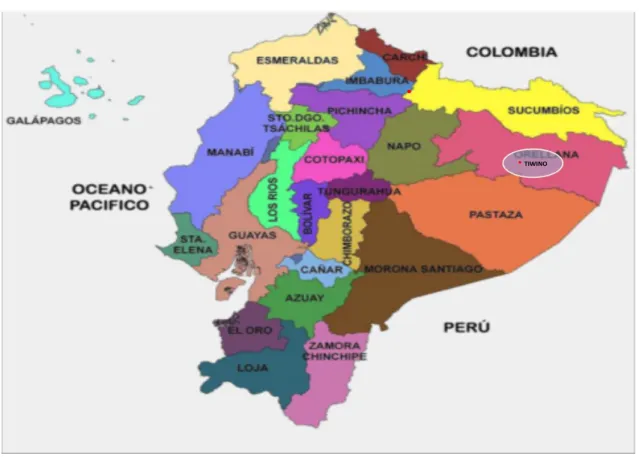
Figure 1: Map of Ecuador
The Waorani are located in the northwest of Ecuador, in the high Amazon basin. They
have traditionally occupied the territory limited by the Napo River to the north, and the Curaray to
the south, within the limits of the provinces of Pastaza, Orellana, and Napo. The Ecuadorian state
currently recognizes 687,000 hectares as constituting Waorani territory (Lara et al. 2002:9). The
Waorani population is estimated at approximately 2,000 individuals (Lu and Sorensen 2013).
Tiwino is found in the extreme northwest of province of Pastaza, in the Curaray parish of Arajuno
canton, on the border with the province of Orellana. The population has built their dwellings
between the oil wells Tiwino 1, 5, and 6, around roads that offer automobile access to the wells,
and near the margins of the Tiwino River, on waters navigable by small watercraft. The
community is found at the end of the Auca road, the roadway constructed to facilitate oil drilling.
It adjoins another community known as Tiwino Colono, together with the encampment of the Petrobell oil company, and a police checkpoint.
The Waorani were the last indigenous group to be colonized and integrated into
Ecuadorian society. There are two moments that have had a strong impact on the life of this
community. The first was put into effect by members of the evangelical organization Summer
Institute of Linguistics (SIL) and the second was brought on by oil companies.
In this project, I view process of evangelization and activities conducted by oil companies
in Waorani territory as a new form of colonization, as well as the continuation of a colonial
process that started 500 years ago, when the Spanish came to South America in search of
resources and introduced new social, economic, and cultural practices that drastically altered the
local cultures, ecology, and the environment. Even though oil extraction has a different modality,
and is carried out by corporations and the state, it shares similar goals, namely to bring benefits to
outside economies at the expense of local economies, territories, and ways of life (Acosta 2013;
Gudynas 2013; Machado 2011; Alimonda 2011). Following Acosta (2013), extractivist activities
and continues operating in a way that affects indigenous territories and livelihoods in the present day (Gudynas 2013).
The Summer Institute of Linguistics and the evangelization of the Waorani
The SIL is a North American scientific organization, founded in 1934, dedicated to the
study of indigenous languages, and whose members belonged to different evangelical groups. At
that time its mission was to translate the Bible and effectuate bilingual literacy programs. The SIL
arrived in Ecuador in 1952. At that moment it was already carrying out activities in other Latin
American countries, with other Amazonian groups. Before contact with the Summer Institute of
Linguistics in the 1950s, the Waorani lived without permanent association with either Ecuadorian
society or other neighboring groups. For years they occupied areas far away from the large rivers
that came to be trafficked over time by colonists and rubber plantation workers, who threatened
their autonomy and territory. They were nomadic, living in groups composed of families amply
distant from one another.
The evangelization of, and first permanent contact between, the Waorani and outsiders
occurred in 1958. SIL missionaries convinced Dayuma Caento, a Waorani woman who was living
as a worker on a hacienda near Waorani territory, to return to the forest where she had lived as a
child and help the missionary-linguists relocate her relatives to a permanent settlement, teach
them to live as Christians, and translate the Bible into their native tongue (Cabodevilla 1994).
When the SIL initiated the evangelization they determined four Waorani groups that amounted to
around 500 people spread over approximately 20,000 km2 (Yost 1985). The missionaries
converted Dayuma’s group in 1959, while other groups were converted in the following years
(Cabodevilla 1994). The SIL, leveraging the increasing demand by the Waorani for goods they
concentrate them in the town of Tihueno, founded in 1959 on the shores of the river of the same
name (Cabodevilla 1994; Yost 1985). This became the first community conceived in such a way
and was the original site of the concentration of the Wao population. It was there that the process
of transculturation and religious conversion began.
Dayuma was the intermediary and principal figure in this process, which marked the
history of the Wao people. When she returned to her group she possessed two essential
advantages: 1) the knowledge of the ways of living, behaviors, and customs of the foreigners, and
2) a thoroughly favorable level of relations with them (Yost 1985). This situation placed her in the
role of intermediary in the process of conversion as well. According to Yost (1985), the power
acquired by Dayuma Caento in this context created a new form of leadership in the community,
different from the traditional circumstantial and gender-equal leadership that prevailed before
contact with the SIL.
During the years of contact with the SIL (from 1958 to 1982)3
and the evangelical
conversion, the Waorani saw a transformation of their demographics, material culture, social and
political organization, subsistence patterns, and vision of the world. They went from being a
socioeconomically autonomous ethnic group to being dependent on goods and services that they
could not produce by their own means (Yost 1985). They became sedentary. They changed their
hunting and fishing patterns, making use of firearms. The evangelical missionaries were able to
greatly change them as a people and leave the path open to future relations with other indigenous
groups, the mestizo population, the Ecuadorian state, other religious groups, adventurers,
researchers, NGOs, and tourism, as well as lumber and oil companies (Yost 1985).
3SIL officially began its work in Ecuador in 1958, and the presidential decree of 1982 ended a
The intrusion of the oil companies in Waorani territory
The drilling of oil in the Ecuadorian Amazon constitutes a determining factor in the
colonization of Waorani territory and was the source of profound environmental and sociocultural
changes (Kimerling 2013; Rival 1992). From 1920 until the end of the 1940s, the Ecuadorian
government granted various concessions for oil exploration to transnational companies (Acción
Ecológica 2006:18). During this period, the oil companies that explored the Amazon did not have
any significant impact on the Waorani people. However, there are stories of attacks against Shell
company employees that were exploring the headwaters of the Napo and Curaray rivers, as well
as attacks carried out by company workers in order to facilitate exploration (Naranjo 1994:37;
Cabodevilla 1994). The Waorani defended their territory from intruders for centuries. They were
the only group in the Ecuadorian Amazon known to have survived the rubber boom of the first
half of the 20th
century as free people (Cabodevilla 1994; Kimerling 2013).
In 1967 the Texaco-Gulf consortium found large hydrocarbon reserves in the northeastern
Ecuadorian Amazon and constructed a 513 km oil pipeline with a capacity to transport 250,000
barrels daily from the Amazon region, across the Andes Mountains to the Pacific coast (Acción
Ecológica 2006: 18, 19, 20; Kimerling 2013). In August 1972 the consortium conducted the first
extraction of oil in the Ecuadorian Amazon, which gave way to the country’s oil era (Kimerling
2013; Naranjo 1994:155). At the beginning of this period the majority of the Waorani population
was living in the evangelical community of Tihueno. In Narváez’s account (Narváez 1996:38),
the oil companies that wound up operating in Waorani territory (Esso Hispano Oil in Block 8,
Petrocanada in Block 9, the Braspetrol-Aquitame-Britoil consortium in block 17) were able to do
Oil extraction and the creation of the Tiwino community
As a consequence of the oil boom, in 1972 the Texaco Company opened the Tiwino oil
field. The field is a grouping of installations, wells, teams, and sites that make the production of
hydrocarbons possible. Its location corresponds to the province of Pastaza, in the Arajuno canton
and Curaray parish (covering a total area of 80,000 hectares, partially within Waorani territory).
This field opened in the area from which Babe Ima, the ancestral leader of the Tiwino community,
and his group had originally been taken to the evangelical community in 1969. They were
mobilized to facilitate the extraction of oil in what had been their ancestral territory. Cabodevilla
(1994: 392, 403) mentions that in that year, during Cepe-Texaco’s explorations to the south of the
Napo River, some laborers crossed paths with Babe’s group, who violently interrupted their work.
At that time the oil companies already had relations with the SIL. They created a strategic alliance in order to progress with hydrocarbon exploration, the former organization advantage of the fact that the latter were the only ones who had successfully made contact with Waorani groups. Years later the Tiwino community was created around the wells of this oil field. The Waorani tell that
the origin of the settlement dates back to the 1980s, when they abandoned the settlement known
as Golondrina.
To understand how Tiwino was created, it is important to discuss events related to the life
of Babe Ima and his family, because they founded the current permanent settlement of Tiwino in
their ancestral territory, after it was occupied by oil companies. Babe’s group left the evangelical
settlement formed by SIL following a polio epidemic in order to establish Golondrina. They later
relocated from this settlement and founded Tiwino (Cabodevilla 1994, 2007). The people I spoke
to do not remember the exact date where they relocated. Cabodevilla (2007) situates it in 1988,
abandonment of Golondrina and the creation of Tiwino. Based on the testimony recovered from
the late Babe and his wife Olga, it is known that their son Cuwemo died in Golondrina after being
attacked by a boa constrictor while swimming in the river, and his body was later found on a
beach. This episode constituted the principal motive for abandoning the settlement: “If my son had not turned up dead we would still be living in Golondrina, because there we had planted enough yucca and plantains” (Olga). Babe and Olga maintain that the death was caused by curses sent by Kichwa witches. Additionally, they had learned from the mouths of those same witches that the entire family was to be cursed.
Furthermore, another reason for Babe to leave Golondrina was that he was already aware that a roadway was going to be opened up in his family’s ancestral territory. This roadway is known as the Auca road. Constructed in 1979, it was a second-class road that began in Coca, crossing Waorani territory until arriving at the Cononaco oil encampment, very close to the Shiripuno River, and extending to the Tiwino River, where another oil field had been laid down. Babe knew very well that the roadways brought with them outsiders of all kinds, which is exactly what happened. Since the area of Tiwino is considered by the Ima family as their ancestral territory, Babe felt that it was up to him and his family to come out in its defense, confront the colonists, fight for the land, and put up barriers to stop the colonists from going deeper, even at the cost of his own life.
Babe left Golondrina together with Yety, his sister Ene’s husband. Yety told me that Babe
planned for and encouraged his family to go live in Tiwino, near the roadway, since for him it was
clear that they were running the risk of losing their territory. Babe recounted that when he arrived,
together with Yety, in the area where Tiwino is currently located, he found that settler families
land, and wells and oil encampments that the outsiders had constructed. He saw soldiers and the
roadway that led to the Tiwino River. At that time, the state oil company, Cepe, which had
acquired Gulf stock in 1976, operated in the Tiwino field. In 1992 Texaco left Ecuadorian
territory and the state-run company Petroecuador assumed exploration and extraction. In the same
year the Tiwino oil field came to be operated by that company. In 1998 the government of Jamil
Mahuad opened five oil fields operated by Petroecuador that yielded marginal production—that is
to say less than 1% of national production—for international bidding (Almeida 2005). Tiwino was
one of those marginal oil fields handed over in the first round of bidding to the Colombian
company Petrocol (Almeida 2005). Since the year 2000 the field has been under the control of the
Colombian company Petrobell.
Babe remembered that he fought to expel the settlers from his territory, but they resisted
abandoning their houses and crops: “I put annatto on my face, I tied my hair up with string, and
without clothing, durani bay, I went to scare the settlers in their homes.” Olga commented that the
settlers fled terrified, thinking that numerous Waorani had come to kill them. However, it was
only Babe, Yety, and their wives.
When I spoke to Babe, to contextualize the reasons for which he expelled the settlers, he
told me, “It was all chakras (crop fields), houses, animals, bananas. If I were to go to Quito and
take a piece of land and build a house and start to live there, you’re not going to like it. You’re
going to talk and you’re going to say, ‘What business do you have in coming here?’ And we
thought the same thing.”
The Tiwino community was initially composed of the families of the couples Babe-Olga
and Yety-Ene. In subsequent years other groups of grandparents arrived with their children and
grandparents, and their children, spouses, grandchildren, and great-grandchildren. The inhabitants
of Tiwino have some link of kinship with the four families and recognize the ancestral leadership
of the Ima family, headed in previous years by the now deceased Babe.
General characteristics of Tiwino
According to information supplied by staff of the Health Center of Tiwino, and based on
the last community census in 2012, there were 227 inhabitants and 40 families registered. Most of
the population of children, adolescents, and young adults has some level of education and are
bilingual (in Waorani and Spanish). The adult and elderly population, especially the women,
speak for the most part only Waorani.
The oil companies, in exchange for the possibility of operating in Tiwino, were tasked by
the Ecuadorian government and local leaders with bringing modernity and western culture to the
community by means of healthcare, education, living spaces, services, and infrastructure. In the
last few years, owing to the change in the country’s oil policy, the Ecuadorian state has been
charged with bringing modern living in exchange for income generated by oil extracted in the
Amazon.
As for infrastructure and Western services, the community possesses running water,
although untreated, provided by the oil company, and electricity from the public grid. They lack a
sewage system. Since the year 2000 they have had a health center, run by the Orellana Province
Department of Health, which provides permanent primary health care. In addition, they can make
use of the oil company’s medical dispensary in cases of emergency.
The community has a primary school founded by the state oil company CEPE, in addition
to a junior high school. The two establishments are public and receive aid from the oil company.
secondary).
The services provided by the company, added to the growing forms of commerce
established by the colonists, along with education and healthcare, continue to mold the new way
of life for the Waorani of Tiwino. Access to remunerations, bonuses, and salaries, either from oil
drilling, the sale of handicrafts, or tourism (and years earlier, the sale of wood), has made the it
easier for families to obtain necessary food, bringing profound changes to the daily diet. Access to
remunerations has also brought the possibility of access to consumer items such as electrical
appliances, cell phones, and more, which have provoked changes in Waorani customs and social
organization.
Current political organization, oil, and the role of men
The Waorani, as an indigenous nationality, created an organizational structure in 1990
with the purpose of having an entity, which could legally dialogue with oil companies, the state,
and the different institutions, which intervene in their territories, and defend the rights of their
people. This structure was initially given the name Organization of the Huaorani Nation of the
Ecuadorian Amazon (OHNAE in Spanish), affiliated with the Confederation of Indigenous
Nations of Ecuador (CONAIE in Spanish).
With the forming of the OHNAE, the Waorani began a process of radical change away from their traditional political structures, based on familial clans, where leadership was
that have, one way or another, intervened in their territories. The organization has suffered from a constant process of internal conflict, resulting in its directives regularly having problems finishing on time and reaching their objectives. Recently the organization changed its name to the Waorani Nation of the Ecuadorian Amazon (NAWE in Spanish). The central offices are located in the city of Puyo, in the province of Pastaza.
Tiwino, as a community, is structured around familial relationships, where families are the basic social group. The political structure of the community is ordered and centered on the
extended family and the male leadership of the Ima family. At the same time, Tiwino has an additional formal, legally recognized political structure, or directiva. This directiva makes decisions for the community, which must be approved by the leaders, since they have greater influence than the directiva. The activities that the directiva realizes generally consist of
representing the community before governmental institutions, NGOs, and principally before the oil company in order to make complaints; petition for construction, work, and production projects;
sign agreements; etc. The posts of the directiva are generally, although not always, occupied by
men, since they have better access to formal education and greater knowledge of Spanish than the
women.
The oil companies have fortified the leadership of men. Since they were the ones who, in
the role of warriors, violently opposed oil drilling operations, the companies have granted them
the power to negotiate and decide overall what oil drilling means for the community:
development, modernity, capital, salaried work, use of territory and resources, etc. Unlike what
happened with the intermediary Waorani women at the time of evangelical conversion in Tiwino,
men are currently the intermediaries with the oil companies and the Ecuadorian state, and
created an imbalance in both gender roles and community relations. Evangelization and oil
drilling have introduced differences in gender to the Waorani community where they didn’t exist
before.
If one follows the decolonial feminist María Lugones (2014), the Eurocentric capitalism
established by the colonization of pre-Columbian America introduced previously non-existent
gender differences into certain indigenous communities, which formerly had conceived of gender
in an egalitarian manner and not in terms that wound up being imposed upon them. Additionally,
“The system of gender imposed by colonialism encompassed the subjugation of women in every
aspect of life” (Lugones 2014: 64). Following these reflections, one can infer that the extraction of
oil and the consequent need to rely on hierarchical decision-making structures, the rise in salaried
work, and the creation of the divide between public and private sectors gave birth to the political
and economic subordination of women in the Waorani community. However, this situation has
awoken in these women the need to organize themselves independently. They created the
Association of Waorani Women of the Ecuadorian Amazon (AMWAE in Spanish) in the decade
of the 2000s. This group’s purpose is to confront extractivism, help women to organize, and look
for alternative female economies, distinct from the income provided by work for oil companies,
such as the making of handicrafts and the cultivation of organic cacao. In the present day the
elaboration of crafts to be sold at market has become popular among the female population. This
practice is promoted by AMWAE, which is responsible for sale in stores in Puyo and Coca. The
Economic activities
The community’s economy has mixed characteristics: it is based on traditional subsistence
and reciprocity activities together with activities integrated with the market economy, such as
salaried work and the sale of goods and services. Traditionally, the Waorani have been a society
of hunting, gathering, and horticulture. In spite of the changes experienced in recent years, in the
present day the population of Tiwino still depends on these activities, in addition to fishing.
Hunting is principally carried out by men, while agriculture is undertaken by women and not
destined for the marketplace. Both men and women take part in fishing. However, in Waorani
society, the division of labor is not rigid, and men as well as women may perform activities
generally carried out by the opposite sex (Rival 1996a). Some families have taken to seasonally
raising poultry and fish in pools, which they use for self-consumption and sale. They do not raise
animals such as swine, cattle, or horses, as their colonist neighbors do. They sporadically sell
jungle animals, either alive or for their meat.
Tiwino is a visible manifestation of the acculturation process, a place where sedentary
living has gained ground. Although it is still possible to live from hunting, fishing, and produce
from chakras, their economic model has transformed due to notable dependency on the wage
labor in oil companies. They have arrived at agreements, understandings, or simply verbal
arrangements with these companies that enable them to access capital and other material,
technical, and financial resources. As opposed to the situation before 2008, new state policies
regulating the relations between the community and the oil company have resulted in the latter
eliminating certain benefits such as welfare for the elderly and support in other areas. The change
in the relationship between the company and the community, and the negative effects of oil
and Bataboro village. The most recent was in January 20154
, when Waorani of Bataboro attacked
the encampment of the Petrobell oil company.
Tourist activity, which was important years ago, has nearly disappeared, owing to the
forced removal of the tourism company by pressure exercised on the part of the Waorani. The
felling and sale of lumber, which years before was one of the principal incomes, fortunately is
entirely prohibited. Wage labor in oil companies, tourism lumber and selling game are activities
mainly carried out by men.
Owing to the intense changes that the community is experiencing from the exhaustion of
the forest’s resources, the contamination of the water and soil by oil drilling, the scarce
opportunities for paid work, and the lack of sustainable economic alternatives, the Waorani of
Tiwino, in the not-so-distant future, will have to face intense economic problems which will place
them in a never before experienced situation of marginality.
4
CHAPTER 2: THEORETICAL LENS AND LITERATURE REVIEW
In this chapter, I will use a Feminist Political Ecology (FPE) approach with some elements of Decolonial Feminism (DF) to examine how the oil industry affects gender relations and teen pregnancy in the Waorani community of Tiwino. I will also analyze gender relations prior to the presence of this industry, to address how it is affecting gender relations, and the pregnancy of adolescent girls.
First, I will use the classical framework of FPE to investigate how the political ecology of a place is mediated by gender, and how it affects gender relations and roles. Second, I will use concepts about the body from the field of FPE to understand how gender relations, economic, social and cultural change, and modernity are embodied, and how these affect women’s bodies, the experience of femininity, and teen pregnancy. Third, I will use Decolonial Feminism to approach how gender is constructed as part of a modern/colonial system that is represented by oil exploitation activity in the Waorani community. With this framework, I will show how oil pipes go not only through the ground of the Waorani territory and forest—but also how they
metaphorically transgress the bodies of women in the community. I will situate the teen body as a symbolic ground in which the politics of the environment take effect.
25
related to teenagers’ lack of sexual and reproductive rights, lack of education, and lack of knowledge about and access to contraceptives. Nevertheless, I would argue that this theme has not been analyzed from a perspective that combines oil exploitation (that shapes the country’s economy), modernization/colonization, gender changes, exploitation of women, and their bodies. This perspective will be my contribution.
Feminist Political Ecology: definitions, framework and genealogy
Feminist Political Ecology (FPE) emerged as an academic field in the 1990s, as a feminist critique of sustainable development and post-structural feminist critique and expansion of Political Ecology (Rocheleau and Nirmal 2014). An important event was the publication of the book, Feminist Political Ecology, edited by Dianne Rocheleau, Barbara Thomas-Slayter and Esther Wangary in 1996. It put together and analyzed the findings and questions generated by a diverse range of feminist scholars and activists involved with gender, women and development, environment issues, and eco-feminism.
and 3) Gendered environmental politics and grassroots activism (Rocheleau, Thomas-Slayter, and Wangari 1996).
The first theme, gendered science of survival, makes reference to gendered knowledge that is the product of everyday actions for creation, maintenance, and protection of healthy environments at home, work, and in regional ecosystems. Women, while exposed to different political and economic systems, may be involved in commercial activities while also being responsible for managing the needs of everyday life, such as food, water, fuel, clothing, taking care of children, and attending to family members’ health (Rocheleau, Thomas-Slayter, and Wangari 1996).
The second theme, gendered environmental rights and responsibilities, refers to the legal and customary rights governing women’s and men’s access to, and control of, resources. This theme suggests that it is important to ask who controls and determines the rights over resources, environmental quality, and the definition of what is a desirable and healthy environment. It also recognizes that rights to environmental access and control are gendered, as are responsibilities for procuring and managing resources in the home and community. Besides the gendered division of resources, there is also a gendered division of power to preserve, protect, replace, rehabilitate, and restore environments and to regulate the actions of others (Rocheleau, Thomas-Slayter, and Wangari 1996).
27
shaping women’s environmental activist movements, which place women as the protagonists of environmental struggles (Rocheleau, Thomas-Slayter, and Wangari 1996).
From this first and “classic” stage of FPE, I would like to address the main ideas in order to analyze the ways in which oil exploitation has a gendered dimension in the community and how that affects men and women differently. There are three ways in which oil exploitation generates gender differences that are embodied in teen pregnancy:
1. Insertion in wage labor 2. Insertion in formal education 3. Modernization of the community
Since oil exploitation in Waorani territory and Tiwino began, a whole new way of life has been introduced. Insertion in wage labor has produced power inequalities between men and women and new forms of modern adulthood. The dominance of men working in oil companies has situated them in a position to acquire money, thus relegating women to the traditional domestic sphere. While men are working and earning a salary, women are expected to take care of children and the household, a distribution of work that did not exist before. This labor
division, introduced by oil extractivism, causes power differences between men and women, and produces unequal access to new economic resources, trends that never previously affected the Waorani. Furthermore, oil companies negotiate only with men, introducing a power dynamic in which men have more power to negotiate land, territory, and resources.
and timber exploitation. For instance, Waorani women have created their own organization, ANMWAE, as a response, and alternative, to oil exploitation. These women have argued that oil exploitation affects them differently and makes them more vulnerable than men, because they must take care of children affected by water and air polluted by the oil activity. They also suffer from the decrease of game around the community due to the presence of oil activity.
Additionally, women living close to the oil roads and work complexes are victims of harassment from oil workers.
The relationship between wage labor and formal education has also created a change in cultural notions of adulthood. Before oil exploitation (and the trappings of modernity it brought), the Waorani got married when they were ready to build a house, maintain a crop, hunt, and fish without the help of their parents. Now, in the context of oil exploitation, the Waorani say they are adults (who are ready to get married and have children) when they have finished secondary school, have a paid job, and can manage all the traditional survival practices. In this new context, being a teen mother is a problem that didn’t exist before. Traditionally, teen pregnancy was (and still is) accepted when it happens within marriage, otherwise, outside of marriage, it was seen as a problem (and continues to be seen as a problem today). Nevertheless, now that men are
privileged to better access wage labor and education, teen pregnancy inside or outside of marriage has situated women at a great disadvantage to men.
29
with oil exploitation, has brought large numbers of men to work on these projects. These workers are taking advantage of teenagers’ lack of education, access to work, and money, creating
damaging sexual dynamics of body commodification among adolescent women. These women exchange sex for material objects or money. These activities have resulted in several teen pregnancy cases in the community.
I define the exchange of sex for money between adolescent women and workers as body commodification because it is a way to access to economic resources in a setting of material and monetary scarcity. This context was created around the Waorani beginning with their insertion into the market economy. Women’s bodies have acquired a certain value, which is to provide access to money and material objects that Waorani do not produce by themselves. To Sharp (2000), the human body (and its parts) has long been a target for commodification in several ways, and prostitution is on of them.
Lock (2002) argues that all forms of commodification involve a complex interaction of temporal, cultural, social, and political factors. The body is not originally a commodity, but it may become commodified. Therefore it is important to consider how, and under what conditions, bodies accrue value. Following Nguyen and Peschard (2003), although there is a debate as to whether sex work represents a form of commodification, it does appear that increased inequality facilitates the exchange of sex for access to economic resources. Materialism intensifies the commodification of the body, and deepened inequalities that have emerged under the sign of globalization call attention to the increasing status of the body as product (Nguyen and Peschard 2003). In the Waorani community of Tiwino, the expansion of a global market economy
commodification of teenagers’ bodies in order to satisfy women’s economic necessities. This is one of the causes of teen pregnancy.
FPE, body politics, embodiment, sexuality and reproduction
Following Harcourt & Nelson (n.d.), and Rocheleau & Nirmal (2014), there is a second stage, or new Feminist Political Ecology, engaged with a variety of theories, such as
Poststructuralism and Science and Technology studies, that problematize human subjectivity and gender subjectivity. New perspectives in the field of gender and environment are also embedded with the politics of knowledge production, which include discussion about the division between theory and practice. In this stage, questions arise regarding how theoretical approaches to problems help in the face of real-world urgent environmental issues. There are also questions about how categories of analysis emerge and how the subjects and objects of gender and environment theory have been constituted(Hawkins and Ojeda 2011).
For the purpose of this work, an important aspect of FPE to take into account is the discussion of the body. In paying attention to the body, FPE has examined how gender, race, class, and other categories are made concrete through spatial and social practices (Hawkins and Ojeda 2011). Wendy Harcourt focuses on the body to gain an understanding of gender, race, nature, and culture, observing the connection between environment and body in networked relations of power (Hawkins and Ojeda 2011; Rocheleau and Nirmal 2014).
For Harcourt (Harcourt 2009), it is important to address the debate in feminist literature around the need to go beyond essentialism, or reducing women and men to an essence
31
into account, this statement helps us understand how the teen body is constructed by public health discourse, development discourse, and also how it is shaped by gender relations that are linked to social, economic, and environmental changes in the Waorani community.
Following Harcourt (2009), particular aspects of female embodiment (such as pregnancy, rape, and aging) become privileged sites of significance bearing on how female experience is lived and changed. In order to understand the body in its physical and social particularities, it must be conceived not as an object, but as a subject central to power, gender, and culture. As Harcourt notes, “Recognizing the fleshy bodies of women—in birth, breast feeding,
menstruating, their material experience of sex, pregnancy, violation, rape—and thus bringing the experience of bodies into political discourses” (Harcourt 2009: 24). These ideas suggest that teen pregnancy in Tiwino is embedded with power, gender, culture, and environmental dynamics, and social change.
A similar situation is happening in Tiwino, where oil exploitation and formal education, as well public health programs, are introducing a new period between childhood and adulthood that didn’t exist before. Some Waorani women are going through a period of adolescence that their mothers did not experience because they transitioned directly from childhood to adulthood. Currently, Waorani women are experiencing adolescence while oil and construction workers commodify their bodies, taking advantage of their lack of money, clothes, shoes, and other necessities, all of which were created by modernity (this issue will be developed in the next chapter). It is paradoxical that a modern/colonial project of the State and oil companies, which has brought adolescence and its associated problems to these young women, also provides public health programs to prevent teen pregnancy, but does not address the structural causes of the issue.
Following Harcourt (2009), I would like to introduce the idea that the female body is not only a site of normalization and commodification, but also a site of resistance, where social norms of being female are inscribed. The body is a site of contestation in a series of economic, political, and sexual struggles. That is the case of the Waorani women who decided to create their own organization, AMAWE, to confront oil exploitation. These women argue that they have suffered from extractivism in a different way than men due only to the fact that they are women.
FPE and the decolonial turn
33
being in different worlds, including more than the human world). It also considers other
developmental alternatives, such as the Buen Vivir, analyzing the pertinence of the appropriation and transportation of these concepts to places far away from the their sites of conception
(Rocheleau and Nirmal 2014; Harcourt and Nelson).
Decolonial FPE also problematizes gender concepts, from intersectional perspectives that recognize the entanglement of patriarchy, racialized processes, and colonialism (Rocheleau and Nirmal 2014). Following this line of analysis, I will use concepts of decolonial feminism from Latin America to analyze how gender and inequalities are constructed in the Waorani community by oil exploitation, which operates as a sort of colonization.
Decolonial feminism
Decolonial feminism in Latin America is rooted in academia and social movements as an answer to European Anglo-Saxon feminism, which has universalized ideas about feminism, women, gender, and patriarchy (Espinoza Miñoso, Gómez Correal, Ochoa Muñoz 2014). The category of gender must be analyzed in its relationship with the process of colonization, with gender being entangled in the modern/colonial system (Lugones 2014). Following Lugones (2013), during the colonial intrusion in what is now Latin America, it was indigenous men who were given much more extensive power than they used to have, since they were the ones to negotiate with white European men, and are now negotiating with the nation state. The nation state reinforced patriarchal hierarchies and women were relegated to the domestic sphere, where their political agency was reduced.
Furthermore, it has created hierarchical differences between men and women relating to the use of, access to, and decisions regarding resources.
Decolonial feminists, such as Bethy Ruth Lozano (Lozano Lerma 2014), propose that we should consider gender from a non-western viewpoint that goes beyond the Eurocentric dualist perspective. This view claims that there is not just one feminism, but multiple, diverse
feminisms—as diverse as we women are. Lozano (2014) argues that gender has been
CHAPTER 3: TEEN PREGNANCY AMONG WAORANI IN THE CONTEXT OF OIL EXPLOITATION
In this chapter, based on ethnographic interviews with members of the community including parents, grandparents, young adults, community leaders; and informants outside the community, such as Waorani general organization leaders and women’s organization leaders; and my own observations, I will address the main research questions that guided my research:
1. What are the social determinants of teen pregnancy in Tiwino? 2. Is teen pregnancy a traditional pattern in Tiwino?
2.1. Is teen pregnancy supported by the family?
2.2. How are adolescence and adulthood conceived by Waorani people? 3. What is the relation of teen pregnancy with insertion into the market economy, oil exploitation, gender role changes, and incorporation into formal education?
while single. The latter occur either due to romantic love or to exchange sex for money
patronized by men from outside the locality who are involved in the oil industry and community development (primarily in construction). Due to acculturation, sedentarization, wage labor, formal education, and changes in family formation, teen pregnancy is currently experienced in a different manner than it was before the time of colonization.
While the data for this chapter are qualitative, and based on the attitudes and opinions of people interviewed, data provided by the staff of the Tiwino Public Health Center show the composition of the population according to age groups and the number of teenagers in the community in 2014:
Table 1: Tiwino Population by age groups, census Tiwino Health Center, 2014
Children Number Teenagers (10-19 years)
Number Adults Number TOTAL
<1 year 11 10 -14 years 29 20-35 years 72
1-4 years 27 15 – 19 years 27 36-49 years 14
5-9 years 29 50-64 years 11
>65 years 4
Total 67 Total 56 Total 101 224
Waorani traditional marriage and teen pregnancy
In the past, during the time of duranis [ancient Waorani], families lived in big malocas [longhouses], separated from one another, and they took care of single girls. Families came into contact with each other mainly during celebrations, and it was there that people got married” (G.E., elder Waorani female).
Before evangelization in 1958 we see that Waorani extended families used to live in an isolated manner. Single people and potential couples were distant from one another, and they were married off during festivities when elders made the decision that they should be together (Rival 1996).
Adult women who got married and had their first children before the beginning of oil exploitation and development told me that, at the time, parents or grandparents arranged the marriages. Marriage alliances were organized without the intervention of the bride and groom. The groom’s parents made a visit to the bride’s parents’ house, generally in the evening. If both grandparents, or parents, agreed to the marriage, the wedding took place during the harvest festivities of chonta [peach palm], yuca [manioc], plátano [plantain], or maní [peanuts]. These women also mention that when they were young, it was the norm to wait to have sexual relations until after marriage, without a phase of pre-marriage courtship. Furthermore, it was not common to have children out of wedlock.
Before they got married first, and now everything has changed. The first kid is born when the mother is single. I think it’s because of how the people from outside are changing everything. Before it wasn’t like that. Now they’re not the same. Now, just like the people from outside, they fall in love and have children in secret. They get pregnant in secret and later they get married. I think it should go back to the way it used to be, because I see that so many of them are coming back like the people from outside, and for me this is very bad. I have a bad opinion of this. Before, they didn’t know how to become single mothers. This didn’t happen before. In other times, before having a child, a mother had to plant a chakra so that her child could later come to harvest what the mother
During family encounters at festivities, the bride and groom were seated in a hammock while older men and women sang around them and gave them advice for their future lives. After this rite, they were allowed to start a household and family together. Parents’ expectations were that women and men were ready to get married when they mastered subsistence activities such as agriculture, hunting, fishing, and house building, all of which were necessary to maintain a family. Recently married couples would wait several years before having children, during which time they worked hard cultivating manioc and plantain crops. Women recount that this form of marriage existed before contact with the Summer Institute of Linguistics (SIL) and the beginning of oil exploitation, however, one cannot account for the extent to which these descriptions of marriage may have been influenced by Christian ideals, such as the prohibition of sex before marriage.
Laura Rival (1996), who did extensive fieldwork in a Waorani community in late 1980s and early 1990s5
, gives a description of a traditional Waorani wedding ceremony, emphasizing that the bride and groom did not choose each other or intervene in the arrangement process. It was the families that chose the best partners in order to strengthen alliances between the families.
Huane and Hueica’s wedding, celebrated a few years ago, was a traditional marriage. The future husband and wife were suddenly presented to each other by their grandparents during a large celebration with drink of yucca. Huane [the husband]’s parents were unaware and weren’t even present at the ceremony. Since Huane’s older sister had married Hueica’s brother a few years earlier, the wedding with Hueica was “good”; it reaffirmed an alliance between the two groups that had had no previous relations. Huane and Hueica weren’t cross cousins; the decisive factor in this case was that two weddings – with the possibility of a third in the future – united two familial groups in the same generation (Rival 1996: 124.)
Huane was just as unsettled and scared as Hueica. He had never seen her before, and in reality he didn’t know that her relatives had planned this marriage for quite some time (Rival 1996: 121).
5French academic, wrote her PhD dissertation (in the London School of Economics) on the
“[During the celebration] young people came from far away and looked at each other. They made jokes and pretended to be married. The elders observed everything, found out who came with whom, and made sure to marry off the fitting pairs in a future party. If they observed two young people who were really attracted to each other, they sat them in a hammock without delay and sang the wedding melodies. In the past it was good to get married’ (His wife adds, ‘Yes, these weddings were good’)” (Yeti, quoted in Rival 1996: 127).
During interviews and informal conversations with adult women, I found different reports of the age of marriage between Waorani before the time of evangelization oil exploitation,
modernity, and development (1958). Some women reported that at that time, men and women got married in late adolescence, around 17-19 years of age, “When we were grownups.” Other women said that, in the past, people got married when they were pike [adult in the Waorani language], or over the age of 20. In general, the Waorani, according to their conceptions of time, do not count years. The elderly especially are not able to calculate years with accuracy, so it is impossible to confirm if those age estimations are correct. Nevertheless, they underline the importance of the idea of reaching adulthood before marriage. Those I spoke to argued that marriage at an early age is a negative, because adolescents are not ready to work and maintain a family, and that it was also a negative to have sexual relations at an early age because a woman’s body is not ready, and childbirth at that time presents a risk to both the mother and baby.
Other informants reported that in the past, some, but not all, women got married very young, even before menstruation began. One of the elder women of the community said that when she was a child her father had died and her mother gave her to her husband, who was much older, when she was a young girl. She lived with him first as a daughter until, two or three years after she began to menstruate, they began to live as a couple:
menstruating, I had my first son. He [husband] took care of me without having relations with me. He took care of me like I was his daughter (G.E., elder Waorani female).
I have a story that my grandmother told me before she died. When she was nine years old they gave her to her husband and her husband had to raise her as a daughter, and when she was older she was then treated as his wife (J.H.P., Waorani male, 20 years old). Rival (1996: 1127, 1128) mentions that traditional Waorani marriage for men and women occurred two or three years after their earlobes were pierced by their grandparents. That ritual, which is no longer practiced, occurred for women when they began to menstruate and for men when they started experiencing changes to their body in puberty. It marked the passage from childhood into adulthood. Rival recounts that ear piercings were gradually made larger using balsa expansions, until they reached a width of five centimeters. By this time the young man was considered physically ready for marriage. For Rival (1996: 145), the piercing ceremony, which prepared young people for marriage, was the sole responsibility of the household, and adulthood was reached through parenthood:
As a consequence of the earlobe-piercing ceremony, the adolescent child acquires a higher social status. For a girl, this occurs after the first menstruation, and then her father takes her hunting. It is part of a child’s upbringing to become a good hunter and a great warrior, and this includes enduring long periods of fasting and other practices in the jungle. The piercing ceremony, like everything else in the Huaorani culture, is given in a spontaneous and improvised manner. An elder, either the grandmother or grandfather, performs it when the child is returning from a hunt or successful raid. After seizing upon the teenager (or adolescent) and piercing their earlobe with a chonta-wood needle, the elder recites songs and stories, and begins to teach the responsibilities of Huaorani social life. The needs to work hard, and obey and follow ancestral customs, are constant themes of these moral teachings. Other adults join these lessons (Rival 1996: 128).
What is common to both informants’ and Rival’s narratives is that some marriages (except in the case where pre-adolescent women were given to older men) and some first
Waorani marriage today and teen pregnancy
Today some Waorani women get married in adulthood, that is, over the age of 19, but others marry, or begin to live with their partner, and become pregnant, during adolescence. In Tiwino, teen pregnancy currently occurs in the context of:
- Marriage by arrangement of elders
- Marriage or cohabitation by the decision of the couple, with or without parental consent - Women being unmarried
Arranged marriages still happen, but cases of young girls being given to older men no longer exist. Still, during some traditional festivities or other events related to modern life, such as the founding of a community, grandparents and other elders with status will choose a couple, marry them, and give them advice on how to live together. Some couples began living together or get married without the approval of their parents while they were living in cities. Other couples chose to leave the community altogether and cohabitate without their parents’ consent. Some of these marriages that occur by arrangement of the couple have weddings during
festivities, in which the bride and groom appear, and the elders perform a ritual around them, thus socially recognizing the union.
marriage with people from non-Waorani nationalities of the Amazon, such as Kichwa or mestizos.
The Waorani of Tiwino argue that one of the differences between the present and the past is that couples fall in love before they get married, and they decide to live together without the permission of their parents and grandparents, which previously did not happen. As one elder woman stated, “Currently they fall in love, they go live together, and they have kids” (G.O.). Old people complain about romantic love and the fact that the youth are getting married without their consent. Rival’s quote precisely demonstrates the attitude of the elders toward these changes:
Are we wild peccaries [wild pigs] because we get married without getting our parents’ permission first? “Weddings need to take place during holiday festivities, otherwise people will say that the newlyweds are only good to ‘sleep together [which implies that they’re not ready to work] and have children’” (Rival 1996: 124-125).
According to Rival (1996), changes in marriage and wedding patterns are caused by sedentarization. As I mentioned, before colonization, the Waorani used to live in large
“malocas” separated from one another, but since evangelization, they live in communities where extended families are gathered and single youths can meet each other. Furthermore, they have adopted Ecuadorian standards of marriage, based on free choice.
Oil exploitation has strengthened sedentarization and community formation. Tiwino is an example of this. The community formed around oil camps and the oil road, as a way for the Ima family to claim their territory. Due to investment in development and infrastructure, it is no longer a traditional Waorani community, but bears more resemblance to a mestizo town, with concert houses, a school, high school, and infrastructure built by oil companies and the government as part of compensation for oil drilling activities in the area.