T
HE
M
ATERIALITY OF
F
UNNELBEAKER
B
URIAL
P
RACTICES
:
E
VIDENCE FROM THE
M
ICROSCOPE
A
NNELOU VAN
G
IJN
Laboratory for Artefact Studies Faculty of Archaeology, Leiden University PB 9514, 2300 RA Leiden, The Netherlands.
Abstract
Flint and amber artefacts from Dutch Funnelbeaker (3400-2900 cal BC) megaliths were examined from a biographical perspective, also involving microwear analysis. It is shown that both flint and amber contributed to the materiality of Funnelbeaker burial practices, which above all stressed the collective identity of the local community. This is evident in the selection of agricultural tools for deposition. Agriculture was of course an important collective task. There are also indications that flint knapping took place around the tomb. A third observation concerns the enigmatic scratches on the transverse arrowheads and flakes, forming regular patterns that cannot have a post-depositional origin. Lastly, both the axes and the amber beads ended up in the grave in a used state, indicating a previous life. However, prior to deposition both items were reground, obliterating any traces of individual ownership before they could be deposited in the communal burial ground.
and jet finds from the megaliths. This project is part of a larger undertaking to understand the structuring role of these materials in Funnelbeaker society, examining artefacts from settlements, burials and special depositions from a biographical perspective (Van Gijn 2010, 2013; Wentink 2006). This paper will examine what kind of finds were deposited in the tombs, what was their use and how had they been treated prior to deposition in the megalith.
The contents of four megaliths were described typo-morphologically: Drouwen-D19, Drouwen-D26, Glimmen-G2 and Glimmen-G3 (Van Woerdekom 2011). Samples were taken for microwear analysis. Additionally, a selection of the flint from megalith Mander-O2 and all the flint material from the stone cist of Diever were studied for use-wear traces as well (Van Gijn 2010, Appendix I). So far, the hard stone objects like the querns have not yet been examined microscopically, but a systematic study was done of the amber and jet ornaments from the megaliths (Verschoof 2011, 2013).
2. The flint assemblage
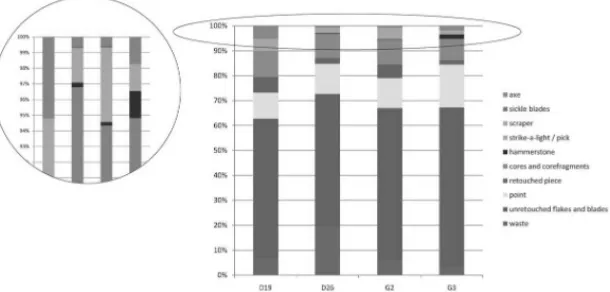
Fig. 1. Typomorphological composition of the flint assemblage from four megaliths (after Van Woerdekom 2011).
The microwear analysis showed that the majority of the transverse arrowheads and the picks did not display traces of wear. Both of these tool types were made in a very ad hoc manner, resulting in irregular shapes. In contrast, the axes, sickle blades and strike-a-lights all showed heavily developed wear traces. The axes were used on wood (visible in the use scars) and displayed evidence for hafting. They were frequently re-sharpened and some were even exhausted considering their very small size. Yet, before deposition in the megaliths they were re-sharpened one last time (Van Gijn 2010, Fig. 6.8; Wentink 2006, Figs. 5.4 and 5.5). Apparently, the used axes had to be transformed to “new” ones before they could be deposited in the tombs (Fig. 2).
Fig. 2. Resharpening of a used edge of an axe from megalith D19 (from Wentink 2006) (orig. magnif. 100x).
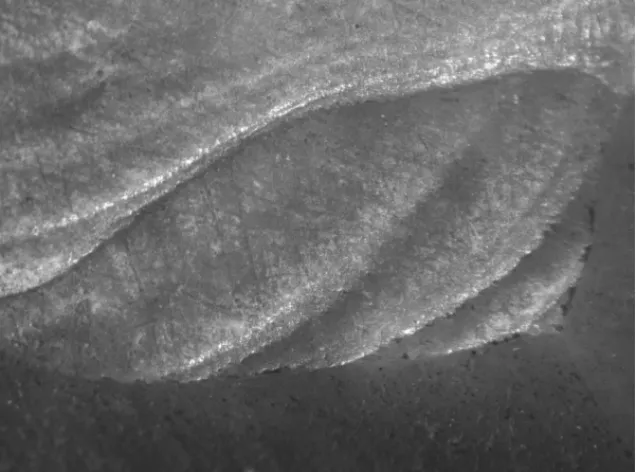
Fig. 3. Cross-hatched scratching seen on a flint tool from megalith G2 (taken with a stereomicroscope, 10x magnification) (Photo Laboratory for Artefact Studies, Leiden University).
The active role of flint in the Funnelbeaker burial ritual is also suggested by the mysterious scratches we continued to find especially on transverse arrowheads and flakes from the various megaliths. The scratches are always very regular and parallel, sometimes even forming a cross-hatched pattern (Fig. 3). Considering their regularity and restricted spatial occurrence on the tools it is highly unlikely that they were caused by post-depositional processes (see for more arguments Van Gijn 2010, 2013). The scratches can be replicated experimentally by scratching the flint surface with the kind of picks so frequently encountered in the megaliths. This is possibly the function of the ubiquitous picks but more experimentation is needed and archaeological picks should be re-examined for traces of wear.
3. The amber beads
4). This constitutes yet another indication that some objects had to be transformed before they could be deposited in the communal grave. As these beads were most likely personal ornaments it can be suggested that their previous life history, linked to a specific person, had to be removed to make it an appropriate object for the communal grave.
4. Conclusion
The megaliths of the Dutch Funnelbeaker Culture also yielded, apart from a great amount of pottery, numerous flint artefacts, various stone objects and amber and jet ornaments. A technological, typo-morphological, and microwear examination of the flint and amber component showed that these objects played a crucial role in the materiality of the communal burial practices. Most of these funerary items functioned in a domestic context before ending up in the grave. With respect to flint, those types of tools were selected which played a role in agriculture, a communal activity of great importance to the survival of the group: axes, strike-a-lights and sickles. This corroborates the communal nature of Funnelbeaker burial tradition. There is also evidence for the ritualization of flint. It is possible that flint was knapped during the burial ceremony, as part of the auditory experience of the event. Considering the large number of transverse arrowheads and picks without traces of wear, typological categories that are moreover lacking in settlement context, these objects may have been made near the megalith, again possibly in the context of special flint knapping sessions. Flint picks and transverse arrowheads seem to be linked in yet another, highly puzzling and presumably ritual, way: transverse arrowheads and flakes seem to have been scratched, possibly by means of the flint picks, to produce an intricate pattern of parallel or cross-hatched lines.
Some objects had to be transformed before deposition in the communal burial tomb. It may not be a coincidence that it is the axes and amber beads that were reground, obliterating their previous use. Both must have been linked to specific individuals: the amber beads as personal ornaments and the axes as personal tools. The axe can be considered as a very personal tool because in use, it virtually becomes an extension of the body of its owner (Clark and Chalmers 1998). Before these very personal objects, intimately tied to specific individuals, could be deposited in a communal grave, all traces of their previous life and individual ownership had to be obliterated. Whether the axes can be linked to men and the beads to women, I leave for others to speculate about. I think it is less important, as the key to understanding Funnelbeaker burial ritual seems to be the emphasis on the collective.
Acknowledgements
19.
Huntington, R. & P. Metcalf, 1979. Celebrations of death. The anthropology
of mortuary ritual. Cambridge University Press, Cambridge.
Needham, R., 1965. Percussion and transition, in: Lessa, W. A. and Vogt, E. (Eds.), Reader in comparative Religion. An anthropological
approach. Harper and Row, New York, 391-398.
Van Gijn, A.L., 2010. Flint in focus. Lithic biographies in the Neolithic
and Bronze Age, Sidestone Press, Leiden.
—. 2013. The ritualisation of flint in TRB society: evidence from the West Group, in: Bakker, J. A.; Bloo, S. B. C.; Dütting, M. K. (eds.), From funneral monuments to household pottery. Current advances in Funnel
Beaker Cultre (TRB/TBK) research. Oxford, BAR Int. S. 2474, 25-32,
Van Gijn, A. L. and Bakker, J. A., 2005. Megalith builders and sturgeon fishers. Middle Neolithic B: Funnel Beaker culture and Vlaardingen group, in: Louwe Kooijmans, L. P., Van den Broeke, P. W., Fokkens, H., Van Gijn, A. L. (Eds.), The Prehistory of the Netherlands. Amsterdam University Press, Amsterdam, 281-306.
Van Ginkel, E., 1988. Hunebedden. Gids en geschiedenis van Nederlands
oudste monumenten. Assen.
Van Woerdekom, P. C., 2011. Scratching the Surface, flint assemblages of the Dutch hunnebedden. MA thesis, Leiden University, Leiden. Verschoof, W. B., 2011. Beads for the dead, the production and use of
ornaments in the Dutch Funnel Beaker culture (3350-2750 Cal BC). MA thesis, Leiden University, Leiden.
Oxford, BAR Int. S. 2474, 33-39.