PARENTAL EXPERIENCES WITH CHILDREN’S HERITAGE LANGUAGE MAINTENANCE AND LOSS: CASES OF ELEVEN CZECH AND SLOVAK TRANSNATIONAL IMMIGRANT FAMILIES IN THE
SOUTHEASTERN UNITED STATES.
Marta McCabe
A dissertation submitted to the faculty of the University of North Carolina at Chapel Hill in partial fulfillment of the requirements for the degree of Doctor of Philosophy in the School of
Education. Chapel Hill
2014
Approved by: Xue Lan Rong Lynda Stone
Rebecca Staples New Claudia Cervantes-‐Soon Jennifer Wooten
©2014 Marta McCabe ALL RIGHTS RESERVED
ABSTRACT
Marta McCabe: Parental experiences with children’s heritage language maintenance and loss: Cases of eleven Czech and Slovak transnational immigrant families in the southeastern United States.
(Under the direction of Xue Lan Rong)
This qualitative study explored experiences of immigrant parents from the Czech Republic and Slovakia with heritage language (HL) learning and use among their children in the southeastern United States. Central European immigrants not only constitute an understudied population, they are highly unlikely to maintain the HL across generations given their relatively small numbers, geographical
dispersal, higher rate of intermarriages, and the general absence of formal heritage language programs. Drawing on in-‐depth interviews and informal conversations with parents in eleven families in which one (n=5) or both (n=6) parents immigrated from the Czech Republic or Slovakia, this study presents an account of the parents’ language goals, their home language practices, and the perceived challenges and opportunities in HL maintenance. The framework of transnational migration theories (Brittain, 2002; 2009) guided the analysis, exploring the potential of transnational practices to overcome the dominant society’s strong pressures for language assimilation.
relationship to the heritage culture and a gap between their original goals and the children’s current HL proficiency. The children’s identity choices and their less-‐than-‐expected HL fluency triggered grief in many parents.
The conditions contributing to HL retention came overwhelmingly from the transnational realm while factors interrupting HL maintenance came largely from the dominant society, supporting the argument that transnational involvement of immigrants affects HL retention positively. Regular and lengthy transnational trips overseas emerged as a crucial strategy for successful HL maintenance. In addition, approaching the HL as a practical resource facilitated HL learning and retention. Implications for public schools, language experts, and immigrant parents are discussed.
To Matouš, Damián, and Bea
ACKNOWLEDGEMENTS
First of all, I would like to express my deepest thanks to the families who allowed me to enter their lives and who shared their personal stories with me, both happy and sad. I truly appreciate their willingness to participate in the study; this dissertation would not have been possible without them.
I offer a huge thanks to Lynda Stone, Rebecca Staples New, Claudia Cervantes-‐Soon, and Jennifer Wooten, my committee members, for their helpful comments, inquisitive questions, and passionate discussions about this study. Each scholar brought a unique angle to this project and challenged me to approach the subject in new ways. Their expertise and enthusiasm have been invaluable. Particularly, I would like to thank Xue Lan Rong, my advisor, for her kind guidance from beginning to end, for her thorough feedback and suggestions, and for her unceasing support. Her encouragement and advice have always helped me move forward.
Thank you also to Katherine Kelleher Sohn for her thoughtful advice and feedback in the early stages of this research, to Ji-‐Yeon Jo for her constructive comments on my early draft, and to Fran Salman for proofreading and polishing the final draft of the dissertation.
TABLE OF CONTENTS
LIST OF TABLES ... x
LIST OF FIGURES ... xi
Chapter 1: Introduction ... 1
Context of the Research Problem ... 1
Research Questions ... 4
Methodology and Theoretical Frame ... 5
Significance of the Study ... 6
Outline of the Dissertation ... 9
Definition of Key Terms ... 9
List of Abbreviations ... 11
Chapter 2: Literature Review and Theoretical Frame ... 12
Literature Review ... 12
Heritage Language Learners in the United States ... 12
Language Loss among Immigrants ... 19
Conditions Contributing to Heritage Language Retention ... 32
Czech and Slovak Language Speakers in the United States ... 49
Theoretical Framework ... 63
Subtractive Assimilation as a Cause for Language Loss ... 64
Transnational Migration Theories ... 70
Chapter 3: Research Methodology ... 77
Qualitative Research Design ... 77
Participant Selection ... 78
Participant Families ... 80
Methods of Data Collection ... 95
Research Questions ... 98
Methods of Data Analysis ... 99
Reciprocity and Ethics ... 101
Positionality ... 102
Chapter 4: Parental Motivations for Heritage Language Maintenance ... 106
Motivation #1: Communication in Transnational Social Spaces ... 110
Motivation #2: Maintenance of Cultural Heritage and Ethnic Identity ... 117
Motivation #3: Academic, Cognitive, and Social Benefits ... 122
Positioning of the Heritage Language ... 125
Gap between Dreams and Reality ... 131
Conclusion ... 143
Chapter 5: Parental Efforts to Provide Heritage Language Exposure ... 145
Parental Use of the Heritage Language ... 146
Transnational Trips and Grandparents Visiting in the United States ... 161
Friends From the Same Linguistic Background ... 167
Chapter 6: Parental Efforts to Make Children Use and Learn the Heritage Language ... 179
Encouraging HL Use and Fluency ... 179
Pursuing Literacy ... 192
Nurturing Motivation ... 200
Chapter 7: Conclusion ... 212
Research Question 1: Parental Experiences with HL Retention in Children ... 212
Research Question 2: Conditions Contributing to Heritage Language Retention/Attrition ... 220
Interpreting Differences among Families ... 226
Chapter 8: Discussion ... 233
Theoretical Implications ... 234
Practical Implications ... 249
Limitations ... 252
Future Research ... 254
APPENDIX 1: Numbers of people with Czech and Slovak ancestry in the U.S. in 2010 ... 256
APPENDIX 2: Community-‐based language classes in Czech and Slovak (not exhaustive) ... 257
APPENDIX 3: Recruitment Letter ... 258
APPENDIX 4: Socio-‐Demographic Survey ... 259
APPENDIX 5: Informed Consent ... 260
APPENDIX 6: Interview Protocol ... 263
REFERENCES ... 265
LIST OF TABLES
Table 1. Heritage language competency across generations ... 21
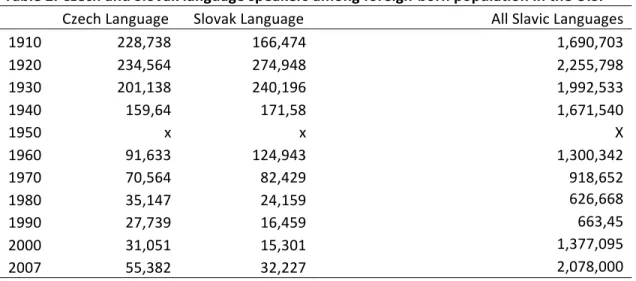
Table 2. Czech and Slovak language speakers among foreign-‐born population in the U.S. ... 57
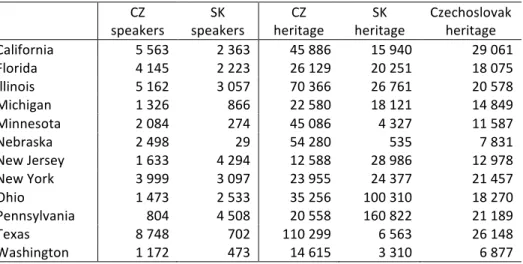
Table 3. Populations speaking Czech (CZ) and Slovak (SK) language and claiming ethnic heritage ... 60
Table 4. Participant families ... 84
Table 5. Parental goals for HL maintenance ... 108
Table 6. Parental goals and motivations for HL maintenance ... 144
Table 7. Home HL exposure in all-‐immigrant families ... 152
Table 8. Home HL exposure in mixed-‐marriage families ... 161
Table 9. The use of transnational trips and grandparents’ visits ... 167
Table 10. Meeting friends from the same linguistic background ... 171
Table 11. Using other forms of exposure to HL ... 175
Table 12. Summary of providing exposure ... 177
Table 13. Summary of fluency ... 189
Table 14. Summary of literacy ... 198
Table 15. Differences among families ... 226
Table 16. Children’s proficiency in the HL ... 227
LIST OF FIGURES
Figure 1. A continuum of bilingual proficiency ... 14
Figure 2. Map of the Czech Republic and Slovakia ... 52
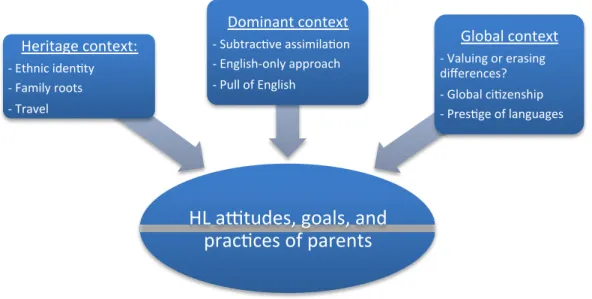
Figure 3. Theoretical framework ... 76
Figure 4. Degrees of HL proficiency ... 83
Chapter 1: Introduction
This dissertation describes experiences of Czech and Slovak immigrant parents in 11 families with heritage language (hereafter referred to as HL) retention and attrition of their children in the southeastern part of the United States. The study illustrates the challenges and dilemmas immigrant parents face when attempting to raise bilingual children in the United States in light of the current English-‐only policies and the largely monocultural education practice. Specifically, this study explores the ways in which transnational (Brittain, 2002; 2009) involvement and practices of the parents might counter the dominant society’s strong pressures for language assimilation.
The focus of this study is on central European immigrants, who constitute an understudied population in educational research. Experiences of Czechs and Slovaks might offer insights about the situation of many other language groups from central, eastern, and southeastern Europe (such as Polish, Bulgarian, Slovenian, Serbian, and Bosnian). Many of these language minorities are highly unlikely to maintain their HL successfully across generations because of their relatively small numbers, geographical dispersal, higher rate of intermarriages, and the general absence of suitable language programs for chidlren. In presenting experiences of understudied immigrant populations, this dissertation informs language education policy and programs in the United States.
Context of the Research Problem
States today are learning English rather quickly (Portes & Rumbaut, 2001; Tse, 2001a; 2001b), they tend to leave their HL behind. This rapid shift from the HL to English, or subtractive bilingualism, has
repercussions for the immigrant children, families, and communities (Fillmore, 2000; Fishman, 1991), such as a creation of a language barrier between parents and children, weakening of parental authority, and growing intergenerational alienation and conflict (Carreon, Drake, & Barton, 2005).
On the other hand, bilingualism is proved to have multiple cognitive, social, and economic benefits for individuals and the whole society (Cummins, 2005). In fact, Cummins (2005) and García (2009) argued that the current practice of educating children in a monolingual setting is no longer appropriate in the 21st century. These scholars claimed that all children should have access to the learning of other languages. Unlike in the United States, the benefits of bilingualism are widely accepted and incorporated into education policies and practice elsewhere in the world. Tucker (2008), for
example, pointed out that every European country has developed a national policy to introduce at least one foreign language into every child’s elementary school curriculum. This is, however, far from the reality in the United States, a country that prides itself on being the most multicultural in the world.
Education policies and practices in the United States have paid little attention to the issue of HL loss and the potential bilingualism of children of immigrants, focusing exclusively on the goal of English language acquisition. In fact, this linguistic asset of immigrant-‐origin children is, ironically, often treated as a deficiency (Valenzuela, 2005), a condition potentially interfering with the children’s acquisition of English and their overall academic achievement, or even as a threat to national unity (Crawford, 2008). It has been documented (Cummins, 1986/2001; Gibson 1988; 1995; Valenzuela, 1999) that the
in their parents’ languages upon entering the public education system, and they grow up to become mostly monolingual English-‐speaking adults. Whereas knowledge of the English language is almost universal among children of immigrants, only a small percentage of second-‐generation immigrants are able to converse in their parents’ language, much less read and write in the HL (Portes & Rumbaut, 2001). Considering that children of immigrants represent one fifth of the total number of school-‐age children in the United States today, and that this number is expected to grow (Rong & Preissle, 2009), a huge linguistic potential is being ignored and wasted by schools’ sole focus on English language
acquisition and proficiency (Suárez-‐Orozco & Suárez-‐Orozco, 2001).
The most important factors affecting HL retention or loss among second-‐generation immigrants include language policies and schooling practices of the receiving country, existence of an ethnic community with language resources and supports, an opportunity to attend a bilingual school or an ethnic community language school (e.g., Chinese language school, Korean language school, and so on), and the use of the HL at home (Lee & Suarez, 2009; Nesteruk, 2010). As a result of these factors, apparent differences exist between distinct language minorities. It has been documented, for example, that children from Spanish-‐speaking backgrounds are four times more likely to retain their HL than children from any other background (Portes & Rumbaut, 2001). The higher rate of HL retention in this language group is attributed mainly to the existence of larger communities, the use of Spanish in public realms, and the existence of bilingual education programs. Children who have the opportunity to use their native language beyond the context of the family, such as in their schools and communities, are generally more likely to retain the HL and become bilingual.
loss with two particular immigrant populations facing these challenges. Because of their geographical dispersal, Czech and Slovak immigrants in the southeastern United States today can typically rely neither on the resources of a large ethnic community nor on any institutional support in terms of HL
maintenance (Kouritzin, 1999; Robila, 2010). Moreover, European-‐origin immigrants in the United States are more likely than other immigrant groups to marry outside their ethnic and linguistic heritage. The fact that a large percentage of European-‐origin immigrants marry English-‐speaking U.S. citizens further reduces the chances of HL retention among their children (Jensen, 2001).
At the same time, language is closely linked to one’s heritage and ethnicity and can be used to claim or distance oneself from a particular identity (Bailey, 2000). The persistent racial discrimination against non-‐White and non-‐English speaking people has the potential to erode HL even in larger Spanish communities. Unlike most current research, this study focused on White immigrants and explored the intersection of language, ethnicity, and race from the viewpoint of central European immigrant parents.
Research Questions
A number of more specific questions guided the research process: How do parents approach the HL philosophically and strategically? According to parents, what is the role and purpose of the HL for their children? What goals do parents have for their children in terms of HL proficiency and use? What strategies for HL maintenance do parents use? Which HL maintenance practices work best and what are the main challenges? How is the HL used in the immigrants’ homes? How are decisions regarding HL use made? Are the choices for language practice made voluntarily or involuntarily? How do other contexts, including the hegemonic social, cultural, political, and ideological forces, influence parental approach and children’s HL maintenance? How does transnational involvement of the families affect HL maintenance?
Methodology and Theoretical Frame
This research employs an interpretive philosophical perspective (Bochner, 2005), focusing on the meaning making in the stories of the participants. It prioritizes the parents’ own understanding of their experiences. As a researcher, I do not seek to discover an objective “truth” but rather to
understand how parents make sense of their specific situation. The parents’ interpretation constitutes a reality they act upon and is crucial to understanding their HL choices, goals, and practices.
Although HL loss is typically explained by the pressures for linguistic assimilation of the receiving society and by the differential power between languages, the life realities of today’s immigrants are often shaped by multiple other contexts. The experiences of current-‐day immigrants range from sojourners and temporary workers to transmigrants, and their motivations are guided not only by the context of the receiving society. Transnational migration theories (Brittain, 2002; 2009; Schiller, Bash, & Blanc, 1995) suggest that today’s immigrants cross boundaries often, continue to be actively involved in their homeland, and continue to draw on the resources from their country of origin. Additionally, they may organize their lives with respect to the rapidly changing world as a whole instead of just a single country or two. Today’s migrants might see themselves as global citizens and make choices accordingly.
The framework of transnational migration theories (Brittain, 2002) guided the analysis of parental experiences with HL maintenance into the 2nd generation, focusing on their goals, motivations, and HL practices as influenced by the dominant context, the heritage context, and a global context. Specifically, this study examines the potential of transnational practices of immigrant families to overcome the strong pressures of the dominant society for language assimilation.
Significance of the Study
attention been paid to HL maintenance and to the prospect of bilingualism among children of
immigrants, at least within the walls of academia (Cummins, 2005; Suarez, 2002; Valdés, 2001; 2005). Still, these scholars have focused primarily on large language groups from Latin America and Asia.
Secondly, this study explores HL use of Czech and Slovak immigrants, two understudied groups from central Europe. These less visible language minorities may be expected to face numerous
challenges in their HL maintenance efforts. Often lacking the resources of ethnic communities, they experience no language support from schools. Moreover, European-‐origin immigrants are more likely than others to marry outside their ethnic and linguistic group, which further lowers their likelihood of raising bilingual children (Jensen, 2001). In families where only one parent speaks the HL, the home exposure to that language is significantly lower than in families where both parents are foreign born.
Fourthly, this study sheds more light on the role of immigrant parents in the process of HL maintenance. Although it has been documented that children of immigrants typically come to prefer English to the HL in their everyday lives (Portes & Rumbaut, 2001), we know much less about the role parents might play in the language shift. In contrast to the commonly held view that immigrant parents strive to devote as much time and resources as possible to the maintenance of the HL in their children, my exploratory study (McCabe, 2011), supported also by the findings of Tse (2001b) and Nesteruk (2010), indicated that parental values and actions may not be as clear-‐cut as expected. To help their children excel academically in a monolingual schooling system, some parents may choose to assist their children primarily with English, as required by schools, which leaves them with less time and energy for any HL maintenance efforts. Some parents might, in fact, contribute to HL loss through the choices they make for their children based on their understanding of the larger social context in which they happen to live. This dissertation examines parents’ values, goals, desires, efforts, and ambitions regarding HL maintenance in order to better understand parental role in the language shift of the second generation.
Fifthly, this study recognizes the new and multiple experiences of migrant populations today. Whereas in the past immigrants were thought to break their ties with the homeland, to settle
Finally, one of the major contributions of this study is its focus on family composition and the language practices of mixed-‐marriage families, which has not yet been explored in depth in educational literature on language and migration (Lam, 2011; Shin 2010). This dissertation included ethnically and linguistically intact families as well as families where only one parent was foreign born, allowing for comparisons between the two groups.
Outline of the Dissertation
Chapter 2 of this dissertation reviews relevant literature on HL maintenance and loss among children of immigrants, focusing specifically on the needs and challenges experienced by central and Eastern European immigrants. Theoretical frame is presented in the second half of Chapter 2. Chapter 3 describes the research methodology in more detail, explaining the sampling procedures and methods of data collection and analysis, noting researcher’s positionality, and introducing the participant families.
Chapters 4, 5, 6, and 7 present the findings of this study. Chapter 4 discusses parental goals and motivations with regard to HL maintenance; Chapter 5 provides an account of parental efforts to provide sufficient HL exposure to their children; Chapter 6 focuses on the children’s HL use as perceived by the parents; and Chapter 7 answers the main research questions, summarizing the differences and similarities across families. Finally, Chapter 8 provides a discussion of the findings, noting the theoretical and practical implications of the study and suggesting directions for future research.
Definition of Key Terms
The following terms are used throughout the text and are defined as outlined below. These terms are not alphabetically listed. Instead, they were clustered into content related categories. More detailed discussion is provided within the text of the dissertation.
§ Balanced (true) bilingual – an individual with a native-‐like control over two or more languages across
domains; an ideal state that is very rarely achieved. Most bilinguals are dominant in one language or develop different levels of proficiency in different domains or situations (Baker, 2011).
§ Emerging (incipient) bilingual – an individual to some degree dominant in one language (Baker,
2011; Suárez-‐Orozco & Suárez-‐Orozco, 2001).
§ Additive Bilingualism – a situation when learning a second language does not interfere with the
learning of the first language and ultimately both languages are developed (Baker, 2011). § Subtractive Bilingualism – a situation when learning of a second language interferes with the
learning of the first language, eventually leading to the loss of the first language (Baker, 2011). § Heritage language -‐ a language other than English spoken in immigrant homes by parents and/or
children (Valdés, 2005).
§ 1.5 generation immigrant – a foreign-‐born individual who arrived in the United States at a young
age, generally before age 10 (Harklau, Losey, & Siegal, 1999).
§ Second-‐generation immigrant – an individual born in the United States to foreign-‐born parents
(Rong & Preissle, 2009).
§ 2.5 generation immigrant – an individual born in the United States in a family where one parent is
foreign born and the other is U.S. born (Rumbaut, 2009).
§ American Transnational – a person born in the United States to at least one foreign-‐born parent, a
person with cosmopolitan social and cultural capital (Cervantes-‐Soon, 2014).
§ Mixed marriage or intermarriage – a marriage in which the two parents come from different cultural
and linguistic backgrounds. An example would be a marriage where one parent is U.S.-‐born English-‐ speaking and one is foreign-‐born, Czech-‐ or Slovak-‐speaking.
§ Eastern Europe – all the countries once a part of the Eastern bloc (such as Bulgaria, Belarus, Ukraine,
and so on), including the central European countries (in other sources, “eastern Europe” may be defined as not including the central European countries).
§ Subtractive assimilation – a process of immigrant adaptation to a new country in which heritage
cultures and languages are being devalued and rapidly replaced by the majority culture and language (Gibson, 1995). Schools play an important role in this process of subtracting students’ culture and language from immigrant youth (Valenzuela, 2005).
§ Additive acculturation – a process of immigrant adaptation to a new country in which heritage
cultures and languages are valued. The new culture and language are added to the children’s home culture and language to expand their repertoire of cultural and linguistic skills (Gibson, 1995). Additive schooling would build on the skills children bring with them from home to the classroom.
§ Linguistic capital – linguistic competency valued in a specific situation or context (Bourdieu, 1977).
§ Transnational social space -‐ a human collectivity that includes people in different localities and the
ties in between them. The ties are instrumental in nature and can be both formal, such as a membership in a political party, and informal, such as family ties (Brittain, 2002).
List of Abbreviations CZ Czech
SK Slovak
ESL English as a Second Language HL Heritage language
Chapter 2: Literature Review and Theoretical Frame Literature Review
This chapter provides a review of literature related to HL maintenance and loss among children of immigrants in the United States. First, the definition of HL learners is outlined and the benefits of HL retention are described. Second, the process of HL loss is documented as it happens over generations of immigrants as well as within the lifespan of individuals. Third, conditions contributing to HL retention are examined, including the presence of an ethnic community, HL use within immigrant families, the prestige of the HL, and a sense of ethnic and racial identity. It is suggested that smaller language minorities, such as Czechs or Slovaks, may face numerous challenges in HL maintenance efforts. At the same time, the role of ethnicity and race in HL use is discussed. Finally, an overview of the immigration history and language practices of Czech and Slovak immigrants in the United States is presented.
Heritage Language Learners in the United States
within the home and among friends. In fact, HL speakers often lack vocabulary in more specialized domains, such as work or politics (Polinsky & Kagan, 2007). Valdés‘ definition assumes that the child is familiar with the HL to some degree, but he or she generally lacks complete acquisition of the language because of the absence of formal schooling in the HL. Some HL speakers might decide to explicitly study the HL later in life, perhaps in college. However, because of their previous exposure to the spoken language, they require a pedagogical approach different from a typical foreign language instruction (Kagan, 2005; Randolph, 2011; Valdés, 2005). Language programs specifically aimed at HL learners are still lacking in the United States, even for larger language groups, such as Spanish speakers.
A broader definition, identifying heritage learners by their cultural and ancestral identification with a given language, was proposed by Fishman (1991; 2001). This second definition does not assume any direct familiarity with the language. An example of an HL learner in Fishman’s view is a fourth-‐ generation Italian immigrant who is monolingual in English or an English-‐speaking descendant of a Native American tribe. Foreign language instruction is appropriate for HL learners as defined by
Fishman. In this text, Valdés’ definition of an HL is used it assumes a degree of familiarity with and use of the HL. In this study, at least one parent in each participant family was fluent in Czech or Slovak.
Therefore, children in all participant families had the potential to become familiar with some aspects of the language, to be to some degree bilingual in English and the HL.
read, and write fluently or almost fluently in both languages. A bilingual competence may be perhaps better understood as a continuum of proficiencies in the two languages. Valdés (2001) developed a diagram (Figure 1) to demonstrate this more fluid understanding of bilingualism. The end points represent a monolingual proficiency and the middle part displays the various types of bilingualism. Figure 1. A continuum of bilingual proficiency
Note: The first letter stands for the stronger language, and font sizes and case suggest different proficiencies. All the combinations represent particular types of bilingualism.
Source: Valdés (2001, p. 4)
One type of bilingual proficiency is not, however, included in the diagram above. “Limited bilinguals” (Portes & Rumbaut, 2001, p. 273), also called “semilinguals” (García, 2009, p. 56) are people who do not acquire fluency in either language. With the prevalent English-‐only policies in education today, certain groups of immigrant youth are in great danger of abandoning their HL and at the same time not learning English well. This concern applies typically to immigrants who come to the United States later than in early childhood but before adulthood because they do not receive a full education in their home country and at the same time they may not become fluent speakers of English. On one hand, this definition has been critiqued as a deficit perspective because it portrays these speakers as lacking full proficiency in at least one language. On the other hand, recent scholarship (García, 2009) critiqued this static definition of bilingualism, stressing the flexible use of both languages in the everyday life of a bilingual person. Instead of a focus on full proficiency in one or more languages, strategic code switching between languages is crucial to this new understanding of bilingualism. García (2009; 2011) developed a new term, “translanguaging,” to describe the process of using multiple languages simultaneously.
A
Ab Ab Ab Ab Ab AB BA Ba Ba Ba Ba Ba
B
monolingual
a range of bilingual proficiency
monolingual
in language A
in language B
Several other terms have been developed to refer to certain types of bilingual proficiency as implied in the diagram above (Figure 1). A native-‐like control over both languages, symbolized by AB and BA in the middle of the continuum, is often referred to as “balanced bilingualism” (García, 2009, p. 44). Balanced bilinguals are ideally able to express any and all levels of communication in more than one language. In reality, however, such accomplishment is rare. Most bilingual speakers are to some degree dominant in one language, often called “incipient bilinguals” or “emerging bilinguals” (Suárez-‐Orozco & Suárez-‐Orozco, 2001, p. 137). In addition, linguists have pointed out that “rarely is anyone equally competent in two or more languages across all situations” (Baker, 2011, p. 8). Instead, most bilinguals use their two languages for different purposes and with different people. These domains or contexts of language use may include the home, school, shopping, media, hobbies, religion, and so on. Thus for some bilinguals, “family and emotional matters may be most comfortably expressed in one language, while conversations about work may be most fluently discussed in another” (Suárez-‐Orozco & Suárez-‐ Orozco, 2001, p. 137). Similarly, Portes and Rumbaut (2001) reported that for Spanish HL speakers “settings requiring strong emotional expression are the proper realm of Spanish [and] English remains the language of work and shopping” (p. 122).
According to Valdés (2001), most immigrant-‐origin children can be defined as bilinguals with a degree of proficiency in the two languages, typically first being dominant in the HL, and later becoming dominant in English. Among children of immigrants, however, learning English too often involves a decline in their proficiency of the HL, eventually leading to an HL loss (Fillmore, 1991). This trend is unfortunate for two reasons. First, a successful retention of the HL language is beneficial for the wellbeing of immigrant families and communities, while HL loss has negative effects. Second, HL retention can lead to balanced bilingualism of the children, providing additional advantages.
to deceive their parents about school activities or report cards, about the price of things they needed for school, … about the courses they were taking in high school, about the precise gender mix, location, and nature of parties, about relationships, about drug use. (p. 173-‐4)
On a similar note, Wiley (1993) warned that the situation of the 1920s and 1930s in which the “widespread loss of parental authority” led to “the rise of juvenile delinquency among European American immigrant youth” (p. 426) may repeat itself again today because of the growing language barrier between immigrant generations. The difference in the pace of Americanization between children and their immigrant parents is referred to as a “dissonant acculturation” (Portes & Rumbaut, 2001), suggesting negative effects. “Selective acculturation,” on the other hand, refers to a type of adaptation that occurs when the ties and communication between parents and children are not broken, a path of adaptation closely linked with the preservation of the HL, resulting in fluent bilingualism.
Benefits of bilingualism. In addition to the family cohesiveness and fluent intergenerational communication, HL maintenance provides children, communities, and whole nations with additional benefits (Cummins, 2005; Lee & Suarez, 2009). Therefore, García (2009) insisted that bilingual education be treated as a desirable goal not only for national minorities and immigrant children, but also for all students in the mainstream classroom. She argued that, “bilingual education is the only way [emphasis in original] to educate children in twenty-‐first century” (p. 5) for a number of reasons.
First, knowledge of more than one language represents an advantage in the job market, where bilingualism is increasingly becoming a sought-‐after qualification. Suárez-‐Orozco and Suárez-‐Orozco (2001) noted the demand for professionals and managers who can operate within more than one cultural code in the global economy. Bilingual speakers are needed in business, science, education, diplomacy, and many other social realms.
2009, p. 146). Matute-‐Bianchi (1986) found that fully bilingual Mexican-‐American children performed better in school than those who lacked proficient bilingual skills. It is believed that students with proficiency in their HL perform better in school because of their flexible cognitive strategies, greater creativity, and a more developed abstract thinking (Baker, 2011; García, 2009). However, as Lee and Suarez (2009) note, “the key to promoting higher academic performance among immigrant children seems to lie in the development of not only oral proficiency in the heritage language, but also literacy skills” (p. 146). As documented by Lutz and Crist (2009), second-‐generation bi-‐literate Latino boys significantly outperformed boys who were less proficient in Spanish.
Third, bilinguals tend to have advanced interpersonal skills. Compared to monolingual speakers, bilinguals are better able to develop empathy and communicative sensitivity in dealing with people from a variety of backgrounds (García, 2009; Suárez-‐Orozco & Suárez-‐Orozco, 2001). Thus, to sum up these three points, bilingual individuals have advantages over monolinguals in the linguistic, cognitive, and social development realms.
university graduates for positions requiring such abilities even at home, within the American job market. The importance of HL maintenance among immigrants is widely recognized. Au (2008) warned that,
when children lose their heritage languages, everyone loses something. The children and their parents may be unable to bond in a language that both are most comfortable with, the community loses its cultural heritage, and the nation loses human resources much needed in bridging cultures within communities and across nations. (p. 337)
For all these reasons it is imperative that HL maintenance leading to bilingualism be valued and cultivated in children of immigrants. In reality, however, most children of immigrants today tend to lose their HL over the course of their lives, or never learn it in the first place (Kouritzin, 1991). As described below, the main reason for the lack of bilingualism among the second generation is not a poor
command of English but rather the insufficient proficiency in the HL.
Language Loss among Immigrants
A gradual loss of HLs among immigrants in the United States happens both across generations and within the lifespan of individuals. “Language shift” typically refers to the change in language
preference and proficiency across generations (Fishman, 1991; 2001), and “language attrition” generally denotes a decreasing competency in the mother tongue for individuals (Baker, 2011; García, 2009). “Language loss” is an overarching term for both of these processes.
positively and studied as first-‐generation Americans or “American transnational people” (Cervantes-‐ Soon, 2014); people with new and diverse forms of social and cultural capital. In addition, some of these transnational people may have dual citizenship, raising further questions about the terminology and their belonging. Thus a more cosmopolitan view of these populations may be appropriate. Still, because of its widespread use in immigration literature I use the term second generation in this dissertation to demonstrate the differences in HL proficiency between immigrant parents and their children. However, it should be kept in mind that this definition is highly problematic for theoretical and practical reasons.
Language shift. Linguists Fishman (1966; 1991) and Veltman (1983) long ago described a pattern of the language shift among immigrants as happening within three generations. According to this model, the first generation is dominant in the HL, the second generation becomes dominant in English while retaining some command of the HL, and by the third generation most knowledge of the foreign
language is lost, because it is supported neither outside nor inside the home. Examining the applicability of this three-‐generation model of linguistic assimilation, Alba, Logan, Lutz, and Stults (2002) used 1990 census data to compare the HL use over generations across language groups. They found that
“Anglicization is occurring at roughly the same pace for Asians as it did for Europeans, but is slower
among the descendants of Spanish speakers” (p. 467). Similarly, Rong and Preissle (2009), based on their analysis of the 2000 census data, reported that HLs in the United States are essentially lost or replaced by English by the third generation. The major shift towards monolingualism happens during the second generation for both European and Asian children; however, it tends to be in the third generation for Hispanic children (Rong & Preissle, 2009).
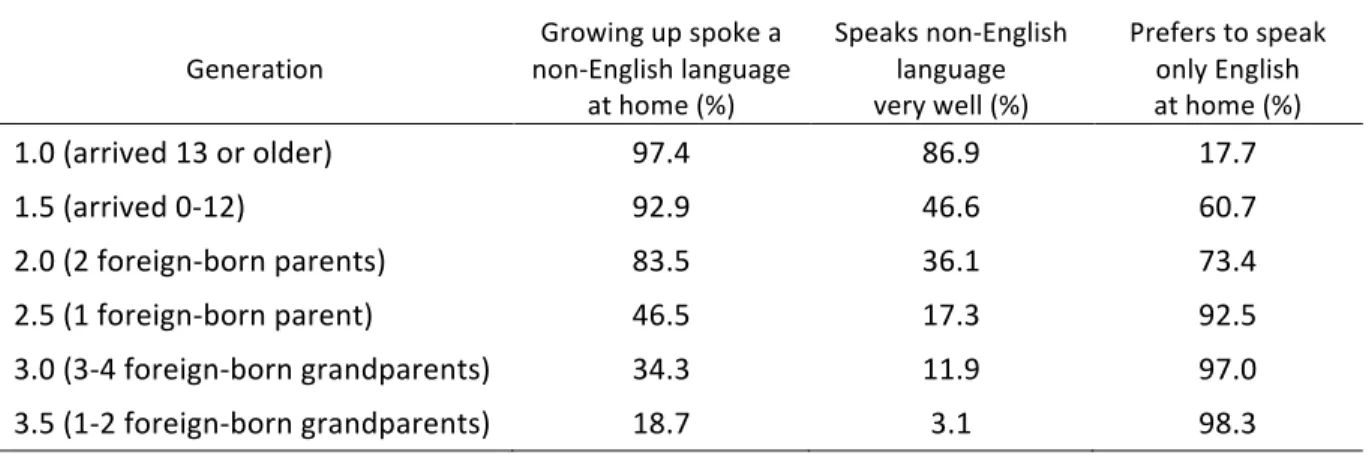
use, proficiency, and preference by generation, showing the decline in the use of the HL at home, the dropping proficiency in the HL, as well as the growing preference for English across generations. He used the concepts of 2.5 generation to refer to children with only one foreign-‐born parent, and 3.5
generation to refer to children with only one or two foreign-‐born grandparents. Larger differences in HL proficiency were found also between 1st and 1.5 generation, between 2nd and 2.5 generations, and between 3rd and 3.5 generations. Table 1 summarizes the findings.
Table 1. Heritage language competency across generations
Generation
Growing up spoke a non-‐English language
at home (%)
Speaks non-‐English language very well (%)
Prefers to speak only English at home (%)
1.0 (arrived 13 or older) 97.4 86.9 17.7
1.5 (arrived 0-‐12) 92.9 46.6 60.7
2.0 (2 foreign-‐born parents) 83.5 36.1 73.4
2.5 (1 foreign-‐born parent) 46.5 17.3 92.5
3.0 (3-‐4 foreign-‐born grandparents) 34.3 11.9 97.0
3.5 (1-‐2 foreign-‐born grandparents) 18.7 3.1 98.3
Source: Rumbaut (2009, p. 47)
across generations, Alba (1990) found a “steep drop-‐off in knowledge and use of a mother tongue between second and later generations” (p. 107). In his study, third-‐generation immigrants were 28% less likely than the second generation to use the HL.
However, some researchers today (Fillmore, 1991; 2000; Kouritzin, 1999) claim that language shift has accelerated lately and that the HL is often lost entirely by second generation. Crawford (2008) argued based on census data that “the pace of Anglicization in this country has never been faster” (p. 10). Similarly, Portes and Rumbaut (2001) found that, “while over 90% of the [second-‐generation] sample report knowing a language other than English, their fluency in that language is significantly poorer” (p. 119). Having applied a language proficiency measure, they found that no second-‐generation ethnic group could be, on average, considered fluent in their parents’ native language. Spanish-‐speaking ethnic groups have scored generally higher than other language groups but were still far from fluent in the HL. This increased erosion of HLs in recent years might be the result of a decline in active usage of HLs within communities as Reese and Goldenberg (2006, p. 45) pointed out on an example of a Puerto Rican community in New York studied twice over the course of twenty years. While in the early 1980 Spanish was used for multiple purposes in the community, 20 years later the use of Spanish became limited to communication with the older generation. The recent push for English-‐only instruction may be playing a major role in this process, strongly discouraging the use of HLs outside of the family context (Crawford, 2008).
ability to speak the language to some degree, reading and writing seldom gets developed to any appreciable level” (p. 32). This pattern is attributed to the general lack of opportunities of second-‐ generation immigrants to receive a formal education in the HL.
Language attrition. Beside language loss across occurring across generations, the ability to use and understand the HL decreases within the lifespan of individuals if not supported by ethnic
community, schools, and the larger society. Portes and Rumbaut (2001) claimed that “of all the distinct legacies transmitted across generations, language is arguably the most important, but it is also the most difficult to transmit because of strong opposing forces” (p. 114). Although young children tend to prefer the HL to English, their knowledge of the HL recedes with the beginning of the compulsory schooling, being gradually replaced by English. Researchers (Fillmore, 1991; Nesteruk, 2010; Polinsky, 2008) documented cases of children who had stopped using Russian, Romanian, and other languages actively, as they entered kindergarten. Without an active use, the children’s ability to express themselves in the HL began decreasing markedly, followed by a drop in their passive understanding of the HL. Thus, within the lifespan of a second-‐generation immigrant, it is most typically around age 5 when English takes precedence over the home language.
Still, HL attrition has been documented even on a preschool level, depending on the children’s exposure to English. Fillmore (1991) surveyed about 1,000 immigrant families from different language backgrounds, including Latinos, Asians, Arabs, American Indians, and others. Some families had placed their children in English-‐only preschool programs, others in bilingual, and yet others in HL preschool programs (all of these were Spanish-‐speaking families). Fillmore (1991) found that early exposure to English, such as in a preschool setting, led to a faster language loss.
Zhou (2001) conducted a study with a sample of 363 Vietnamese teenagers and found that HL declined with age while English proficiency increased. Similarly, Portes and Rumbaut (2001) and Rumbaut, Massey, and Bean (2009) documented the second-‐generation language use and preferences in more detail based on the Children of Immigrants Longitudinal Study (CILS), a large study exploring the patterns of adaptation among second-‐generation immigrants in San Diego, CA and Miami, FL. Following 5,000 second-‐generation youth for several years, this study clearly showed the children’s growing proficiency in English, growing preference for English, as well as a gradual decrease in the knowledge of and preference for the HL. The preference for English grew rapidly over time, from 72% of second-‐
generation children preferring English to their parents’ language in junior high school to 88% by the end of high school. With an exception of Spanish, children of most other language backgrounds, such as Chinese, French, Hmong, or Lao, prefer English overwhelmingly in rates as high as 99%. The results not only document that knowledge of English among second-‐generation immigrants is nearly universal, but also that English is the preferred language for a majority of second-‐generation students, although an HL was spoken in almost all these immigrant homes. Similarly, Hakuta and D’Andrea (1992) found on a sample of over 300 second-‐generation HL speakers that children’s language use and preference had shifted markedly from Spanish to English between elementary and high school.
The process in which the introduction of a new language leads to the loss of the first language is called “subtractive bilingualism” (García, 2009). During the process of schooling, most children of immigrants in the United States are unable to receive any institutional support to maintain and to further develop their proficiency in the HL. Their knowledge of the language atrophies over time such that by adulthood, second-‐generation immigrants typically become markedly dominant or even
entirely lost the HL during their lifespan. Some of the participants admitted a complete inability to understand the language of their parents. Others shared that, when listening to a tape-‐recorded conversation between themselves and their mother in the HL, they were unable to understand what they had been saying. For most of the participants, the experience with HL loss was heartbreaking. Still, while some children do become fluent in the HL early in their lives and later lose this proficiency, others may never have the chance to learn the native language properly in the first place, even if only its spoken form (Kouritzin, 1999).
Social context of language learning and migration. What are the major causes of language loss across immigrant generations as well as with a lifespan of individuals? Many have argued that the strong societal push toward English is to blame for the rapid disappearance of HLs in the United States
(Crawford, 2008; Fishman, 2001; Lee & Suarez, 2009; Wiley & Lee, 2009). Schooling plays an important role in the language assimilation process in this country, promoting English at the expense of HLs.
Today, we find ourselves in the midst of another large and diverse wave of immigration. Similarly to the situation of hundred years ago, the recent movement toward an English-‐only approach “seems to have been fueled by a tide of escalating anti-‐immigrant sentiments throughout the country” (Tucker, 2008, p. 40). One recent example of the various attempts to re-‐instill the English-‐only approach was California’s Proposition 227, also called English for the Children initiative. Passed in 1998, it was an attempt to eliminate bilingual education, suggesting that any teaching of HLs would interfere with English language acquisition, and that the best way for children to learn English is to be immersed in English-‐speaking classrooms (Cummins, 2005; Valenzuela, 1999). A similar measure, Proposition 203, was approved in 2000 in Arizona, mandating that “all children in Arizona public schools shall be taught English by being taught in English” (Mahoney, Haladyna, & MacSwan, 2009, p. 241). Fueled also by the No Child Left Behind Act of 2002, requiring states to adopt a single-‐language proficiency assessment (Mahoney et al., 2009), “the English-‐only initiative is currently spreading rapidly through the United States. Over 20 states have passed official English laws, and over a dozen other states have comparable versions of similar legislation pending” (Rong & Preissle, 2009, p. 59-‐60). Common to all these policies is the emphasis on an abrupt shift from the HL to English as an integration strategy of the new linguistically and racially diverse immigrant groups. Portes and Rumbaut (2001) called this English-‐only approach a “forceful assimilationism” and they maintained that,
policies derived from this ideology de-‐legitimize the culture and language of parents (…). By instilling in children the sense that their parents’ language is inferior and should be abandoned in favor of English, schools help drive a wedge across generations, weakening parental efforts to preserve a common cultural memory. (p. 273)