Rochester Institute of Technology
RIT Scholar Works
Theses
Thesis/Dissertation Collections
3-1-2011
Sculptural life forms
Jaiik Lee
Follow this and additional works at:
http://scholarworks.rit.edu/theses
This Thesis is brought to you for free and open access by the Thesis/Dissertation Collections at RIT Scholar Works. It has been accepted for inclusion in Theses by an authorized administrator of RIT Scholar Works. For more information, please [email protected].
Recommended Citation
Rochester Institute of Technology
A thesis submitted to the faculty of
The College of Imaging Arts and Sciences
In candidacy for the degree of
Master of Fine Arts
Sculptural Life Forms
by
Jaiik Lee
Date: March 2011
Approvals
Chief Advisor: Leonard Urso
Date: / /
Associate Advisor: Juan Carlos Caballero-Perez
Date: / /
Associate Advisor: Eileen Bushnell
Date: / /
School for American Crafts Chairperson:
Donald Arday
Date: / /
I, Jaiik Lee, hereby grant permission to the Wallace Memorial Library of the
Rochester Institute of Technology to reproduce my thesis, Sculptural Life Forms in
whole or in part. Any reproduction will not be for commercial use or profit.
Signature of Author: Date: / /
Table of Contents
Approvals
……….2
Abstract
……….4
Beginning of Idea – Concept
………..6
Influences and Inspirations
………...10
Sculptural Work
………...……….……...16
Viscus
……….………17
Fluo
………..……...17
Navigo
……….………...18
Amnis
……….…………18
Aestus Estus
……….……….19
Navigo II
………20
Figure
………..……….21
Conclusion
……….……….34
Abstract
The purpose of my art is to express the mystery of life. Through the shaping of
material mass, I induce my work to influence space and time in an attempt to discover
special meaning about the life phenomenon of all creatures from the beginning of time
to their present manifestations today.
The origin of life has been the subject of numerous debates including those pitting
creationism against evolution and churchmen against scientists. There remain, however,
discoveries and artifacts like ancient fish fossils, that connect features of our humans
ancestors with other living organisms. Perhaps this is a riddle that will never be solved
and an assignment that cannot be completed. I cannot define what truth is in regards
to this issue and can only guess that the beginning of life started somewhere along the
line. I can, however, define the process for seeking the truth about the nature of life
without hesitation: It is ‘Evolution’, part of the title for my work ‘Evolutionary Stream’.
Evolution is a metaphor for life and also a paradox of life at the same time, because it
reveals that many historical debates and controversies are useless. Most important to
me in relationship to this issue is the facts that we are now living and breathing beings
continually struggle to evolve and develop our life’s future. The different sculptural
forms depicted in my work show the mysterious nature of life, Not only of human
beings, but of everything that is alive. My desire was to create a dynamic yet
harmonious relationship between form and surface, and capture the critical moments
Beginning of Idea - Concept
Alchemy is something that I have been attracted to for many years, and it was
essential in the development of the concept for my thesis. My fascination with alchemy
traces back to the allure of Islamic architecture, whose development was triggered by
advances in mathematics and studies in alchemy.
Alchemy was practiced in Mesopotamia, Ancient Egypt, Persia, India, Japan, Korea
and China, in Classical Greece and Rome, in the Muslim civilizations, and then in
Europe up until the 19th century. Its beliefs and practices were promoted through a
complex network of schools and philosophical systems that operated over a span of at
least 2,500 years. In the history of science, alchemy refers to both an early form of the
investigation of nature and an early philosophical and spiritual discipline, both
combining elements of chemistry, metallurgy, physics, medicine, astrology, semiotics,
mysticism, spiritualism, and art as parts of one greater force.
Gyeongju, one of the ancient capital cities in Korea, is home to many relics including
the Bell of King Seongdeok, also called the Emille Bell. This grand and the graceful Bell
is said to have been made in A.D.771 and a legendary tale of alchemy surrounds its
metal so that the resulting bell would produce a
beautiful sound. While sounding brutal, it
indicates the commitment of the people, who
were ignorant of both the composition of iron
and modern-day smelting processes, to achieve
their goals even by devoting themselves to (or
committing a cruel act of) murder.
The history of alchemy dates back to Aristotle’s
time and it was prevalent throughout Europe and the Arab states. Aristotle saw water,
fire, air and soil as the fundamental elements of life and the source of all creation.
Alchemy embraced the now discredited belief that matter holds different properties
according to the mixed ratio of the four elements. The overarching purpose of alchemy
from the ancient times down to the Middle Ages, was to find a means of turning
common metals into gold, by experimenting with varied ratios of elements. Although
greatly distanced from science and logic by contemporary standards, even men such as
Rene Descartes, the French philosopher who was a major figure in the development of
the concept of continental rationalism, was infatuated by alchemy during his youth.
Issac Newton, the British physicist and father of modern mechanics, is said to have
indulged in alchemy during his later years.
The infatuation with alchemy withered away in the West with the emergence of
modern science. In China, the renaissance of Buddhism and Confucianism also
contributed to its decline in the East. Men of public standing like Isaac Newton, once
enamored by alchemy, turned away from it and made biting remarks about it once his
own scientific theories became popular. The belief in alchemy and the alchemic
tradition in chemistry were replaced by the French chemist Antoine Laurent Lavoisier’s
modern chemistry. Although inevitably seen as both superstitious and unscientific,
alchemy has nonetheless had an important impact on mankind.
What motivated me to develop an interest in alchemy is not the seemingly ridiculous
quest to make gold out of copper but the many attempts made along the way. Some
alchemists who likened the creative power of alchemy to that of an animal’s ovaries are
said to have endured extraordinary pain or even death to produce new materials: They
believed that creation could not be perfected without pain, just as birth could not be
achieved without pain. Their research in various fields marked by their suffering and
pain gave birth to a tremendous amount of evolution in science, math and culture in
general. Their quest for truth was part of a quest to find the true meaning of life.
who tells his son that he buried gold somewhere in his vineyard. Digging up piles of
soil in his search, the son failed to find the gold but later enjoyed a rich grape harvest
thanks to the many grape seeds planted during his quest.
In short, people who tried to make gold were the fathers of so many valuable
inventions and useful experiments. Today, alchemists camouflaged as magicians,
scientists or even ‘aliens’ entertain us with their stories full of creativity and wit. I
personally believe that the alchemists’ rather reckless pursuit of truth is also mirrored
in the pursuits of artists like myself as we try to illustrate the different aspects of life
through our craft: like alchemists mixing elements in special vessels, attempting to
Influences and Inspirations
As an artist, my fascination with alchemy naturally drove me to reflect upon the
alchemists’ thoughts and values in my art. I chose the ‘study of life’ as the theme of
my work and tried to represent the different aspects of life through metal forms. I
thought deeply about picking specific motifs that would accurately describe my theme
of life and finally reached the conclusion that it might be a good idea to allow any form
that I felt was authentic to serve as a motif. My goal was to create motifs that would
illustrate emotions as abstract forms. These motifs crystallized moments of struggle
experienced by all living things in their pursuit of survival.
This may stir some controversy among theists who believe in Creationism but I
personally believe in humankind’s evolution over a long period of time. The motifs I
selected capture the essence of animals, and fish in particular. Fossils work in much the
same way, capturing the essence of living forms that we can experience in museums,
books and the Internet. This easy access can lessen our appreciation of these forms by
mistaking them for similar forms that can be easily made. That fish are frequently
discovered as fossils is evidence of the rich life found in the oceans over a long period
die, they will decay, oxidize and disappear. Only the process of burial under the soil will
make them less vulnerable to chemical decomposition by bacteria, CO₂ and carbon.
The speed that this process had to take may be a convincing explanation of why fossils
of pterosaurs often look as if they are ready to fly away. We can also explore the
evolution of living entities by comparing fossils. Evolution is a powerful and lengthy
struggle by both humans and other living things to survive in an environment. Humans
desiring to achieve goals, both big and small, helped build new civilizations, and made
mankind more fit for survival over a long period of time. The phenomenal advances
accomplished by humans would not have been possible without the human imperative
to win the competition against other carnivores to endure against the mighty force of
nature. I sought to model such primitive yet theoretical aspects of life in my works.
As an artist, I am attracted to the streamlined shapes of fish that are free from any
unnecessary details. Fish fossil specimens are ideal for sketching primitive life motifs.
It’s not clear why I like the shape of fish, but my memories during my childhood years
have had an impact on me. I was born and raised in a big city, but moved to Pohang
when I was six. I lived in this port city in the southern part of Korea for one year. I
remember marveling at the many kinds of fish swimming in tanks at sushi restaurants
There are many artists who get inspiration from the beautiful curves of fish including
Frank Gehry, the leading figure in deconstructive architecture, who is famous for his
lights series designed in the shape of fish. His structures juxtapose contrasting
materials and use fish-shaped curves to give off a primitive voluptuousness.
Constantin Brancusi also relied on various living forms to create symbolic and
abstract works. His bird series sculptures, in particular, are famous for preserving the
identity of his materials while simplifying and abstracting the bird forms. This approach
maximized the power of the forms and breathed life into the works. Birds are not the
only subjects that have influenced his work: Fish, which can be seen as birds of the
underwater world, were also subjects that interested Brancusi. He created fish series
from 1922 to 1930 but his forms are hardly reminiscent of actual fish shapes. Compare
Frank Gehry, <Fish Lamp>, 1986
the ‘fish’ and ‘birds’ among his refined works and you can never imagine for even the
slightest moment that they reference different species with different names. His
minimalist pieces are composed using deft lines that look as if they could slip freely
and fly from your fingers without leaving any traces as they disappear into the skies or
into the water.
.
Lee Bontencou’s works were also a great source of inspiration to me in thinking
about the forms for my project. Her abstract works up to the late 1960s were flawless
representations of human’s vulnerability, violence, war and fear. Later, her works took a
more concrete form associated with natural shapes of plants and fish. Her work further
evolved into even more abstract forms that were significantly different from her earlier
works. Her latest works are mostly mobiles hanging from the ceiling decorated with
ceramic beads, wires and pieces of thin silk whose shape is reminiscent of a
disassembled organism. Although untitled, this evolving work metaphorically and
Lee Bontecou, <Untitled>, 1998
Sculptural Work
In this body of work, I desired to express the flow of time as it might be manifested
in a rapid river, quite tide, or even an intense torrent of water in my art. My work can
be seen as an expression of the history of the human race, and also as the movement
of animals and their struggle for existence through adaptation: the law of the survival
of the fittest. This is also my story.
Although each of my sculptural forms resembles an animal form, I didn’t intend to
create specific animal shapes. Rather, I likened their shapes to the flow of human
history. I also titled each piece with Latin words to reflect the many aspects of flowing,
moving and streaming forms because I did not want to forget the idea of the origin of
living forms. I also chose this language because it was the language of the ancient
alchemists, who profoundly influenced the work in this series.
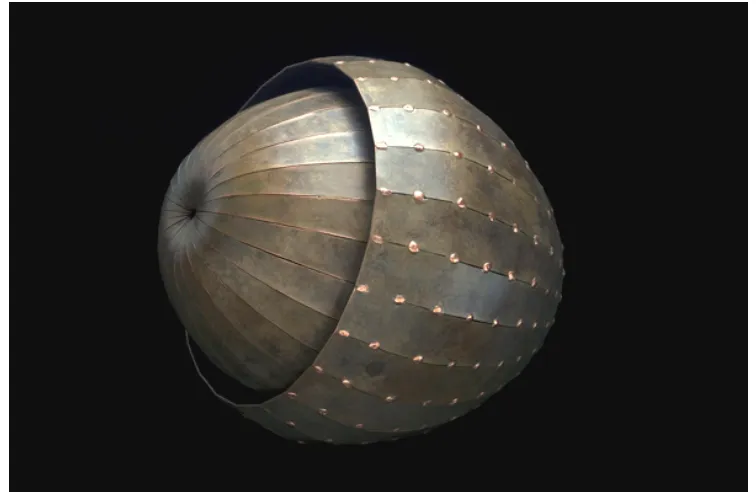
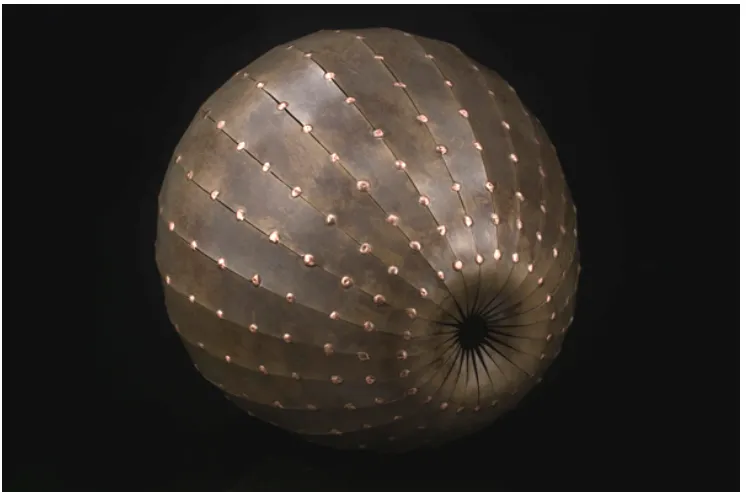
Viscus (Figure 1, 2, 3)
Viscus means ‘organ’ in English. This sculpture is made from copper and applied
ammonia patina. It has a style that is somewhat different from the other forms, being
angles. My previous works from Korea tried to combine an industrialized way of making
with traditional metal craft. I intended to make extremely geometric art pieces with the
possibility that they could be mass produced. These forms have something in common
with each other with regard to their use of regular lines and planes. Viscus is actually the last piece of my previous body of work and plays an important role as the bridge
between previous and current ideas.
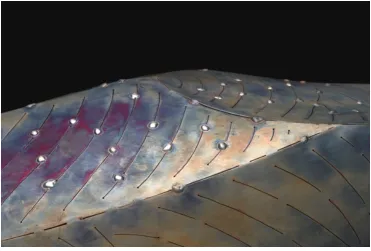
Fluo (Figure 4, 5, 6)
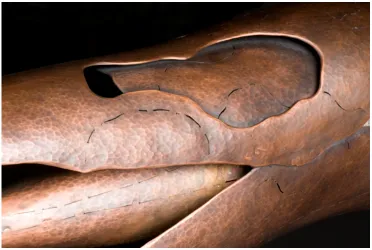
Fluo means ‘stream’. It is made from copper, fine silver and an applied heat patina. I
consider that this was first step towards changing my visual style. I was inspired by the
shape of a whale and used the hammering process to create an organic body shape.
As I had not hammered for almost 10 years, I was nervous about using this method. It
was, however, the correct process for creating forms that referenced living creatures
and brought me back to using these techniques. The regular lines and planes of my
previous style were transformed into irregular curved lines and flexible, sea animal like
Navigo (Figure 7, 8, 9)
Navigo is the first hanging sculpture, and it is made from copper, 24K gold leaf and
applied liver of sulfur patina. The title means ‘slow swimming’ or ‘sailing’ and was
inspired by a fossil fish image. I consider Navigo to occupy an important position among the pieces in this body of art because it is the beginning of the creation of new
style. I tried to capture the calm and quite mood of streaming water. The process
introduced a new method for creating the general structure of the forms as well as the
detail and surface decoration. The organic body of Navigo is united with many small, hammered copper pieces that I spot welded to show irregular cracked lines which
make it seem more primitive.
Amnis (Figure 10, 11, 12)
Amnis means ‘torrent’ in English. This piece is made from copper, 24K gold leaf and
an applied liver of sulfur patina. Unlike the peaceful, calm and flowing Navigo, I wanted this piece to show the fierce and violent moments of life. I have associated the
image of the splashing water of a waterfall with this sculpture.
I left my hometown and came to Rochester NY in 2006. Living in different country as
to me. Therefore, personally, Amnis is my favorite sculpture for the reason that it reflects my own situation of living in unfamiliar world. Like Navigo, however, Amnis is organized with three, separate masses of copper linked with small, individually applied
pieces of copper.
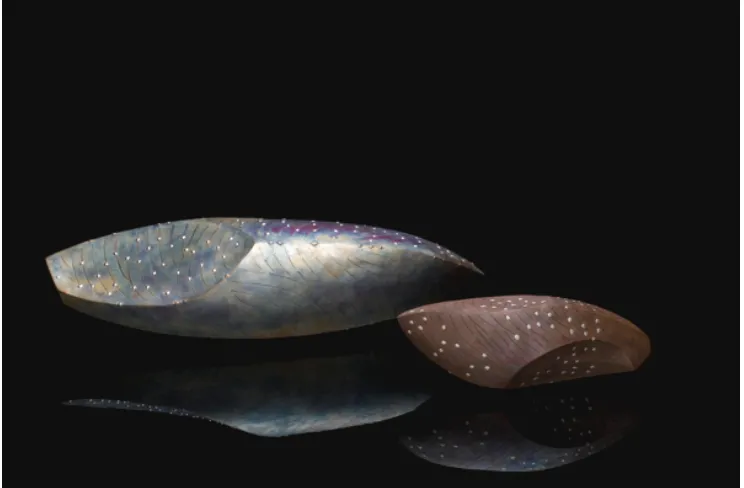
Aestus Estus (Figure 13, 14, 15)
Aestus Estus means ‘tide’. I wanted to create an image of a tidal wave on the ocean. Aestus Estus’ length is over 72 inches and I used 10 gauge copper sheets in its
construction. It was definitely a big challenge because I had never made a large sized
sculpture before with hammering techniques. While I was making this piece, it was
physically strenuous and painful work necessitated by its large size. I was, however,
already skilled at this process through the work that I had done making Navigo and Amnis. This experience with techniques and processes enabled me to master the
creation of its curved bodyline. My focus was mostly on making a stable structure. I
produced the head part and the lower body parts separately. When I joined them by
welding, copper wires 150mm in diameter were added inside of the connecting form
which helps to sustain the weight of the head and prevents the entire form from being
Navigo II (Figure 16, 17, 18)
Navigo II is made from copper, 24K gold leaf with an applied heat patina on the
surface. This is the last work of the living creature form series. For the other pieces, I
placed the emphasis on the expression of various kinds of streaming images with many
decorative factors such as exaggerated lines and shapes. This time, however, I was
going to create something simple and understated flowing off of a natural draft
reminiscent of primitive forms of life at the beginning of their existence. As a result of
Figure
Figure 2 - Viscus
[image:23.595.119.489.425.673.2]Figure 5 – Fluo (detail)
[image:25.595.118.490.419.661.2]Figure 7 - Navigo
[image:26.595.89.513.431.664.2]Figure 10 - Amnis
[image:28.595.113.485.426.672.2]Figure 14 – Aestus Estus
[image:31.595.112.484.423.673.2]Figure 17 – Navigo II
[image:33.595.113.485.423.672.2]Viscus
8"H x 7.8"W x 7.8"D
Copper
Fluo
9"H x 10"W x 24"D
5"H x 4"W x 12"D
Copper, Fine silver
Navigo
8"H x 10"W x 42"D
Copper, 24K gold leaf
Amnis
26"H x 13"W x 60"D
Copper, 24K gold leaf
Aestus Estus 64"H x 36"W x 72"D
Copper
Navigo II
14"H x 9"W x 39"D
Conclusion
This thesis seeks to reveal the mysteries and origins of life and show how these have
evolved to become part of what life is today. The issues surrounding the origins of life
are forever wrapped in a mysterious fog, creating a riddle that may perhaps never be
solved. Of the many theories that deal with the origins of life, those generated by the
scholars who theorized about the development of nature through evolution, have come
the closest to unlocking the mystery. Overtime, countless discussions about the origins
of life have been repeated. For me the discussions are of little significance, as I am
most interested in the fact that human being are alive and prospering.
I have tried to reflect the beliefs and visions of ancient alchemists who searched for
answers to the questions about the origin of life. The most important aspect of this
quest remains for me the fact that human beings have evolved to become one of the
earth’s great creatures as we constantly struggle to adapt to our changing situation.
My art work exhibits this life phenomenon, not only for human beings but for all
creatures. I tried to create a harmonious relationship between sculptural forms and
unique surfaces, which depict the evolutionary stream and movement that that all
Bibliography
Andrea Aromatico, [Alchemy: The Great Secret], Harry N. Abrams, U.S.A., 2000
Kwang Pyo Lee, [Pleasure of Appreciation and Comprehension], Hyohyoung Publishing, South Korea, 2000
Joseph P. Farrell, [The Philosopher's Stone: Alchemy and the Secret Research for Exotic Matter], Feral
House, U.S.A., 2009
Elizabeth A. T. Smith, Donna De Salvo, Mona Hadler, Donald Judd, Robert Storr, [Lee Bontecou: A
Retrospective], Yale University, U.S.A., 2008
James Pearson, [Constantin Brancusi: Sculpting Within the Essence of Things], Crescent Moon Publishing,
U.S.A., 2008
Anne Chave, [Constantin Brancusi: Shifting the Bases of Art], Yale University, U.S.A., 1994
Henry Cobb, [Architecture of Frank Gehry], Rizzoli, U.S.A., 1985
Richard Dawkins, [The Greatest Show on Earth: The Evidence for Evolution], Free Press, U.S.A., 2009
Jaiik Lee, [Study of Stainless-steel Lighting with Electrolytic Etching Technique], Hongik University, South