—
Mobile Data
Management
—
INTRODUCTION
This paper provides an overview of Mad Mobile’s mobile data management capabilities and how it compares and complements existing mobile device management (MDM) platforms. The paper examines some of the current challenges of traditional MDM solutions and how they failed to protect enterprises’ most precious asset: business data. It also introduces mobile data management as the next generation of enterprise mobile management (EMM) technologies.
—
Beyond Mobile Device Management
—
The 4 Tiers of Enterprise Mobile Management
For the last few years, the market has been inundated with mobile device management (MDM) platforms positioned as the main solution to support the usage of mobile devices at work. Despite its broad adoption, MDM solutions have fallen short in addressing the fundamental challenges of enterprise mobile solutions. In that sense, many organizations are starting to look for solutions that complement the capabilities of MDM and address the management requirements of modern enterprise mobile solutions.
From an infrastructure perspective, every enterprise mobile solution includes four main components: devices, applications, APIs and data. These components directly translate into the management units of enterprise mobile management (EMM)
While MDM platforms do a superb job of managing devices and applications, they don’t encompass the required capabilities to manage and secure the two most precious assets of enterprise mobile solutions: APIs and data. As enterprise mobile solutions mature, the importance of managing APIs and data rapidly increases compared to the management of devices
and applications.
As shown in fig. A above, the management of APIs and data isessential in order to effectively operate modern enterprise mobile solutions. Not surprisingly, the EMM industry is starting to transition from traditional MDM platforms to leaner solutions that facilitate the management of APIs and data in enterprise mobile applications.
—
Introducing Mobile Data Management
—
Mad Mobile Mobile Data Management Platform
Mobile data management is a new pattern in enterprise mobile management that advocates modeling security and access control policies at the data level. These policies will be enforced across any device or application that is using the target data. From a functional standpoint, mobile data management offers a more granular level of control of mobile applications by securing and managing the business data consumed by your mobile applications and users.
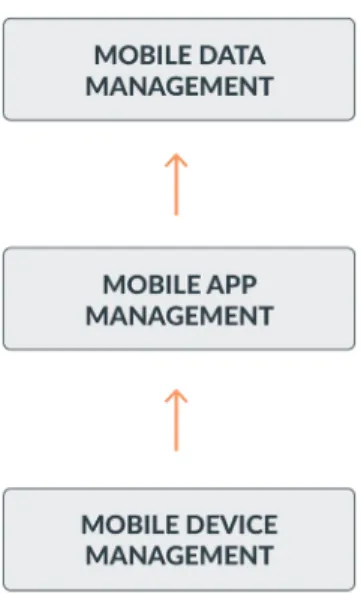
Mad Mobile’s mobile data management is one of the industry’s first mobile platforms to enable access control and privacy policies at the business data level. Mad Mobile’s mobile data management technology leverages the middleware capabilities of the platform to model and enforce data privacy and access control policies over data accessed via the different connectors provided by the platform. In that sense, Mad Mobile applies data management From a functional perspective, there are different types of policies that are relevant at the business data level. These policies can be seen as an extension of traditional data management policies that factors in the contextual information produced by mobile apps. While mobile data management can be mistakenly seen as an alternative to traditional mobile device management solutions, the fact is the two technologies are complementary. Combining mobile device and data management platforms will allow IT organizations to secure the entire cycle of an enterprise mobile infrastructures — from devices, to apps, to data.
Fig. B - Enterprise Mobile Solution Maturity Levels
policies that are relevant to a mobile data management solutions.
—
Contextual Nature of Mobile Business Data
Fig D illustrates the workflow introduced by Mad Mobile’s mobile
data management solution.
From a functional standpoint, the Mad Mobile mobile data management platform provides different types of data access policies including the following:
• User-Based Policies
• Data Access Optimization Policies • Location-Based Policies
• App-Based Policies • Data Privacy Policies
The set of policies provided by Mad Mobile mobile data
management allows architects and devops to secure and control access to business data from mobile applications without having dependencies on any specific app or device. Additionally, Mad Mobile mobile data management enforces the policies at the data level without requiring any app invasive techniques, such as app wrapping containers.
1. A mobile application requests data using a specific API. 2. The request gets routed to Mad Mobile’s mobile data
management solution to identify its validity and apply any specific policies associated with the target data source.
3. If the request doesn’t comply with the data management policies, a request error gets routed to the mobile application. 4. If the request passes the data management policies, it gets routed to the Mad Mobile enterprise mBaaS middleware layer. 5. The Mad Mobile enterprise mBaaS requests the business data using the specific set of connectors.
6. The Mad Mobile enterprise mBaaS receives the response from the line-of business system.
7. The Mad Mobile mobile data management platform inspects the response and applies the relevant policies.
8. The Mad Mobile mobile data management platform triggers any necessary actions required by the policies and returns the
modifiedresponse.
9. The final response is delivered to the mobile app.
—
Benefits
The Mad Mobile mobile data management platform represents an evolution in enterprise mobile management solutions. The platform shifts the security and access control focus from apps and devices to the most important asset of modern enterprises: business data.
Here are a few of the benefits that organizations experience when using the Mad Mobile mobile data management platform. • Apply security and access control policies directly at the data level, independently of mobile devices and applications. • Centralized model for applying access control and privacy policies across hundreds of APIs enabled by Mad Mobile. • Ability to change and test data management policies without requiring deployment to mobile devices.
• Leverage existing access control and security policies in your enterprise
• Flexible model to author and customize data management policies.
Summary
Mobile data management represents the next evolution of EMM platforms. From a functional perspective, mobile data management complements and extends existing investments in MDM platforms. Mad Mobile provides one of the industry’s first mobile data
management solutions that enables access control and privacy policies to the data and APIs required by mobile applications. Mad Mobile’s mobile data management solution leverages its enterprise mBaaS middleware layer to secure data across hundreds of APIs and connectors.