chapter 51
Human resources management and capacity
development
Human resources management
51 Human resources management and capacity development 52 Designing and implementing training programs
Summary 51.2
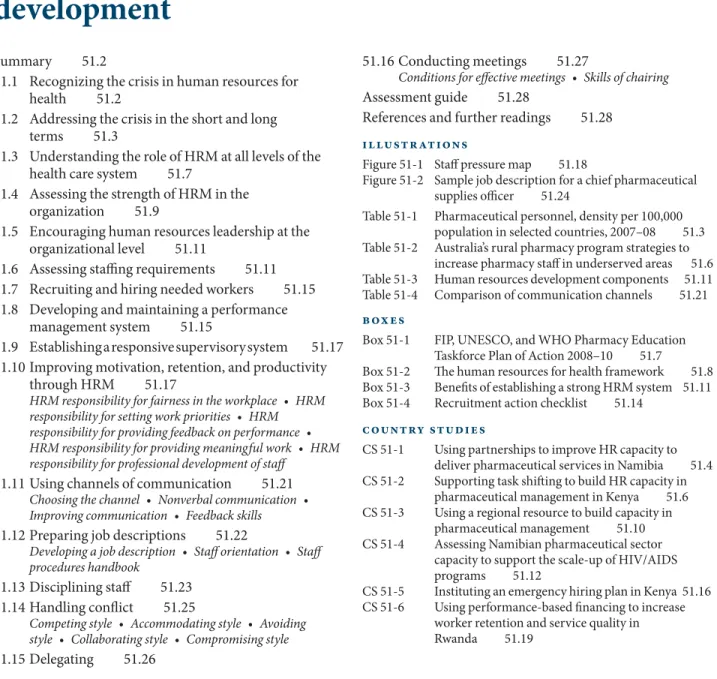
51.1 Recognizing the crisis in human resources for health 51.2
51.2 Addressing the crisis in the short and long terms 51.3
51.3 Understanding the role of HRM at all levels of the health care system 51.7
51.4 Assessing the strength of HRM in the organization 51.9
51.5 Encouraging human resources leadership at the organizational level 51.11
51.6 Assessing staffing requirements 51.11 51.7 Recruiting and hiring needed workers 51.15 51.8 Developing and maintaining a performance
management system 51.15
51.9 Establishing a responsive supervisory system 51.17 51.10 Improving motivation, retention, and productivity
through HRM 51.17
HRM responsibility for fairness in the workplace • HRM responsibility for setting work priorities • HRM responsibility for providing feedback on performance • HRM responsibility for providing meaningful work • HRM responsibility for professional development of staff
51.11 Using channels of communication 51.21 Choosing the channel • Nonverbal communication • Improving communication • Feedback skills
51.12 Preparing job descriptions 51.22
Developing a job description • Staff orientation • Staff procedures handbook
51.13 Disciplining staff 51.23 51.14 Handling conflict 51.25
Competing style • Accommodating style • Avoiding style • Collaborating style • Compromising style 51.15 Delegating 51.26
51.16 Conducting meetings 51.27
Conditions for effective meetings • Skills of chairing Assessment guide 51.28
References and further readings 51.28
illustrations
Figure 51-1 Staff pressure map 51.18
Figure 51-2 Sample job description for a chief pharmaceutical supplies officer 51.24
Table 51-1 Pharmaceutical personnel, density per 100,000 population in selected countries, 2007–08 51.3 Table 51-2 Australia’s rural pharmacy program strategies to
increase pharmacy staff in underserved areas 51.6 Table 51-3 Human resources development components 51.11 Table 51-4 Comparison of communication channels 51.21
boxes
Box 51-1 FIP, UNESCO, and WHO Pharmacy Education Taskforce Plan of Action 2008–10 51.7
Box 51-2 The human resources for health framework 51.8 Box 51-3 Benefits of establishing a strong HRM system 51.11 Box 51-4 Recruitment action checklist 51.14
country studies
CS 51-1 Using partnerships to improve HR capacity to deliver pharmaceutical services in Namibia 51.4 CS 51-2 Supporting task shifting to build HR capacity in
pharmaceutical management in Kenya 51.6 CS 51-3 Using a regional resource to build capacity in
pharmaceutical management 51.10 CS 51-4 Assessing Namibian pharmaceutical sector
capacity to support the scale-up of HIV/AIDS programs 51.12
CS 51-5 Instituting an emergency hiring plan in Kenya 51.16 CS 51-6 Using performance-based financing to increase
worker retention and service quality in Rwanda 51.19
51.1 Recognizing the crisis in human
resources for health
Countries throughout the world, especially developing countries, have long suffered from a severe lack of skilled health workers and managers. The delivery of health ser-vices is labor intensive, and the workforce is the primary determinant of health system effectiveness, yet strategies and systems for human capacity development in most min-istries of health are inadequate to meet the needs of the population. In addition, the lack of health staff, including trained pharmacy staff, has compromised health care in rural areas. Moreover, the demands of scaling up antiret-roviral treatment (ART) programs and the related time-consuming care have overburdened already weak systems for human resources development and management and drained personnel from other health services. Absenteeism and low morale are widespread, and work-related stress reduces health workers’ productivity.
Countries with a high prevalence of HIV/AIDS that can-not address acute shortages in the short term are unable to
deliver effective services. In these countries, staff attrition rates are rising because of HIV infection, illness, and death as well as the migration of staff to urban areas or other coun-tries. Vacancy rates in public-sector organizations are also rising, while the pool of skilled candidates to fill positions is still not deep enough. Results from a twelve-country survey showed that the problem is so serious that countries simply do not have the human resources capacity to absorb, deploy, and use additional funds that they are receiving to improve health (Kinfu et al. 2009). Estimates cited in the survey indi-cate that workforces in the most-affected countries would need to increase by up to 140 percent to attain health devel-opment targets.
The pharmaceutical personnel situation in many coun-tries is dire; for example, councoun-tries such as Benin and Mali have less than one pharmaceutical worker for every 100,000 people, whereas France, in comparison, has more than 100 per 100,000 (Table 51-1). Uganda has an esti-mated 30 percent of the pharmacists it actually needs (Matsiko and Kiwanuka 2003). Some industrialized coun-tries also have pharmacy staff shortages; many areas of the Human resources are central to planning, managing,
and delivering health services, including pharmaceutical services. In most countries, personnel account for a high proportion of the national budget for the health sector— often 75 percent or more. Despite the critical importance of human resources to the functioning of pharmaceuti-cal management programs, few concerted efforts have addressed the severe staff shortages facing the health sector in many countries. The HIV/AIDS pandemic has intensified this already serious situation.
In addition to staffing shortages, the health system faces many human resources challenges, including human resources planning, recruitment, deployment, training, staff motivation, and staff development. The root causes of these issues can be traced to years of neglect, low sala-ries, poor workplace climate, and limited capacity to train and update staff skills. Interventions needed to alleviate the human resources crisis include short-term actions, such as task shifting, while in the long term, countries need to expand their capacity to train enough staff to fill needs. Some issues need to be addressed at the national level (for example, compensation), but many can be addressed through better leadership and human resource management (HRM) at the facility level. In the pharma-ceutical sector, the goal of HRM is to develop and sustain an adequate supply of skilled professionals who are moti-vated to provide a high level of pharmaceutical care.
Effectively addressing human resources challenges requires improved leadership and management at all levels. An expanded HRM role, especially at the facility level, is needed to transform the outdated view of human resources as mainly an administrative function to one where the human resources staff work closely with man-agers to support the health goals of the organization and to ensure that the right staff with the right skills are in place to meet these goals.
Managing people is an important and challenging task for any manager. Employees are motivated by many factors that can be affected by management. Receiving effective supervision, perceiving they are fairly treated, under-standing their job priorities, getting feedback, feeling valued and appreciated, and having opportunities for pro-fessional development can all help staff perform better. Developing and maintaining a fair, equitable, and effec-tive HRM system can motivate staff and increase their level of job satisfaction and efficiency, which can result in improved service quality. An important part of a long-term strategy is creating an organizational and management structure for HRM that is implemented by managers and staff at all levels. A human resources part-nership between senior managers, supervisors, human resources professionals, and individual staff members is what makes an HRM system work.
United States have some difficulty filling pharmacist posi-tions (FIP 2009).
The dynamics of entry and exit from the health workforce in many countries remains poorly understood, and many reasons—such as lack of investment in training, illness, and premature retirement and death—contribute to the shortage. This lack of understanding inhibits countries and development partners from developing and implementing appropriate interventions. Several factors, however, are rec-ognized as important contributors to the shortage of trained pharmacy personnel and other health care workers, includ-ing—
Migration of health personnel: Migration contributes signifi-cantly to the loss of health workers from many countries. For example, almost two-thirds of ghana’s 140 pharmacy school graduates in 2003 migrated to a different country; between 2001 and 2004, Zimbabwe had about 150 new pharmacy graduates, while 100 Zimbabwean pharma-cists registered to work in the United Kingdom during the same period (FIP 2006). Even relatively well-off countries like South Africa are losing trained health pro-fessionals to richer economies (FIP 2006).
Staff leaving the public sector: Health staff members leave the public sector to work for donor-funded projects that are flourishing from the large influx of money into Africa; in addition, health workers often choose to work in the private sector, where remuneration is often better.
For example, in Kenya, 58 percent of health facilities are in the public sector, whereas 86 percent of the pharma-ceutical workforce is employed in the private sector (FIP 2009). Country Study 51-1 shows how a public-private partnership in Namibia, where pharmacists prefer private-sector employment, successfully recruited and pharmacy professionals into public-sector service.
Poor distribution of staff: The predominance of health work-ers is in urban areas—where they earn more and have access to better opportunities—meaning that rural areas often suffer from acute shortages of trained workers. Uganda is a country that has less than one pharmacist per 100,000 people in its population, but almost 90 per-cent of the existing pharmacists are located in the Central region, while the other 10 percent are divided among the other four regions in the country (FIP 2006).
Insufficient preservice training: Many countries lack the ability to train enough pharmaceutical professionals to fill their needs; they may have no or only one accredited school of pharmacy, for example. Increasing the number of skilled workers requires capacity in the educational system—enough teachers, updated curriculum, and adequate infrastructure—which takes time to build. Even when graduates are available, retention is difficult unless good management exists to absorb, train, and support them.
51.2 Addressing the crisis in the short and
long terms
global action is required not only to address high-priority infectious diseases but also to meet the long-term human resources needs of health systems in developing countries. The greatest challenge is to begin addressing shortages of health personnel in an integrated and comprehensive fash-ion. Responses to the challenge must meet both the short-term necessities of providing lifesaving treatment and the long-term human resources needs of the health sector (see Country Study 51-1).
Short-term responses include implementing aggressive retention policies, such as improving terms and conditions of service for health workers, providing ART to health work-ers who need it to preserve their health and productivity, and encouraging temporary regional migration of work-ers from countries with surplus workwork-ers to countries with deficits. For example, Kenya has bilateral agreements with Namibia, Southern Sudan, and Lesotho to send nurses to work on short-term contracts in those countries.
Task shifting has been used extensively and often effec-tively to fill gaps in health care worker shortages, includ-ing in pharmacies (WHO Maximizinclud-ing Positive Synergies Collaborative group 2009). Often, lower-level pharmacy workers, such as pharmacy technicians, or other cadres,
Table 51-1 Pharmaceutical personnel,a density per 100,000 population in selected countries, 2007–08
Country Density Benin < 1 Niger < 1 Senegal 1 Burkina Faso 2 Malawi 2 Uzbekistan 3 Bhutan 4 Ghana 7 Liberia 8 Nigeria 13 Turkey 33 Albania 39 Israel 76 Bahrain 86 France 118
Source: WHO Department of Human Resources for Health 2008.
a Pharmaceutical personnel include pharmacists, pharmaceutical technicians, and pharmaceutical technologists.
Human resources crisis in pharmacy
According to the World Health Organization’s global Atlas of the Health Workforce, in 2004, Namibia had fourteen pharmacists per 100,000 people, or half of South Africa’s twenty-eight pharmacists per 100,000. Namibia’s pharmacists are also poorly distributed—80 percent work in the private sector, leaving priority public health programs short of qualified staff. About half the pharma-cists working in the public sector are located in Khomas region, particularly in Windhoek city, leaving the other twelve regions short of qualified personnel. Pharmacist assistants in most district hospitals occupy positions meant for more highly skilled pharmacists.
In 2006, of the forty-eight public-sector pharmacy posts available, only fourteen were filled—four of these were filled by Namibians.
Challenges in filling positions in Namibia • Foreigners on two-to-three-year contracts fill 90
percent of pharmacist positions. Knowledge of local languages is critical; English speakers usually need translators to communicate with patients, while the many Cuban pharmacists have a hard time because of a lack of Spanish translators.
• No pharmacy school exists in Namibia, and an inadequate number of Namibian students pursue a pharmacy degree abroad. Those who do return from abroad choose careers in the private sector.
• Of 515 students pursuing health and social wel-fare training at the University of Namibia during 2003–04, only two were enrolled in the prepharmacy program.
• The Namibia National Health Training Center trained only about eight pharmacist assistants in a year.
• The public-sector recruitment process was time con-suming; therefore, engaging pharmacists—particu-larly those from abroad—took a long time.
A partnership to expedite the recruitment of pharmacy staff
The Ministry of Health and Social Services (MoHSS) and the Rational Pharmaceutical Management Plus (RPM Plus) Program developed an intervention with the goal of increasing the number of facilities with qualified phar-maceutical staff. The partnership model comprised the following components—
• RPM Plus worked with the MoHSS to develop a mechanism to expedite the hire of pharmacists and pharmacist assistants for priority positions in the public sector; all target positions were identified and aligned with MoHSS priorities.
• Job descriptions for temporary staff were made commensurate with those in the public sector; work standards were set according to MoHSS policies. • The MoHSS led the interview and selection process. • Remuneration for recruited staff was set in
accor-dance with the MoHSS scale.
• A local human resources company, Potentia Namibia Recruitment Consultancy, recruited suc-cessful personnel and managed their remuneration and benefits.
• The MoHSS directly supervised and evaluated the performance of recruited personnel.
• The MoHSS mobilized its own resources and sys-tems to progressively absorb the newly appointed personnel into the government personnel structure. Results of the partnership
In two years, twenty-eight pharmaceutical staff members (eleven pharmacists, one network administrator, and six-teen pharmacy assistants) were recruited; 64 percent of the staff positions have been absorbed into the public ser-vice (46 percent of the pharmacists and 81 percent of the pharmacy assistants). Despite Namibia’s lucrative private sector, no pharmacist that the partnership recruited and supported has been lost to the private sector. Vacancy rates have been reduced by more than half, and evidence suggests that the quality of pharmaceutical care and ser-vices has improved. According to the Kunene regional director, “There is better ordering of pharmaceutical items and stock management has improved. The com-pilation of consumption pattern has been done, and it is easier to forecast needs of certain pharmaceutical items. The Regional and District Therapeutic Committees have been resuscitated and have begun to look more closely at pharmaceutical issues in the region and districts.” Lessons learned
The time and resources needed to manage staff before they were absorbed into the public sector proved higher than RPM Plus expected. Thus, contracting with a local human resources company to manage the seconded staff on behalf of the MoHSS and RPM Plus proved vital to the partnership’s success. Additional steps that were critical to the process included working closely with the MoHSS
Country study 51-1
such as nurses, are given the responsibility of running an entire dispensing site because no fully trained phar-macist is available to do so. Some countries are training community health workers to dispense certain medicines, especially for childhood illnesses. Country Study 51-2 illus-trates how Kenya supported pharmaceutical management task shifting to support ART scale-up. The World Health Organization (WHO), the U.S. President’s Emergency Plan for AIDS Relief, and the Joint United Nations Programme on HIV/AIDS (WHO, PEPFAR, and UNAIDS 2008) have also collaborated on guidelines for task shifting in the health sector.
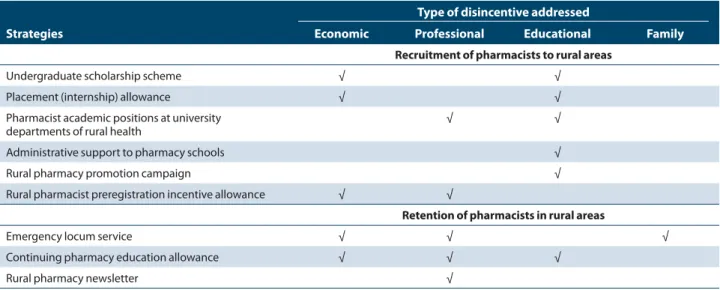
To address the lack of pharmaceutical workers in rural or peri-urban areas, countries such as Vietnam require students receiving government scholarships to work in underserved areas upon graduation. Vietnam also allows pharmacy schools to accept students from underserved provinces and rural areas without a competitive examina-tion (FIP 2009). Other countries use financial incentives to boost recruitment in rural areas, but this strategy may not be sustainable if it relies on outside funds. Australia is tack-ling its shortage of pharmacists through a series of strate-gies known as the Rural Pharmacy Program. The framework is based on the belief that a combination of incentives to address these multiple factors is more likely to be successful than a single intervention and that the synergy among the interventions can improve both recruitment and retention (FIP 2009). Table 51-2 shows examples of the types of strate-gies the program uses.
Countries are also enacting policies and incentives to recruit and retain more pharmaceutical personnel in the public sector. In Kenya, for example, improved policies and terms of service in the public sector have led to higher reten-tion of pharmacy staff—from 433 in 2005 to 609 in 2008— and Sudan now requires pharmacist graduates to spend one year in government health institutions, which has increased the number of pharmacists in the public sector, particularly in rural areas (FIP 2009). Sudan has also created opportuni-ties for postgraduate study to minimize attrition from the public sector (FIP 2009). WHO launched an initiative to increase access to health workers in remote and rural areas
through improved retention (see http://www.who.int/hrh/ migration/expert_meeting/en/index.html).
Long-term solutions require national-level planning and strategies. governments should work with professional organizations, regulatory bodies, training institutions, unions, and employers to develop long-term workforce plans. Strategies should strive for self-sufficiency rather than rely on foreign workers or educational institutions. governments also need to ensure that legislation and regulations keep up with capacity-building strategies. For example, Sudan’s Ribat University opened a new school and approved a three-year curriculum for pharmacy technicians; however, the pharmacy technician cadre was not defined in any policy or legislation, and how the cadre differs from that of pharmacy assistant or what its role is in pharmacy prac-tice is unclear (FIP 2009).
More educational and preservice training opportunities are the key to solving long-term staffing problems. WHO and the International Pharmaceutical Federation (FIP) have established a task force to examine issues related to address-ing pharmacy education as a means of increasaddress-ing the num-ber of pharmacists. Box 51-1 includes the task force’s plan of action. Namibia addressed its lack of pharmaceutical train-ing capacity by expandtrain-ing the ability of the National Health Training Centre to train pharmacy assistants by renovating classrooms and offices, revising curriculum, and provid-ing tutors and trainprovid-ing consultants. As a result, the center increased its yield of pharmacy assistant graduates by 100 percent in one year—from nine in 2009 to eighteen in 2010, with sixty more in line to graduate by 2012. The 2010 gradu-ates were all recruited into the public sector.
In addition to using public institutions to help build pharmaceutical sector human resources, providing techni-cal assistance to academic institutions in resource-limited countries and fostering regional collaboration are efficient ways to build institutional capacity. The Regional Technical Resource Collaboration for Pharmaceutical Management, described in Country Study 51-3, is an example of such a regional approach to capacity building.
Box 51-2 presents a human resources for health (HRH) framework that promotes a comprehensive and integrated to identify its needs, complying with MoHSS policies and
standards, and recruiting pharmacy assistants as they graduate and before they slip into the private sector. Innovative partnerships between the public and private sectors can help national programs expand their human resources base more quickly; however, the success of such partnerships relies heavily on the explicit commit-ment of each partner, including the host governcommit-ment, the donor, and the technical assistance team. Human
capac-ity–building interventions should be based on existing government systems to ensure their eventual integration and sustainability. This innovative collaboration created a new mechanism for the government to fill priority pharmaceutical positions more quickly while allowing it to gradually absorb the positions into its existing struc-ture—thereby addressing immediate program needs while ensuring long-term contributions.
Only 38 to 45 percent of those in need have access to ART in Kenya. Because of the severe shortage of pharma-ceutical professionals, Kenya’s adoption of decentralized ART has resulted in other health cadres being used to manage pharmaceuticals; however, these other health care providers lack skills in pharmaceutical management, thus limiting ART scale-up.
The Strengthening Pharmaceutical Systems (SPS) Program collaborated with the National AIDS and STI Control Programme (NASCOP), training institu-tions, and other government agencies to develop and implement short- and long-term measures that support decentralization and task shifting, thereby strengthen-ing human resources capacity and sustainability. Key interventions included training more than 1,500 health providers in pharmaceutical management and imple-menting a mentorship program. Training of trainers increased the pool of regional experts and created a mechanism to provide ongoing supervision.
SPS developed eleven job aids and eleven pharmaceutical standard operating procedures (SOPs) and guidelines,
which NASCOP adopted and disseminated to more than 400 ART sites to improve services and standard-ize practices. Decentralization of ART pharmaceutical services has been implemented successfully in more than 300 satellite sites. In addition, more than 2,500 public and private practitioners attended continuing profes-sional development courses in pharmaceutical man-agement. Advocacy for incorporating pharmaceutical management into preservice curricula culminated in 162 students at middle- and tertiary-level educational institu-tions receiving training. SPS is developing a pharmaceu-tical management orientation package for new providers at all levels of care and working with institutions to include pretested pharmaceutical management modules in preservice training curricula to promote sustainability. Systematically implemented task shifting strategies that combine pre- and in-service training programs, job aids, reference guides, and SOPs have alleviated human resources challenges in a context of decentralized ART.
Source: MSH/SPS-Kenya 2009.
Country study 51-2
supporting task shifting to build Hr capacity in pharmaceutical management in Kenya
Table 51-2 Australia’s rural pharmacy program strategies to increase pharmacy staff in underserved areas strategies
Type of disincentive addressed
Economic Professional Educational Family
recruitment of pharmacists to rural areas
Undergraduate scholarship scheme √ √
Placement (internship) allowance √ √
Pharmacist academic positions at university
departments of rural health √ √
Administrative support to pharmacy schools √
Rural pharmacy promotion campaign √
Rural pharmacist preregistration incentive allowance √ √
retention of pharmacists in rural areas
Emergency locum service √ √ √
Continuing pharmacy education allowance √ √ √
Rural pharmacy newsletter √
approach to developing strategies to tackle both immediate and longer-term HRM challenges. The framework exam-ines six components of planning and managing the work-force so that appropriately trained personnel are available in the right places at the right time: HRM, policy, finance, education, partnerships, and leadership. HRM systems are at the center of the diagram because of their importance in integrating all the other components. Country Study 51-4 illustrates how the results of an HRM assessment of the pharmaceutical sector in Namibia were organized using the HRH framework.
51.3 Understanding the role of HRM at all
levels of the health care system
Human resources management is the integrated use of sys-tems, policies, and management practices to recruit, main-tain, and develop employees so the organization can meet its desired goals (MSH 1999). Effective HRM should help man-agers make plans and hire trained staff, and help employees find meaningful work with avenues for career development. A comprehensive HRM system provides managers with a framework and tools to better plan, recruit, hire, deploy, motivate, and retain employees. At the national level, HRM involves developing health-sector strategies, policies, and practices to ensure a workforce that is balanced in numbers of staff, qualifications, and placement.
Initiatives such as the global Fund to Fight AIDS, Tuberculosis and Malaria and the President’s Emergency Plan for AIDS Relief, while adding more financial resources, are also putting pressure on human resources. Sometimes such initiatives can be an opportunity to advocate for better
salaries and working conditions, but these benefits must be equitable for all staff.
Even as policy makers adjust policy and regulatory frame-works at the national level, managers of district health ser-vices, nongovernmental organizations, public hospitals, or pharmacies can still do much to strengthen the HRM sys-tem. At the organizational level, where most program man-agers function, HRM involves linking management and development of human resources to an organization’s strate-gic plan, goals, and objectives. Establishing these links is an essential management strategy.
An essential part of the overall management strategy should be to consider how HRM can help the organiza-tion fulfill its goals. Often people view HRM as having a limited, administrative role focused on documenting staff personnel actions. Although this administrative role is very important, the role of human resources should not be lim-ited to these activities. In light of the new global initiatives resulting in scaled-up public health treatment programs for diseases such as HIV/AIDS and malaria, human resources should—
• Be a strategic partner in developing and attaining the goals of global initiatives
• Align human resources needs with the demand for new and old services
• Assess the need for task shifting and new job descrip-tions
• Develop incentives for staffing hard-to-reach areas • Keep all employees informed about the changes taking
place
• Create opportunities for staff to contribute ideas • Encourage teamwork and team spirit
• To define pharmacy service competencies across all settings and levels of the health system
• To set educational objectives aligned with compe-tencies and develop a framework that considers the entire pharmacy education continuum from under-graduate education through to continuing profes-sional development at the postgraduate level • To develop a global framework for quality assurance
and the development of accreditation systems (e.g., development of standards for educational institu-tions and programs) in pharmacy education • To gather and analyze data on the academic/faculty
workforce, and review and develop capacity devel-opment strategies that meet local, regional, or global needs
• To guide stakeholders toward an accepted holistic vision for the entire continuum of pharmacy educa-tion at the global, regional, and local levels
• To provide advocacy and technical guidance to country-level stakeholders and educational institu-tions
• To establish a global platform for ongoing dialogue; sharing of evidence, practices, lessons learned, resources, and tools for pharmacy education; and workforce planning
FIP = International Pharmaceutical Federation; UNESCO = United Nations Educational, Scientific and Cultural Organization; WHO = World Health Organization.
Box 51-1
The World Health Organization and the U.S. Agency for International Development invited thirty-five rep-resentatives from various agencies, donor countries, nongovernmental organizations, and academia to draft a common technical framework to help governments and national planners understand the complex problems of human resources for health.
Meeting participants agreed that the framework should be scientifically based, tested in the field, and useful in a multisectoral and multistakeholder context. It had to capture the content and processes involved in
develop-ing and implementdevelop-ing a national strategy for human resources for health; be simple but comprehensive; and show the interdependencies among the various players, institutions, and labor markets involved in the health workforce.
The following figure and table illustrate and explain the final framework. Additional information on the develop-ment of the framework and how it can be used to develop a national strategy can be found in the publication Tools for Planning and Developing Human Resources for HIV/ AIDS and Other Health Services (MSH/WHO 2006).
Box 51-2
The human resources for health framework
Implementation P lan n in g M on it or i n g a nd ev alu atio n Situational analysis Country-specific contexts, including labor markets Other health
systems components
Better health outcomes Improved health workforce
Health services Equity Effectiveness Efficiency Quality Policy Finance Education Partnership
Leadership Human Resources
Furthermore, a strong and comprehensive HRM system has many benefits for managers and employees at all levels in both public- and private-sector organizations. Such a system can help ensure that staff members deliver quality health and pharmaceutical services to their client communi-ties. Box 51-3 lists the benefits of establishing a strong HRM system.
51.4 Assessing the strength of HRM in the
organization
HRM is perhaps the most misunderstood and poorly used management system in the health sector. As a result, deter-mining an organization’s view of its human resources and how it should strengthen its systems can be a challenging task. One of the most important actions in establishing a
strong, comprehensive HRM system is gathering the infor-mation that will help plan for and implement the system. To do this, management needs to assess the organization’s exist-ing areas of strength and the areas that need strengthenexist-ing. After it has identified the areas that require strengthening, management should prioritize them and develop an HRM action plan to address them.
By asking the following questions, a manager can begin to think about some of the issues involved and begin the process of establishing an HRM system that improves pro-ductivity and helps provide quality services—
• Do employees understand how their work specifically contributes to the mission and goals of the organization? • Do employees view performance appraisals as an
opportunity to learn about their skills and competen-cies and to discuss plans?
Framework components
Component Goal Factors in achieving the goal
HrM systems HRM systems are in place that result in adequate and timely staffing, staff retention, teamwork, effective planning, and good performance.
• HRM capacity in health facilities, local governments, and local health offices
• Effective personnel systems: planning, recruitment, hiring, transfer, promotion, firing
• Staff retention strategies
• Training aligned with job requirements • Human resources information systems • Workplace programs for HIV prevention Policy Employment process in government is streamlined;
appropriate HR policies are in place and enforced. • National civil service rules• Government policies and structure for HRM (such as centralized hiring and firing)
• Authorized scopes of practice for health cadres Finance Approved budget is adequate to sustain projected
health workforce requirements. Allocation authority is aligned with technical and management planning and decision making.
• Health expenditures • Salary structures
• Incentives to prevent migration of health staff • Support for preservice and in-service training • Administrative costs for recruitment, hiring • Supervision
• Accountability Education Preservice training institutions have the capacity to
meet demand for essential health workers and to adapt curricula as needed for new content requirements.
• Enough institutions to train all required health cadres • Adequate number of lecturers and tutors who meet
quality standards for both content and teaching capacity
• Training programs that match demand for health cadres and include essential content (clinic management, health management information systems, etc.)
• Availability of equipment and supplies needed for preservice training
Partnerships Planned links among sectors; districts; and nongovernmental, community, and religious organizations increase human capacity.
• Effective links among public-sector, private-sector, and community networks
• Collaboration between ministry of health and ministries of finance and education
Leadership Managers at all levels demonstrate that they value health workers and provide staff with leadership to face challenges and achieve results.
• Visionary leadership
• Advocacy for reform of human resources policies • Leadership development for managers at all levels
• Is the supervisor’s role valued and supported by the organization?
• Are job descriptions up-to-date and readily available to all employees?
• Are employees routinely considered for job vacancies and other opportunities for promotion?
• Do employees understand the organization’s policies on salaries and benefits and consider them fair and equitable?
• Can the organization engage in long-range planning, knowing it has or can develop the human resources required?
• Does the organization have strategies to provide mean-ingful jobs?
• Does the organization have a spirit of achievement and high performance?
• Do employees come to work on time and work pro-ductively for the full workday?
• Do managers spend less than 10 percent of their time dealing with grievances?
• Can the organization take on new objectives or tasks with cooperation from everyone?
Assuming the assessment identifies gaps that indicate the need to establish a stronger HRM system in the orga-nization, several key issues should be considered, which include—
• Encouraging human resources leadership at the orga-nizational level
• Assessing staffing requirements
• Developing and maintaining a performance manage-ment system
• Establishing a responsive supervisory system
• Improving staff motivation and performance through better human resources practices
In addition to helping public institutions build pharmaceutical-sector human resources, providing technical assistance to academic institutions in resource-limited countries and fostering regional collaboration are efficient ways to build institutional capacity. The Regional Technical Resource Collaboration (RTRC) for Pharmaceutical Management comprises groups from Makerere University in Uganda, Muhimbili College of Health Sciences in Tanzania, the University of Nairobi in Kenya, and the National University of Rwanda. These institutions are leading in-country initiatives for building the capacity of health care workers to manage medicines by developing and adapting training materials, training health care workers, and developing effective approaches for skills building in low-resource settings.
Over a period of two years, the RTRC assessed phar-maceutical supply management systems and practices in Kenya, Rwanda, Tanzania, and Uganda. In a 2006 workshop in Uganda, the RTRC contributed to the devel-opment of comprehensive HIV/AIDS pharmaceutical management training materials, which are now widely available in all four countries. In Tanzania and Uganda, the RTRC has been involved with the training of more than 100 health care workers in HIV/AIDS pharmaceuti-cal management. In Kenya, Tanzania, and Uganda, the RTRC has been conducting operations research to find solutions to those countries’ skills-shortage problems. A number of junior members of the academic staff within the mentioned institutions were targeted for
capacity building. This training allowed the system to build a significant pool of professionals with skills and competences in pharmaceutical supply management. At Tanzania’s Muhimbili University College of Health and Allied Health, ten members of the academic staff— three senior staff members and seven junior staff members— have developed competences and skills in pharmaceuti-cal management. Makerere University in Uganda has thirteen staff members who have developed competences in pharmaceutical management.
Following the development of training materials and the training of a number of academic staff members in phar-maceutical supply management, Makerere University’s Department of Pharmacy has now adapted various components into its preservice pharmacy curriculum. In addition, the schools of pharmacy in both Tanzania and Uganda have plans to develop master of science pro-grams in pharmaceutical supply management that draw largely from the initiative. In Rwanda, the Department of Pharmacy at the National University has revised its preservice curriculum to include components of phar-maceutical supply management.
The skills acquired by local institutions can be incorpo-rated into both preservice and in-service teaching curri-cula to ensure long-term availability of skills in-country. The ability of trained institutions to mobilize their own resources for skills-building activities is crucial for the success and sustainability of these programs.
Source: Matowe et al. 2004.
Country study 51-3
These HRM areas are relevant in any organization, regardless of its size, purpose, and degree of complexity, and whether it is public or private. Carrying out a comprehen-sive HRM assessment will help address policy, planning, training, and management in an integrated way.
51.5 Encouraging human resources leadership
at the organizational level
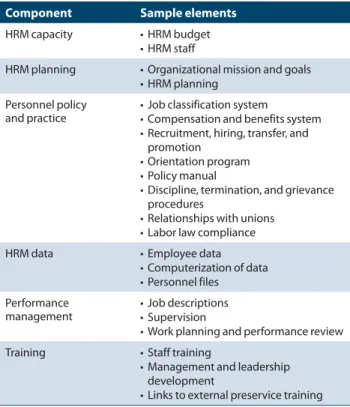
Many organizations treat HRM in a piecemeal fashion. Human resources leaders link all components of human resources to create one, integrated HRM system. When an organization’s leaders create this type of integrated system, the effect on organizational performance can be profound. In supporting human resources by giving it a prominent and strategic role, managers and leaders are also sending a mes-sage to all staff that the organization will treat them fairly and will respect their contribution to its success. Table 51-3 lists the components that contribute to developing a human resources system.
Every organization or program needs leadership at the highest level to support human resources. To take a leader-ship role in HRM, a manager should—
• Create a positive climate for human resources • Create a management structure for human resources • Define what needs to be done
• Forge new organizational arrangements that foster employee participation, teamwork, and growth • Ensure that human resources activities are integrated
throughout the organization
• Involve staff at all levels and from all departments in HRM
• Dedicate staff and budget to building human resources capacity within the organization
• Make learning an organizational priority
• Provide a link between internal HRM and external stakeholders
• Influence health policy makers
• Influence the curricula offered by preservice training organizations
51.6 Assessing staffing requirements
Determining the staffing requirements of a pharmaceutical program means taking into account factors such as the size of the program and its goals, its geographic location, and its place within the agency of which it is a part. Three inter-related questions can be used for an initial determination of staffing requirements—
Benefits to the organization
• Increases the organization’s capacity to achieve its goals
• Increases the level of employee performance • Uses employee skills and knowledge efficiently • Saves costs through the improved efficiency and
productivity of workers
• Improves the organization’s ability to manage change
Benefits to the employee
• Improves equity between employee compensation and level of responsibility
• Helps employees understand how their work relates to the mission and values of the organization • Helps employees feel more highly motivated • Increases employee job satisfaction
Box 51-3
Benefits of establishing a strong HrM system
Table 51-3 Human resources development components
Component sample elements
HRM capacity • HRM budget
• HRM staff
HRM planning • Organizational mission and goals • HRM planning
Personnel policy
and practice • Job classification system• Compensation and benefits system • Recruitment, hiring, transfer, and
promotion • Orientation program • Policy manual
• Discipline, termination, and grievance procedures
• Relationships with unions • Labor law compliance
HRM data • Employee data
• Computerization of data • Personnel files Performance
management • Job descriptions• Supervision
• Work planning and performance review
Training • Staff training
• Management and leadership development
The burden of HIV/AIDS on Namibia’s health service delivery system and human resources is enormous. For example, in 2005, a referral hospital had 2,570 people on ART who must see the pharmacist every month. At that time, the ART pharmacy served approximately eighty people per day, staffed by one pharmacist and one pharmacist assistant. Staff had no computer system to track patients and no telephone or transport to find the patients who had started on ART but then stopped com-ing. Staff members at this hospital were barely coping with the demand; how they were going to be able to scale up ART services without additional pharmacy help was hard to imagine.
In 2005, an assessment in the Namibian pharmaceutical sector was the first step in identifying and implementing both short-term and long-term solutions to the shortage of pharmacists and pharmacist assistants in scaling up HIV/AIDS services in the national health system. The assessment and the resulting recommendations were seen as the first move toward strengthening the capacity of pharmaceutical personnel for the scale-up of HIV/ AIDS as well as the delivery of health services in general. Assessment team activities
• Reviewed all relevant human resources data and pre-service statistics
• Reviewed HIV/AIDS operational strategy, and iden-tified the numbers and types of cadres required to implement it
• Conducted interviews with health staff, especially those linked to pharmacy, using a participatory tool and instrument with questions
• Held meetings and focus group discussions with a diverse range of human resources stakeholders in all sectors of the national health system
• Met with selected training institutions and inter-viewed managers and faculty
• Used the HRH framework to assess and analyze data collected in the assessment
• Formulated both short- and long-term recommen-dations and cost elements
• Debriefed stakeholders on draft findings and recom-mendations
Assessment results
Despite the different approaches used in establishing ART programs as rapidly as possible, the assessment showed that the pharmaceutical services in all of the hospitals had human resources constraints that
compro-mised their delivery of ART services. These constraints included—
• Vacant positions
• Reliance on foreign pharmacists, creating language barriers
• Small number of trained pharmacists and pharma-cist assistants coming from the educational system • Limited opportunities for in-service training and
career mobility for pharmacists and pharmacist assistants
• Difficulty in retaining pharmacists and pharmacist assistants in the public sector
• Inability of pharmacists and pharmacist assistants to perform efficiently
Short- and long-term recommendations
The assessment team used the HRH framework as an approach to capture the recommendations made in their report (see Box 51-2). The HRH framework is based on the understanding that an integrated and comprehensive response is needed to address the global priority of scal-ing up HIV/AIDS treatment. Short-term solutions are needed to address emergency staffing issues, but longer-term strategies are critical to ensure an effective and sus-tainable health workforce over time.
HRM systems
In the short term—
• Contract a marketing firm to develop and imple-ment a marketing campaign to recruit more candi-dates for the pharmacy program.
• Increase the number of pharmacist assistants being trained. Restart the program at another location. • Contract with an outside recruitment firm to secure
more foreign pharmacists. Provide a central-level monitoring mechanism.
• Implement the HIV/AIDS workplace program developed by the MoHSS.
• Use pharmacist assistants to counsel ART patients. • Review the role pharmacists play in hospital
phar-macy to make optimum use of the limited resources. • Reconsider the staffing mix at medical stores to
include more management skills. In the long term—
• Provide a leadership development program for managers at all levels.
• Ensure that trained human resources professionals are in place throughout the health system.
Country study 51-4
• What is the scope of the services to be offered in rela-tion to the selecrela-tion, procurement, distriburela-tion, and use of pharmaceuticals?
• What different types of workers are required at each level of the system?
• What is the optimal number of employees needed to deliver these services in the most efficient and effective manner?
Administrative arrangements can vary considerably, even within one agency or government. For example, medicine selection and use may fall under the purview of the min-istry of health, whereas procurement and distribution may be handled by a different ministry, responsible for supplies. Also, many options exist in linking with pharmaceutical supply sources. If pharmaceutical procurement and distri-bution are provided directly by a government agency, then all jobs may be performed by government staff. If the cen-tral procurement office is limited to negotiating with com-mercial suppliers for direct delivery to health facilities, then
most of the importation, bulk inventory control, and bulk storage occur within the private sector.
An example of a large-scale human resources challenge is the integration of ART for HIV/AIDS into existing pharmacy services, which can easily double the volume of pharmaceutical products the staff handles and dramati-cally increase the number of patients served at the phar-macy. Pharmacy staff that dispenses antiretroviral drugs must spend more time counseling patients, especially new patients. In addition, because patients continue therapy for a lifetime, they need regular monitoring for treatment adher-ence, which adds to staff responsibility.
An analysis of information on human resources require-ments for ART showed that the number of pharmacy staff needed depended on how dispensing and counseling activi-ties were divided among different cadres; however, the aver-age number of pharmacy staff was estimated at one to two per 1,000 ART patients (Hirschhorn et al. 2006). In Kenya, ART managers have addressed the shortage of pharmacists by developing a cluster of facilities that share the services
Policy and financial
In the short term—
• Establish a minimum of ten bursaries or grants for students pursuing a pharmacy degree and two for pharmacist assistants.
• Develop a two-year community service require-ment, in lieu of bonding.
• Permit part-time employment for pharmacists. • Create a new cadre of pharmaceutical technician as
promotional step for pharmacist assistants. • Finalize a policy to permit pharmacists to work in
both the private and public sectors.
• Increase the number of pharmacist assistant stu-dents that a pharmacist may supervise.
• Install computer tracking systems at ART sites. In the long term—
• Streamline the employment process, and improve human resources links between the central and regional levels.
Education
In the short term—
• Install Internet facilities in all district hospitals to enhance learning.
• Review in-service training to improve availability and meet the needs of pharmacy staff.
• Introduce a best practices program for pharmacists and pharmacist assistants to share knowledge.
• Provide intensive English-language training for Cuban pharmacists.
In the long term—
• As a long-term measure, the MoHSS should intro-duce distance learning and computer-aided instruc-tion to its in-service training capacity.
Leadership
In the short term—
• Implement leadership development programs to create a climate of teamwork and support at all ART sites.
In the long term—
• Improve multisector collaboration for strengthening human resources capacity in all areas of health.
Partnerships
In the short term—
• Partner with the Pharmaceutical Society of Namibia to market pharmacy and support more students in training.
• Enlist assistance of district councils to develop for-mal partnerships with community groups that can provide needed human capacity in ART.
In the long term—
• Work with the two education ministries and the University of Namibia to improve science education at the secondary level.
1. Review staff requirements
Take a broad view of your staffing needs and consider whether you really have a vacancy. For example, if an employee is leaving a clinic that you feel is already over-staffed, review the workload at that facility and decide whether a full-time permanent replacement is needed or whether an alternative option would be more appro-priate. For example, would a part-time or temporary worker be sufficient? Should the job be restructured? What would the staffing implications of a restructured position be?
2. Consult with those involved
Always be sure to take any organizational policies and procedures into account. Authorization for a replace-ment or a new appointreplace-ment may be needed from senior management, or in the case of most health ministries, from another government agency. Consult with your personnel or human resources department if you have one, because they will have expertise in this area. 3. Specify the sort of person you are looking for List the duties, responsibilities, and relationships involved in the job role, and define the level of authority the post holder will have. Decide what qualifications and skills are required, what type and length of experience are needed, and which personal attributes will be important. This information will enable you to create an up-to-date job description and role specification. State the geo-graphic location of the vacancy (hospital, clinic, etc.) and set a target start date.
4. Research the labor market
Depending on the nature of the job, you may want to review the job description and role specification and ask yourself whether you are likely to find what you are looking for in one person. If so, undertake some research to gauge the pay and benefits package you will need to offer. Salary surveys are usually expensive, but they are often summarized in the press at the time of publication. Monitoring job advertisements and net-working with employers in your area and sector can also give you an idea of current pay rates for certain com-mon job categories.
5. Comply with local labor laws and other legal requirements
In most countries, recruitment activities are covered by a growing body of legislation and codes of practice
designed to exclude favoritism, discrimination, and unfair treatment. As such, the entire recruitment team needs to be aware of and keep up-to-date with the latest developments to ensure that they follow good practice and do not infringe on the regulations.
6. Plan how to find and attract candidates Again, depending on the position you want to fill, you may want to start within your organization. Are any employees suitable for promotion or reassignment? Even if you are doubtful, advertising internally as a courtesy to staff who may wish to apply is important, and keep in mind that they may have friends or relations who will be interested in the position.
Refer to your existing database of previous applicants, whether unsolicited or otherwise. Draw on any appropri-ate contacts.
Decide whether to use the services of a recruitment agency to identify and short-list candidates for you, weighing the costs incurred against the time and exper-tise at your disposal.
Consider whether electronic recruitment techniques, using either a government website (as in Kenya) or an online recruitment service, would be appropriate. 7. Decide where to advertise
If you decide to advertise independently rather than use an agency, think through the options and decide which is most likely to reach the kinds of candidates you have in mind: local or national press, bulletin boards of profes-sional associations, Internet recruitment sites, or mailing lists. Research the costs involved, and decide what you can afford.
8. Write the advertisement
Decide if you or other staff members have the skills and knowledge required to draft an advertisement. If your organization has a human resources department, they will probably take on this task, but ensure that you are involved throughout the process. In the case of a senior post, or if you are recruiting in large numbers, you may wish to hire an advertising agency to draft the advertise-ment and place it appropriately. Naming your organiza-tion in the advertisement is preferable to using a box number unless you have particular reasons for secrecy. Ensure that the advertisement provides the following details clearly and succinctly—
Box 51-4
of one ART-trained pharmacist, who floats among the clus-tered sites, while technicians or nurses take care of the rou-tine responsibilities.
Calculating and justifying the number of pharmaceuti-cal management staff needed can be difficult. The norms approach, which specifies a standard staffing level, or norm, for each staff cadre, quickly breaks down in practice. For example, a norm that says that each regional store needs three supplies officers will result in overstaffing at small regional stores and understaffing at busier stores.
The workload approach to staffing is based on the activi-ties, volume of work (workload), and activity standards for each type of staff at each level. This is known as the WISN, or workload indicator of staffing need, approach (Shipp 1998). The WISN method is generally a much more realis-tic approach for determining staffing needs than the norms approach. Because it is based on actual workload, results from the WISN method are more readily explained and defended.
No matter how the organizational structure and contrac-tual arrangements are defined, all the tasks and related jobs must be performed if the pharmaceutical supply system is to operate reliably and expeditiously. An organizational chart describing the relationships among different staff positions is very useful.
51.7 Recruiting and hiring needed workers
Effective recruitment processes are vital in ensuring that a ministry of health or any other health organization has the people it needs to implement its strategy and meet its objectives. Recruitment can be expensive, but so too is the appointment of an employee who is inadequately qualified, fails to perform well, or leaves the organization before he or she has been able to make a significant contribution. The time and effort invested in planning the process of recruit-ment carefully can help get the right person for the job, reduce turnover, build a strong team, and enhance organi-zational performance.
Recruitment is the process ofattracting, assessing, select-ing, and employing people to carry out the work activities
required by a health facility or organization. Box 51-4 has a recruitment action checklist that focuses on planning and undertaking the initial stages of the process. In addition to assessing the need for additional or replacement staff, the process involves identifying the tasks to be carried out, spec-ifying the kind of person needed, finding a pool of suitable candidates, drawing up a short list, conducting interviews, hiring, inducting the new hires, and deploying them.
Country Study 51-5 describes how implementing emer-gency administrative reform allowed Kenya to fast-track recruitment and hiring into the public-sector health ser-vices.
51.8 Developing and maintaining a
performance management system
One of the most important tasks for a manager is to support the establishment of an organization-wide performance management system that connects strategic and operational plans with performance measures for organizational units and for individuals. This system helps employees under-stand how their work contributes to the success of the orga-nization, which may make them feel more motivated and be more productive. When implemented in a systematic way, performance management has the potential to improve both group and individual performance and to make organiza-tions more successful.
Human resources elements of a performance manage-ment system include—
• A written job description for each position in the orga-nization
• Defined supervisory relationships
• Regular work-planning meetings between supervisors and their staff
• Periodic performance review meetings
• Opportunities for training and staff development Regular work planning is a key element in an effec-tive performance management system. To do work plan-ning, the supervisor and the employee jointly develop the • Duties and responsibilities of the job
• Qualifications and experience required • Personal qualities sought
• Location
• Some indication of the salary range
• Form of reply you require (i.e., CV and covering let-ter, copies of relevant certificates, and testimonials) • Deadline for the submission of applications and
where the application should be sent
If you are asking applicants to complete an application form, check that it requests all the details you will need to help you assess the candidates. Asking a colleague to complete the form from the perspective of a candidate can also be helpful to ensure that the form is clear.
Source: Society for Human Resources Management (http://www.shrm. org).
employee’s workplan objectives for a designated period, often six months. They derive these objectives in part from the organization’s annual workplan objectives. They should write the employee’s workplan down and sign it. At the end of the designated period, they meet again to review the employee’s performance against his or her performance objectives and to develop a workplan for the next period.
Work planning helps the staff member understand his or her work objectives and understand that he or she is accountable for achieving them. If an employee is unable to perform at a satisfactory level, a good HRM system provides personnel procedures for the supervisor to follow in provid-ing opportunities to learn needed skills or in takprovid-ing correc-tive actions.
Accountability, or being responsible for achieving agreed-upon work objectives, is an important element in a perfor-mance management system. A core set of people-centered values does not mean a lack of employee accountability. A human resources leader shows respect for people by build-ing a performance management system that provides for assessing employee performance in an objective and con-structive way and holds employees accountable for work-planning objectives. (See References and Further Readings for a list of performance management tools.)
As a way to promote accountability and deter unethi-cal behavior in public servants or employees, some coun-tries and organizations establish codes of conduct based on moral values and ethical principles. As part of its good governance for Medicines program, WHO (2006) has laid
out the framework for a code of conduct for public-sector employees—
• A public service is a trust that requires a public servant to place faithfulness to his/her moral contract with society and obedience to the laws and ethical prin-ciples above private gain.
• A public servant shall fulfill his/her lawful obligations to the government and the public with professionalism and integrity.
• A public servant shall perform his/her official duties with justice, truthfulness and with a spirit of service to the common good (public interest).
• A public servant shall perform his/her official duties with honesty, transparency, and accountability. • A public servant shall respect the rights of the public
and of his/her colleagues.
• A public servant shall disclose unethical practice and corruption to appropriate authorities.
• A public servant shall avoid any actions that may create the appearance of violating the law or ethical principles promoted by this code of conduct.
In addition, codes of conduct can specify actions that the employee must avoid to adhere to the code, such as avoiding conflicts of interest, not giving preferential treatment to an organization or person, or not engaging in private activities that would reflect poorly on the government or organization of employment.
Despite a large pool of unemployed health workers in Kenya, staffing levels at most facilities were only 50 percent, and poor geographic distribution of existing staff left many people without access to ART and other essential health services. Because filling vacant posi-tions in the public sector can take one to two years, even when funding is available, an emergency approach was needed to fast-track the hiring and deployment process. Management Sciences for Health staff designed the Kenya Emergency Hiring Plan and led the difficult nego-tiations with senior health-sector leaders that eventually allowed the plan’s successful implementation.
The emergency hiring plan incorporated a nongovern-mental outsourcing mechanism to rapidly hire, train, and deploy workers on short-term contracts. Deloitte & Touche, Kenya, was selected to carry out most business functions, such as screening, recruitment, and benefits
management, while the African Medical and Research Foundation, the Kenya Medical Training College, and the Kenya Institute of Administration worked together to ensure that the newly hired health staff had the necessary knowledge and skills to provide appropriate services. In the first six months, 890 health providers, including 129 pharmacy technologists, were hired for positions in critically underserved public-sector health facilities. The new hires were given three-year contracts after which they will become permanent government staff. After experiencing the initial success, the public health sec-tor fully embraced the concept, and consequently, 3,000 health workers are working in rural health facilities on various kinds of contracts funded by both the govern-ment and donors.
Source: Adano 2008.
Country study 51-5
51.9 Establishing a responsive supervisory
system
The role of the supervisor in an effective human resources system is critical because he or she provides the bridge between the organization and the employee. The supervi-sor communicates the larger goals of the organization to the employee and, through the work-planning process, guides the work of the employee to directly support these goals. The supervisor needs to be aware of gaps in job readiness and to support the development of employee skills and capacity as needed. The supervisor must also be aware of problems in employee performance that cannot be solved through train-ing or development activities and make decisions about how to address them in a positive and constructive manner.
Several characteristics are likely to define supervisors who are concerned about the developmental as well as the disci-plinary aspects of supervision. These supervisors are—
• Knowledgeable and enthusiastic about the jobs they are supervising
• Sensitive to staff members’ needs and feelings • Capable of supporting and guiding without
harass-ment
• Skilled in communication—good listeners, approach-able, and open-minded about ideas that conflict with their own
• Ready to praise good work and quick to support their staff
• Willing, whenever possible and appropriate, to involve staff in making decisions, especially about matters directly affecting their own work
• Able to preserve harmony within the team and the workforce by minimizing personal jealousies and con-flicts
• Able to organize effectively and to mobilize staff • Able to allow staff to complete assigned duties without
interference
• Willing to delegate tasks
• Scrupulous in making regular supervisory visits and punctual in keeping appointments
• Capable of appraising staff without bias and writing reports on the basis of work performance rather than hearsay or favoritism
Managers must allow supervisors adequate time to meet with and develop their supervisees for the supervisory pro-cess to be effective in meeting the needs of the staff and of the organization. In addition, the organization must fully integrate the supervisory process with other HRM com-ponents, such as performance management and personnel policy.
At all levels of the organization, supervisors in pharma-ceutical management and other areas of the health sector
contribute to the delivery of high-quality health services to clients. They do so in two ways: through both individual and team supervision. For either supervisory approach, the role of the supervisor is to facilitate the work of indi-vidual employees or employee teams so they can effectively perform their job responsibilities. Staff members respond positively when they are given interesting and challenging work assignments by supervisors who are themselves clearly working hard toward fulfilling the organization’s objectives.
Individual supervision involves supervising the perfor-mance of an individual employee on a one-to-one basis. It also involves periodic joint work planning and performance review meetings between the supervisor and the staff mem-ber. It can also involve day-to-day guidance, mentoring, and problem solving.
In team supervision, supervisors build and support a clinic team whose members work together to analyze and solve problems on an ongoing basis. A team approach to supervision emphasizes individual performance only as it relates to the ability of the team to achieve common goals. By using a team approach to supervision and by placing an emphasis on team problem solving, supervisors can over-come many of the shortcomings of traditional supervi-sion, which can focus more narrowly on vertical programs or individual performance and may not be as supportive or facilitative (see MSH’s Improving Supervision: A Team Approach in References and Further Readings).
An effective supervisory system—
• Describes all supervisory roles in writing
• Ensures that all supervisors and employees are aware of the system and the procedures
• Makes clear all individual performance objectives and also overall clinic objectives and desired results or out-comes
• Trains supervisors
• Provides adequate time and resources for supervisors and supervisees to meet and work together
• Fully integrates the supervisory system with the overall strategies and goals of the organization and the other components of the HRM system
51.10 Improving motivation, retention, and
productivity through HRM
If staff members were asked to brainstorm on all the factors that affect their attitudes about work, the resulting “pressure map” might look something like Figure 51-1. If staff mem-bers are then asked to say whether each of these pressures is positive or negative, they are likely to find more nega-tives than posinega-tives on the chart. Most will feel that they are poorly paid and are expected to handle heavy workloads with limited resources. Because advancement frequently