Cluster Computing manuscript No. (will be inserted by the editor)
Breaking the MapReduce Stage Barrier
Abhishek Verma · Brian Cho · Nicolas Zea · Indranil Gupta · Roy H. Campbell
Received: date / Accepted: date
Abstract The MapReduce model uses a barrier between the Map and Reduce stages. This provides simplicity in both programming and implementation. However, in many situ-ations, this barrier hurts performance because it is overly restrictive. Hence, we develop a method to break the bar-rier in MapReduce in a way thatimproves efficiency. Care-ful design of our barrier-less MapReduce framework results in equivalent generality and retains ease of programming. We motivate our case with, and experimentally study our barrier-less techniques in, a wide variety of MapReduce ap-plications divided into seven classes. Our experiments show that our approach can achieve better job completion times than a traditional MapReduce framework. This is due pri-marily to the interleaving of I/O and computation, and for-going disk-intensive work. We achieve a reduction in job completion times that is 25% on average and 87% in the best case.
This research was funded, in part, by National Science Foundation Grant CCF #0964471 and IIS #0841765.
This is an extended version of our IEEE Cluster 2010 paper [25]. A. Verma·B. Cho·N. Zea·I. Gupta·R. Campbell
Department of Computer Science, 201 North Goodwin Avenue, Urbana, IL 61801-2302. A. Verma E-mail: [email protected] B. Cho E-mail: [email protected] N. Zea E-mail: [email protected] I. Gupta E-mail: [email protected] R. Campbell E-mail: [email protected]
Keywords MapReduce·Data-intensive computing
1 Introduction
Inspired by themapandreduceprimitives present in func-tional languages, Google proposed MapReduce [10]. The MapReduce framework simplifies the development of large-scale distributed applications on clusters of commodity ma-chines. It has become widely popular, e.g., Google uses it internally to process more than 20 PB per day [10]. Yahoo!, Facebook and others use Hadoop, an open-source imple-mentation of MapReduce [1].
The MapReduce model has become popular because a programmer can harness the processing power of large data centers for very large parallel tasks in a simple way. The programmer only needs to write the logic of a Map function and a Reduce function. This eliminates the need to imple-ment fault-tolerance and low-level memory manageimple-ment in the program; the MapReduce framework takes care of these concerns for general programs.
The MapReduce framework divides the program execu-tion into a Map and a Reduce stage, separated by the transfer of data between machines in the cluster. In the first stage, each machine in the cluster executes a Map function on a distinct portion of the input data. The Map execution pro-duces records that consist of a key and value. Each record is stored on the local machine that it was created on. The records for any given key, which are spread out on many ma-chines, are aggregated at each Reducer for the Reduce stage. This involves a remote data transfer between the machines in the cluster.
In current implementations of MapReduce, the two stages are separated by a barrier. This prevents Reduce function computations from being executed at a machine until all the network transfer of data from the Map stage has been
completed. The barrier ensures that all relevant input data is available to the Reduce function before it proceeds.
In this paper, we break the barrier between stages in MapReduce. The result is a barrier-less version of Map-Reduce, which can have significantly improved performance. At the same time, we take special care to maintain the sim-plicity and generality of the MapReduce framework. To this end, we investigate a broad set of categories of MapReduce programs, differing in the structure and the memory usage of the Reduce function. Based on these observations, we de-velop memory management techniques that are general and yet require minimal additional effort by the MapReduce pro-grammer.
Our main contributions are as follows:
1. We present techniques for supporting general purpose applications in a barrier-less MapReduce framework. 2. For seven different categories of MapReduce algorithms,
we show how they can be converted to their barrier-less forms.
3. We identify and address the memory management con-cerns that arise from removing the barrier.
4. Our experience with implementing various barrier-less algorithms shows there is minimal additional program-mer effort.
5. We experimentally evaluate the benefit of converting al-gorithms to their barrier-less version. Our results show an average improvement of25% (and 87% in the best case) in job completion times.
6. By reviewing the job execution, we observe that the im-provement is due to interleaving of I/O and computation as well as forgoing disk-intensive work.
In this paper, for concreteness, we focus on the Hadoop framework because of its open source nature. However, our contributions are not limited to this particular instance. The technique of using write-local read-remote data transfer with a stage barrier is also used in Google’s MapReduce, as well as related parallel processing frameworks such as Dryad [18]. Barrier-less implementations of these frameworks using our techniques should be able to reap benefits similar to the ones in this paper.
The rest of the paper is structured as follows. We first examine the role of the MapReduce barrier in Section 2. We then discuss our design for breaking the barrier in Section 3. We observe that this improves performance in many cases, but can present a memory management problem. In Sec-tion 4, we investigate the memory usage patterns of Map-Reduce applications, and produce a categorization based on the structure of the Reduce function. Based on these obser-vations, in Section 5 we develop new techniques that are able to manage memory for general applications while breaking the barrier. In Section 6, we present experimental results that show a significant improvement in Hadoop performance
when these techniques are applied. We then discuss related work in Section 7 and finally conclude in Section 8.
2 Motivation: MapReduce Barrier
The execution of a MapReduce program is divided into a Map stage and a Reduce stage. The MapReduce framework writes the Map output locally at each machine and then ag-gregates the relevant records at each Reducer by remotely reading from the Mappers. This process of transferring data is called the Shuffle stage. In current open source MapReduce implementations (i.e., Hadoop), the Shuffle stage contains a distributed barrier.
The Reducer reads the relevant records from many Map nodes. These entries are not in a sorted order, and are buffered at the Reducer. The barrier is reached when the Reducer has received all Map output. The Reducer then sorts the buffered entries, effectively grouping them together by key. Finally, the Reduce function is applied to each group of entries with the same key, one by one.
The barrier is useful for several reasons, most prominent being to provide simplicity and efficiency by allowing the Reduce function to atomically operate on all records for a particular key. This in turn means that once a key is pro-cessed all partial results for that key can be disposed of and the output may be written.
However, despite these apparent advantages, we argue that removing the barrier is, in many practical cases, much more efficient. When we remove the barrier, execution of our Reduce function no longer needs to wait for all records to be remotely read and grouped by key. Instead, the Reduce function can be immediately invoked on each input entry, as it becomes available. This relaxation can significantly im-prove the efficiency of the Reduce task execution.
More concretely, by removing the barrier, we eschew two waiting intervals before the Reduce operations are ex-ecuted: (1) the time interval between remote read of the first and last records, and (2) the time taken for sorting the records. Instead of waiting for remote reads to finish, our framework interleaves the network I/O with the computation of the Reduce function. Our framework forgoes the disk-intensive operation of sorting records altogether for most algorithms. Both of these waiting intervals are sensitive to heterogeneity that is inherent in clusters. Clusters with com-modity hardware often show differences in performance be-tween machines, and they have oversubscribed links bebe-tween machines. The time it takes to read all records depends on the relative speed between the Mapper nodes and the speed of data transfer from the Mapper nodes to Reducer nodes. This can further extend the first interval of waiting. The time consumed by disk-intensive operations in the second inter-val is sensitive to the relative disk speeds across each node.
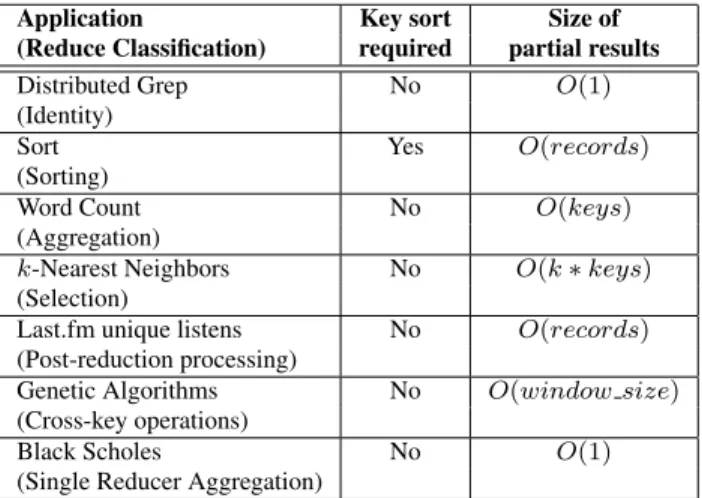
Application Key sort Size of (Reduce Classification) required partial results
Distributed Grep No O(1)
(Identity)
Sort Yes O(records)
(Sorting)
Word Count No O(keys)
(Aggregation)
k-Nearest Neighbors No O(k∗keys) (Selection)
Last.fm unique listens No O(records) (Post-reduction processing)
Genetic Algorithms No O(window size) (Cross-key operations)
Black Scholes No O(1)
(Single Reducer Aggregation)
Table 1: Sort and Memory requirements of MapReduce Jobs.Recordsandkeysdenote respectively, the total num-ber of records and keys, executed at a single Reducer.
The barrier-less model removes these intervals, thus improv-ing performance.
By removing both waiting intervals, the records in the barrier-less model are no longer sorted in key order. Our investigation of seven classes of MapReduce applications summarized in Table 1 (detailed in Section 4) reveals that, in practice, a significant number of applications do not re-quire the full key sorting provided by the MapReduce frame-work. The main role of sorting by key is to group records with the same key together. Grouping is necessary in tradi-tional MapReduce, because it requires all records for a key to be present when the Reduce function is executed. The barrier-less approach removes this requirement, and the Re-duce function is run on records one by one. This approach raises an important problem: partial results for each key must be maintained.
Our investigation shows that the number of partial re-sults that must be maintained differs widely across Map-Reduce applications (see column “Size of partial results” in Table 1). Thus, for the barrier-less model to work with general MapReduce applications, we require techniques for maintaining and updating these partial results. Before we develop these techniques in detail (see Section 5), we first describe the structure and usage of our basic framework for barrier-less MapReduce.
3 Breaking the Barrier
In this section, we describe our implementation of barrier-less MapReduce, and illustrate how to modify an existing MapReduce application to be used in this framework.
3.1 Barrier-less Hadoop Implementation
We implemented barrier-less MapReduce by modifying the open-source Hadoop implementation. The original Hadoop implementation employs a barrier as described in the previ-ous section. In order to break the barrier, we had to incor-porate two primary design decisions: (1) bypass the batched sorting mechanism, and (2) modify the invocation of the Re-duce function so that it can be called with a single record (instead of a key and all values corresponding to it).
Hadoop’s Shuffle stage is implemented by transferring batches of records from Mappers to Reducers. Each Mapper buffers its processed records. When all local processing is finished the Mapper sorts the records by key, a step that par-titions the records to be transferred to each Reducer. If the buffer grows larger than the memory available, it is spilled to disk and later merge-sorted. Each Reducer retrieves the batch of records from each Mapper only after it has com-pleted. When all records from every Mapper are received by the Reducer it merge-sorts them, a step that groups all records together.
For barrier-less MapReduce, we pipeline the record trans-fer and Reduce execution at the single record level, instead of batching. There are two potential benefits to pipelining. First, we make it possible to interleave network I/O of the record transfer with CPU computation. Second, we avoid the need to spill to disk when the size of batched records grows beyond memory.
In our implementation, the Reducer uses one asynchronous thread per Mapper to retrieve records, as soon as they are available. These records are stored into a single buffer, and a separate thread executes the Reduce function on the records in the buffer in a first-in first-out manner. The Reduce func-tion called in this manner is only passed a single key/value record, as opposed to a key and all its corresponding values in the original Hadoop. This subtle difference in the frame-work compared to original Hadoop changes the way applica-tions are implemented slightly, as we show with an example in Section 3.2.
However, these changes do not affect other aspects of the execution of Hadoop. In other words, assignment of tasks, fault-tolerance, scheduling, etc., are handled in the same way as original Hadoop.
3.2 Barrier-less WordCount
As previously mentioned, when executed with barrier-less Hadoop, the Reduce function does not have the guarantee of atomically receiving all records for a given key. There-fore, the application must be modified to handle records one by one. To do this, a programmer must code, in addition to the Map and Reduce function, a custom run functionthat makes calls to the Reduce function. In the original Hadoop,
Algorithm 1Original WordCount function map(key, value):
// key: document name // value: document contents for eachwordinvaluedo
Emit intermediate (word, 1) end for
function reduce(key, values, context): // key: a word
// values: a list of counts result←0
for eachvinvaluesdo result←result + v end for
Write (key, result) to context function run():
whilecontext has more keysdo key←current key from context values←current values from context reduce(key, values, context) end while
the run function invokes the Reduce function once per key. For barrier-less Hadoop, the run function invokes the Re-duce function once per entry, and the programmer addition-ally specifies in this function how partial results are stored and reused across Reduce invocations.
In the rest of this section, we present a concrete example of the difference between an application coded for the orig-inal and barrier-less MapReduce frameworks. For this, we use the WordCount application provided with the Hadoop distribution. The original program is shown in pseudo-code in Algorithm 1. In the Map function, each output entry is simply a word and a count of 1. In the Reduce function, the number of output entries with the same key is counted. The run function, which is part of the Hadoop framework, en-sures that the Reduce function is called once for each key, with all the values as input.
To run WordCount without a barrier, the programmer has to modify the Reduce and run functions as presented in Algorithm 2. The run function calls Reduce on each en-try that is received. In other words,the Reduce function no longer assumes that all values for a key are passed in at once. This implies that the Reducer must maintain partial results for every key it has received. For our purposes, we use the Java implementation of Red-Black trees [16] called TreeMap. A TreeMap can quickly access partial results while maintaining key ordering. As a record (which is a key/value pair) arrives, the run function reads the previous partial re-sult, and passes it to the Reduce function. The Reduce func-tion performs the computafunc-tion, and stores the new result back into place. Once there are no more records and all the Reduce invocations have completed, the output is generated by the run function.
Algorithm 2Barrier-less WordCount
Changes made to Algorithm 1 areboldfaced and italicized. function reduce(key, values, context):
// key: a word
// values: a list of counts result←0
for eachvinvaluesdo result←result + v end for
Insert (key, result) in the TreeMap function run():
Create a new TreeMap whilecontext has more keysdo
key←current key from context values←current values from context ifTreeMap does not contain keythen
Insert (key, 0) in the TreeMap end if
reduce(key, values, context) end while
// After all the reduce invocations are done foreach (key, value) in TreeMapdo
Write (key, value) to context end for
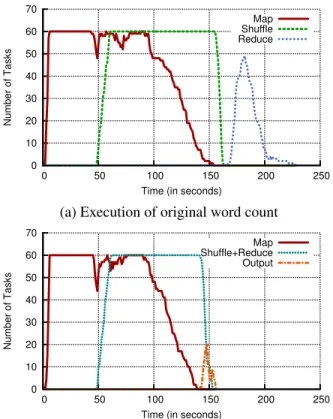
Figure 1 shows the system-wide progress of the Word-Count program with and without a barrier on the same clus-ter. (Details of the experimental setup are provided in Sec-tion 6.) The y-axis represents the number of CPU cores exe-cuting at each stage. In the original MapReduce, we can see the barrier in the delay between the Map tasks finishing at 155 seconds and the Reduce function invocations beginning at 170 seconds. In the barrier-less version though, the com-bined Shuffle and Reduce stage begins at 50 seconds, when the first Mappers begin to complete. We refer to the time gap between when the first Mappers complete and when the shuffle stage completes as themapper slack. It is indicative of the extra time taken by the buffering and sorting parts of the Shuffle stage.
In barrier-less MapReduce, there is no distinct barrier between Shuffle and Reduce. Instead, each Reducer works on individual records as the Shuffle process pulls them in. Because these two stages are combined and interleaved, we see an improvement in job completion time. We observe that the job finishes within 160 seconds, or only 10 seconds after the final Map task completes. This is a 30% improvement in the job completion time for WordCount. This benefit arises because we can perform meaningful work in the form of Re-duce operations during themapper slacktime, in which the barrier version is performing the shuffle/sort operation. At the same time, since our modifications were non-invasive, the correctness and the completeness of the MapReduce ex-ecution is not compromised.
Finally, we observe that depending on the application, the amount of memory consumed at each Reducer by tial results may vary. In the worst case the number of
0 10 20 30 40 50 60 70 0 50 100 150 200 250 Number of Tasks
Time (in seconds)
Map Shuffle Reduce
(a) Execution of original word count
0 10 20 30 40 50 60 70 0 50 100 150 200 250 Number of Tasks
Time (in seconds)
Map Shuffle+Reduce Output
(b) Execution of barrier-less word count
Fig. 1: Progress of MapReduce which performs a word count on a 3GB Wikipedia data set
tial results may become very large and cause the Reducer to run out of memory. This motivates the development of new memory management techniques that can prevent overflows and we address this in Section 5.
4 Classifying Reduce Operations
In order to understand the general implications of breaking the barrier in the general case, we need to understand con-crete MapReduce applications. Hence, we performed a case study of a wide variety of published MapReduce applica-tions and investigated how to break the barrier for each of them. The applications we studied were the following: Map-Reduce example benchmarks [10]; machine learning bench-marks [8]; statistical machine translation [7], [12]; optimiza-tion algorithms [24]; finance algorithms [6]; and similarity scoring [13].
We classified the Reduce operations performed in these applications. The result is a list of seven types: Identity, Sorting, Aggregation, Selection, Post-reduction processing, Cross-key operations and Single reducer aggregations. This information is summarized in Table 1. In the rest of this sec-tion, we present our classification. For each type, we discuss a representative application and how partial results must be
stored and updated during execution in barrier-less Map-Reduce.
4.1 Identity
Identity operations are Reduce operations that perform little to no explicit work. An example of an Identity operation is a Distributed Grep application [10]. The Map function emits a line of text if it matches a pattern. The Reduce function is merely used to write the final output.
Identity operations are the simplest kind of Reduce op-eration. They do not require the Reduce input to be sorted by key. There is also no need to keep partial results for any keys, because the results are written immediately as final output. Hence, there is no difference between implementing this operation for original and for barrier-less MapReduce.
4.2 Sorting
This is the only prominent kind of operation we found that requires a strict ordering on the output keys. For sorting op-erations, the Reduce operation must write output that is in a sorted order. This is a popular application, e.g., a sort im-plemented in Hadoop holds the record for the fastest sort of 100TB of data [20].
The implementation of a sorting operation is dependent on whether or not a barrier is present. With a barrier, the im-plementation of a sorting operation is identical to an Identity operation. The MapReduce framework itself, rather than the Reduce operation, does the job of sorting the output by key. If sorting by value is also required, a secondary sort oper-ation is easily performed using custom grouping and com-parison operations. However, this is not the case when the barrier is broken.
Effect of no barrier:To implement a sorting operation
without a barrier, the data must be sorted in the Reduce func-tion, typically through the use of an ordered data structure like a Red-Black tree. None of the partial results can be emit-ted until all the values have been seen and completely soremit-ted. Thus, in the worst case each Reducer must maintain a data structure of size O(records), the total number of records executed at the Reducer.
4.3 Aggregation
We classify aggregation operations as those that are com-mutative and distributive – they include addition and multi-plication. They perform an operation on all the values asso-ciated with a key, and emit an aggregated value as output. Since the operations are commutative, the ordering of the keys is not required.
An example is the WordCount application from Section 3. For each key, the entries that contain the count of the key are summed up into the aggregate word count. In the original version, the Reduce function is invoked with a key and all of its associated values. Hence, it can aggregate them and emit the final count immediately.
Effect of no barrier:For the barrier-less version, a
run-ning aggregate result must be maintained for each key. Thus, the Reducers must maintainO(keys)state for storing the partial results. The Reducer outputs the results only when all the keys and their associated values have been processed.
4.4 Selection
Selection operations are those that select a subset of the val-ues associated with a key. Examples include finding the max, min, median, or topkvalues.
With a barrier present, while sorting keys the framework can also allow the developers to sort values as well (e.g., Hadoop’s secondary sort). Given such an ordering, the Re-duce function can trivially select the values of interest. For example, when finding a minimum, the Reducer can select and output the first value for every key.
In our barrier-less implementation, we bypass the sort operation, so these operations must be performed on a run-ningbasis. For example, a running minimum (or minimumk values) can be kept and updated as new values arrive. There-fore, the barrier-less version of a selection operation main-tains a per-key context with the currently selected values, and emits the final output once all values have been pro-cessed.
To investigate selection algorithms, we implemented a k−Nearest Neighbors algorithm. This is a classic algorithm that reads in two sets of data, a training set and an experi-mental set, and finds thekvalues in the training set closest to each value in the experimental set. It was first presented in [15] and is often used in statistical analysis applications, such as finding pairwise similarity [13].
The distance between an experimental value (E) and the training value (T) is defined as the absolute value of their difference (|E−V|). It is necessary to compare each exper-imental value to every training value. The barrier version’s Map function emits a tuple(E,|E−V|)for the key, and an integer T for the value. A secondary sort is performed, sorting by the|E−V|value in the key, but grouping byE. Then, in the Reducer, the firstkvalues are emitted.
Effect of no barrier:The barrier-less version maintains
ak-value-per-key context, stored as a TreeMap (a Red-Black tree implementation in Java) of linked lists. The Mapper emits an integerE as the key and a tuple(T,|E−V|)as the value. There is no need to emit a tuple as before, since a sort is not performed. Now, for each key, the Reducer
main-tains a size-kordered linked list, and decides if the most re-cently received(E,|E−V|)tuple belongs in the list, based on the|E−V|value within the tuple. If this is the case, it is inserted into the appropriate location within the ordered linked list, evicting the tuple with the largest distance if the linked list size exceedsk. Once all value tuples have been processed for a key, the contents of the linked list (namely the topk Evalues), are emitted.
4.5 Post-reduction processing
In post-reducer processing operations, the Reduce operation works in two steps. First, the entries with a key are processed and inserted into a temporary data structure. When all the entries for a key have been processed, a post-processing op-eration is applied on the temporary data structure to get the final output for the key.
An example application is the one used at Last.fm to track the number of unique users that listen to each track of music in the service [26]. Entries of the input data consists of a userId and trackId (and other information). The trackId is the key of the record. The number of unique users per track is counted in two steps. In the processing stage, the userId of each record is added into a data structure that does not hold duplicate values e.g., the code presented in [26] uses a Java Set. Then the post-processing step counts the total number of entries in the data structure.
Effect of no barrier:With a barrier, the temporary data
structure will grow with the maximum number of records with a certain key. This in itself could be a large amount of data. However, when the barrier is broken, the structure can grow even larger. The temporary data structure for each key must be maintained, in a partial result structure such as a TreeMap. The total amount of partial results can grow to
O(records).
4.6 Cross-key operations
Typically a Reduce function processes its keys independent of the other Reduce functions. However, in cross key oper-ations, the Reduce function can depend on other keys, for example the previouskkeys. This can be implemented by maintaining a window ofkpreviously seen keys, operating over them and emitting the final output. Since Reduce does not depend on other keys, it can terminate after emitting its output.
To investigate cross-key operations, we use the example of genetic algorithms; in particular we use [24]. Each indi-vidual (I) is represented as a key and the Mapper computes the fitness (F) of each individual and emits the tuple(I, F). The Reducer maintains a window of previously seen indi-viduals and when the window is full, performs the selection
and crossover operations of the genetic algorithm and finally emits the individuals as output.
Effect of no barrier:Only partial results for the window
containing the previouskkeys need to be maintained. When a partial result is removed from the window, it is written as a final result. Thus, the memory requirement for storing partial results isO(k).
4.7 Single reducer aggregation
Single reducer aggregations involve the use of a single Re-ducer to aggregate the outputs from multiple Mappers. This is generally used for determining measures of central ten-dency or dispersion where global knowledge of all the Map outputs is required.
We study single reducer aggregations through a Monte Carlo simulation that computes the Black-Scholes option pricing value ([6], [14]). Each Mapper performs complex floating point operations like exponentiation according to the Black-Scholes formula and the Reducer computes the average and standard deviation of all the values computed by the Mappers.
Effect of no barrier:The average operation can be
in-crementally computed by maintaining a running sum of the values and performing a division at the end. In order to cal-culate the standard deviation along with the average, the Mapper emits the square of the value along with the value itself. The Reducer maintains a running sum of the squares of the values along with a running sum and a count of the values. Letx1, x2, . . . , xN be the values whose mean isx¯. The standard deviation is computed as follows:
σ= v u u t1 N Ã N X i=1 (xi−x¯)2 ! = v u u t1 N Ã N X i=1 x2 i −2¯x N X i=1 xi+Nx¯2 ! = v u u t1 N Ã N X i=1 x2 i ! −x¯2
As only the running sums have to be saved, onlyO(1) memory is required for storing the partial results at the Re-ducer. Since summations are commutative operations, order-ing of the keys is not required.
5 Managing Memory Overflows
As noted in Section 3, an important change in our barrier-less MapReduce framework is the need to manage the stor-age of partial results. Depending on the category of the Re-duce operation involved (see Section 4), the partial result
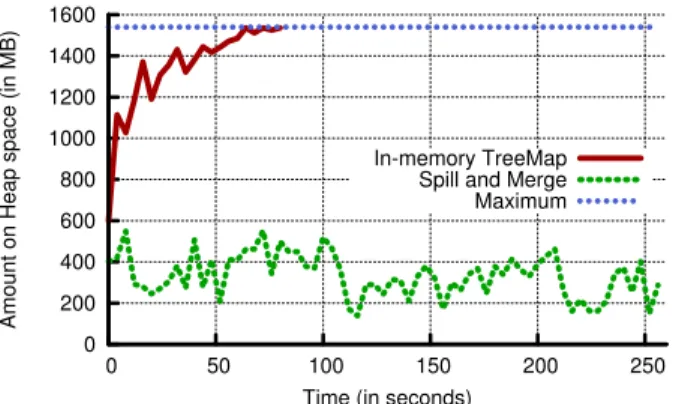
memory complexity can be up toO(records), growing to the number of records executed at the Reducer. For large datasets, which MapReduce caters to, this can quickly over-flow the in-memory capacity at a server. For instance, the line “In-memory TreeMap” in Figure 2 shows the amount of heap space used by a Reducer in a MapReduce job which performs a WordCount on a 16GB dataset. The used mem-ory increased, until the Reducer ran out of available heap space. An OutOfMemory exception was thrown and the job was killed around 80s.
In order to address these memory overflow problems, we explore two possible memory management solutions: adisk spill and merge scheme and an off-the-shelf disk-spilling key/value store.
5.1 Disk Spill and Merge
In the disk spill and merge scheme, we define a memory threshold. If memory usage for partial results reaches this threshold, it is spilled to a newly created file on disk. When all records have been processed, the spilled files are merged using a merge function defined by the programmer.
During the course of execution at a Reducer, the mem-ory threshold may be reached multiple times, creating many spill files. Thus, partial results for a single key may be spilled onto multiple different spill files. After all invocations of the Reduce function at a Reducer are finished, all the partial re-sults for a single key must be merged together.
The disk spill and merge scheme is designed to allow the merge to be performed efficiently. Partial results are sorted by key as they are moved to a spill file. Then the merge phase merges all the partial results for each key in a straightfor-ward manner, similar to an external merge-sort. For every local spill file, the first partial result is loaded into the mem-ory and stored in a buffer. Spill files containing the globally lowest key are then repeatedly read from until the lowest key’s partial results are all loaded into memory. Once all partial results for a key have been merged, the result can be written as the final output. The next globally lowest key is found and processed in the same fashion, until all keys have been processed.
The method of merging results of each key depends on the application and the data structure that stores the partial results. Thus, the programmer supplies the merge function. This function is functionally similar to the combiner method of MapReduce (as specified in [10]), but may be customized if more complex methods are required for maintaining par-tial results.
The effect of using Disk Spill and Merge is shown in Figure 2. In our implementation, we maintain a count of records in the partial result data structure to estimate the memory usage. We spill to and read from disk by using
0 200 400 600 800 1000 1200 1400 1600 0 50 100 150 200 250
Amount on Heap space (in MB)
Time (in seconds) In-memory TreeMap
Spill and Merge Maximum
Fig. 2: WordCount over a 16GB dataset with 10 Reducers. Having the complete TreeMap in memory leads to out of memoryerror. Spill and merge uses less memory and the job completes successfully. Partial results threshold is 240 MB.
Java’s serialize/deserialize interface. The line “Spill and Merge” shows that the partial results data structure is kept below the memory threshold.
5.2 Disk spilling key/value store
Instead of flushing the entire contents of the memory to a file on the disk, the partial results can be maintained in a key/value store that has the capability of spilling to disk. Every invocation of the Reduce function fetches the pre-vious partial result from the key/value store, processes the current input and then stores the result back into the key/-value store. This read-modify-update cycle is carried out for all the inputs to the Reducer. The key/value store is capa-ble of evicting some records out of memory and spilling to disk according to policies like Least Recently Used (LRU), whenever it runs out of memory.
We experimented with different key/value stores such as BerkeleyDB [19], Tokyo Cabinet [4] and MongoDB [3]. Among these, BerkeleyDB (Java Edition) exhibited the high-est raw read and write throughput in terms of operations per second. Hence, we chose it as the key/value system to run our experiments. We configured BerkeleyDB for per-formance without guaranteeing fault-tolerance of the data, because the MapReduce framework takes care of these con-cerns. The transaction log buffers were maintained in mem-ory and only written to stable storage when BerkeleyDB de-termines that they are full or it is out of main memory.
5.3 Qualitative Comparison
The disk spill and merge approach has the advantage of avoiding the thrashing of in-memory data, unlike BerkeleyDB’s
caching scheme. Similarly, because it is intended specifi-cally for managing partial result storage, it is more lightweight and efficient than a generic disk-spillable key/value store. On the other hand, it will not be able to take advantage of any prior knowledge of the distribution of keys, as it treats each of them equally. Therefore, in situations where certain keys are significantly more common than others, unneces-sary spilling may occur. BerkeleyDB, like most key/value stores, performs caching and pre-fetching of common en-tries, in order to minimize reading from disk, and can there-fore exploit temporal locality. We compare these approaches quantitatively in Section 6.5.
6 Experimental Evaluation
In this section, we evaluate the performance characteristics of our implementation of barrier-less MapReduce. Our im-plementation is based on Hadoop 0.20. We measured the improvement over the original Hadoop 0.20 for the seven classes of applications described in Section 4.
We performed our experiments on 16 nodes from the Cloud Computing Testbed (CCT) [2] running 64 bit Cent OS 5.4 operating system. Each node has dual Intel Quad cores, 16GB RAM and a single 1TB hard disk. The nodes are connected together with a Gigabit Ethernet switch. A single node was configured to be the JobTracker and the Na-meNode and the other 15 nodes were used as slaves. The replication factor of the distributed file system was set to 3 and the default chunksize was 64MB. The number of Map-pers and Reducers per node was set to 4, in order to utilize all the 8 cores on each node.
6.1 Improvement with Input Data Size
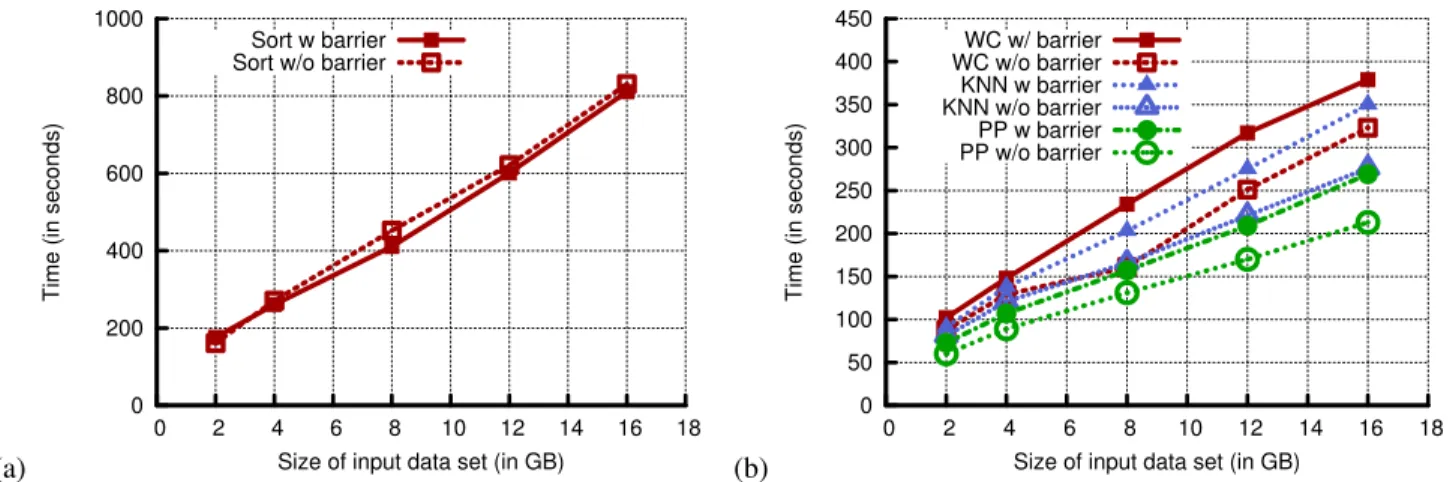
We experimentally evaluated the improvements in the job completion times for six applications in the following sub-sections. These applications correspond to the seven classes described in Section 4. (We omit the Identity class because the original and barrier-less versions are identical.) Figure 3 shows the job completion times for various benchmarks with and without barrier.
6.1.1 Sort
Our barrier-less sort is implemented in a similar manner to our WordCount implementation, in order to avoid consum-ing memory for duplicate keys. We use a Red-Black tree im-plementation (Java TreeMap) to store a per-key count value. This count value is incremented, when a duplicate key is encountered. When we output the results, we emit the dupli-cates of the keycountnumber of times.
(a) 0 200 400 600 800 1000 0 2 4 6 8 10 12 14 16 18
Time (in seconds)
Size of input data set (in GB) Sort w barrier
Sort w/o barrier
(b) 0 50 100 150 200 250 300 350 400 450 0 2 4 6 8 10 12 14 16 18
Time (in seconds)
Size of input data set (in GB) WC w/ barrier WC w/o barrier KNN w barrier KNN w/o barrier PP w barrier PP w/o barrier
Fig. 3: Comparison of different benchmarks: Sort, WordCount(WC),k-Nearest Neighbor(KNN) and Post Processing (PP) with and without barrier, with increasing dataset sizes.
This is a degenerate case, because in the original Map-Reduce, both Mappers and Reducers perform no work. The comparison between the original and the barrier-less Map-Reduce versions becomes a competition between the two sorting mechanisms. In this case the original merge sort is faster than performing insertions into a Red-Black Tree. As a result, we observed slight slowdowns in the barrier-less version, up to 9% in the 8GB case, and going down to 2% for the 16GB case.
6.1.2 WordCount
The WordCount application involves theaggregation oper-ationof summing the count of the word occurrences. De-spite the relatively small amount of non-sorting work per-formed in this benchmark, we observed that the barrier-less approach results in an average of 15% decrease in job com-pletion times. Although the work performed in the barrier-less WordCount is essentially the same as in the barrier-barrier-less Sort, WordCount has more room for improvement due to the extra aggregation work the original version performs. This shows that, although Reducers performing no work may not see gains from our barrier-less system, even work as sple as aggregation can see notable gains. However, this im-provement did not increase proportionally with the size of the dataset, since writing the output to the distributed file system is the bottleneck.
6.1.3k-Nearest Neighbors
This application uses aselection operatorwhich selects the topkvalues from the input keys. For our experiments, we used a k value of 10. Our data values ranged from 0 to 1,000,000. The barrier-less version ofk-Nearest Neighbors must perform extra work in maintaining a sorted list of the
0 50 100 150 200 250 300 350 400 0 50 100 150 200 250 0 10 20 30 40 50 60 70 80 90 100
Time for Genetic Algorithm (in seconds) Time for Black Scholes (in seconds) Number of Mappers
GA w/ barrier GA w/o barrier BS w barrier BS w/o barrier
Fig. 4: Genetic Algorithms(GA) and Black Scholes(BS) with and without barrier, varying the number of Mappers.
top k values, which is done automatically by the Shuffle stage in the original framework.
Nevertheless, we observed an average decrease of 18% in job completion times. This improvement slowly increased as the dataset size was increased, since the number of Map rounds increased, thereby increasing mapper slack. In addi-tion, the experimental values must be unique while training set values need not be. Therefore, the number of keys did not grow at the same rate as the number of values, resulting in less per-key data. This nature of the data affects perfor-mance as it results in relatively lesser memory overhead for the barrier-less version.
6.1.4 Last.fm Unique Listens
The calculation of unique listens uses post-reduction pro-cessing. The application counts the unique number of users
160 180 200 220 240 260 280 300 20 30 40 50 60 70 80
Time (in seconds)
Number of reducers With barrier Without barrier
Fig. 5: Genetic Algorithms with and without barrier, varying the number of reducers.
that listen to a track. We ran our experiments on a dataset that generated track listens, uniformly at random across 50 users and 5000 tracks. For varying sizes of input data, we consistently observed a 20% decrease in job completion time.
6.1.5 Genetic Algorithms
Genetic algorithms are used to exemplify cross-key opera-tions. The genetic algorithm required no change to perform barrier-less calculation, as no per-key data had to be main-tained. The algorithm in both the original and the barrier-less versions only need to maintainO(window size)keys, since each key is independent of the others.
In this experiment (Figure 4), we executed a genetic al-gorithm with a population of 50 million individuals per map-per and varied the dataset size by increasing the number of mappers. The number of Reducers was set to 40. We ob-served that the performance is limited by the time spent in writing intermediate data to the local disk or the output to the distributed filesystem. This resulted in a benefit of about 15%, which stays relatively constant as the dataset size in-creases.
6.1.6 Black-Scholes Options Pricing
The calculation of options pricing using Black-Scholes in-volves using a single reducer aggregationto calculate the mean and standard deviation. In this experiment, we exe-cuted a million iterations of the Black-Scholes algorithm per mapper. Black-Scholes, similar to genetic algorithms, has a constant amount of memory in use at the Reducer (O(1) with relation to the input dataset size). However, unlike ge-netic algorithms, the output data is also constant in size since it is just a single running average and standard deviation.
Figure 4 shows that our approach resulted in an average ben-efit of about 56%, which continued to increase as the number of iterations increased. The maximum improvement in com-pletion time observed was 87%. This is the best performance of our approach across all application classes.
6.1.7 Comparing Improvement Across Applications Black-Scholes showed the largest improvement, due to the O(1)memory overhead and output dataset size. The other benchmarks had improvements that stayed consistent around the 20% mark, which was the common case due to the lim-itations imposed by mapper slack and time spent writing to disk. In addition, sort was observed to be our worst case with a small performance loss on average.
6.2 Performance Improvement Breakdown
In order to better understand the reason behind the improve-ment in overall completion time for barrier-less MapReduce, we take an in-depth look at the execution of two of the ap-plications, WordCount and Genetic Algorithm.
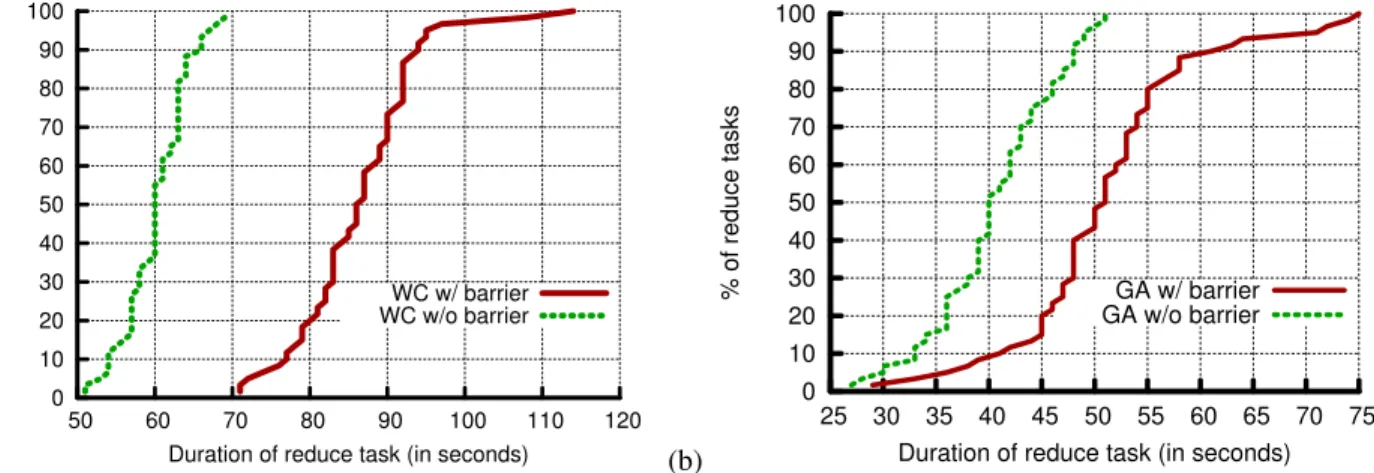
In Figure 6, we plot a CDF of the duration of each task in the Reduce stage, for both original MapReduce and barrier-less MapReduce. The task duration denotes the duration from when the first byte is received at the Reduce task from a Map task, to when the Reduce task emits its final byte of output. We make two observations about the improvement in overall completion time. First, the median Reduce task completion time is smaller for barrier-less MapReduce. For WordCount, up to the 95th percentile, the gap is between 20 to 30 seconds, while for Genetic Algorithm, up to the 90th percentile, the gap is between less than 5, to around 10 seconds. Secondly, the original MapReduce contains out-lier Reduce tasks that have significantly longer completion times than other Reduce tasks. In contrast, we do not see any significant outliers in barrier-less MapReduce. Due to this, there is a large gap between the Reduce tasks with the longest completion times: the gap for WordCount is more than 40 seconds, while for Genetic Algorithm it is almost 25 seconds.
These factors are also visibly present in Figure 7, where we plot the end time for each Reduce task, i.e., when the final byte of output is emitted, counting from the start of the entire MapReduce job.
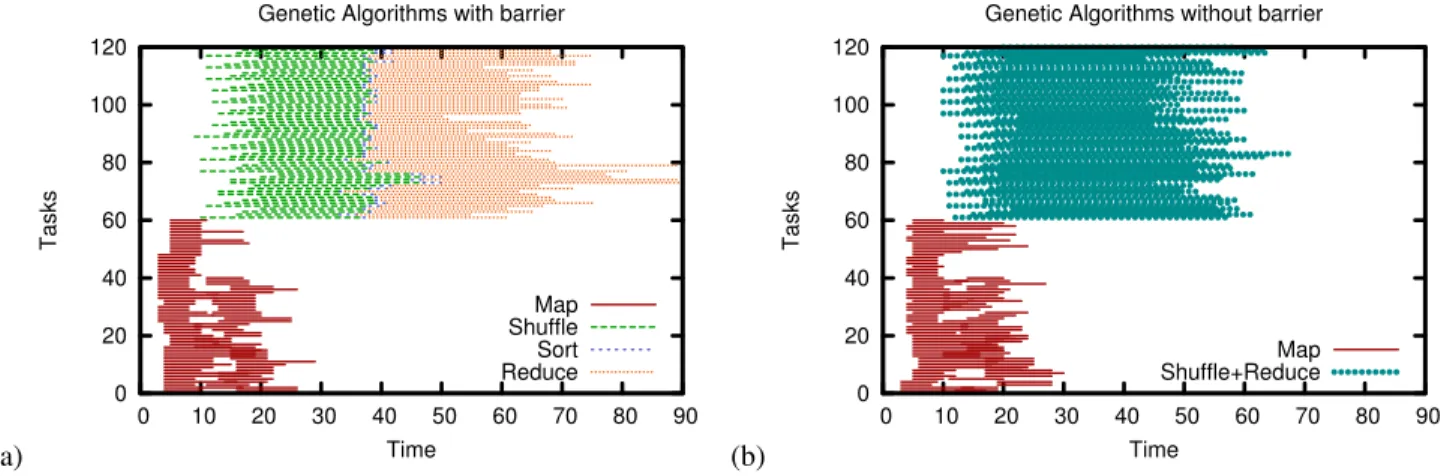
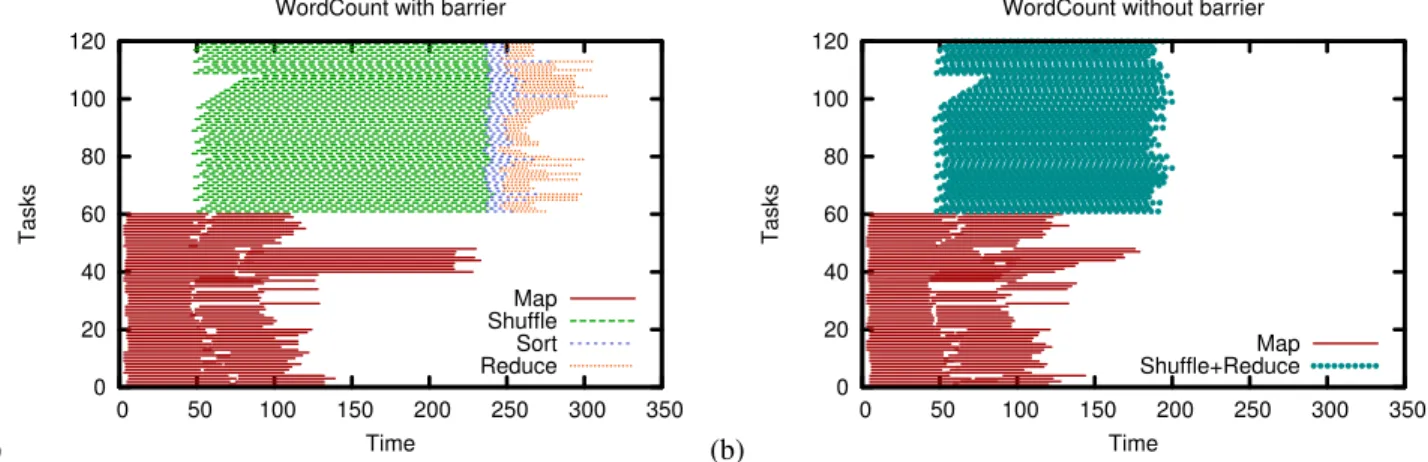
Figures 8 and 9 plot the start and duration for each indi-vidual Map and Reduce task. For original MapReduce, the Reduce stage is separated into Shuffle, Sort (not to be con-fused with the Sort application), and Reduce function exe-cution. Shuffle execution is dominated by network I/O, Sort is dominated by disk I/O, and Reduce is dominated by CPU computation. From the plot, we observe two main causes of the dissimilarity in Reduce task duration times. First, the
(a) 0 10 20 30 40 50 60 70 80 90 100 50 60 70 80 90 100 110 120 % of reduce tasks
Duration of reduce task (in seconds) WC w/ barrier WC w/o barrier (b) 0 10 20 30 40 50 60 70 80 90 100 25 30 35 40 45 50 55 60 65 70 75 % of reduce tasks
Duration of reduce task (in seconds) GA w/ barrier GA w/o barrier
Fig. 6: CDF of Reduce task duration.
(a) 0 10 20 30 40 50 60 70 80 90 100 100 110 120 130 140 150 160 170 % of reduce tasks
End time of reduce task (in seconds) WC w/ barrier WC w/o barrier (b) 0 10 20 30 40 50 60 70 80 90 100 45 50 55 60 65 70 75 80 85 90 % of reduce tasks
End time of reduce task (in seconds) GA w/ barrier GA w/o barrier
Fig. 7: CDF of end times of Reduce tasks.
(a) 0 20 40 60 80 100 120 0 50 100 150 200 Tasks Time WordCount with barrier
Map Shuffle Sort Reduce (b) 0 20 40 60 80 100 120 0 50 100 150 200 Tasks Time
WordCount without barrier
Map Shuffle+Reduce
(a) 0 20 40 60 80 100 120 0 10 20 30 40 50 60 70 80 90 Tasks Time
Genetic Algorithms with barrier
Map Shuffle Sort Reduce (b) 0 20 40 60 80 100 120 0 10 20 30 40 50 60 70 80 90 Tasks Time
Genetic Algorithms without barrier
Map Shuffle+Reduce
Fig. 9: Lanes plot of Genetic Algorithms.
contrast in median completion time is because barrier-less MapReduce is able to successfully interleave both disk I/O and CPU computation together with network I/O. Thus, the duration of the entire barrier-less Reduce task is close to the duration of Shuffle for the original Reduce task. Sec-ond, Sort appears to be the main cause for the outliers of the original Reduce – this is likely caused by heterogeneity of disk I/O performance within the cluster.
The variation in Reduce execution time for Genetic Al-gorithm is likely due to the involved computation being more complex. We observe high variance in the duration for both Map and Reduce function execution for the original tasks. This effect is also observed in the barrier-less setting, where the end times of the Reduce tasks in Genetic Algorithm have more variance than WordCount.
Thus, we conclude that for the Genetic Algorithm and WordCount applications, any outliers arising from our set-ting are eliminated by using a barrier-less approach.
6.3 Improvement with Number of Reducers
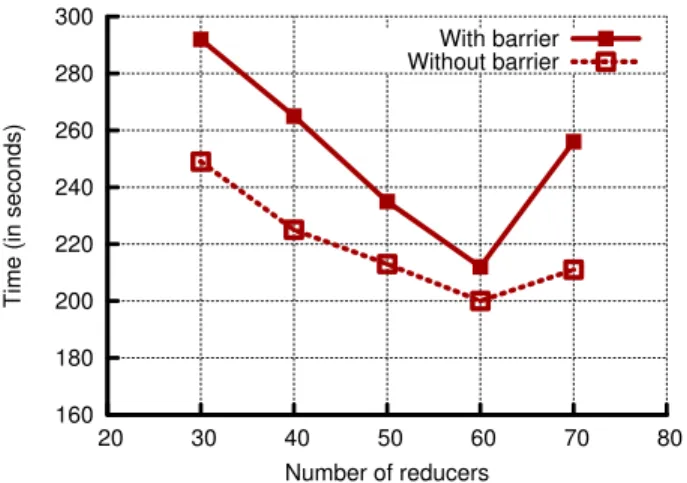
In order to understand the sensitivity to the number of Re-ducers, we varied the Reducer count in Figure 5 and ob-served the improvement as the count rose from 30 to 70 (which is 10 more than the number of available CPU cores for Reducers). This illustrates the effect of applications or systems with an irregular amount of Reducers, for example if nodes fail in the middle of computation.
Our results show that although job completion time de-creased as the compute utilization inde-creased (as the num-ber of Reducers reached the compute capacity of 60), our improvement over the barrier version decreased somewhat. When the number of Reducers surpassed the amount of com-pute resources available (70 Reducers running on 60 cores),
the job completion time increased, but our improvement also increased.
The reason for our scheme having a larger improvement when the system is underutilized (for example when there are only 30 Reducers), is that each Reducer has to shuffle respectively more data than in the fully utilized case. This means that the shuffle time is larger, and themapper slack, during which the barrier-less version can perform meaning-ful work, is also larger. As the utilization becomes more full, the mapper slack decreases, limiting, but not removing, the benefit gained from breaking the barrier. On the other hand, once the system becomes over-saturated (the 70 Re-ducer case), a new round of ReRe-ducers is needed, which must themselves undergo a shuffle stage, once again increasing the mapper slack. In other words, the benefit of switching to a barrier-less framework is closely tied to the amount of mapper slack in the runtime.
6.4 Cluster Heterogeneity
In these experiments, we look at the effect of cluster hetero-geneity on barrier-less MapReduce and compare it to orig-inal MapReduce. Some heterogeneity is already present in our cluster despite it being composed of machines with orig-inally identical specifications. We go a step further and in-duce more heterogeneity, by overloading machines with more Mappers and Reducers. Our 16 machine cluster has 1 master and 15 workers. We vary the number of worker machinesn (from 15 to 13) with the following configuration:n−1 ma-chines each have 4 map and 4 reduce slots while thenth machine has(16−n)∗4map and(16−n)∗4reduce slots. This causes thenth machine to be overloaded.
Figure 10 shows the execution time of WordCount with 15, 14, and 13 worker machines, i.e., when the designated machine is configured with 4, 8, and 12 Mappers and an
(a) 0 50 100 150 200 250 300 350 15 14 13
Time (in seconds)
Number of machines
WordCount processing 7.5GB input dataset WC w/o barrier WC w/ barrier (b) 0 500 1000 1500 2000 15 14 13
Time (in seconds)
Number of machines
WordCount processing 55GB input dataset WC w/o barrier
WC w/ barrier
Fig. 10: WordCount performance on heterogeneous machines processing 7.5GB (left) and 55GB input dataset (right).
(a) 0 20 40 60 80 100 120 0 50 100 150 200 250 300 350 Tasks Time WordCount with barrier
Map Shuffle Sort Reduce (b) 0 20 40 60 80 100 120 0 50 100 150 200 250 300 350 Tasks Time
WordCount without barrier
Map Shuffle+Reduce
Fig. 11: Lanes plot of WordCount processing 7.5GB on 13 heterogeneous machines.
equal number of Reducers respectively. This mimics, for example, a virtualized cluster where heterogeneity can be caused by many virtual machines being run on a single ma-chine. When the input dataset processed is 7.5GB, the entire intermediate data is kept in memory for both barrier-less and original MapReduce. We see a large difference (54%) in ex-ecution time in the case of the 13 worker machines. We ob-serve that increasing the heterogeneity from 14 to 13 worker machines leads to 58% worse performance for original Map-Reduce, but only 27% worse performance for barrier-less MapReduce.
In order to understand the cause for this improvement, Figure 11 shows the start and duration of each task when WordCount is run on 13 worker machines. In this configura-tion, one of the machines is configured with 12 Mappers and 12 Reducers, while the other 12 machines are configured with 4 Mappers and 4 Reducers. We observe that the dura-tion of the map tasks on the overloaded machines is longer in original MapReduce. This is because the overloaded
ma-chines have too little available memory per task, and thus the Mappers must buffer their records on disk. These Map outliers, coupled with the barrier, force the Reduce function execution to be delayed. In contrast, barrier-less Mappers are not required to buffer all records because they transfer records immediately. Thus, disk I/O time is saved resulting in the overloaded Map outliers finishing earlier than their original counterparts. Also, because there is no barrier, the Reduce function execution is interleaved with the network transfer, resulting in the combined Shuffle and Reduce fin-ishing shortly after the final outlier Mapper. As a result of the combination of these factors, we observe that the entire job completes in our barrier-less MapReduce implementa-tion before even the Map stage is completed in original Map-Reduce.
When the input dataset size is increased to 55GB, the amount of intermediate data processed per Reducer increases above the available memory limit and the disk spill and merge technique is used in the barrier-less version, while the
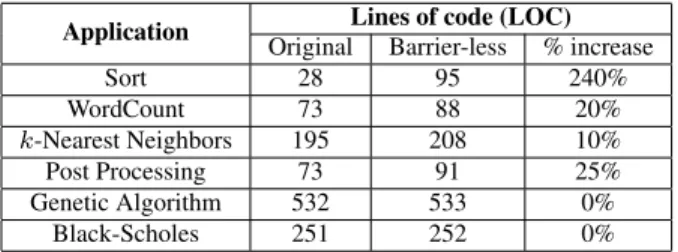
orig-Application Lines of code (LOC) Original Barrier-less % increase
Sort 28 95 240% WordCount 73 88 20% k-Nearest Neighbors 195 208 10% Post Processing 73 91 25% Genetic Algorithm 532 533 0% Black-Scholes 251 252 0%
Table 2: Programmer effort, in terms of LOC required to convert MapReduce applications to their barrier-less ver-sions.
inal version uses an external MergeSort. In this case, we observe that the difference (27%) is smaller when the disk spill and merge technique is used instead of keeping the in-termediate results entirely in memory, because disk I/O is required.
Thus, we conclude that our barrier-less implementation reduces variation in task completion times and thus helps in reducing the performance degradation due to some types of heterogeneity.
6.5 Memory Management Techniques
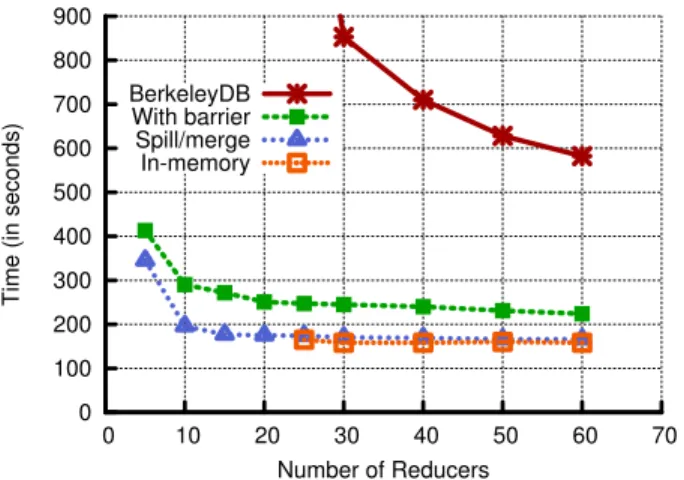
We compared the different memory management techniques described in Section 5. Figure 12 shows a plot of the job completion times for WordCount with and without a barrier, while varying the number of Reducers. The disk spill and merge scheme performed slightly worse than storing the par-tial results in memory. However, as the number of Reducers was decreased below 25, the in-memory technique resulted in an out of memory exception and the job was killed. The spill and merge technique continued to perform better than the original MapReduce. BerkeleyDB on the other hand, performed poorly on the WordCount. Even though we could observe about 30,000 inserts per second into the database, this was not enough throughput to keep up with the millions of small records handled at each Reducer. This result shows that off-the-shelf key/value stores may not be a suitable op-tion for MapReduce workloads.
Figure 13 shows a comparison with increasing dataset size. It can be seen that as the dataset increases, both the disk spill and merge, and the in-memory barrier-less versions, outperformed the original version. Again, the BerkeleyDB key/value store can not keep up with the high frequency of record accesses.
6.6 Programmer Effort
Table 2 summarizes the programmer effort required, in terms of lines of code, to convert the MapReduce applications into their barrier-less counterparts. The code for sorting in the
original case is very short due to the use of the Identity Map-per and the Identity Reducer, since the framework does the job of sorting. However, we had to add more functionality in the Reduce function of the barrier-less version. Word-Count, k-Nearest Neighbors and Post Processing required small changes to compute and update the partial results. For Black-Scholes and the genetic algorithm, the only change required was that a flag for barrier-less execution be turned on.
7 Related Work
MapReduce has been widely used for processing large data because of its simple model that is applicable to “embar-rassingly parallel” problems – such as log processing. Cur-rent research looks to push MapReduce by using it to solve harder problems. These include machine learning [8], sta-tistical machine translation [7] [12], optimization [24], fi-nance [6], and similarity scoring [13]. MapReduce is a log-ical choice because it allows the problems to be solved on a loosely coupled set of machines, with less effort than pro-ducing custom parallel processing code. However, MapReduce does not always give the most efficient parallel processing implementation. In this paper, we looked at the stage barrier in MapReduce and showed how breaking it may result in making MapReduce more efficient for general MapReduce problems.
We are not the first to investigate the transition between the Map and Reduce stages. In MapReduce Online [9], data is pushed by Mappers and merge-sorted by Reducers at a finer granularity. This has two main advantages. First, this effectively overlaps (pipelines) the stages, resulting in faster runtime. Our work can similarly benefit from such an op-timization. Second, this allows early partial results (snap-shots) to be computed to approximate the correct result. Each snapshot must be computed independently of others and fur-thermore, previous snapshots do not help in computing sub-sequent results. In contrast, by storing partial results we are able to decrease the time needed to compute the actual final result.
Similar techniques like incremental updates of materi-alized views [17], hash-based joins [11], etc. have been ex-plored by the parallel database community. However, such techniques can only be applied to a select group of opera-tors, while our technique can be applied to many arbitrary MapReduce programs. Also, MapReduce programs benefit from scalability and fault tolerance at the cost of some per-formance overhead as compared to parallel DBs. There is a considerable amount of debate on MapReduce vs paral-lel databases [23]. Pavlo et. al [21] perform a comparison of MapReduce and parallel databases for large scale data analysis and demonstrate the overhead of materializing the intermediate data in MapReduce.
0 100 200 300 400 500 600 700 800 900 0 10 20 30 40 50 60 70
Time (in seconds)
Number of Reducers BerkeleyDB
With barrier Spill/merge In-memory
Fig. 12: WordCount with different memory management techniques with increasing number of Reducers.
0 100 200 300 400 500 600 700 800 900 0 5 10 15 20 25
Time (in seconds)
Size of input data set (in GB) BerkeleyDB
With barrier Spill/merge In-memory
Fig. 13: WordCount with different memory management techniques with increasing dataset size.
Improving the efficiency of MapReduce has been of cent interest to the systems community. Much of the re-search presented has required changes to the MapReduce API [27]. Other work has aimed to be completely transpar-ent to the programmer [28]. Our work is a combination of both categories. We have preserved the baseline MapReduce API, while empowering the programmer to improve perfor-mance by relaxing assumptions in the Reduce function.
Dryad [18] is a distributed platform that has been de-veloped at Microsoft to provide large-scale, parallel, fault-tolerant execution of processing tasks. The techniques in this paper can likely be applied to break the barrier in a similar way to the MapReduce barrier. Because Dryad is a closed system, we were not able to make modifications to apply these techniques.
There has been recent interest in dealing with outliers in MapReduce clusters. The Longest Approximate Time to End (LATE) scheduling algorithm [28] was designed to pro-vide better performance in the face of outliers. The algo-rithm shows improved performance in virtualized, heteroge-neous clusters. The Mantri system [5] is also designed to tar-get MapReduce outliers to improve performance. The sys-tem uses real-time progress reports to detect outliers early in their lifetime, and takes corrective action depending on the cause of the outlier and the available resources in the cluster. While not the main goal, our barrier-less implementation is shown to reduce outliers and their effect on job completion time, in homogeneous conditions and under some types of heterogeneity.
8 Conclusion
This paper demonstrated that general purpose MapReduce frameworks without a barrier are feasible, and they can re-sult in significant performance benefits. By intelligently
man-aging memory and identifying which forms of Reduce func-tions see the most benefit, our experiments with Hadoop demonstrate speedups of up to 87% for well-suited applica-tions, and an average of 25% for more typical applications. This is because our barrier-less MapReduce framework al-lows the interleaving of network I/O and computation while keeping disk usage to a minimum. At the same time, our approach preserves the fault tolerance of the original Map-Reduce model, and has similar ease of programming. Our work opens up new avenues. Memoization, an optimization similar to DryadInc [22] becomes feasible in the barrier-less model.
References
1. Apache hadoop.http://hadoop.apache.org
2. Illinois Cloud Computing Testbed. http://cloud.cs. illinois.edu/
3. Mongodb.http://www.mongodb.org
4. Tokyo cabinet.http://1978th.net/tokyocabinet/ 5. Ananthanarayanan, G., Kandula, S., Greenberg, A., Stoica, I., Lu,
Y., Saha, B., Harris, E.: Reining in the outliers in map-reduce clus-ters using mantri. In: Proceedings of the 9th USENIX conference on Operating systems design and implementation, OSDI’10, pp. 1–16. USENIX Association, Berkeley, CA, USA (2010) 6. Black, F., Scholes, M.S.: The pricing of options and corporate
lia-bilities. Journal of Political Economy81(3), 637–54 (1973) 7. Brants, T., Popat, A.C., Xu, P., Och, F.J., Dean, J.: Large language
models in machine translation. In: Proc. of the Joint Conference on Empirical Methods in Natural Language Processing and Compu-tational Natural Language Learning (EMNLP-CoNLL), pp. 858– 867 (2007)
8. Chu, C., Kim, S., Lin, Y., Yu, Y., Bradski, G., Ng, A., Olukotun, K.: Map-reduce for machine learning on multicore. Advances in Neural Information Processing Systems (NIPS) pp. 281–288 (2007)
9. Condie, T., Conway, N., Alvaro, P., Hellerstein, Elmeleegy, K., Sears, R.: Online aggregation and continuous query support in mapreduce. In: NSDI’10: Seventh USENIX Symposium on Net-worked Systems Design and Implementation. USENIX Associa-tion, Berkeley, CA, USA (2010)
10. Dean, J., Ghemawat, S.: Mapreduce: Simplified data processing on large clusters. In: Proc. of the USENIX Symposium on Oper-ating Systems Design and Implementation (OSDI), pp. 137–149 (2004)
11. DeWitt, D., Gerber, R.: Multiprocessor hash-based join algo-rithms. In: Proc. of VLDB Conference. Citeseer (1985)
12. Dyer, C., Cordova, A., Mont, A., Lin, J.: Fast, easy, and cheap: construction of statistical machine translation models with map-reduce. In: Proc. of the Third Workshop on Statistical Machine Translation (StatMT), pp. 199–207. Association for Computa-tional Linguistics (2008)
13. Elsayed, T., Lin, J., Oard, D.W.: Pairwise document similarity in large collections with mapreduce. In: Proc. of the Annual Meeting of the Association for Computational Linguistics on Human Lan-guage Technologies (HLT), pp. 265–268. Association for Compu-tational Linguistics (2008)
14. Farivar, R., Verma, A., Chan, E., Campbell, R.: Mithra: Multi-ple data independent tasks on a heterogeneous resource archi-tecture. In: Proc. of IEEE International Conference on Cluster Computing and Workshops (CLUSTER), pp. 1–10 (2009). DOI 10.1109/CLUSTR.2009.5289201
15. Fix, E., Hodges, J.: Discriminatory analysis, nonparametric dis-crimination: Consistency properties. Tech. rep., USAF School of Aviation Medicine, Randolph Field, Texas (1951)
16. Guibas, L.J., Sedgewick, R.: A dichromatic framework for bal-anced trees. In: Proc. of Symposium on Foundations of Computer Science, pp. 8–21 (1978). DOI 10.1109/SFCS.1978.3
17. Gupta, A., Mumick, I.: Maintenance of materialized views: Prob-lems, techniques, and applications. Bulletin of the Technical Comm. on51, 3
18. Isard, M., Budiu, M., Yu, Y., Birrell, A., Fetterly, D.: Dryad: Dis-tributed data-parallel programs from sequential building blocks. In: Proc. of European Conference on Computer Systems (Eu-roSys), pp. 59–72 (2007)
19. Olson, M.A., Bostic, K., Seltzer, M.: Berkeley db. In: Proc. of the USENIX Annual Technical Conference (ATEC), pp. 43–43. USENIX Association (1999)
20. O’Malley, O., Murthy, A.C.: Winning a 60 second dash with a yellow elephant. http://sortbenchmark.org/ Yahoo2009.pdf(2009)
21. Pavlo, A., Paulson, E., Rasin, A., Abadi, D.J., Dewitt, D.J., Mad-den, S., Stonebraker, M.: A comparison of approaches to large-scale data analysis. In: Proc. of the ACM SIGMOD International Conference. ACM (2009). URL http://database.cs. brown.edu/sigmod09/benchmarks-sigmod09.pdf 22. Popa, L., Budiu, M., Yu, Y., Isard, M.: DryadInc: Reusing work in
large-scale computations. In: Proc. of Workshop on Hot Topics in Cloud Computing (HotCloud) (2009)
23. Stonebraker, M., Abadi, D., DeWitt, D., Madden, S., Paulson, E., Pavlo, A., Rasin, A.: MapReduce and parallel DBMSs: friends or foes? Communications of the ACM53(1), 64–71 (2010) 24. Verma, A., Llora, X., Goldberg, D.E., Campbell, R.H.: Scaling
ge-netic algorithms using mapreduce. In: Proc. of International Con-ference on Intelligent Systems Design and Applications (2009) 25. Verma, A., Zea, N., Cho, B., Gupta, I., Campbell, R.: Breaking the
MapReduce Stage Barrier. Proc. of IEEE International Conference on Cluster Computing (CLUSTER) pp. 235 –244 (2010) 26. White, T.: Hadoop: The Definitive Guide. O’Reilly Media, Inc.
(2009)
27. Yang, H., Dasdan, A., Hsiao, R., Parker, D.: Map-reduce-merge: simplified relational data processing on large clusters. Proc. of the 2007 ACM SIGMOD International conf. on Management of data (2007)
28. Zaharia, M., Konwinski, A., Joseph, A.D., Katz, R., Stoica, I.: Im-proving mapreduce performance in heterogeneous environments. In: Proc. of the USENIX Symposium on Operating Systems De-sign and Implementation (OSDI) (2008)
Acknowledgements We would like to thank the anonymous review-ers for their valuable feedback.