Working with objects
The OOram Software Engineering Method
Trygve Reenskaug
with P. Wold and O.A. Lehne
Document date: 29 March 1995 Last update on: 29 March 1995 at: 23:05
Printed on: 29 March 1995 at: 23:06
We dedicate this book to Douglas Engelbart because he made us understand that computers should be used to augment the human intellect
rather than to replace it, and because his deep understanding of the symbiosis between humans and information is still far ahead of the rest of
us.
This is a preprint. Do not copy. All rights reserved.
TASKON
Work EnvironmentsThere are two ways of constructing a software design:
-
One way is to make it so simple that there are
obviously no deficiencies
-
and the other way is to make it so complicated
that there are no obvious deficiencies.
-- C. A. R. Hoare
29 March 1995 23:05
Chapter 0
Preface
Goals
Real software for real users
The main theme of this book is to describe complex phenomena as structures of interacting objects. Object technology is applicable to a wide range of phenomena on many different levels. Examples are work procedures on the enterprise level; large-scale applications on the systems level; and small, technical details on the program design level.
The goals of the book are
1. To provide a comprehensive description of the object paradigm and its applications
2. To show how it supports a number of different views on the same model; permitting the analyst to work with a data-centered approach, a process-centered approach, or a combination of the two.
3. To show how very large and complex systems can be described by a number of distinct models.
To show how composite models can be derived from simpler base models.
4.
To describe a number of powerful reuse techniques. 5.
6. To describe how a systematic policy of reuse impacts work processes and organization.
To show how very large systems can be described and managed in a decentralized manner without central control.
7.
Motivation
A number of important books on object-oriented analysis and design have been published in recent years. The most influential are probably [Cox 87], [Wirfs-Brock 90], [Booch 94], [Rumbaugh 91], and
Motivation 29 March 1995 23:05
[Jacobson 92]. All these methodologies are based on the object as the common building block and on the class as a common abstraction on the objects.
There is a widespread feeling that the methodologies could profitably be merged into a single one, and that the concepts and notation of the composite methodology could be standardized. We feel that such standardization will be premature. Objects and classes represent two different levels of abstraction; each is suited to the expression of certain properties. Static properties and relations are best expressed in terms of classes. Examples are attributes and relations; most notably for expressing the inheritance relation. Dynamic properties are best expressed in terms of objects. Examples are message interactions (scenarios), use cases, and data flows.
The class/object duality is as essential to object oriented programming as it is disruptive to object oriented modeling. A future modeling standard should be built on a unified conceptual framework with sufficient expressive power to describe all interesting aspects of an object system within a single, integrated model.
One candidate is the OOram role model. This conceptual framework combines the expressiveness of the object and the class. All
information that can be expressed in a class-based model can be expressed in a role model. All information that can be expressed in an object-based model can be be expressed in the same role model. Furthermore, there is a synergy effect from merging the class and object properties into one and the same model. The result is increased leverage for the decomposition of large systems and for the systematic reuse of proven components.
The essence of the object-oriented paradigm is the modeling of interesting phenomena as a structure of interacting objects. The architecture of a home can be represented as a structure of room objects interconnected with doors and hallways. A model which says that a room may be adjacent to another room is insufficient. We need to be able to say that the dining room shall be adjacent to the kitchen; and that the childrens' playroom shall be far away from the master bedroom.
In an OOram role model, patterns of interacting objects are abstracted into a corresponding pattern of interacting roles. In our simple
example, one object will play the role of dining room, another the role of kitchen, etc. The roles are interconnected to represent the layout of
Motivation 29 March 1995 23:05
the home. The corresponding objects will belong to the same class if they have the same properties; they will belong to different classes if they have different properties. The role model abstraction belongs to the realm of modeling. The class abstraction belongs to the realm of implementation.
An object can play several roles. This permits a systematic separation
of concern by describing different phenomena in different role models. And conversely, it permits the synthesis of a derived model
by letting its objects play several roles from different role models.
This book is about the added leverage provided by role modeling as opposed to the conventional class modeling. The nature of this leverage is listed under the heading of Goals above. The added leverage motivates our introduction of a new and precisely defined set of concepts and a new notation -- it motivates this book.
Audience
Familiarity with computers assumed
We assume that you are familiar with how computers and computer programming influence modern information processing, but do not assume familiarity with a particular programming language or operating system. Most of the book is written for the manager and person of business who is searching for new and better ways to produce software, for the consultant who wants to use objects to design new business organizations, and for the system creator who wants to understand how to exploit the full power of object
orientation. A few chapters are clearly marked as being directed to the expert computer programmer.
The structure of this book
This book is written to be read in sequence, but we suggest you skip chapters which look uninteresting on your first reading. It is organized in twelve chapters as follows:
A reader's guide to this book
29 March 1995 23:05 The structure of this book
1. The main ideas. An introduction to industrial software
production, object orientation and the OOram method providing an intuitive understanding of the main ideas. We recommend that you study this chapter before embarking on the more detailed expositions in the remainder of the book. It should help you to recognize what objects can do for you and help you to set your goals.
Role Modeling. How to create object-oriented models of
interesting phenomena. This chapter should help you create your first models and establish your work processes for analysis and design.
2.
Role model synthesis. How to create derived models from simpler
ones. Read this chapter to understand how you can divide your problem space and still conquer the whole. If your systems are on a large scale, this chapter should help you tackle them. But be warned; you will need to collect a solid body of experience before you can reasonably expect to establish a successful reuse
operation. 3.
Bridge to implementation. How to specify objects for
implementation in different languages, how to implement the specifications, how to check the implementation against the specification, and how to analyze an existing implementation to create one or more role models describing it. This chapter ties the concepts of the OOram technology to the concepts of two popular programming languages, Smalltalk and C++. This may be the chapter which makes the OOram technology real to you if you are a programmer. If you are not, you may safely ignore the whole chapter.
4.
5. Creating reusable components. How to create reusable
components by exploiting the object inheritance properties. You cannot reuse something before you have used it. There is no snake oil that will magically give you the benefits of reuse; but we present guidelines that will help the serious practitioner gradually build a library of reusable components. Once you master the technology of synthesis, you search for reusable components which transform your large and complex projects into small and manageable ones.
Additional role modeling concepts and notation. Presents
additional role model views that have proven to be useful in certain circumstances.
6.
The structure of this book 29 March 1995 23:05
7. Case study: Development of a business information system.
Stresses the work processes and the relationships between three important models: a model of the system environment, an information model, and a task/tool/service model.
Case study: The analysis and design of a real time system. The
case stresses embedded systems with their behavioral aspects described with Finite State Machines. It also exemplifies a number of different approaches to the implementation. 8.
Case study: The creation of a framework. Describes the creation
of a fairly large framework supporting reuse. The study describes all stages in the creation of the framework, including reverse engineering of existing systems and forward engineering of the new framework.
9.
Organizing for software productivity. Describes how to design a
work organization in the form of a value chain; and how to select appropriate technology for the different layers. This chapter indicates the structure of a future software industry, and is written for readers who are serious about the large-scale provision of customized software. It offers the greatest challenges and promises the biggest rewards. It advises you to reconsider your whole software business, to look for repeating questions which can exploit reusable answers, and to move from a job shop organization to an industrial one.
10.
11. Advanced reuse based on object instances. This chapter is written for the specially interested reader. We describe how you can compose a system from a pool of predefined objects. This technology is an extension of the OOram role modeling technology that is the technology basis of the first part of the book. It is not as mature, but it can become an important supplement to the OOram role modeling technologies.
12. Case study: Intelligent Network Services Organized in a Value
Chain. Exemplifies a complete software industry. Specifies a
complete value chain with the actors and appropriate technology for each layer. The study shows how all the different reuse technologies have a place in a complete value chain.
The structure of this book 29 March 1995 23:05
Using this book
This book helps you get started on industrializing your software production.
The book describes the principles behind an industrial approach to software production. We claim that the technological basis of industrial software production should be object orientation. A large part of the book is devoted to explaining all the different things you can do with objects; we will also match the different operations on objects to the needs of typical value chains for software production.
No viable industry was ever established on an ad hoc basis. Object orientation and industrial production of software are not some kind of magic that will produce immediate results in your next software project. You must identify your potential customers and fully understand their current and future needs. You must identify the complete value chain, and carefully consider your place in that chain. You must devise optimal technologies and production facilities for every step in the chain. You must establish the required infrastructure for supporting the process, and staff the production facilities with people trained for their tasks. This book can help you getting started, but it is only your own long term dedication and investment in time and resources that can lead you to the goal.
The software industry is still in its infancy, and it will take many years to establish an effective industrial infrastructure. We therefore
recommend a gradual transition from the miserable present to the glorious future. The winners will be the companies with a clear vision, an effective strategy, and the stamina needed to transform their operations from the general job shop to the industrial enterprise.
Gradual transition to full industrialization required
Figure 0.1 illustrates our recommended progression through objects and the OOram method. We have indicated that the first step should be to implement systems with objects. If you are a programmer, this means that you should start by writing small, object-oriented
programs. If you are a developer of enterprise processes, you should create some simple processes in object-oriented terms. This first step is shown dashed, because object-oriented programming is not the focus of this book. The remaining steps indicate our recommended progression into the rich world of objects.
29 March 1995 23:05 Using this book
Creating reusable components (Chapter 5)
Role model analysis and design (Chapter 2 )
Combining role models through synthesis (Chapter 3)
Organizing for software productivity (Chapter 10)
Object-oriented implementation
Establishing a software factory (Chapters 10, 11, and 12) Figure 0.1 Stages in
the application of the OOram method
Taskon invites cooperation
It is our hope that this book will cause the wide spread adoption of the OOram method. Taskon markets OOram processes, tools and
consultancy services for a number of application areas. We invite consultants to build special methodologies based on our products; we invite other vendors to create competing products; we invite potential competitors to cooperate with us to ensure interoperability between the products to the benefit of all.
Background
The book is based on continuous experience with objects since 1975 and practical experience in the borderland between software
engineering research and the production of software for computer aided design, production control, management information systems, and telecommunications since 1960. In all our work, the goal has been to create industrial strength software for real users. The software engineering methodologies and tools have been created in response to our own needs and to the needs of our partners, and the success criterion has been that they enabled us to support our clients more effectively.
Our experience has clearly shown that object orientation is a powerful paradigm which is applicable to a wide range of problem areas. We have used it to design improved organizations in oil companies; to describe basic, reusable services in a distributed environment; to design client-server systems; and to specify and implement business information systems.
Object orientation is a powerful paradigm
29 March 1995 23:05 Background
Our most exciting experiences are with systematic reuse and an industrial approach to software production. This enables us to produce large systems in small projects, which we believe is the key to the effective production of quality software.
Large systems, small projects
Different methodologies for different problems
Our accumulated experience also leads to a negative conclusion: There is no silver bullet that will miraculously solve all problems. The work process, the organization and the technology has to be adapted to the problem at hand and the people who are to solve it. We do therefore not have the audacity to present a complete methodology which will solve all problems. We rather present a foundation which can support many different methodologies for different purposes, we call it the OOram method.
Acknowledgments
The senior author has written most of the words you find in this book, and when the pronoun "I" is used, it refers to the senior author. Per Wold has been an essential partner, posing important questions and by suggesting appropriate answers throughout the creation process. Odd Arild Lehne has brought his extensive teaching and consulting
experience to bear on the book's structure, examples, and case studies.
Jørn Andersen, Lasse Bjerde, Jon Ola Hove, Eirik Næss-Ulset, and Carl Petter Swensson have been members of the Taskon book committee. The patience and perseverance they have shown by reading and rereading a steady stream of drafts and their help in shaping the form and contents of the various chapters of the book cannot be overestimated.
The development of the OOram method has taken place at the Center for industrial research (SI) in Oslo, at Taskon AS and at the
University of Oslo. We regard a good development team as a team where ideas and results flow freely, and where the success of the whole team is the only measure of the success of the individual team member. We have always had a very good team, and the results presented in this book have been contributed by a great number of dedicated people over the past 20 years. It is impossible, in retrospect, to identify the individual contributions or even contributors, and we thank them all.
29 March 1995 23:05 Acknowledgments
Our research in the field of applied object-orientation would have died at certain critical times in the late seventies without the
wholehearted support by Bjørn Ørjansen, then director of research at SI. Important work on an object-oriented planning and control system was supported by the Aker Group in the early seventies as part of our long cooperation about the Autokon system for the computer-aided design of ships.
The Royal Norwegian Council for Industrial and Scientific Research has given support through several grants: Grants for the porting of Smalltalk-78 to local equipment and for creating the first Norwegian Ethernet in 1980; for the research that lead to first prototypes of our present range of products in the research and development program
Efficiency and Quality in Engineering; and for our work with an
object-oriented architecture for very large, heterogeneous systems in the Eureka Software Factory Project.
I had the good fortune to spend a year as visiting scientist with Alan Kay, Adele Goldberg and the Smalltalk group at the Xerox Palo Alto Research Center (PARC) in 1978/79. This was a wonderful
experience which completely changed my life, and it is impossible to fully express my gratitude for the help and inspiration I received. I particularly want to thank Adele for the support and interesting discussions that lead to the creation of the first version of the Model-View-Controller; this was probably the world's first reusable, object-oriented framework. After this visit, we got a license to port
Smalltalk-78 to local equipment in Norway. This port was excellently performed by Bruce Horn, who was then a student at PARC. My colleagues and I are eternally grateful to Bruce and Xerox for giving us early experience with the world's most exciting programming environment. We are also very grateful to Bruce for permitting us to publish his work on user interface design which you will find in chapter 7.3.2.
We are strong believers in the axiom that programmers should take their own medicine. The authors and all members of Taskon team are heavy users of our methodologies and tools, and this book is written with our OOram documentation tools. Our own use supplies a steady stream of ideas for improvements, but feedback from other users is also crucial: They solve different problems and have different ideas about what the methodologies should do for them. We therefore thank our customers and other users of the OOram method for constructive criticisms and ideas for improvements.
Acknowledgments 29 March 1995 23:05
Our application of the OOram method to the field of
telecommunications would have been impossible without the initiative of Raymond Nilsen of Norwegian Telecom Research. We thank him, Tom Handegård, Klaus Gaarder, Bengt Jensen and their colleagues for having taught us what we know about
telecommunications and for a number of stimulating discussions in a creative atmosphere. We also thank Dag Brenna and Martha
Haraldsen of Garex A/S, who have given valuable feedback on the application of the OOram technology to the large-scale production of customized communication systems.
We express our sincere thanks to Arne-Jørgen Berre for comparing the OOram method to the currently popular methodologies for object-oriented analysis and design, and for providing important insights into the world of distributed computing. We are also grateful to Espen Frimann Koren, Magnus Rygh, and John Lakos for their preparation and discussion of the programming examples in C++. Stein Krogdahl has helped create the the OOram language presented in Appendix A, but does not want to be responsible for this first version of the language.
A number of people have contributed their time and expertise to reviewing parts or all of this book. We would like to express our sincere thanks to Ralph Johnson, Doug Berrett, Mats Gustafsson, Geir Høydalsvik, Else Nordhagen, Witold Sitek, Anne-Lise Skaar, Gerhard Skagestein, Pål Stenslet, Michael Thurell, and the anonymous
reviewers who have all contributed valuable and insightful comments.
Finally, I would like to express my sincere thanks to a programmer and systems analyst who has been providing inspiration, unfaltering support and valuable advice all through the past 40 years: my wife Oddbjørg Råd Reenskaug.
OOram is a registered trade mark of Taskon A/S.
ObjectsWorks\Smalltalk is a registered trademark of ParcPlace Systems, Inc. LEGO is a registered trademark of the LEGO Group. DecWindows is a registered trademark of Digital Equipment Corporation. Ole is a registered trademark of Microsoft Inc.
Acknowledgments 29 March 1995 23:05
Chapter 1
The main ideas
This chapter gives an overview of object orientation as it is exploited by the OOram method and of our general ideas about organizing software production in value chains.
We recommend that you read this chapter before embarking on the details in the remainder of the book.
The OOram method (p. 12??)
The problem and the three dimensions of the OOram solution
The Technology Dimension (p. 17??)
Representing the real world as objects The powerful role model abstraction
Separation of concern and Role model Synthesis
OOram implementation links role models to computer programs OOram reuse technology
Comparison with other methods
Process and deliverables (p.41??)
Introduction to the model-building processes Introduction to the system development processes Introduction to the reusable assets building processes
Organization (p. 48??)
Industrial software production The value chain
The OOram fountain model
The urgent need for effective metrics 29 March 1995 23:05
The OOram method
1.1
In a nutshell
In the software engineering community, a methodology usually denotes an approach to accomplish a task. We find it convenient to study methodologies in three dimensions: a technology dimension describing the concepts, notation, and tools; a
process dimension describing the steps to be performed (mainly in parallel) together
with the deliverables from each step; and an organization dimension describing the organization for effective software development.
The OOram idea is that there is no single, ideal methodology. We need different methodologies for different purposes; each tailored to a specific combination of product, people, and information environment.
The OOram method is generic: it forms a framework for creating a variety of methodologies. They will all build on selected parts of the OOram technology; and will have their own, unique processes and organization. We stress the common technology in this book, but we will also discuss aspects of the other two
dimensions in order to help you create your own methodology that is optimized for your requirements.
The "software crisis" was first officially recognized at the NATO Conference on Software Engineering in Garmisch, Germany in 1968. The conference identified the problem and started a discussion about its solution. Much has been achieved in the intervening period, but requirements have grown at least as fast as our ability to satisfy them. Today, more than twenty-five years and many "solutions" after the Garmisch conference, we still have a software crisis and we are still searching for better solutions.
The software crisis
The latest solution to catch the fancy of system developers is the technology based on the object paradigm. The first object-oriented programming language, Simula, was developed in Norway in the sixities. The field got a tremendous boost when the Smalltalk language and development system became available in the early eighties. The introduction of the C++ programming language made object orientation generally acceptable to the systems programming community. (FOOTNOTE: See [Birth 73], [Gold 83]), and [Strou 86])
Object-oriented methods are the latest "solution"
Books on methodologies for object-oriented analysis and design appeared in the late eighties. The different authors started out with different approaches to the common theme of describing interesting things with objects. Cox, Booch, and Wirfs-Brock based their work on the concepts of object-oriented programming languages. Rumbaugh
1.1 The OOram method 29 March 1995 23:05
and Jacobson started from earlier modeling paradigms; Rumbaugh from a data-centered approach and Jacobson from a function-centered approach.
(FOOTNOTE: See [Cox 87], [Booch 91], [Wirfs-Brock 90], [Rumbaugh 91], and [Jacobson 92].)
Object technology has moved from the exotic to the feasible. It is now rapidly moving from the feasible into the mainstream of systems development.
The reason for the popularity of objects is easy to see. We have earlier been using a number of different modeling paradigms to describe different aspects of our systems. The data-centered approaches, e.g., Entity-Relation modeling, were excellent for modeling the static properties of information; but they were weak for modeling functionality. The behavior-centered approaches, e.g., functional decomposition or finite state machines, were great for modeling the dynamics of the system; but they were weak on the modeling of data.
A powerful paradigm merging many earlier concepts
The advantage of the object-oriented paradigm is that it neatly
combines the strengths of the data-centered and the behavior-centered approaches. It is great for modeling information and it is great for modeling behavior.
Like all previous solutions, object orientation is no panacea. It is still easy to create lousy systems and hard to create good ones. Objects offer no more and no less than an opportunity for mastering even harder problems than we have been able to master in the past.
BOX: Methodology and method.
In normal usage, a method is an approach to accomplishing a task, and a
methodology is the study of a family of methods. Within the software community,
the term methodology usually denotes an approach to accomplishing a task. We have therefore taken the liberty to let the OOram method denote our strategy and technology for the creation of a family of methodologies for different purposes.
Within the software community, a methodology is taken to mean an approach to accomplishing a task. (See box.) We do not believe that we will ever find an ideal methodology that will serve all purposes equally well. On the contrary, we believe that a methodology not only has to be optimized for its goals; it should also be tailored to suit the culture, competence and preferences of its people. It is therefore not possible to create an overall methodology which covers all needs. But we do give guidelines, examples, and case studies that may be helpful when you create your own solutions to your problems in software creation; in model and software reuse; or in setting up an organization for the large-scale provision of customized software.
The OOram method is a frame of reference
1.1 The OOram method 29 March 1995 23:05
The OOram method is a frame of reference for a family of object-oriented methodologies. It captures the essence of object orientation, which is to model interesting phenomena as a structure of interacting
objects. It offers the role model as a powerful abstraction that
supports a very general separation of concern. The notion of role
model synthesis supports the construction of complex models from
simpler ones in a safe and controlled manner, and offers many opportunities for the systematic application of reusable components.
Process
with Deliverables
Technology
(Concepts-Notation-Tools)
Organization
(Value Chain)
Impl. Des. Req. User
Real World
Reuse Technology
Objects Roles Implement-ation Figure 1.1 Three
dimensions of system development methodologies
A methodology has technology, process, and organization
A methodology is usually considered to consist of the three main dimensions illustrated in figure 1.1. The OOram method opens for important improvements along all three dimensions:
Technology consists of the concepts, notation, techniques and
tools used to describe phenomena of all kinds and sizes in terms of objects. Reuse Technology offers a range of opportunities for materially reducing the size and complexity of application development projects through the systematic reuse of proven components.
1.
Process with Deliverables. The steps to be performed and the
results to be delivered from each step. Our capability for working with several models permit us to gradually zoom in on the system from its environment to its inner details in a controlled manner. 2.
29 March 1995 23:05 1.1 The OOram method
Organization. How the enterprise is organized to accommodate
the operation. The OOram reuse technology permits the creation of industrial strength organizations for the systematic investment in reusable components and their routine application in
development projects. 3.
A wide range of methodologies for a wide range of problems can be based on the OOram method. In the later chapters of this book, we will describe how OOram supports different methodologies covering the technical, organizational, and process dimensions. Our main concern will be the technical dimension because it is common to all methodologies and a prerequisite to our proposed solutions for different processes and organizations.
The OOram method widely applicable
The OOram method traces its history to the early seventies. One of its first applications was an object-oriented shipyard production control system [Ree 77]. The Smalltalk Model-View-Controller paradigm is another application of the OOram ideas; the senior author developed the first version in association with Adele Goldberg at Xerox Palo Alto Research Center (PARC) in 1979/80.
The OOram method based on 20 years of experience.
Driving force is the need for professional software engineering.
The driving force behind the development of the OOram method has been our own need for professional software engineering
methodologies. Concepts, notations, and tools have been developed concurrently, because modeling concepts and notation are maximally effective when they can be supported by current workstation
technology. The success criteria are:
1. The combination of concepts, notations, and tools shall help a team of developers cooperate in the development and
maintenance of large object-oriented systems in a way that ensures high reliability, efficiency, and stability.
The reuse of ideas, designs, and code shall be maximized for the efficient development of a large family of related systems. 2.
OOram is practical, sound and useful with or without tools
These success criteria are strongly utilitarian, leverage provided by tools is as important as the theoretical soundness of the technology. In particular:
29 March 1995 23:05 1.1 The OOram method
Diagrams and tables must be informative and fit on a computer screen. We have developed the OOram method and the OOram tools concurrently, and rarely use the one without the other. Other people have successfully used the OOram method without the tools. We therefore claim that the concepts and notation are suitable for manual as well as computer assisted modes of working.
1.
2. Software is created by people, and quality software is created by people of quality. Methods and tools cannot be a substitute for quality people; the best we can hope for is that they will be of assistance to quality people who will adapt them to their needs and use them with discretion.
3. Methods and tools must scale. Practical programs are often several orders of magnitude larger and more complex than typical textbook examples. Scaleability and practicability are critical to the success of software engineering methods and tools. The OOram method and tools have been created to help real people solve real problems. The goal of this book is to share our experiences with you in the hope that they will help you solve
your problems in your environment.
29 March 1995 23:05 1.1 The OOram method
1.2 The Technology Dimension
In a nutshell
This dimension covers the concepts that form the basis of the work; the notation used for documentation; and the tools. Figure 1.1 illustrates the main ideas: We
select a bounded part of the real world as a phenomenon to be the subject of our
study. We choose to model the phenomenon as a structure of objects in an object model; where we distinguish between system objects and environment objects. Patterns of objects in the object model are abstracted into role models. A role model describes how a structure of objects achieves a given area of concern by playing appropriate roles. Finally, classes are defined in the implementation so that their instances play a specified set of roles.
The phenomena to be described can be of any kind and any size. The technology must be selected to suit the problem; we cannot expect that the same concepts shall be equally relevant to all problems.
Object technology offers several opportunities for reuse, we will discuss five of them in this book. These technologies do not in any way guarantee reuse, but they give the production engineer the freedom to select the appropriate technology for each layer in the value chain mentioned above.
Our first object application: An enterprise model for ship design
Object technology is pervasive, it can be used for almost anything. We first applied it to modeling ship design processes on the enterprise level, (FOOTNOTE: [Ree 73].) when we introduced coordinated computer support for the different stages in the design process. Controlling computer-based information transfer between project stages and company divisions proved to be a serious problem, and we used objects to model the flow of information and the dependencies between divisions.
We next applied objects to shipyard scheduling and control. (FOOTNOTE: [Ree 77]) The yard was a heavy user of an activity planning system, but it also needed a number of specialized systems for scheduling dockside jobs, for scheduling the use of the big crane, and for scheduling a panel assembly line. Our idea was to replace all of their disparate systems with a single, object-oriented scheduling and control system. We represented the ship as an object, its parts as objects, the construction jobs were represented as objects. We also represented the yard, its production facilities such as dockside facilities, the big crane and the panel assembly line as objects. The objects are illustrated in figure 1.2.
Our second object application: Shipyard scheduling
29 March 1995 23:05 1.2 The Technology Dimension
The concepts and notation of the OOram technology is common to all OOram methodologies. A specific methodology will use a selected subset, and any selection will be consistent and workable. We will here give a brief taste of its main features. You will find the complete description of the OOram technology in the main body of the book. The description is like a large salad bar; it is up to you to select the dishes you want and to ignore those that you do not like or need.
OOram technology common to all OOram methodologies
Representing the real world as objects
1.2.1
We think of the shipyard in terms of objects as illustrated informally in figure 1.2. The planning and control functionality is represented by the system dynamics: the objects interact according to a master strategy in order to produce the desired results.
All objects have certain general behavior that enable them to
participate in the interaction. Each job object tries to get scheduled at the best possible time; each resource object strives for optimal utilization of its resource. But the objects also behave according to their specific nature: the big crane can handle only one ship's part at a time; the dockside facilities allocate available area to as many parts as possible; the panel assembly line object maintains the constraint that two large panels can not be adjacent on the line.
Object representing the shipyard facilities Object representing
the shipyard
Object representing a ship's part Object representing
a ship
Object representing a resource Object representing
a construction job Object representing a construction schedule Figure 1.2 Some
objects relevant to the shipyard scheduling and control operation
29 March 1995 23:05 1.2 The Technology Dimension
1.2.2 The powerful role model abstraction
The total system consists of a very large number of objects, and the object interaction processes needed to create and maintain a schedule will be very complex. We clearly need some form of abstraction so that we can focus on one portion of the total problem at the time.
The OOram method tells us to isolate an area of concern and to create a role model for it. One possible area of concern is the job scheduling activity. A simple algorithm, activity network
frontloading, schedules all jobs as early as possible. An example
network of participating objects is shown in figure 1.3. Given that job A can start in week 5, the algorithm determines that job F, the final job, can be completed in week 24.
(FOOTNOTE: The common terminology is to say that an activity
network is a structure of activities. We use the the term job instead of
activity, because we use activity for another purpose.)
Job-F 20 (4) 24
Job-E 13 (7) 20
Job-D 13 (3) 16
Job-C 8 (5) 13
Job-B 8 (4) 12
Job-A 5 (3) 8
Duration Completion time
Start time
Figure 1.3 An activity network
The frontloading algorithm states that all jobs are characterized by their duration, their predecessor jobs and their successor jobs. A job can start as soon as all its predecessors are completed; and no successor can start before this job is completed.
A job can start when all predecessors are completed
The start job, Job-A, can start in week 5; it takes 3 weeks and is completed in week 8. Job-B can start when Job-A is completed; it takes 4 weeks and completes in week 12. Job-D can start when both Job-B and Job-C are completed; its starts in week 13, takes 3 weeks, and completes in week 16. The project is completed when the end job, Job-F, completes in week 24.
29 March 1995 23:05 1.2 The Technology Dimension
Successor
Job
Job-D 13 (3) 16
Predecessor
Job-B 8 (4) 12
Job-A 5 (3) 8
CompletionTime messages early_completion early_startduration
early_completion Figure 1.4
Identifying an object pattern
The class abstraction does not help us understand the essence of the network in figure 1.3 All Jobs could in fact be instances of the same class. It is better to identify a pattern of objects which together capture an interesting phenomenon. In figure 1.4, we have focused on Job-E and isolated the object pattern consisting of Job-E, its predecessors (just one, Job-C in this case), and its successors (Job-F).
Object patterns abstracted into role models
The object pattern is abstracted into a corresponding role model, where each pattern object is mapped on to a corresponding role. In our example, we see that this is a recurring pattern, and that any network can be constructed as a repeated overlay of these roles. (FOOTNOTE: Overlaying role models will be discussed in the next section on synthesis.)
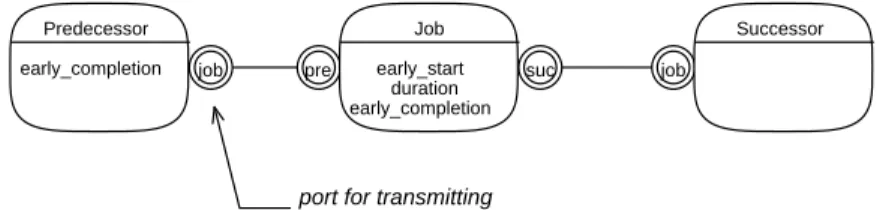
The role model captures an archetypical pattern of objects and permits us to study its essential static and dynamic properties. A Predecessor role has one interesting attribute: its early_completion time. The Job role has three interesting attributes: Its early_start time, its duration, and its early_completion time.
The OOram method supports a number of different views on the role model; each view highlighting some aspects of the model and hiding others. For example, figure 1.5 is a role model collaboration view. This view shows the roles, their attributes, and their collaboration structure.
The role model provides a more fine-grained control of message passing than the more common class or type. The role model specifies not only the messages that must be understood by an object (role), but also who are allowed to send the different messages. The
collaboration view may optionally show some or all the messages that one role may send to another, or the message interfaces can be
presented in an interface view.
29 March 1995 23:05 1.2 The Technology Dimension
Figure 1.5 The essential roles for understanding the frontloading scheduling algorithm
job pre suc job
Predecessor
early_completion
Job
early_start duration early_completion
Successor
port for transmitting messages to collaborator
The frontloading activity is specified as a sequence of messages flowing through the role model as shown in the scenario view of figure 1.6. The Predecessor objects send a message, CompletionTime, to the Job role. The Job computes its own early_completion, and reports it to all its Successor roles.
Predecessor Job Successor
CompletionTime
CompletionTime
Figure 1.6 Message scenario illustrating frontloading activity
If we open the Job role, we can study what takes place when it receives CompletionTime messages. This is illustrated in the method
view of figure 1.7 We see that the method is triggered when the Job
role receives the CompletionTime message. The method computes its own early_completion when all predecessors are ready, and the method finally reports the Job's completion time to its Successors.
Figure 1.7 Frontloading method in Job role
Job Successor
CompletionTime
<Wait for all predecessor early_completion times>
<Record own early_start as latest predecessor completion>
<Determine early_completion>
<Report to all successors> CompletionTime
The notion of role modeling is a very powerful concept. We have created a single role model, the three diagrams are different views on one and the same model. The message received in figure 1.7 is the same as the first message in the scenario of figure 1.6. The message is sent through the left port of figure 1.5, and we could have annotated the ports with the messages that can legally be sent through them.
29 March 1995 23:05 1.2 The Technology Dimension
1.2.3 Separation of concern and Role model Synthesis
Divide and conquer is an important concept in all modeling practices.
In the previous section, we created a role model for an interesting phenomenon, namely network frontloading.
The frontloading algorithm is just one of the many concerns that are relevant to shipyard scheduling and control. Another area of concern is the allocation of resources to the different jobs. A possible role model is shown in figure 1.8. The corresponding scenario is shown in figure 1.9; where the Job asks the Resource to allocate it, and the Resource answers the reserved time period.
Divide and conquer
Figure 1.8 Collaborators for basic resource allocation
res
job Job
planned_start default_duration planned_completion
Resource
reservations
Job Resource
allocate The resource returns the reserved time slot
Figure 1.9 Scenario for basic resource allocation
29 March 1995 23:05 1.2 The Technology Dimension
The advantage of this separation of concern is that we get manageable models. The disadvantage is that it can lead to a
fragmented description of large problems, since each model describes only a limited aspect of the total problem. We meet this fragmentation problem with role model synthesis, where we construct derived role
models whose objects play multiple roles from several base role models.
Role model synthesis is one of the most powerful features of the
OOram role model. All object oriented methods support class
inheritance, where a derived class can be defined to inherit attributes and behavior from one or more base classes. In the OOram method, inheritance is lifted to the model level so that a derived model inherits the static and dynamic properties of one or more base models.
Synthesis: Objects play multiple roles
BOX: Synthesis
The antonym of analysis is synthesis, and we use the term role model synthesis to denote the construction of a derived model from one or more base models in a controlled manner:
synthesis: 1a: the composition or combination of parts or elements so as to form a
whole... 1c: the combination of often diverse conceptions into a coherent whole.
[Webster 77].
The use of role model synthesis permits us to build complex models out of simple ones in a safe and controlled manner. Dr. Philip
Dellaferra of the Deutsche Telekom Research Center first introduced the "hat stand synthesis model" of figure 1.10. This figure, which illustrates scheduling with resources, highlights two important aspects of synthesis. First, role models are combined vertically by letting their objects play multiple roles. Second, the integration between role models is through the methods that objects use to process incoming messages.
Resource allocation Role Model
Network frontloading Role Model
Job-F Job-E
Job-C
Resource Role
Job Role Job Role
Predecessor Role
Successor Role
a Resource
Figure 1.10 Synthesis specifies that objects play several roles in a coordinated manner
Role model synthesis gets its leverage from always seeing inheritance in the context of a "complete" pattern of collaborating objects. We
29 March 1995 23:05 1.2 The Technology Dimension
therefore inherit not only the characteristics of individual objects, but also the structure and behavior of the model as a whole. Figure 1.11 illustrates the two synthesis operations needed to derive a composite scheduling model from the frontloading and the resource allocation models.
Figure 1.11 Derived scheduling model synthesized from two base models
suc job
res
job
suc job
res
job job pre
job pre
Job
Resource
Predecessor Job Successor
Predecessor Job Successor
Resource
Frontloading model
Resource allocation model
Derived (composite) model
The dependencies between synthesized role models are expressed in the methods of the objects. The behavior of an object when receiving a message in the context of a role in one role model may be modified because it is also playing some other role. In figure 1.12, the method for computing early completion time has been modified from just adding the duration to asking the resource for allocation.
Methods synthesize behavior
29 March 1995 23:05 1.2 The Technology Dimension
Figure 1.12 Integration through scheduling method
Job Successor Resource
CompletionTime
<Wait for all predecessor early_completion times> <Record own early_start as latest predecessor completion>
<Determine early_completion> allocate
^reservation
<Report to all successors> CompletionTime
The Job determines its completion time through Resource allocation.
The role models are integrated through the Allocate message to the Resource role.
In the ideal case, the correct functioning of a base model will automatically be retained in a derived model after synthesis. Such
safe synthesis is very valuable, since it permits the reuse of a correct
role model with a minimum of hassle. Indeed, if we think of a role model that is solely created by the safe synthesis from a number of correct base models, we would create it only if we needed it for explanation purposes.
Safe synthesis is essential for designing a truly global data processing system. Ideally, we should not need to construct the overall system model with all its details. An overall model should be expressed in terms of high-level base models; a high-level base model in terms of low-level base models. Every base model should be independent in the sense that its correctness will be preserved if it is applied with safe synthesis.
Safe synthesis
In unsafe synthesis, the derived model has to be analyzed in total before we can assume it to be correct. You might believe that unsafe synthesis is something to be avoided like the plague, but we find it useful when we analyze some limited phenomenon in order to
understand it and communicate our findings. (Even if synthesizing the resource model into a wider context were unsafe, doing so could still help us create a derived model to understand the phenomenon. But we would have to recheck the complete derived model). In general, we permit unsafe synthesis when we analyze a relatively limited area of concern. Safe synthesis is required when we want to create models that can be reused in a general context.
Unsafe synthesis
29 March 1995 23:05 1.2 The Technology Dimension
Hierarchical decomposition is a commonly used device for dividing a complex problem into a number of simpler ones. Hierarchical
decomposition is easily achieved in object systems by means of the encapsulation property. An object can contain any amount of complexity within itself, including a complex object structure, without exposing this complexity. But there is also a weakness with hierarchical decomposition: true hierarchies are rarely found in the real world.
Synthesis, a very powerful notion
Role model synthesis is a powerful notion because it facilitates the decomposition of large problems in arbitrary structures. The resource model of figure 1.8 can in one sense be regarded as subordinate to the frontloading model of figure 1.5. But the resources are primary phenomena if we study the shipyard as such, and in this context the jobs may be seen as subordinate to the resources. Other superimposed structures abound in a typical enterprise. Examples are project
organizations, professional structures and various ad hoc structures. If these structures are independent, all is well. If they are dependent, role model synthesis enables us to model the dependencies between them.
OOram implementation links role models to computer
programs
1.2.4
In a nutshell
This section has been written for computer programmers who are familiar with an object-oriented programming language. Nonprogrammers may safely skip it.
Any role model can be promoted to an object specification. Real world models may be implemented as office procedures or as computerbased simulation models. Object-oriented models are implemented as programs to create executable specifications or to create application programs.
In all our work with objects over the past 20 years, we have found that a programming language is ideally suited to express a detailed
definition of the system under consideration. We have likewise found that a programming language is useless for expressing an overview of the system; for describing the structure of objects and their
interaction. So there is nothing resembling code in the production control system of [Ree 77], only attempts at expressing the static and dynamic interdependencies between objects.
The essence of an object system is not easily seen from the code
29 March 1995 23:05 1.2 The Technology Dimension
The objects of figure 1.3 play one or two roles: job A plays the Predecessor role; role F plays the Successor role; and all the other objects play all three roles.
The simplest way to implement a role model is to define a single class, e.g., Job1, that implements all three roles. We choose a programming language, e.g., C++ or Smalltalk, and implement a single class which covers all three roles. The class will have instance variables for the attributes and for the collaborators: early_start, duration, early_completion, predecessors and successors. It will have methods to enable its instances to handle the CompletionTime message and other messages not mentioned here.
A single class implements all three roles
Object specification models
Since objects are meaningless when seen in isolation, we prefer to describe object types in the context of their collaborators. An object
specification model is the role model of a structure of objects that we
have implemented or intend to implement. A role in an object specification model is called an object type, which is a specification of a set of objects with identical externally observable properties. An implementation of an object type is called a class in conformance with common object-oriented programming terminology.
Different classes can implement the same type. The inheritance relationships between these classes are implementation issues and immaterial in the context of types. It may be appropriate to implement two classes in different branches of the class inheritance hierarchy for the same type. In many cases, we find it convenient to create derived classes for code sharing purposes even if the corresponding objects have dissimilar types. Objects of the same type can, and often do, play several roles. For example, an object can be member of a list and also the currently selected object. Therefore, many-to-many relationships exist between objects, roles, types and classes; this is illustrated in figure 1.13:
Basic OOram concepts
The object is the "is" abstraction and represents a part of a system. An object has identity and attributes, and it is
encapsulated so that the messages it sends and receives constitute all its externally observable properties.
1.
The role is the "why" abstraction. All objects that serve the same purpose in a structure of collaborating objects as viewed in the context of some area of concern are said to play the same role. 2.
1.2 The Technology Dimension 29 March 1995 23:05
The type is the "what" abstraction. All objects that exhibit the same externally observable properties are considered to belong to the same type.
3.
The class is the "how" abstraction. All objects that share a common implementation are considered to belong to the same
class.
4.
Figure 1.13 Many-to-many relationships between object, role, type and class
specifies
implements
Class Type
Role Object in pattern
instantiates
OOram technology independent of programming language
The OOram technology is independent of programming language, and most popular object-oriented programming languages may be used to implement OOram object types.
The OOram concepts are based on the ideas of collaborating objects and model inheritance. The concepts of the major object oriented programming languages are based on the ideas of classes and class inheritance.
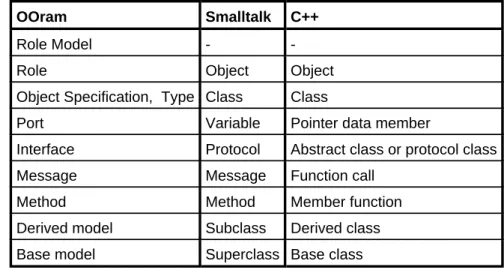
It is easy to go from an OOram model to an implementation, since the object specifications are given explicitly in the role models. A
possible mapping from OOram concepts to some programming language constructs used for their implementation is shown in table 1.1.
It is harder to derive role models from the implementation because the code reflects the complete, complex object model and some of the collaboration structure may be implicit in the details of the code.
29 March 1995 23:05 1.2 The Technology Dimension
Table 1.1 Mapping OOram models to programs
OOram Smalltalk C++
Role Model -
-Role Object Object
Object Specification, Type Class Class
Port Variable Pointer data member
Interface Protocol Abstract class or protocol class
Message Message Function call
Method Method Member function
Derived model Subclass Derived class
Base model Superclass Base class
Single and multiple inheritance
All object-oriented programming languages support some form of inheritance. (Languages missing this feature are usually called object
based languages.) Some commonly used languages such as Smalltalk
only permit single inheritance; i.e., a class may only have a single superclass. Other popular languages such as C++ support multiple
inheritance; i.e., a class may be derived from several base classes.
The class inheritance structure of an object-oriented program may be designed for two entirely different and often conflicting purposes. We usually design it to reflect the structure of our concepts, and it will then map nicely on to the role model synthesis structure. But some class structures are designed just to share common code irrespective of conceptual relationships. Both purposes are legitimate and useful; both purposes may be exploited in a well-designed program. Since our focus is on the modeling of concepts, OOram synthesis always reflects the conceptual structure.
Class inheritance used for concept specialization and code reuse
Figure 1.14 illustrates how some of the models in the role model synthesis structure are promoted to object specifications and implemented as a corresponding set of coordinated classes. Object Specification 2 inherits from Object Specification 1, this indicates that Class Set 2 may profitably be derived from Class Set 1.
Class inheritance structure may be mapped on the role model synthesis structure
29 March 1995 23:05 1.2 The Technology Dimension
Figure 1.14 The class inheritance structure can be fashioned after the model synthesis structure
Class Set 1 Object Specification 1
Role Model 3
Role Model 2
Role Model 1
Object Specification 2 Class Set 2
Implemented by
Class inheritance Role model synthesis
Implemented by
Role model synthesis
OOram reuse technology
1.2.5
OOram reuse The OOram method exploits object technology to support the
controlled reuse of proven components. This facilitates the creation of information environments tailored to the needs of the particular actors, reduces production costs and lead time, increases system reliability, and protects critical resources with mandatory access through proven components.
The single most highly promoted advantage of the object paradigm is its support for reuse, but this is also the area of the deepest
disappointments.
Reusable components imply repeat business
Ralph Johnson has been quoted as saying that nothing can be reused
before it has been used. Reuse requires repeat business so that
reusable components can be identified, created, installed in a software development environment, and finally reused. Investment is needed to create the reusable components, the only payoff is through their actual use.
A reusable component has a supplier and one or more consumers. The supplier and consumers may be the same people; they must still create the reusable component before they can use it. More commonly, the suppliers and consumers will be different people or even different organizations.
Reusable components have suppliers and consumers
Both the creation and the application of reusable components depend upon appropriate solutions along all three dimensions of figure 1.1 for their success.
Successful reuse involves all three dimensions
1.2 The Technology Dimension 29 March 1995 23:05
1. Technology. The creator of a reusable component must choose
technology that is not only appropriate for the problem, but also appropriate for the people who are going to apply it. We will here distinguish between patterns and frameworks, they are best applied by professional developers. In the advanced section, we will discuss composition and duplication; technologies that are well adapted to support non-professionals such as sales
consultants and end users.
2. Organization. The benefits of reuse can only be achieved through
an appropriate organization. We suggest the idea of a value chain, where the people on one level build on the results from the layer below and deliver results to the layer above. The results delivered to the layer above are their production facilities including
reusable components. This is in contrast to the deliverables from the various stages of the project work process; these deliverables are parts of the total project deliverables. For this reason, we regard the value chain as orthogonal to the work process on each layer.
3. Process with deliverables. The proper application of reusable
components should be an integral part of the development work process. The success criterion for the developers must include reuse; measuring programmer productivity by lines of code produced is finally shown to be counter-productive. The
development of a reusable component is a product development that must be guided by an appropriate work process.
A pattern tells the reader how to solve a problem
In the early seventies, the architect Alexander (FOOTNOTE: [Alexander 79]) proposed patterns as an interesting way for
communicating important ideas among professionals. An enthusiastic group of computer professionals have adapted these ideas to our field, and a book on Design Patterns has been published (FOOTNOTE: [GaHeJoVli 95]).
In the Alexander sense of the word, a pattern is a specification of a problem and and a guide to its solution. For problems in object oriented design, the solution frequently involves an archetypical structure of objects. In these cases, the solution can often be described in terms of a role model. But this is to be construed as a
communication device only, and not as a canned solution.
1.2 The Technology Dimension 29 March 1995 23:05
Some professionals are using the term pattern in a different meaning; they take it to mean an archetypical structure of collaborating objects, very similar to what Booch has called a mechanism and what we have formalized into the role model abstraction. We use the term pattern in the original sense to denote a guide to the solution of a problem; and we use the term object pattern to denote an archetypical structure of objects. We give object pattern a precise meaning by defining it as an instance of a role model.
A framework is a canned solution
A framework is usually defined as a collection of classes that together solve a general problem, and that are intended for specialization through subclassing. The main difference between a framework and a pattern is that while the pattern tells the reader how to solve a
problem, the framework provides a canned solution.
Role models are admirably suited for describing frameworks. The role model defining the framework functionality can easily be synthesized into an application model. This model inherits all static and dynamic properties and possible constraints from the framework role model.
Example: The activity network as a specialization of a graph
As an example, let us return to the network planning example of figure 1.3. The model we presented was just a small fragment of a real model. It did not include the insertion and removal of jobs; it did not include protection against cycles in the network; and it did not provide facilities for setting and modifying job attributes. All these details could probably be omitted at the analysis stage, but would at least have to be taken seriously at the design stage.
Most of the details are not specific to the activity network; they are common to a broad group of structures called Directed, Acyclic
Graphs (DAGs). An appropriate pattern would give us access to
accumulated experience with these structures: it would identify the objects, give all important algorithms, and provide practical hints as to the best solutions under different circumstances.
A graph pattern tells us how to design a network
A graph framework provides a solution
An alternative reusable component would be a framework for
directed, acyclic graphs. This framework would include classes for
the objects, these classes would have programs for the insertion and removal of nodes and for protection against cycles in the network. They would probably not include facilities for setting and modifying object attributes, since this will typically be done in the derived models.
29 March 1995 23:05 1.2 The Technology Dimension
The component user is fortunate
Consider that we should meet the activity planning problem for the first time. We study the problem and try to identify key processes and key actors. We study examples such as figure 1.3 to better understand the phenomenon. We tentatively create a role model such as the model shown in the views of figure 1.5 through 1.7. But how do we know that we have chosen appropriate roles? How do we know that we haven't overlooked some essential part of the problem? The answer is that we can hope for the best and suspect the worst, but we just cannot
know. We must expect to revise our ideas several times as we study
the problem and analyze its possible solutions.
The developer who finds an applicable reusable component is a truly fortunate person. He can build on the mature wisdom and experience of people who have not only solved similar problems in the past, but who have actually studied a number of different solutions and who have carefully recorded their competence.
nod
own
suc nod nod pre
Owner
Pred Node Succ
Figure 1.15 Collaboration view of a reusable Directed Acyclic Graph
Let us assume that we identified our problem as being a specialization of a Directed, Acyclic Graph (DAG), and that our library included a DAG reusable component. (At this stage, it is immaterial if it is a pattern or a framework.) Let us further assume that the component suggests the roles shown in the collaboration view of figure 1.15. We find the expected network roles of a Node with its Pred(ecessors) and Succ(essors). But we also find an Owner. The experience of the component developers told them that there should be an object
responsible for managing the whole network. Further, they tell us that these are all the roles needed for an adequate model of a DAG.
Given this DAG reusable component, the modeling of our activity network is much simplified and the risks are greatly reduced. All we need to do is to map the roles of the DAG model on to corresponding roles in our world of activity networks. We had overlooked the Owner role in our initial solution, we now easily map it onto a Schedule role (Object representing a construction schedule in figure 1.2). The full mapping between the DAG model and the Frontloading model is shown in figure 1.16.
29 March 1995 23:05 1.2 The Technology Dimension