Chapter 2
The Marketing Plan
Chapter 2
The Marketing Plan
•
Section 2.1 Marketing Planning
•
Section 2.2 Market Segmentation
•
Section 2.1 Marketing Planning
Marketing Planning
Objectives
• Conduct a SWOT analysis
• List the three key areas of an internal company
analysis
• Identify the factors in an environmental scan • Explain the basic elements of a marketing plan
Key Terms SWOT analysis environmental scan marketing plan executive summary situation analysis marketing strategy sales forecasts performance standard
Marketing Planning
Graphic Organizer
Marketing Planning
A business can analyze its strengths, weaknesses, opportunities, and threats using a process called a
SWOT analysis X. This helps because it:
• prepares a company for competition or a
changing marketplace.
• provides guidance and direction for future
marketing strategies. SWOT analysis
An assessment of a company’s
strengths and weaknesses and the opportunities and threats that surround it; SWOT: strengths, weaknesses, opportunities, threats.
Internal Strengths and Weaknesses
Strengths and weaknesses are internal factors that affect a business operation. The analysis centers around three Cs:
• Company • Customers • Competition
Internal Strengths and Weaknesses
When evaluating itself, a company must analyze these areas:
• Company staff • Financial situation
Four Ps of Marketing Mix
The company must also consider the four Ps of the
1. Product
2. Place
3. Price
4. Promotion
Marketing Essentials Chapter 2, Section 2.1
Customer Analysis
Companies study buying patterns using surveys or conducting interviews with people in their target markets. These methods help to:
Competitive Position
To help a company find its strengths and
weaknesses, the following questions may be asked:
• What market share does the company have? • What advantages does the company have over
its competitors?
External Opportunities and
Threats
Businesses must always look for opportunities to create competitive
Competition
Changes in competing companies’ financial situations affect the
marketplace. Conducting a SWOT analysis helps a business react and adjust to these shifts.
Environmental Scan
A business may conduct an environmental scan X
to methodically examine four main areas of the marketplace. The acronym PEST refers to these four factors: • Political • Economic • Socio-cultural • Technological environmental scan
An analysis of outside influences that may have an impact on an
Political
Political issues center around government involvement in business operations, such as:
• Laws
• Regulations
Economic
Businesses are always interested in the economy, which is affected by factors such as:
• Unemployment rate • Inflation
Socio-Cultural
A socio-cultural analysis is based on customers and potential customers. It focuses on their:
• Attitudes • Lifestyles • Opinions
Socio-Cultural
Social cultural analysis also considers:
• Age • Income • Occupation
Technological
Changing technology may be a threat for one industry, but an opportunity for others. Companies develop new products or capitalize on new
developments by making products to support them.
Writing a Marketing Plan
Marketers create a marketing plan X to
communicate aspects such as:
• Company goals
• Specific responsibilities • Budgets and deadlines • Overall performance
marketing plan
A formal written document
communicating the goals,
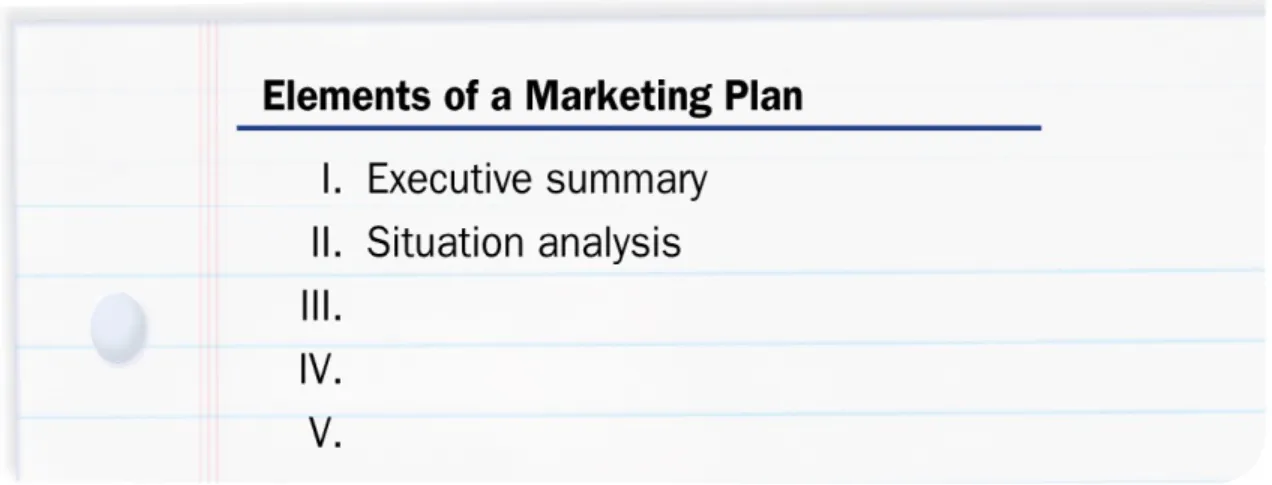
The six basic elements of a marketing plan are:
1. Executive summary
2. Situation analysis
3. Marketing goals/objectives
4. Marketing strategies
5. Implementation
6. System for evaluation and control
Marketing Essentials Chapter 2, Section 2.1
Writing a Marketing Plan
An executive summary X briefly summarizes the
marketing plan.
The situation analysis X studies the internal and
external factors that affect marketing strategies based on the SWOT analysis.
executive summary
A brief overview of an entire
marketing plan.
situation analysis
Marketing Planning
A marketing strategy X identifies target markets
and sets marketing mix choices. The strategy is determined by the company’s or product’s
competitive position and the SWOT analysis. marketing
strategy
Identification of target markets and determination of marketing mix choices that focus on those markets.
Marketing Planning
A good marketing strategy will focus on points of difference between companies in areas such as:
• quality
Implementation: Make the Plan,
Work the Plan
A timetable shows where the plan come into play, such as:
• Schedule of activities • Job assignments
• Sales forecasts X
• Budgets and personnel
sales forecasts
The projection of probable future sales in units or dollars.
Evaluation and Control
To evaluate how well a marketing plan is being carried out, performance standards X measure
progress against the plan’s original objectives. performance
standard
An expectation of performance that reflects a
Market Segmentation
Objectives
• Explain the concept of market segmentation • Analyze a target market
• Differentiate between mass marketing and
market segmentation Key Terms market segmentation demographics disposable income discretionary income geographics psychographics mass marketing
Market Segmentation
Graphic Organizer
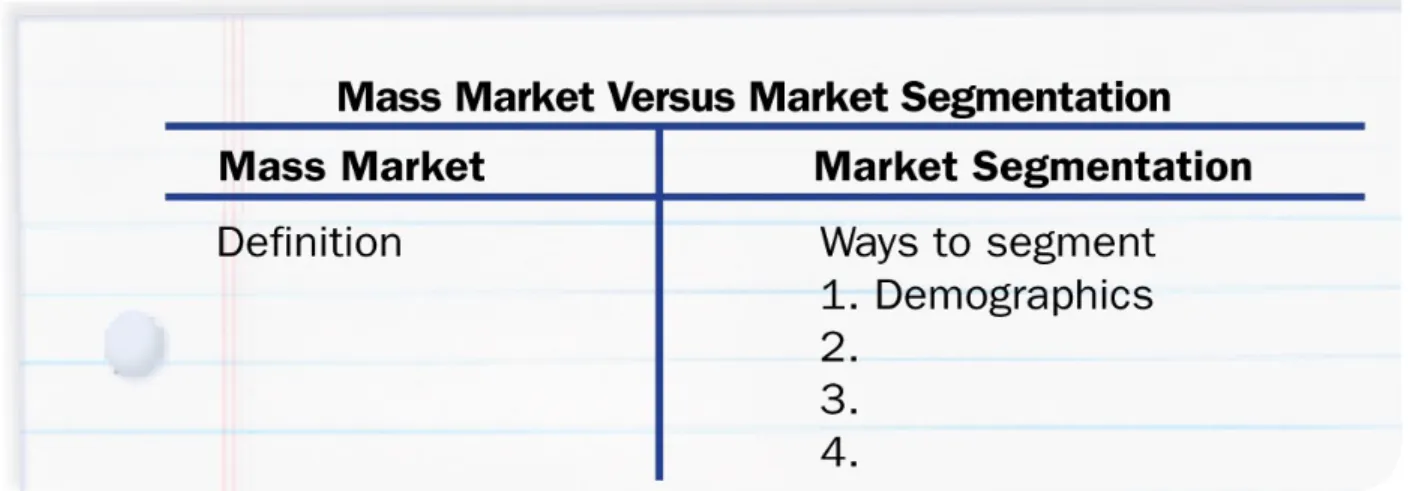
Use a chart like the one below to list differences between mass marketing and market
Identifying and Analyzing Markets
Companies identify groups of people who have
common interests and traits. This is called market segmentation X. Businesses use these groups to
create market-specific ads and products. market
segmentation
The process of analyzing and classifying
customers in a given market to create smaller, more precise target markets.
Identifying and Analyzing Markets
The four factors that help segment a market and describe a target market are:
Identifying and Analyzing Markets
Demographics X refer to statistics that describe a
population in terms of personal characteristics such as: • Age • Gender • Income demographics Statistics that describe a population in
terms of personal characteristics such as age, gender, income, marital status, ethnicity,
education, and occupation.
Identifying and Analyzing Markets
• Marital status
• Ethnic background • Education
Identifying and Analyzing Markets
When calculating how much products should cost, marketers look at:
• disposable income X
• discretionary income X
disposable income
The money left over after taxes are taken out of a consumer’s
income.
discretionary income
The money left over from a consumer’s income after paying for basic living necessities such as food, shelter, and clothing.
Geographics
The term geographics X refers to segmentation of
the market based on where people live. To
segment a market geographically, you can refer to:
• Local and regional markets • National and global markets
Psychographics
Psychographics X involves grouping people with
similar:
• Lifestyles, attitudes, values, and opinions.
The different sections of magazines in a bookstore illustrate segmentation by:
• Activities and interests
psychographics
Studies of
consumers based on social and
psychological characteristics.
Behavioral
Separating the market based on product-related behavior involves looking at the:
• Benefits desired by consumers • Shopping patterns
Behavioral
By studying consumer behavior, many businesses find that 80 percent of a company’s sales are
generated by 20 percent of its customers. This phenomenon is known as the “80/20" rule.
Mass Marketing versus
Segmentation
When products have universal appeal and few
features differentiate them from competitors, mass marketing is used. Mass marketing X involves
using a single marketing strategy to reach all customers.
mass marketing
Use of a single marketing plan to reach all
Section 2.1
• A SWOT analysis identifies a company’s internal
strengths and weaknesses, as well as external opportunities and threats.
Section 2.1
• A marketing plan is a written document that
directs the marketing activities of a company for a specific period of time. The elements include an executive summary, a situation analysis,
Section 2.2
• Marketing segmentation classifies people in a
given market into smaller groups.
• Demographics can be broken down into age,
gender, income, marital status, and ethnic background.
Section 2.2
• Geographics relates to similarities among people
This chapter prepared you to meet the following DECA performance indicators:
• Describe the need for marketing information. • Explain the nature of marketing planning. • Identify market segments.
• Select target market.
click twice to continue